
Introduction
AI clinical trial site selection tools help sponsors, CROs, and research teams find the best hospitals, clinics, investigators, and regions for a study by using data, prediction models, and workflow automation instead of manual review alone. These tools matter because poor site selection can slow enrollment, increase startup delays, raise costs, and create study risk, while strong site selection can improve speed, recruitment quality, and trial execution. Real world use cases include ranking sites for a new protocol, identifying investigators with relevant experience, forecasting enrollment strength, comparing regions, improving diversity planning, and reducing the risk of low performing sites. Buyers should evaluate these tools based on data coverage, protocol fit, explainability, workflow support, human review, privacy controls, integration options, auditability, usability, and cost efficiency.
These tools are best for biopharma sponsors, CROs, feasibility teams, trial startup leaders, and research operations groups that need faster and smarter study planning across multiple sites. They are especially useful for complex studies in oncology, immunology, rare disease, and other areas where patient access, investigator quality, and enrollment speed are critical. They are not ideal for very small single site studies, low complexity academic research, or teams that only need a simple feasibility checklist and not a full data driven ranking workflow.
Why it matters
Choosing the right sites is one of the most powerful levers for trial success, because it directly affects enrollment speed, data quality, and overall cost. When site selection is slow or inaccurate, you see delayed first patient in, high screen failure rates, more protocol deviations, and a higher chance that you will need expensive rescue sites later in the study. AI driven tools are important because they can scan far more data than a human team, highlight patterns that would be easy to miss, and give a ranked view of site options that matches the specific needs of each protocol. In an environment where pipelines are crowded, budgets are tight, and patient populations are often fragmented, any improvement in site fit can make the difference between a clean, on time trial and a painful, extended one.
Real world use cases
One common use case is protocol driven shortlisting, where the team uploads or enters key protocol details and the tool generates a ranked list of sites that most closely match the inclusion and exclusion criteria, equipment needs, and experience requirements. Another use case is investigator discovery, where sponsors look beyond their usual partners to find investigators who have strong experience in a particular indication, biomarker, or procedure but have not yet worked with that sponsor. AI tools are also used for enrollment risk prediction, flagging sites that look attractive on paper but have signs of weak performance, limited patient flow, or competing studies that could slow recruitment. In global programs, these platforms help compare countries and regions on feasibility, speed, and diversity potential so planners can make smarter choices about where to open sites. Some teams also use them to simulate different mixes of sites and countries to see how changes in selection might affect overall timelines and cost.
Evaluation criteria for buyers
When buyers evaluate AI clinical trial site selection tools, the first thing to check is data quality and coverage, including which geographies, therapeutic areas, and site types are well represented. The second is protocol intelligence, meaning how well the tool understands and applies protocol criteria rather than only supporting simple filters. Explainability is another key factor, because operational and clinical leaders need clear reasons for each recommendation before they will trust it. Buyers should also look at workflow fit, such as how the tool connects to existing feasibility processes, startup systems, and trial management tools, and whether it supports human review and overrides rather than forcing black box decisions. Privacy, security, and governance are essential, including how trial data is stored, how long it is kept, how access is controlled, and whether actions are logged for audit. Finally, teams should compare usability, training needs, and total cost of ownership, and run at least one pilot on a real protocol to see if the tool actually improves shortlist quality, enrollment expectations, and planning speed in practice.
What Is Changing in This Category
- More vendors now use protocol aware analysis instead of only filter based database search.
- Agentic AI is becoming part of site ranking and feasibility workflows.
- Explainable recommendations are becoming more important because trial teams need to understand why a site is ranked highly.
- Historical trial data and real world evidence are being combined more often for better site fit analysis.
- Vendors are focusing more on predicting weak enrollment and rescue site risk earlier.
- Natural language search is reducing the need for rigid manual query building.
- Diversity and representation goals are influencing how sites are reviewed and prioritized.
- Buyers are asking harder questions about privacy, auditability, and governance before adoption.
- More tools now promise faster shortlist creation instead of just broader site databases.
- Site readiness and operational strength are becoming important ranking inputs alongside patient fit.
Quick Buyer Checklist
- Check whether the tool can understand protocol requirements instead of only offering basic search.
- Ask what data sources are used, such as historical site performance, investigator history, patient signals, or public trial data.
- Confirm whether recommendations are explainable to business and clinical users.
- Verify if human review and manual override are built into the workflow.
- Ask about privacy, retention, and audit controls because public detail is often limited.
- Check how well the platform supports exports, APIs, and workflow integration.
- Evaluate how the vendor measures prediction quality and shortlist accuracy.
- Test the platform on a real study protocol instead of relying only on a demo.
- Ask whether the tool can support region analysis, diversity goals, and enrollment forecasting.
- Review vendor lock in risk by checking data portability and process flexibility.
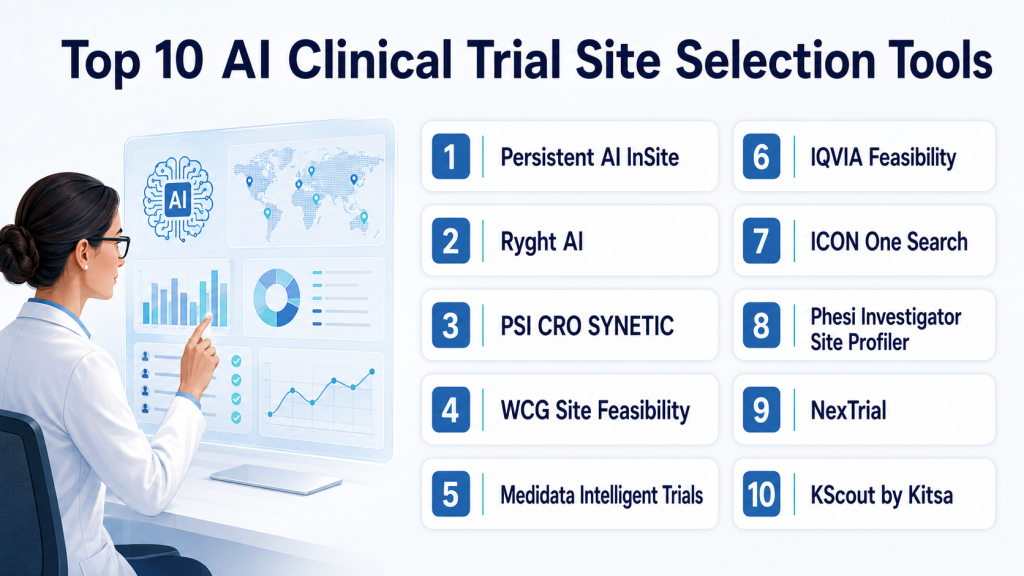
Top 10 AI Clinical Trial Site Selection Tools
1. Persistent AI InSite
One line verdict: Best for enterprise teams that want protocol driven, explainable, and governance aware site selection.
Short description:
Persistent AI InSite is built to modernize clinical site selection with agentic AI and protocol intelligence. It converts protocol details into structured feasibility criteria, matches them against historical evidence and real world evidence, and creates explainable site rankings.
Standout Capabilities
- Protocol driven feasibility analysis.
- Agentic AI workflow for site ranking.
- Matching against historical trial data and real world evidence.
- Explainable site ranking outputs.
- Human in the loop governance support.
- Designed for study and portfolio level use.
AI Specific Depth
- Model support: Proprietary workflow, exact model flexibility not publicly stated.
- Knowledge integration: Historical trial data and real world evidence are used, broader connector detail not publicly stated.
- Evaluation: Public material supports predictive ranking claims, formal evaluation workflow not publicly stated.
- Guardrails: Human in the loop governance is publicly stated.
- Observability: Traces, token metrics, and latency detail not publicly stated.
Pros
- Strong protocol aware intelligence.
- Good balance of AI support and human governance.
- Suitable for scaled enterprise study planning.
Cons
- Public technical detail is still limited in some areas.
- Deployment detail is not clearly published.
- Public ecosystem depth is still emerging.
Security and Compliance
SSO, RBAC, audit logs, encryption, residency, retention controls, and certifications are not publicly stated in the reviewed public material. Human in the loop governance is publicly stated.
Deployment and Platforms
Web and operating system support are not clearly detailed in the reviewed public material. Cloud, self hosted, and hybrid options are not publicly stated.
Integrations and Ecosystem
Persistent positions this as part of a broader enterprise AI strategy, but detailed integration documentation is limited in public materials. Buyers should validate API support, export options, and workflow connection into trial planning systems during evaluation.
- Historical data integration.
- Real world evidence integration.
- Protocol document ingestion.
- Enterprise AI portfolio alignment.
Pricing Model
Best Fit Scenarios
- Large sponsors standardizing site selection.
- CROs needing explainable protocol based ranking.
- Teams that require AI support with human review.
2. Ryght AI
One line verdict: Best for teams that want fast global site search and intelligent shortlist generation.
Short description:
Ryght AI focuses on AI powered site search, ranking, and feasibility using AI Site Twins and a large global research site network. It is designed for sponsors and CROs that want faster site discovery and program fit analysis.
Standout Capabilities
- AI Site Twins for digital site representation.
- Search across more than one hundred thousand site locations in many countries.
- Filter by disease, biomarker, geography, and phase.
- Agentic ranking based on study fit.
- Public search access lowers the barrier for initial use.
- Strong focus on faster site selection cycles.
AI Specific Depth
- Model support: Proprietary AI platform, BYO model and multi model routing not publicly stated.
- Knowledge integration: Internal site and protocol knowledge, external connector detail not publicly stated.
- Evaluation: Vendor case study claims exist, formal evaluation framework not publicly stated.
- Guardrails: Not publicly stated.
- Observability: Not publicly stated.
Pros
- Strong speed and scale story.
- Good for fast shortlist creation.
- Useful filters for practical site planning.
Cons
- Public governance and security detail is limited.
- Independent benchmarking is limited in public view.
- Better as a starting engine than a full replacement for sponsor due diligence.
Security and Compliance
SSO, RBAC, audit logs, encryption, residency, retention controls, and certifications are not publicly stated in the reviewed material.
Deployment and Platforms
Web support appears likely from the public product presentation, but exact platform coverage is not publicly stated. Cloud, self hosted, and hybrid options are not publicly stated.
Integrations and Ecosystem
Ryght is strongest as a search and ranking engine. Buyers should ask for API access, export workflows, and integration support into startup operations and broader study planning tools.
Pricing Model
Not publicly stated. Public search access is mentioned, but enterprise commercial structure is not clearly published.
Best Fit Scenarios
- Sponsors needing a fast first shortlist.
- CROs running many feasibility projects.
- Global studies with complex geography filters.
3. PSI CRO SYNETIC
One line verdict: Best for sponsors that want semantic search and predictive intelligence in a CRO ecosystem.
Short description:
SYNETIC is an AI powered semantic knowledge platform for site selection and feasibility. It combines semantic search, predictive analytics, site scoring, and relationship intelligence within a broader PSI clinical intelligence environment.
Standout Capabilities
- Semantic search for site discovery.
- Predictive analytics to identify likely low performing sites.
- AI driven site scoring.
- Knowledge graph style relationship intelligence.
- Fits into a larger clinical intelligence suite.
AI Specific Depth
- Model support: Proprietary platform, exact model flexibility not publicly stated.
- Knowledge integration: Semantic knowledge platform and knowledge graph style architecture are publicly indicated, connector detail not publicly stated.
- Evaluation: Predictive modeling is public, formal evaluation methods are not publicly stated.
- Guardrails: Not publicly stated.
- Observability: Not publicly stated.
Pros
- Strong semantic discovery approach.
- Good fit for intelligence rich startup workflows.
- Useful for sponsors already working with PSI.
Cons
- Public security detail is limited.
- Best value may depend on broader PSI ecosystem use.
- Newer platform maturity is harder to judge publicly.
Security and Compliance
SSO, RBAC, audit logs, encryption, residency, retention controls, and certifications are not publicly stated in the reviewed public material.
Deployment and Platforms
Platform and deployment details are not publicly stated in the reviewed material.
Integrations and Ecosystem
The clearest strength is alignment with the broader PSI intelligence suite. Buyers should confirm APIs, exports, and sponsor system support during pilot review.
- PSI intelligence suite alignment.
- Semantic search.
- Knowledge graph style intelligence.
- Predictive analytics.
Pricing Model
Best Fit Scenarios
- Sponsors already working with PSI.
- Teams that want semantic discovery over manual filtering.
- Studies where relationship intelligence matters.
4. WCG Site Feasibility
One line verdict: Best for teams that value investigator history and structured feasibility support.
Short description:
WCG Site Feasibility helps identify and qualify sites using historical site and investigator performance. It is positioned as part of a broader study acceleration workflow and supports ranking based on experience, specialization, compliance, and enrollment performance.
Standout Capabilities
- Large historical performance repository.
- Broad investigator ranking support.
- Focus on enrollment, experience, and specialization.
- Site survey support for qualification.
- Part of a broader study acceleration workflow.
AI Specific Depth
- Model support: Not clearly described publicly as model based in the reviewed material.
- Knowledge integration: Historical performance repository, connector detail not publicly stated.
- Evaluation: Not publicly stated.
- Guardrails: Not publicly stated.
- Observability: Not publicly stated.
Pros
- Strong historical evidence focus.
- Good fit for qualification driven workflows.
- Broad investigator and geographic scope.
Cons
- AI depth is less visible publicly than AI native competitors.
- Public guardrail detail is limited.
- Public integration detail is limited.
Security and Compliance
Security and compliance details are not publicly stated in the reviewed public material.
Deployment and Platforms
Platform and deployment details are not publicly stated in the reviewed public material.
Integrations and Ecosystem
WCG presents this offering as part of a broader workflow for faster study startup. Buyers should validate exports, APIs, and interoperability during product review.
- Study acceleration alignment.
- Site survey workflow.
- Historical investigator intelligence.
- Qualification support.
Pricing Model
Best Fit Scenarios
- Sponsors that trust historical performance data.
- Trials with strong qualification needs.
- Teams that prefer service backed feasibility support.
5. Medidata Intelligent Trials
One line verdict: Best for enterprises that prefer platform depth and large scale clinical data context.
Short description:
Medidata Intelligent Trials is positioned to improve study feasibility and site selection using real time site performance data, historical trial data, and predicted site performance. It is well suited to organizations that want site planning in a broader clinical technology environment.
Standout Capabilities
- Real time site performance data.
- Historical and predicted site performance support.
- Large clinical and operational dataset.
- Useful for broader study planning, not only ranking.
- Enterprise friendly market presence.
AI Specific Depth
- Model support: Not publicly stated in the reviewed material.
- Knowledge integration: Uses large clinical and operational datasets, detailed connector support not publicly stated.
- Evaluation: Not publicly stated.
- Guardrails: Not publicly stated.
- Observability: Not publicly stated.
Pros
- Strong enterprise reputation.
- Deep industry data positioning.
- Good fit for organizations seeking a broader platform.
Cons
- Public AI specific detail remains limited.
- May be more than smaller teams need.
- Pricing detail is not publicly stated.
Security and Compliance
SSO, RBAC, audit logs, encryption, residency, retention controls, and certifications are not publicly stated in the reviewed material for this comparison.
Deployment and Platforms
Platform and deployment details are not publicly stated in the reviewed material used here.
Integrations and Ecosystem
The biggest value here is likely ecosystem breadth. Buyers should confirm exact workflow integration and site selection process support during evaluation.
- Broad clinical technology environment.
- Large operational dataset.
- Study planning support.
- Enterprise ecosystem relevance.
Pricing Model
Best Fit Scenarios
- Large sponsors consolidating tools.
- Enterprises already using Medidata solutions.
- Teams wanting planning and feasibility in one environment.
6. IQVIA Feasibility
One line verdict: Best for global study planning teams that want data first feasibility analysis.
Short description:
IQVIA Feasibility uses automated technology and advanced analytics to support study planning, protocol design, country planning, and site selection. It is best suited to organizations that value broad healthcare data, global scale, and structured feasibility processes.
Standout Capabilities
- Data first feasibility strategy.
- Supports planning from protocol design through site selection.
- Uses automated technology and advanced analytics.
- Strong global enterprise relevance.
- Good fit for cost and delay reduction efforts.
AI Specific Depth
- Model support: Not publicly stated in reviewed material.
- Knowledge integration: Uses broad connected intelligence and feasibility data, detailed connector support not publicly stated.
- Evaluation: Not publicly stated.
- Guardrails: Not publicly stated.
- Observability: Not publicly stated.
Pros
- Strong data and analytics positioning.
- Good fit for multinational study planning.
- Supports country and site scenario analysis.
Cons
- Public AI specific details are limited.
- May feel more enterprise and service heavy than self serve buyers prefer.
- Exact deployment detail is not publicly stated in the reviewed material.
Security and Compliance
Not publicly stated in the reviewed public material for this comparison.
Deployment and Platforms
Platform and deployment details are not publicly stated in the reviewed material used here.
Integrations and Ecosystem
IQVIA is strongest where global study planning, healthcare data, and enterprise services intersect. Buyers should validate integration, transparency, and workflow fit during pilot testing.
- Connected intelligence approach.
- Global planning support.
- Advanced analytics.
- Enterprise services alignment.
Pricing Model
Best Fit Scenarios
- Global biopharma programs.
- Protocol and country planning workflows.
- Organizations that value large scale healthcare data.
7. ICON One Search
One line verdict: Best for trial teams that want AI aided site identification with CRO execution support.
Short description:
ICON One Search uses human enabled AI to process large datasets, improve site identification, support patient recruitment, and help sponsors move from data overload to data driven site decisions.
Standout Capabilities
- Processes large datasets from multiple sources.
- Improves site identification accuracy and efficiency.
- Supports patient recruitment through network feasibility analysis.
- Helps maximize representation and inclusion.
- Connects AI workflow with human expertise.
AI Specific Depth
- Model support: Not publicly stated.
- Knowledge integration: Multiple datasets are used, detailed connector support not publicly stated.
- Evaluation: Public outcome improvement claims are shared, formal evaluation workflow not publicly stated.
- Guardrails: Human enabled AI is publicly emphasized.
- Observability: Not publicly stated.
Pros
- Good balance of AI and expert review.
- Useful for recruitment sensitive trials.
- Strong operational relevance for CRO led execution.
Cons
- Public product level detail is limited.
- Security detail is not clearly published in reviewed material.
- Harder to compare technically with more AI native tools.
Security and Compliance
Not publicly stated in the reviewed public material.
Deployment and Platforms
Platform and deployment details are not publicly stated in the reviewed public material.
Integrations and Ecosystem
ICON appears strongest where technology and operational execution work together. Buyers should validate workflow integration, data transparency, and export flexibility during evaluation.
- Multi source data support.
- Network feasibility analysis.
- Site identification support.
- CRO workflow alignment.
Pricing Model
Best Fit Scenarios
- Sponsors already using ICON.
- Recruitment heavy studies.
- Teams wanting AI plus operational delivery support.
8. Phesi Investigator Site Profiler
One line verdict: Best for data rich investigator selection and evidence based site list reduction.
Short description:
Phesi supports investigator site optimization using advanced clinical data analytics and investigator profiling. It is aimed at helping sponsors remove weak fit sites and focus on sites with stronger protocol relevance and enrollment potential.
Standout Capabilities
- Investigator profile generation using data lake information.
- Helps remove weak evidence sites from large lists.
- Supports quality assurance in selection.
- Uses real world data driven analysis.
- Good fit for investigator focused evaluation.
AI Specific Depth
- Model support: Not publicly stated in reviewed material.
- Knowledge integration: Uses a data lake and investigator profiling data, detailed connector support not publicly stated.
- Evaluation: Public outcome claims exist around list reduction and efficiency, formal evaluation method not publicly stated.
- Guardrails: Not publicly stated.
- Observability: Not publicly stated.
Pros
- Strong practical focus on investigator quality.
- Useful for reducing noisy long lists.
- Good fit for evidence first sponsor review.
Cons
- Public platform detail is limited.
- Broader integration ecosystem is not clear publicly.
- Security and compliance specifics are not publicly stated.
Security and Compliance
Not publicly stated in the reviewed public material.
Deployment and Platforms
Platform and deployment details are not publicly stated in the reviewed public material.
Integrations and Ecosystem
The clearest value is data driven investigator profiling rather than broad platform extensibility. Buyers should ask how easily outputs can move into internal startup workflows.
- Data lake based profiling.
- Investigator site analysis.
- Evidence based site reduction.
- Quality assurance support.
Pricing Model
Best Fit Scenarios
- Large investigator long list reduction.
- Studies needing stronger investigator fit evidence.
- Teams focused on selection quality over raw search breadth.
9. NexTrial
One line verdict: Best for CROs needing physician matching and real time site readiness insights.
Short description:
NexTrial is built around AI powered physician matching and site readiness tracking. It helps CROs and study teams upload protocol requirements, analyze fit across many data points, and identify physicians and sites with the right specialty and enrollment readiness.
Standout Capabilities
- AI powered physician matching.
- Real time site readiness tracking.
- Analyzes more than two hundred data points.
- Filters by location, experience, and previous enrollment performance.
- Supports fast access to pre qualified physicians.
AI Specific Depth
- Model support: Not publicly stated.
- Knowledge integration: Uses protocol requirements and site matching data, detailed connector support not publicly stated.
- Evaluation: Not publicly stated.
- Guardrails: Not publicly stated.
- Observability: Not publicly stated.
Pros
- Strong fit for physician and site readiness matching.
- Practical filters for CRO workflows.
- Useful for speeding early site identification.
Cons
- Limited public security detail.
- Broader ecosystem depth is unclear publicly.
- Public evaluation transparency is limited.
Security and Compliance
Not publicly stated in the reviewed public material.
Deployment and Platforms
Platform and deployment details are not publicly stated in the reviewed public material.
Integrations and Ecosystem
NexTrial looks useful for matching and readiness workflows, though deeper integration detail is not clear in public materials reviewed here. Buyers should validate APIs, exports, and enterprise controls.
- Protocol upload workflow.
- Physician matching.
- Site readiness engine.
- Enrollment performance filtering.
Pricing Model
Best Fit Scenarios
- CRO physician matching workflows.
- Fast site readiness review.
- Early feasibility for specialty studies.
10. KScout by Kitsa
One line verdict: Best for teams that want large network based AI driven feasibility analysis.
Short description:
KScout by Kitsa is an AI clinical trial site selection tool that identifies optimal research sites from a very large global research site network. It focuses on AI driven feasibility analysis and site discovery at scale.
Standout Capabilities
- Large global network of research sites.
- AI driven feasibility analysis.
- Site identification at scale.
- Useful for broad search and ranking workflows.
- Good visibility as a specialist site selection product.
AI Specific Depth
- Model support: Not publicly stated.
- Knowledge integration: Large network based site data is public, connector detail not publicly stated.
- Evaluation: Not publicly stated.
- Guardrails: Not publicly stated.
- Observability: Not publicly stated.
Pros
- Strong scale orientation.
- Purpose built for clinical site selection.
- Useful for broad network search.
Cons
- Public feature depth is limited.
- Security and governance details are not publicly stated.
- Integration detail is limited in reviewed material.
Security and Compliance
Not publicly stated in the reviewed public material.
Deployment and Platforms
Platform and deployment details are not publicly stated in the reviewed public material.
Integrations and Ecosystem
KScout appears focused on site identification and feasibility rather than a broad public ecosystem. Buyers should validate workflow interoperability and export options.
Pricing Model
Best Fit Scenarios
- Global network based site discovery.
- Broad initial site shortlist creation.
- Teams wanting a specialist product.
Comparison Table
Scoring and Evaluation
The scores below are comparative and designed to help shortlist options, not to declare one universal winner. Vendors with stronger public evidence on protocol intelligence, explainability, and workflow maturity scored higher, while tools with limited public technical documentation scored more conservatively. In this category, lower visibility does not always mean lower real world value, but it does increase buyer due diligence requirements.
| Tool | Core | Reliability and Eval | Guardrails | Integrations | Ease | Performance and Cost | Security and Admin | Support | Weighted Total |
|---|---|---|---|---|---|---|---|---|---|
| Persistent AI InSite | 9 | 8 | 8 | 7 | 7 | 7 | 6 | 7 | 7.65 |
| Ryght AI | 8 | 7 | 5 | 6 | 8 | 8 | 5 | 6 | 6.95 |
| PSI CRO SYNETIC | 8 | 7 | 5 | 7 | 7 | 7 | 5 | 7 | 6.95 |
| WCG Site Feasibility | 8 | 6 | 4 | 6 | 7 | 6 | 5 | 8 | 6.35 |
| Medidata Intelligent Trials | 8 | 6 | 4 | 8 | 7 | 6 | 6 | 8 | 6.80 |
| IQVIA Feasibility | 8 | 6 | 4 | 8 | 6 | 6 | 6 | 8 | 6.70 |
| ICON One Search | 7 | 6 | 5 | 6 | 6 | 6 | 5 | 7 | 6.10 |
| Phesi Investigator Site Profiler | 7 | 6 | 4 | 5 | 7 | 7 | 4 | 6 | 5.95 |
| NexTrial | 7 | 6 | 4 | 5 | 7 | 7 | 4 | 6 | 5.95 |
| KScout by Kitsa | 7 | 5 | 4 | 5 | 7 | 7 | 4 | 5 | 5.75 |
- Top 3 for Enterprise: Persistent AI InSite, Medidata Intelligent Trials, IQVIA Feasibility.
- Top 3 for SMB: Ryght AI, PSI CRO SYNETIC, KScout by Kitsa.
- Top 3 for Developers: Persistent AI InSite, Ryght AI, NexTrial.
Which Tool Is Right for You
Solo and Freelancer
Most solo consultants do not need a large enterprise platform. A focused tool with clear shortlist output and low friction adoption is usually the better choice, especially when the goal is research support and recommendation building rather than end to end operational execution.
SMB
Small and growing biotech teams usually need speed, practical output, and limited setup effort. Ryght AI, PSI CRO SYNETIC, and KScout by Kitsa stand out for teams that want focused discovery and feasibility support without starting with a heavy platform strategy.
Mid Market
Mid market sponsors often need both speed and process maturity. Persistent AI InSite and WCG Site Feasibility are attractive here because they support structured ranking and qualification while still fitting operational trial planning.
Enterprise
Large pharma and global CRO teams should prioritize governance, explainability, integration potential, and scale. Persistent AI InSite, Medidata Intelligent Trials, and IQVIA Feasibility are the most natural fits for enterprise buying motions and multi study standardization.
Regulated Industries
Healthcare buyers need evidence trails, human review, explainable rankings, and strong privacy review before production use. Public detail on compliance and admin controls still varies across vendors, so security assessment must be part of the buying process from the start.
Budget vs Premium
Budget conscious teams should focus on shortlist quality and workflow fit, not just brand size. Premium enterprise platforms make more sense when there is strong need for portfolio scale, governance, and ecosystem consolidation.
Build vs Buy
Buy if speed to value, external data access, and operational support matter most. Build only if the organization has strong internal data assets, AI engineering capability, governance maturity, and a clear reason to control every part of the ranking workflow.
Implementation Playbook
First 30 Days
Start with one real protocol and define success metrics before the pilot begins. Measure shortlist speed, site relevance, enrollment fit, user trust in the ranking, and how much manual effort is reduced. Make sure clinical and operations teams review the results together.
Next 60 Days
Harden the workflow by setting review roles, approval rules, documentation standards, and data handling policies. Build an evaluation process that checks missed site risk, ranking quality, regional fit, diversity goals, and low confidence recommendations.
Next 90 Days
Expand only after the pilot proves value across more than one study type. Standardize protocol intake, create red team testing for weak prompts or misleading inputs, review cost and speed over time, and build governance around exceptions, overrides, and post study learning.
Common Mistakes and How to Avoid Them
- Using AI ranking as final truth instead of decision support.
- Skipping human review for site recommendations.
- Ignoring whether protocol criteria were interpreted correctly.
- Trusting large databases without checking shortlist quality.
- Failing to test the tool on a real study.
- Not measuring ranking quality against actual outcomes.
- Overlooking privacy and retention questions.
- Missing audit trails for why sites were selected or removed.
- Assuming public data alone is enough for final decisions.
- Underestimating vendor lock in risk.
- Ignoring regional data freshness and therapeutic fit.
- Expanding too fast before proving real operational value.
FAQs
1. What are AI clinical trial site selection tools
These tools help research teams choose the best sites, investigators, and regions for a study by combining data, prediction, and workflow support. They reduce manual effort and can improve site quality, speed, and enrollment planning.
2. Why does this category matter so much
Site selection has a direct effect on startup speed, patient recruitment, and trial cost. Better site choices can reduce delays and lower the risk of weak or non enrolling sites.
3. Who should use these tools
They are most useful for sponsors, CROs, feasibility teams, and study startup leaders running multi site or complex trials. They are especially valuable when protocols are difficult or enrollment risk is high.
4. Are these tools replacing human feasibility teams
No. The strongest products support human decision making instead of removing it. Human review is still critical because site selection has operational and regulatory impact.
5. Do these tools use real world evidence
Some do. Persistent publicly states that it matches protocol criteria against historical trial data and real world evidence, while others focus more on investigator data, historical site performance, or public trial data.
6. How should buyers evaluate these tools
Buyers should test them with a real protocol and score them on shortlist relevance, explainability, speed, usability, and workflow fit. Demo quality alone is not enough.
7. Are public ratings available for these tools
Reliable public ratings were not confidently verified for most tools in this comparison. That is why the comparison table uses N A instead of guessing.
8. What is the biggest buying risk
The biggest risk is choosing a tool that looks smart in a demo but does not improve real study outcomes. Weak explainability, poor data fit, and limited governance can reduce trust fast.
9. What privacy questions should buyers ask
Ask how protocol data is stored, how long it is retained, who can access it, whether usage is logged, and whether customer data is reused for model improvement. Public detail is often limited, so direct verification is necessary.
10. Can these tools support diversity goals
They can help by improving site selection across geography and patient access patterns, but they do not solve diversity alone. Trial design, outreach, site support, and local execution still matter.
11. Are these tools useful for smaller biotech companies
Yes, especially when they reduce manual research and help create a faster shortlist. Smaller teams often benefit most from focused tools that are easier to adopt.
12. When should a company build instead of buy
A company should build only when it has strong internal data, AI engineering skills, and strict governance needs that justify long term ownership. Most teams get value faster by buying and piloting first.
Conclusion
The best AI clinical trial site selection tool depends on your workflow, study complexity, internal data maturity, and governance needs. Some teams need fast search and shortlist generation, some need strong protocol intelligence and explainability, and some need broad enterprise planning support across many studies. The most practical path is to shortlist a small set of tools, run a protocol based pilot, verify privacy and governance controls, measure ranking quality against real study goals, and scale only after proving operational value with human review built into the process.

Find Trusted Cardiac Hospitals
Compare heart hospitals by city and services — all in one place.
Explore Hospitals
AI site selection tools are helpful, but trial success still depends on investigator quality, patient diversity, and real-world enrollment performance at each site.