
Introduction
AI defect detection tools for production lines help manufacturers find scratches, cracks, contamination, missing parts, misalignment, print issues, and other product defects automatically while production is still running. These platforms combine computer vision, deep learning, anomaly detection, and industrial automation integration to inspect more units, more consistently, than manual checks or rigid rule-based vision systems can manage alone. This matters because line speeds are rising, product variation is increasing, and the cost of defect escapes, scrap, rework, recalls, and customer complaints keeps growing. Real world use cases include inline surface inspection, food contamination checks, PCB and electronics inspection, packaging and label verification, dimensional defect detection, and automated alerts that trigger corrective action or reject faulty units in real time. Buyers should evaluate these tools based on real-time inference speed, false positive control, support for rare or unknown defects, camera and PLC integration, labeling effort, deployment architecture, retraining workflows, and how quickly the system can move from proof of concept to stable production.
These tools are best for manufacturers in automotive, electronics, food and beverage, pharma, packaging, consumer goods, and industrial equipment where product quality must be controlled at line speed. They are especially useful when manual inspection is inconsistent, existing machine vision misses subtle defects, or quality teams need to inspect 100 percent of output instead of spot samples. They are less ideal for very low-volume operations, unstable imaging environments, or factories without enough process discipline to support data capture, repeatable camera positioning, and operator follow-through.
Why it matters
Traditional production-line inspection breaks down when defects are subtle, production speed is high, or product appearance varies naturally from batch to batch. AI changes that by learning what normal and abnormal products look like across real manufacturing variation, allowing more consistent decisions at line speed and better handling of complex visual patterns than fixed-rule systems. This matters even more in 2026 because manufacturers increasingly want real-time quality control tied directly to operations, not just isolated quality checks after the fact. The category is also evolving from simple “good versus bad” classification toward segmentation, multi-defect detection, edge inference, and anomaly detection that can catch unexpected issues before they scale into broader production losses.
Real world use cases
A common use case is inline surface defect detection, where AI models inspect every unit for scratches, dents, pits, contamination, or texture abnormalities and flag defects in milliseconds without slowing throughput. Another is assembly-line verification, where the system checks whether parts are present, positioned correctly, and assembled in the right orientation, reducing rework and preventing faulty units from moving downstream. AI defect detection is also used in food production to identify foreign objects and contaminants, in electronics to find solder or component issues, and in packaging lines to spot label, seal, or print defects. In more advanced deployments, the system not only detects the defect but also classifies it, localizes it precisely, triggers automatic alerts, and stores inspection data for traceability and process improvement.
Evaluation criteria for buyers
When evaluating AI defect detection tools for production lines, buyers should first assess how well the system handles real line conditions, including speed, vibration, lighting changes, product variation, and rare defects. The next priority is data efficiency: some tools need hundreds of labeled examples, while newer approaches can train with much smaller sample sets or use anomaly detection for unknown defect types. Buyers should also review deployment architecture, especially whether the system can run at the edge for low latency and factory privacy, or whether cloud processing is acceptable. Integration with cameras, PLCs, MES, and alert workflows matters just as much as model quality, because production value depends on the system fitting operational reality. Finally, compare false positive behavior, retraining workflows, auditability, and the vendor’s ability to move from proof of concept to a stable production rollout across more than one line
What Is Changing in This Category
- More vendors now position AI defect detection as a real-time production system, not just an offline quality analytics tool.
- Edge-based deployment is gaining importance for lower latency and easier factory rollout.
- Anomaly detection is becoming more valuable because many production lines do not have enough labeled defect data for every failure type.
- Low-sample and faster-training approaches are becoming a major differentiator for time-to-value.
- Vendors increasingly market 100 percent inspection coverage instead of statistical spot checks.
- Defect detection is being tied more closely to root cause analysis and operator guidance, not only reject decisions.
- Synthetic data is becoming more common to improve model performance where defect samples are scarce.
- Turnkey and no-code deployment models are growing because many quality teams do not have in-house AI specialists.
- Integration with shop-floor systems and corrective-action workflows is becoming a core requirement.
- Buyers are asking harder questions about false positives, retraining burden, and production stability rather than demo accuracy alone.
Quick Buyer Checklist
- Check whether the platform supports your exact defect type, such as surface flaws, assembly defects, print quality, contamination, or dimensional issues.
- Ask how many labeled images are needed before the model becomes useful.
- Review whether the tool supports anomaly detection for rare or unseen defects.
- Confirm real-time inference at your production-line speed.
- Check camera, lighting, PLC, MES, and alert integration options.
- Ask how alerts are handled operationally, including reject triggers, operator notifications, and audit records.
- Evaluate edge versus cloud deployment based on latency, privacy, and reliability needs.
- Review retraining workflows when products, materials, or defect patterns change.
- Pilot the system on real line conditions, including vibration, lighting shifts, and normal product variation.
- Confirm whether the vendor offers a packaged product, modular hardware bundle, or custom services-heavy solution.
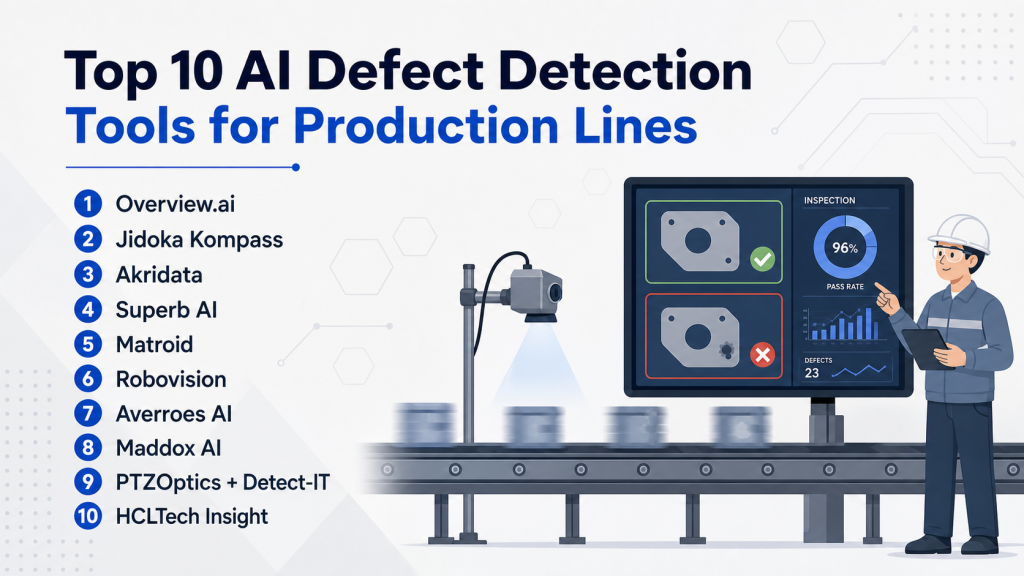
Top 10 AI Defect Detection Tools for Production Lines
1. Overview.ai
One-line verdict: Best for fast deployment on production lines that need edge-based, low-sample defect detection at high accuracy.
Short description (2–3 lines):
Overview.ai offers AI vision systems for manufacturing quality control with edge-computing cameras and a strong focus on rapid deployment. Public product material emphasizes training models in hours with far fewer images than traditional approaches and detecting micron-level defects directly on the line.
Standout Capabilities
- Edge-computing cameras with on-device processing.
- Public claim of model training in hours.
- Public claim of using 10x fewer images than conventional setups.
- 99.9%+ accuracy claim for micron-level defects in public material.
- Strong fit for real-time inspection on live production lines.
- Practical positioning around faster deployment than many enterprise-heavy systems.
AI-Specific Depth (Must Include)
- Model support: Proprietary AI vision system; BYO model and multi-model routing are not publicly stated.
- RAG / knowledge integration: N/A for core inspection use case based on reviewed material.
- Evaluation: Publicly claims high accuracy and fast training, but detailed evaluation methodology is not publicly stated.
- Guardrails: Not publicly stated.
- Observability: Edge processing is public; deeper trace and model observability detail is not publicly stated.
Pros
- Strong speed-to-value story.
- Attractive for plants that want edge deployment and lower latency.
- Lower training-data burden is appealing for rare-defect environments.
Cons
- Public benchmark details are limited.
- Security and compliance specifics are not publicly stated in reviewed material.
- Buyers should validate long-term retraining and integration depth directly.
Security & Compliance (Only if confidently known)
Deployment & Platforms
- Web/Windows/macOS/Linux/iOS/Android: Not publicly stated.
- Cloud/Self-hosted/Hybrid: Edge deployment is publicly indicated; broader deployment mix is not publicly stated.
Integrations & Ecosystem
Overview.ai is most compelling when a manufacturer wants a tightly packaged inspection system rather than a broader cloud AI program. Public material clearly emphasizes speed, edge hardware, and ease of rollout more than a large ecosystem story.
- Edge-computing cameras.
- Deep learning inspection.
- Production-line quality control fit.
- Fast model setup orientation.
Pricing Model (No exact prices unless confident)
Best-Fit Scenarios
- Fast pilot deployments on live lines.
- Manufacturers with limited defect-image history.
- Sites that prefer on-device inference over cloud-heavy workflows.
2. Jidoka Kompass
One-line verdict: Best for manufacturers seeking end-to-end, high-throughput AI defect detection with modular industrial vision hardware.
Short description (2–3 lines):
Jidoka’s Kompass is positioned as a cognitive product inspection system paired with modular vision hardware. Public material highlights 360-degree inspection, high throughput, and 99%+ defect detection accuracy for surface, cosmetic, and functional defect detection across product lines.
Standout Capabilities
- End-to-end automated inspection system.
- AI-powered 360-degree inspection.
- Public claim of over 99% defect detection accuracy.
- Surface, cosmetic, and functional defect coverage.
- Modular hardware pairing for industrial deployment.
- Strong positioning for replacing manual inspection bottlenecks.
AI-Specific Depth (Must Include)
- Model support: Proprietary AI vision system; BYO model support not publicly stated.
- RAG / knowledge integration: N/A for core defect-detection workflow based on reviewed material.
- Evaluation: Publicly states over 99% accuracy and high-throughput consistency; detailed methodology is not publicly stated.
- Guardrails: Not publicly stated beyond positioning for consistent automated inspection.
- Observability: Not publicly stated in detail.
Pros
- Very clear production-line defect-detection positioning.
- Strong public emphasis on throughput and zero-escape outcomes.
- Good fit for replacing manual visual checks at scale.
Cons
- Public technical transparency beyond headline claims is limited.
- Security and deployment specifics are not publicly stated in reviewed material.
- Needs direct validation of false-positive behavior in real production settings.
Security & Compliance (Only if confidently known)
Deployment & Platforms
- Web/Windows/macOS/Linux/iOS/Android: Not publicly stated.
- Cloud/Self-hosted/Hybrid: Not publicly stated.
Integrations & Ecosystem
Jidoka appears strongest as a packaged industrial inspection solution with hardware plus AI rather than a general-purpose vision platform. Buyers should verify integration with line controls, reject mechanisms, and quality systems during pilot evaluation.
- Modular vision hardware.
- End-to-end automated inspection.
- 360-degree inspection workflows.
- High-throughput line relevance.
Pricing Model (No exact prices unless confident)
Best-Fit Scenarios
- High-throughput production lines.
- Manual inspection replacement programs.
- Plants prioritizing zero-defect escapes.
3. Akridata
One-line verdict: Best for manufacturers wanting AI-powered visual inspection with strong visual data management and model-building workflows.
Short description (2–3 lines):
Akridata positions itself around AI-powered visual inspection for quality control and asset monitoring. Its public messaging emphasizes VisionCopilot and visual data modeling, making it attractive for teams that care not only about inference but also about organizing, preparing, and improving inspection datasets.
Standout Capabilities
- AI-powered visual inspection for manufacturing.
- VisionCopilot product positioning.
- Visual data modeling emphasis.
- Relevance for smarter quality control and lower inspection cost.
- Useful for both inspection and data-centric workflow improvement.
AI-Specific Depth (Must Include)
- Model support: Proprietary AI platform; open-source, BYO model, and multi-model routing are not publicly stated.
- RAG / knowledge integration: N/A for core inspection use case in reviewed material.
- Evaluation: Publicly framed around improved quality and lower costs; formal evaluation methodology is not publicly stated.
- Guardrails: Not publicly stated.
- Observability: Visual data modeling suggests data workflow visibility, but model-trace observability is not publicly stated.
Pros
- Strong fit for teams that need better visual-data management.
- More data-centric than many hardware-first solutions.
- Good shortlist option when model improvement workflow matters.
Cons
- Public deployment details are limited.
- Security and compliance specifics are not publicly stated in reviewed material.
- Real-time production-line integration depth should be validated directly.
Security & Compliance (Only if confidently known)
Deployment & Platforms
- Web/Windows/macOS/Linux/iOS/Android: Not publicly stated.
- Cloud/Self-hosted/Hybrid: Not publicly stated.
Integrations & Ecosystem
Akridata appears especially relevant for teams that see inspection as a continuous data and model management problem, not only a one-time camera deployment. Buyers should confirm line-integration maturity and edge/plant architecture options.
Pricing Model (No exact prices unless confident)
Best-Fit Scenarios
- Manufacturers with messy or growing image datasets.
- Quality teams improving model training workflows.
- Plants wanting smarter inspection data operations.
4. Superb AI
One-line verdict: Best for industrial teams needing tailored defect detection with on-premise deployment and synthetic-data support.
Short description (2–3 lines):
Superb AI offers industrial AI defect detection with field-driven models, on-premise deployment, and synthetic-data support. It is a strong fit for manufacturers that need to improve inspection accuracy when defect samples are limited and privacy or latency requirements favor local deployment.
Standout Capabilities
- On-premise deployment is publicly stated.
- Synthetic-data support for insufficient defect samples.
- Tailored defect detection solutions for industrial applications.
- Real-time analysis of shapes and defects in raw materials and components.
- Fast-deployment positioning across industrial use cases.
AI-Specific Depth (Must Include)
- Model support: Proprietary field-driven AI models; BYO model and multi-model routing are not publicly stated.
- RAG / knowledge integration: N/A for core inspection use case in reviewed material.
- Evaluation: Publicly emphasizes improved model performance through synthetic data, but formal evaluation methodology is not publicly stated.
- Guardrails: Not publicly stated.
- Observability: Not publicly stated in detail.
Pros
- Strong answer for rare-defect sample scarcity.
- On-premise deployment is useful for factory privacy and latency.
- Good fit for industrial customization needs.
Cons
- Public integration specifics are limited.
- Security/compliance specifics beyond on-premise deployment are not publicly stated.
- Requires pilot validation for production-line stability and retraining effort.
Security & Compliance (Only if confidently known)
On-premise deployment is publicly stated. Other security and compliance details are not publicly stated.
Deployment & Platforms
- Web/Windows/macOS/Linux/iOS/Android: Not publicly stated.
- Cloud/Self-hosted/Hybrid: On-premise is publicly stated; other models are not publicly stated.
Integrations & Ecosystem
Superb AI is especially interesting for manufacturers that need tailored industrial models rather than generic inspection templates. Its strongest public differentiator is synthetic-data support combined with local deployment.
- On-premise deployment.
- Synthetic-data augmentation.
- Industrial AI defect detection.
- Raw material and component inspection.
Pricing Model (No exact prices unless confident)
Best-Fit Scenarios
- Rare-defect inspection programs.
- Privacy-sensitive or low-latency factory deployments.
- Manufacturers needing tailored industrial models.
5. Matroid
One-line verdict: Best for manufacturers wanting scalable, camera-agnostic AI QA detection across lines, sites, and processes.
Short description (2–3 lines):
Matroid provides AI-based QA detection for industrial manufacturing with an emphasis on end-to-end oversight, real-time automated visual inspection, and scale across locations. Public material highlights both known-defect detection and support for potential unknown defects.
Standout Capabilities
- Real-time automated visual inspection.
- Scales across lines, sites, and processes.
- Publicly states support for both known and potential unknown defects.
- Inspects every item in real time according to public material.
- Camera- and setup-flexible positioning in reviewed content.
- Strong fit for expanding beyond one inspection cell.
AI-Specific Depth (Must Include)
- Model support: Proprietary AI detection platform; open-source, BYO model, and multi-model routing are not publicly stated.
- RAG / knowledge integration: N/A for core inspection use case in reviewed material.
- Evaluation: Publicly emphasizes real-time scale and full inspection coverage; detailed evaluation methodology is not publicly stated.
- Guardrails: Not publicly stated.
- Observability: End-to-end oversight is publicly stated, but model traceability details are not publicly stated.
Pros
- Strong multi-site scalability story.
- Good fit for teams needing flexible camera coverage.
- Attractive for mixed known/unknown defect programs.
Cons
- Public deployment architecture details are limited.
- Security and compliance specifics are not publicly stated.
- Buyers should validate latency and PLC workflow integration directly.
Security & Compliance (Only if confidently known)
Deployment & Platforms
- Web/Windows/macOS/Linux/iOS/Android: Not publicly stated.
- Cloud/Self-hosted/Hybrid: Not publicly stated.
Integrations & Ecosystem
Matroid’s public story is strongest around scaling detection logic across many visual environments rather than being tied to one hardware configuration. That makes it interesting for organizations standardizing inspection across multiple sites.
- Real-time automated inspection.
- Multi-line and multi-site scale.
- QA detection orientation.
- Known and unknown defect support.
Pricing Model (No exact prices unless confident)
Best-Fit Scenarios
- Multi-site quality standardization.
- Camera-diverse factory environments.
- Teams needing full-output inspection at scale.
6. Robovision
One-line verdict: Best for manufacturers that want retrainable AI inspection embedded in industrial machines and workflows.
Short description (2–3 lines):
Robovision offers a platform for managing vision intelligence in industrial machines, and its success story material shows strong fit for high-speed defect detection in laminate flooring production. Public evidence emphasizes easy retraining, operator alerts, and scaling across product variants and lines.
Standout Capabilities
- Platform to manage vision intelligence in industrial machines.
- Public case shows defect detection at 100 meters of laminate plates per minute.
- Easy retraining for new product types and colors.
- Supports operator alerts and early intervention.
- Strong fit for yield improvement through automated visual inspection.
- Scales across product types and production lines.
AI-Specific Depth (Must Include)
- Model support: Proprietary deep-learning-based platform; BYO model support is not publicly stated.
- RAG / knowledge integration: N/A for core defect detection in reviewed material.
- Evaluation: Public success story reports increased yield and high-speed feasible monitoring; broader formal evaluation methodology is not publicly stated.
- Guardrails: Operator alert and intervention workflow is publicly stated.
- Observability: Visual insights and defect-pattern analysis are publicly stated; deeper model observability is not publicly stated.
Pros
- Strong real-world production-line example.
- Retraining workflow appears practical for changing product mixes.
- Good fit for manufacturers wanting operator involvement in continuous improvement.
Cons
- Public product architecture detail is limited.
- Security and compliance specifics are not publicly stated in reviewed material.
- Best evidence here comes from a success story, not a broad product-spec page.
Security & Compliance (Only if confidently known)
Deployment & Platforms
- Web/Windows/macOS/Linux/iOS/Android: Not publicly stated.
- Cloud/Self-hosted/Hybrid: Not publicly stated.
Integrations & Ecosystem
Robovision is especially compelling where the inspection system needs to adapt across product variants and line changes without requiring a large AI team. Its case-study evidence suggests good operator-facing workflow design.
- Industrial machine vision intelligence.
- Easy retraining.
- Operator alerting.
- Line and product-type scalability.
Pricing Model (No exact prices unless confident)
Best-Fit Scenarios
- High-speed surface inspection.
- Product lines with frequent visual variation.
- Yield-improvement initiatives tied to operator action.
7. Averroes AI
One-line verdict: Best for manufacturers wanting AI defect classification and localization without changing existing hardware.
Short description (2–3 lines):
Averroes AI markets an automated visual inspection platform that detects, categorizes, and classifies defects with bounding boxes and regions. Public product material highlights a no-hardware-change approach and 98.5% accuracy claim for manufacturing defect detection.
Standout Capabilities
- Detects, categorizes, and classifies defects.
- Detailed bounding boxes and region-based outputs.
- Public claim of 98.5% accuracy.
- Public claim of no hardware changes required.
- Good fit for modernizing existing inspection setups.
AI-Specific Depth (Must Include)
- Model support: Proprietary AI and machine-learning platform; BYO model and open-source support are not publicly stated.
- RAG / knowledge integration: N/A for core inspection use case in reviewed material.
- Evaluation: Publicly claims 98.5% accuracy, but evaluation methodology is not publicly stated.
- Guardrails: Not publicly stated.
- Observability: Bounding boxes and classifications provide output visibility, but trace/cost/latency observability is not publicly stated.
Pros
- Clear value proposition for upgrading existing lines.
- Useful localization and classification outputs.
- Good fit for quality teams needing more than binary pass/fail.
Cons
- Public deployment and integration details are limited.
- Security and compliance specifics are not publicly stated.
- Accuracy claims need production-specific validation.
Security & Compliance (Only if confidently known)
Deployment & Platforms
- Web/Windows/macOS/Linux/iOS/Android: Not publicly stated.
- Cloud/Self-hosted/Hybrid: Not publicly stated.
Integrations & Ecosystem
Averroes AI is most relevant for teams that already have imaging infrastructure and want to add more intelligent defect localization and classification without large hardware redesigns.
- Defect classification.
- Bounding-box localization.
- No-hardware-change positioning.
- Automated visual inspection platform.
Pricing Model (No exact prices unless confident)
Best-Fit Scenarios
- Existing lines with installed vision hardware.
- Quality teams needing defect categorization.
- Plants upgrading from simpler inspection outputs.
8. Maddox AI
One-line verdict: Best for manufacturers focused on visual quality control with a simpler, defect-elimination-oriented buying story.
Short description (2–3 lines):
Maddox AI positions itself around AI-based visual quality control and defect elimination for manufacturers. Public messaging is straightforward and focused on helping production teams detect and remove defects across manufacturing operations.
Standout Capabilities
- AI-based visual quality control.
- Strong manufacturing defect-elimination positioning.
- Designed for production-quality workflows.
- Clear fit for manufacturers seeking a more focused vendor.
AI-Specific Depth (Must Include)
- Model support: AI-based platform; detailed model flexibility is not publicly stated.
- RAG / knowledge integration: N/A in reviewed material.
- Evaluation: Publicly states that leading manufacturers rely on it, but benchmark methodology is not publicly stated.
- Guardrails: Not publicly stated.
- Observability: Not publicly stated.
Pros
- Clear manufacturing-specific focus.
- Straightforward messaging around defect elimination.
- Suitable for buyers who want a specialized visual QC vendor.
Cons
- Public product depth is limited.
- Security, deployment, and integration specifics are not publicly stated.
- Requires direct validation against better-documented vendors.
Security & Compliance (Only if confidently known)
Deployment & Platforms
- Web/Windows/macOS/Linux/iOS/Android: Not publicly stated.
- Cloud/Self-hosted/Hybrid: Not publicly stated.
Integrations & Ecosystem
Maddox AI appears most relevant for teams that want a focused AI visual QC vendor rather than a broader industrial platform. Buyers should verify hardware compatibility and line integration early in the process.
- Visual quality control positioning.
- Defect elimination focus.
- Manufacturing-specific orientation.
- Demo-led evaluation path.
Pricing Model (No exact prices unless confident)
Best-Fit Scenarios
- Plants seeking focused visual QC modernization.
- Mid-sized manufacturers evaluating specialized vendors.
- Quality teams prioritizing simpler vendor messaging.
9. PTZOptics + Detect-IT
One-line verdict: Best for no-code camera-based defect detection pilots that need rapid proof-of-concept on production lines.
Short description (2–3 lines):
PTZOptics and Detect-IT provide a camera plus no-code software path for manufacturers that want to set up AI defect detection with custom neural networks. Public guidance emphasizes camera positioning, PoE connectivity, local deployment, and real-time analysis on the production line.
Standout Capabilities
- No-code defect-detection setup path.
- Custom neural-network training for specific products.
- Local machine or server deployment is publicly described.
- PoE camera connectivity simplifies installation.
- Supports external-system interaction through IP protocols.
- Real-time analysis and alerting on live production lines.
AI-Specific Depth (Must Include)
- Model support: Custom neural network training is publicly stated; open-source, BYO model, and multi-model routing are not publicly stated.
- RAG / knowledge integration: N/A for core inspection workflow in reviewed material.
- Evaluation: Publicly describes a practical setup process, but benchmark metrics are not publicly stated.
- Guardrails: Human setup and local deployment create practical control points; specific AI guardrails are not publicly stated.
- Observability: Real-time analysis is public; deeper model observability is not publicly stated.
Pros
- Very practical for fast proof-of-concept work.
- Strong fit for teams that want local control.
- Good entry point for simpler camera-based deployments.
Cons
- More starter-stack oriented than enterprise platform oriented.
- Security and compliance specifics are not publicly stated.
- Best fit may be narrower in very high-throughput industrial environments.
Security & Compliance (Only if confidently known)
Deployment & Platforms
- Web/Windows/macOS/Linux/iOS/Android: Local machine or server deployment is publicly described; exact OS support is not publicly stated.
- Cloud/Self-hosted/Hybrid: Local deployment is publicly described.
Integrations & Ecosystem
This combination is best seen as a practical no-code inspection stack for manufacturers who want to get started quickly with camera-based defect detection and external alerts.
Pricing Model (No exact prices unless confident)
Best-Fit Scenarios
- Fast proof-of-concept projects.
- Simpler camera-led production-line inspection.
- Teams preferring local server control.
10. HCLTech Insight
One-line verdict: Best for enterprises wanting deployment-ready, services-backed real-time defect detection across multiple manufacturing use cases.
Short description (2–3 lines):
HCLTech Insight is presented as an industry-focused, repeatable AI solution for real-time defect detection in manufacturing. Public case material highlights AI-powered cameras, IoT sensors, defect categorization, operator guidance, and a broad list of applicable inspection scenarios.
Standout Capabilities
- AI-powered cameras and IoT sensors for real-time defect detection.
- Categorizes defects for root-cause analysis.
- Provides real-time guidance to shop-floor operators.
- Broad use-case coverage, including PCB inspection, dimensional defects, assembly-line defects, and automated X-ray inspection.
- Industry-focused repeatable solution for enterprise deployment.
- Also ties into predictive maintenance and efficiency goals.
AI-Specific Depth (Must Include)
- Model support: AI and machine learning are publicly stated; exact model flexibility is not publicly stated.
- RAG / knowledge integration: Not a core RAG product based on reviewed material; N/A.
- Evaluation: Public case material lists quality, waste, and efficiency benefits, but formal benchmark methodology is not publicly stated.
- Guardrails: Operator guidance and real-time human support are publicly stated.
- Observability: Real-time categorization and operator guidance are public; deeper trace observability is not publicly stated.
Pros
- Broad enterprise use-case coverage.
- Good fit for companies wanting services-backed delivery.
- Strong operational linkage from defect detection to root-cause analysis.
Cons
- Likely more services-heavy than packaged platform buyers may want.
- Public deployment architecture and pricing are not fully stated.
- Security and compliance specifics are not publicly stated in reviewed material.
Security & Compliance (Only if confidently known)
Deployment & Platforms
- Web/Windows/macOS/Linux/iOS/Android: Not publicly stated.
- Cloud/Self-hosted/Hybrid: Not publicly stated.
Integrations & Ecosystem
HCLTech Insight is strongest for enterprises that want defect detection embedded in a broader operations-improvement program, especially when vendor services and integration support matter as much as the models themselves.
- AI-powered cameras.
- IoT sensors.
- Real-time operator guidance.
- Broad manufacturing use-case coverage.
Pricing Model (No exact prices unless confident)
Best-Fit Scenarios
- Enterprise defect-detection transformation programs.
- Plants needing root-cause analysis and operator guidance.
- Manufacturers spanning multiple inspection use cases.
Comparison Table (Top 10)
Scoring & Evaluation (Transparent Rubric)
These scores are comparative, not absolute, and they are based only on publicly reviewable evidence from the sources above rather than private demos or customer references. Tools with clearer production-line positioning, real-time workflow evidence, and distinctive AI capabilities such as synthetic data or low-sample training scored higher. Tools with sparse public technical detail were scored more conservatively, especially in guardrails, security-admin, and observability-related areas. In this category, lower scores often reflect limited public disclosure rather than necessarily weaker real-world performance. The weighting favors practical production value over vendor hype, so integration fit, reliability signals, and ease of deployment matter more than broad AI marketing claims.
| Tool | Core | Reliability/Eval | Guardrails | Integrations | Ease | Perf/Cost | Security/Admin | Support | Weighted Total |
|---|---|---|---|---|---|---|---|---|---|
| Overview.ai | 9 | 7 | 5 | 6 | 9 | 8 | 4 | 6 | 7.20 |
| Jidoka Kompass | 9 | 7 | 5 | 7 | 7 | 7 | 4 | 6 | 6.95 |
| Akridata | 8 | 6 | 4 | 7 | 7 | 7 | 4 | 6 | 6.40 |
| Superb AI | 8 | 7 | 5 | 6 | 7 | 7 | 6 | 6 | 6.75 |
| Matroid | 8 | 6 | 4 | 8 | 7 | 7 | 4 | 6 | 6.60 |
| Robovision | 8 | 7 | 6 | 7 | 7 | 7 | 4 | 7 | 6.95 |
| Averroes AI | 7 | 6 | 4 | 6 | 8 | 7 | 4 | 5 | 6.10 |
| Maddox AI | 7 | 5 | 4 | 5 | 7 | 7 | 4 | 5 | 5.75 |
| PTZOptics + Detect-IT | 7 | 5 | 5 | 6 | 8 | 8 | 4 | 5 | 6.30 |
| HCLTech Insight | 8 | 6 | 6 | 8 | 5 | 6 | 4 | 8 | 6.65 |
- Top 3 for Enterprise: Jidoka Kompass, Robovision, HCLTech Insight.
- Top 3 for SMB: Overview.ai, PTZOptics + Detect-IT, Superb AI.
- Top 3 for Developers: Akridata, Superb AI, Robovision.
Which AI Defect Detection Tool Is Right for You
Solo / Freelancer
Most solo operators and consultants do not need a full enterprise defect-detection stack. A simpler camera-led or edge-led setup, especially something like PTZOptics + Detect-IT or a compact packaged system, makes more sense when the goal is proving value quickly without a long integration program.
SMB
SMBs usually need fast time-to-value, low setup burden, and manageable retraining. Overview.ai and Superb AI stand out here because public material emphasizes lower sample requirements, edge or on-prem deployment, and practical industrial rollout without assuming a large in-house AI team.
Mid-Market
Mid-market manufacturers often need a balance between packaged deployment and scalable data workflows. Akridata, Matroid, and Robovision are stronger fits when the company expects multiple lines, multiple SKUs, and ongoing improvement of training data rather than a one-time inspection pilot.
Enterprise
Enterprises should favor vendors that can handle scale, operator workflows, retraining governance, and integration across plants. Jidoka Kompass, Robovision, and HCLTech Insight are the strongest choices in this set when the problem extends beyond one inspection cell into broader operational transformation.
Regulated industries (finance/healthcare/public sector)
For regulated manufacturing such as pharma or medical devices, evidence capture, repeatability, and controlled operator intervention matter as much as model accuracy. HCLTech’s broader workflow orientation and services-backed delivery, along with packaged industrial systems like Jidoka, may be safer starting points than thinner self-serve tools where auditability must be built around the core product.
Budget vs premium
Budget-conscious buyers should start with one costly defect family and one line, then prove defect escape reduction or manual-inspection savings before expanding. Premium buyers can justify deeper platform investments when product variation, multi-site rollout, traceability, or root-cause analysis creates long-term operational leverage.
Build vs buy (when to DIY)
Build when the inspection problem is highly specialized, the team has strong machine-vision and MLOps capability, and line integration is already under internal control. Buy when speed, packaged workflows, and repeatable deployment matter more, which is true for most manufacturers because the hard part is usually operationalization rather than inventing a new model architecture.
Implementation Playbook (30 / 60 / 90 Days)
30 days: pilot + success metrics
Choose one production line and one high-cost defect mode, then capture real good and bad samples from the line rather than staged lab images. Define success in operational terms, such as false-reject reduction, defect escape rate, inspection coverage, cycle-time impact, and operator acceptance before training begins.
60 days: harden security + eval + rollout
Stabilize camera position, lighting, line timing, reject logic, and alert workflows so the model is evaluated under the same conditions it will face in production. Create a basic evaluation harness with holdout defect sets, normal-variation samples, retraining rules, version control for models, and operator review steps for low-confidence or high-cost decisions.
90 days: optimize cost/latency + governance + scale
Expand only after the first line shows reliable performance over enough production variability. Add audit-friendly logging, feedback loops from operators and quality engineers, model retraining schedules, incident handling for false positives and false negatives, and a rollout template for additional product families or sites.
Common Mistakes & How to Avoid Them
- Starting with a vague goal like “use AI for quality” instead of one defect family and one business metric.
- Training only on ideal images and ignoring real production variation.
- Underestimating lighting, angle, and camera-position consistency.
- Treating demo accuracy as production readiness.
- Ignoring false positives and operator trust.
- Skipping anomaly detection when labeled defect examples are scarce.
- Failing to connect alerts to real corrective-action workflows.
- Choosing a cloud-first design when edge latency or factory privacy is critical.
- Not planning for retraining as products, materials, or processes change.
- Trying to scale to many lines before stabilizing one.
- Assuming all vendors are packaged products when some are more services-led.
- Ignoring audit logs and evidence capture in regulated production.
FAQs (At Least 12)
What is AI defect detection for production lines?
It is the use of computer vision and machine learning to inspect products in real time and identify defects automatically as units move through manufacturing. It helps reduce scrap, rework, and defect escapes while increasing inspection consistency.
How is it different from traditional machine vision?
Traditional machine vision often depends on fixed rules and thresholds, which work well for stable, simple tasks but struggle with visual variation and subtle defects. AI defect detection learns from examples and can adapt better to complex or changing defect patterns.
Does it require lots of labeled defect images?
Not always. Some platforms emphasize lower sample requirements, and others use anomaly detection or synthetic data to improve performance when defect examples are limited.
Can it run in real time on fast production lines?
Yes, many tools in this category are specifically positioned for real-time inspection on live production lines. Actual performance depends on line speed, imaging setup, model complexity, and whether inference runs on edge hardware or elsewhere.
Is edge deployment better than cloud deployment?
It depends on the use case. Edge deployment is usually better when latency, factory reliability, or privacy is critical, while cloud architectures may help when broader analytics or centralized management matter more.
What defects can these systems detect?
Common examples include scratches, cracks, dents, contamination, missing components, assembly defects, print issues, surface flaws, and dimensional problems. Specific coverage varies by vendor, camera setup, and training data.
Can these tools handle unknown defects?
Some can, especially platforms that support anomaly detection or broader unknown-defect workflows. This is especially useful when new failure modes appear before enough labeled data exists.
Do these systems replace human inspectors completely?
Usually not at first. The most successful deployments often use AI for full-time visual coverage while humans handle exceptions, validation, retraining feedback, and root-cause investigation.
What integrations matter most?
The most important integrations are typically cameras, lighting controls, PLCs, reject systems, MES or QMS workflows, and operator alerting. Without those connections, even strong models may not create real production value.
How should a company pilot one of these tools?
Start with one line, one defect family, stable imaging conditions, and a clearly defined financial or quality goal. Then validate performance on live production variability, not just a handpicked demo dataset.
What is the biggest implementation risk?
The biggest risk is not the model itself but unstable production conditions and weak workflow integration. Poor camera placement, inconsistent lighting, vague quality rules, and no operator action path can ruin otherwise promising AI results.
Are public ratings available for these tools?
For most vendors in this category, reliable public ratings were not confidently verified in the reviewed material. That is why the comparison table uses “N/A” instead of guessing.
When should a company build instead of buy?
A company should build when it has unusual products, strong in-house vision engineering, and enough long-term volume to justify maintaining its own defect-detection stack. Most teams should buy first because deployment speed and line integration usually matter more than custom model ownership.
What does success look like?
Success means fewer escaped defects, lower scrap, fewer manual bottlenecks, more stable inspection decisions, and measurable production or quality gains that hold up over time. The best systems also improve operator confidence rather than creating constant alert fatigue.
Conclusion
AI defect detection for production lines is no longer just a lab experiment or a niche machine-vision upgrade. The category now includes practical edge systems, packaged inspection products, data-centric model platforms, and services-backed enterprise solutions that can inspect at line speed, support operators, and reduce escapes when deployed correctly. There is no single universal winner: Overview.ai looks strongest for fast edge rollout, Jidoka and Robovision stand out for industrial execution, and Superb AI is especially compelling when on-prem deployment and synthetic data matter. The right next steps are simple: shortlist the vendors that match your line reality, run a controlled pilot on one costly defect type, verify the system’s false-positive behavior and workflow fit, then scale only after the production team trusts it.

Find Trusted Cardiac Hospitals
Compare heart hospitals by city and services — all in one place.
Explore Hospitals
AI defect detection works best when training data is diverse, labeling is accurate, and edge-device latency doesn’t slow down real-time production decisions.