
Introduction
AI Digital Twin Analytics tools help organizations create, monitor, analyze, and optimize virtual representations of physical assets, systems, processes, buildings, factories, supply chains, and infrastructure. A digital twin connects real-world operational data with a virtual model so teams can understand what is happening, simulate what may happen, and decide what action should be taken next.
When artificial intelligence is added to digital twin analytics, the platform becomes more than a visual model. It can detect anomalies, predict failures, recommend optimizations, simulate scenarios, improve maintenance planning, and support faster decision-making. This makes AI Digital Twin Analytics valuable for manufacturing, energy, utilities, construction, smart buildings, transportation, healthcare operations, logistics, and industrial engineering.
The category is growing because organizations want better visibility into complex physical operations. Instead of relying only on dashboards, reports, or manual inspections, digital twin analytics allows teams to combine real-time data, simulation, AI models, and operational context in one environment. The result is better planning, lower risk, improved reliability, stronger sustainability performance, and smarter operations.
Why It Matters
Modern organizations operate complex physical systems that are difficult to manage with traditional tools alone. A factory may include thousands of sensors, machines, robotics systems, control points, maintenance workflows, and production dependencies. A utility network may include distributed assets, weather exposure, energy demand, and safety risks. A building portfolio may include HVAC systems, occupancy data, maintenance records, and energy consumption patterns.
AI Digital Twin Analytics helps teams understand these complex environments more clearly. It connects live and historical data with virtual models, then applies analytics and AI to reveal patterns, risks, and improvement opportunities. This allows organizations to move from reactive troubleshooting to proactive simulation and optimization.
The business value can be significant. Teams can reduce downtime, improve asset utilization, optimize energy consumption, test operational changes before applying them, identify safety risks, and improve long-term planning. For leadership teams, digital twin analytics provides a practical foundation for data-driven operations and intelligent automation.
Real World Use Cases
- Predictive maintenance for machines and industrial assets
- Factory performance monitoring and process simulation
- Energy optimization in buildings and industrial sites
- Smart city infrastructure planning and monitoring
- Supply chain simulation and risk analysis
- Construction project planning and asset handover
- Product design validation and performance simulation
- Utility network monitoring and reliability planning
- Equipment lifecycle analysis
- Sustainability and emissions tracking
- Robotic system simulation
- Operational scenario testing before real-world changes
Evaluation Criteria for Buyers
When evaluating AI Digital Twin Analytics tools, buyers should consider:
- Ability to model assets, processes, systems, and environments
- Real-time data connectivity
- AI and machine learning analytics depth
- Simulation and scenario testing capabilities
- Integration with industrial systems and enterprise platforms
- Support for predictive maintenance
- Ability to handle time-series data
- Visualization and three-dimensional modeling capabilities
- Data governance and access control
- Deployment flexibility across cloud, hybrid, edge, and on-premises environments
- Support for open standards and interoperability
- Scalability across facilities, assets, and regions
- Ease of use for engineers, operators, analysts, and business users
- Cost visibility and infrastructure requirements
- Vendor ecosystem and implementation support
Best For
AI Digital Twin Analytics tools are best for manufacturers, energy companies, utilities, construction firms, smart building operators, logistics organizations, industrial engineering teams, asset managers, operations leaders, simulation engineers, data science teams, and digital transformation teams that need better visibility, simulation, and predictive intelligence for physical systems.
Not Ideal For
These tools may not be ideal for small organizations with limited operational data, teams that only need basic dashboard reporting, or businesses without physical assets or processes to model. If an organization does not have connected systems, sensor data, or a clear operational use case, a simpler analytics or asset management platform may be a better starting point.
What’s Changing in AI Digital Twin Analytics
- Digital twins are moving from static visual models to live operational intelligence platforms.
- AI is helping teams detect anomalies, predict failures, and recommend actions.
- Simulation is becoming more connected with real-time operational data.
- Edge analytics is improving response time for industrial environments.
- Three-dimensional and immersive visualization is becoming more practical for complex assets.
- Industrial teams are combining digital twins with predictive maintenance workflows.
- Data contextualization is becoming essential for scaling digital twins across sites.
- AI copilots are helping users query asset behavior and operational risks in natural language.
- Governance and security are becoming more important as twins connect to critical systems.
- Sustainability use cases are becoming a major driver for digital twin adoption.
- Organizations are using digital twins to test operational changes before applying them.
- Digital twin analytics is becoming part of broader industrial AI and automation strategies.
Quick Buyer Checklist
Before selecting an AI Digital Twin Analytics platform, verify:
- It supports your target asset, process, or environment
- It can connect to real-time and historical data sources
- It supports AI-driven analytics and predictions
- It includes simulation or scenario modeling capabilities
- It can scale across facilities, systems, or asset groups
- It supports your preferred deployment model
- It includes strong access control and governance
- It supports open integrations and APIs
- It can work with industrial data and time-series data
- It provides useful visualization for technical and business users
- It supports model monitoring and continuous improvement
- It helps reduce operational risk or cost
- It supports sustainability or energy analytics if needed
- It avoids unnecessary vendor lock-in
- It has proven relevance to your industry
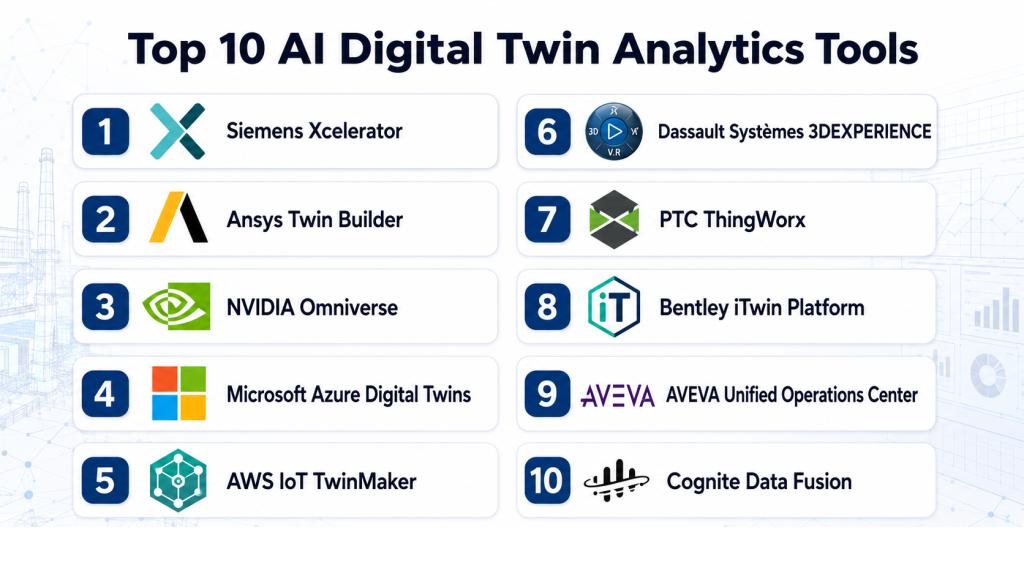
Top 10 AI Digital Twin Analytics Tools
1- Siemens Xcelerator
One-Line Verdict: Best for industrial enterprises building connected digital twins across engineering, manufacturing, and operations.
Short Description
Siemens Xcelerator is a broad digital business platform that supports industrial software, automation, digital twin workflows, simulation, and connected operations. It is especially relevant for manufacturers and industrial organizations that want to connect product design, production planning, automation, and operational analytics.The platform is useful when digital twin analytics must span multiple stages of the asset or product lifecycle, from design and engineering to manufacturing and service operations.
Standout Capabilities
- Industrial digital twin development
- Engineering and manufacturing simulation
- Asset and process modeling
- Automation ecosystem integration
- Industrial IoT connectivity
- Lifecycle data management
- Smart manufacturing support
- Scalable enterprise deployment
AI-Specific Depth
- Model support: Proprietary and ecosystem-based AI capabilities
- Knowledge integration: Varies by implementation
- Evaluation: Model and simulation validation workflows vary
- Guardrails: Industrial governance and access controls
- Observability: Operational dashboards and analytics depend on connected solutions
Pros
- Strong industrial and manufacturing depth
- Broad digital twin ecosystem
- Supports complex engineering and operations use cases
Cons
- Can be complex for smaller teams
- Best value often requires Siemens ecosystem alignment
- Implementation may require specialist support
Security and Compliance
Enterprise security features are available across Siemens solutions. Buyers should verify role-based access, identity management, audit logging, encryption, data governance, and deployment-specific compliance needs.
Deployment and Platforms
- Cloud
- Hybrid
- Enterprise industrial environments
Integrations and Ecosystem
Siemens Xcelerator supports broad industrial and engineering ecosystems.
- Industrial automation systems
- Product lifecycle management tools
- Manufacturing execution systems
- Industrial IoT platforms
- Simulation tools
- Enterprise systems
Pricing Model
Enterprise licensing and subscription models. Exact pricing is not publicly stated.
Best-Fit Scenarios
- Smart manufacturing digital twins
- Product and process lifecycle analytics
- Industrial transformation programs
2- Ansys Twin Builder
One-Line Verdict: Best for engineering teams building physics-based digital twins for simulation and predictive analytics.
Short Description
Ansys Twin Builder helps engineering teams create physics-based digital twins that can simulate asset behavior, test scenarios, and support predictive insights. It is especially valuable for organizations that need high-fidelity modeling of machines, systems, electronics, thermal behavior, mechanical behavior, or complex engineered assets.The platform is best suited for teams that require simulation depth rather than only operational dashboards.
Standout Capabilities
- Physics-based digital twin modeling
- System simulation
- Predictive behavior analysis
- Model reduction workflows
- Asset performance simulation
- Engineering design validation
- Scenario testing
- Integration with broader simulation workflows
AI-Specific Depth
- Model support: Physics-based models with analytics and AI ecosystem support
- Knowledge integration: Varies
- Evaluation: Simulation validation and model accuracy review
- Guardrails: Engineering constraints and model validation practices
- Observability: Simulation outputs and asset behavior analytics
Pros
- Strong simulation depth
- Useful for complex engineered systems
- Supports predictive and scenario-based analysis
Cons
- Requires engineering expertise
- Less suited for simple operational dashboards
- Implementation can be technical
Security and Compliance
Enterprise security features vary by deployment. Buyers should verify access controls, encryption, audit logging, data governance, and deployment-specific compliance needs.
Deployment and Platforms
- Cloud
- Desktop and engineering environments
- Hybrid workflows may vary
Integrations and Ecosystem
Ansys Twin Builder fits well into engineering simulation and product development environments.
- Simulation tools
- Engineering design platforms
- Model-based systems engineering workflows
- Industrial data sources
- Product development environments
- Analytics pipelines
Pricing Model
Enterprise licensing and subscription models. Exact pricing is not publicly stated.
Best-Fit Scenarios
- Physics-based asset twins
- Engineering simulation and validation
- Predictive behavior modeling
3- NVIDIA Omniverse
One-Line Verdict: Best for immersive industrial digital twins, robotics simulation, and physically accurate virtual environments.
Short Description
NVIDIA Omniverse is a platform for building and connecting industrial digital twins, simulation workflows, robotics environments, and physically based three-dimensional collaboration experiences. It is especially useful for organizations that need realistic visualization, simulation, synthetic data, and AI-enabled physical system development.The platform is commonly considered for advanced manufacturing, robotics, factory simulation, autonomous systems, and industrial design collaboration.
Standout Capabilities
- Industrial digital twin visualization
- Robotics and physical AI simulation
- Three-dimensional collaboration
- Synthetic data generation
- Simulation-ready virtual environments
- Integration with design and engineering tools
- GPU-accelerated workflows
- Advanced visualization for complex systems
AI-Specific Depth
- Model support: NVIDIA AI and ecosystem-based models
- Knowledge integration: Varies by workflow
- Evaluation: Simulation validation and physical behavior testing
- Guardrails: Workflow governance depends on implementation
- Observability: Simulation dashboards and connected analytics vary
Pros
- Excellent visual and simulation depth
- Strong for robotics and physical AI use cases
- Powerful ecosystem for advanced digital twin development
Cons
- Requires technical and graphics expertise
- May be more advanced than needed for basic monitoring
- Infrastructure requirements can be significant
Security and Compliance
Security depends on deployment architecture, connected systems, and enterprise configuration. Buyers should verify identity management, access controls, audit logging, encryption, and data governance requirements.
Deployment and Platforms
- Cloud
- Workstation and GPU-accelerated environments
- Hybrid workflows
Integrations and Ecosystem
NVIDIA Omniverse is designed to connect design, simulation, robotics, and AI workflows.
- Three-dimensional design tools
- Simulation environments
- Robotics platforms
- Synthetic data workflows
- AI development pipelines
- Industrial visualization tools
Pricing Model
Varies by product, deployment, and enterprise requirements. Exact pricing is not publicly stated.
Best-Fit Scenarios
- Factory and robotics simulation
- Immersive industrial digital twins
- Synthetic data and physical AI workflows
4- Microsoft Azure Digital Twins
One-Line Verdict: Best for teams building cloud-based digital twin graphs for buildings, IoT, and operational systems.
Short Description
Microsoft Azure Digital Twins enables organizations to model physical environments, assets, devices, and relationships using a digital twin graph. It is useful for building connected twin applications that represent buildings, factories, campuses, infrastructure, and IoT environments.The platform is well suited for teams already using cloud services and looking to build custom digital twin analytics applications.
Standout Capabilities
- Digital twin graph modeling
- IoT and operational data integration
- Cloud-native application development
- Spatial and asset relationship modeling
- Event-driven analytics workflows
- Enterprise scalability
- Integration with broader cloud services
- Custom digital twin application support
AI-Specific Depth
- Model support: Azure AI ecosystem and bring-your-own models
- Knowledge integration: Supported through cloud data and AI services
- Evaluation: Depends on connected AI workflows
- Guardrails: Cloud governance and access controls
- Observability: Monitoring through cloud dashboards and connected services
Pros
- Strong cloud ecosystem
- Flexible for custom digital twin applications
- Useful for smart buildings, infrastructure, and IoT systems
Cons
- Requires cloud and developer expertise
- Not a fully packaged industry solution by itself
- Implementation depends heavily on architecture design
Security and Compliance
Enterprise cloud security, identity management, access controls, encryption, and governance capabilities are available. Buyers should verify exact compliance requirements based on deployment and data location needs.
Deployment and Platforms
- Cloud
- Hybrid through connected services
- Developer-driven environments
Integrations and Ecosystem
Azure Digital Twins works with cloud, IoT, analytics, and application development services.
- IoT platforms
- Cloud data services
- AI and machine learning services
- Visualization tools
- Enterprise applications
- APIs and developer tools
Pricing Model
Usage-based cloud pricing. Exact cost depends on usage, services, and architecture.
Best-Fit Scenarios
- Smart building digital twins
- IoT-connected operational twins
- Custom cloud-based twin applications
5- AWS IoT TwinMaker
One-Line Verdict: Best for teams building industrial and facility digital twins on cloud and IoT data.
Short Description
AWS IoT TwinMaker helps organizations create digital twins of real-world systems by connecting data from equipment, sensors, video, documents, and operational systems. It is useful for teams that want to build custom digital twin applications for facilities, factories, energy assets, and industrial operations.The platform is a good fit for organizations that already use cloud and IoT services and want flexible architecture for digital twin analytics.
Standout Capabilities
- Digital twin application development
- Industrial and facility data integration
- Three-dimensional scene support
- IoT data connectivity
- Operational data contextualization
- Custom analytics workflows
- Cloud-native scalability
- Integration with dashboards and visualization tools
AI-Specific Depth
- Model support: AWS AI ecosystem and bring-your-own models
- Knowledge integration: Supported through connected data services
- Evaluation: Depends on connected analytics and AI workflows
- Guardrails: Cloud access controls and governance
- Observability: Monitoring through cloud and IoT services
Pros
- Flexible for custom digital twin applications
- Strong cloud and IoT ecosystem
- Useful for facilities and industrial environments
Cons
- Requires cloud architecture expertise
- Not a simple plug-and-play solution
- AI depth depends on connected services and implementation
Security and Compliance
Cloud-native security, identity controls, access management, encryption, and governance capabilities are available. Buyers should verify compliance, data retention, and data residency requirements.
Deployment and Platforms
- Cloud
- Hybrid through connected edge and IoT services
- Developer-driven environments
Integrations and Ecosystem
AWS IoT TwinMaker connects with cloud, IoT, analytics, and visualization services.
- IoT data services
- Industrial data sources
- Cloud storage
- Analytics tools
- Visualization dashboards
- AI and machine learning services
Pricing Model
Usage-based cloud pricing. Exact cost depends on services, data volume, and architecture.
Best-Fit Scenarios
- Facility digital twins
- Industrial IoT digital twins
- Custom operational analytics applications
6- Dassault Systèmes 3DEXPERIENCE
One-Line Verdict: Best for engineering-driven organizations building product, process, and lifecycle digital twins.
Short Description
Dassault Systèmes 3DEXPERIENCE provides a collaborative platform for product design, simulation, manufacturing planning, lifecycle management, and digital twin development. It is especially useful for engineering, aerospace, automotive, industrial equipment, life sciences, and manufacturing organizations that need connected models across design, production, and operations.The platform helps teams connect virtual product models with real-world performance insights. For AI Digital Twin Analytics, it supports simulation, lifecycle data, engineering collaboration, and analytics-driven decision-making across complex products and industrial systems.
Standout Capabilities
- Product lifecycle digital twin support
- Engineering simulation and analysis
- Collaborative design and manufacturing workflows
- Virtual product validation
- Process planning and optimization
- Lifecycle data management
- Manufacturing and operations visibility
- Enterprise collaboration environment
AI-Specific Depth
- Model support: Proprietary and ecosystem-based AI capabilities
- Knowledge integration: Varies by implementation
- Evaluation: Simulation validation and lifecycle review workflows
- Guardrails: Governance, approval workflows, and access controls
- Observability: Lifecycle dashboards and operational analytics vary by deployment
Pros
- Strong engineering and product lifecycle depth
- Useful for complex product and manufacturing environments
- Supports collaboration across engineering and operations teams
Cons
- Can be complex for smaller organizations
- Best value requires strong process maturity
- Implementation may need expert support
Security and Compliance
Enterprise security capabilities are available. Buyers should verify access control, identity management, encryption, audit logging, data governance, data retention, and compliance needs based on deployment.
Deployment and Platforms
- Cloud
- Hybrid
- Enterprise engineering environments
Integrations and Ecosystem
Dassault Systèmes 3DEXPERIENCE fits into complex engineering and manufacturing ecosystems.
- Product lifecycle management systems
- Computer-aided design tools
- Simulation platforms
- Manufacturing planning systems
- Enterprise resource planning tools
- Industrial analytics workflows
Pricing Model
Enterprise subscription and licensing models. Exact pricing is not publicly stated.
Best-Fit Scenarios
- Product lifecycle digital twins
- Engineering simulation and validation
- Manufacturing process planning
7- PTC ThingWorx
One-Line Verdict: Best for industrial IoT teams building connected asset twins and operational analytics applications.
Short Description
PTC ThingWorx is an industrial IoT platform used to connect machines, assets, sensors, systems, and operational workflows. It helps organizations create connected applications that monitor asset behavior, visualize performance, and support digital twin analytics across industrial environments.For AI Digital Twin Analytics, ThingWorx is valuable when teams need to connect physical assets to operational dashboards, predictive insights, and service workflows. It is commonly considered by manufacturers, industrial equipment companies, and connected product teams.
Standout Capabilities
- Industrial IoT application development
- Connected asset modeling
- Real-time asset monitoring
- Operational analytics dashboards
- Remote service enablement
- Equipment performance visibility
- Integration with augmented reality workflows
- Scalable industrial connectivity
AI-Specific Depth
- Model support: Varies through connected analytics and AI services
- Knowledge integration: Industrial asset context and IoT data integration
- Evaluation: Depends on connected analytics workflows
- Guardrails: Access controls, workflow rules, and governance features
- Observability: Asset dashboards, IoT monitoring, and operational alerts
Pros
- Strong industrial IoT foundation
- Good fit for connected products and assets
- Useful for monitoring and service applications
Cons
- AI depth depends on implementation
- Requires industrial connectivity planning
- May need customization for advanced analytics
Security and Compliance
Enterprise security features are available. Buyers should verify role-based access, audit logging, encryption, user management, data governance, and deployment-specific security controls.
Deployment and Platforms
- Cloud
- Hybrid
- Industrial IoT environments
Integrations and Ecosystem
PTC ThingWorx works well in connected industrial and service operations.
- Industrial sensors
- Machine data systems
- Asset management platforms
- Service management tools
- Augmented reality workflows
- Enterprise systems
Pricing Model
Enterprise licensing and subscription models. Exact pricing is not publicly stated.
Best-Fit Scenarios
- Connected asset digital twins
- Industrial IoT monitoring
- Remote service and equipment analytics
8- Bentley iTwin Platform
One-Line Verdict: Best for infrastructure, construction, and asset operators building engineering-grade digital twins.
Short Description
Bentley iTwin Platform helps infrastructure teams create and manage digital twins for buildings, roads, bridges, rail systems, utilities, plants, and other physical infrastructure. It connects engineering data, reality data, asset information, and operational context to support better planning and asset management.For AI Digital Twin Analytics, Bentley iTwin is especially relevant for organizations managing complex infrastructure where visual context, engineering accuracy, asset data, and operational insights must work together.
Standout Capabilities
- Infrastructure digital twin creation
- Engineering data integration
- Reality modeling support
- Asset lifecycle visibility
- Change tracking and visualization
- Infrastructure performance analytics
- Collaboration across project teams
- Open ecosystem support
AI-Specific Depth
- Model support: Varies through connected analytics and AI workflows
- Knowledge integration: Strong engineering and asset data context
- Evaluation: Model and design validation depends on workflow
- Guardrails: Project governance and access controls
- Observability: Infrastructure dashboards and twin views vary by deployment
Pros
- Strong infrastructure and engineering focus
- Useful for asset lifecycle management
- Good fit for construction and infrastructure owners
Cons
- Less focused on factory process analytics
- Advanced workflows require implementation expertise
- AI capabilities depend on connected tools and data strategy
Security and Compliance
Enterprise security features are available. Buyers should verify access controls, project permissions, audit logs, encryption, data governance, and compliance requirements.
Deployment and Platforms
- Cloud
- Hybrid project environments
- Infrastructure operations environments
Integrations and Ecosystem
Bentley iTwin connects engineering, infrastructure, and asset operations workflows.
- Engineering design systems
- Reality modeling tools
- Asset management platforms
- Geographic information systems
- Project collaboration platforms
- Infrastructure analytics workflows
Pricing Model
Enterprise subscription and project-based licensing models. Exact pricing is not publicly stated.
Best-Fit Scenarios
- Infrastructure digital twins
- Construction project analytics
- Asset lifecycle planning for physical infrastructure
9- AVEVA Unified Operations Center
One-Line Verdict: Best for industrial enterprises needing operational visibility across plants, assets, and processes.
Short Description
AVEVA Unified Operations Center helps industrial organizations bring operational data, asset information, dashboards, and performance insights into a unified view. It supports digital twin-style operational visibility by helping teams monitor assets, processes, and performance across facilities.For AI Digital Twin Analytics, AVEVA is useful when the goal is to connect plant operations, process data, asset status, and analytics into a common environment for better decision-making.
Standout Capabilities
- Unified operational visibility
- Industrial dashboarding and analytics
- Asset and process monitoring
- Contextualized operational data
- Performance management support
- Multi-site operations visibility
- Integration with industrial systems
- Support for control room and operations teams
AI-Specific Depth
- Model support: Proprietary and connected industrial AI capabilities
- Knowledge integration: Industrial process and asset data context
- Evaluation: Operational analytics and model monitoring vary
- Guardrails: Operational workflows and role-based access
- Observability: Industrial dashboards and performance monitoring
Pros
- Strong industrial operations focus
- Good for multi-site visibility
- Useful for operations command centers
Cons
- May require mature industrial data architecture
- Implementation can be complex
- Best suited for enterprise operations
Security and Compliance
Enterprise-grade access controls, user management, audit capabilities, encryption, and governance features are available. Buyers should verify specific compliance and deployment requirements.
Deployment and Platforms
- Cloud
- Hybrid
- Industrial enterprise environments
Integrations and Ecosystem
AVEVA Unified Operations Center connects industrial systems and operations data.
- SCADA systems
- Historian databases
- Manufacturing execution systems
- Enterprise asset systems
- Operational dashboards
- Industrial analytics platforms
Pricing Model
Enterprise subscription and licensing models. Exact pricing is not publicly stated.
Best-Fit Scenarios
- Plant operations digital twins
- Multi-site industrial visibility
- Operations command center analytics
10- Cognite Data Fusion
One-Line Verdict: Best for industrial companies building AI-ready digital twins from contextualized operational data.
Short Description
Cognite Data Fusion is an industrial data platform that helps organizations collect, contextualize, and use operational data for analytics, AI, and digital twin workflows. It connects asset data, time-series data, documents, engineering information, and operational systems to create a trusted data foundation.For AI Digital Twin Analytics, Cognite Data Fusion is valuable when organizations need to make messy industrial data usable for AI models, digital twin applications, and operational decision-making.
Standout Capabilities
- Industrial data contextualization
- Asset hierarchy mapping
- Time-series data management
- AI-ready data foundation
- Digital twin application support
- Operational analytics enablement
- Document and engineering data connection
- Scalable industrial data integration
AI-Specific Depth
- Model support: Bring-your-own models and ecosystem-based AI workflows
- Knowledge integration: Strong industrial data contextualization
- Evaluation: Varies based on connected AI workflows
- Guardrails: Data governance and access controls
- Observability: Operational data visibility and analytics dashboards
Pros
- Strong industrial data foundation
- Useful for scaling AI digital twins
- Flexible for custom analytics and applications
Cons
- Not a fully packaged digital twin solution for every use case
- Requires data and AI workflow design
- Best value depends on data maturity
Security and Compliance
Enterprise security and governance capabilities are available. Buyers should verify identity controls, audit logging, encryption, data residency, retention policies, and compliance requirements.
Deployment and Platforms
- Cloud
- Hybrid industrial environments
Integrations and Ecosystem
Cognite Data Fusion connects industrial data sources for analytics and AI workflows.
- Industrial historians
- Asset management systems
- Engineering documents
- Sensor data platforms
- Maintenance systems
- Analytics and AI tools
Pricing Model
Enterprise subscription pricing. Exact pricing is not publicly stated.
Best-Fit Scenarios
- AI-ready industrial digital twins
- Contextualized operational data platforms
- Scaling analytics across complex assets
Comparison Table
| Tool Name | Best For | Deployment | Model Flexibility | Strength | Watch-Out | Public Rating |
|---|---|---|---|---|---|---|
| Siemens Xcelerator | Industrial lifecycle twins | Cloud and hybrid | Proprietary and ecosystem-based | Manufacturing and engineering depth | Complex implementation | N/A |
| Ansys Twin Builder | Physics-based simulation twins | Cloud and engineering environments | Physics-based and ecosystem AI | Simulation accuracy | Requires engineering expertise | N/A |
| NVIDIA Omniverse | Immersive industrial twins | Cloud and GPU environments | NVIDIA and ecosystem AI | Visual simulation depth | Infrastructure needs can be high | N/A |
| Microsoft Azure Digital Twins | Cloud-based twin graphs | Cloud and hybrid | Bring-your-own model | Cloud flexibility | Requires developer expertise | N/A |
| AWS IoT TwinMaker | IoT-connected digital twins | Cloud and hybrid | Bring-your-own model | Flexible twin applications | Needs architecture design | N/A |
| Dassault Systèmes 3DEXPERIENCE | Product lifecycle twins | Cloud and hybrid | Proprietary and ecosystem AI | Engineering lifecycle depth | Platform complexity | N/A |
| PTC ThingWorx | Connected asset twins | Cloud and hybrid | Varies by implementation | Industrial IoT strength | AI depth depends on setup | N/A |
| Bentley iTwin Platform | Infrastructure twins | Cloud and hybrid | Varies by workflow | Infrastructure modeling | Less factory-focused | N/A |
| AVEVA Unified Operations Center | Industrial operations visibility | Cloud and hybrid | Proprietary and connected AI | Multi-site operations view | Needs data maturity | N/A |
| Cognite Data Fusion | Industrial data foundation | Cloud and hybrid | Bring-your-own model | Data contextualization | Requires workflow design | N/A |
Scoring and Evaluation
The scoring below is a practical comparative guide, not an absolute ranking. Each score reflects digital twin relevance, AI readiness, simulation strength, integration potential, enterprise usability, governance, and implementation practicality. Buyers should validate these scores through a focused pilot using their own assets, data, workflows, and business goals.
| Tool | Core Features | Reliability and Evaluation | Guardrails | Integrations | Ease of Use | Performance and Cost | Security and Admin | Support | Weighted Total |
| Siemens Xcelerator | 10 | 9 | 9 | 9 | 7 | 8 | 9 | 9 | 8.9 |
| Ansys Twin Builder | 9 | 9 | 8 | 8 | 7 | 8 | 8 | 8 | 8.3 |
| NVIDIA Omniverse | 9 | 8 | 8 | 9 | 7 | 8 | 8 | 9 | 8.4 |
| Microsoft Azure Digital Twins | 8 | 8 | 9 | 10 | 7 | 8 | 9 | 9 | 8.6 |
| AWS IoT TwinMaker | 8 | 8 | 9 | 10 | 7 | 8 | 9 | 9 | 8.6 |
| Dassault Systèmes 3DEXPERIENCE | 9 | 9 | 8 | 9 | 7 | 8 | 9 | 8 | 8.5 |
| PTC ThingWorx | 8 | 8 | 8 | 9 | 8 | 8 | 8 | 8 | 8.2 |
| Bentley iTwin Platform | 9 | 8 | 8 | 9 | 8 | 8 | 8 | 8 | 8.4 |
| AVEVA Unified Operations Center | 8 | 8 | 8 | 9 | 8 | 8 | 9 | 8 | 8.3 |
| Cognite Data Fusion | 8 | 8 | 8 | 9 | 7 | 8 | 8 | 8 | 8.1 |
Top 3 for Enterprise
- Siemens Xcelerator
- Microsoft Azure Digital Twins
- AWS IoT TwinMaker
Top 3 for SMB
- PTC ThingWorx
- Bentley iTwin Platform
- AVEVA Unified Operations Center
Top 3 for Developers
- Microsoft Azure Digital Twins
- AWS IoT TwinMaker
- NVIDIA Omniverse
Which AI Digital Twin Analytics Tool Is Right for You
Solo and Freelancer
Solo consultants, simulation specialists, and independent developers should choose tools based on the type of project they support. Microsoft Azure Digital Twins and AWS IoT TwinMaker are useful for cloud-based twin application development. NVIDIA Omniverse is suitable for advanced visual simulation and robotics-related work. Ansys Twin Builder is better for engineering simulation projects where physics-based modeling is important.
SMB
Small and medium-sized organizations should avoid starting with overly complex digital twin programs. A practical approach is to begin with a focused asset, building, production line, or facility use case. PTC ThingWorx can work well for connected asset monitoring, while Bentley iTwin can support infrastructure projects. AVEVA Unified Operations Center may fit industrial teams that need operational visibility without building everything from scratch.
Mid-Market
Mid-market companies usually need stronger integration, better governance, and more scalable analytics than small teams. AWS IoT TwinMaker, Microsoft Azure Digital Twins, PTC ThingWorx, and Cognite Data Fusion can support flexible digital twin development. The best choice depends on whether the organization needs cloud-native twin applications, industrial IoT connectivity, or a strong data foundation.
Enterprise
Large enterprises often need digital twins across facilities, product lines, infrastructure networks, and operational teams. Siemens Xcelerator is strong for industrial lifecycle twins, while Dassault Systèmes 3DEXPERIENCE is strong for product and engineering lifecycle twins. Microsoft Azure Digital Twins and AWS IoT TwinMaker are strong for cloud-based custom applications. Cognite Data Fusion is valuable when the main challenge is contextualizing industrial data at scale.
Regulated Industries
Regulated industries should prioritize governance, auditability, security, data retention, and explainable analytics. Utilities, energy, healthcare operations, public infrastructure, aerospace, and pharmaceutical organizations should verify access controls, data residency, model monitoring, and compliance requirements before implementation. Digital twin analytics should support review workflows and clear documentation.
Budget vs Premium
Budget-conscious teams should start with one use case and avoid overbuilding. Cloud-based platforms can be cost-effective for developer-led projects, but costs can grow with data volume, compute, storage, and integrations. Premium enterprise platforms offer deeper industry functionality, simulation, and lifecycle management, but require stronger planning and implementation investment.
Build vs Buy
Build a custom digital twin when the organization has strong data engineering, cloud, simulation, and AI expertise. This approach offers flexibility but requires more ownership. Buy or adopt an enterprise platform when the organization needs proven workflows, vendor support, industrial templates, and faster rollout. Many organizations combine both approaches by using a digital twin platform while building custom analytics and AI models around it.
Continued in Part 3 with Implementation Playbook, Common Mistakes, 15 FAQs, and Conclusion.
please write blog part 3
Here is Blog Part 3 for AI Digital Twin Analytics, following your locked format.
Implementation Playbook
Implementing AI Digital Twin Analytics requires a structured approach because digital twins connect physical systems, operational data, simulations, analytics, and business workflows. A successful rollout should not begin with a large and complex enterprise-wide model. It should start with a focused operational use case, reliable data, clear success metrics, and strong collaboration between engineering, operations, IT, data teams, and business leaders.
First Phase
The first phase should focus on selecting the right use case and preparing the foundation. A digital twin is only useful when it represents a real business problem clearly. Teams should choose one asset, process, facility, production line, building, or infrastructure system where better visibility and predictive insight can create measurable value.
Key activities include:
- Select one high-value digital twin use case
- Define the physical asset, process, or environment to model
- Identify operational data sources
- Review sensor quality and data completeness
- Map asset relationships and dependencies
- Define baseline performance metrics
- Align engineering, operations, IT, and leadership teams
- Decide whether the twin will support monitoring, simulation, prediction, or optimization
- Create a basic twin model
- Document data ownership and governance rules
AI-specific tasks include:
- Define what AI should predict or optimize
- Prepare clean training and validation datasets
- Identify historical events for model learning
- Define model evaluation criteria
- Create dashboards for early insights
- Set human review workflows for AI recommendations
- Document model assumptions
- Define safety boundaries for automated insights
Success metrics should include:
- Better asset visibility
- Faster issue investigation
- Reduced downtime
- Improved energy efficiency
- Better production planning
- Improved simulation accuracy
- Stronger maintenance planning
- Improved operational decision-making
Second Phase
The second phase should focus on validation, workflow integration, and controlled rollout. During this stage, teams should confirm that the digital twin accurately reflects real-world behavior and that AI recommendations are useful, understandable, and safe. The goal is to move from a basic model to a trusted operational tool.
Key activities include:
- Validate the digital twin against real operational data
- Compare simulated outputs with actual outcomes
- Connect the twin to live data streams
- Build user dashboards for engineers and operators
- Add alerting for abnormal behavior
- Integrate insights with maintenance and operations workflows
- Train users on how to interpret twin analytics
- Conduct security and access reviews
- Improve model explainability
- Refine the twin based on user feedback
AI-specific tasks include:
- Monitor model performance
- Detect model drift
- Review false alerts and missed events
- Improve prediction accuracy
- Add scenario testing workflows
- Create version control for AI models and twin logic
- Add audit trails for recommendations
- Establish approval workflows for high-impact decisions
- Review data retention policies
- Test unusual operating conditions
Success metrics should include:
- Prediction accuracy improvement
- Reduced manual investigation time
- Better maintenance prioritization
- Higher user adoption
- Improved alert quality
- Faster response to operational issues
- Better planning confidence
- Stronger governance readiness
Third Phase
The third phase should focus on scaling, optimization, governance, and long-term value creation. Once a pilot proves value, organizations can expand digital twin analytics across more assets, facilities, business units, or operational domains. Scaling should be controlled because each asset and process may behave differently.
Key activities include:
- Expand successful twins to additional assets or facilities
- Standardize data pipelines and asset models
- Create reusable twin templates
- Build governance processes for model updates
- Integrate with enterprise systems
- Create executive dashboards
- Track business value across departments
- Improve simulation and optimization workflows
- Train more teams on twin usage
- Establish a center of excellence
AI-specific tasks include:
- Automate retraining where appropriate
- Monitor long-term model drift
- Improve latency for real-time insights
- Optimize cloud, edge, and compute costs
- Add stronger access controls
- Expand AI models across use cases
- Introduce multimodal data where useful
- Review model risk regularly
- Maintain model documentation
- Improve recommendation quality through feedback loops
Long-term success metrics should include:
- Lower unplanned downtime
- Better asset utilization
- Reduced energy consumption
- Higher production efficiency
- Improved sustainability performance
- Faster scenario testing
- Improved capital planning
- Stronger operational resilience
- Better cross-team collaboration
- Higher return from operational data
Common Mistakes and How to Avoid Them
1. Starting Too Broad
Many organizations try to build a full enterprise digital twin at the beginning. This often creates complexity, high cost, and slow progress. Start with one focused use case where value can be measured clearly.
2. Ignoring Data Quality
A digital twin depends on accurate and reliable data. If sensor data is incomplete, delayed, inconsistent, or poorly contextualized, the twin will produce weak insights. Teams should clean and validate data before scaling.
3. Building a Twin Without a Business Goal
A visually impressive digital twin does not automatically create value. The twin should solve a specific problem such as reducing downtime, improving energy use, optimizing maintenance, or testing operational scenarios.
4. Treating the Twin as a Static Model
A digital twin should evolve as the physical system changes. Equipment ages, processes change, layouts shift, and operating conditions vary. Teams should update the twin regularly to keep it useful.
5. Overlooking Simulation Validation
Simulation outputs must be compared with real-world outcomes. If the model is not validated, teams may make decisions based on incorrect assumptions. Validation improves trust and decision quality.
6. Weak Integration With Operational Workflows
Digital twin insights must connect to real action. If alerts, predictions, or simulations are not linked to maintenance, planning, engineering, or operations workflows, the value will remain limited.
7. Lack of Explainability
Users need to understand why an AI model predicts failure, recommends action, or identifies risk. Explainable insights help engineers and operators trust the platform and use it confidently.
8. Ignoring Security and Access Controls
Digital twins may connect to sensitive operational systems and critical infrastructure. Buyers should evaluate role-based access, audit logs, encryption, identity management, data retention, and governance before deployment.
9. Underestimating Implementation Skills
AI Digital Twin Analytics often requires engineering knowledge, data engineering, cloud skills, simulation expertise, and operational understanding. Teams should plan for cross-functional involvement from the beginning.
10. Focusing Only on Visualization
Three-dimensional views and dashboards are useful, but they are not enough. A strong digital twin should support analytics, prediction, simulation, optimization, and decision-making.
11. Poor Change Management
Operators, engineers, and managers may need to adjust how they work. Training, communication, and feedback loops are necessary to increase adoption and reduce resistance.
12. Not Measuring Business Value
Teams should track outcomes such as downtime reduction, energy savings, maintenance efficiency, production improvement, and faster planning. Without measurable value, digital twin projects may lose support.
13. Creating Vendor Lock-In
Digital twin platforms can become deeply connected to operational data and enterprise systems. Buyers should evaluate APIs, export options, data ownership, interoperability, and long-term flexibility.
14. Scaling Before the Pilot Is Proven
Scaling too early can spread mistakes across the organization. Validate the first use case, prove value, improve workflows, then expand gradually.
FAQs
1. What is AI Digital Twin Analytics?
AI Digital Twin Analytics combines digital twin technology with artificial intelligence and analytics to create a virtual representation of real-world assets, systems, or processes. It uses operational data to monitor behavior, predict problems, simulate scenarios, and recommend improvements. These tools help organizations understand complex physical environments more clearly. They are widely used in manufacturing, infrastructure, energy, buildings, logistics, and industrial operations.
2. Why is AI important in digital twin analytics?
AI makes digital twins more intelligent by helping them detect patterns, predict failures, optimize performance, and support better decisions. Without AI, a digital twin may simply show a visual or data-driven representation of an asset. With AI, it can identify abnormal behavior, forecast outcomes, and recommend actions. This makes the twin more valuable for proactive operations and long-term planning.
3. What are the main benefits of AI Digital Twin Analytics?
The main benefits include better visibility, faster decision-making, reduced downtime, improved maintenance planning, energy optimization, safer operations, and stronger scenario testing. Teams can test changes virtually before applying them in real operations. This reduces risk and helps leaders make more confident decisions. It also improves collaboration across engineering, operations, and business teams.
4. Which industries use AI Digital Twin Analytics the most?
Manufacturing, energy, utilities, construction, transportation, aerospace, automotive, smart buildings, logistics, infrastructure, and industrial equipment companies commonly use AI Digital Twin Analytics. These industries manage complex physical systems where downtime, inefficiency, and poor planning can be expensive. Digital twins help them monitor and improve these systems with better context and predictive intelligence.
5. How is a digital twin different from a dashboard?
A dashboard mainly displays data and metrics, while a digital twin represents how real-world assets, systems, and relationships behave. A digital twin can connect data, models, simulations, and operational context. It can help users understand what happened, what is happening, and what may happen next. Dashboards are useful, but digital twins provide deeper operational intelligence.
6. Does every organization need a digital twin?
No, not every organization needs a digital twin. Companies with simple operations or limited physical assets may not need a full digital twin platform. A digital twin is most useful when systems are complex, data-rich, and expensive to operate or maintain. Organizations should begin only when they have a clear use case and measurable business value.
7. What data is needed for AI Digital Twin Analytics?
Common data sources include sensor data, asset data, maintenance records, engineering documents, control system data, production data, energy data, geographic data, and operational logs. The exact data depends on the use case. A factory twin may need machine and production data, while a building twin may need energy, occupancy, and equipment data. Data quality and context are critical for success.
8. Can AI Digital Twin Analytics predict equipment failure?
Yes, many digital twin analytics platforms can support predictive maintenance and equipment failure prediction. They analyze asset behavior, sensor patterns, operating conditions, and historical failure data. When early warning signals appear, the system can alert maintenance teams. The accuracy depends on data quality, model design, asset complexity, and validation.
9. Can digital twins help with sustainability?
Yes, digital twins can support sustainability by helping organizations monitor energy use, simulate efficiency improvements, reduce waste, and optimize resource consumption. Buildings can use digital twins to improve HVAC performance, while factories can use them to reduce energy waste and process inefficiency. Sustainability use cases are becoming one of the strongest reasons to adopt digital twin analytics.
10. What is the role of simulation in digital twin analytics?
Simulation allows teams to test possible changes before applying them in the real world. This can include testing production changes, equipment settings, facility layouts, maintenance strategies, energy use, or infrastructure scenarios. Simulation reduces operational risk and helps teams compare options. When combined with AI, simulation becomes more predictive and decision-focused.
11. Are digital twins only for industrial companies?
No, digital twins are used across many sectors. Smart buildings, cities, hospitals, airports, logistics networks, infrastructure projects, and product engineering teams can all use digital twins. However, the highest value often appears where physical systems are complex, expensive, and data-rich. Industrial companies are major adopters because they have many assets and operational risks to manage.
12. What security features should buyers evaluate?
Buyers should evaluate access control, audit logging, encryption, identity management, data governance, data retention, and data residency options. Digital twins may connect to critical systems, so security must be reviewed carefully. Teams should also control who can view, modify, simulate, and act on twin data. Strong governance helps reduce operational and compliance risks.
13. How can companies measure return from AI Digital Twin Analytics?
Return can be measured through reduced downtime, lower energy consumption, improved asset utilization, faster planning, better maintenance efficiency, reduced waste, and improved production output. Teams should define baseline metrics before implementation. A successful pilot should show measurable improvement in one or more operational outcomes. Business value should guide expansion decisions.
14. Should companies build or buy a digital twin platform?
Companies with strong cloud, data engineering, simulation, and AI teams may build custom digital twin applications. This provides flexibility but requires more ownership and technical effort. Buying a platform is better when teams need proven workflows, vendor support, industry templates, and faster deployment. Many organizations use a hybrid approach by adopting a platform and building custom analytics on top.
15. What is the future of AI Digital Twin Analytics?
The future of AI Digital Twin Analytics will include more intelligent simulations, stronger predictive models, natural language copilots, real-time optimization, and deeper integration with automation systems. Digital twins will become more connected to enterprise decision-making and operational workflows. The strongest value will come from twins that combine accurate data, AI insights, simulation, governance, and human expertise.
Conclusion
AI Digital Twin Analytics is becoming a powerful foundation for organizations that want smarter, safer, and more efficient operations. It helps teams connect physical assets with virtual models, real-time data, simulation, and AI-driven intelligence. The right tool depends on the organization’s industry, asset complexity, data maturity, technical skills, and business goals. Siemens Xcelerator, Ansys Twin Builder, NVIDIA Omniverse, Microsoft Azure Digital Twins, AWS IoT TwinMaker, Dassault Systèmes 3DEXPERIENCE, PTC ThingWorx, Bentley iTwin Platform, AVEVA Unified Operations Center, and Cognite Data Fusion each serve different needs across engineering, manufacturing, infrastructure, cloud development, and industrial operations.The best approach is to start with one valuable use case rather than trying to digitize everything at once. Shortlist tools that match your asset type, data environment, and deployment model. Run a focused pilot, validate the digital twin against real-world behavior, test AI predictions, review security and governance, and measure business results. Once the pilot proves value, scale carefully with reusable templates, strong data foundations, user training, and continuous improvement. With the right strategy, AI Digital Twin Analytics can improve reliability, reduce costs, support sustainability, and help organizations make better operational decisions.

Find Trusted Cardiac Hospitals
Compare heart hospitals by city and services — all in one place.
Explore Hospitals
Digital twin analytics only deliver real value when models are continuously calibrated with accurate real-time sensor data and tightly integrated with actual plant operations.