
Introduction
AI Compliance Workflow Automation tools are intelligent systems that help organizations automate end-to-end compliance processes such as regulatory tracking, policy enforcement, audit preparation, risk assessment, control testing, and reporting. These platforms combine artificial intelligence, workflow orchestration, and NLP-driven document understanding to reduce manual compliance effort and improve governance accuracy.
In 2026, compliance teams face increasing pressure from rapidly evolving regulations across privacy, AI governance, financial reporting, cybersecurity, and ESG standards. Manual workflows are no longer sufficient to handle continuous audits, multi-jurisdiction regulations, and real-time risk monitoring. AI automation solves this by orchestrating compliance tasks, detecting policy violations, generating audit trails, and triggering corrective workflows automatically.
Modern systems integrate with GRC platforms, enterprise data systems, cloud infrastructure, and security tools. They use NLP to interpret regulatory text, machine learning to detect anomalies, and rule engines to enforce compliance across business processes.
Common use cases include automated audit workflows, regulatory reporting, internal control testing, vendor compliance monitoring, policy enforcement, incident response compliance, ESG reporting automation, and continuous compliance monitoring.
Key evaluation criteria include workflow automation depth, regulatory coverage, AI accuracy, integration capabilities, auditability, explainability, scalability, governance controls, and security.
Best for: enterprise compliance teams, risk officers, internal audit teams, financial institutions, healthcare organizations, and global enterprises.
Not ideal for: small teams with minimal regulatory requirements or organizations without structured compliance processes.
What’s Changed in AI Compliance Workflow Automation in 2026+
- Shift from static compliance checklists to fully autonomous workflow orchestration
- AI-driven continuous control monitoring instead of periodic audits
- Real-time regulatory change ingestion into compliance workflows
- NLP-based interpretation of regulatory obligations
- Automated mapping of regulations to internal controls and policies
- Event-driven compliance workflows triggered by system activity
- AI-assisted audit preparation and evidence collection
- Integration of compliance with DevOps and security pipelines
- Self-healing compliance workflows that auto-correct deviations
- Cross-system orchestration across GRC, ERP, and cloud platforms
- Predictive compliance risk scoring before violations occur
- Automated ESG and sustainability reporting workflows
- AI governance workflow automation for LLM usage
- Explainable compliance decisions for audit transparency
- Multi-jurisdiction workflow standardization
Quick Buyer Checklist
- Does the platform automate end-to-end compliance workflows?
- Can it integrate with GRC, ERP, and security systems?
- Does it support real-time regulatory updates?
- Is NLP used for understanding regulatory text?
- Can it trigger workflows based on risk events?
- Does it provide audit-ready evidence collection?
- Are workflows customizable by jurisdiction and industry?
- Does it support continuous control monitoring?
- Can it detect compliance violations automatically?
- Is there explainability for automated decisions?
- Does it support multi-cloud and hybrid environments?
- Can it map regulations to internal controls?
- Does it reduce manual compliance tasks significantly?
- Is role-based access and audit logging supported?
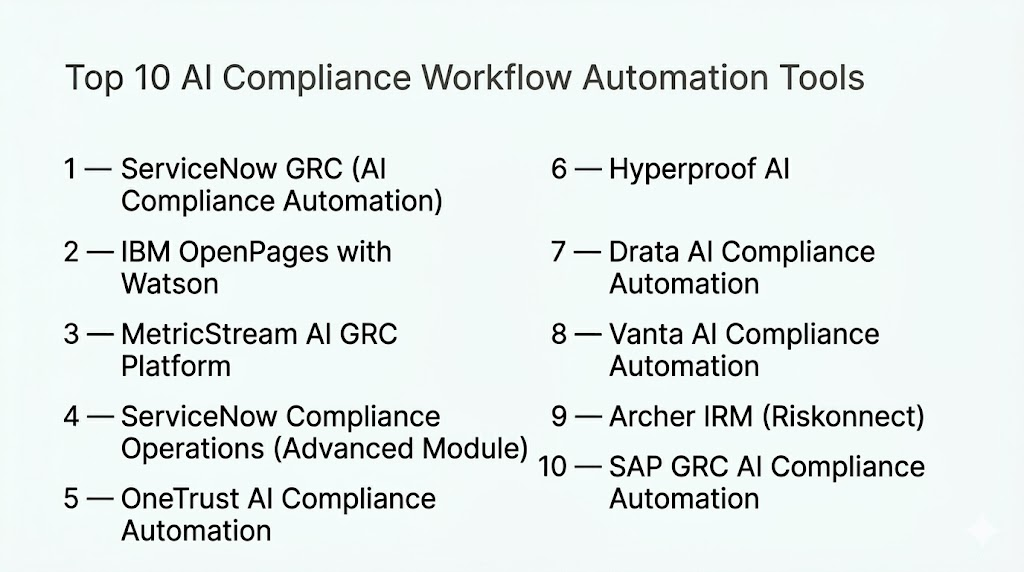
Top 10 AI Compliance Workflow Automation Tools
#1 — ServiceNow GRC (AI Compliance Automation)
One-line verdict: Best enterprise AI platform for end-to-end compliance workflow automation and governance orchestration.
Short description:
ServiceNow GRC automates compliance workflows across risk, audit, and regulatory domains using AI-driven orchestration and enterprise-scale governance controls.
Standout Capabilities
- Automated compliance workflow orchestration
- AI-driven risk and control mapping
- Continuous control monitoring
- Regulatory change-to-workflow automation
- Audit lifecycle automation
- Incident-driven compliance workflows
- Policy enforcement automation
- GRC dashboard and reporting
AI-Specific Depth
- Model support: ServiceNow AI + workflow intelligence models
- RAG / knowledge integration: Enterprise governance knowledge base
- Evaluation: Compliance workflow validation scoring
- Guardrails: Rule-based governance and approval systems
- Observability: Real-time GRC dashboards and audit logs
Pros
- Extremely strong enterprise workflow automation
- Deep integration across IT and compliance
- Scalable governance system
Cons
- Complex implementation
- Requires enterprise ecosystem adoption
- High configuration overhead
Security & Compliance
Enterprise-grade encryption, RBAC, audit logs, and compliance controls.
Deployment & Platforms
- Cloud-based GRC platform
- Enterprise workflow engine
- Web dashboards
Integrations & Ecosystem
- ITSM systems
- ERP platforms
- Security tools
- API integrations
- Enterprise governance systems
Pricing Model
Enterprise subscription (not publicly stated).
Best-Fit Scenarios
- Enterprise compliance automation
- Risk-driven workflow orchestration
- Continuous audit operations
#2 — IBM OpenPages with Watson
One-line verdict: Best AI-powered enterprise GRC platform for structured compliance workflow automation.
Short description:
IBM OpenPages uses AI to automate compliance workflows, risk management, and audit processes across large enterprises.
Standout Capabilities
- AI-driven compliance workflow automation
- Risk and control mapping engine
- Audit management system
- Regulatory compliance tracking
- Policy enforcement workflows
- Governance dashboards
- Incident tracking automation
- Compliance reporting system
AI-Specific Depth
- Model support: IBM Watson NLP models
- RAG / knowledge integration: Enterprise compliance knowledge base
- Evaluation: Workflow compliance scoring system
- Guardrails: Enterprise governance framework
- Observability: GRC analytics dashboards
Pros
- Strong enterprise governance capabilities
- Highly scalable compliance automation
- Deep regulatory alignment
Cons
- Complex deployment
- Requires technical expertise
- Enterprise-only focus
Security & Compliance
Enterprise-grade encryption, audit logging, RBAC, and governance controls.
Deployment & Platforms
- Cloud and hybrid deployment
- Enterprise GRC system
- Web-based dashboards
Integrations & Ecosystem
- ERP systems
- Security platforms
- Compliance tools
- API integrations
- IBM ecosystem
Pricing Model
Enterprise subscription (not publicly stated).
Best-Fit Scenarios
- Large-scale compliance automation
- Risk governance programs
- Audit lifecycle management
#3 — MetricStream AI GRC Platform
One-line verdict: Best dedicated AI-driven GRC platform for automated compliance workflows and risk monitoring.
Short description:
MetricStream provides AI-powered compliance workflow automation across risk, audit, and regulatory domains.
Standout Capabilities
- AI compliance workflow engine
- Risk and control automation
- Regulatory change management workflows
- Audit automation tools
- Policy enforcement system
- Incident management workflows
- Compliance reporting automation
- Enterprise dashboards
AI-Specific Depth
- Model support: Proprietary GRC AI models
- RAG / knowledge integration: Compliance and regulatory knowledge base
- Evaluation: Workflow compliance accuracy scoring
- Guardrails: Governance rules engine
- Observability: GRC performance dashboards
Pros
- Strong GRC specialization
- Good automation depth
- Scalable enterprise platform
Cons
- Complex implementation
- Enterprise pricing model
- Requires structured setup
Security & Compliance
Not publicly stated in full detail; includes enterprise-grade controls.
Deployment & Platforms
- Cloud-based GRC platform
- Enterprise compliance system
Integrations & Ecosystem
- ERP systems
- Security tools
- Audit platforms
- API integrations
- Enterprise workflows
Pricing Model
Enterprise subscription (not publicly stated).
Best-Fit Scenarios
- Enterprise GRC automation
- Risk and audit workflows
- Regulatory compliance management
#4 — ServiceNow Compliance Operations (Advanced Module)
One-line verdict: Best AI-driven real-time compliance workflow automation layer within enterprise IT ecosystems.
Short description:
ServiceNow Compliance Operations automates compliance workflows across IT, security, and regulatory domains using AI-driven orchestration.
Standout Capabilities
- Real-time compliance workflow automation
- AI-driven incident response compliance
- Continuous control monitoring
- Regulatory-to-action mapping
- Automated audit workflows
- Risk-based task orchestration
- Policy enforcement automation
- Compliance dashboards
AI-Specific Depth
- Model support: ServiceNow AI workflow models
- RAG / knowledge integration: Enterprise operational data
- Evaluation: Compliance task automation scoring
- Guardrails: Workflow governance controls
- Observability: Real-time compliance monitoring dashboards
Pros
- Strong IT + compliance integration
- Real-time automation capabilities
- Enterprise scalability
Cons
- Requires ServiceNow ecosystem
- Complex configuration
- High cost structure
Security & Compliance
Enterprise-grade RBAC, encryption, audit logs, and governance controls.
Deployment & Platforms
- Cloud-based ServiceNow platform
- Enterprise workflow system
Integrations & Ecosystem
- ITSM systems
- Security operations tools
- ERP platforms
- API integrations
- Enterprise systems
Pricing Model
Enterprise subscription (not publicly stated).
Best-Fit Scenarios
- IT-driven compliance automation
- Security compliance workflows
- Enterprise risk orchestration
#5 — OneTrust AI Compliance Automation
One-line verdict: Best AI-driven privacy and compliance workflow automation platform for regulatory-heavy organizations.
Short description:
OneTrust automates compliance workflows across privacy, security, and governance domains using AI-driven regulatory intelligence.
Standout Capabilities
- AI compliance workflow automation
- Privacy regulation management workflows
- Vendor compliance automation
- Risk assessment workflows
- Policy enforcement automation
- Regulatory change workflows
- Audit reporting system
- Compliance dashboards
AI-Specific Depth
- Model support: Privacy and compliance NLP models
- RAG / knowledge integration: Global privacy regulatory database
- Evaluation: Workflow compliance scoring system
- Guardrails: Privacy governance controls
- Observability: Compliance analytics dashboards
Pros
- Strong privacy compliance automation
- Good regulatory mapping
- Easy policy enforcement workflows
Cons
- Less flexible outside privacy domain
- Enterprise pricing structure
- Requires configuration effort
Security & Compliance
Enterprise-grade privacy and security controls depending on deployment.
Deployment & Platforms
- Cloud-based compliance platform
- Web dashboard system
Integrations & Ecosystem
- GRC platforms
- Privacy tools
- ERP systems
- API integrations
- Enterprise systems
Pricing Model
Enterprise subscription (not publicly stated).
Best-Fit Scenarios
- Privacy compliance automation
- GDPR workflow management
- Vendor risk compliance
#6 — Hyperproof AI
One-line verdict: Best AI-powered continuous compliance automation platform for control monitoring.
Short description:
Hyperproof automates compliance workflows by continuously monitoring controls and triggering remediation actions using AI.
Standout Capabilities
- Continuous compliance workflows
- AI control monitoring system
- Audit workflow automation
- Risk-based compliance alerts
- Regulatory mapping automation
- Evidence collection workflows
- Policy lifecycle automation
- Compliance dashboards
AI-Specific Depth
- Model support: Compliance automation models
- RAG / knowledge integration: Control framework database
- Evaluation: Control monitoring accuracy metrics
- Guardrails: Workflow validation rules
- Observability: Compliance dashboards
Pros
- Strong continuous monitoring
- Good automation for audits
- Easy compliance tracking
Cons
- Limited deep AI reasoning
- Requires structured setup
- Enterprise pricing model
Security & Compliance
Not publicly stated in full detail.
Deployment & Platforms
- Cloud-based platform
- Compliance dashboard system
Integrations & Ecosystem
- GRC systems
- ERP platforms
- Security tools
- API integrations
- Enterprise workflows
Pricing Model
Enterprise subscription (not publicly stated).
Best-Fit Scenarios
- Continuous compliance monitoring
- Audit automation workflows
- Risk-based control tracking
#7 — Drata AI Compliance Automation
One-line verdict: Best lightweight AI compliance automation tool for startups and fast-growing SaaS companies.
Short description:
Drata automates compliance workflows for SOC 2, ISO 27001, and other frameworks using AI and prebuilt controls.
Standout Capabilities
- Automated compliance workflows
- AI policy and control mapping
- Audit readiness automation
- Evidence collection workflows
- Continuous compliance monitoring
- Risk tracking system
- Security framework alignment
- Compliance dashboards
AI-Specific Depth
- Model support: Compliance automation NLP models
- RAG / knowledge integration: Security framework templates
- Evaluation: Compliance scoring engine
- Guardrails: Automated control validation
- Observability: Audit readiness dashboards
Pros
- Fast implementation
- Ideal for startups
- Strong audit readiness support
Cons
- Limited enterprise depth
- Narrow compliance focus
- Less customization flexibility
Security & Compliance
Not publicly stated in full detail.
Deployment & Platforms
- Cloud-based SaaS platform
- Compliance dashboard system
Integrations & Ecosystem
- Cloud infrastructure tools
- DevOps systems
- Security platforms
- API integrations
- GRC tools
Pricing Model
Subscription-based.
Best-Fit Scenarios
- Startup compliance automation
- SOC 2 readiness workflows
- Fast audit preparation
#8 — Vanta AI Compliance Automation
One-line verdict: Best AI-driven security compliance automation platform for fast-growing companies.
Short description:
Vanta automates compliance workflows across security frameworks using AI-driven monitoring and policy enforcement.
Standout Capabilities
- AI compliance workflow automation
- Security policy enforcement
- Continuous monitoring system
- Vendor risk workflows
- Audit automation tools
- Evidence collection engine
- Risk tracking system
- Compliance dashboards
AI-Specific Depth
- Model support: Security compliance models
- RAG / knowledge integration: Security framework database
- Evaluation: Compliance automation scoring
- Guardrails: Policy enforcement system
- Observability: Security dashboards
Pros
- Strong automation for security compliance
- Easy setup and onboarding
- Good for scaling startups
Cons
- Limited enterprise governance depth
- Focused mainly on security
- Less flexibility for complex workflows
Security & Compliance
Enterprise-grade security controls depending on configuration.
Deployment & Platforms
- Cloud-based platform
- Compliance dashboard system
Integrations & Ecosystem
- Cloud providers
- Security tools
- DevOps systems
- API integrations
- GRC systems
Pricing Model
Subscription-based (varies).
Best-Fit Scenarios
- Security compliance automation
- Startup audit readiness
- Vendor risk monitoring
#9 — Archer IRM (Riskonnect)
One-line verdict: Best enterprise risk workflow automation platform for compliance-heavy industries.
Short description:
Archer IRM automates compliance workflows across risk, audit, and regulatory functions using structured enterprise governance models.
Standout Capabilities
- Risk-based compliance workflows
- Audit automation system
- Regulatory compliance tracking
- Incident management workflows
- Policy enforcement system
- Governance dashboards
- Risk control mapping
- Compliance reporting tools
AI-Specific Depth
- Model support: Risk and compliance automation models
- RAG / knowledge integration: Enterprise governance knowledge base
- Evaluation: Risk workflow validation scoring
- Guardrails: Enterprise governance framework
- Observability: Compliance dashboards
Pros
- Strong risk governance capabilities
- Good enterprise scalability
- Structured compliance workflows
Cons
- Complex implementation
- Requires enterprise expertise
- Less modern UX
Security & Compliance
Enterprise-grade governance controls depending on deployment.
Deployment & Platforms
- Cloud and hybrid deployment
- Enterprise GRC system
Integrations & Ecosystem
- ERP systems
- Security tools
- Audit platforms
- API integrations
- Enterprise workflows
Pricing Model
Enterprise subscription (not publicly stated).
Best-Fit Scenarios
- Enterprise risk compliance
- Audit lifecycle automation
- Regulatory governance
#10 — SAP GRC AI Compliance Automation
One-line verdict: Best enterprise ERP-integrated compliance workflow automation platform.
Short description:
SAP GRC uses AI to automate compliance workflows directly within enterprise ERP environments.
Standout Capabilities
- ERP-integrated compliance workflows
- AI-driven risk monitoring
- Audit automation system
- Policy enforcement workflows
- Control mapping system
- Compliance reporting tools
- Regulatory alignment engine
- Enterprise dashboards
AI-Specific Depth
- Model support: SAP AI + compliance models
- RAG / knowledge integration: ERP + compliance data systems
- Evaluation: Workflow compliance scoring
- Guardrails: ERP governance framework
- Observability: Enterprise dashboards
Pros
- Deep ERP integration
- Strong enterprise governance
- Scalable compliance automation
Cons
- Complex deployment
- High cost structure
- Requires SAP ecosystem
Security & Compliance
Enterprise-grade security, RBAC, audit logs, and governance controls.
Deployment & Platforms
- Cloud and hybrid deployment
- SAP enterprise ecosystem
- Web dashboards
Integrations & Ecosystem
- SAP ERP systems
- GRC tools
- Security platforms
- API integrations
- Enterprise workflows
Pricing Model
Enterprise subscription (not publicly stated).
Best-Fit Scenarios
- ERP-driven compliance automation
- Enterprise governance workflows
- Financial compliance operations
Comparison Table
| Tool Name | Best For | Deployment | Model Flexibility | Strength | Watch-Out | Public Rating |
|---|---|---|---|---|---|---|
| ServiceNow GRC | Enterprise automation | Cloud | Hosted | Workflow orchestration | Complexity | N/A |
| IBM OpenPages | Governance | Hybrid | Hosted | Compliance depth | Heavy setup | N/A |
| MetricStream | GRC automation | Cloud | Hosted | Risk workflows | Enterprise focus | N/A |
| OneTrust | Privacy compliance | Cloud | Hosted | Privacy automation | Narrow scope | N/A |
| Hyperproof | Continuous monitoring | Cloud | Hosted | Control tracking | Limited AI depth | N/A |
| Drata | Startup compliance | Cloud | Hosted | Fast setup | Limited depth | N/A |
| Vanta | Security compliance | Cloud | Hosted | Automation speed | Narrow focus | N/A |
| Archer IRM | Risk workflows | Cloud/Hybrid | Hosted | Governance strength | Complex UX | N/A |
| SAP GRC | ERP compliance | Cloud/Hybrid | Hosted | ERP integration | SAP dependency | N/A |
| ServiceNow Compliance Ops | Real-time workflows | Cloud | Hosted | Event-driven automation | Lock-in | N/A |
Scoring & Evaluation
This scoring reflects comparative capability across workflow automation depth, compliance intelligence, AI accuracy, integration strength, scalability, governance, usability, auditability, and enterprise readiness. Scores are relative and should be validated in real deployments due to differences in regulatory environments, industry requirements, and organizational maturity.
| Tool | Core | Reliability/Eval | Guardrails | Integrations | Ease | Perf/Cost | Security/Admin | Support | Weighted Total |
|---|---|---|---|---|---|---|---|---|---|
| ServiceNow GRC | 10 | 10 | 10 | 10 | 7 | 8 | 10 | 9 | 9.0 |
| IBM OpenPages | 9 | 9 | 10 | 10 | 6 | 7 | 10 | 9 | 8.6 |
| MetricStream | 9 | 9 | 9 | 9 | 7 | 8 | 9 | 8 | 8.5 |
| OneTrust | 9 | 9 | 9 | 9 | 8 | 8 | 9 | 8 | 8.6 |
| Hyperproof | 8 | 8 | 9 | 9 | 8 | 8 | 9 | 8 | 8.3 |
| Drata | 8 | 8 | 8 | 9 | 9 | 9 | 8 | 8 | 8.4 |
| Vanta | 8 | 8 | 8 | 9 | 9 | 9 | 8 | 8 | 8.4 |
| Archer IRM | 9 | 9 | 9 | 9 | 7 | 8 | 9 | 8 | 8.5 |
| SAP GRC | 9 | 9 | 10 | 10 | 6 | 7 | 10 | 9 | 8.7 |
| ServiceNow Ops | 9 | 9 | 10 | 10 | 7 | 8 | 10 | 9 | 8.8 |
Which AI Compliance Workflow Automation Tool Is Right for You?
Solo / Small Teams
Drata and Vanta are ideal for fast, automated compliance setup with minimal complexity.
SMB / Growing Companies
Hyperproof and OneTrust provide balanced automation and regulatory coverage.
Mid-Market Enterprises
MetricStream and Archer IRM deliver strong workflow orchestration and risk alignment.
Large Enterprises
ServiceNow, IBM OpenPages, and SAP GRC dominate due to deep integration and governance strength.
Privacy-Focused Organizations
OneTrust is the strongest for privacy-first compliance automation.
ERP-Centric Organizations
SAP GRC is best for finance-heavy enterprise ecosystems.
Build vs Buy
Compliance workflow systems should always be bought due to regulatory complexity, integration requirements, and audit constraints.
Implementation Playbook
30 Days: Setup & Baseline
- Identify compliance domains (security, privacy, finance)
- Select automation platform
- Map existing workflows
- Configure regulatory rules
- Test workflow automation triggers
- Validate audit trails
60 Days: Integration & Expansion
- Integrate with GRC and ERP systems
- Automate compliance workflows
- Train compliance teams
- Expand regulatory coverage
- Enable continuous monitoring
- Optimize alerts and triggers
90 Days: Scale & Governance
- Deploy across enterprise compliance operations
- Standardize workflows
- Monitor automation performance
- Improve risk detection accuracy
- Implement governance controls
- Optimize cost and performance
Common Mistakes & How to Avoid Them
- Automating workflows without defining governance rules
- Ignoring regulatory mapping accuracy
- Overloading teams with unnecessary alerts
- Skipping audit trail configuration
- Poor integration with GRC systems
- Not validating workflow triggers
- Ignoring jurisdiction-specific compliance rules
- Lack of human oversight in automation loops
- Using generic tools for regulated environments
- Not training compliance teams
- Failing to track workflow performance
- Not updating regulatory rules regularly
- Over-automating critical approval steps
- Ignoring explainability requirements
FAQs
1. What is AI compliance workflow automation?
It is the use of AI to automate compliance processes and workflows.
2. How does it improve compliance?
It reduces manual work and ensures continuous monitoring.
3. Can it replace compliance teams?
No, it supports but does not replace human oversight.
4. Does it integrate with GRC systems?
Yes, integration is a core feature.
5. Can it handle real-time compliance?
Yes, advanced systems support real-time workflows.
6. Is it secure?
Enterprise tools include encryption and access controls.
7. Does it support audit automation?
Yes, audit workflows are commonly automated.
8. Can it detect compliance violations?
Yes, using AI-driven monitoring systems.
9. Is it suitable for startups?
Yes, tools like Drata and Vanta are ideal.
10. Can it map regulations to controls?
Yes, advanced platforms support mapping.
11. Does it support ESG compliance?
Yes, many platforms include ESG workflows.
12. What is continuous control monitoring?
It is real-time tracking of compliance controls.
13. Can workflows be customized?
Yes, enterprise platforms support customization.
14. What is the biggest limitation?
Human oversight is still required for final compliance decisions.
Conclusion
AI Compliance Workflow Automation is transforming enterprise governance by enabling organizations to automate complex compliance processes, reduce manual effort, and improve regulatory accuracy. These platforms help organizations shift from reactive compliance to continuous, real-time governance.ServiceNow, IBM OpenPages, and SAP GRC lead enterprise adoption with deep workflow orchestration, while MetricStream and Archer IRM provide strong risk-driven automation. OneTrust, Drata, and Vanta simplify compliance for privacy and startup environments, and Hyperproof strengthens continuous monitoring capabilities.The key to success is combining AI-driven automation with strong governance frameworks, human validation, and well-integrated compliance systems. When implemented correctly, these tools significantly reduce risk, improve audit readiness, and enable scalable compliance operations.

Find Trusted Cardiac Hospitals
Compare heart hospitals by city and services — all in one place.
Explore Hospitals
The article provides a strong comparison of AI-powered compliance workflow platforms, but another important aspect is the ongoing governance needed to keep these automations effective. Regulatory standards, business processes, and control frameworks evolve regularly, making it essential to periodically review automated workflows to ensure they continue to capture the right evidence and meet compliance objectives. It would also be worthwhile to explore best practices for handling exceptions, maintaining audit-ready records, integrating with issue-tracking tools, and evaluating whether automation efforts are genuinely improving compliance efficiency without introducing additional operational risks.