
Introduction
AI GRC Evidence Collection Tools are platforms that help organizations automatically gather, organize, and validate compliance evidence across systems, applications, and workflows using AI-driven automation. In simple terms, they reduce the manual effort of collecting audit data for frameworks like SOC 2, ISO 27001, GDPR, HIPAA, and internal governance controls.
In 2026+, this category has become critical because enterprises now operate across multi-cloud environments, AI-driven workflows, and distributed SaaS ecosystems, making manual audits nearly impossible. AI is increasingly used to continuously collect evidence, detect compliance drift, and prepare audit-ready reports in real time.
Real-world use cases include:
- Automated SOC 2 and ISO audit preparation
- Continuous compliance monitoring across cloud infrastructure
- AI-driven risk detection in SaaS environments
- Evidence collection for vendor security reviews
- Internal policy enforcement and governance tracking
- Automated audit trails for AI systems and agents
What buyers should evaluate:
- Automation depth of evidence collection
- AI-assisted mapping of controls to systems
- Integration coverage (cloud, SaaS, IAM, CI/CD)
- Audit readiness and reporting accuracy
- Data privacy and retention controls
- Role-based access and governance features
- Evaluation and validation capabilities
- Observability and traceability of evidence
- Cost scaling with enterprise complexity
- Vendor lock-in risks
Best for: Enterprise security teams, GRC managers, compliance officers, CTOs in regulated industries, and fast-scaling SaaS companies preparing for audits or certifications.
Not ideal for: Very small teams with no compliance requirements, early-stage startups without regulatory exposure, or organizations without structured IT systems.
What’s Changed in AI GRC Evidence Collection Tools in 2026+
- Shift from manual audits to continuous compliance systems
- Increased use of agentic AI for evidence gathering and mapping
- Deep integration with cloud-native architectures (Kubernetes, serverless, multi-cloud)
- Emergence of real-time compliance dashboards
- AI-driven control mapping across frameworks (SOC 2, ISO, NIST, GDPR)
- Strong focus on data lineage and traceability
- Built-in prompt injection and workflow integrity safeguards
- Expansion of audit-ready evidence pipelines
- Growth of policy-as-code + compliance-as-code models
- Advanced risk scoring using machine learning models
- Stronger enterprise demand for privacy-first architecture
- Increasing adoption of self-healing compliance systems
Quick Buyer Checklist
- Does the tool automate evidence collection or require manual uploads?
- Can it integrate with your cloud stack (AWS, Azure, GCP)?
- Does it support AI-driven control mapping?
- How strong is audit traceability and version history?
- Does it support multi-framework compliance?
- Are there RBAC, SSO, and audit logs available?
- Can it handle real-time compliance monitoring?
- Is data retention configurable per policy?
- Does it support BYO integrations or APIs?
- How well does it scale with enterprise systems?
- Are evaluation and validation workflows included?
- What is the vendor lock-in risk?
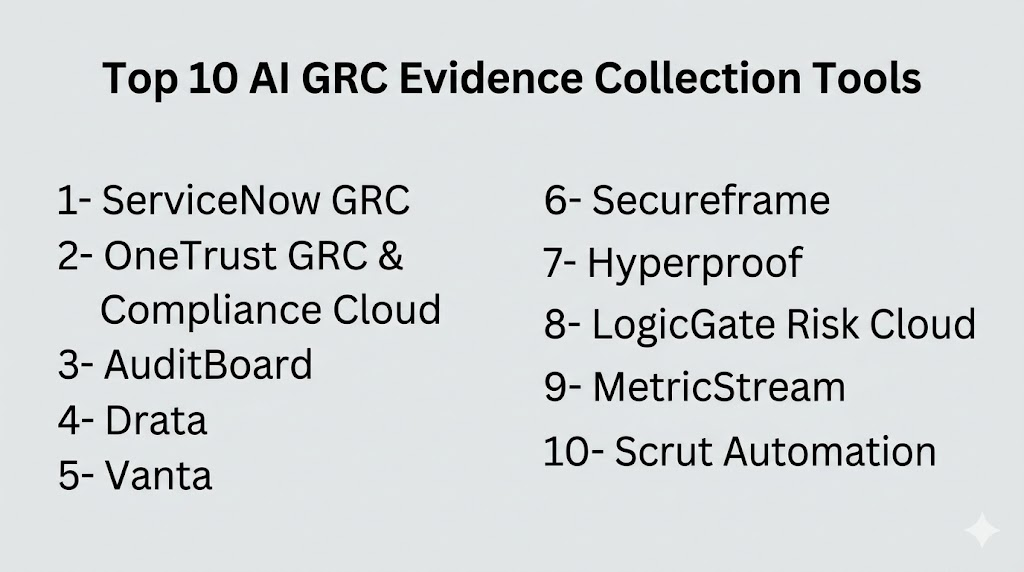
Top 10 AI GRC Evidence Collection Tools
1- ServiceNow GRC
One-line verdict: Best for large enterprises needing end-to-end governance and compliance automation at scale.
Short description:
ServiceNow GRC module provides governance, risk, and compliance workflows with AI-assisted automation for evidence collection and reporting. It is widely used by large enterprises with complex IT ecosystems.
Standout Capabilities
- Automated control mapping across enterprise systems
- Workflow-based compliance tracking
- Centralized risk and audit management
- AI-assisted reporting and insights
- Strong integration with ITSM and SecOps modules
- Continuous compliance monitoring
- Scalable enterprise architecture
AI-Specific Depth
- Model support: Proprietary AI workflows (N/A for external models)
- RAG / knowledge integration: Limited / Varies
- Evaluation: Workflow-based validation checks
- Guardrails: Role-based governance and approval flows
- Observability: Audit logs and workflow tracing
Pros
- Extremely scalable for large organizations
- Deep enterprise integration capabilities
- Strong governance and control framework
Cons
- Complex setup and configuration
- High operational overhead
- Less suitable for small teams
Security & Compliance
- Enterprise-grade RBAC and audit logging
- Encryption and access controls available
- Certifications: Not publicly stated
Deployment & Platforms
- Cloud-based enterprise SaaS
- Limited hybrid support depending on setup
Integrations & Ecosystem
Deep integration with enterprise IT systems:
- ITSM tools
- Cloud platforms
- Identity providers
- Security orchestration tools
Pricing Model
Enterprise subscription-based model (Not publicly stated)
Best-Fit Scenarios
- Large regulated enterprises
- Multi-department compliance programs
- Organizations with complex IT infrastructure
2- OneTrust GRC & Compliance Cloud
One-line verdict: Best for privacy-first organizations managing global compliance frameworks.
Short description:
OneTrust provides a unified GRC suite with strong automation for evidence collection and privacy compliance workflows.
Standout Capabilities
- Automated privacy and compliance mapping
- AI-assisted evidence collection workflows
- Vendor risk and third-party tracking
- Cross-framework compliance management
- Policy lifecycle management
- Data discovery and classification
- Centralized compliance dashboard
AI-Specific Depth
- Model support: Proprietary AI features
- RAG / knowledge integration: Enterprise connectors available
- Evaluation: Automated compliance checks
- Guardrails: Policy enforcement workflows
- Observability: Reporting dashboards and audit trails
Pros
- Strong privacy and compliance focus
- Good multi-framework support
- Strong enterprise adoption
Cons
- Can be complex for small teams
- Setup requires expertise
- UI can feel dense
Security & Compliance
- RBAC and enterprise access controls
- Audit logging supported
- Certifications: Not publicly stated
Deployment & Platforms
- Cloud-based SaaS platform
Integrations & Ecosystem
- Cloud providers
- SaaS applications
- Identity systems
- Data governance tools
Pricing Model
Tiered enterprise subscription (Not publicly stated)
Best-Fit Scenarios
- Privacy-heavy organizations
- Global enterprises
- Regulated industries (finance, healthcare)
3- AuditBoard
One-line verdict: Best for audit-centric organizations needing structured evidence workflows.
Short description:
AuditBoard focuses on audit automation and structured compliance workflows with strong evidence collection capabilities.
Standout Capabilities
- Automated audit workflow management
- Evidence tracking and documentation
- Risk and control mapping
- Compliance dashboards
- Collaboration tools for audit teams
- Continuous control monitoring
- Reporting automation
AI-Specific Depth
- Model support: Limited AI assistance
- RAG / knowledge integration: N/A
- Evaluation: Manual + workflow validation
- Guardrails: Role-based approval flows
- Observability: Audit logs and history tracking
Pros
- Strong audit lifecycle management
- Easy collaboration for audit teams
- Reliable compliance tracking
Cons
- Limited AI-native capabilities
- Less flexible for developer-heavy environments
- Enterprise-focused pricing
Security & Compliance
- RBAC and audit logging
- Encryption supported
- Certifications: Not publicly stated
Deployment & Platforms
- Cloud SaaS platform
Integrations & Ecosystem
- ERP systems
- Cloud infrastructure tools
- Identity management systems
Pricing Model
Enterprise subscription (Not publicly stated)
Best-Fit Scenarios
- Internal audit teams
- Compliance-heavy organizations
- Financial services firms
4- Drata
One-line verdict: Best for fast-growing SaaS companies automating SOC 2 readiness.
Short description:
Drata automates evidence collection and continuous compliance monitoring for modern SaaS companies.
Standout Capabilities
- Continuous compliance monitoring
- Automated evidence collection pipelines
- Control mapping across cloud tools
- Security posture tracking
- Audit readiness dashboards
- Workflow automation for compliance tasks
- Real-time alerts for compliance drift
AI-Specific Depth
- Model support: Limited AI-assisted workflows
- RAG / knowledge integration: SaaS connectors
- Evaluation: Automated compliance validation checks
- Guardrails: Policy enforcement rules
- Observability: Compliance dashboards
Pros
- Fast implementation
- Strong automation for SOC 2
- Great SaaS ecosystem coverage
Cons
- Less customizable for complex enterprises
- Limited deep governance features
- Focused mainly on compliance readiness
Security & Compliance
- SSO, RBAC support
- Audit logs available
- Certifications: Not publicly stated
Deployment & Platforms
- Cloud-based SaaS
Integrations & Ecosystem
- AWS, GCP, Azure
- SaaS tools (HR, DevOps, IAM)
- Ticketing systems
Pricing Model
Subscription-based SaaS
Best-Fit Scenarios
- SaaS startups
- Mid-stage tech companies
- SOC 2 preparation teams
5- Vanta
One-line verdict: Best for automated compliance for startups and mid-market SaaS companies.
Short description:
Vanta automates trust management, evidence collection, and audit readiness workflows.
Standout Capabilities
- Automated security monitoring
- Evidence collection pipelines
- Vendor risk tracking
- Compliance dashboards
- Policy management automation
- Continuous control checks
- Integrations with SaaS stack
AI-Specific Depth
- Model support: Limited AI-assisted automation
- RAG / knowledge integration: SaaS integrations
- Evaluation: Compliance rule engine
- Guardrails: Policy enforcement workflows
- Observability: Audit and monitoring dashboards
Pros
- Very easy to deploy
- Strong SaaS ecosystem coverage
- Good automation for compliance tasks
Cons
- Limited enterprise customization
- Less advanced governance features
- Pricing scales with usage
Security & Compliance
- RBAC and SSO
- Audit logging available
- Certifications: Not publicly stated
Deployment & Platforms
- Cloud SaaS
Integrations & Ecosystem
- Cloud providers
- SaaS tools
- Developer platforms
Pricing Model
Tiered SaaS subscription
Best-Fit Scenarios
- Startups scaling compliance
- SaaS companies
- Security-first engineering teams
6- Secureframe
One-line verdict: Best for automated compliance with guided audit readiness workflows.
Short description:
Secureframe simplifies compliance audits with automation and guided workflows.
Standout Capabilities
- Automated compliance workflows
- Evidence collection automation
- Security control mapping
- Audit readiness dashboards
- Vendor risk tracking
- Policy templates
- Continuous monitoring
AI-Specific Depth
- Model support: Not publicly stated
- RAG / knowledge integration: SaaS connectors
- Evaluation: Rule-based checks
- Guardrails: Workflow approvals
- Observability: Compliance tracking dashboards
Pros
- Easy onboarding
- Strong compliance automation
- Good for SMBs
Cons
- Limited enterprise depth
- Less flexible customization
- Smaller ecosystem than competitors
Security & Compliance
- RBAC and SSO
- Audit logs available
- Certifications: Not publicly stated
Deployment & Platforms
- Cloud SaaS
Integrations & Ecosystem
- Cloud infrastructure
- SaaS applications
- Identity systems
Pricing Model
Subscription-based
Best-Fit Scenarios
- SMB SaaS companies
- Compliance beginners
- Audit preparation teams
7- Hyperproof
One-line verdict: Best for centralized compliance operations with strong visibility across frameworks.
Short description:
Hyperproof provides centralized compliance tracking and evidence collection.
Standout Capabilities
- Centralized compliance tracking
- Automated evidence collection
- Control mapping across frameworks
- Risk tracking dashboards
- Audit collaboration tools
- Workflow automation
- Reporting and analytics
AI-Specific Depth
- Model support: Limited AI assistance
- RAG / knowledge integration: SaaS connectors
- Evaluation: Workflow validation
- Guardrails: Role-based approvals
- Observability: Reporting dashboards
Pros
- Strong multi-framework support
- Good collaboration tools
- Scalable compliance workflows
Cons
- UI complexity for beginners
- Limited AI-native capabilities
- Requires onboarding effort
Security & Compliance
- RBAC, SSO supported
- Audit logs available
- Certifications: Not publicly stated
Deployment & Platforms
- Cloud SaaS
Integrations & Ecosystem
- Cloud platforms
- SaaS tools
- Identity providers
Pricing Model
Subscription-based (Not publicly stated)
Best-Fit Scenarios
- Mid-market enterprises
- Multi-framework compliance teams
- Audit-heavy organizations
8- LogicGate Risk Cloud
One-line verdict: Best for customizable risk and compliance workflows.
Short description:
LogicGate enables flexible GRC workflows with strong automation capabilities.
Standout Capabilities
- Custom workflow builder
- Risk assessment automation
- Evidence tracking tools
- Compliance dashboards
- Audit workflow management
- Reporting automation
- Integration flexibility
AI-Specific Depth
- Model support: Not publicly stated
- RAG / knowledge integration: Limited
- Evaluation: Workflow-based checks
- Guardrails: Approval workflows
- Observability: Logging and dashboards
Pros
- Highly customizable workflows
- Strong risk management features
- Flexible deployment options
Cons
- Learning curve for setup
- Requires configuration effort
- Limited out-of-box AI features
Security & Compliance
- RBAC, SSO supported
- Audit logs included
- Certifications: Not publicly stated
Deployment & Platforms
- Cloud / Hybrid options (Varies)
Integrations & Ecosystem
- Enterprise systems
- Cloud tools
- Security platforms
Pricing Model
Enterprise subscription
Best-Fit Scenarios
- Custom GRC workflows
- Large organizations
- Risk-heavy industries
9- MetricStream
One-line verdict: Best for enterprise-grade governance, risk, and compliance transformation.
Short description:
MetricStream provides large-scale compliance and risk management solutions.
Standout Capabilities
- Enterprise GRC framework
- Risk intelligence dashboards
- Compliance automation
- Audit lifecycle management
- Policy governance tools
- Analytics and reporting
- Integrated risk monitoring
AI-Specific Depth
- Model support: Proprietary analytics (Not publicly stated)
- RAG / knowledge integration: Limited
- Evaluation: Risk scoring models
- Guardrails: Governance workflows
- Observability: Enterprise reporting systems
Pros
- Extremely powerful enterprise toolset
- Strong governance capabilities
- Suitable for global compliance
Cons
- Complex deployment
- High cost structure (Not publicly stated)
- Requires expert teams
Security & Compliance
- Enterprise RBAC
- Audit logging
- Certifications: Not publicly stated
Deployment & Platforms
- Cloud / On-prem hybrid options
Integrations & Ecosystem
- ERP systems
- Security tools
- Cloud infrastructure
Pricing Model
Enterprise licensing (Not publicly stated)
Best-Fit Scenarios
- Global enterprises
- Regulated financial institutions
- Large compliance teams
10- Scrut Automation
One-line verdict: Best for automated compliance workflows for modern cloud-native startups.
Short description:
Scrut Automation helps organizations automate security compliance and evidence collection.
Standout Capabilities
- Continuous compliance monitoring
- Automated evidence collection
- Control mapping dashboards
- Risk tracking tools
- SaaS integrations
- Audit readiness workflows
- Policy management automation
AI-Specific Depth
- Model support: Limited AI-assisted automation
- RAG / knowledge integration: SaaS connectors
- Evaluation: Compliance rule engine
- Guardrails: Policy enforcement workflows
- Observability: Monitoring dashboards
Pros
- Fast deployment
- Strong SaaS integrations
- Good for startups and SMBs
Cons
- Limited enterprise depth
- Smaller ecosystem
- Less customization than enterprise tools
Security & Compliance
- RBAC and SSO
- Audit logs available
- Certifications: Not publicly stated
Deployment & Platforms
- Cloud SaaS
Integrations & Ecosystem
- Cloud platforms
- DevOps tools
- SaaS applications
Pricing Model
Subscription-based SaaS
Best-Fit Scenarios
- Cloud-native startups
- SMB compliance teams
- Fast-growing SaaS companies
Comparison Table
| Tool Name | Best For | Deployment | Model Flexibility | Strength | Watch-Out | Public Rating |
|---|---|---|---|---|---|---|
| ServiceNow GRC | Enterprise governance | Cloud/Hybrid | Proprietary | Full enterprise suite | Complexity | N/A |
| OneTrust | Privacy compliance | Cloud | Proprietary | Privacy-first GRC | Setup complexity | N/A |
| AuditBoard | Audit teams | Cloud | Limited | Audit workflows | Limited AI | N/A |
| Drata | SaaS compliance | Cloud | SaaS AI-assisted | SOC 2 automation | SMB-focused | N/A |
| Vanta | Startups | Cloud | SaaS automation | Fast compliance | Limited depth | N/A |
| Secureframe | SMB compliance | Cloud | SaaS automation | Guided workflows | Less scalable | N/A |
| Hyperproof | Mid-market GRC | Cloud | SaaS workflows | Multi-framework tracking | UI complexity | N/A |
| LogicGate | Custom workflows | Cloud/Hybrid | Configurable | Workflow flexibility | Setup effort | N/A |
| MetricStream | Global enterprises | Hybrid | Enterprise analytics | Deep governance | Complexity | N/A |
| Scrut Automation | Startups | Cloud | SaaS automation | Fast deployment | Limited enterprise features | N/A |
Scoring & Evaluation (Transparent Rubric)
Scoring reflects comparative strength across AI-driven compliance and evidence automation capabilities.
| Tool | Core | Reliability/Eval | Guardrails | Integrations | Ease | Perf/Cost | Security/Admin | Support | Weighted Total |
|---|---|---|---|---|---|---|---|---|---|
| ServiceNow GRC | 9.5 | 9.0 | 9.0 | 9.5 | 6.0 | 8.5 | 9.5 | 9.0 | 8.9 |
| OneTrust | 9.0 | 8.5 | 9.0 | 9.0 | 7.0 | 8.0 | 9.0 | 8.5 | 8.6 |
| AuditBoard | 8.5 | 8.0 | 8.0 | 8.5 | 8.0 | 8.5 | 8.5 | 8.0 | 8.3 |
| Drata | 8.0 | 8.5 | 8.0 | 9.0 | 9.0 | 8.5 | 8.0 | 8.5 | 8.4 |
| Vanta | 8.0 | 8.0 | 8.0 | 9.0 | 9.0 | 8.5 | 8.0 | 8.0 | 8.3 |
| Secureframe | 7.5 | 7.5 | 7.5 | 8.5 | 9.0 | 8.5 | 8.0 | 8.0 | 8.0 |
| Hyperproof | 8.5 | 8.0 | 8.5 | 8.5 | 7.5 | 8.0 | 8.5 | 8.0 | 8.2 |
| LogicGate | 8.5 | 8.0 | 8.5 | 8.5 | 7.0 | 8.0 | 8.5 | 8.0 | 8.2 |
| MetricStream | 9.0 | 8.5 | 9.0 | 9.0 | 6.0 | 8.0 | 9.0 | 8.5 | 8.5 |
| Scrut Automation | 7.5 | 7.5 | 7.5 | 8.5 | 9.0 | 8.5 | 8.0 | 8.0 | 8.0 |
Top 3 for Enterprise
- ServiceNow GRC
- MetricStream
- OneTrust
Top 3 for SMB
- Vanta
- Drata
- Scrut Automation
Top 3 for Developers
- Drata
- LogicGate
- Hyperproof
Which AI GRC Evidence Collection Tools Tool Is Right for You?
Solo / Freelancer
Light compliance needs; tools like Vanta or Scrut are sufficient due to simplicity and automation.
SMB
Drata, Secureframe, and Scrut Automation offer balanced automation and affordability.
Mid-Market
Hyperproof and LogicGate provide better scalability and customization.
Enterprise
ServiceNow GRC, OneTrust, and MetricStream dominate with deep governance and AI-assisted compliance orchestration.
Regulated industries (finance/healthcare/public sector)
OneTrust and MetricStream are strong due to governance depth and audit rigor.
Budget vs premium
- Budget: Scrut, Vanta, Secureframe
- Premium: ServiceNow, MetricStream, OneTrust
Build vs buy (when to DIY)
- Build if you have strong DevOps + compliance engineering teams
- Buy if you need faster audit readiness and multi-framework compliance
Implementation Playbook (30 / 60 / 90 Days)
30 Days: Pilot Phase
- Connect key SaaS systems (cloud, IAM, CI/CD)
- Define compliance scope (SOC 2, ISO, etc.)
- Run initial evidence collection
- Set baseline compliance metrics
- Build initial evaluation harness for controls
60 Days: Harden & Expand
- Add RBAC and governance policies
- Introduce AI-based anomaly detection
- Implement audit workflows
- Expand integrations across systems
- Conduct internal red-teaming for compliance gaps
90 Days: Scale & Optimize
- Optimize cost of evidence collection workflows
- Implement continuous compliance dashboards
- Add multi-framework support
- Automate incident response linking to compliance
- Establish governance review cycles
Common Mistakes & How to Avoid Them
- Ignoring AI evaluation and relying only on automation
- No audit trail for evidence changes
- Poor data retention configuration
- Over-automation without human validation
- Underestimating integration complexity
- Not testing compliance workflows before audits
- Vendor lock-in without abstraction layer
- Lack of role-based access controls
- No observability into compliance pipelines
- Skipping red-team testing for workflows
- Treating compliance as one-time setup
- Not aligning tools with actual frameworks needed
- Overpaying for unused enterprise features
- Failing to track cost scaling with data growth
FAQs
1. What are AI GRC Evidence Collection Tools?
They are platforms that automate compliance evidence gathering using AI and integrations across enterprise systems.
They reduce manual audit preparation and improve accuracy in governance reporting.
2. How do these tools collect evidence automatically?
They integrate with cloud, SaaS, and identity systems to continuously pull logs, configurations, and policy data.
AI helps map this data to compliance controls.
3. Do these tools replace auditors?
No. They support auditors by preparing structured evidence and reports.
Human auditors are still required for final validation.
4. Are these tools safe for sensitive data?
Yes, most use encryption and role-based access, but security depends on vendor setup.
Always evaluate retention policies and access controls.
5. Can I use my own AI model?
Some platforms support BYO models or integrations, but many use proprietary AI systems.
This varies significantly by vendor.
6. Do they support multiple compliance frameworks?
Yes, most modern tools support SOC 2, ISO 27001, GDPR, and others.
Coverage depth varies by platform.
7. What is continuous compliance?
It is the real-time monitoring of systems to ensure ongoing compliance instead of periodic audits.
AI tools enable this by streaming evidence continuously.
8. Are these tools suitable for startups?
Yes, especially tools like Vanta, Drata, and Scrut Automation.
They simplify SOC 2 and ISO readiness.
9. How expensive are they?
Pricing varies widely based on scale and features.
Enterprise tools are significantly more expensive than SMB solutions.
10. Can these tools integrate with DevOps pipelines?
Yes, many integrate with CI/CD tools and cloud environments.
This helps capture infrastructure changes automatically.
11. What is the biggest risk using these tools?
Vendor lock-in and misconfigured compliance workflows are major risks.
Proper architecture planning reduces these issues.
12. Do they support AI governance?
Some platforms are starting to include AI governance modules.
However, maturity varies widely across vendors.
Conclusion
AI GRC Evidence Collection Tools have become essential for modern organizations operating in complex, cloud-native, and regulated environments. They reduce audit burden, improve compliance accuracy, and enable continuous governance through automation and AI-assisted workflows. However, the “best” platform depends heavily on organizational size, regulatory requirements, and technical maturity.

Find Trusted Cardiac Hospitals
Compare heart hospitals by city and services — all in one place.
Explore Hospitals
The comparison effectively outlines the strengths and limitations of AI-based evidence collection platforms, but a valuable addition would be a discussion on sustaining these systems in dynamic environments. As organizations continuously modify cloud resources, permissions, and compliance requirements, automated evidence pipelines can become outdated or miss critical artifacts if they are not regularly reviewed. Exploring topics such as evidence integrity checks, exception handling, integration with workflow management tools, and periodic assessments of collection accuracy would provide readers with a more practical understanding of operating these solutions at scale while maintaining audit readiness.