
Introduction
AI Driver Monitoring Systems are intelligent safety technologies that use artificial intelligence, computer vision, sensors, and real-time analytics to understand driver behavior and improve road safety. These systems monitor factors such as driver attention, fatigue, distraction, gaze direction, and unsafe behaviors to provide alerts or support automated safety responses.
The importance of AI Driver Monitoring Systems is increasing as vehicles become more connected, autonomous features expand, and organizations focus more on reducing accidents caused by human error. Modern solutions combine cameras, edge AI processing, machine learning models, and vehicle data analysis to deliver faster and more accurate safety insights.
Businesses across transportation, logistics, automotive manufacturing, fleet management, and mobility services use these systems to improve driver safety, reduce operational risks, and support compliance requirements.
Real-world use cases:
- Fleet operators use AI monitoring systems to identify distracted driving patterns and improve driver training programs.
- Logistics companies use driver attention monitoring to reduce accident risks during long-distance transportation.
- Automotive manufacturers integrate driver monitoring technology into advanced driver assistance systems.
- Ride-sharing and commercial mobility providers use AI-based monitoring to improve passenger safety.
- Insurance companies analyze driving behavior data to support risk assessment models.
- Transportation organizations use AI insights to improve fleet performance and safety policies.
Evaluation Criteria for Buyers
When selecting an AI Driver Monitoring System, organizations should evaluate:
- Accuracy of driver detection and behavior recognition.
- Real-time processing capability and response speed.
- Privacy controls and handling of driver data.
- Edge computing versus cloud processing options.
- Compatibility with existing vehicle systems.
- AI model performance across different environments.
- Security controls and access management.
- Integration capabilities through APIs and SDKs.
- Scalability across vehicles and fleets.
- Reporting, analytics, and operational insights.
- Vendor support and long-term technology roadmap.
Best for:
Automotive companies, fleet operators, logistics organizations, transportation businesses, mobility providers, and enterprises managing large vehicle operations that require improved driver safety and operational visibility.
Not ideal for:
Small businesses with limited vehicle operations, organizations without the need for continuous driver analytics, or teams that can achieve safety goals through traditional training and manual monitoring methods.
What’s Changed in AI Driver Monitoring Systems in 2026+
AI Driver Monitoring Systems are evolving beyond simple camera-based alerts. Modern platforms are becoming more intelligent, connected, and focused on privacy, reliability, and enterprise governance.
- Multimodal AI understanding: Systems increasingly combine camera feeds, vehicle sensors, location signals, and contextual data to understand driving situations more accurately.
- Edge AI processing: More solutions are moving intelligence closer to vehicles to reduce latency, improve reliability, and minimize unnecessary cloud data transmission.
- Advanced driver behavior analysis: AI models are moving beyond detecting distraction and fatigue toward understanding complex driving patterns and risk indicators.
- Privacy-focused architecture: Organizations are demanding stronger controls around video storage, retention policies, encryption, and local processing.
- AI model evaluation: Companies are adopting structured testing methods to measure accuracy, false alerts, missed detections, and performance across different driving environments.
- Real-time decision support: AI systems are becoming capable of providing immediate recommendations instead of only generating historical reports.
- Integration with autonomous driving systems: Driver monitoring is becoming an important component of advanced vehicle assistance and semi-autonomous driving technologies.
- Improved environmental understanding: Modern AI models are designed to handle different lighting conditions, camera angles, weather situations, and driver variations.
- Security-by-design approach: Vendors are focusing more on protecting vehicle data, preventing unauthorized access, and maintaining system integrity.
- Fleet intelligence platforms: Driver monitoring is increasingly combined with fleet analytics, maintenance insights, and operational optimization tools.
Quick Buyer Checklist
Use this checklist before selecting an AI Driver Monitoring System:
- ✅ Confirm whether processing happens locally, in the cloud, or through a hybrid model.
- ✅ Review driver data privacy policies and retention controls.
- ✅ Check whether the platform supports multiple AI models or vendor-specific models.
- ✅ Evaluate detection accuracy in real-world driving conditions.
- ✅ Verify testing methods for reliability and false alert reduction.
- ✅ Review security features including encryption and access controls.
- ✅ Check API and SDK availability for custom integrations.
- ✅ Evaluate dashboard quality and reporting capabilities.
- ✅ Understand scalability across vehicle fleets.
- ✅ Compare deployment complexity and maintenance requirements.
- ✅ Review vendor lock-in risks before long-term adoption.
- ✅ Confirm compliance requirements for your industry and region.
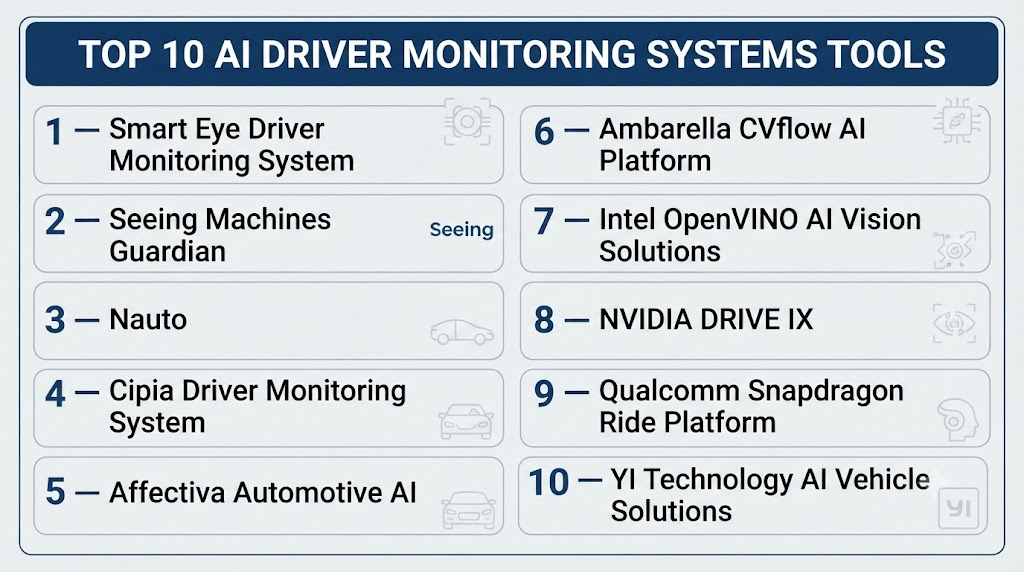
Top 10 AI Driver Monitoring Systems Tools
#1 — Smart Eye Driver Monitoring System
One-line verdict: Best for automotive manufacturers seeking advanced AI-based driver attention and safety monitoring.
Short description:
Smart Eye provides AI-powered driver monitoring technology designed for automotive safety applications. It focuses on understanding driver attention, awareness, and behavior using computer vision and machine learning.
Standout Capabilities
- Real-time driver attention monitoring.
- Eye gaze and head position tracking.
- Fatigue and distraction detection.
- Computer vision-based safety analysis.
- Automotive-grade AI development.
- Integration support for vehicle manufacturers.
- Driver state monitoring capabilities.
AI-Specific Depth
- Model support: Proprietary AI models; multi-model flexibility varies.
- RAG / knowledge integration: N/A.
- Evaluation: Automotive testing and validation processes; detailed evaluation methods are not publicly stated.
- Guardrails: Safety-focused design practices; specific AI guardrail details are not publicly stated.
- Observability: Vehicle analytics capabilities vary by implementation.
Pros
- Strong focus on automotive safety applications.
- Designed for real-time driving environments.
- Supports advanced driver monitoring scenarios.
Cons
- Primarily targeted toward automotive organizations rather than small teams.
- Deployment may require vehicle-level integration.
- Pricing information is not publicly stated.
Security & Compliance
Security architecture details vary depending on implementation. Specific certifications and compliance information are not publicly stated.
Deployment & Platforms
- Embedded automotive systems.
- Vehicle hardware integrations.
- Cloud connectivity varies by deployment.
Integrations & Ecosystem
Common integration areas include:
- Vehicle electronic systems.
- Automotive software platforms.
- Embedded computing environments.
- Fleet technology solutions.
- Safety analytics platforms.
Pricing Model
Not publicly stated. Enterprise automotive technology solutions commonly use customized licensing models.
Best-Fit Scenarios
- Automotive manufacturers developing safety features.
- Vehicle technology providers.
- Advanced driver assistance projects.
#2 — Seeing Machines Guardian
One-line verdict: Best for commercial fleets needing continuous driver fatigue and distraction monitoring.
Short description:
Seeing Machines Guardian is an AI-powered driver monitoring solution focused on improving fleet safety through real-time driver behavior analysis. It is commonly used in commercial transportation environments.
Standout Capabilities
- Driver fatigue monitoring.
- Distraction detection.
- Real-time safety alerts.
- Fleet safety analytics.
- Camera-based driver observation.
- Risk behavior identification.
- Fleet management support.
AI-Specific Depth
- Model support: Proprietary AI models.
- RAG / knowledge integration: N/A.
- Evaluation: Safety performance evaluation methods are not publicly stated in detail.
- Guardrails: Safety-focused monitoring controls; detailed AI guardrail implementation is not publicly stated.
- Observability: Fleet reporting and analytics capabilities available.
Pros
- Designed specifically for commercial fleet safety.
- Helps organizations identify risky driving behavior.
- Supports large-scale vehicle deployments.
Cons
- More suitable for enterprise fleets than individual drivers.
- Hardware installation may increase deployment complexity.
- Pricing varies based on deployment requirements.
Security & Compliance
Specific security certifications and detailed compliance information are not publicly stated.
Deployment & Platforms
- Vehicle-installed hardware.
- Fleet management platforms.
- Cloud-connected deployments.
Integrations & Ecosystem
Integrates with:
- Fleet management systems.
- Transportation platforms.
- Vehicle data systems.
- Safety reporting workflows.
Pricing Model
Varies based on fleet size, hardware requirements, and deployment model.
Best-Fit Scenarios
- Logistics companies.
- Mining and industrial fleets.
- Commercial transportation operators.
#3 — Nauto
One-line verdict: Best for organizations combining driver safety analytics with predictive risk insights.
Short description:
Nauto provides AI-based vehicle safety technology designed to analyze driving behavior and help organizations reduce collisions. It combines computer vision and predictive analytics.
Standout Capabilities
- Driver distraction monitoring.
- Collision risk prediction.
- AI-powered safety coaching.
- Fleet behavior analytics.
- Video-based safety insights.
- Real-time alerts.
- Risk identification.
AI-Specific Depth
- Model support: Proprietary AI models.
- RAG / knowledge integration: N/A.
- Evaluation: Performance evaluation details are not publicly stated.
- Guardrails: Safety-oriented monitoring controls.
- Observability: Fleet analytics and reporting features.
Pros
- Focuses on proactive safety improvement.
- Provides actionable driving insights.
- Supports enterprise fleet operations.
Cons
- Enterprise-focused deployment approach.
- Specific pricing is not publicly stated.
- Integration requirements may vary.
Security & Compliance
Security and certification details are not publicly stated.
Deployment & Platforms
- Vehicle hardware solutions.
- Cloud-based analytics platform.
Integrations & Ecosystem
Supports integration with:
- Fleet management systems.
- Safety programs.
- Vehicle data platforms.
- Enterprise workflows.
Pricing Model
Not publicly stated.
Best-Fit Scenarios
- Corporate fleets.
- Transportation companies.
- Organizations focused on accident reduction.
#4 — Cipia Driver Monitoring System
One-line verdict: Best for automotive companies needing AI-powered cabin monitoring and driver safety intelligence.
Short description:
Cipia develops AI-based in-cabin monitoring technology focused on understanding driver behavior, passenger activity, and vehicle safety conditions. Its solutions use computer vision and machine learning to support advanced vehicle safety features.
Standout Capabilities
- Driver attention monitoring.
- Distraction and fatigue detection.
- In-cabin computer vision analysis.
- Passenger monitoring capabilities.
- Real-time safety insights.
- Automotive integration support.
- Edge AI processing capabilities.
AI-Specific Depth
- Model support: Proprietary AI models; deployment flexibility varies.
- RAG / knowledge integration: N/A.
- Evaluation: Automotive testing processes are used; detailed AI evaluation frameworks are not publicly stated.
- Guardrails: Safety-oriented AI development practices; specific guardrail systems are not publicly stated.
- Observability: Vehicle analytics and monitoring capabilities vary by implementation.
Pros
- Strong focus on in-cabin AI applications.
- Supports multiple automotive safety scenarios.
- Designed for embedded vehicle environments.
Cons
- Primarily targeted toward automotive manufacturers.
- Integration requires vehicle-level development.
- Pricing details are not publicly stated.
Security & Compliance
Specific certifications, security standards, and compliance details are not publicly stated.
Deployment & Platforms
- Embedded vehicle systems.
- Automotive hardware environments.
- Cloud connectivity varies.
Integrations & Ecosystem
Common integration areas include:
- Vehicle operating systems.
- Automotive software platforms.
- Embedded AI processors.
- Mobility technology solutions.
Pricing Model
Not publicly stated. Enterprise automotive deployments typically use customized commercial agreements.
Best-Fit Scenarios
- Automotive OEM development programs.
- Connected vehicle projects.
- Advanced driver safety applications.
#5 — Affectiva Automotive AI
One-line verdict: Best for organizations exploring emotion-aware and human-centered vehicle intelligence.
Short description:
Affectiva Automotive AI focuses on analyzing human behavior inside vehicles using computer vision and artificial intelligence. The technology is designed to understand driver and passenger states.
Standout Capabilities
- Facial analysis technology.
- Driver state monitoring.
- Emotion recognition capabilities.
- Human behavior understanding.
- In-cabin sensing.
- Automotive AI research.
- Real-time cabin insights.
AI-Specific Depth
- Model support: Proprietary AI models.
- RAG / knowledge integration: N/A.
- Evaluation: Testing approaches vary; detailed evaluation methods are not publicly stated.
- Guardrails: Responsible AI considerations are important for facial analysis applications; specific guardrail systems are not publicly stated.
- Observability: Analytics capabilities vary by deployment.
Pros
- Strong expertise in human behavior AI.
- Useful for next-generation vehicle experiences.
- Supports multimodal cabin intelligence concepts.
Cons
- Emotion-based AI applications require careful validation.
- Deployment depends on automotive integration needs.
- Pricing information is not publicly stated.
Security & Compliance
Privacy and biometric data handling requirements vary by region. Specific certifications are not publicly stated.
Deployment & Platforms
- Automotive embedded environments.
- Cloud-connected implementations.
- Platform availability varies.
Integrations & Ecosystem
Potential integrations include:
- Automotive platforms.
- Cabin monitoring systems.
- AI research environments.
- Mobility solutions.
Pricing Model
Not publicly stated.
Best-Fit Scenarios
- Automotive innovation teams.
- Research organizations.
- Smart vehicle experience development.
#6 — Ambarella CVflow AI Platform
One-line verdict: Best for edge AI developers building efficient vision-based vehicle safety systems.
Short description:
Ambarella provides AI processing platforms designed for computer vision applications. Its technology is used by organizations building intelligent cameras, automotive systems, and edge AI solutions.
Standout Capabilities
- Low-power AI processing.
- Computer vision acceleration.
- Edge inference capabilities.
- Automotive AI support.
- Real-time video processing.
- Embedded AI development.
- Hardware acceleration.
AI-Specific Depth
- Model support: Supports AI model deployment depending on hardware environment.
- RAG / knowledge integration: N/A.
- Evaluation: Developer testing workflows vary by implementation.
- Guardrails: Application-specific; not publicly stated.
- Observability: Depends on deployed software stack.
Pros
- Strong edge AI performance.
- Suitable for real-time vision applications.
- Helps reduce cloud processing requirements.
Cons
- Requires technical expertise.
- Hardware-focused rather than complete monitoring solution.
- Deployment complexity varies.
Security & Compliance
Specific certifications and security details are not publicly stated.
Deployment & Platforms
- Embedded hardware.
- Edge AI devices.
- Automotive computing environments.
Integrations & Ecosystem
Supports:
- AI frameworks.
- Embedded software platforms.
- Camera systems.
- Automotive hardware solutions.
Pricing Model
Not publicly stated.
Best-Fit Scenarios
- AI hardware developers.
- Automotive technology companies.
- Edge computer vision projects.
#7 — Intel OpenVINO AI Vision Solutions
One-line verdict: Best for developers optimizing computer vision workloads across edge devices.
Short description:
Intel OpenVINO provides tools for optimizing and deploying AI models on Intel hardware. It can support driver monitoring applications requiring efficient computer vision processing.
Standout Capabilities
- AI model optimization.
- Edge inference acceleration.
- Computer vision deployment.
- Hardware optimization.
- Developer tooling.
- Multiple hardware support.
- AI performance tuning.
AI-Specific Depth
- Model support: Supports multiple AI frameworks and model conversion workflows.
- RAG / knowledge integration: N/A.
- Evaluation: Developers can create custom testing pipelines.
- Guardrails: Application-specific.
- Observability: Depends on deployment architecture.
Pros
- Flexible developer ecosystem.
- Supports edge AI optimization.
- Useful for custom driver monitoring solutions.
Cons
- Not a complete driver monitoring product.
- Requires engineering resources.
- Implementation quality depends on development teams.
Security & Compliance
Security features depend on deployment architecture. Certifications are not publicly stated.
Deployment & Platforms
- Windows.
- Linux.
- Edge devices.
- Industrial and automotive environments.
Integrations & Ecosystem
Supports:
- AI frameworks.
- Computer vision libraries.
- Edge hardware.
- Developer applications.
Pricing Model
Open-source components with enterprise options depending on usage.
Best-Fit Scenarios
- Developers creating custom AI monitoring systems.
- Research teams.
- Organizations requiring deployment flexibility.
#8 — NVIDIA DRIVE IX
One-line verdict: Best for automotive developers building advanced AI-powered vehicle experiences.
Short description:
NVIDIA DRIVE IX is part of NVIDIA’s automotive AI ecosystem focused on intelligent vehicle applications. It supports technologies related to driver monitoring, cabin awareness, and AI-powered vehicle computing.
Standout Capabilities
- Automotive AI computing.
- Driver monitoring support.
- Computer vision processing.
- Real-time AI inference.
- Vehicle intelligence workflows.
- Hardware acceleration.
- Developer ecosystem.
AI-Specific Depth
- Model support: Supports AI model development within NVIDIA ecosystems.
- RAG / knowledge integration: N/A.
- Evaluation: Depends on application testing.
- Guardrails: Application-specific safety controls.
- Observability: Depends on software implementation.
Pros
- Strong automotive AI ecosystem.
- High-performance AI computing capabilities.
- Supports advanced vehicle applications.
Cons
- Requires specialized automotive development knowledge.
- Hardware ecosystem dependency.
- Not designed for small fleet operators.
Security & Compliance
Specific certifications vary by implementation and are not publicly stated.
Deployment & Platforms
- Automotive computing platforms.
- Embedded AI systems.
- Vehicle environments.
Integrations & Ecosystem
Integrates with:
- Automotive software stacks.
- AI development tools.
- Vehicle computing platforms.
- Sensor systems.
Pricing Model
Not publicly stated.
Best-Fit Scenarios
- Automotive manufacturers.
- Autonomous vehicle developers.
- Advanced mobility projects.
#9 — Qualcomm Snapdragon Ride Platform
One-line verdict: Best for automotive companies developing efficient AI-powered vehicle computing systems.
Short description:
Qualcomm Snapdragon Ride provides automotive computing technologies designed for advanced driver assistance and intelligent vehicle applications. It supports AI processing for next-generation mobility solutions.
Standout Capabilities
- Automotive AI processing.
- Advanced driver assistance support.
- Efficient edge computing.
- Sensor processing.
- Vehicle AI workloads.
- Embedded intelligence.
- Hardware acceleration.
AI-Specific Depth
- Model support: AI model support depends on platform implementation.
- RAG / knowledge integration: N/A.
- Evaluation: Application-specific testing.
- Guardrails: Safety implementation depends on system design.
- Observability: Depends on software architecture.
Pros
- Designed for automotive workloads.
- Efficient AI processing capabilities.
- Supports large-scale vehicle development.
Cons
- Requires automotive engineering expertise.
- Hardware platform dependency.
- Not a ready-to-use fleet monitoring product.
Security & Compliance
Security details vary by implementation.
Deployment & Platforms
- Automotive embedded systems.
- Vehicle computing platforms.
Integrations & Ecosystem
Supports:
- Automotive software.
- Sensor technologies.
- AI development environments.
- Vehicle platforms.
Pricing Model
Not publicly stated.
Best-Fit Scenarios
- Automotive OEMs.
- Mobility technology companies.
- Vehicle AI developers.
#10 — YI Technology AI Vehicle Solutions
One-line verdict: Best for organizations exploring AI camera-based vehicle monitoring solutions.
Short description:
YI Technology provides AI-enabled camera and monitoring technologies. Its solutions focus on intelligent video analysis and connected monitoring use cases.
Standout Capabilities
- AI video monitoring.
- Camera-based analysis.
- Vehicle observation.
- Remote monitoring.
- Intelligent alerts.
- Video intelligence workflows.
- Connected device support.
AI-Specific Depth
- Model support: Proprietary AI capabilities; details vary.
- RAG / knowledge integration: N/A.
- Evaluation: Not publicly stated.
- Guardrails: Not publicly stated.
- Observability: Depends on deployment.
Pros
- Camera-based AI monitoring approach.
- Useful for basic intelligent monitoring needs.
- Supports connected video workflows.
Cons
- Advanced driver monitoring capabilities may vary.
- Enterprise automotive integrations may require customization.
- Detailed AI governance information is limited.
Security & Compliance
Specific certifications and compliance details are not publicly stated.
Deployment & Platforms
- Camera devices.
- Connected monitoring systems.
- Cloud-connected deployments.
Integrations & Ecosystem
Integrations may include:
- Video platforms.
- Monitoring systems.
- Connected device ecosystems.
- Custom applications.
Pricing Model
Not publicly stated.
Best-Fit Scenarios
- Small-to-medium monitoring deployments.
- Connected camera projects.
- Basic AI video analytics use cases.
Comparison Table: Top 10 AI Driver Monitoring Systems
| Tool Name | Best For | Deployment | Model Flexibility | Strength | Watch-Out | Public Rating |
|---|---|---|---|---|---|---|
| Smart Eye Driver Monitoring System | Automotive manufacturers | Embedded / Enterprise | Hosted proprietary models | Advanced driver attention monitoring | Requires automotive integration | N/A |
| Seeing Machines Guardian | Commercial fleets | Hardware + Cloud | Proprietary models | Fleet fatigue and distraction monitoring | Enterprise-focused deployment | N/A |
| Nauto | Fleet safety organizations | Cloud-connected vehicle systems | Proprietary models | Predictive safety analytics | Pricing not publicly stated | N/A |
| Cipia Driver Monitoring System | Vehicle manufacturers | Embedded automotive systems | Proprietary models | In-cabin AI monitoring | Requires vehicle development support | N/A |
| Affectiva Automotive AI | Human-centered vehicle intelligence | Automotive environments | Proprietary models | Human behavior analysis | Requires careful privacy considerations | N/A |
| Ambarella CVflow AI Platform | Edge AI developers | Embedded hardware | Flexible AI deployment | Efficient AI vision processing | Requires technical expertise | N/A |
| Intel OpenVINO AI Vision Solutions | Developers building custom systems | Edge / Cloud hybrid | Multi-framework support | AI model optimization | Not a complete monitoring product | N/A |
| NVIDIA DRIVE IX | Automotive AI developers | Embedded vehicle platforms | AI ecosystem-based | High-performance automotive computing | Specialized development required | N/A |
| Qualcomm Snapdragon Ride Platform | Automotive technology companies | Vehicle computing platforms | Platform-based AI support | Automotive AI processing | Hardware ecosystem dependency | N/A |
| YI Technology AI Vehicle Solutions | Connected monitoring projects | Camera + Cloud | Proprietary AI capabilities | Intelligent video monitoring | Advanced features vary | N/A |
Scoring & Evaluation: Transparent Rubric
The following scoring approach compares AI Driver Monitoring Systems based on practical enterprise requirements. Scores are comparative indicators rather than absolute rankings because different organizations have different safety goals, deployment environments, and technical requirements.
The evaluation considers AI capability, reliability, security, integrations, operational usability, and scalability. A system designed for automotive manufacturers may score differently from one designed for fleet operators or AI developers.
| Tool | Core Features | Reliability/Eval | Guardrails | Integrations | Ease | Performance/Cost | Security/Admin | Support | Weighted Total |
|---|---|---|---|---|---|---|---|---|---|
| Smart Eye Driver Monitoring System | 9 | 9 | 8 | 8 | 7 | 8 | 8 | 8 | 8.35 |
| Seeing Machines Guardian | 9 | 8 | 8 | 8 | 8 | 8 | 8 | 8 | 8.20 |
| Nauto | 8 | 8 | 8 | 8 | 8 | 8 | 8 | 8 | 8.00 |
| Cipia Driver Monitoring System | 8 | 8 | 8 | 8 | 7 | 8 | 8 | 8 | 7.95 |
| Affectiva Automotive AI | 8 | 8 | 7 | 7 | 7 | 8 | 7 | 8 | 7.55 |
| Ambarella CVflow AI Platform | 8 | 8 | 7 | 9 | 6 | 9 | 8 | 8 | 8.00 |
| Intel OpenVINO AI Vision Solutions | 8 | 8 | 7 | 9 | 7 | 9 | 8 | 9 | 8.35 |
| NVIDIA DRIVE IX | 9 | 9 | 8 | 9 | 6 | 9 | 8 | 9 | 8.55 |
| Qualcomm Snapdragon Ride Platform | 9 | 8 | 8 | 9 | 6 | 9 | 8 | 8 | 8.35 |
| YI Technology AI Vehicle Solutions | 7 | 7 | 6 | 7 | 8 | 7 | 7 | 7 | 7.05 |
Top 3 for Enterprise
- NVIDIA DRIVE IX
- Strong choice for automotive companies building advanced AI vehicle platforms.
- Smart Eye Driver Monitoring System
- Suitable for organizations requiring mature driver monitoring capabilities.
- Seeing Machines Guardian
- Strong option for large commercial fleets focused on safety improvement.
Top 3 for SMB
- Seeing Machines Guardian
- Suitable for businesses needing practical fleet safety monitoring.
- Nauto
- Useful for organizations wanting predictive driving insights.
- YI Technology AI Vehicle Solutions
- Better suited for simpler monitoring requirements.
Top 3 for Developers
- NVIDIA DRIVE IX
- Provides a strong automotive AI development ecosystem.
- Intel OpenVINO AI Vision Solutions
- Useful for building customized AI vision applications.
- Ambarella CVflow AI Platform
- Good option for efficient edge AI development.
Which AI Driver Monitoring System Is Right for You?
Choosing the right AI Driver Monitoring System depends on your organization size, technical capability, safety goals, and deployment requirements. There is no universal winner because different tools solve different problems.
Solo / Freelancer
Individual developers, researchers, or small AI teams usually need flexible platforms rather than complete automotive solutions.
Recommended options:
- Intel OpenVINO AI Vision Solutions for experimentation and custom AI development.
- Ambarella CVflow AI Platform for edge AI projects.
- Developer-focused computer vision frameworks for prototype building.
Focus areas:
- SDK availability.
- Hardware compatibility.
- Documentation quality.
- Development flexibility.
SMB
Small and medium businesses usually need practical safety improvements without complex automotive development.
Recommended options:
- Seeing Machines Guardian for fleet safety monitoring.
- Nauto for driving risk insights.
- Camera-based AI monitoring solutions for smaller deployments.
Focus areas:
- Easy deployment.
- Fleet management integration.
- Operational reporting.
- Cost control.
Mid-Market
Mid-sized transportation and logistics companies need scalability and stronger analytics.
Recommended options:
- Seeing Machines Guardian.
- Nauto.
- Smart Eye solutions depending on vehicle requirements.
Focus areas:
- Fleet-wide deployment.
- Driver training insights.
- Safety analytics.
- Centralized management.
Enterprise
Large automotive companies and global transportation organizations require highly scalable AI systems.
Recommended options:
- NVIDIA DRIVE IX.
- Smart Eye Driver Monitoring System.
- Qualcomm Snapdragon Ride Platform.
Focus areas:
- Automotive integration.
- Security architecture.
- AI performance.
- Long-term technology roadmap.
Regulated Industries
Organizations operating in transportation, public services, and highly controlled environments should prioritize:
- Strong privacy controls.
- Data retention management.
- Audit capabilities.
- Secure deployment models.
- Transparent AI decision processes.
Recommended approach:
- Evaluate vendors based on security architecture rather than only detection accuracy.
- Require clear data handling policies.
- Test systems in real operational conditions.
Budget vs Premium
Budget-focused approach
Prioritize:
- Basic driver monitoring features.
- Cloud dashboards.
- Simple deployment.
- Lower infrastructure requirements.
Suitable options:
- Camera-based AI monitoring solutions.
- Fleet-focused platforms.
Premium approach
Prioritize:
- Advanced AI models.
- Embedded processing.
- Automotive-grade reliability.
- Deep integration capabilities.
Suitable options:
- NVIDIA DRIVE IX.
- Smart Eye.
- Qualcomm Snapdragon Ride.
Build vs Buy: When to DIY
Build internally when:
- You have strong AI engineering resources.
- You need complete control over models.
- Your use case is highly customized.
- You require specific hardware integration.
Buy a platform when:
- You need faster deployment.
- Safety requirements are high.
- You lack specialized computer vision expertise.
- You need vendor support.
A hybrid approach is often practical: use existing AI platforms while customizing specific analytics and workflows.
Implementation Playbook: 30 / 60 / 90 Days
First 30 Days: Pilot and Define Success Metrics
Primary goals:
- Select vehicles or environments for testing.
- Define safety objectives.
- Establish measurement criteria.
- Validate AI detection accuracy.
Key activities:
- Run controlled pilot deployments.
- Measure distraction detection accuracy.
- Review false alerts.
- Evaluate privacy requirements.
- Define human review processes.
AI-specific tasks:
- Create evaluation datasets.
- Establish baseline performance metrics.
- Test different driving conditions.
- Document model limitations.
First 60 Days: Security Hardening and Operational Rollout
Primary goals:
- Improve reliability.
- Secure deployment.
- Expand usage.
Key activities:
- Configure access controls.
- Review data retention policies.
- Connect fleet management systems.
- Train operational teams.
AI-specific tasks:
- Create evaluation workflows.
- Perform edge-case testing.
- Review AI decision accuracy.
- Establish incident handling procedures.
- Maintain model and configuration versions.
First 90 Days: Optimization and Governance
Primary goals:
- Scale deployment.
- Reduce operational costs.
- Improve AI governance.
Key activities:
- Expand across additional vehicles.
- Optimize processing costs.
- Improve reporting workflows.
- Establish governance processes.
AI-specific tasks:
- Monitor model performance.
- Review AI drift.
- Improve evaluation datasets.
- Conduct security testing.
- Establish ongoing improvement cycles.
Common Mistakes & How to Avoid Them
- Choosing a system only based on detection accuracy without considering deployment needs.
- Ignoring driver privacy requirements.
- Collecting excessive video data without retention policies.
- Deploying AI without proper testing.
- Not measuring false alerts and missed detections.
- Avoiding human review for important safety decisions.
- Selecting platforms without integration planning.
- Underestimating hardware requirements.
- Ignoring cybersecurity risks.
- Not preparing employees for AI-assisted monitoring.
- Creating vendor dependency without exit planning.
- Failing to evaluate performance across different environments.
- Treating AI monitoring as a replacement for safety training.
- Scaling before completing successful pilot testing.
FAQs
What is an AI Driver Monitoring System?
An AI Driver Monitoring System uses artificial intelligence and sensors to analyze driver behavior, attention, fatigue, and safety risks in real time.
How does AI detect driver distraction?
AI systems analyze visual information such as eye direction, head position, and driving behavior patterns to identify possible distraction.
Are AI Driver Monitoring Systems accurate?
Accuracy depends on camera quality, AI models, environmental conditions, and system implementation. Organizations should evaluate performance through real-world testing.
Do these systems record drivers continuously?
Data handling depends on the vendor and deployment model. Organizations should review storage, retention, and privacy settings before implementation.
Can AI Driver Monitoring Systems work offline?
Some solutions support edge processing where AI analysis happens locally inside vehicles. Availability depends on the platform.
Can organizations use their own AI models?
Some developer-focused platforms support custom AI models, while complete commercial solutions may use proprietary models.
Are these systems suitable for small businesses?
Yes, especially fleet-focused solutions designed for easier deployment. However, advanced automotive platforms may be better suited for larger organizations.
How much do AI Driver Monitoring Systems cost?
Pricing varies based on hardware, software licensing, fleet size, and deployment requirements. Exact pricing is usually not publicly stated.
Do AI Driver Monitoring Systems replace human safety managers?
No. They support safety teams by providing additional insights and alerts but should work alongside human decision-making.
What security features should buyers check?
Important areas include encryption, access control, audit capability, data retention management, and secure device communication.
Can these systems integrate with fleet management software?
Many solutions support integrations with fleet platforms, APIs, and vehicle data systems. Availability depends on the vendor.
How can companies evaluate AI performance?
Organizations should test detection accuracy, false alerts, environmental performance, and operational impact before full deployment.
Is self-hosting possible?
Self-hosting depends on the technology provider. Hardware-based and developer platforms may provide more flexibility than fully managed services.
Conclusion
AI Driver Monitoring Systems are becoming an important part of modern transportation safety strategies. As vehicles become more connected and AI capabilities improve, these platforms are moving beyond simple distraction alerts toward intelligent safety assistance, predictive risk analysis, and real-time operational insights.The best solution depends on your organization’s requirements. Automotive manufacturers may prioritize embedded AI performance and vehicle integration, while fleet operators may focus more on deployment simplicity, reporting, and safety improvements.Organizations should evaluate AI Driver Monitoring Systems based on accuracy, privacy, security, integration capability, scalability, and long-term operational value rather than selecting a platform only because of feature lists.

Find Trusted Cardiac Hospitals
Compare heart hospitals by city and services — all in one place.
Explore Hospitals
One area that could make this comparison more practical is examining how these AI driver monitoring systems perform over long-term deployments rather than short evaluation tests. In real-world environments, factors such as different lighting conditions, camera placement, driver behavior, and hardware variations can affect detection reliability. It would also be valuable to compare how these platforms minimize false alerts, monitor model performance over time, and protect sensitive driver data through strong privacy and governance controls. As intelligent vehicle technologies continue to evolve, dependable monitoring, explainable AI decisions, and continuous system validation will be essential for building user trust and ensuring consistent safety.