
Introduction
AI Fleet Route Planning for Mobility tools use artificial intelligence, machine learning, optimization algorithms, and real-time data analysis to help organizations plan, manage, and improve vehicle routes. These platforms analyze factors such as traffic conditions, delivery requirements, vehicle capacity, driver schedules, fuel efficiency, and operational constraints to create smarter transportation plans.
Traditional route planning often depends on fixed schedules and manual adjustments, which can lead to inefficient routes, higher fuel costs, delivery delays, and poor fleet utilization. AI-powered route planning systems help organizations make faster decisions by continuously analyzing changing conditions and recommending optimized routes.
The importance of AI Fleet Route Planning is increasing as transportation networks become more complex and businesses demand faster, more sustainable, and cost-efficient mobility operations. Modern platforms combine predictive analytics, real-time optimization, geospatial intelligence, and automation to improve fleet performance.
Real-world use cases:
- Logistics companies use AI route planning to optimize delivery schedules and reduce transportation costs.
- Ride-sharing platforms use AI optimization to improve driver allocation and passenger pickup efficiency.
- Transportation companies use AI systems to manage large commercial fleets.
- Field service organizations use intelligent routing to schedule technicians efficiently.
- Public transportation providers use AI planning tools to improve route reliability.
- E-commerce companies use AI optimization to manage last-mile delivery operations.
Evaluation Criteria for Choosing AI Fleet Route Planning Tools
Organizations should evaluate AI Fleet Route Planning platforms based on:
- Route optimization accuracy.
- Real-time traffic and location intelligence.
- Fleet size scalability.
- Support for multiple vehicle types.
- Driver and workforce management capabilities.
- AI prediction and forecasting capabilities.
- Integration with GPS and telematics systems.
- API and automation support.
- Data privacy and security controls.
- Reporting and analytics capabilities.
- Cost optimization features.
- Ease of deployment and adoption.
Best for:
Logistics companies, transportation providers, delivery organizations, mobility platforms, field service businesses, and enterprises managing vehicle operations that need smarter routing, improved efficiency, and better fleet visibility.
Not ideal for:
Small businesses with very limited transportation needs, organizations operating only a few vehicles without complex scheduling requirements, or teams that can manage routes effectively through basic navigation tools.
What’s Changed in AI Fleet Route Planning for Mobility
AI Fleet Route Planning is evolving from simple navigation optimization into intelligent transportation management systems powered by automation, prediction, and real-time decision-making.
- AI-powered dynamic routing: Modern systems continuously adjust routes based on traffic, weather, delivery changes, vehicle conditions, and operational priorities.
- Predictive fleet optimization: AI models increasingly predict delays, demand patterns, and operational challenges before they happen.
- Real-time mobility intelligence: Platforms now combine GPS, telematics, traffic information, and historical data to create better routing decisions.
- Autonomous planning workflows: AI agents are beginning to automate route adjustments, scheduling decisions, and fleet coordination tasks.
- Multimodal transportation support: Advanced platforms increasingly support different transportation methods including delivery vehicles, public mobility, and mixed fleets.
- Sustainability-focused routing: Organizations are using AI optimization to reduce fuel consumption, emissions, and unnecessary vehicle movement.
- Integration with IoT and telematics: Fleet platforms are connecting more deeply with vehicle sensors and operational systems.
- Improved forecasting capabilities: AI helps businesses predict delivery demand, driver requirements, and fleet utilization.
- Edge and cloud optimization: Some systems process vehicle information locally while using cloud intelligence for large-scale optimization.
- AI governance and security: Enterprises are focusing more on data privacy, access control, transparency, and responsible AI usage.
Quick Buyer Checklist
Use this checklist before selecting an AI Fleet Route Planning platform:
- ✅ Does the platform support real-time route optimization?
- ✅ Can it handle changing traffic and operational conditions?
- ✅ Does it integrate with GPS and telematics systems?
- ✅ Can it scale from small fleets to enterprise operations?
- ✅ Does it support multiple vehicle types?
- ✅ Are AI predictions and forecasting capabilities available?
- ✅ Does it provide driver management features?
- ✅ Are APIs and automation options available?
- ✅ Does it support reporting and analytics?
- ✅ Are data privacy and security controls available?
- ✅ Can it integrate with existing business systems?
- ✅ Does it reduce fuel costs and operational inefficiencies?
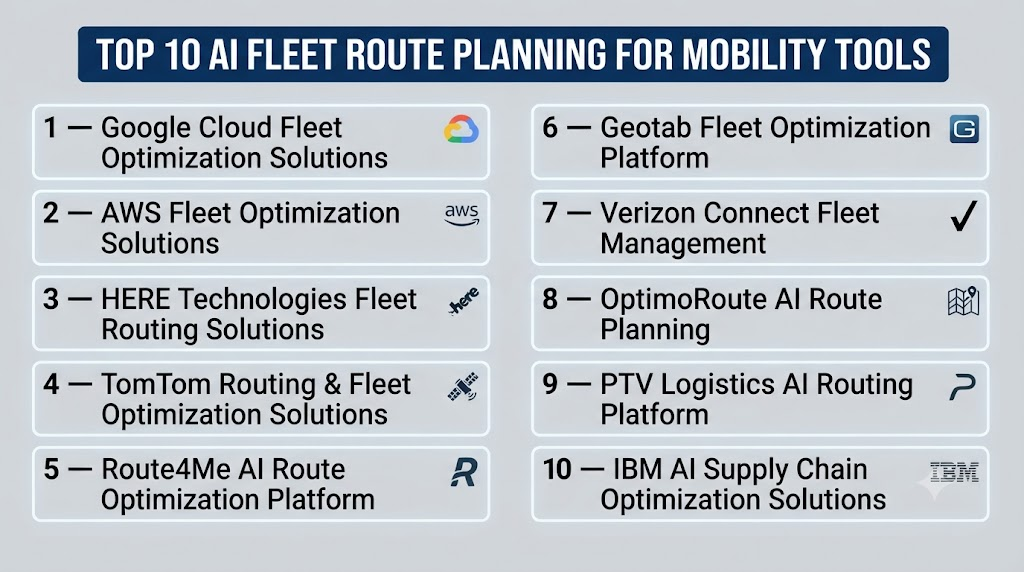
Top 10 AI Fleet Route Planning for Mobility Tools
#1 — Google Cloud Fleet Optimization Solutions
One-line verdict: Best for enterprises building customized AI-powered mobility optimization systems.
Short description:
Google Cloud provides artificial intelligence, machine learning, and data processing capabilities that organizations can use to build fleet optimization and route planning solutions. It supports large-scale transportation analytics and intelligent decision-making workflows.
Standout Capabilities
- AI-powered data analysis.
- Machine learning optimization workflows.
- Large-scale data processing.
- Predictive analytics capabilities.
- Cloud-based fleet intelligence.
- Custom route optimization solutions.
- Data integration capabilities.
- Enterprise scalability.
AI-Specific Depth
- Model support: Supports custom AI and machine learning models.
- RAG / knowledge integration: N/A.
- Evaluation: Organizations can build custom evaluation workflows.
- Guardrails: Cloud AI governance capabilities vary by implementation.
- Observability: Cloud monitoring and analytics capabilities available.
Pros
- Strong cloud AI ecosystem.
- Highly scalable infrastructure.
- Flexible customization options.
Cons
- Requires technical expertise.
- Not a ready-made fleet management product.
- Implementation complexity varies.
Security & Compliance
Security controls depend on configuration and selected cloud services. Specific certifications vary by implementation.
Deployment & Platforms
- Cloud-based deployment.
- Enterprise data environments.
- Hybrid architectures.
Integrations & Ecosystem
Supports:
- Data analytics platforms.
- Machine learning workflows.
- Fleet management systems.
- Enterprise applications.
- Geospatial services.
Pricing Model
Usage-based cloud pricing. Exact costs vary depending on infrastructure usage.
Best-Fit Scenarios
- Large transportation enterprises.
- Custom mobility platforms.
- Data-driven fleet optimization projects.
#2 — AWS Fleet Optimization Solutions
One-line verdict: Best for organizations requiring scalable cloud infrastructure for intelligent fleet operations.
Short description:
AWS provides cloud computing, analytics, and machine learning services that organizations can use to develop fleet routing and mobility optimization solutions. It supports real-time data processing and operational intelligence.
Standout Capabilities
- Cloud-scale optimization.
- Machine learning workflows.
- Real-time data processing.
- Fleet analytics.
- IoT integration support.
- Predictive insights.
- Enterprise infrastructure.
- Automation capabilities.
AI-Specific Depth
- Model support: Supports custom machine learning models.
- RAG / knowledge integration: N/A.
- Evaluation: Customer-defined evaluation workflows.
- Guardrails: Cloud AI security controls vary by implementation.
- Observability: Cloud monitoring capabilities available.
Pros
- Flexible infrastructure.
- Strong enterprise ecosystem.
- Supports large-scale data operations.
Cons
- Requires cloud engineering expertise.
- Organizations must build or integrate optimization logic.
- Costs depend on usage.
Security & Compliance
Security depends on architecture and service configuration.
Deployment & Platforms
- Cloud.
- Hybrid environments.
- Enterprise infrastructure.
Integrations & Ecosystem
Supports:
- IoT platforms.
- Data pipelines.
- Machine learning systems.
- Fleet applications.
- Enterprise software.
Pricing Model
Usage-based cloud pricing.
Best-Fit Scenarios
- Enterprise fleets.
- Mobility technology companies.
- Custom transportation platforms.
#3 — HERE Technologies Fleet Routing Solutions
One-line verdict: Best for organizations needing location intelligence and professional fleet routing capabilities.
Short description:
HERE Technologies provides location-based services, mapping, and mobility solutions that support fleet routing and transportation optimization. Its technologies help organizations manage vehicle movement and location intelligence.
Standout Capabilities
- Route optimization.
- Location intelligence.
- Traffic-aware routing.
- Fleet mobility solutions.
- Mapping data.
- Navigation support.
- Geospatial analytics.
- Transportation workflows.
AI-Specific Depth
- Model support: Proprietary location intelligence technologies.
- RAG / knowledge integration: N/A.
- Evaluation: Mapping and routing validation processes vary.
- Guardrails: Safety and data controls depend on implementation.
- Observability: Analytics capabilities vary by deployment.
Pros
- Strong mapping expertise.
- Designed for mobility applications.
- Supports enterprise transportation workflows.
Cons
- Enterprise-focused solution.
- Advanced customization may require integration work.
- Pricing details are not publicly stated.
Security & Compliance
Specific certifications are not publicly stated.
Deployment & Platforms
- Cloud-based services.
- Enterprise mobility platforms.
Integrations & Ecosystem
Supports:
- Fleet management systems.
- Navigation applications.
- Mobility platforms.
- Location-based services.
- Transportation workflows.
Pricing Model
Not publicly stated.
Best-Fit Scenarios
- Logistics companies.
- Transportation providers.
- Mobility platforms.
#4 — TomTom Routing & Fleet Optimization Solutions
One-line verdict: Best for businesses requiring reliable mapping intelligence and optimized transportation planning.
Short description:
TomTom provides mapping, navigation, and location technology solutions that support fleet routing and mobility applications. Its technologies help organizations improve route efficiency by using geographic data, traffic information, and navigation intelligence.
Standout Capabilities
- Traffic-aware route optimization.
- Digital mapping capabilities.
- Navigation intelligence.
- Fleet mobility support.
- Location data processing.
- Route planning workflows.
- Transportation analytics.
- Real-time location services.
AI-Specific Depth
- Model support: Proprietary mapping and location intelligence technologies.
- RAG / knowledge integration: N/A.
- Evaluation: Routing quality testing processes vary by implementation.
- Guardrails: Data quality and operational controls depend on deployment.
- Observability: Monitoring capabilities vary based on integration.
Pros
- Strong expertise in navigation and mapping.
- Useful for transportation applications.
- Supports enterprise mobility workflows.
Cons
- Not a complete fleet management platform.
- Advanced AI customization may require additional development.
- Pricing details are not publicly stated.
Security & Compliance
Specific security certifications and compliance details are not publicly stated.
Deployment & Platforms
- Cloud-based services.
- Enterprise mobility systems.
- Navigation platforms.
Integrations & Ecosystem
Supports:
- Fleet management software.
- Navigation systems.
- Mobility platforms.
- Location-based applications.
- Transportation solutions.
Pricing Model
Not publicly stated.
Best-Fit Scenarios
- Logistics companies.
- Fleet operators.
- Transportation technology providers.
#5 — Route4Me AI Route Optimization Platform
One-line verdict: Best for businesses needing automated route planning and delivery optimization.
Short description:
Route4Me provides route optimization software designed to help businesses plan efficient vehicle routes. It focuses on improving delivery operations, reducing travel time, and simplifying fleet scheduling.
Standout Capabilities
- Automated route planning.
- Multi-stop optimization.
- Driver scheduling.
- Delivery route management.
- Fleet visibility.
- Route analytics.
- Mobile driver workflows.
- Operational reporting.
AI-Specific Depth
- Model support: Optimization algorithms and intelligent routing capabilities; specific model details are not publicly stated.
- RAG / knowledge integration: N/A.
- Evaluation: Route performance analytics available; AI evaluation details are not publicly stated.
- Guardrails: Operational rules and constraints can be configured.
- Observability: Route analytics and reporting capabilities available.
Pros
- Easy-to-use route planning workflows.
- Suitable for delivery businesses.
- Supports operational efficiency improvements.
Cons
- Advanced autonomous AI capabilities may vary.
- Enterprise customization may require additional setup.
- Pricing depends on usage and features.
Security & Compliance
Specific certifications and compliance details are not publicly stated.
Deployment & Platforms
- Cloud-based platform.
- Web applications.
- Mobile applications.
Integrations & Ecosystem
Supports:
- GPS systems.
- Delivery platforms.
- Fleet management tools.
- Business applications.
- Driver mobile workflows.
Pricing Model
Subscription-based pricing model. Exact pricing varies depending on requirements.
Best-Fit Scenarios
- Delivery businesses.
- Field service companies.
- Small and medium fleets.
#6 — Geotab Fleet Optimization Platform
One-line verdict: Best for organizations combining fleet tracking, telematics, and operational analytics.
Short description:
Geotab provides fleet management and telematics solutions that help organizations monitor vehicles, analyze driving behavior, and optimize fleet operations. Its platform supports data-driven mobility decisions.
Standout Capabilities
- GPS fleet tracking.
- Vehicle data analytics.
- Fleet performance monitoring.
- Driver behavior insights.
- Telematics integration.
- Operational reporting.
- Vehicle utilization analysis.
- Mobility management.
AI-Specific Depth
- Model support: AI and analytics capabilities vary by implementation.
- RAG / knowledge integration: N/A.
- Evaluation: Analytics and reporting workflows available.
- Guardrails: Depends on configuration and usage policies.
- Observability: Fleet monitoring and reporting capabilities available.
Pros
- Strong fleet management ecosystem.
- Supports large vehicle operations.
- Provides valuable operational insights.
Cons
- Requires telematics hardware integration.
- AI capabilities depend on selected features.
- Enterprise deployments may require configuration.
Security & Compliance
Security capabilities vary by deployment. Specific certifications are not publicly stated.
Deployment & Platforms
- Cloud-based platform.
- Vehicle telematics systems.
- Mobile and web applications.
Integrations & Ecosystem
Supports:
- GPS devices.
- Vehicle sensors.
- Fleet management systems.
- Business applications.
- Analytics platforms.
Pricing Model
Not publicly stated. Pricing typically depends on fleet size and selected services.
Best-Fit Scenarios
- Enterprise fleets.
- Transportation companies.
- Commercial vehicle operators.
#7 — Verizon Connect Fleet Management
One-line verdict: Best for businesses needing connected fleet management with route visibility and optimization.
Short description:
Verizon Connect provides fleet management solutions that combine GPS tracking, vehicle monitoring, and operational analytics. The platform helps organizations improve fleet efficiency and manage vehicle operations.
Standout Capabilities
- GPS tracking.
- Route visibility.
- Fleet monitoring.
- Driver activity insights.
- Vehicle management.
- Operational dashboards.
- Mobile fleet access.
- Reporting tools.
AI-Specific Depth
- Model support: AI capabilities vary by feature set.
- RAG / knowledge integration: N/A.
- Evaluation: Performance analytics available; detailed AI evaluation methods are not publicly stated.
- Guardrails: Depends on operational configuration.
- Observability: Fleet monitoring capabilities available.
Pros
- Strong fleet visibility features.
- Suitable for commercial fleets.
- Supports operational decision-making.
Cons
- More focused on fleet management than advanced AI route planning.
- Feature availability varies by package.
- Pricing details are not publicly stated.
Security & Compliance
Security details depend on deployment. Specific certifications are not publicly stated.
Deployment & Platforms
- Cloud platform.
- Web application.
- Mobile applications.
Integrations & Ecosystem
Supports:
- GPS systems.
- Fleet management workflows.
- Vehicle data platforms.
- Business applications.
Pricing Model
Not publicly stated.
Best-Fit Scenarios
- Commercial vehicle fleets.
- Service organizations.
- Transportation businesses.
#8 — OptimoRoute AI Route Planning
One-line verdict: Best for delivery teams optimizing schedules, routes, and workforce productivity.
Short description:
OptimoRoute provides route planning and scheduling software designed for delivery and field service organizations. It helps businesses optimize daily operations through automated route calculations.
Standout Capabilities
- Route optimization.
- Driver scheduling.
- Delivery planning.
- Time window management.
- Field service routing.
- Route analytics.
- Mobile driver support.
- Operational automation.
AI-Specific Depth
- Model support: Uses optimization technologies; specific AI model details are not publicly stated.
- RAG / knowledge integration: N/A.
- Evaluation: Route efficiency analytics available.
- Guardrails: Business rules and routing constraints supported.
- Observability: Operational reporting available.
Pros
- Simplifies route scheduling.
- Useful for delivery operations.
- Supports workforce planning.
Cons
- More focused on business routing than autonomous mobility.
- Advanced AI capabilities may vary.
- Pricing depends on requirements.
Security & Compliance
Specific certifications are not publicly stated.
Deployment & Platforms
- Cloud-based.
- Web applications.
- Mobile applications.
Integrations & Ecosystem
Supports:
- Delivery platforms.
- GPS systems.
- Scheduling tools.
- Business software.
Pricing Model
Subscription-based model. Exact pricing varies.
Best-Fit Scenarios
- Delivery companies.
- Field service organizations.
- Local transportation businesses.
#9 — PTV Logistics AI Routing Platform
One-line verdict: Best for transportation organizations managing complex logistics networks.
Short description:
PTV provides transportation planning and mobility software designed for logistics, traffic management, and route optimization. Its solutions support organizations handling complex transportation scenarios.
Standout Capabilities
- Transportation planning.
- Logistics optimization.
- Route simulation.
- Traffic analysis.
- Mobility modeling.
- Fleet planning.
- Scenario analysis.
- Network optimization.
AI-Specific Depth
- Model support: Optimization and analytics technologies; details vary.
- RAG / knowledge integration: N/A.
- Evaluation: Simulation and planning evaluation workflows.
- Guardrails: Business constraints and planning rules.
- Observability: Analytics capabilities available.
Pros
- Suitable for complex transportation planning.
- Strong mobility expertise.
- Supports enterprise logistics workflows.
Cons
- Requires transportation planning expertise.
- Implementation can be complex.
- Pricing information is not publicly stated.
Security & Compliance
Security information varies by deployment.
Deployment & Platforms
- Enterprise software environments.
- Cloud and on-premise options may vary.
Integrations & Ecosystem
Supports:
- Transportation systems.
- Logistics platforms.
- Mobility applications.
- Enterprise data systems.
Pricing Model
Not publicly stated.
Best-Fit Scenarios
- Large logistics organizations.
- Transportation planners.
- Smart mobility projects.
#10 — IBM AI Supply Chain Optimization Solutions
One-line verdict: Best for enterprises combining AI analytics with large-scale transportation operations.
Short description:
IBM provides AI and analytics technologies that organizations can use for supply chain planning, logistics optimization, and operational decision-making. These capabilities can support intelligent fleet and mobility workflows.
Standout Capabilities
- AI-powered analytics.
- Supply chain optimization.
- Predictive insights.
- Enterprise data processing.
- Decision support.
- Automation workflows.
- Business intelligence.
- Integration capabilities.
AI-Specific Depth
- Model support: Supports enterprise AI workflows.
- RAG / knowledge integration: Depends on implementation.
- Evaluation: Customer-specific evaluation processes.
- Guardrails: Enterprise AI governance capabilities vary.
- Observability: Monitoring depends on deployed solutions.
Pros
- Strong enterprise AI capabilities.
- Suitable for complex operations.
- Supports large-scale analytics.
Cons
- Requires enterprise implementation expertise.
- Not a dedicated fleet routing product.
- Deployment complexity may be high.
Security & Compliance
Enterprise security capabilities depend on selected services and configuration.
Deployment & Platforms
- Cloud.
- Hybrid environments.
- Enterprise infrastructure.
Integrations & Ecosystem
Supports:
- Supply chain systems.
- Enterprise applications.
- Data platforms.
- AI workflows.
- Analytics solutions.
Pricing Model
Not publicly stated.
Best-Fit Scenarios
- Enterprise logistics organizations.
- Global supply chain operations.
- Large mobility programs.
Comparison Table: Top 10 AI Fleet Route Planning for Mobility Tools
| Tool Name | Best For | Deployment | Model Flexibility | Strength | Watch-Out | Public Rating |
|---|---|---|---|---|---|---|
| Google Cloud Fleet Optimization Solutions | Enterprise AI mobility platforms | Cloud / Hybrid | Custom AI models | Scalable AI infrastructure | Requires development expertise | N/A |
| AWS Fleet Optimization Solutions | Enterprise fleet data processing | Cloud / Hybrid | Custom AI models | Flexible cloud ecosystem | Requires cloud engineering | N/A |
| HERE Fleet Routing Solutions | Mobility and logistics companies | Cloud | Proprietary routing technologies | Location intelligence | Enterprise integration complexity | N/A |
| TomTom Routing Solutions | Navigation and transportation companies | Cloud | Proprietary mapping technology | Traffic-aware routing | Limited customization | N/A |
| Route4Me AI Route Optimization | Delivery and field service teams | Cloud / Mobile | Optimization algorithms | Easy route automation | Advanced AI features vary | N/A |
| Geotab Fleet Optimization Platform | Large commercial fleets | Cloud / Telematics | Analytics-based AI | Fleet visibility | Requires vehicle data integration | N/A |
| Verizon Connect Fleet Management | Commercial fleet operators | Cloud / Mobile | Analytics-driven | Fleet monitoring | Less focused on advanced AI routing | N/A |
| OptimoRoute AI Route Planning | SMB delivery operations | Cloud / Mobile | Optimization-based | Scheduling efficiency | Limited enterprise mobility features | N/A |
| PTV Logistics AI Routing Platform | Transportation planning organizations | Enterprise / Cloud | Optimization models | Complex logistics planning | Requires expertise | N/A |
| IBM AI Supply Chain Optimization | Large enterprises | Cloud / Hybrid | Enterprise AI workflows | Business intelligence | Not dedicated only to fleet routing | N/A |
Scoring & Evaluation: Transparent Rubric
The following evaluation compares AI Fleet Route Planning tools based on important operational requirements including routing capabilities, AI optimization, integrations, scalability, security, performance, and usability.
Scores are comparative indicators and not absolute rankings. The best solution depends on fleet size, transportation complexity, business goals, available data, and technology requirements.
| Tool | Core Features | Reliability/Eval | Guardrails | Integrations | Ease | Perf/Cost | Security/Admin | Support | Weighted Total |
|---|---|---|---|---|---|---|---|---|---|
| Google Cloud Fleet Optimization Solutions | 9 | 9 | 8 | 10 | 7 | 9 | 9 | 9 | 8.95 |
| AWS Fleet Optimization Solutions | 9 | 9 | 8 | 10 | 7 | 9 | 10 | 9 | 9.00 |
| HERE Fleet Routing Solutions | 10 | 9 | 8 | 9 | 8 | 8 | 9 | 9 | 8.90 |
| TomTom Routing Solutions | 9 | 9 | 8 | 9 | 8 | 8 | 9 | 9 | 8.75 |
| Route4Me AI Route Optimization | 8 | 8 | 7 | 8 | 9 | 8 | 8 | 8 | 8.05 |
| Geotab Fleet Optimization Platform | 9 | 9 | 8 | 9 | 8 | 8 | 9 | 9 | 8.75 |
| Verizon Connect Fleet Management | 8 | 8 | 8 | 8 | 9 | 8 | 8 | 8 | 8.15 |
| OptimoRoute AI Route Planning | 8 | 8 | 7 | 8 | 9 | 8 | 8 | 8 | 8.05 |
| PTV Logistics AI Routing Platform | 9 | 9 | 8 | 9 | 7 | 8 | 9 | 9 | 8.65 |
| IBM AI Supply Chain Optimization | 9 | 9 | 9 | 10 | 7 | 8 | 10 | 9 | 9.00 |
Top 3 for Enterprise
1. AWS Fleet Optimization Solutions
Best suited for enterprises that need scalable cloud infrastructure, data processing, and customized AI routing workflows.
2. IBM AI Supply Chain Optimization
Strong option for organizations combining fleet routing with broader supply chain intelligence.
3. HERE Fleet Routing Solutions
Suitable for transportation companies requiring professional mapping and mobility capabilities.
Top 3 for SMB
1. Route4Me AI Route Optimization
Best for small and medium businesses needing simple route automation and delivery planning.
2. OptimoRoute AI Route Planning
Useful for companies managing deliveries, appointments, and field service schedules.
3. Verizon Connect Fleet Management
Suitable for businesses needing fleet visibility with operational insights.
Top 3 for Developers
1. Google Cloud Fleet Optimization Solutions
Provides flexible infrastructure for creating customized AI mobility solutions.
2. AWS Fleet Optimization Solutions
Strong choice for developers building scalable transportation applications.
3. Open optimization frameworks with mapping APIs
Useful for teams developing custom routing engines and mobility experiments.
Which AI Fleet Route Planning Tool Is Right for You?
Choosing an AI Fleet Route Planning platform depends on your fleet size, business model, operational complexity, and technical resources.
A delivery company may need simple route automation, while an enterprise transportation organization may require advanced AI optimization, predictive analytics, and large-scale integrations.
Solo / Freelancer
Individual developers and small teams usually need flexible tools for building mobility applications.
Recommended options:
- Cloud AI routing services.
- Mapping APIs.
- Developer-focused optimization platforms.
Focus areas:
- API availability.
- Documentation quality.
- Testing flexibility.
- Low infrastructure requirements.
- Custom workflow support.
SMB
Small and medium businesses should prioritize easy deployment and operational efficiency.
Recommended options:
- Route4Me AI Route Optimization.
- OptimoRoute AI Route Planning.
- Verizon Connect Fleet Management.
Focus areas:
- Quick setup.
- Delivery scheduling.
- Driver productivity.
- Affordable scaling.
- Simple reporting.
Mid-Market
Growing logistics companies need stronger automation and integration capabilities.
Recommended options:
- HERE Fleet Routing Solutions.
- TomTom Routing Solutions.
- Geotab Fleet Optimization Platform.
Focus areas:
- Fleet visibility.
- Telematics integration.
- Real-time optimization.
- Operational analytics.
- Multi-vehicle support.
Enterprise
Large transportation companies need highly scalable AI-driven mobility platforms.
Recommended options:
- AWS Fleet Optimization Solutions.
- IBM AI Supply Chain Optimization.
- Google Cloud Fleet Optimization Solutions.
Focus areas:
- Large-scale data processing.
- AI automation.
- Security controls.
- System integration.
- Governance.
Regulated Industries
Organizations handling sensitive transportation data should prioritize:
- Data security.
- Access management.
- Audit capabilities.
- Privacy controls.
- Transparent AI decision-making.
Recommended approach:
- Review how vehicle and driver data is processed.
- Establish clear data retention policies.
- Validate AI recommendations before automation.
- Maintain human oversight for critical routing decisions.
Budget vs Premium
Budget-focused approach
Prioritize:
- Simple route optimization.
- Cloud-based subscriptions.
- Easy deployment.
- Basic fleet analytics.
Suitable options:
- Route4Me.
- OptimoRoute.
- Verizon Connect.
Premium approach
Prioritize:
- Enterprise AI optimization.
- Large-scale integrations.
- Predictive analytics.
- Advanced mobility intelligence.
Suitable options:
- AWS solutions.
- IBM AI solutions.
- HERE mobility platforms.
Build vs Buy: When to DIY
Build internally when:
- You have strong AI and software engineering teams.
- You need unique routing logic.
- You manage specialized transportation operations.
- You require complete control over optimization models.
Buy a platform when:
- You need faster implementation.
- You want proven routing capabilities.
- Your organization lacks AI infrastructure.
- You need vendor support.
A hybrid approach is often effective. Companies can combine existing fleet platforms with custom AI models to improve specific transportation workflows.
Implementation Playbook: 30 / 60 / 90 Days
First 30 Days: Pilot and Define Success Metrics
Main objectives:
- Understand current fleet challenges.
- Select a testing group.
- Define optimization goals.
Key activities:
- Analyze current routes.
- Identify delivery inefficiencies.
- Connect available fleet data.
- Establish performance benchmarks.
AI-specific tasks:
- Prepare historical route datasets.
- Create optimization evaluation criteria.
- Test AI recommendations.
- Measure baseline performance.
First 60 Days: Integration and Operational Rollout
Main objectives:
- Improve routing accuracy.
- Connect business systems.
- Prepare wider adoption.
Key activities:
- Integrate GPS and telematics systems.
- Configure routing rules.
- Train operational teams.
- Review AI-generated recommendations.
AI-specific tasks:
- Evaluate model performance.
- Monitor prediction accuracy.
- Test unusual scenarios.
- Establish model version management.
First 90 Days: Optimization and Governance
Main objectives:
- Scale deployment.
- Reduce operational costs.
- Establish long-term AI management.
Key activities:
- Expand across fleets.
- Automate routing workflows.
- Improve reporting.
- Optimize infrastructure usage.
AI-specific tasks:
- Monitor model drift.
- Update training data.
- Review AI decisions.
- Establish incident response workflows.
- Maintain governance documentation.
Common Mistakes & How to Avoid Them
- Selecting a route planning tool without understanding operational requirements.
- Ignoring existing fleet data quality.
- Not integrating GPS and telematics information.
- Automating routes without human review.
- Failing to measure fuel and time savings.
- Choosing tools that cannot scale with fleet growth.
- Ignoring driver adoption challenges.
- Overlooking security of vehicle data.
- Not testing different route scenarios.
- Failing to evaluate AI recommendations.
- Poor integration planning.
- Ignoring vendor lock-in risks.
- Not monitoring AI performance after deployment.
- Expecting AI to solve inefficient business processes automatically.
FAQs
What is AI Fleet Route Planning?
AI Fleet Route Planning uses artificial intelligence and optimization algorithms to create efficient vehicle routes based on traffic, delivery requirements, and operational conditions.
How does AI improve fleet routing?
AI analyzes large amounts of transportation data to recommend better routes, predict delays, and improve fleet utilization.
Can AI route planning reduce fuel costs?
Yes. Optimized routes can reduce unnecessary travel, idle time, and inefficient vehicle movement.
Is AI route planning suitable for small businesses?
Yes. Many platforms provide simple solutions for delivery companies and field service teams.
Can AI systems handle real-time traffic changes?
Many modern platforms support dynamic routing based on changing traffic and operational conditions.
Do AI fleet tools require GPS data?
Most advanced solutions use GPS and location data, although capabilities vary by platform.
Can companies customize AI routing models?
Some platforms support customization through APIs and development tools.
Are AI fleet platforms expensive?
Costs vary based on fleet size, features, integrations, and deployment requirements.
Can AI replace fleet managers?
No. AI supports decision-making but human oversight remains important for complex operational decisions.
What integrations are important for fleet routing tools?
Common integrations include GPS systems, telematics platforms, ERP systems, delivery software, and analytics platforms.
How should companies evaluate AI routing accuracy?
Organizations should test route efficiency, delivery performance, travel time improvements, and operational impact.
Are AI fleet tools secure?
Security depends on the provider and implementation. Organizations should review data protection, access controls, and privacy policies.
Conclusion
AI Fleet Route Planning for Mobility is becoming an essential technology for organizations looking to improve transportation efficiency, reduce operational costs, and manage increasingly complex mobility networks.The best platform depends on business requirements. Small businesses may benefit from simple route optimization solutions, while large enterprises may require advanced AI infrastructure, predictive analytics, and deep system integrations.Successful adoption requires more than selecting a routing tool. Organizations must focus on data quality, integration planning, AI evaluation, security, and continuous optimization to achieve long-term value.

Find Trusted Cardiac Hospitals
Compare heart hospitals by city and services — all in one place.
Explore Hospitals
An interesting area to explore further is how these AI-powered fleet route planning solutions perform when faced with real operational challenges instead of ideal conditions. Daily operations often involve unexpected road closures, fluctuating traffic patterns, delayed vehicle updates, and last-minute schedule changes that require rapid adjustments. A comparison of how these platforms manage dynamic re-routing, monitor AI decision quality, and maintain service reliability would provide deeper insights. In large-scale mobility environments, success depends not only on generating efficient routes but also on delivering consistent, transparent, and resilient operations as conditions continuously evolve.