
Introduction
AI ADAS Perception Tooling refers to artificial intelligence platforms, frameworks, and software systems that help vehicles understand their surroundings using cameras, radar, lidar, and other sensor inputs. These tools use computer vision, deep learning, sensor fusion, and real-time AI inference to detect objects, recognize road conditions, and support advanced driver assistance systems.
As vehicles become more intelligent, ADAS perception technology has become a critical foundation for safer transportation. Modern automotive companies are investing in AI perception systems to improve capabilities such as lane detection, pedestrian recognition, collision avoidance, traffic sign understanding, and autonomous driving assistance.
AI ADAS Perception Tooling is becoming more important because automotive AI systems must process massive amounts of sensor data with high accuracy, low latency, and strong reliability. Organizations now require solutions that support multimodal AI workflows, edge computing, advanced evaluation methods, and secure deployment practices.
Real-world use cases:
- Automotive manufacturers use AI perception tools to develop advanced driver assistance features.
- Autonomous vehicle companies use perception frameworks for object detection and environmental understanding.
- Transportation companies use AI vision systems to improve vehicle safety and operational efficiency.
- Research teams use perception platforms to train and evaluate computer vision models.
- Mobility providers use AI perception systems for intelligent navigation and road awareness.
- Robotics and industrial vehicle companies use similar technologies for machine vision applications.
Evaluation Criteria for Choosing AI ADAS Perception Tooling
Organizations should evaluate AI ADAS Perception Tooling based on:
- Accuracy of object detection and classification.
- Support for camera, radar, lidar, and sensor fusion workflows.
- Real-time inference performance.
- Edge deployment capabilities.
- AI model flexibility and customization options.
- Dataset management and training support.
- Evaluation and benchmarking capabilities.
- Security and privacy controls.
- Integration with automotive platforms.
- Scalability across development and production environments.
- Hardware compatibility.
- Developer ecosystem and support.
Best for:
Automotive manufacturers, autonomous vehicle developers, mobility companies, robotics organizations, and engineering teams building AI-powered perception systems that require reliable environmental understanding.
Not ideal for:
Organizations without AI engineering resources, businesses looking for simple vehicle monitoring solutions, or teams that do not need custom perception models and advanced computer vision capabilities.
What’s Changed in AI ADAS Perception Tooling
AI ADAS Perception Tooling is rapidly evolving as automotive AI moves toward more intelligent, connected, and autonomous systems.
- Multimodal sensor intelligence: Modern perception systems increasingly combine cameras, radar, lidar, GPS, and vehicle data to create richer environmental understanding.
- Foundation models for perception: AI research is moving toward larger models capable of handling complex visual reasoning and multiple driving scenarios.
- Edge AI optimization: Automotive organizations are focusing on low-latency processing directly inside vehicles instead of depending completely on cloud infrastructure.
- Improved AI evaluation frameworks: Companies are adopting advanced testing methods to measure detection accuracy, reliability, and performance in different driving environments.
- Synthetic data generation: Organizations are using simulated driving environments to create training data for rare and dangerous scenarios.
- Real-time AI inference optimization: New tools focus on reducing latency, improving hardware efficiency, and supporting automotive-grade performance.
- Sensor fusion advancement: AI systems are improving how multiple sensors work together for better perception accuracy.
- AI safety and governance: Automotive teams are paying more attention to validation, explainability, security, and responsible AI practices.
- Cloud-to-edge workflows: Modern platforms support training models in the cloud while deploying optimized versions directly on vehicles.
- Developer-friendly AI platforms: More tools now provide APIs, SDKs, model optimization utilities, and workflow automation for engineering teams.
Quick Buyer Checklist
Use this checklist when selecting AI ADAS Perception Tooling:
- ✅ Does the platform support camera-based perception?
- ✅ Can it integrate radar or lidar data?
- ✅ Does it support sensor fusion workflows?
- ✅ Can models run on automotive edge hardware?
- ✅ Does it provide AI model optimization tools?
- ✅ Are evaluation and benchmarking capabilities available?
- ✅ Can teams monitor model performance after deployment?
- ✅ Does it support custom datasets and training workflows?
- ✅ Are APIs and SDKs available for developers?
- ✅ Does it provide security controls for automotive environments?
- ✅ Can it scale from research projects to production vehicles?
- ✅ Does it reduce vendor lock-in risks?
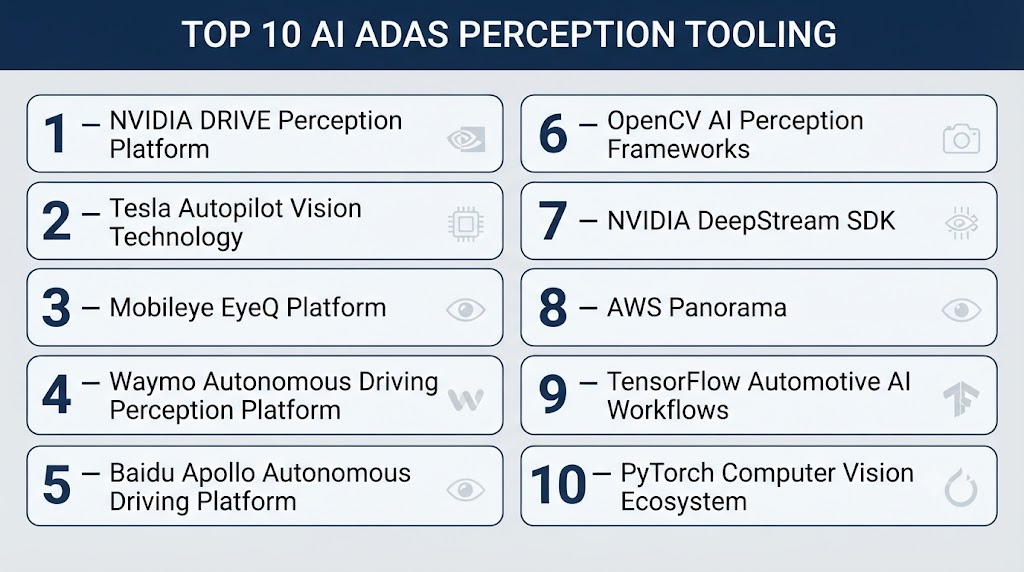
Top 10 AI ADAS Perception Tooling
#1 — NVIDIA DRIVE Perception Platform
One-line verdict: Best for automotive companies developing advanced AI perception systems for intelligent vehicles.
Short description:
NVIDIA DRIVE provides an automotive AI ecosystem designed for developing perception, autonomous driving, and advanced vehicle intelligence applications. It combines AI computing, software frameworks, and development tools for processing complex sensor data.
Standout Capabilities
- AI-based object detection.
- Sensor processing workflows.
- Real-time perception pipelines.
- Automotive AI computing support.
- Deep learning model deployment.
- Simulation and testing capabilities.
- Developer ecosystem support.
- Autonomous driving development tools.
AI-Specific Depth
- Model support: Supports AI model development and deployment within NVIDIA ecosystems.
- RAG / knowledge integration: N/A.
- Evaluation: Supports simulation and testing workflows; detailed evaluation frameworks vary by implementation.
- Guardrails: Safety implementation depends on application architecture.
- Observability: Monitoring capabilities depend on deployed software stack.
Pros
- Strong automotive AI ecosystem.
- High-performance computing capabilities.
- Suitable for complex perception workloads.
Cons
- Requires specialized automotive AI expertise.
- Hardware ecosystem dependency.
- Enterprise deployment complexity.
Security & Compliance
Security features depend on implementation. Specific certifications are not publicly stated.
Deployment & Platforms
- Automotive computing platforms.
- Embedded vehicle systems.
- Cloud development environments.
Integrations & Ecosystem
Common integrations include:
- AI development frameworks.
- Vehicle sensor systems.
- Simulation platforms.
- Automotive software stacks.
- Edge computing environments.
Pricing Model
Not publicly stated. Enterprise automotive solutions typically use customized licensing models.
Best-Fit Scenarios
- Autonomous vehicle development.
- Automotive OEM engineering teams.
- Advanced driver assistance projects.
#2 — Tesla Autopilot Vision Technology
One-line verdict: Best known for large-scale vision-based autonomous driving development approaches.
Short description:
Tesla’s Autopilot technology uses AI-based computer vision and neural networks to interpret vehicle surroundings. Its approach focuses heavily on camera-based perception and large-scale AI training workflows.
Standout Capabilities
- Computer vision-based perception.
- Object recognition.
- Lane understanding.
- Driving environment analysis.
- Neural network processing.
- Large-scale AI training approach.
- Vehicle intelligence workflows.
AI-Specific Depth
- Model support: Proprietary AI models.
- RAG / knowledge integration: N/A.
- Evaluation: Uses internal testing processes; detailed methods are not publicly stated.
- Guardrails: Safety mechanisms exist within vehicle systems; detailed AI guardrail architecture is not publicly stated.
- Observability: Internal monitoring details are not publicly stated.
Pros
- Demonstrates large-scale AI perception deployment.
- Strong focus on computer vision.
- Extensive real-world driving data approach.
Cons
- Technology is not available as a commercial developer toolkit.
- Internal architecture details are limited.
- Not designed for external customization.
Security & Compliance
Specific security certifications and technical details are not publicly stated.
Deployment & Platforms
- Vehicle-integrated systems.
- Proprietary automotive platforms.
Integrations & Ecosystem
Integrations include:
- Vehicle software systems.
- Automotive computing platforms.
- AI development infrastructure.
Pricing Model
Not publicly stated.
Best-Fit Scenarios
- Automotive AI research analysis.
- Autonomous vehicle benchmarking.
- Industry innovation studies.
#3 — Mobileye EyeQ Platform
One-line verdict: Best for automotive manufacturers building production-grade ADAS perception systems.
Short description:
Mobileye EyeQ is an automotive AI computing platform designed for advanced driver assistance and autonomous driving applications. It focuses on efficient AI processing for real-world vehicle environments.
Standout Capabilities
- Computer vision processing.
- ADAS perception workloads.
- Automotive-grade AI computing.
- Object detection.
- Road understanding.
- Efficient edge inference.
- Vehicle integration support.
AI-Specific Depth
- Model support: Proprietary AI technologies.
- RAG / knowledge integration: N/A.
- Evaluation: Automotive testing methods are used; details vary.
- Guardrails: Safety-oriented automotive development practices.
- Observability: Depends on implementation.
Pros
- Strong automotive industry adoption.
- Designed for vehicle environments.
- Efficient AI processing.
Cons
- Primarily focused on automotive partners.
- Limited customization compared with developer platforms.
- Pricing information is not publicly stated.
Security & Compliance
Specific certifications and compliance details are not publicly stated.
Deployment & Platforms
- Embedded automotive systems.
- Vehicle computing platforms.
Integrations & Ecosystem
Supports:
- Automotive manufacturers.
- Vehicle sensors.
- ADAS software systems.
- Embedded AI environments.
Pricing Model
Not publicly stated.
Best-Fit Scenarios
- Automotive OEM programs.
- ADAS production systems.
- Vehicle intelligence projects.
#4 — Waymo Autonomous Driving Perception Platform
One-line verdict: Best for organizations studying advanced autonomous vehicle perception and large-scale AI driving systems.
Short description:
Waymo develops autonomous driving technology that uses AI perception systems to understand complex road environments. Its platform combines multiple sensors, machine learning models, and real-world testing approaches to support autonomous mobility.
Standout Capabilities
- Multi-sensor perception processing.
- Object detection and tracking.
- Road environment understanding.
- Autonomous driving AI workflows.
- Real-world driving data analysis.
- Simulation-based testing.
- Large-scale AI model development.
- Advanced perception research.
AI-Specific Depth
- Model support: Proprietary AI models.
- RAG / knowledge integration: N/A.
- Evaluation: Uses simulation and testing workflows; detailed evaluation processes are not publicly stated.
- Guardrails: Safety-focused autonomous driving approaches; detailed AI guardrail architecture is not publicly stated.
- Observability: Internal system monitoring details are not publicly stated.
Pros
- Advanced autonomous driving research capabilities.
- Strong focus on safety-oriented AI development.
- Uses large-scale real-world driving scenarios.
Cons
- Not available as a general developer toolkit.
- Internal technologies are limited for external access.
- Suitable mainly for large-scale autonomous mobility projects.
Security & Compliance
Specific security certifications and compliance details are not publicly stated.
Deployment & Platforms
- Autonomous vehicle systems.
- Simulation environments.
- Automotive computing platforms.
Integrations & Ecosystem
Common integration areas include:
- Vehicle sensor platforms.
- Simulation systems.
- AI development environments.
- Autonomous driving workflows.
Pricing Model
Not publicly stated.
Best-Fit Scenarios
- Autonomous vehicle research.
- Mobility innovation programs.
- Large-scale AI transportation projects.
#5 — Baidu Apollo Autonomous Driving Platform
One-line verdict: Best for developers and automotive teams building customizable autonomous driving solutions.
Short description:
Baidu Apollo is an autonomous driving development platform that provides tools, frameworks, and resources for building intelligent vehicle applications. It supports perception, planning, simulation, and autonomous driving workflows.
Standout Capabilities
- Autonomous driving development framework.
- Perception module support.
- Sensor data processing.
- Simulation capabilities.
- Open development ecosystem.
- Vehicle intelligence workflows.
- AI model experimentation.
- Autonomous driving testing.
AI-Specific Depth
- Model support: Supports AI development workflows; specific model flexibility varies.
- RAG / knowledge integration: N/A.
- Evaluation: Supports testing and simulation workflows.
- Guardrails: Safety mechanisms depend on implementation.
- Observability: Depends on deployed components.
Pros
- Flexible development environment.
- Useful for research and experimentation.
- Supports multiple autonomous driving components.
Cons
- Requires strong technical expertise.
- Production deployment requires additional engineering.
- Implementation complexity can be high.
Security & Compliance
Specific certifications and security details are not publicly stated.
Deployment & Platforms
- Cloud development environments.
- Vehicle computing platforms.
- Simulation systems.
Integrations & Ecosystem
Supports:
- Autonomous vehicle frameworks.
- Simulation tools.
- Sensor platforms.
- Developer environments.
- Automotive software systems.
Pricing Model
Open-source components with enterprise options depending on usage.
Best-Fit Scenarios
- Autonomous driving research.
- University and engineering projects.
- Automotive innovation teams.
#6 — OpenCV AI Perception Frameworks
One-line verdict: Best for developers creating customized computer vision-based ADAS perception solutions.
Short description:
OpenCV provides widely used computer vision libraries and tools that developers can use to build perception systems. It is commonly used for image processing, object detection, and AI vision experiments.
Standout Capabilities
- Image processing capabilities.
- Computer vision algorithms.
- Object detection workflows.
- Camera-based perception development.
- AI model integration.
- Developer-friendly APIs.
- Rapid prototyping support.
AI-Specific Depth
- Model support: Supports integration with multiple AI frameworks.
- RAG / knowledge integration: N/A.
- Evaluation: Developers create custom evaluation pipelines.
- Guardrails: Application-specific.
- Observability: Requires custom implementation.
Pros
- Highly flexible for developers.
- Large community ecosystem.
- Suitable for research and prototypes.
Cons
- Not a complete automotive ADAS solution.
- Requires significant engineering work.
- Production safety validation requires additional systems.
Security & Compliance
Security depends on implementation. Certifications are not publicly stated.
Deployment & Platforms
- Windows.
- Linux.
- Embedded systems.
- Edge computing devices.
Integrations & Ecosystem
Supports:
- AI frameworks.
- Programming environments.
- Camera systems.
- Embedded platforms.
- Machine learning workflows.
Pricing Model
Open-source with optional commercial support depending on usage.
Best-Fit Scenarios
- AI researchers.
- Computer vision developers.
- Prototype ADAS projects.
#7 — NVIDIA DeepStream SDK
One-line verdict: Best for building real-time AI video analytics and perception pipelines.
Short description:
NVIDIA DeepStream is an AI streaming analytics toolkit designed for processing video, sensor feeds, and computer vision workloads. It is widely used for building real-time perception applications.
Standout Capabilities
- Real-time video analytics.
- AI inference pipelines.
- Multi-camera processing.
- Object detection workflows.
- Edge AI optimization.
- Sensor data processing.
- Developer customization.
AI-Specific Depth
- Model support: Supports multiple AI model frameworks.
- RAG / knowledge integration: N/A.
- Evaluation: Developers can create custom evaluation workflows.
- Guardrails: Application-specific.
- Observability: Depends on implementation.
Pros
- Strong real-time AI processing capabilities.
- Flexible for custom perception systems.
- Supports edge deployment.
Cons
- Requires development expertise.
- Not a ready-made ADAS product.
- Hardware optimization may require NVIDIA ecosystem usage.
Security & Compliance
Security depends on deployment architecture.
Deployment & Platforms
- Linux.
- Edge AI devices.
- Cloud-connected systems.
Integrations & Ecosystem
Supports:
- AI frameworks.
- Video analytics systems.
- Camera networks.
- Edge computing platforms.
- Automotive AI workflows.
Pricing Model
Toolkit availability varies depending on hardware and enterprise requirements.
Best-Fit Scenarios
- AI perception developers.
- Smart mobility projects.
- Real-time video analytics systems.
#8 — AWS Panorama
One-line verdict: Best for organizations deploying computer vision applications at the edge.
Short description:
AWS Panorama provides tools for running computer vision applications on edge devices. It helps organizations process camera data locally for faster AI-based decision-making.
Standout Capabilities
- Edge computer vision processing.
- Camera data analysis.
- Cloud-managed deployments.
- AI application development.
- Local inference capabilities.
- Enterprise cloud integration.
- Device management.
AI-Specific Depth
- Model support: Supports machine learning models compatible with the platform.
- RAG / knowledge integration: N/A.
- Evaluation: Depends on customer-developed applications.
- Guardrails: Application-specific.
- Observability: Cloud monitoring capabilities vary.
Pros
- Supports edge AI deployment.
- Integrates with cloud infrastructure.
- Useful for enterprise computer vision projects.
Cons
- Not specifically designed only for ADAS.
- Requires AI development knowledge.
- Vehicle integration requires customization.
Security & Compliance
Security controls depend on cloud configuration and implementation.
Deployment & Platforms
- Edge devices.
- Cloud-connected environments.
- Enterprise infrastructure.
Integrations & Ecosystem
Supports:
- Cloud services.
- Machine learning workflows.
- Camera systems.
- Enterprise applications.
Pricing Model
Usage-based cloud pricing model; exact costs vary by implementation.
Best-Fit Scenarios
- Enterprise vision applications.
- Edge AI projects.
- Industrial perception systems.
#9 — TensorFlow Automotive AI Workflows
One-line verdict: Best for teams building custom deep learning perception models.
Short description:
TensorFlow provides machine learning frameworks that developers can use to train and deploy AI perception models. Automotive teams often use similar deep learning workflows for object detection and classification.
Standout Capabilities
- Deep learning model development.
- Neural network training.
- Computer vision workflows.
- Model optimization.
- AI experimentation.
- Custom perception development.
- Large ecosystem support.
AI-Specific Depth
- Model support: Supports custom AI model development.
- RAG / knowledge integration: N/A.
- Evaluation: Supports custom model evaluation pipelines.
- Guardrails: Requires application-specific implementation.
- Observability: Requires additional tooling.
Pros
- Highly customizable.
- Large developer ecosystem.
- Supports advanced AI research.
Cons
- Requires ML expertise.
- Not a complete ADAS platform.
- Production deployment needs additional engineering.
Security & Compliance
Depends on implementation and infrastructure.
Deployment & Platforms
- Cloud.
- Linux.
- Edge devices.
- Development environments.
Integrations & Ecosystem
Supports:
- Machine learning tools.
- AI libraries.
- Data pipelines.
- Deployment frameworks.
Pricing Model
Open-source framework.
Best-Fit Scenarios
- AI research teams.
- Custom perception development.
- Machine learning engineers.
#10 — PyTorch Computer Vision Ecosystem
One-line verdict: Best for research teams developing advanced AI perception models.
Short description:
PyTorch is a popular deep learning framework used for building and experimenting with AI models. It supports computer vision research and custom perception model development.
Standout Capabilities
- Deep learning development.
- Computer vision research.
- Model experimentation.
- Neural network training.
- Custom AI pipelines.
- Research flexibility.
- Large developer community.
AI-Specific Depth
- Model support: Supports custom AI model development.
- RAG / knowledge integration: N/A.
- Evaluation: Developers create custom testing pipelines.
- Guardrails: Application-specific.
- Observability: Requires additional tools.
Pros
- Strong research ecosystem.
- Highly flexible.
- Supports advanced AI experimentation.
Cons
- Requires technical expertise.
- Not a complete ADAS product.
- Production deployment requires additional systems.
Security & Compliance
Depends on implementation.
Deployment & Platforms
- Cloud environments.
- Linux.
- Edge AI systems.
- Development platforms.
Integrations & Ecosystem
Supports:
- AI libraries.
- Computer vision tools.
- ML infrastructure.
- Research workflows.
Pricing Model
Open-source.
Best-Fit Scenarios
- AI researchers.
- Autonomous driving experiments.
- Computer vision development teams.
Part 3 will include:
- AI ADAS Perception Tooling Comparison Table
- Scoring & Evaluation Rubric
- Top 3 Enterprise / SMB / Developers
- Which Tool Is Right for You
- 30/60/90 Day Implementation Playbook
- Common Mistakes
- FAQs
- Conclusion
- 5 SEO hashtags
Comparison Table: Top 10 AI ADAS Perception Tooling
| Tool Name | Best For | Deployment | Model Flexibility | Strength | Watch-Out | Public Rating |
|---|---|---|---|---|---|---|
| NVIDIA DRIVE Perception Platform | Automotive AI development | Embedded / Cloud | Multi-model ecosystem | Complete automotive AI stack | Requires specialized expertise | N/A |
| Tesla Autopilot Vision Technology | Vision-based autonomous driving research | Vehicle-integrated | Proprietary models | Large-scale computer vision approach | Not available as developer platform | N/A |
| Mobileye EyeQ Platform | Production ADAS systems | Embedded automotive | Proprietary automotive AI | Automotive-grade perception processing | Limited external customization | N/A |
| Waymo Autonomous Driving Platform | Autonomous mobility research | Vehicle + Simulation | Proprietary models | Advanced autonomous perception | Not commercially available | N/A |
| Baidu Apollo Platform | Autonomous driving developers | Cloud / Vehicle | Flexible development ecosystem | Open development approach | Requires engineering resources | N/A |
| OpenCV AI Frameworks | Computer vision developers | Edge / Cloud | Open ecosystem | Flexible image processing | Requires custom development | N/A |
| NVIDIA DeepStream SDK | Real-time AI video analytics | Edge / Cloud | Multi-framework support | High-performance AI pipelines | Requires technical knowledge | N/A |
| AWS Panorama | Enterprise edge AI applications | Edge / Cloud | Flexible ML models | Cloud-connected vision deployment | Not ADAS-specific | N/A |
| TensorFlow Automotive Workflows | AI researchers | Cloud / Edge | Custom models | Deep learning flexibility | Requires ML expertise | N/A |
| PyTorch Computer Vision Ecosystem | AI research teams | Cloud / Edge | Custom models | Research flexibility | Needs production engineering | N/A |
Scoring & Evaluation: Transparent Rubric
The scoring below provides a comparative view of AI ADAS Perception Tooling based on practical requirements for automotive development, AI engineering, and enterprise deployment. Scores are not absolute rankings because different organizations have different priorities, hardware environments, safety requirements, and development goals.
The evaluation considers perception capabilities, AI reliability, safety practices, ecosystem strength, usability, performance optimization, security controls, and support availability.
| Tool | Core Features | Reliability/Eval | Guardrails | Integrations | Ease | Perf/Cost | Security/Admin | Support | Weighted Total |
|---|---|---|---|---|---|---|---|---|---|
| NVIDIA DRIVE Perception Platform | 10 | 9 | 9 | 10 | 7 | 9 | 9 | 9 | 9.25 |
| Tesla Autopilot Vision Technology | 9 | 9 | 8 | 7 | 6 | 9 | 8 | 8 | 8.15 |
| Mobileye EyeQ Platform | 9 | 9 | 9 | 8 | 7 | 9 | 9 | 8 | 8.80 |
| Waymo Autonomous Driving Platform | 10 | 10 | 9 | 8 | 6 | 9 | 9 | 8 | 8.85 |
| Baidu Apollo Platform | 9 | 8 | 8 | 9 | 7 | 8 | 8 | 9 | 8.40 |
| OpenCV AI Frameworks | 8 | 8 | 7 | 10 | 8 | 8 | 7 | 10 | 8.10 |
| NVIDIA DeepStream SDK | 9 | 8 | 8 | 10 | 7 | 9 | 8 | 9 | 8.70 |
| AWS Panorama | 8 | 8 | 8 | 9 | 8 | 8 | 9 | 9 | 8.45 |
| TensorFlow Automotive Workflows | 8 | 9 | 7 | 10 | 7 | 8 | 8 | 10 | 8.35 |
| PyTorch Computer Vision Ecosystem | 8 | 9 | 7 | 10 | 7 | 8 | 8 | 10 | 8.35 |
Top 3 for Enterprise
1. NVIDIA DRIVE Perception Platform
Best suited for automotive companies building advanced vehicle intelligence systems with complex AI workloads.
2. Mobileye EyeQ Platform
Strong choice for organizations requiring production-focused ADAS perception technology.
3. Waymo Autonomous Driving Platform
Suitable for large-scale autonomous mobility research and advanced AI perception development.
Top 3 for SMB
1. NVIDIA DeepStream SDK
Useful for businesses building customized AI vision solutions without creating the entire perception stack.
2. OpenCV AI Frameworks
Good choice for smaller engineering teams experimenting with computer vision applications.
3. AWS Panorama
Suitable for organizations wanting cloud-connected edge AI deployment.
Top 3 for Developers
1. OpenCV AI Frameworks
Provides flexibility for creating customized computer vision applications.
2. PyTorch Computer Vision Ecosystem
Strong option for AI researchers developing advanced perception models.
3. TensorFlow Automotive AI Workflows
Useful for teams building and optimizing deep learning models.
Which AI ADAS Perception Tool Is Right for You?
Selecting the right AI ADAS Perception Tool depends on your organization’s goals, technical resources, vehicle requirements, and production expectations.
There is no single solution that fits every organization. Automotive manufacturers, researchers, startups, and enterprises have different priorities.
Solo / Freelancer
Individual developers and independent researchers usually need flexible development frameworks rather than complete automotive platforms.
Recommended options:
- OpenCV AI Frameworks
- PyTorch Computer Vision Ecosystem
- TensorFlow Automotive AI Workflows
Focus on:
- Open development environments.
- Documentation quality.
- Community support.
- Model customization.
- Low-cost experimentation.
SMB
Small and medium businesses usually need practical AI vision capabilities without large automotive engineering teams.
Recommended options:
- NVIDIA DeepStream SDK
- AWS Panorama
- OpenCV-based solutions
Focus on:
- Deployment simplicity.
- Hardware compatibility.
- Integration capabilities.
- Development speed.
- Infrastructure costs.
Mid-Market
Mid-sized companies developing mobility, robotics, or transportation solutions require more scalable AI platforms.
Recommended options:
- NVIDIA DeepStream SDK.
- Baidu Apollo Platform.
- AWS Panorama.
Focus on:
- Production scalability.
- AI monitoring.
- Sensor integration.
- Operational management.
- Model lifecycle control.
Enterprise
Large automotive organizations need highly reliable platforms capable of supporting production vehicle programs.
Recommended options:
- NVIDIA DRIVE Perception Platform.
- Mobileye EyeQ Platform.
- Qualcomm and automotive AI computing ecosystems.
Focus on:
- Automotive reliability.
- Security architecture.
- Hardware optimization.
- Long-term support.
- Safety validation.
Regulated Industries
Industries requiring stronger governance should prioritize:
- Data protection.
- Secure AI deployment.
- Audit capabilities.
- Model validation.
- Human oversight.
Recommended approach:
- Select platforms with clear security documentation.
- Validate AI performance under real operating conditions.
- Maintain human review processes for safety-critical decisions.
Budget vs Premium
Budget-focused approach
Prioritize:
- Open-source frameworks.
- Flexible development tools.
- Existing hardware compatibility.
- Smaller-scale deployments.
Suitable options:
- OpenCV.
- TensorFlow.
- PyTorch.
Premium approach
Prioritize:
- Automotive-grade reliability.
- High-performance computing.
- Production support.
- Advanced safety capabilities.
Suitable options:
- NVIDIA DRIVE.
- Mobileye EyeQ.
- Enterprise automotive platforms.
Build vs Buy: When to DIY
Build internally when:
- Your organization has strong AI engineering capabilities.
- You need complete control over models.
- Your use case requires unique perception logic.
- You want full customization.
Buy a platform when:
- You need faster deployment.
- Safety requirements are high.
- You lack specialized AI infrastructure.
- You require vendor support.
A hybrid strategy is often effective. Organizations can use established AI platforms while customizing models, analytics, or workflows according to their needs.
Implementation Playbook: 30 / 60 / 90 Days
First 30 Days: Pilot and Define Success Metrics
Main objectives:
- Select a controlled testing environment.
- Identify target perception scenarios.
- Establish evaluation metrics.
Key activities:
- Collect representative sensor data.
- Test object detection performance.
- Measure inference speed.
- Identify model limitations.
- Define safety requirements.
AI-specific tasks:
- Build evaluation datasets.
- Create baseline benchmarks.
- Test different environmental conditions.
- Document failure cases.
First 60 Days: Security, Testing, and Deployment Preparation
Main objectives:
- Improve reliability.
- Prepare production workflows.
- Strengthen security.
Key activities:
- Optimize AI models.
- Validate hardware performance.
- Configure deployment environments.
- Integrate operational systems.
AI-specific tasks:
- Create model evaluation pipelines.
- Test edge cases.
- Perform robustness testing.
- Review data management policies.
- Establish model version control.
First 90 Days: Scale and Governance
Main objectives:
- Expand deployment.
- Improve performance.
- Establish long-term AI management.
Key activities:
- Deploy across larger environments.
- Monitor system performance.
- Improve operational workflows.
- Reduce processing costs.
AI-specific tasks:
- Monitor model drift.
- Update evaluation datasets.
- Improve reliability testing.
- Establish AI incident response processes.
- Maintain governance documentation.
Common Mistakes & How to Avoid Them
- Selecting tools without testing real-world driving scenarios.
- Ignoring sensor compatibility requirements.
- Focusing only on AI accuracy metrics.
- Deploying models without proper evaluation.
- Lack of simulation testing.
- Ignoring environmental conditions such as weather and lighting.
- Poor data management practices.
- No model version tracking.
- Weak cybersecurity planning.
- Underestimating hardware requirements.
- Not measuring latency performance.
- Overlooking integration complexity.
- Expecting AI systems to replace human safety validation.
- Choosing platforms without considering future scalability.
FAQs
What is AI ADAS Perception Tooling?
AI ADAS Perception Tooling includes software platforms and frameworks that help vehicles understand their surroundings using AI, sensors, and computer vision.
How does AI perception work in vehicles?
AI perception systems analyze camera, radar, lidar, and sensor information to detect objects, understand roads, and support driving decisions.
Are AI ADAS perception systems accurate?
Accuracy depends on AI models, sensor quality, environmental conditions, and testing methods. Real-world validation is essential.
Can companies build their own ADAS perception systems?
Yes. Organizations with AI expertise can build custom systems using frameworks and development platforms.
Do these tools support edge AI?
Many modern perception platforms support edge deployment for faster processing and reduced dependency on cloud systems.
Can open-source tools be used for ADAS development?
Yes. Open-source frameworks are commonly used for research, prototypes, and customized AI development.
What sensors are used with ADAS perception systems?
Common sensors include cameras, radar, lidar, GPS, and vehicle data systems.
How important is AI model evaluation?
Evaluation is critical because perception failures can affect safety. Testing helps identify weaknesses before deployment.
Do AI perception tools require specialized hardware?
Some platforms require dedicated AI hardware, while others can run on general computing environments.
Are these systems expensive?
Costs vary based on hardware, software licensing, development requirements, and deployment scale.
Can AI perception systems work in different environments?
Performance depends on training data, sensor quality, and validation across different conditions.
How do organizations choose between building and buying?
Organizations should consider technical expertise, safety requirements, timeline, budget, and customization needs.
Conclusion
AI ADAS Perception Tooling is becoming a fundamental technology for modern vehicle intelligence. These platforms help organizations build safer, smarter, and more responsive transportation systems by enabling machines to understand complex environments.The right solution depends on business goals. Automotive manufacturers may require production-grade platforms, while developers and researchers may prefer flexible AI frameworks. Organizations should evaluate tools based on accuracy, scalability, security, integration capabilities, and long-term technology requirements.Successful ADAS development requires more than selecting an AI model. It requires strong evaluation processes, responsible data handling, continuous testing, and careful deployment planning.

Find Trusted Cardiac Hospitals
Compare heart hospitals by city and services — all in one place.
Explore Hospitals
A valuable topic to explore further is how these AI ADAS perception platforms perform as driving environments become more complex over time. Factors such as sensor degradation, diverse road conditions, seasonal weather changes, and unexpected obstacles can gradually affect perception quality in production. It would be helpful to assess how these tools support continuous testing, identify performance degradation, and validate AI outputs using real-world driving data. As autonomous driving technologies mature, organizations will benefit most from platforms that emphasize operational resilience, transparent decision-making, and continuous improvement alongside high perception accuracy.