
Introduction
AI Predictive Maintenance for Vehicles tools use artificial intelligence, machine learning, sensor analytics, and vehicle data processing to predict potential failures before they happen. These platforms analyze information from vehicle sensors, telematics systems, maintenance records, driving patterns, and operational conditions to identify early warning signs and recommend proactive maintenance actions.
Traditional vehicle maintenance often follows fixed schedules, which can result in unnecessary servicing or unexpected breakdowns. AI-powered predictive maintenance changes this approach by continuously monitoring vehicle health and using data-driven predictions to improve reliability, reduce downtime, and optimize maintenance costs.
As fleets become larger and vehicles become more connected, AI predictive maintenance is becoming an important technology for transportation companies, automotive manufacturers, logistics providers, and mobility operators. Modern solutions combine machine learning models, real-time monitoring, anomaly detection, and automated maintenance workflows.
AI Predictive Maintenance for Vehicles helps organizations improve vehicle availability, extend asset lifespan, reduce operational disruptions, and create more efficient maintenance strategies.
Real-world use cases:
- Fleet operators use AI maintenance prediction to identify vehicle issues before breakdowns occur.
- Logistics companies use predictive analytics to reduce delivery delays caused by vehicle failures.
- Automotive manufacturers use AI models to analyze vehicle performance and improve reliability.
- Public transportation providers use predictive maintenance to maintain buses and large vehicle fleets.
- Rental and mobility companies use AI insights to improve vehicle availability.
- Service organizations use AI diagnostics to optimize repair scheduling and technician workloads.
Evaluation Criteria for Choosing AI Predictive Maintenance Tools
Organizations should evaluate AI Predictive Maintenance platforms based on:
- Accuracy of failure prediction.
- Real-time vehicle health monitoring.
- Support for IoT and telematics data.
- Anomaly detection capabilities.
- Integration with fleet management systems.
- Maintenance workflow automation.
- Machine learning model performance.
- Support for different vehicle types.
- Data security and privacy controls.
- API and integration availability.
- Reporting and analytics capabilities.
- Scalability across vehicle fleets.
Best for:
Fleet operators, transportation companies, logistics providers, automotive manufacturers, rental vehicle businesses, and organizations managing large vehicle assets that need improved reliability, reduced downtime, and optimized maintenance operations.
Not ideal for:
Individuals managing a single personal vehicle, small businesses without enough operational data, or organizations that do not require automated monitoring and predictive maintenance capabilities.
What’s Changed in AI Predictive Maintenance for Vehicles
AI Predictive Maintenance is evolving from basic vehicle diagnostics into intelligent systems that continuously learn from operational data.
- AI-based failure prediction: Modern systems analyze patterns in vehicle behavior to identify possible failures before they become critical.
- Real-time vehicle intelligence: Connected vehicles now provide continuous data streams from sensors, engines, batteries, and other components.
- Advanced anomaly detection: AI models identify unusual behavior that may indicate mechanical or electrical problems.
- Digital twin technology: Organizations are increasingly using digital representations of vehicles to simulate performance and predict maintenance requirements.
- Edge AI processing: Some maintenance analytics are moving closer to vehicles to enable faster decisions and reduce cloud dependency.
- Connected fleet management: Predictive maintenance is becoming integrated with fleet tracking, scheduling, and operational platforms.
- AI-assisted diagnostics: Modern systems help technicians identify possible causes of issues faster.
- Predictive battery monitoring: EV fleets are using AI to forecast battery degradation and optimize maintenance planning.
- Automated maintenance scheduling: AI systems increasingly recommend service timing based on vehicle condition rather than fixed intervals.
- Improved data governance: Enterprises are focusing more on protecting vehicle data, maintenance records, and operational information.
Quick Buyer Checklist
Use this checklist before selecting an AI Predictive Maintenance platform:
- ✅ Does the platform support real-time vehicle monitoring?
- ✅ Can it analyze telematics and sensor data?
- ✅ Does it detect potential failures early?
- ✅ Can it integrate with existing fleet systems?
- ✅ Does it support multiple vehicle types?
- ✅ Are AI prediction models evaluated regularly?
- ✅ Does it provide maintenance recommendations?
- ✅ Can it automate service workflows?
- ✅ Are APIs available for integration?
- ✅ Does it support cloud, edge, or hybrid deployment?
- ✅ Are security and privacy controls available?
- ✅ Can it scale across large fleets?
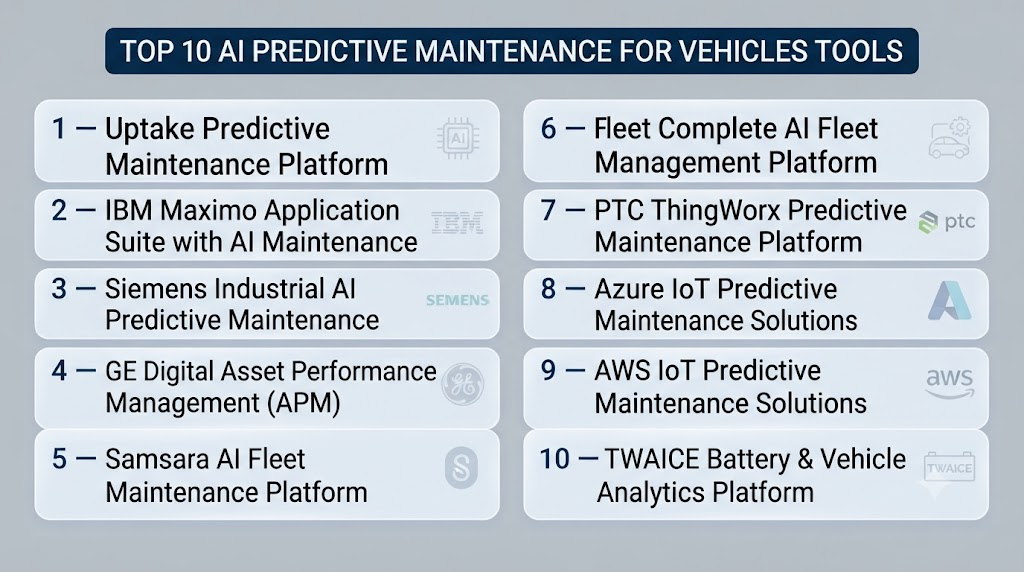
Top 10 AI Predictive Maintenance for Vehicles Tools
#1 — Uptake Predictive Maintenance Platform
One-line verdict: Best for enterprises using AI-driven analytics to predict industrial and vehicle maintenance needs.
Short description:
Uptake provides AI-powered predictive analytics solutions designed to help organizations monitor assets, identify potential failures, and improve maintenance decisions. Its technology supports transportation and industrial operations.
Standout Capabilities
- Predictive maintenance analytics.
- Asset health monitoring.
- Machine learning-based insights.
- Failure prediction workflows.
- Operational analytics.
- Condition monitoring.
- Fleet performance analysis.
- Maintenance optimization.
AI-Specific Depth
- Model support: Proprietary AI and analytics models.
- RAG / knowledge integration: N/A.
- Evaluation: Analytics validation processes vary by implementation.
- Guardrails: Operational controls depend on deployment.
- Observability: Asset monitoring and analytics capabilities available.
Pros
- Strong focus on predictive analytics.
- Supports large-scale asset operations.
- Helps reduce unexpected downtime.
Cons
- Enterprise-focused solution.
- Requires quality operational data.
- Pricing information is not publicly stated.
Security & Compliance
Specific certifications and compliance details are not publicly stated.
Deployment & Platforms
- Cloud-based platform.
- Enterprise environments.
- Connected asset systems.
Integrations & Ecosystem
Supports:
- Fleet systems.
- IoT platforms.
- Asset management systems.
- Data analytics platforms.
- Enterprise applications.
Pricing Model
Not publicly stated.
Best-Fit Scenarios
- Large transportation fleets.
- Industrial vehicle operations.
- Enterprise asset management programs.
#2 — IBM Maximo Application Suite with AI Maintenance
One-line verdict: Best for enterprises combining vehicle maintenance with broader asset management workflows.
Short description:
IBM Maximo provides asset management capabilities enhanced with AI and analytics. Organizations use it to manage maintenance operations, monitor equipment conditions, and improve asset reliability.
Standout Capabilities
- Asset lifecycle management.
- Predictive maintenance workflows.
- Maintenance scheduling.
- Asset health analytics.
- Work order management.
- AI-assisted insights.
- Enterprise reporting.
- Operational automation.
AI-Specific Depth
- Model support: Enterprise AI capabilities.
- RAG / knowledge integration: Depends on implementation.
- Evaluation: Customer-defined evaluation workflows.
- Guardrails: Enterprise AI governance features vary.
- Observability: Monitoring capabilities available.
Pros
- Strong enterprise asset management ecosystem.
- Supports complex maintenance operations.
- Integrates with business systems.
Cons
- Requires enterprise implementation.
- May be complex for smaller fleets.
- Pricing details are not publicly stated.
Security & Compliance
Security capabilities depend on deployment configuration.
Deployment & Platforms
- Cloud.
- Hybrid.
- Enterprise infrastructure.
Integrations & Ecosystem
Supports:
- Fleet management systems.
- ERP platforms.
- IoT systems.
- Maintenance applications.
- Enterprise workflows.
Pricing Model
Not publicly stated.
Best-Fit Scenarios
- Large transportation organizations.
- Enterprise fleet operations.
- Industrial mobility companies.
#3 — Siemens Industrial AI Predictive Maintenance
One-line verdict: Best for organizations combining vehicle maintenance with industrial IoT analytics.
Short description:
Siemens provides industrial software and AI analytics solutions that support predictive maintenance, equipment monitoring, and operational optimization. Its technologies can support vehicle and transportation asset management workflows.
Standout Capabilities
- Predictive maintenance analytics.
- Industrial IoT integration.
- Asset monitoring.
- Condition-based maintenance.
- Data-driven insights.
- Simulation support.
- Operational optimization.
- Enterprise analytics.
AI-Specific Depth
- Model support: AI analytics capabilities vary by implementation.
- RAG / knowledge integration: N/A.
- Evaluation: Industrial validation workflows supported.
- Guardrails: Depends on operational deployment.
- Observability: Monitoring capabilities available.
Pros
- Strong industrial technology expertise.
- Supports complex asset environments.
- Useful for large operations.
Cons
- Requires technical implementation.
- Not focused only on vehicle maintenance.
- Deployment complexity varies.
Security & Compliance
Security depends on selected solutions and configuration.
Deployment & Platforms
- Cloud.
- Industrial environments.
- Enterprise systems.
Integrations & Ecosystem
Supports:
- IoT platforms.
- Industrial systems.
- Asset management solutions.
- Analytics platforms.
Pricing Model
Not publicly stated.
Best-Fit Scenarios
- Large fleet operators.
- Industrial transportation companies.
- Enterprise maintenance teams.
#4 — GE Digital Asset Performance Management (APM)
One-line verdict: Best for enterprises managing complex vehicle fleets and asset-heavy transportation operations.
Short description:
GE Digital Asset Performance Management provides AI-powered analytics and monitoring capabilities designed to improve asset reliability and maintenance decisions. Organizations use these solutions to analyze equipment health, identify risks, and optimize maintenance strategies.
Standout Capabilities
- Asset health monitoring.
- Predictive maintenance analytics.
- Failure risk identification.
- Condition monitoring.
- Operational performance insights.
- Maintenance optimization.
- Industrial data analysis.
- Reliability management.
AI-Specific Depth
- Model support: Proprietary analytics and AI capabilities.
- RAG / knowledge integration: N/A.
- Evaluation: Performance validation depends on implementation.
- Guardrails: Operational safety controls vary by deployment.
- Observability: Asset monitoring and analytics capabilities available.
Pros
- Strong asset performance expertise.
- Suitable for large operational environments.
- Helps improve maintenance planning.
Cons
- Enterprise-focused solution.
- Requires significant data integration.
- Pricing details are not publicly stated.
Security & Compliance
Specific certifications and compliance information are not publicly stated.
Deployment & Platforms
- Cloud environments.
- Enterprise systems.
- Industrial platforms.
Integrations & Ecosystem
Supports:
- IoT platforms.
- Asset management systems.
- Fleet data sources.
- Enterprise analytics tools.
- Maintenance workflows.
Pricing Model
Not publicly stated.
Best-Fit Scenarios
- Large transportation organizations.
- Industrial fleets.
- Asset-intensive businesses.
#5 — Samsara AI Fleet Maintenance Platform
One-line verdict: Best for fleet operators needing connected vehicle monitoring and predictive maintenance insights.
Short description:
Samsara provides connected operations solutions that combine vehicle telematics, IoT data, and analytics to help organizations monitor fleet performance. Its platform supports vehicle health tracking, maintenance workflows, and operational visibility.
Standout Capabilities
- Vehicle telematics.
- Fleet health monitoring.
- Maintenance alerts.
- Driver behavior analysis.
- Vehicle diagnostics.
- Real-time fleet visibility.
- Operational reporting.
- Connected fleet management.
AI-Specific Depth
- Model support: Proprietary analytics and AI capabilities.
- RAG / knowledge integration: N/A.
- Evaluation: Analytics performance evaluation varies by deployment.
- Guardrails: Operational controls depend on configuration.
- Observability: Fleet monitoring dashboards available.
Pros
- Strong fleet management ecosystem.
- Real-time vehicle visibility.
- Easy integration with fleet operations.
Cons
- Requires connected vehicle hardware.
- Advanced predictive capabilities vary by use case.
- Pricing is not publicly stated.
Security & Compliance
Security capabilities depend on implementation. Specific certifications are not publicly stated.
Deployment & Platforms
- Cloud-based platform.
- Web applications.
- Mobile applications.
- Vehicle-connected devices.
Integrations & Ecosystem
Supports:
- Vehicle sensors.
- Fleet management systems.
- GPS platforms.
- Maintenance workflows.
- Business applications.
Pricing Model
Not publicly stated.
Best-Fit Scenarios
- Commercial fleets.
- Logistics companies.
- Transportation operators.
#6 — Fleet Complete AI Fleet Management Platform
One-line verdict: Best for organizations combining fleet tracking with maintenance optimization workflows.
Short description:
Fleet Complete provides fleet management and telematics solutions that help organizations monitor vehicles, track assets, and improve operational efficiency. Its analytics capabilities support maintenance planning and vehicle monitoring.
Standout Capabilities
- GPS fleet tracking.
- Vehicle monitoring.
- Maintenance notifications.
- Asset tracking.
- Fleet analytics.
- Driver performance insights.
- Operational dashboards.
- Telematics integration.
AI-Specific Depth
- Model support: Analytics capabilities vary by implementation.
- RAG / knowledge integration: N/A.
- Evaluation: Reporting and analytics available.
- Guardrails: Depends on configuration.
- Observability: Fleet monitoring capabilities available.
Pros
- Suitable for various fleet sizes.
- Strong tracking capabilities.
- Supports operational improvement.
Cons
- Predictive AI capabilities may vary.
- Requires telematics deployment.
- Pricing information is not publicly stated.
Security & Compliance
Security information depends on deployment configuration.
Deployment & Platforms
- Cloud platform.
- Mobile applications.
- Vehicle-connected systems.
Integrations & Ecosystem
Supports:
- GPS devices.
- Fleet platforms.
- Maintenance systems.
- Business software.
- Asset management tools.
Pricing Model
Not publicly stated.
Best-Fit Scenarios
- Commercial fleets.
- Service businesses.
- Transportation companies.
#7 — PTC ThingWorx Predictive Maintenance Platform
One-line verdict: Best for organizations building IoT-powered vehicle monitoring and predictive analytics systems.
Short description:
PTC ThingWorx provides an industrial IoT platform that helps organizations connect assets, analyze data, and create predictive maintenance workflows. It supports connected vehicle and equipment monitoring applications.
Standout Capabilities
- IoT connectivity.
- Sensor data processing.
- Predictive analytics.
- Asset monitoring.
- Digital twin support.
- Data visualization.
- Workflow automation.
- Industrial application development.
AI-Specific Depth
- Model support: Supports AI and analytics integrations.
- RAG / knowledge integration: N/A.
- Evaluation: Customer-defined analytics evaluation.
- Guardrails: Application-specific controls.
- Observability: IoT monitoring capabilities available.
Pros
- Strong IoT ecosystem.
- Flexible customization options.
- Supports connected asset applications.
Cons
- Requires technical expertise.
- Not a ready-made vehicle maintenance solution.
- Implementation can be complex.
Security & Compliance
Security depends on deployment architecture.
Deployment & Platforms
- Cloud.
- Edge.
- Enterprise environments.
Integrations & Ecosystem
Supports:
- IoT devices.
- Vehicle sensors.
- Analytics platforms.
- Enterprise applications.
- Digital twin systems.
Pricing Model
Not publicly stated.
Best-Fit Scenarios
- Connected vehicle projects.
- Industrial fleets.
- IoT-based maintenance programs.
#8 — Azure IoT Predictive Maintenance Solutions
One-line verdict: Best for enterprises building customized AI vehicle maintenance systems using cloud infrastructure.
Short description:
Microsoft Azure provides cloud, IoT, and machine learning capabilities that organizations can use to create predictive maintenance solutions. Companies can build custom vehicle monitoring workflows using connected data sources.
Standout Capabilities
- IoT data processing.
- Machine learning workflows.
- Predictive analytics.
- Cloud-scale infrastructure.
- Vehicle data integration.
- Digital monitoring.
- AI model deployment.
- Enterprise security tools.
AI-Specific Depth
- Model support: Supports custom AI and machine learning models.
- RAG / knowledge integration: Depends on implementation.
- Evaluation: Organizations create custom evaluation pipelines.
- Guardrails: Cloud AI governance capabilities available depending on configuration.
- Observability: Cloud monitoring tools available.
Pros
- Highly customizable.
- Strong enterprise cloud ecosystem.
- Supports large-scale vehicle data processing.
Cons
- Requires AI and cloud expertise.
- Not a dedicated vehicle maintenance product.
- Implementation requires development resources.
Security & Compliance
Security depends on selected services and configuration.
Deployment & Platforms
- Cloud.
- Hybrid.
- Edge environments.
Integrations & Ecosystem
Supports:
- IoT platforms.
- Machine learning tools.
- Fleet systems.
- Data pipelines.
- Enterprise applications.
Pricing Model
Usage-based cloud pricing.
Best-Fit Scenarios
- Enterprise fleets.
- Automotive technology companies.
- Custom AI maintenance solutions.
#9 — AWS IoT Predictive Maintenance Solutions
One-line verdict: Best for organizations developing scalable AI-driven vehicle monitoring applications.
Short description:
AWS provides IoT, analytics, and machine learning services that enable organizations to build predictive maintenance solutions. These services support connected vehicle data processing and AI model development.
Standout Capabilities
- IoT device connectivity.
- Machine learning workflows.
- Data analytics.
- Vehicle monitoring.
- Cloud processing.
- Predictive modeling.
- Automation workflows.
- Enterprise scalability.
AI-Specific Depth
- Model support: Custom AI and ML models supported.
- RAG / knowledge integration: Depends on implementation.
- Evaluation: Customer-defined evaluation methods.
- Guardrails: Cloud security and AI governance features vary.
- Observability: Cloud monitoring available.
Pros
- Flexible cloud infrastructure.
- Strong developer ecosystem.
- Supports large-scale deployments.
Cons
- Requires technical implementation.
- Not a complete maintenance platform.
- Costs depend on usage.
Security & Compliance
Security depends on architecture and selected services.
Deployment & Platforms
- Cloud.
- Hybrid.
- Edge-connected systems.
Integrations & Ecosystem
Supports:
- IoT devices.
- Vehicle sensors.
- AI services.
- Data platforms.
- Fleet applications.
Pricing Model
Usage-based pricing.
Best-Fit Scenarios
- Large fleet technology projects.
- Automotive AI development.
- Connected vehicle platforms.
#10 — TWAICE Battery & Vehicle Analytics Platform
One-line verdict: Best for organizations using AI analytics to monitor EV battery-related vehicle maintenance.
Short description:
TWAICE provides battery analytics solutions that help organizations understand battery performance, degradation, and lifecycle behavior. These capabilities support predictive maintenance strategies for electric vehicles.
Standout Capabilities
- Battery health monitoring.
- Battery degradation prediction.
- Lifecycle analytics.
- EV performance insights.
- Predictive maintenance support.
- Battery data analysis.
- Fleet battery monitoring.
- Performance optimization.
AI-Specific Depth
- Model support: Proprietary battery analytics models.
- RAG / knowledge integration: N/A.
- Evaluation: Battery analytics validation workflows supported.
- Guardrails: Safety controls depend on application.
- Observability: Battery monitoring dashboards available.
Pros
- Specialized battery intelligence capabilities.
- Useful for EV maintenance planning.
- Supports lifecycle optimization.
Cons
- Focused mainly on battery analytics.
- Requires battery data access.
- Pricing information is not publicly stated.
Security & Compliance
Specific certifications and compliance details are not publicly stated.
Deployment & Platforms
- Cloud-based platform.
- Connected vehicle environments.
- Enterprise analytics systems.
Integrations & Ecosystem
Supports:
- Battery management systems.
- EV platforms.
- Fleet solutions.
- Data analytics workflows.
Pricing Model
Not publicly stated.
Best-Fit Scenarios
- EV fleet operators.
- Battery-focused maintenance teams.
- Electric vehicle manufacturers.
Comparison Table: Top 10 AI Predictive Maintenance for Vehicles Tools
| Tool Name | Best For | Deployment | Model Flexibility | Strength | Watch-Out | Public Rating |
|---|---|---|---|---|---|---|
| Uptake Predictive Maintenance Platform | Enterprise fleet analytics | Cloud | Proprietary AI models | AI-driven failure prediction | Requires operational data | N/A |
| IBM Maximo Application Suite with AI Maintenance | Enterprise asset management | Cloud / Hybrid | Enterprise AI workflows | Maintenance management ecosystem | Complex implementation | N/A |
| Siemens Industrial AI Predictive Maintenance | Industrial vehicle operations | Cloud / Enterprise | AI analytics models | Industrial IoT capabilities | Requires technical expertise | N/A |
| GE Digital Asset Performance Management | Large asset-heavy organizations | Cloud | Proprietary analytics | Asset reliability optimization | Enterprise-focused | N/A |
| Samsara AI Fleet Maintenance Platform | Commercial fleet operators | Cloud | Proprietary analytics | Connected fleet monitoring | Requires hardware integration | N/A |
| Fleet Complete AI Fleet Management | Fleet tracking and maintenance teams | Cloud | Analytics-based | Fleet visibility | AI depth varies | N/A |
| PTC ThingWorx Predictive Maintenance | IoT-based vehicle monitoring | Cloud / Edge | Flexible AI integration | IoT customization | Requires development skills | N/A |
| Azure IoT Predictive Maintenance Solutions | Enterprise AI development teams | Cloud / Hybrid | Custom AI models | Cloud scalability | Requires engineering resources | N/A |
| AWS IoT Predictive Maintenance Solutions | Developers building custom systems | Cloud / Edge | Custom ML models | Flexible infrastructure | Not ready-made solution | N/A |
| TWAICE Battery & Vehicle Analytics | EV battery maintenance | Cloud | Proprietary battery models | Battery intelligence | Limited non-EV use cases | N/A |
Scoring & Evaluation: Transparent Rubric
The following evaluation compares AI Predictive Maintenance for Vehicles tools based on practical factors including predictive accuracy, AI capabilities, integration flexibility, scalability, security, performance, and operational usability.
The scores are comparative indicators and may vary depending on vehicle type, data availability, business requirements, and deployment approach.
| Tool | Core Features | Reliability/Eval | Guardrails | Integrations | Ease | Perf/Cost | Security/Admin | Support | Weighted Total |
|---|---|---|---|---|---|---|---|---|---|
| Uptake Predictive Maintenance Platform | 9 | 9 | 8 | 9 | 8 | 8 | 8 | 9 | 8.55 |
| IBM Maximo Application Suite | 10 | 9 | 9 | 10 | 7 | 8 | 10 | 9 | 9.00 |
| Siemens Industrial AI Predictive Maintenance | 9 | 9 | 9 | 10 | 7 | 8 | 9 | 9 | 8.90 |
| GE Digital APM | 9 | 9 | 8 | 9 | 7 | 8 | 9 | 9 | 8.65 |
| Samsara AI Fleet Maintenance | 9 | 8 | 8 | 9 | 9 | 8 | 8 | 9 | 8.60 |
| Fleet Complete AI Fleet Management | 8 | 8 | 8 | 8 | 9 | 8 | 8 | 8 | 8.15 |
| PTC ThingWorx Predictive Maintenance | 9 | 9 | 8 | 10 | 7 | 8 | 9 | 9 | 8.75 |
| Azure IoT Predictive Maintenance Solutions | 9 | 9 | 9 | 10 | 7 | 9 | 10 | 9 | 9.00 |
| AWS IoT Predictive Maintenance Solutions | 9 | 9 | 9 | 10 | 7 | 9 | 10 | 9 | 9.00 |
| TWAICE Battery & Vehicle Analytics | 9 | 9 | 8 | 9 | 8 | 8 | 8 | 9 | 8.60 |
Top 3 for Enterprise
1. IBM Maximo Application Suite with AI Maintenance
Best suited for large organizations managing complex vehicle assets and maintenance operations.
2. AWS IoT Predictive Maintenance Solutions
Strong option for enterprises building customized AI maintenance platforms with cloud infrastructure.
3. Azure IoT Predictive Maintenance Solutions
Suitable for organizations requiring scalable AI, IoT, and enterprise integration capabilities.
Top 3 for SMB
1. Samsara AI Fleet Maintenance Platform
Best for businesses needing connected fleet monitoring and maintenance visibility.
2. Fleet Complete AI Fleet Management
Useful for smaller fleets requiring tracking and operational improvement.
3. TWAICE Battery & Vehicle Analytics
Suitable for EV-focused businesses managing battery health and vehicle performance.
Top 3 for Developers
1. AWS IoT Predictive Maintenance Solutions
Provides flexible infrastructure for developers creating custom predictive maintenance applications.
2. Azure IoT Predictive Maintenance Solutions
Strong choice for building AI-powered vehicle monitoring workflows.
3. PTC ThingWorx Predictive Maintenance Platform
Useful for developers working on IoT-connected vehicle solutions.
Which AI Predictive Maintenance for Vehicles Tool Is Right for You?
Selecting the right AI Predictive Maintenance platform depends on your fleet size, vehicle complexity, available data sources, and maintenance objectives.
Different organizations require different approaches. A logistics company may need fleet monitoring, while an automotive manufacturer may require advanced engineering analytics.
Solo / Freelancer
Individual developers and researchers usually need flexible tools for experimentation and application development.
Recommended options:
- Cloud-based AI and IoT platforms.
- Developer-focused analytics tools.
- Open machine learning frameworks.
Focus areas:
- API availability.
- Data accessibility.
- Model customization.
- Documentation quality.
- Development flexibility.
SMB
Small and medium businesses should prioritize simple deployment and operational improvements.
Recommended options:
- Samsara AI Fleet Maintenance.
- Fleet Complete.
- TWAICE for EV-focused operations.
Focus areas:
- Easy setup.
- Fleet visibility.
- Maintenance alerts.
- Cost reduction.
- Driver and vehicle monitoring.
Mid-Market
Growing transportation companies need scalable analytics and better system integration.
Recommended options:
- Uptake Predictive Maintenance.
- GE Digital APM.
- PTC ThingWorx.
Focus areas:
- Predictive analytics.
- IoT connectivity.
- Maintenance automation.
- Fleet performance improvement.
Enterprise
Large organizations require advanced AI capabilities, security controls, and integration with existing systems.
Recommended options:
- IBM Maximo Application Suite.
- AWS IoT Predictive Maintenance Solutions.
- Azure IoT Predictive Maintenance Solutions.
Focus areas:
- Large-scale data processing.
- AI governance.
- Enterprise security.
- Custom workflows.
- Multi-fleet management.
Regulated Industries
Organizations managing transportation infrastructure should prioritize:
- Data security.
- Audit capabilities.
- Access control.
- Reliable prediction validation.
- Human review for critical maintenance decisions.
Recommended approach:
- Review vehicle data protection practices.
- Validate AI recommendations before automated actions.
- Maintain maintenance approval workflows.
- Monitor model performance continuously.
Budget vs Premium
Budget-focused approach
Prioritize:
- Fleet monitoring basics.
- Cloud subscriptions.
- Simple predictive alerts.
- Existing telematics integration.
Suitable options:
- Samsara.
- Fleet Complete.
- Cloud-based analytics tools.
Premium approach
Prioritize:
- Advanced AI models.
- Enterprise integrations.
- Digital twins.
- Large-scale predictive analytics.
Suitable options:
- IBM Maximo.
- Siemens solutions.
- AWS and Azure AI platforms.
Build vs Buy: When to DIY
Build internally when:
- You have AI engineering expertise.
- You collect large amounts of vehicle data.
- You need custom prediction models.
- You require complete control over algorithms.
Buy a platform when:
- You need faster implementation.
- You want proven maintenance workflows.
- You lack AI infrastructure.
- You require vendor support.
A hybrid approach is often effective. Organizations can use commercial fleet platforms while developing custom AI models for specific vehicle conditions.
Implementation Playbook: 30 / 60 / 90 Days
First 30 Days: Pilot and Define Success Metrics
Main objectives:
- Understand current maintenance challenges.
- Select vehicles for testing.
- Define prediction goals.
Key activities:
- Collect vehicle sensor data.
- Analyze maintenance history.
- Identify common failure patterns.
- Establish baseline performance.
AI-specific tasks:
- Prepare training datasets.
- Define evaluation metrics.
- Test anomaly detection models.
- Identify missing data sources.
First 60 Days: Integration and Model Improvement
Main objectives:
- Improve prediction accuracy.
- Connect operational systems.
- Prepare wider adoption.
Key activities:
- Integrate telematics systems.
- Connect maintenance platforms.
- Train maintenance teams.
- Validate AI recommendations.
AI-specific tasks:
- Build evaluation workflows.
- Monitor prediction errors.
- Test different vehicle conditions.
- Maintain model version tracking.
First 90 Days: Scale and Governance
Main objectives:
- Expand predictive maintenance.
- Improve operational efficiency.
- Establish AI governance.
Key activities:
- Deploy across more vehicles.
- Automate maintenance workflows.
- Improve reporting.
- Optimize operational costs.
AI-specific tasks:
- Monitor model drift.
- Update training data.
- Review prediction accuracy.
- Establish AI incident processes.
- Maintain governance documentation.
Common Mistakes & How to Avoid Them
- Implementing AI without enough vehicle data.
- Ignoring data quality issues.
- Using outdated maintenance records.
- Failing to integrate sensor data.
- Automating maintenance decisions without human review.
- Ignoring vehicle-specific conditions.
- Choosing tools without scalability planning.
- Overlooking cybersecurity risks.
- Not monitoring model performance.
- Ignoring technician feedback.
- Expecting AI to replace maintenance expertise.
- Failing to define success metrics.
- Not updating AI models regularly.
- Selecting platforms without integration support.
FAQs
What is AI Predictive Maintenance for Vehicles?
AI Predictive Maintenance uses artificial intelligence to analyze vehicle data and predict possible failures before they happen.
How does AI predict vehicle failures?
AI analyzes sensor readings, maintenance history, driving patterns, and operational data to identify unusual behavior.
Can AI reduce vehicle maintenance costs?
Yes. Predictive maintenance can reduce unexpected failures and improve service planning.
What data is needed for predictive maintenance?
Common data sources include vehicle sensors, telematics, diagnostics, maintenance records, and operational information.
Is AI predictive maintenance useful for fleets?
Yes. Fleet operators use AI to improve vehicle availability and reduce downtime.
Can AI work with electric vehicles?
Yes. AI can analyze EV batteries, motors, charging behavior, and other vehicle systems.
Does predictive maintenance replace technicians?
No. AI supports technicians by providing insights and recommendations.
Are AI maintenance systems expensive?
Costs vary based on fleet size, software capabilities, integrations, and deployment requirements.
Can small businesses use AI maintenance tools?
Yes. Many fleet platforms support smaller vehicle operations.
How accurate are AI maintenance predictions?
Accuracy depends on data quality, model performance, vehicle conditions, and validation processes.
Are vehicle AI maintenance systems secure?
Security depends on implementation. Organizations should review encryption, access controls, and data policies.
How should companies evaluate AI maintenance tools?
Companies should test prediction accuracy, integration capabilities, usability, security, and operational impact.
Conclusion
AI Predictive Maintenance for Vehicles is transforming how organizations manage vehicle reliability, maintenance planning, and fleet operations. By combining artificial intelligence, sensor data, and predictive analytics, these systems help reduce unexpected failures, improve efficiency, and extend vehicle lifespan.The best solution depends on organizational requirements. Small fleets may benefit from connected fleet platforms, while large enterprises may require advanced AI infrastructure and asset management systems.Successful adoption requires accurate data, proper evaluation methods, secure implementation, and continuous improvement. Organizations that strategically adopt AI predictive maintenance can create more reliable, efficient, and cost-effective vehicle operations.

Find Trusted Cardiac Hospitals
Compare heart hospitals by city and services — all in one place.
Explore Hospitals