
Introduction
AI Building Energy Optimization refers to the use of artificial intelligence systems to intelligently manage and reduce energy consumption in commercial and residential buildings. These platforms analyze HVAC systems, lighting, occupancy patterns, weather data, and IoT sensor inputs to optimize energy usage while maintaining comfort, safety, and operational efficiency.
In 2026 and beyond, buildings are becoming intelligent energy ecosystems. Rising energy costs, sustainability mandates, ESG reporting requirements, and net-zero targets are pushing organizations to adopt AI-driven optimization systems. Traditional building management systems (BMS) are no longer sufficient due to their static and rule-based nature.
Modern AI building optimization platforms dynamically adjust heating, cooling, ventilation, lighting, and power usage in real time using machine learning models and predictive analytics.
Key real-world use cases:
- HVAC energy optimization in commercial buildings
- Smart lighting control based on occupancy
- Predictive maintenance of HVAC systems
- Energy cost reduction in office buildings
- Smart campus and university energy management
- Hospital energy optimization with patient comfort balancing
- Industrial facility energy efficiency optimization
Key evaluation criteria:
- Real-time building energy monitoring capability
- HVAC and lighting system integration
- Occupancy detection and prediction accuracy
- Weather-aware energy optimization
- Predictive maintenance support
- Edge AI deployment for building controllers
- Scalability across multiple buildings
- Integration with BMS/IoT platforms
- Energy cost reduction effectiveness
- ESG and sustainability reporting features
Best for: Commercial real estate, smart buildings, corporate campuses, hospitals, universities, industrial facilities, and government infrastructure.
Not ideal for: Small standalone buildings without smart meters or IoT systems.
What’s Changed in AI Building Energy Optimization in 2026+
- Shift from rule-based building automation to AI-driven autonomous energy systems
- Increased use of occupancy prediction models using computer vision and sensor fusion
- Adoption of digital twin buildings for energy simulation and optimization
- Strong integration of HVAC systems with real-time AI control loops
- Expansion of edge AI controllers inside smart thermostats and building gateways
- Use of foundation models for energy demand forecasting in buildings
- Strong focus on carbon-aware building operations and ESG reporting
- Integration with renewable energy and battery storage systems
- Real-time coordination between multiple buildings in a campus ecosystem
- Predictive maintenance for HVAC, chillers, and electrical systems
- Automated compliance reporting for energy regulations
- Use of multi-agent AI systems for distributed building control
Quick Buyer Checklist (Building Energy Optimization)
Before selecting a platform, evaluate:
- HVAC system compatibility
- Lighting and occupancy sensor integration
- Real-time optimization speed
- Edge AI support for building controllers
- Multi-building scalability
- Energy savings measurement accuracy
- Predictive maintenance capability
- Integration with existing BMS systems
- Weather and occupancy forecasting support
- ESG and reporting dashboards
- Security and data privacy controls
- Vendor lock-in risk
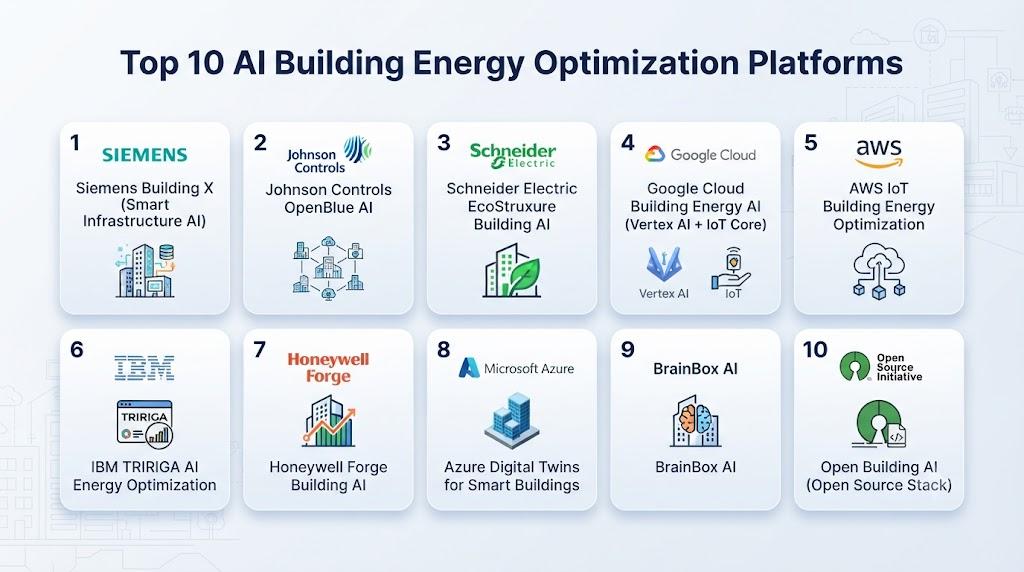
Top 10 AI Building Energy Optimization Platforms
#1 — Siemens Building X (Smart Infrastructure AI)
One-line verdict: Best for enterprise-grade smart building energy optimization and automation.
Short description (2–3 lines):
Siemens Building X provides AI-powered building management and energy optimization for commercial and industrial facilities, integrating HVAC, lighting, and occupancy systems.
Standout Capabilities
- AI-driven HVAC optimization
- Smart lighting control systems
- Occupancy-based energy adjustment
- Predictive maintenance for building systems
- Digital twin building modeling
- Multi-building energy management
AI-Specific Depth
- Model support: Proprietary industrial AI models
- RAG / knowledge integration: Building sensor + BMS data
- Evaluation: Energy efficiency KPIs
- Guardrails: Operational safety constraints
- Observability: Facility energy dashboards
Pros
- Strong industrial reliability
- Deep building automation expertise
- Scalable enterprise deployment
Cons
- Complex implementation
- High deployment cost
Security & Compliance
- Enterprise-grade security
- Industrial compliance support
Deployment & Platforms
- Cloud + edge + on-premise
Integrations & Ecosystem
- BMS systems
- HVAC controllers
- Smart grid systems
Pricing Model
Enterprise licensing
Best-Fit Scenarios
- Corporate campuses
- Smart cities
- Industrial facilities
#2 — Johnson Controls OpenBlue AI
One-line verdict: Best for intelligent building automation and HVAC optimization.
Short description:
OpenBlue uses AI to optimize energy consumption in buildings while maintaining occupant comfort and operational efficiency.
Standout Capabilities
- HVAC optimization and automation
- Energy consumption analytics
- Predictive maintenance for building systems
- Occupancy-based energy control
- Smart facility monitoring
AI-Specific Depth
- Model support: Proprietary AI models
- RAG / knowledge integration: Building telemetry data
- Evaluation: Energy efficiency metrics
- Guardrails: Facility safety constraints
- Observability: Real-time dashboards
Pros
- Strong HVAC expertise
- Good enterprise adoption
- Reliable building automation
Cons
- Limited developer flexibility
- Ecosystem dependency
Security & Compliance
- Enterprise security controls
Deployment & Platforms
- Cloud + hybrid
Integrations & Ecosystem
- BMS systems
- IoT sensors
Pricing Model
Enterprise subscription
Best-Fit Scenarios
- Commercial buildings
- Hospitals
- Universities
#3 — Schneider Electric EcoStruxure Building AI
One-line verdict: Best for energy efficiency and sustainability-focused building optimization.
Short description:
Schneider Electric provides AI-powered building energy optimization focusing on sustainability and cost reduction.
Standout Capabilities
- Smart HVAC optimization
- Energy usage analytics
- Carbon footprint tracking
- Predictive maintenance
- Edge AI control systems
AI-Specific Depth
- Model support: Industrial AI models
- RAG / knowledge integration: Facility data integration
- Evaluation: Sustainability KPIs
- Guardrails: Energy safety rules
- Observability: Energy dashboards
Pros
- Strong sustainability focus
- Excellent edge computing support
- Energy efficiency leader
Cons
- Less flexible for developers
- Industrial focus
Security & Compliance
- Enterprise-grade compliance
Deployment & Platforms
- Edge + hybrid
Integrations & Ecosystem
- BMS systems
- Smart grid platforms
Pricing Model
Enterprise pricing
Best-Fit Scenarios
- Smart buildings
- Industrial facilities
- Sustainability programs
#4 — Google Cloud Building Energy AI (Vertex AI + IoT Core)
One-line verdict: Best for data-driven building energy optimization at scale.
Standout Capabilities
- Predictive energy modeling
- Occupancy-based optimization
- HVAC load forecasting
- Multi-building analytics
- IoT integration for sensors
AI-Specific Depth
- Model support: Vertex AI + ML models
- RAG / knowledge integration: IoT + building datasets
- Evaluation: Model drift monitoring
- Guardrails: Limited built-in
- Observability: Strong analytics dashboards
Pros
- Highly scalable
- Strong AI ecosystem
- Advanced analytics
Cons
- Requires ML expertise
- Complex setup
Security & Compliance
- Enterprise cloud security
Deployment & Platforms
- Cloud-native
Integrations & Ecosystem
- BigQuery
- Vertex AI
- IoT platforms
Pricing Model
Usage-based
Best-Fit Scenarios
- Smart campuses
- Large enterprises
- Multi-building portfolios
#5 — AWS IoT Building Energy Optimization
One-line verdict: Best for scalable IoT-driven building energy control systems.
Standout Capabilities
- Real-time energy optimization
- HVAC and lighting control
- Predictive maintenance
- IoT sensor integration
- Multi-building management
AI-Specific Depth
- Model support: AWS ML models
- RAG / knowledge integration: IoT datasets
- Evaluation: Energy KPIs
- Guardrails: IAM policies
- Observability: CloudWatch dashboards
Pros
- Strong IoT ecosystem
- Scalable infrastructure
- Reliable performance
Cons
- Requires AWS expertise
- Limited building-specific UX
Security & Compliance
- Enterprise-grade AWS security
Deployment & Platforms
- Cloud-native
Integrations & Ecosystem
- AWS IoT Core
- Lambda
- Energy systems
Pricing Model
Pay-per-use
Best-Fit Scenarios
- Smart buildings
- Enterprise campuses
- Industrial facilities
#6 — IBM TRIRIGA AI Energy Optimization
One-line verdict: Best for enterprise facility management with AI energy intelligence.
Standout Capabilities
- Facility energy optimization
- Space utilization analytics
- Predictive maintenance
- ESG reporting dashboards
AI-Specific Depth
- Model support: IBM AI models
- RAG / knowledge integration: Facility datasets
- Evaluation: Performance KPIs
- Guardrails: Enterprise governance
- Observability: Analytics dashboards
Pros
- Strong enterprise facility management
- Good ESG reporting tools
- Reliable analytics
Cons
- Complex system
- Not lightweight
Security & Compliance
- Strong enterprise governance
Deployment & Platforms
- Cloud-based IBM systems
Integrations & Ecosystem
- Facility management systems
- IoT platforms
Pricing Model
Enterprise contract
Best-Fit Scenarios
- Corporate real estate
- Government buildings
- Large enterprises
#7 — Honeywell Forge Building AI
One-line verdict: Best for industrial-grade building automation and energy control.
Standout Capabilities
- HVAC optimization
- Energy performance analytics
- Predictive maintenance
- Industrial building control
AI-Specific Depth
- Model support: Proprietary AI models
- RAG / knowledge integration: Building telemetry
- Evaluation: Efficiency KPIs
- Guardrails: Operational safety rules
- Observability: Facility dashboards
Pros
- Strong industrial reliability
- HVAC expertise
- Good automation
Cons
- Less flexible
- Enterprise-focused
Security & Compliance
- Industrial-grade controls
Deployment & Platforms
- Hybrid systems
Integrations & Ecosystem
- HVAC systems
- Building automation
Pricing Model
Enterprise licensing
Best-Fit Scenarios
- Industrial buildings
- Airports
- Hospitals
#8 — Azure Digital Twins for Smart Buildings
One-line verdict: Best for digital twin-based building energy optimization.
Standout Capabilities
- Digital twin building modeling
- Energy simulation
- Predictive optimization
- IoT integration
- Occupancy modeling
AI-Specific Depth
- Model support: Azure ML + digital twin models
- RAG / knowledge integration: IoT + BMS data
- Evaluation: Model monitoring
- Guardrails: Enterprise policies
- Observability: Azure dashboards
Pros
- Strong digital twin capability
- Excellent IoT integration
- Scalable architecture
Cons
- Complex setup
- Requires Azure ecosystem
Security & Compliance
- Enterprise compliance support
Deployment & Platforms
- Cloud + hybrid
Integrations & Ecosystem
- Azure IoT Hub
- BMS systems
Pricing Model
Usage-based
Best-Fit Scenarios
- Smart cities
- Corporate campuses
- Government infrastructure
#9 — BrainBox AI
One-line verdict: Best for autonomous HVAC optimization using AI.
Standout Capabilities
- Autonomous HVAC control
- Energy consumption optimization
- Predictive adjustments
- Real-time building intelligence
AI-Specific Depth
- Model support: Proprietary deep learning models
- RAG / knowledge integration: Building sensor data
- Evaluation: Energy savings KPIs
- Guardrails: Safety constraints
- Observability: Energy dashboards
Pros
- Strong HVAC optimization
- Easy deployment
- Real-time automation
Cons
- Limited scope
- HVAC-focused only
Security & Compliance
- Enterprise-grade security
Deployment & Platforms
- Cloud + edge
Integrations & Ecosystem
- HVAC systems
- Smart building sensors
Pricing Model
Subscription
Best-Fit Scenarios
- Commercial offices
- Retail buildings
- Small-to-mid enterprises
#10 — Open Building AI (Open Source Stack)
One-line verdict: Best open-source framework for custom building energy optimization systems.
Standout Capabilities
- Custom energy optimization models
- IoT integration flexibility
- HVAC control logic customization
- Edge AI deployment
- Fully customizable architecture
AI-Specific Depth
- Model support: Open-source ML models
- RAG / knowledge integration: Fully custom
- Evaluation: Developer-defined
- Guardrails: None built-in
- Observability: Custom dashboards
Pros
- Maximum flexibility
- No vendor lock-in
- Ideal for innovation
Cons
- Requires expertise
- No enterprise support
Security & Compliance
- Depends on deployment
Deployment & Platforms
- Self-hosted / hybrid
Integrations & Ecosystem
- IoT systems
- HVAC controllers
- Smart building APIs
Pricing Model
Open-source
Best-Fit Scenarios
- Research projects
- Custom smart buildings
- Experimental AI systems
Comparison Table
| Tool Name | Best For | Deployment | Model Flexibility | Strength | Watch-Out | Public Rating |
|---|---|---|---|---|---|---|
| Siemens | Smart buildings | Hybrid | Proprietary | Reliability | Cost | N/A |
| Johnson Controls | HVAC optimization | Cloud/Hybrid | Proprietary | Automation | Limited flexibility | N/A |
| Schneider | Sustainability | Edge/Hybrid | Proprietary | Energy efficiency | Industrial focus | N/A |
| Google Cloud | Analytics | Cloud | Multi-model | Scalability | Complexity | N/A |
| AWS | IoT buildings | Cloud | ML models | Scalability | AWS dependency | N/A |
| IBM | Facility management | Cloud | Hybrid | ESG reporting | Complexity | N/A |
| Honeywell | Industrial buildings | Hybrid | Proprietary | HVAC control | Limited scope | N/A |
| Azure Digital Twins | Smart cities | Cloud/Hybrid | ML + digital twin | Simulation | Setup complexity | N/A |
| BrainBox AI | HVAC automation | Cloud | Proprietary | Real-time control | Narrow focus | N/A |
| Open Building AI | Custom systems | Self-hosted | Open-source | Flexibility | No support | N/A |
Scoring & Evaluation (Transparent Rubric)
| Tool | Core | Reliability | Guardrails | Integrations | Ease | Perf/Cost | Security/Admin | Support | Weighted Total |
|---|---|---|---|---|---|---|---|---|---|
| Siemens | 9 | 9 | 9 | 8 | 6 | 8 | 9 | 9 | 8.3 |
| Johnson Controls | 8 | 9 | 8 | 8 | 7 | 8 | 9 | 9 | 8.2 |
| Schneider | 8 | 8 | 8 | 8 | 7 | 8 | 8 | 8 | 8.0 |
| 9 | 9 | 8 | 9 | 8 | 8 | 8 | 8 | 8.4 | |
| AWS | 8 | 9 | 7 | 9 | 7 | 8 | 9 | 8 | 8.1 |
| IBM | 8 | 8 | 9 | 8 | 7 | 7 | 9 | 8 | 7.9 |
| Honeywell | 8 | 8 | 8 | 7 | 7 | 8 | 8 | 8 | 7.9 |
| Azure Digital Twins | 9 | 9 | 9 | 9 | 7 | 8 | 9 | 9 | 8.6 |
| BrainBox AI | 8 | 8 | 8 | 7 | 8 | 8 | 8 | 8 | 8.0 |
| Open Building AI | 8 | 7 | 6 | 7 | 6 | 9 | 6 | 7 | 7.2 |
Which Building Energy Optimization Tool Is Right for You?
Small Buildings / SMEs
Best fit: BrainBox AI, Schneider Electric
Focus: simplicity + HVAC efficiency
Mid-Sized Enterprises
Best fit: Johnson Controls, IBM, Honeywell
Focus: automation + facility management
Enterprise / Smart Cities
Best fit: Siemens, Azure Digital Twins, Google Cloud
Focus: scalability + integration
Developers / Custom Systems
Best fit: Open Building AI
Focus: flexibility + experimentation
Implementation Playbook (30 / 60 / 90 Days)
30 Days: Pilot
- Install IoT sensors
- Baseline energy usage tracking
- Define KPIs (energy savings, HVAC efficiency)
60 Days: Integration
- Connect HVAC + lighting systems
- Deploy AI optimization models
- Enable real-time dashboards
90 Days: Scale
- Expand across multiple buildings
- Automate energy controls
- Integrate ESG reporting
- Optimize multi-building coordination
Common Mistakes & How to Avoid Them
- Ignoring occupancy patterns
- Poor HVAC integration
- No real-time control loops
- Lack of IoT sensor calibration
- Over-reliance on cloud-only systems
- No predictive maintenance layer
- Weak cybersecurity controls
- Missing digital twin modeling
- Ignoring lighting optimization
- No ESG tracking integration
- Poor data quality management
- Lack of automation safeguards
- No multi-building coordination
- Vendor lock-in risks
FAQs
What is AI building energy optimization?
It is the use of AI systems to reduce and optimize energy usage in buildings using smart automation.
Why is it important?
It reduces energy costs and improves sustainability.
Does it work with HVAC systems?
Yes, HVAC optimization is a core use case.
Can it reduce electricity bills?
Yes, significantly in large buildings.
Is real-time control possible?
Yes, modern systems support real-time optimization.
What data is used?
IoT sensors, occupancy data, weather, and energy meters.
Is cloud required?
Not always; edge systems are common.
What is digital twin in buildings?
A virtual model of a building used for simulation and optimization.
Can it work in old buildings?
Yes, but requires sensor upgrades.
What is the biggest challenge?
System integration and data quality.
Who uses it most?
Commercial buildings, enterprises, and smart cities.
Is open-source viable?
Yes, but requires technical expertise.
Conclusion
AI Building Energy Optimization is transforming how modern buildings operate by enabling intelligent, real-time control of energy systems. It reduces costs, improves comfort, and supports sustainability goals across commercial and industrial infrastructure.The best solution depends on scale: industrial vendors dominate reliability, hyperscalers lead in analytics, and open-source systems provide maximum customization.

Find Trusted Cardiac Hospitals
Compare heart hospitals by city and services — all in one place.
Explore Hospitals