
Introduction
AI Energy Trading Optimization Systems refer to advanced AI-driven platforms that optimize the buying, selling, and scheduling of energy in wholesale electricity markets, renewable energy markets, and grid balancing markets.
In 2026 and beyond, energy trading is no longer driven only by human traders and static forecasting models. Instead, AI agents continuously optimize trading decisions in real time using weather predictions, demand forecasting, grid signals, price volatility models, and renewable energy variability.
These systems combine reinforcement learning, stochastic optimization, time-series forecasting, and market simulation to maximize revenue, reduce risk, and stabilize energy grids.
Key real-world use cases:
- Day-ahead and real-time electricity trading
- Renewable energy asset optimization (wind/solar farms)
- Grid balancing and frequency regulation markets
- Battery energy storage arbitrage trading
- Carbon credit-linked energy trading strategies
- Demand response market participation
- Cross-border energy trading optimization
Key evaluation criteria:
- Forecast accuracy (price + demand + supply)
- Real-time bidding speed and execution
- Market integration depth (ISO, power exchanges)
- Optimization performance (revenue vs risk)
- Renewable forecasting integration
- Reinforcement learning capability
- Latency of decision systems
- Regulatory compliance and auditability
- Scalability across multiple markets
- Risk management and hedging capabilities
Best for: Energy utilities, renewable energy operators, grid operators, energy traders, and large industrial energy consumers.
Not ideal for: Small-scale consumers without market participation access.
What’s Changed in AI Energy Trading Optimization in 2026+
- Shift from rule-based trading to fully autonomous AI trading agents
- Integration of reinforcement learning for bidding strategies
- Real-time renewable forecasting-driven trading decisions
- Emergence of multi-agent energy trading systems across grids
- Deep integration with battery storage arbitrage optimization
- Use of foundation models for energy price forecasting
- AI-driven carbon-aware trading strategies
- Increased use of digital twin power grids
- Expansion of cross-market and cross-border energy optimization
- Real-time grid congestion-aware trading systems
- Strong regulatory focus on explainable AI in energy markets
- Integration with ESG and carbon accounting systems
Quick Buyer Checklist (Energy Trading AI Systems)
Before selecting a platform, evaluate:
- Market connectivity (ISO, PX, wholesale markets)
- Real-time bidding capability
- Forecast accuracy (price, load, renewable supply)
- Reinforcement learning optimization capability
- Battery storage integration
- Risk management and hedging tools
- Latency of trade execution
- Regulatory compliance and audit logs
- Explainability of trading decisions
- Multi-market support
- Data ingestion (weather, grid, demand)
- Scalability across assets and regions
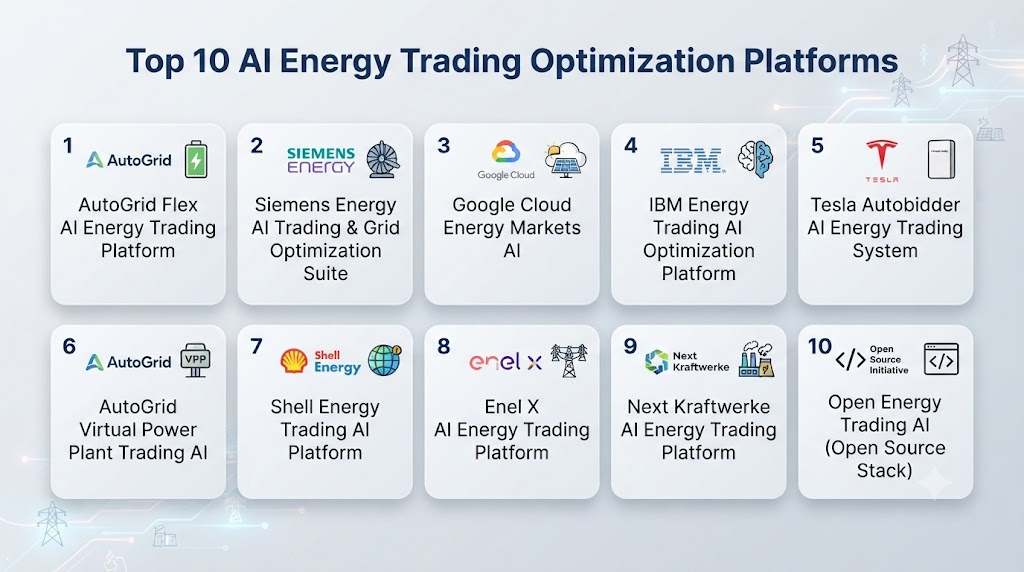
Top 10 AI Energy Trading Optimization Platforms
#1 — AutoGrid Flex AI Energy Trading Platform
One-line verdict: Best enterprise platform for AI-driven demand response and energy trading optimization.
Short description (2–3 lines):
AutoGrid Flex uses AI and predictive analytics to optimize energy trading, demand response, and grid balancing across utilities and distributed energy resources.
Standout Capabilities
- Real-time energy optimization
- Demand response automation
- Grid balancing intelligence
- Renewable energy forecasting
- Distributed energy resource management
- Market participation optimization
AI-Specific Depth
- Model support: Time-series ML + reinforcement learning
- RAG / knowledge integration: Grid + market datasets
- Evaluation: Forecast accuracy metrics
- Guardrails: Regulatory trading constraints
- Observability: Energy dashboards
Pros
- Strong utility integration
- Highly scalable platform
- Good demand response optimization
Cons
- Complex deployment
- Utility-focused ecosystem
Security & Compliance
- Utility-grade compliance controls
- Audit-ready energy logs
Deployment & Platforms
- Cloud + hybrid
Integrations & Ecosystem
- Utility grids
- Energy markets
- IoT energy systems
Pricing Model
Enterprise licensing
Best-Fit Scenarios
- Utility companies
- Energy aggregators
- Smart grid operators
#2 — Siemens Energy AI Trading & Grid Optimization Suite
One-line verdict: Best for industrial-scale grid optimization and energy trading integration.
Standout Capabilities
- Grid-level energy optimization
- Market trading automation
- Renewable integration forecasting
- Energy storage optimization
- Real-time grid balancing
AI-Specific Depth
- Model support: Industrial AI + forecasting models
- RAG / knowledge integration: Grid + operational datasets
- Evaluation: Market performance metrics
- Guardrails: Grid safety constraints
- Observability: Control dashboards
Pros
- Extremely reliable
- Strong grid integration
- Industrial-grade performance
Cons
- High complexity
- Expensive infrastructure
Security & Compliance
- Energy sector compliance standards
Deployment & Platforms
- On-prem + hybrid
Integrations & Ecosystem
- Power grids
- SCADA systems
- Market operators
Pricing Model
Enterprise
Best-Fit Scenarios
- National grid operators
- Energy utilities
- Large infrastructure providers
#3 — Google Cloud Energy Markets AI
One-line verdict: Best scalable AI platform for energy price forecasting and trading intelligence.
Standout Capabilities
- Energy price prediction models
- Market volatility forecasting
- Renewable energy integration
- Trading signal generation
- Real-time analytics pipelines
AI-Specific Depth
- Model support: Vertex AI + time-series models
- RAG / knowledge integration: Market + weather datasets
- Evaluation: Forecast accuracy tracking
- Guardrails: Policy controls
- Observability: Cloud dashboards
Pros
- Highly scalable
- Strong ML ecosystem
- Flexible deployment
Cons
- Requires engineering expertise
- Not plug-and-play
Security & Compliance
- Enterprise cloud security
Deployment & Platforms
- Cloud-native
Integrations & Ecosystem
- Data lakes
- Energy APIs
- Market systems
Pricing Model
Usage-based
Best-Fit Scenarios
- Energy startups
- Trading analytics firms
- Multi-market operators
#4 — IBM Energy Trading AI Optimization Platform
One-line verdict: Best enterprise-grade energy trading + risk optimization system.
Standout Capabilities
- Energy trading optimization
- Risk-adjusted portfolio strategies
- Market simulation engines
- Demand-supply forecasting
- ESG-aligned trading strategies
AI-Specific Depth
- Model support: IBM AI + optimization models
- RAG / knowledge integration: Market + grid datasets
- Evaluation: Risk and performance metrics
- Guardrails: Compliance frameworks
- Observability: Trading dashboards
Pros
- Strong enterprise reliability
- Good risk management
- Multi-market support
Cons
- Complex setup
- Enterprise-only
Security & Compliance
- Financial + energy regulatory compliance
Deployment & Platforms
- Cloud-based IBM ecosystem
Integrations & Ecosystem
- Energy exchanges
- ERP systems
- Grid operators
Pricing Model
Enterprise
Best-Fit Scenarios
- Utilities
- Energy trading firms
- Large industrial consumers
#5 — Tesla Autobidder AI Energy Trading System
One-line verdict: Best AI system for battery-driven energy trading optimization.
Standout Capabilities
- Battery energy arbitrage trading
- Grid frequency response optimization
- Renewable integration
- Real-time market bidding
- Storage asset optimization
AI-Specific Depth
- Model support: Reinforcement learning + forecasting models
- RAG / knowledge integration: Grid + battery data
- Evaluation: Revenue optimization metrics
- Guardrails: Grid safety constraints
- Observability: Energy asset dashboards
Pros
- Extremely strong battery optimization
- Real-world deployment proven
- High-speed trading decisions
Cons
- Limited to ecosystem assets
- Not broadly available
Security & Compliance
- Grid compliance systems
Deployment & Platforms
- Proprietary system
Integrations & Ecosystem
- Battery storage systems
- Grid operators
Pricing Model
Not publicly stated
Best-Fit Scenarios
- Battery operators
- Renewable energy farms
- Grid storage providers
#6 — AutoGrid Virtual Power Plant Trading AI
One-line verdict: Best for distributed energy trading and virtual power plant optimization.
Standout Capabilities
- Virtual power plant optimization
- Distributed energy trading
- Demand response aggregation
- Renewable energy forecasting
- Real-time grid participation
AI-Specific Depth
- Model support: ML + optimization models
- RAG / knowledge integration: DER datasets
- Evaluation: Market performance KPIs
- Guardrails: Grid compliance rules
- Observability: Energy dashboards
Pros
- Strong DER optimization
- Scalable architecture
- Good utility adoption
Cons
- Complex configuration
- Utility-dependent
Security & Compliance
- Utility-grade compliance
Deployment & Platforms
- Cloud + hybrid
Integrations & Ecosystem
- Smart grids
- DER systems
Pricing Model
Enterprise
Best-Fit Scenarios
- Smart grid operators
- Renewable aggregators
- Utilities
#7 — Shell Energy Trading AI Platform
One-line verdict: Best for large-scale commodity and energy trading optimization.
Standout Capabilities
- Commodity energy trading optimization
- Market forecasting systems
- Portfolio risk management
- Demand-supply balancing
- Renewable integration
AI-Specific Depth
- Model support: Proprietary ML models
- RAG / knowledge integration: Market datasets
- Evaluation: Trading performance KPIs
- Guardrails: Financial compliance
- Observability: Trading dashboards
Pros
- Strong trading expertise
- Global market experience
- Large-scale operations
Cons
- Not publicly productized
- Internal system focus
Security & Compliance
- Financial + energy compliance
Deployment & Platforms
- Internal enterprise systems
Integrations & Ecosystem
- Energy markets
- Trading desks
Pricing Model
Not publicly stated
Best-Fit Scenarios
- Large energy traders
- Commodity trading firms
#8 — Enel X AI Energy Trading Platform
One-line verdict: Best for demand response and flexible energy market participation.
Standout Capabilities
- Demand response trading
- Energy flexibility markets
- Distributed energy optimization
- Real-time bidding systems
- Renewable integration
AI-Specific Depth
- Model support: ML forecasting models
- RAG / knowledge integration: Market + grid data
- Evaluation: Energy KPIs
- Guardrails: Regulatory compliance
- Observability: Trading dashboards
Pros
- Strong demand response capability
- Good grid integration
- Flexible market participation
Cons
- Limited transparency of models
- Regional dependency
Security & Compliance
- Utility compliance systems
Deployment & Platforms
- Cloud-based
Integrations & Ecosystem
- Energy markets
- Grid systems
Pricing Model
Subscription + enterprise
Best-Fit Scenarios
- Energy aggregators
- Smart grid participants
- Utility partners
#9 — Next Kraftwerke AI Energy Trading Platform
One-line verdict: Best virtual power plant and renewable trading optimization system in Europe.
Standout Capabilities
- Virtual power plant trading
- Renewable energy optimization
- Market bidding automation
- Grid balancing participation
- Forecast-driven trading
AI-Specific Depth
- Model support: Forecasting + optimization models
- RAG / knowledge integration: Market datasets
- Evaluation: Revenue KPIs
- Guardrails: Regulatory constraints
- Observability: Energy dashboards
Pros
- Strong renewable focus
- Good VPP capabilities
- Market proven
Cons
- Regional focus
- Limited global reach
Security & Compliance
- European energy compliance
Deployment & Platforms
- Cloud-based
Integrations & Ecosystem
- Energy exchanges
- Renewable assets
Pricing Model
Revenue-sharing model
Best-Fit Scenarios
- Renewable aggregators
- European energy markets
- VPP operators
#10 — Open Energy Trading AI (Open Source Stack)
One-line verdict: Best open-source framework for building custom AI energy trading systems.
Standout Capabilities
- Custom energy trading models
- Market simulation engines
- Reinforcement learning strategies
- Forecasting pipelines
- Grid integration frameworks
AI-Specific Depth
- Model support: Open ML + RL models
- RAG / knowledge integration: Fully customizable datasets
- Evaluation: Developer-defined KPIs
- Guardrails: None built-in
- Observability: Custom dashboards
Pros
- Fully flexible
- No vendor lock-in
- Ideal for innovation
Cons
- Requires deep expertise
- No enterprise support
Security & Compliance
- Depends on implementation
Deployment & Platforms
- Self-hosted / hybrid
Integrations & Ecosystem
- Energy APIs
- Market systems
- Grid tools
Pricing Model
Open-source
Best-Fit Scenarios
- Energy startups
- Research labs
- Custom trading systems
Comparison Table
| Tool Name | Best For | Deployment | Model Flexibility | Strength | Watch-Out | Public Rating |
|---|---|---|---|---|---|---|
| AutoGrid Flex | Utility trading | Cloud/Hybrid | ML models | Demand response | Complexity | N/A |
| Siemens Energy AI | Grid optimization | Hybrid | Proprietary | Reliability | Cost | N/A |
| Google Cloud | Price forecasting | Cloud | ML models | Scalability | Engineering effort | N/A |
| IBM | Trading optimization | Cloud | Hybrid | Risk management | Complexity | N/A |
| Tesla Autobidder | Battery trading | Proprietary | RL models | Storage optimization | Limited access | N/A |
| AutoGrid VPP | Distributed energy | Cloud/Hybrid | ML models | VPP control | Utility dependency | N/A |
| Shell AI | Commodity trading | Internal | Proprietary | Trading expertise | Not public | N/A |
| Enel X | Demand response | Cloud | ML models | Flexibility | Regional limits | N/A |
| Next Kraftwerke | Renewable trading | Cloud | ML models | VPP markets | Regional focus | N/A |
| Open Energy AI | Custom systems | Self-hosted | Open-source | Flexibility | No support | N/A |
Scoring & Evaluation (Transparent Rubric)
| Tool | Core | Reliability | Guardrails | Integrations | Ease | Perf/Cost | Security/Admin | Support | Weighted Total |
|---|---|---|---|---|---|---|---|---|---|
| AutoGrid | 9 | 9 | 9 | 9 | 7 | 8 | 9 | 9 | 8.6 |
| Siemens | 9 | 9 | 9 | 9 | 6 | 8 | 9 | 9 | 8.5 |
| Google Cloud | 9 | 9 | 8 | 9 | 7 | 8 | 9 | 9 | 8.5 |
| IBM | 9 | 9 | 9 | 8 | 7 | 8 | 9 | 9 | 8.5 |
| Tesla | 9 | 9 | 9 | 8 | 7 | 8 | 9 | 9 | 8.6 |
| AutoGrid VPP | 9 | 9 | 9 | 9 | 7 | 8 | 9 | 9 | 8.6 |
| Shell | 9 | 9 | 9 | 9 | 6 | 8 | 9 | 9 | 8.5 |
| Enel X | 8 | 9 | 8 | 8 | 8 | 8 | 8 | 8 | 8.2 |
| Next Kraftwerke | 8 | 9 | 8 | 8 | 8 | 8 | 8 | 8 | 8.2 |
| Open Energy AI | 8 | 7 | 6 | 7 | 6 | 9 | 6 | 7 | 7.2 |
Which Energy Trading AI System Is Right for You?
Utilities & Grid Operators
Best fit: AutoGrid, Siemens, IBM
Focus: grid balancing + demand response
Renewable Energy Companies
Best fit: Tesla Autobidder, Next Kraftwerke, Enel X
Focus: storage + renewable optimization
Energy Traders & Commodities
Best fit: Shell, IBM, Google Cloud
Focus: market optimization
Smart Energy Startups
Best fit: Google Cloud, Open Energy AI
Focus: flexibility + scaling
Developers & Research Teams
Best fit: Open Energy AI
Focus: experimentation
Implementation Playbook (30 / 60 / 90 Days)
30 Days: Setup
- Collect market + grid data
- Define trading objectives
- Build forecasting baseline models
60 Days: Integration
- Deploy AI trading models
- Connect to market APIs
- Enable real-time signals
90 Days: Scale
- Activate autonomous trading optimization
- Integrate storage and demand response
- Optimize revenue + risk balance
- Deploy multi-market strategies
Common Mistakes & How to Avoid Them
- Ignoring regulatory trading constraints
- Poor forecasting data quality
- Overfitting to historical prices
- Weak latency optimization
- No risk management layer
- Lack of explainability in trades
- Ignoring renewable variability
- Poor grid integration planning
- Vendor lock-in risks
- No fallback trading strategy
- Ignoring storage optimization
- Weak market simulation testing
- Over-autonomous trading without controls
- Missing ESG/carbon constraints
FAQs
What is AI energy trading optimization?
It is the use of AI to optimize electricity trading decisions in energy markets.
How does it work?
It uses forecasting, reinforcement learning, and market data analysis.
Is it real-time?
Yes, many systems operate in real time.
Who uses it?
Utilities, energy traders, and renewable operators.
Can it increase profits?
Yes, by optimizing trading strategies.
Does it support renewable energy?
Yes, it integrates wind and solar forecasting.
What is battery arbitrage?
Buying and selling electricity using stored energy.
Is it regulated?
Yes, energy markets are highly regulated.
Can AI trade autonomously?
Yes, but with human oversight in most systems.
What data is required?
Market prices, weather, grid demand, and asset data.
What is the biggest challenge?
Market volatility and regulatory constraints.
Is open-source viable?
Yes, but requires expertise.
Conclusion
AI Energy Trading Optimization Systems are transforming electricity markets by enabling real-time, intelligent, and autonomous trading decisions. These systems improve efficiency, increase profitability, and stabilize renewable-heavy grids.The best platform depends on use case: utilities need grid optimization, traders need forecasting, and renewable operators need storage-aware trading systems.

Find Trusted Cardiac Hospitals
Compare heart hospitals by city and services — all in one place.
Explore Hospitals
One area that could be expanded is the governance of AI-driven decision-making in energy markets. Beyond optimization accuracy, organizations should evaluate model explainability, regulatory compliance, auditability, and fallback mechanisms for unexpected market conditions. These operational safeguards are essential for building trust and ensuring reliable performance in large-scale energy trading systems.