
Introduction
AI Grid Load Balancing Optimization refers to the use of artificial intelligence systems to dynamically manage electricity distribution across power grids by balancing supply and demand in real time. These systems ensure that energy is routed efficiently from generation sources (including renewable energy like solar and wind) to consumers, while preventing overloads, reducing wastage, and maintaining grid stability.
In 2026 and beyond, this technology has become critical due to the growing complexity of modern energy ecosystems. The rise of electric vehicles, distributed energy resources (DERs), smart homes, and AI-driven data centers has made traditional grid management insufficient. AI now plays a central role in ensuring resilience, efficiency, and sustainability in power distribution networks.
Modern AI grid optimization platforms combine real-time sensor data, weather forecasting, energy pricing signals, and demand prediction models to continuously adjust grid flows and prevent instability.
Key real-world use cases:
- Real-time electricity distribution balancing across national grids
- Renewable energy integration (solar and wind variability management)
- Smart city energy optimization systems
- EV charging load distribution
- Industrial energy peak shaving
- Data center energy load optimization
- Emergency grid stabilization during outages
Key evaluation criteria:
- Real-time optimization capability (milliseconds to seconds)
- Integration with SCADA and smart grid infrastructure
- Support for distributed energy resources (DERs)
- Forecasting accuracy for demand prediction
- Automation and agentic decision-making capability
- Grid safety constraints and failover systems
- Edge computing support for local grid nodes
- Scalability across regional/national grids
- Observability and monitoring tools
- Security and compliance readiness
Best for: Utility companies, national grid operators, renewable energy providers, smart cities, and large industrial energy consumers.
Not ideal for: Small-scale users or static energy systems without dynamic load variation.
What’s Changed in AI Grid Load Balancing in 2026+
- Shift from rule-based grid control to fully AI-driven autonomous grid balancing systems
- Adoption of real-time reinforcement learning for energy routing decisions
- Integration of digital twin simulations for entire power grids
- Increased use of edge AI for substation-level optimization
- Expansion of multi-agent AI systems managing distributed energy resources
- Strong focus on carbon-aware load balancing (green energy prioritization)
- Real-time integration of EV charging networks into grid optimization
- Improved handling of renewable energy intermittency (solar/wind fluctuations)
- Use of predictive congestion management in transmission networks
- Increased deployment of self-healing grid systems using AI agents
- Stronger regulatory emphasis on grid transparency and explainability
- Integration of AI-driven dynamic pricing and demand response systems
Quick Buyer Checklist (Grid Operators)
Before selecting an AI grid load balancing platform, evaluate:
- Real-time optimization speed and latency
- Integration with SCADA and grid control systems
- Support for renewable energy variability
- Distributed energy resource (DER) management
- Edge AI capabilities at substations
- Security, encryption, and operational safety controls
- Failover and redundancy mechanisms
- Forecasting accuracy for demand prediction
- Multi-agent AI coordination capability
- Observability and grid monitoring dashboards
- API and interoperability with legacy systems
- Vendor lock-in risk and portability
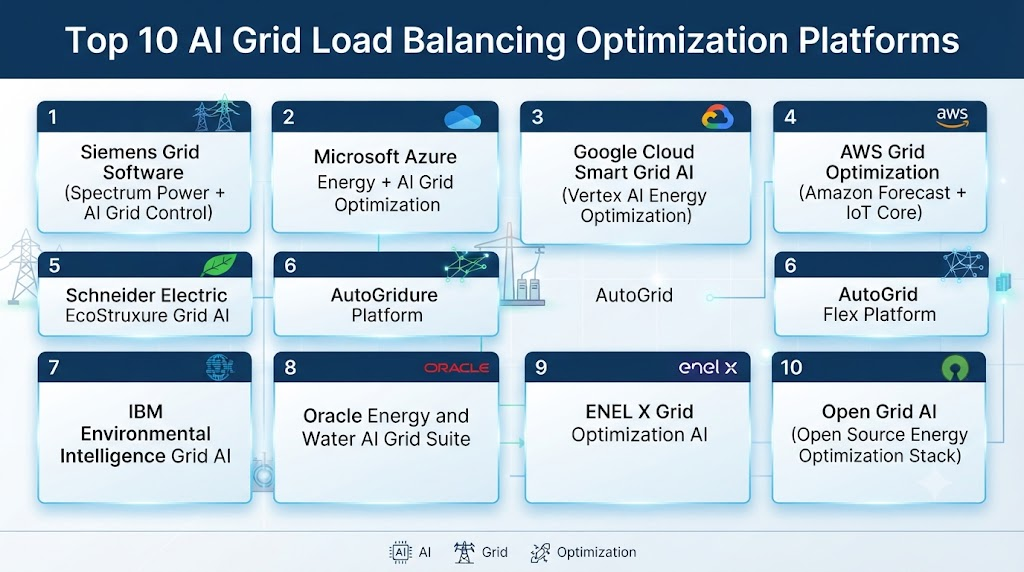
Top 10 AI Grid Load Balancing Optimization Platforms
#1 — Siemens Grid Software (Spectrum Power + AI Grid Control)
One-line verdict: Best for mission-critical national grid load balancing and real-time control systems.
Short description (2–3 lines):
Siemens provides advanced grid control software integrated with AI-based optimization for real-time electricity distribution. It is widely used by national utilities and transmission system operators for maintaining grid stability.
Standout Capabilities
- Real-time grid load balancing across transmission networks
- AI-assisted congestion management
- Integration with SCADA systems
- Digital twin simulation of power grids
- Renewable energy integration optimization
- Fault detection and self-healing grid support
AI-Specific Depth
- Model support: Proprietary industrial AI + optimization models
- RAG / knowledge integration: Grid operational data integration
- Evaluation: Utility-grade performance monitoring
- Guardrails: Hard safety constraints for grid protection
- Observability: Advanced grid control dashboards
Pros
- Extremely reliable for critical infrastructure
- Strong real-time control systems
- Deep utility industry adoption
Cons
- High implementation complexity
- Limited flexibility for developers
Security & Compliance
- Industrial-grade security controls
- Full audit logging and operational compliance
- Air-gapped deployment support available
Deployment & Platforms
- On-premise + hybrid deployments
Integrations & Ecosystem
- SCADA systems
- Energy management platforms
- Transmission control networks
Pricing Model
Enterprise licensing (utility-scale contracts)
Best-Fit Scenarios
- National grid operators
- Transmission system operators
- Critical infrastructure balancing
#2 — Microsoft Azure Energy + AI Grid Optimization
One-line verdict: Best for enterprise and government smart grid optimization systems.
Short description:
Microsoft Azure combines AI, IoT, and digital twin capabilities to optimize grid load balancing across distributed energy systems.
Standout Capabilities
- AI-driven load balancing across smart grids
- IoT integration with smart meters and substations
- Digital twin energy grid modeling
- Real-time demand response optimization
- Renewable integration forecasting
- Predictive grid maintenance
AI-Specific Depth
- Model support: Azure ML + time-series models
- RAG / knowledge integration: External energy datasets supported
- Evaluation: Model drift monitoring tools
- Guardrails: Enterprise policy enforcement
- Observability: Azure Monitor dashboards
Pros
- Strong enterprise ecosystem
- Excellent IoT + AI integration
- Government-friendly deployment options
Cons
- Complex architecture setup
- Requires Azure ecosystem dependency
Security & Compliance
- RBAC, encryption, audit logs
- Sovereign cloud support in some regions
Deployment & Platforms
- Cloud + hybrid
Integrations & Ecosystem
- Azure IoT Hub
- Power BI
- Smart grid APIs
Pricing Model
Usage-based enterprise pricing
Best-Fit Scenarios
- Smart cities
- Government energy programs
- Utility companies
#3 — Google Cloud Smart Grid AI (Vertex AI Energy Optimization)
One-line verdict: Best for large-scale predictive load balancing and renewable integration.
Short description:
Google Cloud provides AI-driven optimization tools for energy grids using Vertex AI and large-scale data analytics.
Standout Capabilities
- Predictive grid load balancing
- Renewable energy forecasting integration
- Real-time energy optimization pipelines
- Large-scale time-series analytics
- Smart city energy optimization models
- Distributed energy coordination
AI-Specific Depth
- Model support: Vertex AI + custom ML pipelines
- RAG / knowledge integration: External data ingestion supported
- Evaluation: ML monitoring and drift detection
- Guardrails: Limited built-in safety constraints
- Observability: Strong analytics dashboards
Pros
- Highly scalable infrastructure
- Strong data analytics capabilities
- Excellent for complex energy datasets
Cons
- Requires advanced ML expertise
- Complex configuration
Security & Compliance
- Enterprise-grade cloud security
- Data residency options available
Deployment & Platforms
- Cloud-native (GCP)
Integrations & Ecosystem
- BigQuery
- Vertex AI
- IoT and energy APIs
Pricing Model
Usage-based cloud pricing
Best-Fit Scenarios
- National energy systems
- Renewable-heavy grids
- Smart city infrastructure
#4 — AWS Grid Optimization (Amazon Forecast + IoT Core)
One-line verdict: Best for scalable cloud-native grid load balancing pipelines.
Short description:
AWS provides AI-based forecasting and optimization tools for energy load balancing using cloud-native services.
Standout Capabilities
- Real-time load balancing optimization
- AI forecasting for energy demand
- IoT-based grid data ingestion
- Scalable distributed energy pipelines
- Demand response automation
- Renewable integration support
AI-Specific Depth
- Model support: Amazon Forecast + ML models
- RAG / knowledge integration: External pipelines required
- Evaluation: Forecast accuracy metrics
- Guardrails: AWS policy framework
- Observability: CloudWatch monitoring
Pros
- Highly scalable architecture
- Strong IoT integration
- Reliable cloud infrastructure
Cons
- AWS dependency required
- Limited grid-specific UX
Security & Compliance
- IAM-based access control
- Encryption and audit logging
Deployment & Platforms
- Cloud-native AWS ecosystem
Integrations & Ecosystem
- AWS IoT Core
- Lambda
- Energy data pipelines
Pricing Model
Pay-per-use
Best-Fit Scenarios
- Utility-scale forecasting
- Smart grid cloud systems
- Industrial energy optimization
#5 — Schneider Electric EcoStruxure Grid AI
One-line verdict: Best for industrial and smart infrastructure load optimization.
Short description:
Schneider Electric provides AI-based energy optimization and grid balancing for industrial and smart infrastructure systems.
Standout Capabilities
- Industrial load balancing optimization
- Smart building energy coordination
- Renewable integration management
- Edge-based energy optimization
- Predictive energy demand control
AI-Specific Depth
- Model support: Proprietary industrial AI models
- RAG / knowledge integration: Facility-level data integration
- Evaluation: Energy efficiency KPIs
- Guardrails: Operational safety constraints
- Observability: Energy dashboards
Pros
- Strong industrial adoption
- High reliability in infrastructure
- Edge computing support
Cons
- Less flexible for developers
- Narrow industrial focus
Security & Compliance
- Enterprise-grade security
- Operational compliance controls
Deployment & Platforms
- Edge + hybrid deployments
Integrations & Ecosystem
- Building management systems
- Industrial IoT platforms
Pricing Model
Enterprise subscription
Best-Fit Scenarios
- Smart buildings
- Industrial plants
- Energy efficiency programs
#6 — AutoGrid Flex Platform
One-line verdict: Best for demand response and distributed energy balancing.
Short description:
AutoGrid provides AI-powered grid flexibility and load balancing solutions for utilities.
Standout Capabilities
- Demand response optimization
- Distributed energy resource management
- Real-time grid balancing
- Renewable integration support
- Energy flexibility analytics
AI-Specific Depth
- Model support: Proprietary AI optimization models
- RAG / knowledge integration: Grid datasets
- Evaluation: Forecast accuracy tracking
- Guardrails: Grid safety constraints
- Observability: Energy analytics dashboards
Pros
- Strong demand response capabilities
- Good renewable integration
- Utility-focused design
Cons
- Industry-specific limitations
- Limited developer ecosystem
Security & Compliance
- Utility-grade compliance support
Deployment & Platforms
- Cloud + hybrid
Integrations & Ecosystem
- Utility control systems
- Smart grid APIs
Pricing Model
Enterprise pricing
Best-Fit Scenarios
- Utility demand response
- Renewable-heavy grids
- Smart energy networks
#7 — IBM Environmental Intelligence Grid AI
One-line verdict: Best for climate-aware grid balancing optimization.
Short description:
IBM provides AI-powered environmental intelligence integrated with grid optimization systems.
Standout Capabilities
- Climate-aware grid balancing
- Weather-driven energy optimization
- Risk-based energy forecasting
- Renewable integration analytics
- Environmental monitoring systems
AI-Specific Depth
- Model support: IBM AI + hybrid models
- RAG / knowledge integration: Environmental datasets
- Evaluation: Risk modeling tools
- Guardrails: Enterprise governance
- Observability: Analytics dashboards
Pros
- Strong climate integration
- Enterprise governance focus
- Good risk modeling
Cons
- Complex platform
- Not purely grid-focused
Security & Compliance
- Strong enterprise compliance
Deployment & Platforms
- Cloud-based IBM ecosystem
Integrations & Ecosystem
- Climate data systems
- Energy management platforms
Pricing Model
Enterprise contract pricing
Best-Fit Scenarios
- Climate-aware utilities
- Government energy planning
- Risk-based grid management
#8 — Oracle Energy and Water AI Grid Suite
One-line verdict: Best for utility billing + grid optimization integration.
Short description:
Oracle provides AI-driven energy grid optimization combined with utility management systems.
Standout Capabilities
- Load balancing optimization
- Utility billing integration
- Smart meter analytics
- Demand forecasting systems
- Customer energy insights
AI-Specific Depth
- Model support: Oracle AI + analytics models
- RAG / knowledge integration: Utility data integration
- Evaluation: Business KPI tracking
- Guardrails: Enterprise controls
- Observability: Operational dashboards
Pros
- Strong utility billing integration
- Enterprise-ready systems
- Good data analytics
Cons
- Complex deployment
- Limited innovation flexibility
Security & Compliance
- Enterprise-grade security
Deployment & Platforms
- Cloud + hybrid
Integrations & Ecosystem
- Oracle Cloud systems
- Utility platforms
Pricing Model
Enterprise pricing
Best-Fit Scenarios
- Utility providers
- Billing + grid optimization systems
#9 — ENEL X Grid Optimization AI
One-line verdict: Best for EV-driven grid load balancing and demand-side optimization.
Short description:
ENEL X focuses on AI-powered load balancing for EV charging networks and smart energy systems.
Standout Capabilities
- EV charging load balancing
- Demand-side energy management
- Smart grid optimization
- Energy storage balancing
- Real-time consumption analytics
AI-Specific Depth
- Model support: Proprietary energy models
- RAG / knowledge integration: Grid + EV data
- Evaluation: Operational KPIs
- Guardrails: Grid safety rules
- Observability: Energy dashboards
Pros
- Strong EV integration
- Real-time optimization
- Smart city compatibility
Cons
- Limited global coverage
- Narrow industry focus
Security & Compliance
- Utility-grade compliance
Deployment & Platforms
- Edge + cloud
Integrations & Ecosystem
- EV charging systems
- Smart grid platforms
Pricing Model
Usage-based enterprise
Best-Fit Scenarios
- EV infrastructure
- Smart cities
- Demand response systems
#10 — Open Grid AI (Open Source Energy Optimization Stack)
One-line verdict: Best open-source framework for custom grid load balancing systems.
Short description:
Open Grid AI represents open-source tools for building custom AI-driven energy grid optimization systems.
Standout Capabilities
- Custom grid optimization models
- Time-series forecasting pipelines
- Edge AI deployment support
- IoT integration flexibility
- Fully customizable architecture
AI-Specific Depth
- Model support: Open-source ML models
- RAG / knowledge integration: Fully customizable
- Evaluation: Developer-defined metrics
- Guardrails: None built-in
- Observability: Custom implementation required
Pros
- Full flexibility
- No vendor lock-in
- Ideal for innovation
Cons
- Requires advanced expertise
- No enterprise support
Security & Compliance
- Depends on deployment
Deployment & Platforms
- Self-hosted / hybrid
Integrations & Ecosystem
- Python ML ecosystem
- IoT systems
- Custom energy stacks
Pricing Model
Open-source
Best-Fit Scenarios
- Research labs
- Experimental smart grid systems
- Custom utility platforms
Comparison Table
| Tool Name | Best For | Deployment | Model Flexibility | Strength | Watch-Out | Public Rating |
|---|---|---|---|---|---|---|
| Siemens | National grids | Hybrid | Proprietary | Reliability | Complexity | N/A |
| Microsoft Azure | Smart cities | Cloud/Hybrid | ML + proprietary | Ecosystem | Setup complexity | N/A |
| Google Cloud | Large-scale analytics | Cloud | Multi-model | Scalability | Complexity | N/A |
| AWS | Cloud pipelines | Cloud | ML models | Infrastructure | AWS dependency | N/A |
| Schneider | Industrial systems | Edge/Hybrid | Proprietary | Efficiency | Narrow scope | N/A |
| AutoGrid | Demand response | Cloud/Hybrid | Proprietary | Flexibility | Industry-specific | N/A |
| IBM | Climate-energy | Cloud | Hybrid | Risk modeling | Complexity | N/A |
| Oracle | Utilities billing | Cloud | Proprietary | Billing integration | Complex setup | N/A |
| ENEL X | EV grids | Edge/Cloud | Proprietary | EV optimization | Regional limits | N/A |
| Open Grid AI | Custom systems | Self-hosted | Open-source | Flexibility | No support | N/A |
Scoring & Evaluation (Transparent Rubric)
| Tool | Core | Reliability | Guardrails | Integrations | Ease | Perf/Cost | Security/Admin | Support | Weighted Total |
|---|---|---|---|---|---|---|---|---|---|
| Siemens | 9 | 9 | 9 | 8 | 6 | 8 | 9 | 9 | 8.3 |
| Microsoft | 9 | 9 | 9 | 9 | 7 | 8 | 9 | 9 | 8.6 |
| 9 | 9 | 8 | 9 | 8 | 8 | 8 | 8 | 8.4 | |
| AWS | 8 | 9 | 7 | 9 | 7 | 8 | 9 | 8 | 8.1 |
| Schneider | 8 | 8 | 8 | 8 | 7 | 8 | 8 | 8 | 8.0 |
| AutoGrid | 8 | 8 | 8 | 8 | 7 | 8 | 8 | 8 | 8.0 |
| IBM | 8 | 8 | 9 | 8 | 7 | 7 | 9 | 8 | 7.9 |
| Oracle | 8 | 8 | 8 | 8 | 7 | 7 | 9 | 8 | 7.9 |
| ENEL X | 8 | 8 | 8 | 8 | 7 | 8 | 8 | 8 | 7.9 |
| Open Grid AI | 8 | 7 | 6 | 7 | 6 | 9 | 6 | 7 | 7.2 |
Which AI Grid Load Balancing Tool Is Right for You?
Small Utilities / Regional Operators
Best fit: Schneider Electric, Oracle
Focus: efficiency + integration
Mid-Sized Utilities
Best fit: AutoGrid, IBM, ENEL X
Focus: demand response + renewables
Enterprise / National Grids
Best fit: Siemens, Microsoft Azure, Google Cloud
Focus: reliability + scale + governance
Regulated Infrastructure
Best fit: Siemens, IBM, Oracle
Focus: compliance + auditability
Build vs Buy
- Build: Open Grid AI, AWS, Google Cloud
- Buy: Siemens, Microsoft, Schneider
Implementation Playbook (30 / 60 / 90 Days)
30 Days: Pilot
- Collect grid load + weather + IoT data
- Run baseline load balancing simulations
- Define KPIs (stability, latency, cost)
60 Days: Integration
- Connect SCADA + IoT systems
- Deploy real-time prediction models
- Introduce anomaly detection systems
90 Days: Scale
- Deploy across grid regions
- Enable automated load balancing
- Optimize cost and renewable integration
- Implement governance + audit systems
Common Mistakes & How to Avoid Them
- Ignoring real-time latency requirements
- Not modeling renewable variability
- Over-reliance on single AI model
- Weak SCADA integration planning
- No fallback grid safety rules
- Lack of edge computing strategy
- Poor IoT data quality handling
- Missing observability dashboards
- No demand response integration
- Underestimating regulatory constraints
- Ignoring EV charging load impact
- No model drift monitoring
- Weak cybersecurity controls
- Poor disaster recovery planning
FAQs
What is AI grid load balancing optimization?
It is the use of AI systems to dynamically distribute electricity across grids based on demand and supply conditions.
Why is it important?
It prevents blackouts, reduces waste, and improves renewable energy utilization.
Can AI manage national grids?
Yes, many national grids already use AI-assisted or hybrid control systems.
Does it work in real time?
Yes, modern systems operate in seconds or milliseconds.
What data is used?
IoT sensors, smart meters, weather data, and grid telemetry.
Can it integrate renewable energy?
Yes, it is essential for managing solar and wind variability.
Is it safe?
Yes, when combined with strict grid safety constraints and human oversight.
What industries use it?
Utilities, governments, smart cities, and industrial energy systems.
Is cloud required?
Not always; edge and hybrid systems are widely used.
What is the biggest challenge?
Handling variability and ensuring real-time stability.
Can it reduce energy costs?
Yes, through optimized distribution and demand balancing.
Is open-source viable?
Yes, but requires strong engineering expertise.
Conclusion
AI Grid Load Balancing Optimization is transforming how modern energy systems operate. It enables real-time intelligence, improves renewable integration, and ensures stable electricity distribution across increasingly complex grids.The right solution depends on scale and governance needs—hyperscalers dominate cloud intelligence, industrial vendors lead in grid safety, and open-source systems provide maximum flexibility.

Find Trusted Cardiac Hospitals
Compare heart hospitals by city and services — all in one place.
Explore Hospitals