
Introduction
AI Renewable Output Prediction refers to the use of artificial intelligence systems to forecast how much energy will be generated from renewable sources such as solar, wind, hydro, and hybrid energy systems. These platforms analyze weather patterns, historical generation data, satellite imagery, and sensor inputs to predict energy output with high accuracy.
In 2026 and beyond, renewable prediction has become a foundational capability for modern energy systems. As global grids shift toward decarbonization, solar and wind energy are now major contributors—but they are also highly variable. AI helps solve this unpredictability by forecasting generation in advance and enabling grid operators to balance supply and demand effectively.
Modern systems combine meteorological data, deep learning models, and real-time IoT sensor feeds to optimize renewable integration into national and regional grids.
Key real-world use cases:
- Solar farm energy output forecasting
- Wind turbine generation prediction
- Hydro energy reservoir planning
- Smart grid renewable balancing
- Energy trading and market pricing optimization
- Battery storage charging and discharge planning
- National grid stability management
Key evaluation criteria:
- Forecast accuracy across weather conditions
- Real-time prediction capabilities
- Integration with meteorological and satellite data
- Support for multi-source renewable systems
- Handling of intermittency (solar/wind variability)
- Edge computing capability for local generation sites
- Scalability for utility-scale deployments
- Explainability and model transparency
- Data freshness and ingestion speed
- Cost efficiency of prediction pipelines
Best for: Renewable energy companies, utility providers, national grid operators, energy traders, smart city planners, and industrial energy consumers.
Not ideal for: Small-scale users without renewable infrastructure or those needing only static energy estimation.
What’s Changed in AI Renewable Output Prediction in 2026+
- Shift from static weather-based models to AI + satellite + IoT fusion forecasting systems
- Adoption of foundation models for weather-energy correlation analysis
- Increased use of real-time digital twins for solar and wind farms
- Integration of edge AI at turbine and panel level for local prediction
- Strong focus on grid-carbon optimization and renewable-first dispatching
- Improved forecasting of extreme weather impacts on renewable output
- Use of multi-agent AI systems managing distributed energy assets
- Expansion of battery-aware renewable forecasting systems
- Better modeling of cloud cover micro-variations for solar accuracy
- Increased regulatory demand for transparent forecasting models
- Integration of energy trading systems with predictive outputs
- Continuous learning models adapting to climate pattern shifts
Quick Buyer Checklist (Renewable Energy Operators)
Before selecting a renewable output prediction platform, evaluate:
- Accuracy for solar, wind, and hybrid systems
- Real-time forecasting latency
- Integration with weather and satellite datasets
- IoT sensor compatibility (turbines, panels)
- Edge AI support for remote sites
- Multi-location scalability
- Model transparency and explainability
- Data pipeline robustness and freshness
- Battery and storage system integration
- API availability and extensibility
- Vendor lock-in risks
- Cost per prediction or per MW capacity
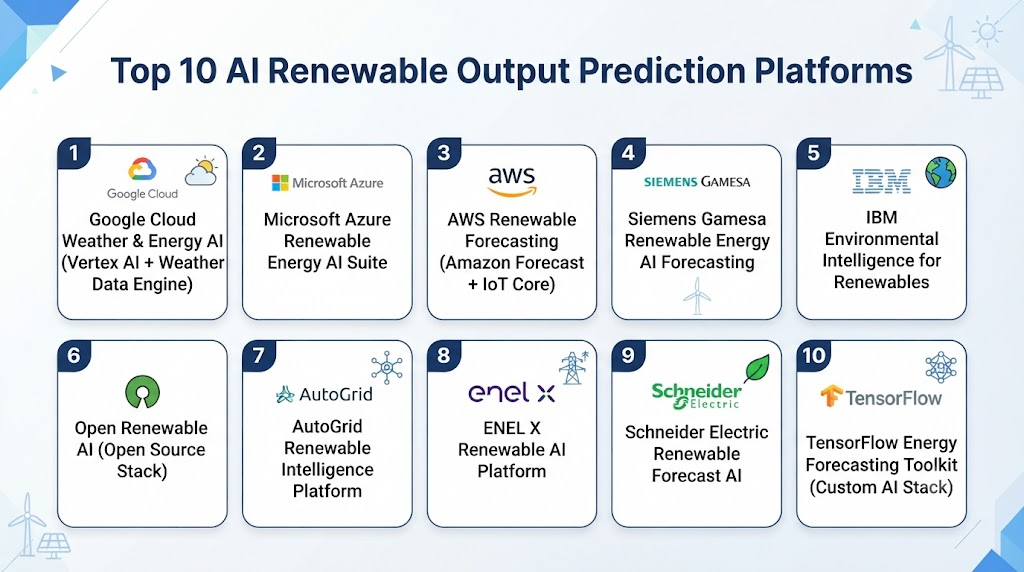
Top 10 AI Renewable Output Prediction Platforms
#1 — Google Cloud Weather & Energy AI (Vertex AI + Weather Data Engine)
One-line verdict: Best for large-scale renewable forecasting using global weather + AI fusion models.
Short description (2–3 lines):
Google Cloud combines Vertex AI with weather and satellite data systems to deliver highly accurate renewable energy output predictions for solar and wind farms at scale.
Standout Capabilities
- High-resolution solar and wind forecasting
- Satellite + weather data integration
- Real-time renewable output prediction
- Large-scale time-series modeling
- Digital twin simulation of energy farms
- Grid integration for renewable balancing
AI-Specific Depth
- Model support: Vertex AI + custom forecasting models
- RAG / knowledge integration: External weather + energy datasets
- Evaluation: Drift detection and forecasting accuracy metrics
- Guardrails: Limited built-in safety constraints
- Observability: Strong ML monitoring dashboards
Pros
- Extremely scalable infrastructure
- Strong integration with geospatial data
- High forecasting accuracy potential
Cons
- Requires advanced ML expertise
- Complex setup for energy-specific workflows
Security & Compliance
- Enterprise-grade cloud security
- Regional data residency options
Deployment & Platforms
- Cloud-native (GCP)
Integrations & Ecosystem
- BigQuery
- Vertex AI
- Satellite and weather APIs
- Energy analytics systems
Pricing Model
Usage-based cloud pricing
Best-Fit Scenarios
- Utility-scale renewable farms
- National energy forecasting systems
- Smart grid renewable integration
#2 — Microsoft Azure Renewable Energy AI Suite
One-line verdict: Best for enterprise renewable forecasting integrated with IoT and grid systems.
Short description:
Microsoft Azure provides AI-powered renewable output prediction using IoT sensors, weather analytics, and digital twin modeling.
Standout Capabilities
- Solar and wind output forecasting
- IoT-based turbine and panel monitoring
- Digital twin renewable modeling
- Real-time prediction pipelines
- Energy storage forecasting integration
- Smart grid coordination
AI-Specific Depth
- Model support: Azure ML + time-series models
- RAG / knowledge integration: External energy datasets
- Evaluation: Model monitoring and drift tracking
- Guardrails: Enterprise governance policies
- Observability: Azure Monitor dashboards
Pros
- Strong enterprise ecosystem
- Excellent IoT integration
- Government-friendly deployment
Cons
- Complex architecture setup
- Requires Azure ecosystem dependency
Security & Compliance
- RBAC, encryption, audit logging
- Sovereign cloud options in some regions
Deployment & Platforms
- Cloud + hybrid
Integrations & Ecosystem
- Azure IoT Hub
- Power BI
- Smart grid systems
Pricing Model
Enterprise usage-based pricing
Best-Fit Scenarios
- Utility companies
- Smart cities
- Renewable energy operators
#3 — AWS Renewable Forecasting (Amazon Forecast + IoT Core)
One-line verdict: Best for scalable cloud-native renewable prediction pipelines.
Short description:
AWS provides renewable energy forecasting using machine learning pipelines combined with IoT sensor data ingestion.
Standout Capabilities
- Solar and wind output forecasting
- Real-time prediction pipelines
- IoT-based energy monitoring
- Weather data integration
- Scalable ML infrastructure
- Demand-response integration
AI-Specific Depth
- Model support: Amazon Forecast + ML models
- RAG / knowledge integration: External pipelines required
- Evaluation: Forecast accuracy metrics
- Guardrails: AWS policy-based controls
- Observability: CloudWatch monitoring
Pros
- Highly scalable infrastructure
- Strong IoT integration
- Reliable cloud performance
Cons
- Requires AWS expertise
- Limited renewable-specific UX tools
Security & Compliance
- IAM, encryption, audit logging
- Enterprise compliance readiness
Deployment & Platforms
- Cloud-native AWS ecosystem
Integrations & Ecosystem
- AWS IoT Core
- Lambda
- Energy data pipelines
Pricing Model
Pay-per-use
Best-Fit Scenarios
- Utility-scale renewable forecasting
- Smart grid integration
- Industrial energy planning
#4 — Siemens Gamesa Renewable Energy AI Forecasting
One-line verdict: Best for industrial-scale wind farm output prediction.
Short description:
Siemens provides advanced AI forecasting systems optimized for wind turbine and renewable farm output prediction.
Standout Capabilities
- Wind turbine output prediction
- Farm-level energy forecasting
- Predictive maintenance integration
- Grid integration optimization
- Weather-driven turbine modeling
AI-Specific Depth
- Model support: Proprietary industrial AI models
- RAG / knowledge integration: Weather + turbine data
- Evaluation: Operational performance tracking
- Guardrails: Safety and turbine constraints
- Observability: Industrial dashboards
Pros
- Deep wind energy expertise
- High reliability in industrial setups
- Strong operational safety
Cons
- Narrow focus (wind-heavy systems)
- Less flexible for developers
Security & Compliance
- Industrial-grade controls
- Utility compliance standards
Deployment & Platforms
- On-premise + hybrid
Integrations & Ecosystem
- SCADA systems
- Wind farm control systems
Pricing Model
Enterprise licensing
Best-Fit Scenarios
- Wind energy operators
- Utility-scale wind farms
- Renewable infrastructure companies
#5 — IBM Environmental Intelligence for Renewables
One-line verdict: Best for climate-aware renewable forecasting and risk modeling.
Short description:
IBM provides AI-driven environmental intelligence for renewable energy forecasting and climate risk analysis.
Standout Capabilities
- Climate-aware renewable prediction
- Weather risk modeling
- Solar and wind forecasting
- Environmental data analytics
- Energy planning optimization
AI-Specific Depth
- Model support: IBM AI + hybrid forecasting models
- RAG / knowledge integration: Climate datasets
- Evaluation: Risk-based forecasting metrics
- Guardrails: Enterprise governance
- Observability: Analytics dashboards
Pros
- Strong climate intelligence integration
- Enterprise-grade analytics
- Good risk modeling
Cons
- Complex platform
- Not purely renewable-focused
Security & Compliance
- Strong enterprise governance
- Compliance-ready architecture
Deployment & Platforms
- Cloud-based IBM systems
Integrations & Ecosystem
- Climate data platforms
- Energy management systems
Pricing Model
Enterprise contract pricing
Best-Fit Scenarios
- Climate-risk energy planning
- Government renewable programs
- Utility forecasting systems
#6 — Open Renewable AI (Open Source Stack)
One-line verdict: Best open-source framework for custom renewable forecasting systems.
Short description:
Open Renewable AI includes open-source tools for building customizable renewable energy prediction pipelines.
Standout Capabilities
- Custom solar/wind forecasting models
- Time-series ML pipelines
- Edge AI deployment support
- Weather data integration
- Fully customizable architecture
AI-Specific Depth
- Model support: Open-source ML models
- RAG / knowledge integration: Fully customizable
- Evaluation: Developer-defined metrics
- Guardrails: Not built-in
- Observability: Custom implementation
Pros
- Full flexibility
- No vendor lock-in
- Ideal for innovation
Cons
- Requires ML expertise
- No enterprise support
Security & Compliance
- Depends on deployment setup
Deployment & Platforms
- Self-hosted / hybrid
Integrations & Ecosystem
- Python ML ecosystem
- IoT systems
- Custom energy pipelines
Pricing Model
Open-source
Best-Fit Scenarios
- Research labs
- Experimental renewable systems
- Custom energy AI solutions
#7 — AutoGrid Renewable Intelligence Platform
One-line verdict: Best for utility-scale renewable integration and demand response.
Standout Capabilities
- Renewable output forecasting
- Demand response coordination
- Grid balancing optimization
- Distributed energy support
AI-Specific Depth
- Model support: Proprietary AI models
- RAG / knowledge integration: Grid datasets
- Evaluation: Forecast KPIs
- Guardrails: Utility constraints
- Observability: Energy dashboards
Pros
- Strong utility adoption
- Good renewable-grid integration
- Real-time optimization
Cons
- Industry-specific
- Limited flexibility
Security & Compliance
- Utility-grade controls
Deployment & Platforms
- Cloud + hybrid
Integrations & Ecosystem
- Smart grid systems
- Renewable farms
Pricing Model
Enterprise
Best-Fit Scenarios
- Utilities
- Renewable operators
- Smart grids
#8 — ENEL X Renewable AI Platform
One-line verdict: Best for EV + renewable hybrid forecasting systems.
Standout Capabilities
- EV + solar + wind forecasting
- Demand-side optimization
- Energy storage prediction
- Smart grid coordination
AI-Specific Depth
- Model support: Proprietary energy models
- RAG / knowledge integration: Energy ecosystem data
- Evaluation: Operational KPIs
- Guardrails: Grid safety constraints
- Observability: Dashboards
Pros
- Strong EV integration
- Smart city compatibility
- Real-time analytics
Cons
- Regional limitations
- Narrow ecosystem
Security & Compliance
- Utility-grade compliance
Deployment & Platforms
- Edge + cloud
Integrations & Ecosystem
- EV networks
- Smart grids
Pricing Model
Usage-based
Best-Fit Scenarios
- EV-heavy grids
- Smart cities
- Renewable integration
#9 — Schneider Electric Renewable Forecast AI
One-line verdict: Best for industrial and building-level renewable optimization.
Standout Capabilities
- Solar panel forecasting
- Building energy optimization
- Edge AI prediction systems
- Sustainability tracking
AI-Specific Depth
- Model support: Proprietary AI models
- RAG / knowledge integration: Facility data
- Evaluation: Efficiency KPIs
- Guardrails: Safety constraints
- Observability: Energy dashboards
Pros
- Strong industrial use
- Edge deployment support
- Energy efficiency focus
Cons
- Not developer-centric
- Limited large-scale modeling
Security & Compliance
- Enterprise controls
Deployment & Platforms
- Edge + hybrid
Integrations & Ecosystem
- Building systems
- Industrial IoT
Pricing Model
Enterprise
Best-Fit Scenarios
- Smart buildings
- Industrial renewable systems
- Energy efficiency programs
#10 — TensorFlow Energy Forecasting Toolkit (Custom AI Stack)
One-line verdict: Best for developers building custom renewable forecasting models.
Standout Capabilities
- Custom ML model training
- Time-series forecasting pipelines
- Weather-energy modeling
- Flexible AI architecture
- Research-grade experimentation
AI-Specific Depth
- Model support: Open ML frameworks
- RAG / knowledge integration: Fully custom
- Evaluation: Developer-defined
- Guardrails: None built-in
- Observability: Custom
Pros
- Maximum flexibility
- Research-friendly
- Full control over models
Cons
- Requires deep ML expertise
- No enterprise support
Security & Compliance
- Depends on deployment
Deployment & Platforms
- Self-hosted / cloud / hybrid
Integrations & Ecosystem
- Python ML ecosystem
- Energy datasets
- IoT pipelines
Pricing Model
Open-source
Best-Fit Scenarios
- Research institutions
- Custom energy AI systems
- Experimental renewable forecasting
Comparison Table
| Tool Name | Best For | Deployment | Model Flexibility | Strength | Watch-Out | Public Rating |
|---|---|---|---|---|---|---|
| Google Cloud | Large-scale forecasting | Cloud | Multi-model | Scalability | Complexity | N/A |
| Microsoft Azure | Enterprise renewables | Cloud/Hybrid | ML + proprietary | IoT integration | Setup complexity | N/A |
| AWS | Cloud pipelines | Cloud | ML models | Scalability | AWS dependency | N/A |
| Siemens | Wind energy systems | Hybrid | Proprietary | Reliability | Narrow focus | N/A |
| IBM | Climate forecasting | Cloud | Hybrid | Risk modeling | Complexity | N/A |
| Open Renewable AI | Custom systems | Self-hosted | Open-source | Flexibility | No support | N/A |
| AutoGrid | Utilities | Cloud/Hybrid | Proprietary | Grid integration | Industry-specific | N/A |
| ENEL X | EV + renewables | Edge/Cloud | Proprietary | EV integration | Regional limits | N/A |
| Schneider | Industrial systems | Edge/Hybrid | Proprietary | Efficiency | Limited scale | N/A |
| TensorFlow Stack | Developers | Self-hosted | Open-source | Full control | Requires expertise | N/A |
Scoring & Evaluation (Transparent Rubric)
| Tool | Core | Reliability | Guardrails | Integrations | Ease | Perf/Cost | Security/Admin | Support | Weighted Total |
|---|---|---|---|---|---|---|---|---|---|
| 9 | 9 | 8 | 9 | 8 | 8 | 8 | 8 | 8.4 | |
| Microsoft | 9 | 9 | 9 | 9 | 7 | 8 | 9 | 9 | 8.6 |
| AWS | 8 | 9 | 7 | 9 | 7 | 8 | 9 | 8 | 8.1 |
| Siemens | 9 | 9 | 9 | 8 | 6 | 8 | 9 | 9 | 8.3 |
| IBM | 8 | 8 | 9 | 8 | 7 | 7 | 9 | 8 | 7.9 |
| AutoGrid | 8 | 8 | 8 | 8 | 7 | 8 | 8 | 8 | 8.0 |
| ENEL X | 8 | 8 | 8 | 8 | 7 | 8 | 8 | 8 | 7.9 |
| Schneider | 8 | 8 | 8 | 8 | 7 | 8 | 8 | 8 | 8.0 |
| Open Renewable AI | 8 | 7 | 6 | 7 | 6 | 9 | 6 | 7 | 7.2 |
| TensorFlow Stack | 8 | 7 | 6 | 7 | 6 | 9 | 6 | 7 | 7.3 |
Which AI Renewable Output Tool Is Right for You?
Small Renewable Operators
Best fit: Schneider Electric, ENEL X
Focus: efficiency and monitoring
Mid-Sized Utilities
Best fit: AutoGrid, IBM, Siemens
Focus: grid integration + forecasting
Enterprise / National Energy Systems
Best fit: Microsoft Azure, Google Cloud, AWS
Focus: scalability + real-time prediction
Research & Developers
Best fit: TensorFlow Stack, Open Renewable AI
Focus: flexibility and experimentation
Implementation Playbook (30 / 60 / 90 Days)
30 Days: Pilot
- Collect solar/wind + weather data
- Train baseline forecasting models
- Benchmark accuracy
60 Days: Integration
- Connect IoT sensors + weather APIs
- Add real-time prediction pipelines
- Introduce monitoring dashboards
90 Days: Scale
- Deploy across multiple renewable sites
- Optimize model performance
- Integrate with grid balancing systems
- Enable automated energy dispatch
Common Mistakes & How to Avoid Them
- Ignoring weather variability granularity
- Using only historical energy data
- Not modeling cloud cover for solar systems
- Poor IoT sensor integration
- Lack of real-time forecasting pipelines
- No model drift detection
- Ignoring battery storage interaction
- Over-reliance on single ML model
- Weak edge computing strategy
- Missing renewable-grid integration layer
- No explainability in forecasting models
- Underestimating data quality issues
- No fallback systems for prediction errors
- Ignoring climate change trend shifts
FAQs
What is AI renewable output prediction?
It is the use of AI models to forecast energy generation from solar, wind, and other renewable sources.
Why is it important?
It helps balance renewable energy with grid demand and improves stability.
Can it predict solar energy accurately?
Yes, especially when combined with satellite and weather data.
What data is used?
Weather data, satellite imagery, IoT sensors, and historical generation data.
Is it real-time?
Many systems support near real-time predictions.
Does it support wind forecasting?
Yes, wind energy prediction is one of its core use cases.
Can it reduce energy waste?
Yes, by improving grid balancing and storage planning.
Is cloud required?
Not always; edge systems are widely used.
What is the biggest challenge?
Weather unpredictability and data accuracy.
Can it integrate with batteries?
Yes, modern systems include storage-aware forecasting.
Is open-source viable?
Yes, but requires strong technical expertise.
Who uses it most?
Utilities, renewable energy companies, and smart grids.
Conclusion
AI Renewable Output Prediction is a key technology powering the transition to clean and sustainable energy systems. It enables accurate forecasting of solar, wind, and hybrid energy sources, helping utilities and governments stabilize grids and maximize renewable utilization.The best platform depends on scale and complexity: hyperscalers dominate large-scale forecasting, industrial systems excel in wind and solar operations, and open-source frameworks provide maximum flexibility.

Find Trusted Cardiac Hospitals
Compare heart hospitals by city and services — all in one place.
Explore Hospitals