
Introduction
AI Supply Chain Sustainability Scoring refers to the use of artificial intelligence to evaluate, rank, and continuously monitor the environmental, social, and governance (ESG) performance of suppliers and end-to-end supply chains. These systems analyze emissions, labor practices, ethical sourcing, energy usage, transportation impact, and compliance risks to generate a unified sustainability score.
In 2026 and beyond, supply chains are under intense pressure from regulators, investors, and consumers to prove sustainability claims with data—not estimates. AI-driven scoring systems now replace manual audits and static ESG reports with real-time, dynamic supplier intelligence.
Modern platforms combine machine learning, graph analytics, ESG data extraction, satellite insights, IoT signals, and third-party risk databases to produce explainable sustainability scores at supplier, product, and network levels.
Key real-world use cases:
- Supplier ESG risk scoring
- Scope 3 emissions evaluation
- Ethical sourcing validation
- Procurement decision optimization
- Supply chain carbon footprint tracking
- Supplier onboarding risk assessment
- Regulatory ESG compliance reporting
Key evaluation criteria:
- Accuracy of ESG scoring models
- Scope 3 emissions integration depth
- Supplier data coverage and completeness
- Real-time monitoring capability
- Explainability of scoring methodology
- Integration with procurement systems
- Risk detection (environmental + social + governance)
- Data source diversity (IoT, reports, audits, news)
- Scalability across global supplier networks
- Auditability and compliance alignment
Best for: Large enterprises, global manufacturers, retail brands, logistics companies, and regulated industries with complex supplier ecosystems.
Not ideal for: Small businesses with limited supplier networks or minimal ESG reporting requirements.
What’s Changed in AI Supply Chain Sustainability Scoring in 2026+
- Shift from annual supplier audits to continuous AI-based scoring systems
- Integration of Scope 3 emissions into real-time supplier evaluation models
- Use of graph neural networks for supply chain relationship mapping
- Adoption of LLMs for analyzing supplier documents, audits, and disclosures
- Expansion of satellite + IoT + financial data fusion for ESG scoring
- Strong focus on regulatory compliance (CSRD, ISSB, SEC climate rules)
- AI-driven supplier risk prediction (before disruptions occur)
- Real-time ethical sourcing and labor risk monitoring
- Automated procurement optimization based on sustainability score
- Increased use of digital twins for supply chain simulation
- Integration with carbon accounting and ESG reporting platforms
- Strong demand for explainable AI sustainability scoring systems
Quick Buyer Checklist (Sustainability Scoring Platforms)
Before selecting a platform, evaluate:
- Scope 3 emissions scoring capability
- Supplier ESG data coverage depth
- Real-time vs batch scoring updates
- Explainability of scoring models
- Integration with procurement systems (ERP, SRM)
- Risk detection (environmental, social, governance)
- Data source diversity (audit, IoT, news, financial)
- API and automation capabilities
- Supplier onboarding scalability
- Compliance framework alignment
- Model accuracy and validation methods
- Vendor lock-in risk
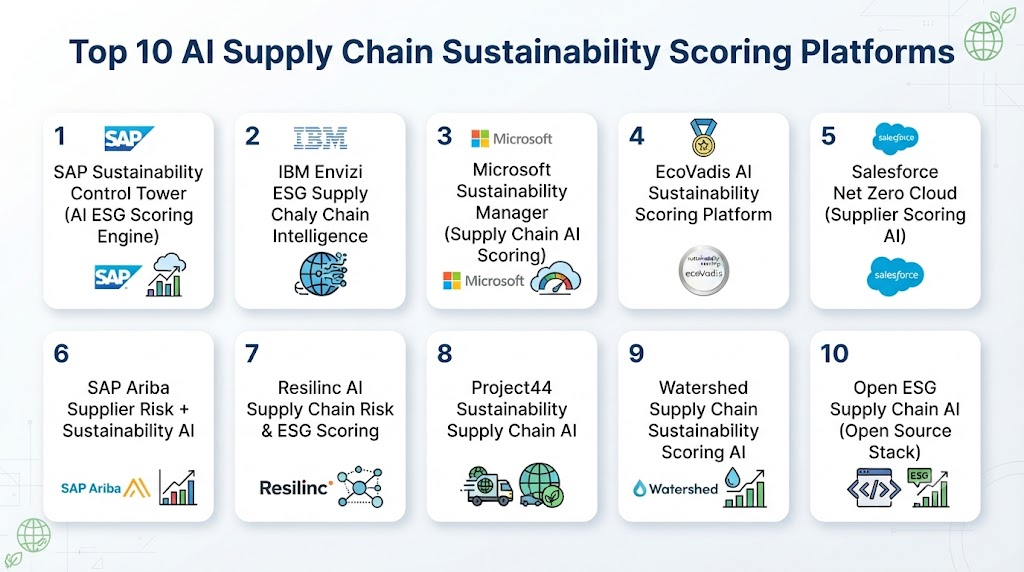
Top 10 AI Supply Chain Sustainability Scoring Platforms
#1 — SAP Sustainability Control Tower (AI ESG Scoring Engine)
One-line verdict: Best enterprise-grade sustainability scoring system deeply integrated with ERP supply chains.
Short description (2–3 lines):
SAP Sustainability Control Tower uses AI-driven analytics to calculate sustainability scores across suppliers, products, and operations by combining ERP data, emissions tracking, and supply chain intelligence.
Standout Capabilities
- Supplier sustainability scoring
- Scope 1, 2, and 3 emissions integration
- Real-time ESG dashboards
- Supply chain transparency analytics
- Procurement sustainability optimization
- Regulatory ESG reporting automation
AI-Specific Depth
- Model support: SAP AI + ESG scoring models
- RAG / knowledge integration: ERP + supplier + emissions datasets
- Evaluation: ESG KPI tracking and validation
- Guardrails: Enterprise governance rules
- Observability: ESG dashboards and scorecards
Pros
- Deep ERP integration
- Strong enterprise adoption
- Reliable sustainability scoring
Cons
- Complex implementation
- SAP ecosystem dependency
Security & Compliance
- Enterprise-grade SAP security
- Audit-ready ESG reporting
Deployment & Platforms
- Cloud + hybrid
Integrations & Ecosystem
- SAP ERP
- Procurement systems
- Logistics platforms
Pricing Model
Enterprise licensing
Best-Fit Scenarios
- Global manufacturers
- Supply chain-heavy enterprises
- ERP-driven organizations
#2 — IBM Envizi ESG Supply Chain Intelligence
One-line verdict: Best for AI-driven ESG analytics and supplier sustainability scoring.
Standout Capabilities
- Supplier ESG risk scoring
- Scope 3 emissions tracking
- Supply chain analytics
- ESG reporting automation
- Sustainability performance dashboards
AI-Specific Depth
- Model support: IBM AI + ESG analytics models
- RAG / knowledge integration: Supplier + ESG datasets
- Evaluation: Sustainability KPI metrics
- Guardrails: Governance frameworks
- Observability: ESG dashboards
Pros
- Strong ESG analytics depth
- Trusted enterprise platform
- Good compliance support
Cons
- Complex setup
- Requires onboarding effort
Security & Compliance
- Enterprise governance controls
- Audit-ready reporting
Deployment & Platforms
- Cloud-based IBM ecosystem
Integrations & Ecosystem
- ERP systems
- ESG platforms
- Supply chain tools
Pricing Model
Enterprise licensing
Best-Fit Scenarios
- Large enterprises
- Regulated industries
- ESG reporting teams
#3 — Microsoft Sustainability Manager (Supply Chain AI Scoring)
One-line verdict: Best scalable cloud-based sustainability scoring for global supply chains.
Standout Capabilities
- Supplier sustainability scoring
- Emissions tracking across supply chain
- ESG reporting automation
- Real-time data analytics
- Digital twin supply chain modeling
AI-Specific Depth
- Model support: Azure AI + ML models
- RAG / knowledge integration: ERP + IoT + supplier data
- Evaluation: Model drift + ESG validation metrics
- Guardrails: Policy-based governance
- Observability: Sustainability dashboards
Pros
- Highly scalable
- Strong Microsoft ecosystem integration
- Flexible deployment
Cons
- Complex configuration
- Requires Azure expertise
Security & Compliance
- Enterprise-grade security
- Global compliance support (varies)
Deployment & Platforms
- Cloud + hybrid
Integrations & Ecosystem
- Microsoft Dynamics
- Power BI
- ERP systems
Pricing Model
Usage-based enterprise
Best-Fit Scenarios
- Global enterprises
- Smart supply chains
- ESG-driven organizations
#4 — EcoVadis AI Sustainability Scoring Platform
One-line verdict: Best dedicated supplier ESG scoring and risk rating system.
Standout Capabilities
- Supplier ESG scorecards
- Sustainability risk assessments
- Ethical sourcing evaluation
- Supplier benchmarking
- Compliance tracking
AI-Specific Depth
- Model support: Proprietary ESG scoring models
- RAG / knowledge integration: Supplier audits + ESG datasets
- Evaluation: ESG rating validation metrics
- Guardrails: Compliance frameworks
- Observability: Supplier dashboards
Pros
- Strong supplier focus
- Widely adopted ESG scoring system
- Good benchmarking capability
Cons
- Less customizable AI models
- Limited deep integration flexibility
Security & Compliance
- Enterprise security controls
- Audit-ready ESG documentation
Deployment & Platforms
- Cloud-based
Integrations & Ecosystem
- Procurement systems
- ERP platforms
- Supplier portals
Pricing Model
Subscription + enterprise licensing
Best-Fit Scenarios
- Procurement teams
- Global sourcing organizations
- Compliance-heavy industries
#5 — Salesforce Net Zero Cloud (Supplier Scoring AI)
One-line verdict: Best CRM-integrated sustainability scoring for supplier ecosystems.
Standout Capabilities
- Supplier ESG scoring
- Carbon footprint tracking
- Procurement sustainability insights
- ESG reporting dashboards
- Customer-facing sustainability reporting
AI-Specific Depth
- Model support: Salesforce AI models
- RAG / knowledge integration: CRM + supplier datasets
- Evaluation: ESG KPI tracking
- Guardrails: Enterprise governance
- Observability: ESG dashboards
Pros
- Strong CRM integration
- Easy visibility into supplier ESG
- Good automation features
Cons
- Limited deep supply chain modeling
- Salesforce dependency
Security & Compliance
- Enterprise Salesforce security
Deployment & Platforms
- Cloud-native
Integrations & Ecosystem
- Salesforce CRM
- ERP systems
- Supplier management tools
Pricing Model
Subscription
Best-Fit Scenarios
- Retail enterprises
- CRM-driven organizations
- Supplier transparency programs
#6 — SAP Ariba Supplier Risk + Sustainability AI
One-line verdict: Best for procurement-driven supplier sustainability scoring.
Standout Capabilities
- Supplier ESG risk scoring
- Procurement sustainability analytics
- Supplier lifecycle monitoring
- Risk-based sourcing decisions
- Compliance tracking
AI-Specific Depth
- Model support: SAP AI + procurement models
- RAG / knowledge integration: Supplier + procurement datasets
- Evaluation: Risk scoring KPIs
- Guardrails: Governance policies
- Observability: Procurement dashboards
Pros
- Strong procurement integration
- Reliable enterprise scoring
- Deep supply chain visibility
Cons
- Complex ecosystem
- SAP dependency
Security & Compliance
- Enterprise SAP security
Deployment & Platforms
- Cloud + hybrid
Integrations & Ecosystem
- SAP ERP
- Procurement systems
Pricing Model
Enterprise licensing
Best-Fit Scenarios
- Manufacturing enterprises
- Procurement-heavy organizations
- Global sourcing teams
#7 — Resilinc AI Supply Chain Risk & ESG Scoring
One-line verdict: Best for supply chain risk + sustainability disruption prediction.
Standout Capabilities
- Supplier ESG scoring
- Supply chain disruption risk prediction
- Sustainability risk analytics
- Tier-1 and tier-2 supplier mapping
- Real-time monitoring
AI-Specific Depth
- Model support: ML + risk prediction models
- RAG / knowledge integration: Supply chain + risk datasets
- Evaluation: Risk scoring metrics
- Guardrails: Governance frameworks
- Observability: Risk dashboards
Pros
- Strong predictive capabilities
- Good supply chain visibility
- Real-time monitoring
Cons
- Less ESG reporting depth
- Specialized focus
Security & Compliance
- Enterprise-grade controls
Deployment & Platforms
- Cloud-based
Integrations & Ecosystem
- ERP systems
- Supply chain tools
Pricing Model
Enterprise subscription
Best-Fit Scenarios
- Global supply chains
- Manufacturing companies
- Logistics-heavy businesses
#8 — Project44 Sustainability Supply Chain AI
One-line verdict: Best for logistics-driven sustainability scoring and emissions tracking.
Standout Capabilities
- Transportation emissions scoring
- Logistics sustainability analytics
- Supply chain visibility
- Route optimization impact scoring
- Real-time shipment tracking
AI-Specific Depth
- Model support: Logistics ML models
- RAG / knowledge integration: Transportation + emissions data
- Evaluation: Emissions KPIs
- Guardrails: Operational constraints
- Observability: Logistics dashboards
Pros
- Strong logistics intelligence
- Real-time tracking
- Good emissions visibility
Cons
- Focused on logistics only
- Limited ESG breadth
Security & Compliance
- Enterprise security controls
Deployment & Platforms
- Cloud-based
Integrations & Ecosystem
- Logistics platforms
- ERP systems
Pricing Model
Subscription
Best-Fit Scenarios
- Logistics companies
- Retail supply chains
- Transport-heavy industries
#9 — Watershed Supply Chain Sustainability Scoring AI
One-line verdict: Best modern ESG-focused platform for fast supplier sustainability insights.
Standout Capabilities
- Supplier ESG scoring
- Carbon + sustainability tracking
- Scope 3 emissions integration
- ESG reporting automation
- Decarbonization insights
AI-Specific Depth
- Model support: Proprietary ML models
- RAG / knowledge integration: ESG + supplier datasets
- Evaluation: Sustainability scoring KPIs
- Guardrails: Governance controls
- Observability: ESG dashboards
Pros
- Easy to use
- Strong ESG automation
- Fast deployment
Cons
- Less customizable
- Limited deep ERP integration
Security & Compliance
- Enterprise-grade controls
Deployment & Platforms
- Cloud-native
Integrations & Ecosystem
- ERP systems
- Data warehouses
Pricing Model
Subscription
Best-Fit Scenarios
- Fast-growing enterprises
- ESG-first organizations
- Tech companies
#10 — Open ESG Supply Chain AI (Open Source Stack)
One-line verdict: Best open-source framework for building custom sustainability scoring systems.
Standout Capabilities
- Custom ESG scoring models
- Supplier data pipelines
- Graph-based supply chain modeling
- AI risk scoring systems
- Flexible analytics architecture
AI-Specific Depth
- Model support: Open ML + graph neural networks
- RAG / knowledge integration: Fully customizable
- Evaluation: Developer-defined metrics
- Guardrails: None built-in
- Observability: Custom dashboards
Pros
- Fully flexible
- No vendor lock-in
- Ideal for innovation
Cons
- Requires expertise
- No enterprise support
Security & Compliance
- Depends on implementation
Deployment & Platforms
- Self-hosted / hybrid
Integrations & Ecosystem
- ERP systems
- Data lakes
- Supply chain APIs
Pricing Model
Open-source
Best-Fit Scenarios
- Research teams
- Custom ESG platforms
- Advanced engineering organizations
Comparison Table
| Tool Name | Best For | Deployment | Model Flexibility | Strength | Watch-Out | Public Rating |
|---|---|---|---|---|---|---|
| SAP Control Tower | ERP ESG scoring | Cloud/Hybrid | Proprietary | Supply chain depth | Complexity | N/A |
| IBM Envizi | ESG analytics | Cloud | Hybrid | Reporting depth | Complexity | N/A |
| Microsoft | Global supply chains | Cloud/Hybrid | ML + proprietary | Scalability | Setup effort | N/A |
| EcoVadis | Supplier rating | Cloud | Proprietary | Benchmarking | Limited flexibility | N/A |
| Salesforce | CRM ESG | Cloud | Proprietary | Supplier visibility | CRM dependency | N/A |
| SAP Ariba | Procurement ESG | Cloud | Proprietary | Procurement focus | SAP lock-in | N/A |
| Resilinc | Risk prediction | Cloud | ML models | Risk intelligence | Narrow ESG scope | N/A |
| Project44 | Logistics ESG | Cloud | ML models | Transport visibility | Logistics-only | N/A |
| Watershed | ESG automation | Cloud | Proprietary | Ease of use | Limited customization | N/A |
| Open ESG AI | Custom systems | Self-hosted | Open-source | Flexibility | No support | N/A |
Scoring & Evaluation (Transparent Rubric)
| Tool | Core | Reliability | Guardrails | Integrations | Ease | Perf/Cost | Security/Admin | Support | Weighted Total |
|---|---|---|---|---|---|---|---|---|---|
| SAP Control Tower | 9 | 9 | 9 | 9 | 6 | 8 | 9 | 9 | 8.5 |
| IBM Envizi | 9 | 9 | 9 | 8 | 7 | 8 | 9 | 9 | 8.5 |
| Microsoft | 9 | 9 | 9 | 9 | 7 | 8 | 9 | 9 | 8.6 |
| EcoVadis | 8 | 9 | 9 | 8 | 8 | 8 | 9 | 9 | 8.4 |
| Salesforce | 8 | 9 | 8 | 9 | 8 | 8 | 9 | 9 | 8.4 |
| SAP Ariba | 9 | 9 | 9 | 9 | 6 | 8 | 9 | 9 | 8.5 |
| Resilinc | 8 | 9 | 8 | 8 | 8 | 8 | 8 | 8 | 8.1 |
| Project44 | 8 | 8 | 8 | 8 | 8 | 8 | 8 | 8 | 8.0 |
| Watershed | 8 | 8 | 8 | 8 | 9 | 9 | 8 | 8 | 8.3 |
| Open ESG AI | 8 | 7 | 6 | 7 | 6 | 9 | 6 | 7 | 7.2 |
Which Supply Chain Sustainability Scoring Tool Is Right for You?
Large Enterprises
Best fit: SAP Control Tower, Microsoft, IBM, SAP Ariba
Focus: ERP + global supply chain integration
Procurement Teams
Best fit: EcoVadis, SAP Ariba
Focus: supplier evaluation
Logistics-Heavy Businesses
Best fit: Project44, Resilinc
Focus: transport emissions + risk
ESG-First Companies
Best fit: Watershed, Salesforce
Focus: sustainability reporting
Developers & Custom Systems
Best fit: Open ESG Supply Chain AI
Focus: flexibility + innovation
Implementation Playbook (30 / 60 / 90 Days)
30 Days: Setup
- Map supplier ecosystem
- Define ESG scoring metrics
- Collect emissions + supplier data
60 Days: Integration
- Connect ERP and procurement systems
- Deploy AI scoring models
- Build dashboards
90 Days: Scale
- Automate supplier scoring updates
- Integrate Scope 3 emissions fully
- Enable procurement decision automation
- Expand across global supply chain
Common Mistakes & How to Avoid Them
- Ignoring Scope 3 emissions complexity
- Over-reliance on self-reported supplier data
- Weak data validation systems
- Lack of explainability in scoring models
- Poor ERP integration planning
- No real-time scoring updates
- Ignoring supplier onboarding friction
- Vendor lock-in risks
- Missing regulatory mapping (CSRD/ISSB)
- No multi-source data fusion
- Weak risk detection models
- Over-automation without human review
- Poor supply chain mapping
- Lack of continuous monitoring
FAQs
What is supply chain sustainability scoring?
It is the AI-driven evaluation of supplier ESG performance and emissions impact.
Why is it important?
It helps companies reduce environmental and social risks across suppliers.
What data is used?
Emissions data, audits, supplier reports, IoT, and financial data.
Is it real-time?
Modern systems support continuous scoring updates.
What is Scope 3?
Emissions from suppliers and external value chains.
Can AI improve accuracy?
Yes, it reduces manual bias and improves prediction.
Is ERP integration required?
Yes, for enterprise-scale deployments.
Who uses these tools?
Procurement, ESG, and supply chain teams.
Can it predict supplier risk?
Yes, advanced models detect risk early.
Is open-source viable?
Yes, but requires engineering expertise.
What is the biggest challenge?
Supplier data completeness and quality.
Can it support compliance?
Yes, especially for ESG regulations.
Conclusion
AI Supply Chain Sustainability Scoring is becoming a core pillar of modern ESG and procurement strategy. It enables organizations to evaluate suppliers continuously, reduce emissions, and ensure compliance with global sustainability regulations.The best platform depends on organizational needs: ERP leaders dominate enterprise integration, ESG platforms simplify reporting, and open-source tools enable full customization.

Find Trusted Cardiac Hospitals
Compare heart hospitals by city and services — all in one place.
Explore Hospitals