
Introduction
AI Waste Sorting Computer Vision refers to the use of artificial intelligence, image recognition, and robotics to automatically identify, classify, and sort waste materials such as plastics, metals, paper, glass, organic waste, and hazardous materials.
In 2026 and beyond, waste management is rapidly shifting from manual and semi-automated systems to fully AI-powered sorting facilities. These systems use computer vision models, edge AI cameras, robotic arms, and sensor fusion to increase recycling rates, reduce landfill dependency, and improve circular economy efficiency.
Modern systems combine deep learning vision models, hyperspectral imaging, conveyor belt robotics, and real-time decision systems to classify waste at high speed and accuracy.
Key real-world use cases:
- Automated recycling facility sorting
- Plastic type classification (PET, HDPE, etc.)
- E-waste separation and recovery
- Organic vs non-organic waste identification
- Construction waste segregation
- Hazardous waste detection
- Smart city waste bin monitoring
Key evaluation criteria:
- Classification accuracy of waste materials
- Real-time processing speed on conveyor systems
- Multi-material detection capability
- Robotics integration quality
- Edge AI deployment efficiency
- Contamination detection accuracy
- Dataset diversity (waste image training sets)
- System scalability in industrial plants
- Maintenance and calibration requirements
- Integration with recycling infrastructure
Best for: Recycling companies, waste management operators, municipalities, smart cities, and environmental service providers.
Not ideal for: Small-scale households without automated waste infrastructure.
What’s Changed in AI Waste Sorting Computer Vision in 2026+
- Shift from manual sorting to fully autonomous robotic recycling facilities
- Use of multimodal vision systems (RGB + infrared + hyperspectral imaging)
- Adoption of real-time edge AI inference on conveyor belts
- Integration of robotic arms with reinforcement learning control systems
- Expansion of fine-grained plastic polymer classification models
- AI-driven detection of microplastics and composite materials
- Smart bins using embedded vision for household-level sorting
- Use of foundation vision models trained on global waste datasets
- Strong focus on circular economy optimization systems
- Integration with city-level waste analytics dashboards
- Automated compliance reporting for environmental regulations
- AI agents optimizing waste collection routes and recycling flows
Quick Buyer Checklist (Waste Sorting AI Systems)
Before selecting a platform, evaluate:
- Classification accuracy across waste categories
- Real-time processing capability on conveyor belts
- Edge AI deployment performance
- Multi-sensor fusion (vision + infrared + hyperspectral)
- Robotics integration support
- Contamination detection accuracy
- Dataset training diversity
- Throughput per hour (industrial scale)
- System downtime and maintenance needs
- Integration with recycling workflows
- Scalability across multiple facilities
- Model retraining and adaptability
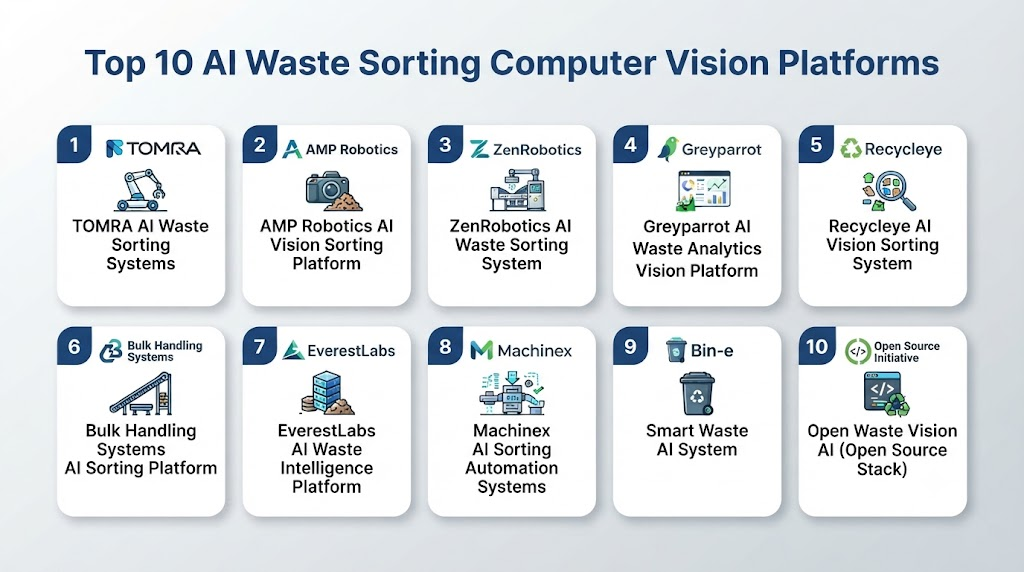
Top 10 AI Waste Sorting Computer Vision Platforms
#1 — TOMRA AI Waste Sorting Systems
One-line verdict: Best industrial-grade AI waste sorting system for large recycling facilities.
Short description (2–3 lines):
TOMRA uses advanced optical sensors and AI-driven classification models to sort waste materials at high speed in recycling plants, enabling precise separation of plastics, metals, and paper.
Standout Capabilities
- High-speed conveyor belt sorting
- AI-based material classification
- Plastic polymer identification
- Metal and glass separation
- Contamination detection systems
- Industrial-scale throughput optimization
AI-Specific Depth
- Model support: Proprietary computer vision + sensor fusion models
- RAG / knowledge integration: Waste material databases
- Evaluation: Sorting accuracy KPIs
- Guardrails: Industrial safety constraints
- Observability: Facility dashboards
Pros
- Extremely high industrial reliability
- Proven at global scale
- High sorting speed
Cons
- Expensive infrastructure
- Hardware-heavy dependency
Security & Compliance
- Industrial compliance systems
- Safety-certified operations
Deployment & Platforms
- On-premise industrial systems
Integrations & Ecosystem
- Recycling plants
- Industrial conveyor systems
- Waste management systems
Pricing Model
Enterprise hardware + licensing
Best-Fit Scenarios
- Large recycling facilities
- Municipal waste centers
- Industrial waste plants
#2 — AMP Robotics AI Vision Sorting Platform
One-line verdict: Best robotics-driven AI waste sorting system using deep learning vision.
Standout Capabilities
- Robotic arm waste sorting
- Deep learning object detection
- Real-time conveyor belt analysis
- Material classification (plastics, metals, paper)
- Adaptive learning models
AI-Specific Depth
- Model support: Deep CNN + reinforcement learning
- RAG / knowledge integration: Waste image datasets
- Evaluation: Classification accuracy metrics
- Guardrails: Industrial safety systems
- Observability: Robotic performance dashboards
Pros
- Strong AI robotics integration
- Highly flexible system
- Continuous learning capability
Cons
- Requires infrastructure setup
- Moderate complexity
Security & Compliance
- Industrial safety compliance
Deployment & Platforms
- Edge + industrial systems
Integrations & Ecosystem
- Recycling plants
- Robotics systems
- Conveyor belt infrastructure
Pricing Model
Enterprise subscription + hardware
Best-Fit Scenarios
- Smart recycling plants
- Automated sorting facilities
- Municipal waste systems
#3 — ZenRobotics AI Waste Sorting System
One-line verdict: Best AI robotic sorting solution for heavy and mixed waste streams.
Standout Capabilities
- Heavy waste robotic sorting
- Construction waste separation
- AI-based material detection
- Hazardous material identification
- Industrial-grade automation
AI-Specific Depth
- Model support: Computer vision + industrial ML models
- RAG / knowledge integration: Waste classification datasets
- Evaluation: Sorting precision metrics
- Guardrails: Safety constraints
- Observability: Industrial dashboards
Pros
- Handles complex waste streams
- Strong industrial reliability
- Good for construction waste
Cons
- High cost
- Requires maintenance expertise
Security & Compliance
- Industrial safety compliance
Deployment & Platforms
- On-premise robotics systems
Integrations & Ecosystem
- Waste plants
- Construction recycling facilities
Pricing Model
Enterprise
Best-Fit Scenarios
- Construction waste processing
- Heavy industrial recycling
- Municipal sorting centers
#4 — Greyparrot AI Waste Analytics Vision Platform
One-line verdict: Best AI analytics platform for waste composition intelligence.
Standout Capabilities
- Waste stream composition analytics
- AI-powered vision monitoring
- Real-time recycling insights
- Contamination detection
- Waste audit automation
AI-Specific Depth
- Model support: Computer vision + analytics models
- RAG / knowledge integration: Waste datasets
- Evaluation: Detection accuracy metrics
- Guardrails: Data validation systems
- Observability: Analytics dashboards
Pros
- Strong analytics focus
- Good transparency into waste streams
- Easy integration with plants
Cons
- Not full robotics system
- Requires hardware integration
Security & Compliance
- Industrial data security
Deployment & Platforms
- Cloud + edge
Integrations & Ecosystem
- Recycling systems
- Waste analytics platforms
Pricing Model
Subscription
Best-Fit Scenarios
- Recycling operators
- Municipal analytics teams
- ESG reporting systems
#5 — Recycleye AI Vision Sorting System
One-line verdict: Best AI-powered optical sorting system for recycling automation.
Standout Capabilities
- AI optical waste sorting
- Conveyor belt object detection
- Material classification models
- Robotic picking systems
- Contamination reduction
AI-Specific Depth
- Model support: Vision transformer + CNN models
- RAG / knowledge integration: Waste classification datasets
- Evaluation: Sorting accuracy metrics
- Guardrails: Industrial safety systems
- Observability: System dashboards
Pros
- Strong AI vision performance
- Modular deployment
- Good scalability
Cons
- Requires setup integration
- Hardware dependency
Security & Compliance
- Industrial safety standards
Deployment & Platforms
- Edge + industrial systems
Integrations & Ecosystem
- Recycling facilities
- Robotics platforms
Pricing Model
Enterprise
Best-Fit Scenarios
- Mid-to-large recycling plants
- Smart waste facilities
- Municipal systems
#6 — Bulk Handling Systems AI Sorting Platform
One-line verdict: Best for large-scale municipal waste processing systems.
Standout Capabilities
- High-throughput waste sorting
- AI-assisted conveyor classification
- Mixed waste separation
- Material recovery optimization
- Facility-wide automation
AI-Specific Depth
- Model support: Industrial ML models
- RAG / knowledge integration: Waste flow datasets
- Evaluation: System efficiency metrics
- Guardrails: Safety compliance
- Observability: Plant dashboards
Pros
- Very high throughput
- Industrial reliability
- Strong infrastructure
Cons
- Less AI sophistication
- Hardware-heavy
Security & Compliance
- Industrial compliance systems
Deployment & Platforms
- On-premise
Integrations & Ecosystem
- Waste facilities
- Municipal systems
Pricing Model
Enterprise hardware
Best-Fit Scenarios
- City waste plants
- Large recycling centers
#7 — EverestLabs AI Waste Intelligence Platform
One-line verdict: Best AI-driven waste intelligence and optimization platform for recycling facilities.
Standout Capabilities
- Waste facility AI optimization
- Material recovery insights
- Contamination tracking
- Operational efficiency analytics
- Real-time dashboards
AI-Specific Depth
- Model support: ML + analytics models
- RAG / knowledge integration: Waste operational data
- Evaluation: Efficiency KPIs
- Guardrails: Operational rules
- Observability: Analytics dashboards
Pros
- Strong analytics layer
- Good operational insights
- Easy integration
Cons
- Not full robotics system
- Depends on external hardware
Security & Compliance
- Enterprise security controls
Deployment & Platforms
- Cloud-based
Integrations & Ecosystem
- Recycling plants
- Waste monitoring systems
Pricing Model
Subscription
Best-Fit Scenarios
- Recycling operators
- ESG reporting teams
#8 — Machinex AI Sorting Automation Systems
One-line verdict: Best modular AI waste sorting infrastructure for recycling facilities.
Standout Capabilities
- Automated waste sorting systems
- AI-assisted material detection
- Conveyor-based classification
- Recycling optimization systems
- Industrial waste processing
AI-Specific Depth
- Model support: Computer vision models
- RAG / knowledge integration: Waste datasets
- Evaluation: Sorting accuracy metrics
- Guardrails: Industrial safety systems
- Observability: Facility dashboards
Pros
- Modular design
- Strong industrial reliability
- Flexible deployment
Cons
- Requires infrastructure investment
- Moderate AI sophistication
Security & Compliance
- Industrial compliance systems
Deployment & Platforms
- On-premise
Integrations & Ecosystem
- Recycling plants
- Industrial systems
Pricing Model
Enterprise
Best-Fit Scenarios
- Municipal recycling
- Industrial sorting plants
#9 — Bin-e Smart Waste AI System
One-line verdict: Best smart bin AI system for small-scale waste sorting.
Standout Capabilities
- Smart bin waste classification
- Image-based waste detection
- Automatic sorting into compartments
- Waste usage analytics
- IoT-connected monitoring
AI-Specific Depth
- Model support: Lightweight vision models
- RAG / knowledge integration: Waste classification datasets
- Evaluation: Detection accuracy metrics
- Guardrails: Device-level controls
- Observability: IoT dashboards
Pros
- Easy deployment
- Smart city friendly
- Low infrastructure requirement
Cons
- Not industrial scale
- Limited throughput
Security & Compliance
- IoT security controls
Deployment & Platforms
- Edge devices
Integrations & Ecosystem
- Smart city systems
- IoT platforms
Pricing Model
Hardware + subscription
Best-Fit Scenarios
- Smart offices
- Public spaces
- Small municipalities
#10 — Open Waste Vision AI (Open Source Stack)
One-line verdict: Best open-source framework for building custom waste sorting computer vision systems.
Standout Capabilities
- Custom waste classification models
- Computer vision pipelines
- Dataset training frameworks
- Edge AI deployment support
- Flexible robotics integration
AI-Specific Depth
- Model support: Open CV + deep learning models
- RAG / knowledge integration: Fully customizable datasets
- Evaluation: Developer-defined metrics
- Guardrails: None built-in
- Observability: Custom dashboards
Pros
- Fully flexible
- No vendor lock-in
- Ideal for innovation
Cons
- Requires expertise
- No enterprise support
Security & Compliance
- Depends on implementation
Deployment & Platforms
- Self-hosted / hybrid
Integrations & Ecosystem
- Robotics systems
- IoT sensors
- AI pipelines
Pricing Model
Open-source
Best-Fit Scenarios
- Research labs
- Smart city pilots
- AI startups
Comparison Table
| Tool Name | Best For | Deployment | Model Flexibility | Strength | Watch-Out | Public Rating |
|---|---|---|---|---|---|---|
| TOMRA | Industrial sorting | On-prem | Proprietary | Speed | Cost | N/A |
| AMP Robotics | AI robotics | Edge | ML models | Automation | Setup effort | N/A |
| ZenRobotics | Heavy waste | On-prem | Proprietary | Robustness | High cost | N/A |
| Greyparrot | Analytics | Cloud/Edge | ML models | Insights | Not robotics | N/A |
| Recycleye | Optical sorting | Edge | Vision models | Flexibility | Hardware need | N/A |
| Bulk Handling | Municipal scale | On-prem | Proprietary | Throughput | Limited AI depth | N/A |
| EverestLabs | Analytics AI | Cloud | ML models | Optimization | No robotics | N/A |
| Machinex | Modular systems | On-prem | Proprietary | Infrastructure | Cost | N/A |
| Bin-e | Smart bins | Edge | Lightweight ML | Simplicity | Low scale | N/A |
| Open Waste AI | Custom systems | Self-hosted | Open-source | Flexibility | No support | N/A |
Scoring & Evaluation (Transparent Rubric)
| Tool | Core | Reliability | Guardrails | Integrations | Ease | Perf/Cost | Security/Admin | Support | Weighted Total |
|---|---|---|---|---|---|---|---|---|---|
| TOMRA | 9 | 9 | 9 | 9 | 6 | 8 | 9 | 9 | 8.5 |
| AMP | 9 | 9 | 8 | 8 | 7 | 8 | 8 | 8 | 8.3 |
| ZenRobotics | 9 | 9 | 9 | 8 | 6 | 8 | 9 | 9 | 8.4 |
| Greyparrot | 8 | 8 | 8 | 8 | 8 | 8 | 8 | 8 | 8.0 |
| Recycleye | 8 | 8 | 8 | 8 | 8 | 8 | 8 | 8 | 8.0 |
| Bulk Systems | 9 | 9 | 9 | 8 | 6 | 8 | 9 | 9 | 8.4 |
| EverestLabs | 8 | 8 | 8 | 8 | 9 | 9 | 8 | 8 | 8.3 |
| Machinex | 9 | 9 | 9 | 8 | 6 | 8 | 9 | 9 | 8.4 |
| Bin-e | 7 | 8 | 7 | 7 | 9 | 9 | 7 | 8 | 7.9 |
| Open Waste AI | 8 | 7 | 6 | 7 | 6 | 9 | 6 | 7 | 7.2 |
Which Waste Sorting AI System Is Right for You?
Industrial Recycling Plants
Best fit: TOMRA, ZenRobotics, Machinex
Focus: high-throughput automation
Smart Recycling Facilities
Best fit: AMP Robotics, Recycleye
Focus: AI + robotics integration
Waste Analytics Teams
Best fit: Greyparrot, EverestLabs
Focus: insights + optimization
Smart Cities
Best fit: Bin-e, AMP Robotics
Focus: distributed waste intelligence
Developers & Researchers
Best fit: Open Waste Vision AI
Focus: customization + experimentation
Implementation Playbook (30 / 60 / 90 Days)
30 Days: Setup
- Install vision systems and sensors
- Define waste classification taxonomy
- Collect labeled waste image dataset
60 Days: Integration
- Deploy computer vision models
- Connect robotics or conveyor systems
- Enable real-time classification
90 Days: Scale
- Optimize sorting accuracy
- Expand across facilities
- Automate recycling workflows
- Integrate ESG reporting dashboards
Common Mistakes & How to Avoid Them
- Poor dataset labeling quality
- Ignoring mixed-material waste complexity
- Lack of edge AI optimization
- Overfitting to clean datasets only
- Weak robotics integration
- No contamination handling strategy
- Poor lighting condition handling
- Ignoring real-world conveyor variability
- No continuous model retraining
- High false-positive rates
- Lack of industrial safety constraints
- Vendor lock-in risks
- No throughput optimization
- Ignoring maintenance requirements
FAQs
What is AI waste sorting computer vision?
It is AI that identifies and classifies waste materials using images.
How does it work?
It uses cameras, deep learning, and robotics to sort waste.
Can it detect plastic types?
Yes, advanced models can distinguish polymer types.
Is it real-time?
Yes, industrial systems process waste in real time.
Where is it used?
Recycling plants, cities, and waste facilities.
Does it use robots?
Yes, many systems use robotic arms.
Can it reduce landfill waste?
Yes, significantly improves recycling efficiency.
Is it expensive?
Industrial systems can be costly but highly efficient.
Can it detect hazardous waste?
Yes, in advanced systems.
Is edge AI used?
Yes, most systems run on edge devices.
What is the biggest challenge?
Mixed and contaminated waste classification.
Is open-source available?
Yes, but requires engineering expertise.
Conclusion
AI Waste Sorting Computer Vision is transforming global recycling systems by enabling fast, accurate, and automated material classification. It plays a critical role in building a circular economy and reducing landfill dependency.The best system depends on scale: industrial platforms dominate high-throughput plants, robotics systems enable automation, and open-source frameworks support innovation.

Find Trusted Cardiac Hospitals
Compare heart hospitals by city and services — all in one place.
Explore Hospitals