
Introduction
AI Water Leak Detection with Machine Learning refers to intelligent systems that analyze water flow data, pressure readings, acoustic signals, and IoT sensor inputs to detect leaks, bursts, and abnormal consumption patterns in real time. These systems help utilities, industries, and smart buildings reduce water loss, prevent infrastructure damage, and optimize resource usage.
In 2026 and beyond, water infrastructure is becoming increasingly digitized. Aging pipelines, urban expansion, and climate stress are making water loss (Non-Revenue Water) a major global challenge. Traditional manual inspections are too slow and expensive, which is why AI-driven leak detection has become essential.
Modern platforms combine time-series anomaly detection, edge AI sensors, acoustic signal processing, and predictive modeling to detect leaks early—often before visible damage occurs.
Key real-world use cases:
- Underground pipeline leak detection
- Smart water meter anomaly detection
- Industrial water system monitoring
- Building plumbing leak detection
- Pressure drop anomaly detection in utilities
- Non-revenue water reduction in cities
- Agricultural irrigation leak monitoring
Key evaluation criteria:
- Detection accuracy (false positives vs true leaks)
- Real-time monitoring capability
- Acoustic + pressure sensor fusion
- Scalability across water networks
- Edge AI deployment support
- Integration with SCADA / AMI systems
- Predictive maintenance capability
- Geographic leak localization accuracy
- Data latency and processing speed
- Cost efficiency of deployment
Best for: Water utilities, smart cities, industrial plants, real estate operators, and infrastructure companies.
Not ideal for: Small buildings without IoT or water monitoring infrastructure.
What’s Changed in AI Water Leak Detection in 2026+
- Shift from periodic inspections to continuous AI-driven pipeline monitoring
- Increased use of acoustic ML models for underground leak detection
- Adoption of edge AI devices installed on smart meters and valves
- Integration of digital twin water networks for simulation and prediction
- Use of graph neural networks for pipe network anomaly propagation
- Real-time detection of micro-leaks before visible failure occurs
- Strong focus on non-revenue water (NRW) reduction analytics
- Multi-sensor fusion combining pressure, flow, vibration, and acoustic data
- AI-driven automatic leak localization systems (GIS integration)
- Predictive maintenance for aging water infrastructure
- Integration with smart city water management platforms
- Autonomous AI agents for water network optimization
Quick Buyer Checklist (Water Leak AI Systems)
Before selecting a platform, evaluate:
- Real-time detection capability
- Acoustic + pressure sensor integration
- Leak localization accuracy
- Edge AI support for remote pipelines
- Scalability across city-wide networks
- SCADA/AMI integration support
- False positive rate control
- Predictive maintenance features
- GIS mapping and visualization
- Data latency and bandwidth requirements
- Sensor calibration and drift handling
- Cost per monitored kilometer of pipeline
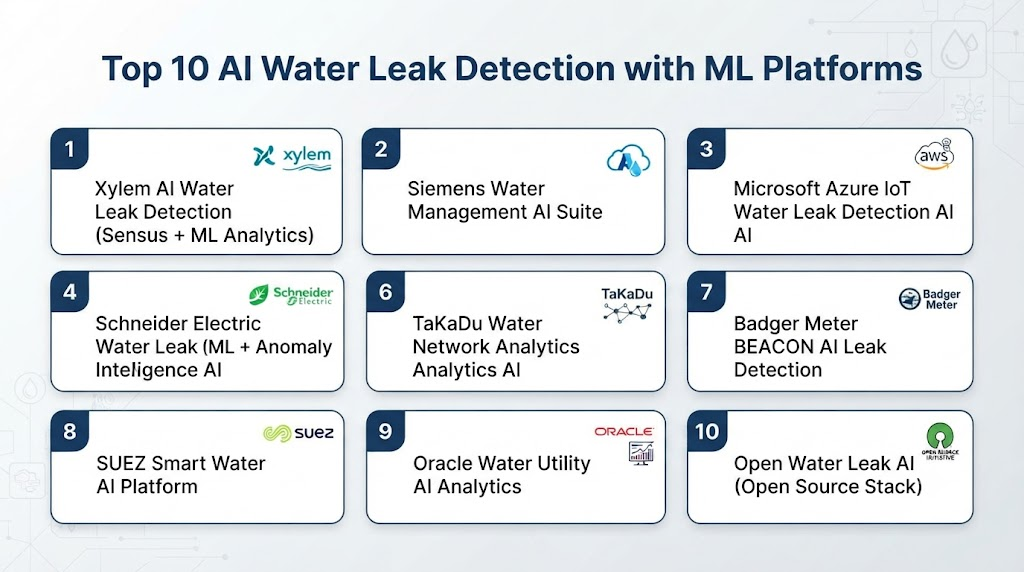
Top 10 AI Water Leak Detection with ML Platforms
#1 — Xylem AI Water Leak Detection (Sensus + ML Analytics)
One-line verdict: Best enterprise-grade AI leak detection platform for municipal water utilities.
Short description (2–3 lines):
Xylem combines smart water meters, acoustic sensors, and ML-based analytics to detect leaks, bursts, and abnormal consumption patterns across large water distribution networks.
Standout Capabilities
- Real-time leak detection in pipelines
- Smart meter anomaly detection
- Acoustic leak identification
- Pressure and flow monitoring
- GIS-based leak localization
- Non-revenue water (NRW) analytics
AI-Specific Depth
- Model support: Proprietary ML + anomaly detection models
- RAG / knowledge integration: Water network + sensor data
- Evaluation: Leak detection accuracy metrics
- Guardrails: Utility safety thresholds
- Observability: Water network dashboards
Pros
- Strong utility adoption
- Highly reliable detection
- End-to-end water intelligence
Cons
- Enterprise-focused
- Hardware dependency
Security & Compliance
- Utility-grade security
- Regulatory reporting support
Deployment & Platforms
- Cloud + edge hybrid
Integrations & Ecosystem
- SCADA systems
- Smart meters
- GIS platforms
Pricing Model
Enterprise licensing
Best-Fit Scenarios
- Municipal water utilities
- Smart cities
- Large infrastructure operators
#2 — Siemens Water Management AI Suite
One-line verdict: Best for industrial-grade water infrastructure monitoring and predictive leak prevention.
Standout Capabilities
- Pipeline leak detection
- Pressure anomaly monitoring
- Water distribution optimization
- Predictive maintenance systems
- SCADA integration
AI-Specific Depth
- Model support: Industrial AI models
- RAG / knowledge integration: Utility sensor networks
- Evaluation: Operational KPIs
- Guardrails: Safety constraints
- Observability: Infrastructure dashboards
Pros
- Highly reliable industrial system
- Strong SCADA integration
- Scalable infrastructure
Cons
- Complex deployment
- High cost
Security & Compliance
- Industrial-grade compliance
Deployment & Platforms
- On-premise + hybrid
Integrations & Ecosystem
- SCADA systems
- Industrial IoT platforms
Pricing Model
Enterprise
Best-Fit Scenarios
- Utility companies
- Industrial water systems
- Government infrastructure
#3 — Microsoft Azure IoT Water Leak Detection AI
One-line verdict: Best scalable cloud-based water leak detection system for smart cities.
Standout Capabilities
- Real-time leak detection analytics
- Smart water meter integration
- Pressure anomaly detection
- Predictive maintenance models
- City-wide water monitoring
AI-Specific Depth
- Model support: Azure ML + anomaly detection
- RAG / knowledge integration: IoT + water network data
- Evaluation: Model drift monitoring
- Guardrails: Enterprise policy controls
- Observability: Azure dashboards
Pros
- Highly scalable
- Strong IoT ecosystem
- Flexible integration
Cons
- Requires Azure expertise
- Complex setup
Security & Compliance
- Enterprise security controls
Deployment & Platforms
- Cloud + edge
Integrations & Ecosystem
- Azure IoT Hub
- Power BI
- SCADA systems
Pricing Model
Usage-based
Best-Fit Scenarios
- Smart cities
- Utilities
- Large enterprises
#4 — AWS IoT Water Leak Detection (ML + Anomaly Detection)
One-line verdict: Best cloud-native solution for scalable IoT water monitoring.
Standout Capabilities
- Smart meter water monitoring
- Leak detection via anomaly models
- Pressure and flow analytics
- Edge IoT integration
- Real-time alerting
AI-Specific Depth
- Model support: AWS ML + anomaly detection models
- RAG / knowledge integration: IoT sensor streams
- Evaluation: Statistical anomaly scoring
- Guardrails: IAM-based controls
- Observability: CloudWatch monitoring
Pros
- Strong scalability
- Reliable infrastructure
- Good IoT integration
Cons
- Requires AWS expertise
- Limited water-specific UI
Security & Compliance
- Enterprise AWS security
Deployment & Platforms
- Cloud-native AWS
Integrations & Ecosystem
- AWS IoT Core
- Lambda
- Data lakes
Pricing Model
Pay-per-use
Best-Fit Scenarios
- Utilities
- Industrial systems
- Smart infrastructure
#5 — Schneider Electric Water Leak Intelligence AI
One-line verdict: Best for integrated water + energy infrastructure monitoring.
Standout Capabilities
- Leak detection in pipelines
- Smart building water monitoring
- Pressure anomaly detection
- Predictive maintenance
- Edge AI water systems
AI-Specific Depth
- Model support: Industrial AI models
- RAG / knowledge integration: Facility water data
- Evaluation: Efficiency KPIs
- Guardrails: Safety rules
- Observability: Infrastructure dashboards
Pros
- Strong sustainability focus
- Excellent edge AI integration
- Reliable industrial systems
Cons
- Industrial-focused
- Limited customization
Security & Compliance
- Enterprise-grade controls
Deployment & Platforms
- Edge + hybrid
Integrations & Ecosystem
- Building management systems
- IoT water sensors
Pricing Model
Enterprise
Best-Fit Scenarios
- Smart buildings
- Industrial plants
- Sustainability projects
#6 — TaKaDu Water Network Analytics AI
One-line verdict: Best pure software AI platform for water network leak analytics.
Standout Capabilities
- Leak detection in distribution networks
- Pressure anomaly analytics
- Event detection in water systems
- Network optimization insights
AI-Specific Depth
- Model support: Proprietary ML models
- RAG / knowledge integration: Water network datasets
- Evaluation: Leak detection KPIs
- Guardrails: Utility thresholds
- Observability: Network dashboards
Pros
- Strong analytics focus
- No heavy hardware dependency
- Easy integration
Cons
- Requires sensor infrastructure
- Limited physical hardware stack
Security & Compliance
- Enterprise security
Deployment & Platforms
- Cloud-based
Integrations & Ecosystem
- SCADA
- Water utilities
Pricing Model
Subscription
Best-Fit Scenarios
- Water utilities
- Smart cities
- Utility analytics teams
#7 — Badger Meter BEACON AI Leak Detection
One-line verdict: Best smart meter-based leak detection system for residential and commercial networks.
Standout Capabilities
- Smart water meter analytics
- Household leak detection
- Consumption anomaly alerts
- Real-time monitoring dashboards
AI-Specific Depth
- Model support: Meter-based anomaly ML
- RAG / knowledge integration: Meter data streams
- Evaluation: Consumption anomaly scoring
- Guardrails: Usage thresholds
- Observability: Utility dashboards
Pros
- Strong smart meter integration
- Easy deployment
- Good residential use cases
Cons
- Limited industrial scale
- Hardware dependency
Security & Compliance
- Utility-grade controls
Deployment & Platforms
- Cloud + device-based
Integrations & Ecosystem
- Smart meters
- Utility billing systems
Pricing Model
Hardware + subscription
Best-Fit Scenarios
- Residential utilities
- Small municipalities
- Smart homes
#8 — SUEZ Smart Water AI Platform
One-line verdict: Best for large-scale municipal water network optimization.
Standout Capabilities
- Leak detection in pipelines
- Water distribution optimization
- Pressure monitoring systems
- Non-revenue water reduction
- Predictive analytics
AI-Specific Depth
- Model support: Proprietary AI models
- RAG / knowledge integration: Utility datasets
- Evaluation: Network efficiency KPIs
- Guardrails: Operational safety rules
- Observability: Utility dashboards
Pros
- Strong municipal adoption
- Reliable infrastructure
- Good scalability
Cons
- Complex setup
- Enterprise-only
Security & Compliance
- Utility compliance standards
Deployment & Platforms
- Hybrid systems
Integrations & Ecosystem
- SCADA
- Smart city systems
Pricing Model
Enterprise
Best-Fit Scenarios
- City water utilities
- Government infrastructure
#9 — Oracle Water Utility AI Analytics
One-line verdict: Best for utility billing + leak detection integration.
Standout Capabilities
- Water consumption anomaly detection
- Leak detection analytics
- Billing integration
- Customer usage insights
AI-Specific Depth
- Model support: Oracle AI models
- RAG / knowledge integration: Utility billing data
- Evaluation: Consumption KPIs
- Guardrails: Enterprise controls
- Observability: Utility dashboards
Pros
- Strong billing integration
- Good enterprise tools
- Reliable analytics
Cons
- Complex setup
- Less flexible AI models
Security & Compliance
- Enterprise-grade security
Deployment & Platforms
- Cloud + hybrid
Integrations & Ecosystem
- ERP systems
- Utility billing platforms
Pricing Model
Enterprise licensing
Best-Fit Scenarios
- Utility companies
- Billing-integrated water systems
#10 — Open Water Leak AI (Open Source Stack)
One-line verdict: Best open-source framework for building custom water leak detection systems.
Standout Capabilities
- Custom leak detection models
- IoT sensor integration pipelines
- Time-series anomaly detection
- Edge AI deployment support
- Flexible architecture
AI-Specific Depth
- Model support: Open-source ML models
- RAG / knowledge integration: Fully customizable
- Evaluation: Developer-defined metrics
- Guardrails: None built-in
- Observability: Custom dashboards
Pros
- Full flexibility
- No vendor lock-in
- Ideal for innovation
Cons
- Requires expertise
- No enterprise support
Security & Compliance
- Depends on deployment
Deployment & Platforms
- Self-hosted / hybrid
Integrations & Ecosystem
- IoT systems
- Data lakes
- Cloud platforms
Pricing Model
Open-source
Best-Fit Scenarios
- Research labs
- Smart infrastructure prototypes
- Engineering teams
Comparison Table
| Tool Name | Best For | Deployment | Model Flexibility | Strength | Watch-Out | Public Rating |
|---|---|---|---|---|---|---|
| Xylem | Utility leak detection | Hybrid | Proprietary | Accuracy | Hardware dependency | N/A |
| Siemens | Industrial water systems | Hybrid | Proprietary | Reliability | Complexity | N/A |
| Microsoft | Smart cities | Cloud | ML + proprietary | Scalability | Setup complexity | N/A |
| AWS | IoT water monitoring | Cloud | ML models | Infrastructure scale | Limited UI | N/A |
| Schneider | Smart buildings | Edge | Proprietary | Sustainability | Industrial focus | N/A |
| TaKaDu | Network analytics | Cloud | ML models | Software analytics | Sensor dependency | N/A |
| Badger Meter | Smart meters | Cloud/device | Proprietary | Residential focus | Hardware dependency | N/A |
| SUEZ | Municipal systems | Hybrid | Proprietary | Scale | Complexity | N/A |
| Oracle | Utility billing | Cloud | Proprietary | Billing integration | Less flexible AI | N/A |
| Open Water AI | Custom systems | Self-hosted | Open-source | Flexibility | No support | N/A |
Scoring & Evaluation (Transparent Rubric)
| Tool | Core | Reliability | Guardrails | Integrations | Ease | Perf/Cost | Security/Admin | Support | Weighted Total |
|---|---|---|---|---|---|---|---|---|---|
| Xylem | 9 | 9 | 9 | 9 | 7 | 8 | 9 | 9 | 8.5 |
| Siemens | 9 | 9 | 9 | 8 | 6 | 8 | 9 | 9 | 8.3 |
| Microsoft | 9 | 9 | 9 | 9 | 7 | 8 | 9 | 9 | 8.6 |
| AWS | 8 | 9 | 8 | 9 | 7 | 8 | 9 | 8 | 8.1 |
| Schneider | 8 | 8 | 8 | 8 | 7 | 8 | 8 | 8 | 8.0 |
| TaKaDu | 8 | 8 | 8 | 8 | 8 | 8 | 8 | 8 | 8.0 |
| Badger Meter | 8 | 8 | 8 | 8 | 8 | 8 | 8 | 8 | 8.0 |
| SUEZ | 9 | 9 | 9 | 8 | 6 | 8 | 9 | 9 | 8.4 |
| Oracle | 8 | 8 | 8 | 8 | 7 | 7 | 9 | 8 | 7.9 |
| Open Water AI | 8 | 7 | 6 | 7 | 6 | 9 | 6 | 7 | 7.2 |
Which Water Leak Detection Tool Is Right for You?
Residential Utilities
Best fit: Badger Meter, TaKaDu
Focus: smart meter + household leak detection
Municipal Water Systems
Best fit: Xylem, SUEZ, Siemens
Focus: network-wide leak detection
Smart Cities
Best fit: Microsoft, AWS, IBM-style systems
Focus: scalability + real-time analytics
Industrial Facilities
Best fit: Schneider Electric, Siemens
Focus: infrastructure safety
Developers & Researchers
Best fit: Open Water Leak AI
Focus: flexibility + experimentation
Implementation Playbook (30 / 60 / 90 Days)
30 Days: Setup
- Install sensors and meters
- Define baseline water usage patterns
- Identify leak detection KPIs
60 Days: Integration
- Connect SCADA / IoT pipelines
- Deploy ML anomaly detection models
- Enable alerting dashboards
90 Days: Scale
- Expand across full pipeline networks
- Automate leak localization
- Optimize maintenance scheduling
- Integrate with GIS mapping systems
Common Mistakes & How to Avoid Them
- Ignoring sensor calibration issues
- Poor pressure-flow data alignment
- No acoustic signal modeling
- Weak anomaly threshold tuning
- Lack of GIS integration
- Over-reliance on cloud-only systems
- Missing edge AI deployment
- No predictive maintenance layer
- High false positive rates
- Poor data quality management
- No network topology modeling
- Vendor lock-in risks
- Lack of real-time alerts
- Ignoring seasonal water usage patterns
FAQs
What is AI water leak detection?
It is the use of machine learning to detect leaks in water systems using sensor data.
How does it work?
It analyzes pressure, flow, and acoustic data for anomalies.
Can it detect underground leaks?
Yes, acoustic ML models are widely used for this.
Is it real-time?
Yes, most modern systems operate in real time.
What sensors are used?
Flow meters, pressure sensors, acoustic sensors, and IoT devices.
Can it reduce water loss?
Yes, significantly in municipal systems.
What is NRW?
Non-Revenue Water—water lost due to leaks or theft.
Is cloud required?
Not always; edge AI is widely used.
Who uses it?
Utilities, governments, and industrial operators.
What is the biggest challenge?
Accurate leak localization.
Can it prevent bursts?
Yes, predictive models can forecast failures.
Is open-source viable?
Yes, but requires expertise.
Conclusion
AI Water Leak Detection with ML is transforming water infrastructure by enabling real-time leak detection, predictive maintenance, and large-scale water conservation. It is becoming a critical technology for smart cities and utilities facing increasing water scarcity.The best solution depends on scale: industrial vendors ensure reliability, cloud providers enable scalability, and open-source systems provide maximum flexibility.

Find Trusted Cardiac Hospitals
Compare heart hospitals by city and services — all in one place.
Explore Hospitals