
Research cut-off: October 6, 2026
Authority used: Current official Red Hat certification, exam, FAQ, policy, and documentation pages only.
1. Introduction
Red Hat significantly reorganized its certification program on May 11, 2026.
The current program is no longer best understood using the traditional generic diagram:
RHCSA
  |
RHCE
  |
RHCA
That model is now incomplete.
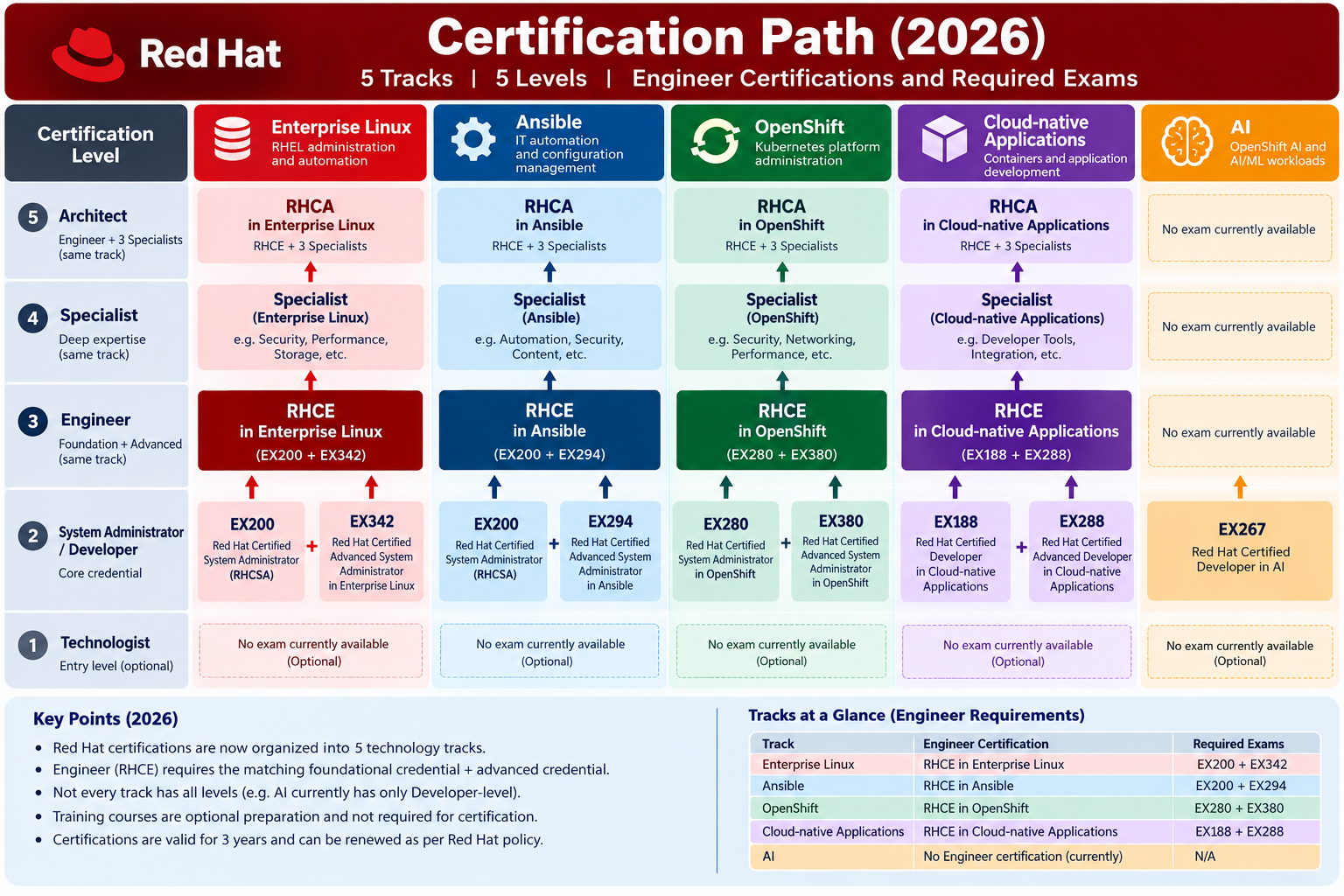
Red Hat now organizes certification into five technology specializations:
Enterprise Linux
Ansible
OpenShift
Cloud-native Applications
AI
and into a common five-level framework:
Level 1  Technologist
Level 2  System Administrator / Developer
Level 3  Engineer
Level 4  Specialist
Level 5  Architect
Not every specialization currently has an exam at every level. This is particularly important for AI, where only the Developer-level certification is currently populated.
What does “Engineer” mean now?
An Engineer credential is effectively a stacked designation.
Red Hat states that a candidate must earn:
Matching foundational credential
        +
Matching advanced credential
        =
Engineer credential
There is not necessarily a separate exam named “Engineer exam.”
For example:
RHCSA
+
RHCASA in Ansible
=
RHCE in Ansible
Red Hat describes Engineer as Level 3 and says both the foundational credential and its corresponding advanced credential within the same specialization must be earned.
Certification track vs training path
A certification track defines which credentials/exams lead to certifications.
A training path consists of optional or recommended Red Hat courses intended to help prepare for those exams.
They are not the same thing.
TRAINING COURSE
      ≠
CERTIFICATION EXAM
      ≠
CERTIFICATION
2. Current Red Hat Certification Framework
The officially defined levels are:
| Level | Current designation | Purpose |
|---|---|---|
| 1 | Technologist | Optional entry-level foundation |
| 2 | System Administrator / Developer | Core administration or development credential |
| 3 | Engineer | Foundational + matching advanced credential |
| 4 | Specialist | Deep expertise in one technical area; no prerequisite as a designation |
| 5 | Architect | Engineer + three qualifying Specialist credentials within the same specialization |
A simplified view is:
                         RED HAT CERTIFICATION — 2026
                                      |
       ----------------------------------------------------------------
       |                 |                |                |            |
 Enterprise Linux      Ansible         OpenShift       Cloud-native    AI
       |                 |                |             Applications    |
       |                 |                |                |            |
 Admin: RHCSA       Admin: RHCSA     Admin: RHCSA     Developer      Developer
                                     - OpenShift       EX188          EX267
       |                 |                |                |            |
 Advanced            Advanced         Advanced         Advanced        |
 EX342               EX294            EX380            EX288           |
       |                 |                |                |            |
 Engineer            Engineer         Engineer         Engineer       NONE
 RHCE-EL             RHCE-Ansible     RHCE-OpenShift   RHCE-CNA       currently
       |                 |                |                |            |
 Specialists         Specialists      Specialists      Specialists     NONE
       |                 |                |                |            |
 Architect           Architect        Architect        Architect       NONE
The absence of an AI Engineer/Architect path above is intentional: Red Hat’s current catalog explicitly says that no exam is presently available at those AI levels.
3. Track 1 — Enterprise Linux
Certification
Engineer certification: Red Hat Certified Engineer in Enterprise Linux
Official designation: RHCE — Enterprise Linux
Red Hat describes this credential as validating the ability to automate Red Hat Enterprise Linux tasks, integrate emerging technologies, and use automation effectively in enterprise Linux environments.
Required exams
| Exam | Exact current name | Result of passing |
|---|---|---|
| EX200 | Red Hat Certified System Administrator (RHCSA) exam | Red Hat Certified System Administrator |
| EX342 | Red Hat Certified Advanced System Administrator in Enterprise Linux exam | Red Hat Certified Advanced System Administrator in Enterprise Linux |
EX200 currently tests core RHEL system-administration skills.
EX342 is an advanced troubleshooting-focused performance exam covering issues such as boot failures, filesystems, networking, packages, authentication, applications, and diagnostic information collection. The current exam page is based on RHEL 10.2.
Mandatory certification requirement
To earn:
Red Hat Certified Engineer in Enterprise Linux
you need:
EX200
  ↓
Red Hat Certified System Administrator
  +
EX342
  ↓
Red Hat Certified Advanced System Administrator
in Enterprise Linux
  =
Red Hat Certified Engineer
in Enterprise Linux
The current certification catalog explicitly lists EX200 + EX342 as the requirements for RHCE in Enterprise Linux.
Prerequisite table
| Requirement | Required? | Official status | Source |
|---|---|---|---|
| Pass EX200 for RHCE-Enterprise Linux | Yes | RHCSA is the foundational Engineer requirement | |
| Pass EX342 | Yes | Required advanced credential | |
| Hold RHCSA simply to sit EX342 | Not stated as a mandatory exam-registration requirement | EX342 lists RHCSA or equivalent administration experience under recommended preparation | |
| RH342 training course | No | Recommended preparation or similar experience | |
| Specific number of years of experience | No published requirement | No number of years specified |
Does order matter?
Red Hat’s official certification path is:
EX200 → RHCSA → EX342 → RHCE in Enterprise LinuxThe current RHCE page explicitly describes becoming RHCSA first and then completing EX342.
However, EX342 itself awards the Red Hat Certified Advanced System Administrator in Enterprise Linux credential, and its page does not state that RHCSA is a mandatory registration prerequisite.
Therefore:
For the officially documented RHCE progression, use EX200 → EX342.
Whether Red Hat will automatically create the Engineer designation when a person earns EX342 first and EX200 later is not explicitly specified in the current public documentation reviewed here.
Who should consider this track?
Career-oriented guidance—not an official Red Hat prerequisite:
- Linux administrators
- RHEL administrators
- Infrastructure engineers
- SREs
- Platform engineers
- DevOps engineers whose responsibilities include Linux systems
- Engineers responsible for RHEL troubleshooting
4. Track 2 — Ansible
Certification
Engineer certification: Red Hat Certified Engineer in Ansible
Official designation: RHCE — Ansible
It validates the ability to use Red Hat Ansible technologies to automate systems management and standard system-administration tasks.
Required exams
| Exam | Exact current name | Result |
|---|---|---|
| EX200 | Red Hat Certified System Administrator (RHCSA) exam | RHCSA |
| EX294 | Red Hat Certified Advanced System Administrator in Ansible Exam | Red Hat Certified Advanced System Administrator in Ansible |
Passing EX294 itself gives the advanced Ansible administrator credential. It is not, by itself, RHCE in Ansible.
The Engineer credential requires:
EX200
   ↓
RHCSA
   +
EX294
   ↓
Red Hat Certified Advanced
System Administrator in Ansible
   =
Red Hat Certified Engineer
in Ansible
Is RHCSA required?
To earn RHCE in Ansible?
Yes.
Red Hat explicitly says candidates who hold RHCSA can earn RHCE in Ansible by completing EX294.
To take EX294 itself?
The current EX294 exam page does not list possession of the RHCSA certification as a mandatory credential prerequisite.
Instead, it lists preparation such as:
- RH124 + RH134/RH199 or comparable RHEL administration experience
- Ansible training or comparable experience
- familiarity with the EX200 objectives
The same page explicitly says classroom attendance is not required and candidates may choose to take only the exam.
Therefore the distinction is:
Take EX294
    ≠
Automatically receive RHCE-Ansible
If you pass EX294 without satisfying the RHCSA component, the directly earned credential is:
Red Hat Certified Advanced System Administrator in Ansible.
Exam order
Official RHCE progression:
EX200 → RHCSA → EX294 → RHCE-AnsibleRed Hat’s Engineer certification page documents this sequence.
A reverse-order Engineer award is not officially specified in the current public documentation reviewed here.
Target audience
Career alignment:
- Automation engineers
- DevOps engineers
- Linux administrators
- Infrastructure automation engineers
- Platform engineers
- SREs using Ansible
- Configuration-management engineers
5. Track 3 — OpenShift
Certification
Engineer certification: Red Hat Certified Engineer in OpenShift
Official designation on the current certification page: RHCE — OpenShift
Red Hat says the credential validates advanced OpenShift administration capabilities required to maintain and scale OpenShift in enterprise environments.
Required exams
| Exam | Exact current name | Credential obtained |
|---|---|---|
| EX280 | Red Hat Certified System Administrator in OpenShift exam | Red Hat Certified System Administrator in OpenShift |
| EX380 | Red Hat Certified Advanced System Administrator in OpenShift exam | Red Hat Certified Advanced System Administrator in OpenShift |
The catalog lists EX280 + EX380 as the Engineer requirements.
Progression:
EX280
   ↓
Red Hat Certified
System Administrator in OpenShift
   +
EX380
   ↓
Red Hat Certified Advanced
System Administrator in OpenShift
   =
Red Hat Certified Engineer
in OpenShift
Is traditional RHCSA/EX200 required?
No.
The RHCE-OpenShift requirements are EX280 and EX380—not EX200.
The EX280 preparation page actually states that traditional RHEL RHCSA is strongly recommended but not required for EX280.
That distinction matters:
RHCSA                  = Enterprise Linux credential
RHCSA - OpenShift      = OpenShift credential

They are not the same certification.
Must EX280 be passed before taking EX380?
The EX380 exam page does not list the EX280 certification as a mandatory exam-registration prerequisite.
Its recommended preparation is OpenShift administration training or equivalent advanced OpenShift experience.
Passing EX380 produces the advanced OpenShift administrator credential. Red Hat explains that the matching advanced credential together with the matching System Administrator credential earns Engineer.
For the documented Engineer path, however, Red Hat describes:
EX280 → RHCSA-OpenShift → EX380 → RHCE-OpenShiftReverse-order automatic Engineer designation is not officially specified in the current public documentation reviewed here.
Is Kubernetes knowledge required?
EX280 includes extensive Kubernetes/OpenShift resource administration and Red Hat explicitly recommends OpenShift/container experience. It also expects candidates to work with Kubernetes resources.
However, Red Hat does not state that a separate Kubernetes certification such as CKA is required.
Target audience
- OpenShift administrators
- Platform engineers
- Kubernetes/OpenShift engineers
- Cloud engineers
- Cluster engineers
- SREs
- DevOps engineers responsible for OpenShift platforms
6. Track 4 — Cloud-native Applications
Certification
Engineer certification: Red Hat Certified Engineer in Cloud-native Applications
Official designation: RHCE — Cloud-native Applications
It validates skills for developing and deploying applications in modern container-orchestration environments.
Required exams
| Exam | Exact current name | Credential |
|---|---|---|
| EX188 | Red Hat Certified Developer in Cloud-native Applications exam | Red Hat Certified Developer in Cloud-native Applications |
| EX288 | Red Hat Certified Advanced Developer in Cloud-native Applications exam | Red Hat Certified Advanced Developer in Cloud-native Applications |
The Engineer requirements are officially:
EX188
   ↓
Red Hat Certified Developer
in Cloud-native Applications
   +
EX288
   ↓
Red Hat Certified Advanced Developer
in Cloud-native Applications
   =
Red Hat Certified Engineer
in Cloud-native Applications
EX188
EX188 validates container fundamentals: building and managing container images and running, managing, and troubleshooting containers with Podman.
Recommended preparation includes practical Podman/Linux container experience. Training is preparation rather than the certification itself.
EX288
EX288 validates the ability to deploy and manage applications in OpenShift, including application deployment, builds, image streams, configuration, pipelines, templates, and related development workflows.
Is RHCSA required?
No.
The current Cloud-native Engineer requirements are EX188 + EX288. EX200/RHCSA is not listed.
Is EX280/OpenShift Administrator required?
No.
EX280 is not listed as a Cloud-native Engineer requirement.
OpenShift knowledge is certainly relevant to EX288, but a separate OpenShift Administrator certification is not an official certification prerequisite.
Is programming experience mandatory?
Red Hat’s current pages focus on practical container and OpenShift application skills.
They do not state a mandatory Java, Python, Go, or other specific programming-language certification requirement for EX188 or EX288.
Therefore claims such as:
“You must know Java to earn RHCE in Cloud-native Applications”
would not be supported by the current Red Hat requirements.
Exam order
Official certification progression:
EX188 → Developer → EX288 → EngineerEX288’s exam page itself does not state that the EX188 certification is a mandatory registration prerequisite; it gives its own recommended preparation.
Reverse-order Engineer award behavior is not officially specified in the current public documentation reviewed here.
Target audience
- Application developers
- Cloud-native developers
- DevOps engineers
- SREs working with application platforms
- Software engineers deploying workloads to OpenShift
- Developers working with containers and CI/CD
7. Track 5 — AI
This is where the supplied starting hypothesis requires the biggest correction.
Current certification
Red Hat Certified Developer in AI
Current exam:
EX267 — Red Hat Certified Developer in AI
Passing EX267 directly awards the Red Hat Certified Developer in AI certification.
It currently covers Red Hat OpenShift AI and skills around:
- OpenShift AI architecture
- data-science projects and workbenches
- resource allocation
- data connections
- model deployment and serving
- ML/AI workflows
- OpenShift AI administration
Current AI Engineer certification
No Engineer-level AI certification is currently available.
Red Hat’s current catalog shows:
AI

Technologist:
No exam available

Developer:
EX267 — available

Engineer:
No exam available

Specialist:
No exam available

Architect:
No exam available
Therefore:
"AI Administrator/Developer exam
          +
 AI Engineer exam
          =
 RHCE in AI"Code language: PHP (php)
is not a current Red Hat certification path as of October 6, 2026.
EX267 prerequisites/readiness
Red Hat says candidates should have either training or comparable experience with:
- OpenShift Container Platform
- Red Hat OpenShift AI
The exam page mentions DO288 or comparable OpenShift experience and AI267 or comparable OpenShift AI experience.
Is RHCSA required?
No RHCSA certification is listed as an EX267 certification requirement.
Is EX280/OpenShift certification required?
No separate OpenShift certification is listed as a mandatory credential prerequisite.
Relevant OpenShift experience is expected/recommended through the EX267 readiness requirements, but that is different from requiring EX280 certification.
Is Ansible certification required?
No.
No Ansible certification appears in the current EX267 requirement.
AI progression today
EX267
   ↓
Red Hat Certified Developer in AI
   ↓
Engineer level:
NO EXAM CURRENTLY AVAILABLE
The correct guidance is therefore to stop here rather than inventing a future Engineer exam.
8. Side-by-Side Comparison
| Track | Current Engineer certification | Foundation exam | Advanced exam | Mandatory Engineer foundation | Official Engineer exam sequence | Main technology |
|---|---|---|---|---|---|---|
| Enterprise Linux | Red Hat Certified Engineer in Enterprise Linux | EX200 | EX342 | RHCSA | Official path: EX200 → EX342 | RHEL |
| Ansible | Red Hat Certified Engineer in Ansible | EX200 | EX294 | RHCSA | Official path: EX200 → EX294 | Ansible Automation Platform |
| OpenShift | Red Hat Certified Engineer in OpenShift | EX280 | EX380 | RHCSA in OpenShift | Official path: EX280 → EX380 | OpenShift |
| Cloud-native Applications | Red Hat Certified Engineer in Cloud-native Applications | EX188 | EX288 | Developer in Cloud-native Applications | Official path: EX188 → EX288 | Containers/OpenShift application development |
| AI | No Engineer certification/exam currently available | EX267 gives Developer | None | N/A | N/A | OpenShift AI |
Official certification requirements:
9. Prerequisite Matrix
This is the key distinction between taking an exam and earning an Engineer credential.
| Track | Exam | Must hold another certification to earn the credential directly associated with this exam? | Engineer prerequisite | What passing this exam alone gives |
|---|---|---|---|---|
| Enterprise Linux | EX200 | No prior certification listed | N/A | RHCSA |
| Enterprise Linux | EX342 | RHCSA is recommended preparation, not stated as mandatory for the EX342 credential itself | RHCSA required for RHCE-EL | RHCASA in Enterprise Linux |
| Ansible | EX294 | RHCSA credential itself is not listed as an EX294 exam-registration prerequisite | RHCSA required for RHCE-Ansible | RHCASA in Ansible |
| OpenShift | EX280 | No prior certification required; traditional RHCSA is recommended, not required | Foundation for RHCE-OpenShift | RHCSA in OpenShift |
| OpenShift | EX380 | EX280 credential is not listed as a mandatory EX380 exam prerequisite | RHCSA-OpenShift required for RHCE-OpenShift | RHCASA in OpenShift |
| Cloud-native | EX188 | No prior certification listed | Foundation for RHCE-CNA | Developer in Cloud-native Applications |
| Cloud-native | EX288 | EX188 is not stated as a mandatory exam-registration prerequisite on the EX288 page | Developer credential required for RHCE-CNA | Advanced Developer in Cloud-native Applications |
| AI | EX267 | No prior Red Hat certification listed | No Engineer path currently exists | Developer in AI |
Sources:
The practical rule
If you pass an advanced exam before possessing its Engineer-level foundation:
You have passed the advanced exam
            ↓
You earn its directly associated advanced credential
            ↓
That does NOT, by itself, mean
you hold the corresponding RHCE
Engineer requires the complete matching stack.
10. Exam-Only Paths
Training is deliberately omitted below.
Enterprise Linux
EX200
  ↓
RHCSA
  ↓
EX342
  ↓
RHCASA — Enterprise Linux
  ↓
RHCE — Enterprise Linux
Ansible
EX200
  ↓
RHCSA
  ↓
EX294
  ↓
RHCASA — Ansible
  ↓
RHCE — Ansible
OpenShift
EX280
  ↓
RHCSA — OpenShift
  ↓
EX380
  ↓
RHCASA — OpenShift
  ↓
RHCE — OpenShift
Cloud-native Applications
EX188
  ↓
Developer — Cloud-native Applications
  ↓
EX288
  ↓
Advanced Developer — Cloud-native Applications
  ↓
RHCE — Cloud-native Applications
AI
EX267
  ↓
Red Hat Certified Developer in AI
  ↓
STOP

No Engineer-level AI exam
is currently published.
11. Can I Skip the Previous Certification? — FAQ
Can I directly take an Engineer exam?
Under the 2026 framework, the Engineer designation is generally not a separate third exam.
It is created from the matching Level 2 foundation plus advanced credential.
Do I need RHCSA for every Engineer certification?
No.
RHCSA/EX200 is the foundation specifically for:
- Enterprise Linux
- Ansible
OpenShift uses EX280 as its foundation.
Cloud-native Applications uses EX188.
AI currently has no Engineer level.
Can I take EX294 without RHCSA?
The current EX294 exam page does not state possession of the RHCSA certification itself as a required credential to sit the exam.
Passing EX294 gives Red Hat Certified Advanced System Administrator in Ansible.
But you need RHCSA as well to receive RHCE in Ansible.
Can I take EX380 without EX280?
EX380’s current exam page does not list EX280 certification as a mandatory prerequisite.
Passing EX380 earns the advanced OpenShift administrator credential.
To receive RHCE in OpenShift, however, the matching EX280/RHCSA-OpenShift foundation is required.
Can I take EX342 without RHCSA?
The current EX342 page lists RHCSA or equivalent system-administration experience as recommended preparation rather than presenting RHCSA as a mandatory credential requirement for the EX342 exam itself.
But RHCSA is required for RHCE in Enterprise Linux.
Can I take EX288 without EX188?
The EX288 exam page does not state EX188 certification as a mandatory exam-registration prerequisite.
But EX188 + EX288 are required for RHCE in Cloud-native Applications.
Can I take exams in any order?
The current Red Hat Engineer certification pages consistently describe the official progression as:
Foundation credential
        ↓
Advanced credential
        ↓
Engineer designation
Taking an advanced exam independently can produce its associated advanced credential, but reverse-order automatic Engineer-award behavior is not explicitly documented in the current public sources reviewed here.
Therefore, if RHCE is your objective, use the official foundation-first sequence.
If I pass an exam, am I automatically an Engineer?
No.
Example:
Pass EX294
   =
RHCASA in Ansible

NOT necessarily

RHCE in Ansible
RHCE-Ansible additionally requires RHCSA.
Are Red Hat training courses mandatory?
For these certification paths, Red Hat normally presents courses as preparation.
EX294 explicitly says attendance is not required and candidates can take only the exam. Other exam pages offer training or comparable experience as preparation.
Is work experience mandatory?
Red Hat exam pages frequently say candidates should have training or comparable work experience.
They do not specify a mandatory number of employment years for the Engineer paths examined here.
That is different from saying practical knowledge is unnecessary—the exams themselves are hands-on.
Official prerequisite vs recommended prerequisite?
This distinction is essential.
Certification prerequisite
Example:
RHCSA is required
to become RHCE in Ansible.
Recommended exam preparation
Example:
Ansible course
or comparable practical experience.
Do not treat these as equivalent.
12. Training vs Certification
TRAINING COURSE
       |
       | teaches/prepares
       v

CERTIFICATION EXAM
       |
       | assesses skills
       v

CERTIFICATION
       |
       | awarded when official
       | credential requirements
       | are satisfied
       v

ENGINEER / ARCHITECT
stacked designation where applicable
Training
Training teaches the technology and helps prepare you.
Training completion does not automatically mean you are certified.
Exam
A certification exam is the hands-on assessment.
Current Red Hat exams are performance-based rather than conventional multiple-choice examinations.
Certification
A certification is the credential awarded after the relevant certification requirements have been satisfied.
This distinction becomes especially important at Engineer level because an advanced exam may produce an advanced credential, while RHCE requires the corresponding credential stack.
13. Exam Cost and Purchase Information
Red Hat’s current Certification Program Guide states a standard list price of USD $500 for a certification exam, but it explicitly warns that the actual price may vary by region and that the accurate price appears in the shopping cart.
Therefore, for a country-specific purchase:
Price varies by region; check the current Red Hat exam purchase page.
I am not substituting a guessed JPY, EUR, INR, or other regional price.
| Exam | Regional price |
|---|---|
| EX200 | Price varies by region; check the current Red Hat exam purchase page. |
| EX342 | Price varies by region; check the current Red Hat exam purchase page. |
| EX294 | Price varies by region; check the current Red Hat exam purchase page. |
| EX280 | Price varies by region; check the current Red Hat exam purchase page. |
| EX380 | Price varies by region; check the current Red Hat exam purchase page. |
| EX188 | Price varies by region; check the current Red Hat exam purchase page. |
| EX288 | Price varies by region; check the current Red Hat exam purchase page. |
| EX267 | Price varies by region; check the current Red Hat exam purchase page. |
Delivery
Red Hat’s certification program supports:
- Remote exams
- Red Hat/partner testing locations
- Classroom/on-site examination delivery where applicable
Exact availability depends on the exam and region, so the scheduling system should be treated as authoritative for the actual purchase.
Retake policy
For an eligible paid Individual Exam, Red Hat currently provides one free second attempt following an unsuccessful first attempt.
The current program guide states:
- after the first failed attempt, the free retake can be scheduled;
- the same exam cannot be taken more than once on the same calendar day;
- further attempts after the free retake require another paid registration and may be subject to a waiting period.
14. Certification Validity and Renewal
Red Hat’s current 2026 policy states that certifications are current for three years from the date earned.
Renewal must happen before the certification becomes non-current/expired under the program policy.
The current framework provides several renewal mechanisms:
Retake highest-level exam
          |
          v
Renews credentials at or below that level

OR

Earn another credential
at the same level
          |
          v
Renews credentials at that level and below

OR

Advance to a higher level
          |
          v
Renews lower-level credentials
If a certification has already expired, the current program guide says it must be earned again rather than renewed retroactively.
This renewal model is another significant difference from many older Red Hat certification diagrams found online.
15. How to Choose a Track
The following is career-oriented guidance, not an official Red Hat prerequisite table.
| If your work primarily focuses on… | Consider |
|---|---|
| RHEL/Linux system administration | Enterprise Linux |
| Linux troubleshooting and enterprise RHEL operations | Enterprise Linux |
| Infrastructure automation | Ansible |
| Configuration management with Ansible | Ansible |
| Kubernetes/OpenShift cluster administration | OpenShift |
| OpenShift platform engineering | OpenShift |
| Containers and deploying applications | Cloud-native Applications |
| OpenShift application development | Cloud-native Applications |
| OpenShift AI / AI platform operations | AI |
There is no universally “best” track.
The correct choice depends on the technology you actually operate or develop against.
16. Track Comparison by Job Role
Again, these are reasonable career alignments—not mandatory Red Hat mappings.
| Job role | Relevant track(s) | Why |
|---|---|---|
| Linux Administrator | Enterprise Linux | Core RHEL administration and troubleshooting |
| System Administrator | Enterprise Linux, Ansible | Linux operations plus automation |
| DevOps Engineer | Ansible, OpenShift, Cloud-native | Automation, platforms and application delivery |
| SRE | Enterprise Linux, OpenShift, Ansible | Troubleshooting, reliability, automation |
| Platform Engineer | OpenShift, Ansible, Enterprise Linux | Platform administration and automation |
| Kubernetes Engineer | OpenShift | OpenShift/Kubernetes platform operations |
| OpenShift Administrator | OpenShift | Direct technology alignment |
| Automation Engineer | Ansible | Ansible-based infrastructure automation |
| Application Developer | Cloud-native Applications | Containers and OpenShift application deployment |
| Cloud-native Developer | Cloud-native Applications | Containerized application lifecycle |
| AI Engineer / MLOps Engineer | AI, potentially OpenShift | OpenShift AI and AI/ML platform operations |
17. Common Mistakes
Mistake 1 — Following the old generic RHCSA → RHCE → RHCA diagram
The May 2026 framework is specialization-based.
Mistake 2 — Assuming every RHCE requires EX200/RHCSA
Wrong.
EX200 is foundational for Enterprise Linux and Ansible.
OpenShift uses EX280.
Cloud-native Applications uses EX188.
AI currently has no Engineer credential.
Mistake 3 — Confusing EX294 with RHCE
EX294 directly earns RHCASA in Ansible.
RHCE-Ansible requires the corresponding foundational RHCSA as well.
Mistake 4 — Confusing EX380 with RHCE-OpenShift
EX380 directly represents the Advanced System Administrator credential.
RHCE-OpenShift requires the matching EX280 foundation too.
Mistake 5 — Assuming an exam and a certification are identical
One exam can represent one credential while contributing to another stacked designation.
Mistake 6 — Assuming training is certification
Completing RH294, DO280, DO380, DO288, AI267, or another course does not by itself mean you hold the certification.
Mistake 7 — Assuming traditional RHCSA is required for OpenShift
Red Hat explicitly says traditional RHCSA is recommended but not required for EX280.
Mistake 8 — Inventing an AI Engineer exam
There is currently no Engineer-level AI exam in Red Hat’s catalog.
Mistake 9 — Assuming a course prerequisite is the same as a certification prerequisite
They are different.
Mistake 10 — Relying on old exam titles
Red Hat renamed several credentials when the new framework took effect on May 11, 2026.
Final 2026 Answer in One Table
| Track | Level-2 credential | Advanced credential | Engineer credential | Exams required for Engineer |
|---|---|---|---|---|
| Enterprise Linux | RHCSA | RHCASA in Enterprise Linux | RHCE in Enterprise Linux | EX200 + EX342 |
| Ansible | RHCSA | RHCASA in Ansible | RHCE in Ansible | EX200 + EX294 |
| OpenShift | RHCSA in OpenShift | RHCASA in OpenShift | RHCE in OpenShift | EX280 + EX380 |
| Cloud-native Applications | Red Hat Certified Developer in Cloud-native Applications | Red Hat Certified Advanced Developer in Cloud-native Applications | RHCE in Cloud-native Applications | EX188 + EX288 |
| AI | Red Hat Certified Developer in AI | No current exam | No current Engineer certification | No current Engineer path |
The central rule is therefore:
DO NOT ASK ONLY:

"What exam do I pass for RHCE?"

ASK:

"What foundational credential
+
what matching advanced credential
does this specialization require?"Code language: PHP (php)
That is the correct way to read the post-May-2026 Red Hat framework.
18. Official Red Hat Sources
These are the primary official sources used for this guide.
Certification framework and 2026 changes
Red Hat Certification Catalog — Current Framework
Red Hat Training & Certification FAQ — May 2026 Framework Changes
Red Hat Certification Program Guide
Enterprise Linux
Red Hat Certified Engineer in Enterprise Linux
EX342 — Red Hat Certified Advanced System Administrator in Enterprise Linux Exam
Ansible
Red Hat Certified Engineer in Ansible
EX294 — Red Hat Certified Advanced System Administrator in Ansible Exam
OpenShift
Red Hat Certified Engineer in OpenShift
EX280 — Red Hat Certified System Administrator in OpenShift Exam
EX380 — Red Hat Certified Advanced System Administrator in OpenShift Exam
Cloud-native Applications
Red Hat Certified Engineer in Cloud-native Applications
EX188 — Red Hat Certified Developer in Cloud-native Applications Exam
EX288 — Red Hat Certified Advanced Developer in Cloud-native Applications Exam
AI
Red Hat Certified Developer in AI
EX267 — Red Hat Certified Developer in AI Exam
Exam delivery and policies
Red Hat Training and Certification Policies
Verification Status
The following core findings were verified against current official Red Hat material:
[x] Current framework verified
[x] Five specializations verified
[x] Five certification levels verified
[x] May 11, 2026 framework change verified
[x] Enterprise Linux Engineer requirements verified
[x] Ansible Engineer requirements verified
[x] OpenShift Engineer requirements verified
[x] Cloud-native Engineer requirements verified
[x] AI Developer EX267 verified
[x] Absence of current AI Engineer exam verified
[x] EX200 verified
[x] EX342 verified
[x] EX294 verified
[x] EX280 verified
[x] EX380 verified
[x] EX188 verified
[x] EX288 verified
[x] EX267 verified
[x] Three-year certification currency policy verified
[x] Current free-retake policy verified
[x] Training/exam/certification distinction verified
[x] Regional-price limitation verified
Where Red Hat does not explicitly document reverse-order Engineer-award behavior, this guide deliberately marks it as not officially specified rather than guessing.

I’m Rajesh Kumar, a DevOps, SRE, DevSecOps, Cloud, and Platform Engineering expert passionate about sharing practical knowledge, real-world experiences, and industry best practices. I have worked at Cotocus and regularly write about technology, travel, investing, health, product reviews, and digital marketing through my various platforms.
I publish technical articles at DevOps School, travel stories at Holiday Landmark, stock market insights at Stocks Mantra, health and fitness guidance at My Medic Plus, product reviews at TrueReviewNow, and SEO and digital marketing strategies at Wizbrand.
Find Trusted Cardiac Hospitals
Compare heart hospitals by city and services — all in one place.
Explore Hospitals