
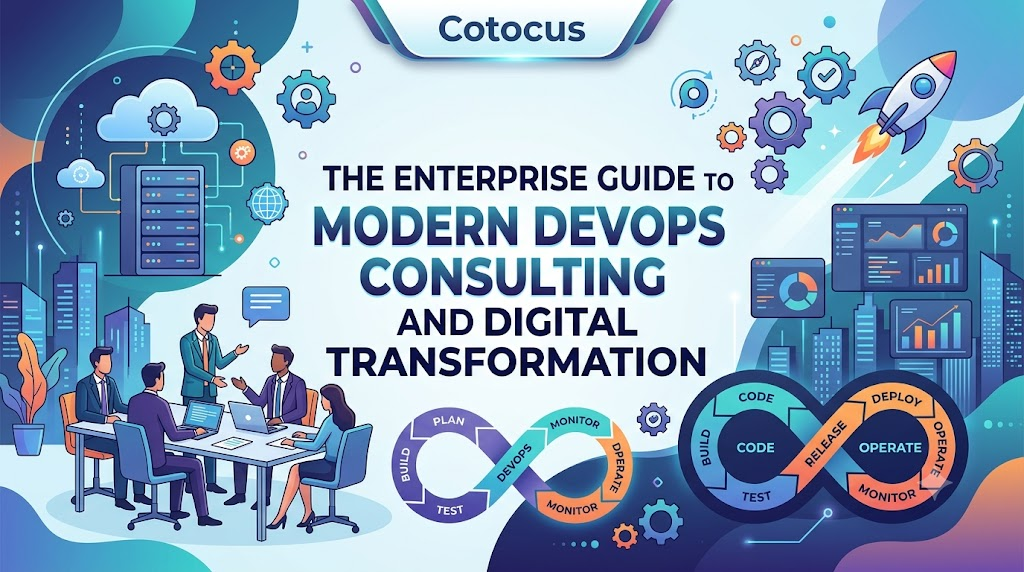
Modern enterprise environments face an unrelenting pressure to deliver software faster while maintaining high levels of security, reliability, and cost-efficiency. As legacy systems struggle to keep pace with market demands, organizations must pivot toward integrated engineering practices. This transition is not merely about adopting new tools, but about fundamentally reengineering how software is developed, deployed, and managed. Enterprises often find that the complexity of these transformations requires specialized guidance to navigate successfully. Cotocus serves as a strategic partner in this journey, providing the architectural expertise and implementation rigor required to achieve sustainable operational excellence.
Enterprise Challenges Driving Modernization
Many organizations operate under the weight of “technical debt,” where legacy systems create silos that impede agility. Deployment bottlenecks frequently occur when manual processes are used to bridge the gap between development and operations. These bottlenecks, combined with fragmented toolchains and inconsistent environments, lead to increased error rates and longer time-to-market cycles.
Furthermore, the surge in operational complexity—driven by hybrid cloud environments and microservices architectures—often outstrips existing internal expertise. Security concerns also remain a significant barrier, as traditional, perimeter-based security models fail to address the needs of dynamic, cloud-native deployments. Finally, a widening skill gap prevents teams from effectively utilizing modern infrastructure, creating a critical need for structured modernization initiatives.
Why Organizations Need Experienced Consulting Partners
Transformation is high-stakes work; misaligned strategies can lead to significant downtime, security vulnerabilities, or wasted cloud spend. Experienced consulting partners provide a proven roadmap, reducing risk by identifying potential pitfalls before they impact production environments. They offer an objective perspective that internal teams, often constrained by “business as usual,” may lack.
A qualified partner does more than implement technology. They focus on institutionalizing best practices and fostering a culture of continuous improvement. By prioritizing knowledge transfer and capability development, they ensure that the organization remains self-sufficient long after the initial engagement concludes. This partnership model is essential for shifting the focus from short-term fixes to long-term architectural stability.
Characteristics of a Mature DevOps Consulting Company
A top-tier DevOps consulting company distinguishes itself through a systematic approach to engagement. It starts with comprehensive assessment methodologies that evaluate an organization’s current state across people, process, and technology dimensions. These firms possess deep architectural expertise, capable of designing solutions that balance current requirements with future scalability.
Furthermore, a mature partner emphasizes governance frameworks that satisfy compliance requirements without slowing down delivery. Their methodology includes robust knowledge-sharing practices, ensuring that documentation, training, and mentoring are central components of every project. Their goal is to build an internal engine of innovation, rather than creating a dependency on external consultants.
Understanding DevOps Consulting Services
DevOps consulting focuses on dismantling the barriers between functional teams to accelerate value delivery. Core services include the design and implementation of robust CI/CD pipelines, which automate the path from code commit to production. By focusing on infrastructure automation, consultants help organizations treat their environment as code, ensuring consistency across development, staging, and production.
Optimization efforts also extend to monitoring and observability. Without a clear view into system performance, teams remain reactive. Implementing modern observability frameworks allows for proactive identification of performance degradations, while refined release management strategies reduce the risk associated with production changes.
Cloud Consulting and Migration Services
Effective cloud adoption requires more than a simple “lift and shift” migration. It involves thorough cloud readiness assessments to determine which workloads are best suited for transformation versus refactoring. Migration planning must account for data gravity, security posture, and the operational requirements of hybrid or multi-cloud environments.
Modernization strategies often involve breaking down monolithic applications into cloud-native services. This provides the elasticity needed to scale effectively and optimizes cost through intelligent resource allocation. A successful migration strategy prioritizes long-term operational health, ensuring that the cloud environment remains secure and cost-optimized as it grows.
Kubernetes Consulting Services
Kubernetes has become the de facto standard for container orchestration, but its operational overhead is significant. Kubernetes consulting services help organizations standardize their container platforms, ensuring that clusters are secure, scalable, and manageable. This involves defining clear standards for cluster operations and workload deployment.
Production-readiness is a critical focus area. Consultants assist in configuring auto-scaling, resource quotas, and networking policies that protect production environments. By establishing standardized engineering workflows, teams can focus on shipping features rather than debugging platform-level infrastructure issues.
SRE Consulting Services
Site Reliability Engineering (SRE) bridges the gap between software development and IT operations through an engineering-first mindset. SRE consulting services guide organizations in defining Service Level Objectives (SLOs) that align technical performance with business outcomes. This shift moves the focus from merely “avoiding downtime” to managing availability against defined tolerance thresholds.
Observability is the bedrock of SRE. Consultants help implement advanced telemetry and distributed tracing, providing the visibility needed to manage complex distributed systems. Incident response processes are also formalized, incorporating blameless post-mortems that turn failures into opportunities for system hardening and reliability improvements.
DevSecOps Consulting Services
Security can no longer be an afterthought or a final gateway in the development lifecycle. DevSecOps consulting integrates security controls directly into the CI/CD pipeline, often referred to as “shifting left.” This includes automated vulnerability scanning, dependency analysis, and policy-as-code enforcement.
By automating compliance requirements, organizations ensure that every deployment adheres to security standards. This proactive approach significantly reduces the time required for security audits and fosters a culture where security is a shared responsibility among developers and operations professionals.
GitOps and Platform Engineering Consulting
GitOps introduces a declarative approach to infrastructure management, where the desired state of the system is stored in version control. This provides an audit trail for all changes and enables rapid disaster recovery. Platform engineering takes this further by creating internal developer platforms (IDP).
These platforms provide self-service capabilities that allow developers to provision resources and deploy services without waiting for manual intervention from operations teams. This dramatically improves developer productivity, reduces cognitive load, and standardizes engineering workflows across the enterprise.
AIOps, MLOps, and DataOps Consulting Services
Intelligent automation is rapidly becoming a competitive necessity. AIOps consulting helps enterprises leverage machine learning to analyze vast amounts of operational data, identifying patterns that would be invisible to human operators. This reduces noise and helps teams resolve issues before they escalate.
Similarly, MLOps consulting focuses on the lifecycle management of machine learning models, ensuring they can be reliably trained, deployed, and monitored in production. DataOps applies similar principles to data pipelines, improving the quality and reliability of data delivery, which is essential for informed decision-making in large organizations.
Corporate Training for Engineering Teams
Technology is only as effective as the people who operate it. Corporate training for engineering teams is a vital component of any successful transformation. This goes beyond generic coursework; it involves hands-on workshops and customized learning paths tailored to the organization’s specific technical stack and architectural goals.
Lab-driven sessions allow engineers to practice implementing automation, managing Kubernetes clusters, or performing security audits in a controlled environment. Continuous capability development programs ensure that the team keeps pace with evolving technologies and industry standards, maintaining the organization’s long-term competitive edge.
Selecting the Right Consulting Partner
When evaluating a consulting partner, look beyond superficial certifications. Assess their actual implementation history—can they provide examples of how they handled complex architectural challenges? A strong partner must demonstrate a clear approach to knowledge transfer, viewing their own engagement as a temporary catalyst for internal growth.
Engagement models should be flexible, reflecting the reality that enterprise needs evolve. Furthermore, verify that the partner prioritizes long-term support and sustainability. The right partner will be invested in the success of your internal teams, not just the successful delivery of a project milestone.
Recommended Learning and Adoption Paths by Role
- Developers: Should focus on mastering containerization, CI/CD pipeline integration, and security best practices.
- DevOps Engineers: Need to prioritize platform engineering, automation scripting, and infrastructure-as-code expertise.
- Platform Teams: Should emphasize Kubernetes operations, service mesh, and self-service platform design.
- Security Professionals: Focus on policy-as-code, automated compliance, and threat modeling in cloud environments.
- Operations Teams: Need to pivot toward observability, SRE principles, and automated incident management.
- Architects & Leaders: Should concentrate on modernization roadmaps, governance, and fostering a culture of high-performance engineering.
Industry-Specific Section for Financial Services
Financial services organizations face unique challenges, primarily regarding strict regulatory compliance and the need for absolute transactional integrity. Modernization in this sector requires a “compliance-by-design” approach. Automation must include rigorous audit trails for every infrastructure change, and DevSecOps practices are mandatory to protect sensitive financial data.
Consulting for this sector often involves navigating legacy mainframes alongside modern cloud-native systems. The implementation focus remains on hybrid-cloud strategies that ensure zero-trust security while allowing the agility required to meet modern customer expectations for digital banking services.
Frequently Asked Questions
How does DevOps consulting improve time-to-market? It automates manual processes, reduces deployment frequency barriers, and provides standardized environments, which collectively minimize the time between code completion and production availability.
What is the difference between DevOps and SRE? DevOps describes a cultural shift toward shared responsibility and automation; SRE is a specific engineering implementation of those principles, focusing heavily on reliability, SLOs, and observability.
Why is Kubernetes adoption difficult for enterprises? Kubernetes introduces significant complexity in networking, security, and cluster management that requires specialized operational knowledge and standardized platform engineering.
How does DevSecOps change developer workflows? It requires developers to integrate security testing into their daily coding process and adhere to automated security policies, effectively making security a shared responsibility.
Can cloud migration be done without full refactoring? Yes, while refactoring yields the most benefits, initial migrations often use re-platforming to move workloads to the cloud while minimizing immediate code changes.
What is the value of an Internal Developer Platform (IDP)? An IDP simplifies the developer experience by providing self-service tools for infrastructure, reducing the cognitive load on developers and speeding up the delivery process.
How do we ensure knowledge transfer occurs during a consulting engagement? Effective engagements include pair programming, technical workshops, comprehensive documentation, and a focus on mentoring internal teams to own the solution.
Is AIOps only for large-scale enterprises? While large enterprises benefit most, any organization with complex distributed systems can use AIOps to reduce noise and improve the efficiency of their operations teams.
Final Thoughts
The journey toward a modernized, high-performance enterprise is continuous. It requires a commitment to building sustainable capabilities rather than seeking shortcuts. By integrating expert consulting, hands-on training, and a focus on modern engineering practices, organizations can navigate the complexities of digital transformation. The objective remains clear: to build resilient systems, empower engineering teams, and deliver consistent value to the business through technical excellence and operational maturity.

Find Trusted Cardiac Hospitals
Compare heart hospitals by city and services — all in one place.
Explore Hospitals
A valuable addition would be discussing the importance of operational maturity after DevOps adoption. Implementing automation and modern delivery practices is only the beginning; organizations also need clear governance, standardized platforms, and continuous performance evaluation to maintain momentum. Tracking indicators such as service reliability, deployment quality, incident trends, and developer efficiency enables teams to identify bottlenecks early and continuously refine their engineering processes as business demands evolve.