
Introduction
AI Accident Detection & Claims Automation tools use artificial intelligence, computer vision, machine learning, telematics data, and automation technologies to help insurance companies detect vehicle accidents, analyze damage, speed up claims processing, and improve customer experiences. These systems combine data from vehicle sensors, mobile applications, images, videos, and insurance workflows to automate different stages of the claims lifecycle.
Traditional accident reporting and claims processing often require manual documentation, inspections, and long review cycles. AI-powered claims automation helps insurers process information faster by analyzing accident images, estimating damage, identifying relevant details, and supporting claims decisions.
Modern insurance organizations use AI accident detection solutions to improve customer service, reduce administrative workload, detect potential fraud patterns, and create more efficient claims operations. These technologies are becoming increasingly important as connected vehicles, digital insurance platforms, and automated workflows continue to expand.
Real-world use cases:
- 🚗 Automatically detecting vehicle accidents using sensor and telematics data.
- 📸 Analyzing vehicle damage images through computer vision.
- 📝 Automating first notice of loss and claim submission processes.
- 🔍 Supporting faster damage assessment and repair estimation.
- 🛡️ Identifying suspicious claims patterns using AI analytics.
- 📱 Helping customers submit accident details through mobile applications.
Evaluation Criteria for Buyers:
- Accident detection accuracy and reliability.
- Computer vision capabilities for damage analysis.
- Support for telematics and vehicle sensor data.
- Claims workflow automation features.
- AI model evaluation and performance monitoring.
- Fraud detection and anomaly analysis capabilities.
- Explainability of AI-generated recommendations.
- Integration with insurance policy and claims platforms.
- Data privacy and security controls.
- Scalability for large claim volumes.
- Human review and approval workflows.
- Cost efficiency and operational impact.
Best for: Insurance companies, automotive insurers, fleet operators, repair networks, mobility platforms, and organizations looking to modernize claims operations.
Not ideal for: Small insurers with low claim volumes, companies without digital claims infrastructure, or organizations where manual inspection processes are still sufficient.
What’s Changed in AI Accident Detection & Claims Automation in 2026+
AI Accident Detection & Claims Automation is evolving from simple digital claims processing into intelligent insurance operations platforms. Modern solutions combine computer vision, predictive analytics, telematics, automation, and responsible AI practices.
Key changes include:
- 🤖 AI-powered claims assistants: Insurance companies are increasingly using AI assistants to guide customers through accident reporting and claims workflows.
- 📸 Advanced computer vision: AI systems are improving their ability to analyze vehicle damage images and support assessment processes.
- 🚗 Connected vehicle accident detection: More systems combine vehicle sensors, telematics, and mobile data to identify accident events faster.
- ⚡ Real-time claims processing: Insurers are moving toward faster digital claim decisions using automated data analysis.
- 🧠 Multimodal AI analysis: Modern platforms combine images, text descriptions, sensor information, and historical claims data.
- 🔍 AI fraud detection integration: Claims systems are increasingly using AI to identify unusual patterns and potential fraud risks.
- 🧪 AI evaluation and testing: Insurance teams are adopting testing methods to measure model accuracy and reliability.
- 🔐 Privacy-focused claims processing: Organizations are improving protection of customer information, images, and vehicle data.
- ⚖️ Explainable AI adoption: Insurers require clearer reasoning behind AI-generated damage assessments and recommendations.
- 📊 Claims workflow automation: More manual steps are being automated, including document processing and claim classification.
- 💰 Cost optimization: Insurance companies are focusing on reducing claims handling costs while maintaining service quality.
- 🔗 Insurance ecosystem integration: AI claims tools are connecting with repair shops, policy systems, customer applications, and payment platforms.
Quick Buyer Checklist (Scan-Friendly)
Use this checklist before selecting an AI Accident Detection & Claims Automation platform:
✅ Accident detection capabilities
- Can the system identify accidents accurately?
- Does it support telematics and sensor data?
✅ Computer vision features
- Can it analyze damage images?
- Does it support automated damage assessment?
✅ Claims automation
- Can it automate claim submission?
- Does it reduce manual processing?
✅ AI model capabilities
- Does it support machine learning workflows?
- Can models be customized?
✅ Evaluation and monitoring
- Can teams measure AI accuracy?
- Are performance reports available?
✅ Fraud detection
- Can it identify suspicious claims?
- Does it support anomaly detection?
✅ Privacy and security
- How is customer data protected?
- Are access controls available?
✅ Human review workflows
- Can adjust decisions be reviewed by claims professionals?
- Are approval processes supported?
✅ Integration capabilities
- Claims management systems.
- Policy platforms.
- Repair networks.
- Customer applications.
✅ Scalability
- Can it handle large claim volumes?
- Does it support multiple regions?
✅ Cost management
- Infrastructure requirements.
- Processing costs.
- Operational savings.
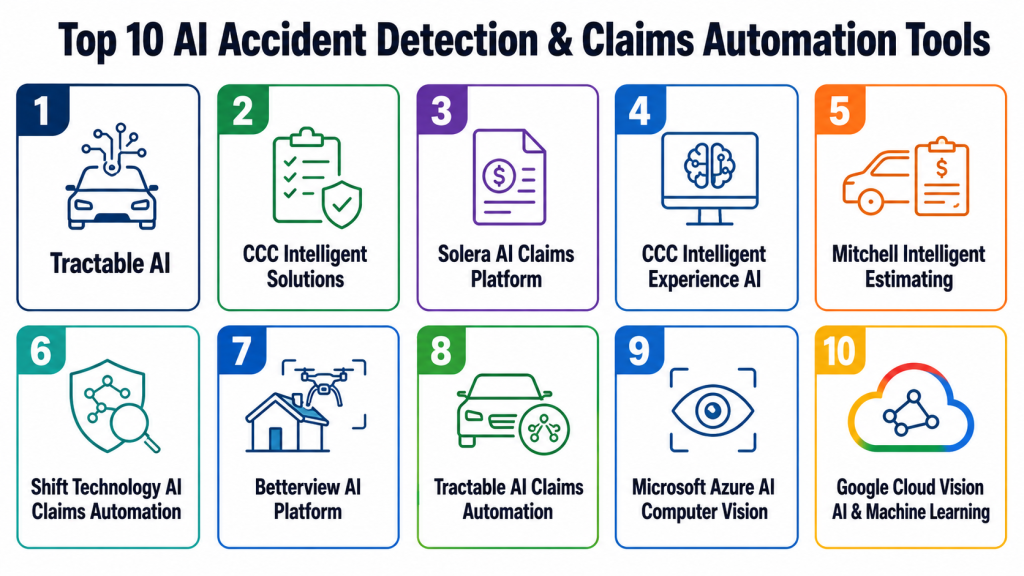
Top 10 AI Accident Detection & Claims Automation Tools
#1 — Tractable AI
One-line verdict: Best for insurers automating vehicle damage assessment and claims processing workflows.
Short description:
Tractable AI provides artificial intelligence solutions for insurance workflows, especially vehicle damage assessment and claims automation. It uses computer vision technology to analyze images and support faster insurance decisions.
Standout Capabilities
- AI-powered damage assessment.
- Computer vision analysis.
- Claims workflow automation.
- Vehicle image processing.
- Insurance decision support.
- Digital claims experiences.
- Repair process support.
AI-Specific Depth
- Model support: Proprietary AI models.
- RAG / knowledge integration: Varies depending on implementation.
- Evaluation: Model performance evaluation depends on deployment.
- Guardrails: Human review and governance depend on insurer workflows.
- Observability: Monitoring capabilities vary.
Pros
- Strong focus on insurance automation.
- Helps reduce manual damage assessment effort.
- Supports faster claims workflows.
Cons
- Primarily focused on specific insurance use cases.
- Requires integration with insurer systems.
- Pricing information is not publicly stated.
Security & Compliance
Security capabilities depend on deployment and customer requirements. Specific certifications are not publicly stated.
Deployment & Platforms
- Cloud-based platform.
- Insurance workflow environments.
Integrations & Ecosystem
Supports integration with:
- Claims management systems
- Insurance platforms
- Repair workflows
- Digital customer applications
- Data systems
Pricing Model
Not publicly stated.
Best-Fit Scenarios
- Auto insurance companies.
- Digital claims processing teams.
- Vehicle damage assessment workflows.
#2 — CCC Intelligent Solutions
One-line verdict: Best for insurers and repair networks managing digital automotive claims ecosystems.
Short description:
CCC Intelligent Solutions provides technology solutions for automotive insurance claims, repair workflows, and connected mobility processes. Its platforms support digital claims operations and communication between insurers, repair providers, and customers.
Standout Capabilities
- Claims workflow automation.
- Repair process management.
- Digital claim collaboration.
- Automotive data integration.
- Customer communication support.
- Insurance ecosystem connectivity.
- Analytics capabilities.
AI-Specific Depth
- Model support: AI capabilities vary by solution.
- RAG / knowledge integration: Varies depending on implementation.
- Evaluation: Depends on deployed AI workflows.
- Guardrails: Governance depends on insurance processes.
- Observability: Monitoring varies.
Pros
- Strong automotive insurance ecosystem.
- Supports end-to-end claims workflows.
- Useful for large insurance operations.
Cons
- Enterprise-focused platform.
- Implementation can require significant integration.
- Exact AI capabilities vary by product.
Security & Compliance
Security depends on deployment configuration. Specific certifications are not publicly stated.
Deployment & Platforms
- Cloud-based services.
- Enterprise insurance environments.
Integrations & Ecosystem
Supports:
- Insurance platforms
- Repair networks
- Claims systems
- Customer applications
- Automotive data sources
Pricing Model
Not publicly stated.
Best-Fit Scenarios
- Large auto insurers.
- Claims management organizations.
- Automotive repair ecosystems.
#3 — Solera AI Claims Platform
One-line verdict: Best for insurance companies modernizing automotive claims and repair management workflows.
Short description:
Solera provides automotive lifecycle technology solutions that support insurance claims, vehicle repair processes, and damage assessment workflows. Its AI capabilities help organizations improve claims efficiency by analyzing vehicle information and automating operational processes.
Standout Capabilities
- Digital claims management.
- Vehicle damage assessment support.
- Repair workflow automation.
- Automotive data processing.
- Insurance workflow integration.
- Customer claims communication.
- Analytics-driven decision support.
AI-Specific Depth
- Model support: AI and analytics capabilities vary by solution.
- RAG / knowledge integration: Varies depending on implementation.
- Evaluation: Model evaluation depends on deployed workflows.
- Guardrails: Governance controls depend on insurer processes.
- Observability: Monitoring capabilities vary.
Pros
- Strong automotive claims ecosystem.
- Supports multiple claims processes.
- Helps improve operational efficiency.
Cons
- Enterprise-focused deployment.
- Integration complexity may vary.
- Detailed AI capabilities are not publicly stated.
Security & Compliance
Security capabilities depend on deployment architecture. Specific certifications are not publicly stated.
Deployment & Platforms
- Cloud-based platform.
- Enterprise insurance environments.
Integrations & Ecosystem
Supports:
- Claims management systems
- Repair networks
- Insurance platforms
- Vehicle data systems
- Customer applications
Pricing Model
Not publicly stated.
Best-Fit Scenarios
- Large automotive insurers.
- Claims management organizations.
- Repair ecosystem providers.
#4 — CCC Intelligent Experience AI
One-line verdict: Best for insurers needing connected claims workflows and automotive ecosystem integration.
Short description:
CCC Intelligent Solutions supports insurance organizations with digital claims management, repair coordination, and automotive workflow technology. Its AI capabilities help improve claims processing efficiency and decision support.
Standout Capabilities
- Digital claims workflows.
- Repair estimation support.
- Insurance collaboration tools.
- Automotive data integration.
- Claims communication automation.
- Workflow optimization.
- Analytics support.
AI-Specific Depth
- Model support: AI capabilities depend on specific solutions.
- RAG / knowledge integration: Varies.
- Evaluation: Depends on workflow implementation.
- Guardrails: Insurance governance depends on customer processes.
- Observability: Monitoring varies.
Pros
- Strong insurance industry integration.
- Supports end-to-end claims workflows.
- Useful for automotive claims ecosystems.
Cons
- Primarily designed for enterprise customers.
- Requires integration with existing systems.
- Pricing information is not publicly stated.
Security & Compliance
Security depends on customer deployment requirements. Specific certifications are not publicly stated.
Deployment & Platforms
- Cloud-based services.
- Enterprise environments.
Integrations & Ecosystem
Supports:
- Insurance carriers
- Repair facilities
- Claims systems
- Automotive partners
- Customer platforms
Pricing Model
Not publicly stated.
Best-Fit Scenarios
- Automotive insurance companies.
- Claims operations teams.
- Repair management networks.
#5 — Mitchell Intelligent Estimating
One-line verdict: Best for insurers and repair organizations improving AI-assisted vehicle damage estimation.
Short description:
Mitchell provides automotive claims and repair technology solutions that support estimating, workflow management, and insurance operations. AI capabilities help organizations improve damage evaluation and claims decision processes.
Standout Capabilities
- Damage estimation support.
- Repair workflow management.
- Automotive data analysis.
- Claims automation.
- Insurance process optimization.
- Digital estimating workflows.
- Repair intelligence.
AI-Specific Depth
- Model support: AI capabilities vary by solution.
- RAG / knowledge integration: Varies.
- Evaluation: Depends on implementation.
- Guardrails: Human review processes depend on organization workflows.
- Observability: Monitoring capabilities vary.
Pros
- Strong automotive repair expertise.
- Useful for claims estimation workflows.
- Supports insurance operations.
Cons
- Primarily focused on automotive claims.
- Requires integration with existing platforms.
- AI details vary by implementation.
Security & Compliance
Security depends on deployment configuration. Specific certifications are not publicly stated.
Deployment & Platforms
- Cloud-based solutions.
- Enterprise claims environments.
Integrations & Ecosystem
Supports:
- Repair systems
- Insurance platforms
- Claims workflows
- Automotive data sources
- Estimation tools
Pricing Model
Not publicly stated.
Best-Fit Scenarios
- Auto insurers.
- Repair networks.
- Claims estimation teams.
#6 — Shift Technology AI Claims Automation
One-line verdict: Best for insurers using AI to automate claims analysis and improve operational efficiency.
Short description:
Shift Technology provides AI solutions for insurance operations, including claims automation and fraud detection workflows. Its technology helps insurers analyze claims information and improve decision-making processes.
Standout Capabilities
- Claims analysis automation.
- Fraud detection support.
- AI-powered workflow optimization.
- Insurance analytics.
- Decision support.
- Data analysis.
- Operational automation.
AI-Specific Depth
- Model support: Proprietary AI capabilities.
- RAG / knowledge integration: Varies depending on implementation.
- Evaluation: Model evaluation depends on workflow.
- Guardrails: Insurance governance depends on deployment.
- Observability: Monitoring capabilities vary.
Pros
- Strong insurance AI focus.
- Supports claims automation.
- Helps identify unusual claim patterns.
Cons
- Not specifically focused only on accident detection.
- Requires insurance workflow integration.
- Pricing is not publicly stated.
Security & Compliance
Security depends on deployment. Specific certifications are not publicly stated.
Deployment & Platforms
- Cloud-based platform.
- Enterprise insurance environments.
Integrations & Ecosystem
Supports:
- Claims platforms
- Insurance systems
- Data environments
- Fraud management workflows
- Analytics tools
Pricing Model
Not publicly stated.
Best-Fit Scenarios
- Insurance companies.
- Claims automation teams.
- Fraud analysis programs.
#7 — Betterview AI Platform
One-line verdict: Best for insurers applying AI-based risk analysis and automated inspection workflows.
Short description:
Betterview provides AI-powered insurance inspection and risk analysis capabilities. While its primary focus is property insurance, its computer vision approach represents broader AI automation patterns used across insurance operations.
Standout Capabilities
- Computer vision analysis.
- Risk assessment.
- Image-based inspection.
- Automated evaluation workflows.
- Insurance analytics.
- AI decision support.
- Data-driven insights.
AI-Specific Depth
- Model support: Computer vision AI models.
- RAG / knowledge integration: Varies.
- Evaluation: Depends on inspection workflows.
- Guardrails: Requires insurance governance processes.
- Observability: Monitoring varies.
Pros
- Strong computer vision capabilities.
- Demonstrates AI-based insurance automation.
- Useful for inspection workflows.
Cons
- Not focused specifically on vehicle accidents.
- Requires adaptation for automotive claims.
- Pricing information is not publicly stated.
Security & Compliance
Security depends on implementation. Specific certifications are not publicly stated.
Deployment & Platforms
- Cloud-based platform.
Integrations & Ecosystem
Supports:
- Insurance platforms
- Image analysis workflows
- Risk management systems
- Data platforms
Pricing Model
Not publicly stated.
Best-Fit Scenarios
- Insurance automation projects.
- Computer vision-based inspections.
- AI risk assessment workflows.
#8 — Tractable AI Claims Automation
One-line verdict: Best for insurers automating image-based vehicle damage assessment.
Short description:
Tractable AI uses computer vision technology to help insurers analyze vehicle damage images and support faster claims processing. It focuses on reducing manual inspection efforts through AI-powered assessment workflows.
Standout Capabilities
- Vehicle damage image analysis.
- Computer vision processing.
- Automated assessment support.
- Claims workflow integration.
- Repair decision support.
- Digital inspection processes.
- Insurance automation.
AI-Specific Depth
- Model support: Proprietary computer vision models.
- RAG / knowledge integration: Varies.
- Evaluation: Model accuracy depends on deployment.
- Guardrails: Human review depends on insurer workflow.
- Observability: Monitoring varies.
Pros
- Strong vehicle damage assessment focus.
- Helps accelerate claims workflows.
- Reduces manual inspection effort.
Cons
- Requires quality images and data.
- Integration effort may vary.
- Pricing details are not publicly stated.
Security & Compliance
Security depends on deployment. Specific certifications are not publicly stated.
Deployment & Platforms
- Cloud-based platform.
- Insurance workflow environments.
Integrations & Ecosystem
Supports:
- Claims systems
- Repair workflows
- Insurance applications
- Digital inspection tools
Pricing Model
Not publicly stated.
Best-Fit Scenarios
- Auto insurers.
- Digital claims teams.
- Vehicle damage assessment workflows.
#9 — Microsoft Azure AI Computer Vision
One-line verdict: Best for organizations building customized AI-powered claims inspection solutions.
Short description:
Microsoft Azure AI Computer Vision provides image analysis capabilities that organizations can use to develop custom insurance claims automation workflows. Insurers can build solutions for damage analysis, document processing, and visual inspection.
Standout Capabilities
- Image analysis.
- Custom AI application development.
- Computer vision processing.
- Document intelligence support.
- AI workflow integration.
- Developer APIs.
- Cloud scalability.
AI-Specific Depth
- Model support: Supports AI vision models and custom integrations.
- RAG / knowledge integration: Varies depending on application.
- Evaluation: Requires implementation-specific testing.
- Guardrails: Requires application-level controls.
- Observability: Cloud monitoring capabilities available.
Pros
- Flexible development platform.
- Strong enterprise cloud ecosystem.
- Supports custom claims solutions.
Cons
- Requires technical expertise.
- Not a ready-made insurance claims platform.
- Needs custom development.
Security & Compliance
Security depends on Azure configuration and implementation. Specific automotive claims certifications are not publicly stated.
Deployment & Platforms
- Cloud.
- Hybrid environments.
Integrations & Ecosystem
Supports:
- Insurance applications
- AI workflows
- Data platforms
- APIs
- Enterprise systems
Pricing Model
Usage-based pricing model.
Best-Fit Scenarios
- Insurance technology developers.
- Custom claims automation projects.
- Enterprise AI teams.
#10 — Google Cloud Vision AI & Machine Learning
One-line verdict: Best for insurers developing flexible AI-based accident analysis solutions.
Short description:
Google Cloud AI services provide computer vision and machine learning capabilities that can support insurance claims automation projects. Organizations can use these tools to build customized image analysis and claims intelligence workflows.
Standout Capabilities
- Computer vision analysis.
- Machine learning development.
- Image processing.
- AI model deployment.
- Data analytics.
- Custom automation workflows.
- Cloud scalability.
AI-Specific Depth
- Model support: Supports AI models and custom development.
- RAG / knowledge integration: Varies.
- Evaluation: Requires custom evaluation workflows.
- Guardrails: Depends on application design.
- Observability: Cloud monitoring available.
Pros
- Flexible AI development environment.
- Strong scalability.
- Supports custom insurance solutions.
Cons
- Requires AI expertise.
- Not insurance-specific.
- Development effort is required.
Security & Compliance
Security depends on implementation. Specific certifications are not publicly stated.
Deployment & Platforms
- Cloud deployment.
- Hybrid architectures.
Integrations & Ecosystem
Supports:
- Insurance systems
- Data platforms
- AI pipelines
- APIs
- Enterprise applications
Pricing Model
Usage-based pricing.
Best-Fit Scenarios
- Insurance technology teams.
- Custom claims AI development.
- Large-scale automation projects.
Comparison Table (Top 10 AI Accident Detection & Claims Automation Tools)
| Tool Name | Best For | Deployment | Model Flexibility | Strength | Watch-Out | Public Rating |
|---|---|---|---|---|---|---|
| Tractable AI | Vehicle damage assessment | Cloud | Proprietary AI | Computer vision claims | Requires image data | N/A |
| CCC Intelligent Solutions | Claims ecosystems | Cloud | AI varies | Insurance workflows | Enterprise complexity | N/A |
| Solera AI Platform | Automotive claims | Cloud | AI varies | Repair workflows | Integration effort | N/A |
| CCC Intelligent Experience AI | Digital claims | Cloud | AI varies | Claims connectivity | Implementation needs | N/A |
| Mitchell Intelligent Estimating | Damage estimation | Cloud | AI varies | Repair intelligence | Automotive focus | N/A |
| Shift Technology | Claims automation | Cloud | Proprietary AI | Insurance AI | Not accident-only | N/A |
| Betterview | AI inspection | Cloud | Vision AI | Risk analysis | Not vehicle-specific | N/A |
| Tractable Claims Automation | Image assessment | Cloud | Vision AI | Damage analysis | Data quality needs | N/A |
| Azure AI Computer Vision | Custom solutions | Cloud/Hybrid | Custom AI | Flexibility | Requires development | N/A |
| Google Cloud Vision AI | AI development | Cloud | Custom AI | Scalability | Not insurance-specific | N/A |
Scoring & Evaluation (Transparent Rubric)
The following scoring framework compares AI Accident Detection & Claims Automation tools based on practical insurance requirements. The evaluation considers accident analysis capabilities, computer vision performance, claims workflow automation, AI reliability, security, integrations, scalability, and operational efficiency. Scores are comparative indicators and should be validated according to insurer objectives, claim volumes, regulatory requirements, and existing technology environments.
| Tool | Core | Reliability/Eval | Guardrails | Integrations | Ease | Perf/Cost | Security/Admin | Support | Weighted Total |
|---|---|---|---|---|---|---|---|---|---|
| Tractable AI | 9 | 9 | 8 | 9 | 8 | 8 | 8 | 9 | 8.55 |
| CCC Intelligent Solutions | 9 | 9 | 8 | 10 | 8 | 8 | 9 | 9 | 8.75 |
| Solera AI Platform | 8 | 8 | 8 | 9 | 8 | 8 | 8 | 9 | 8.30 |
| CCC Intelligent Experience AI | 8 | 8 | 8 | 9 | 8 | 8 | 8 | 9 | 8.25 |
| Mitchell Intelligent Estimating | 8 | 8 | 8 | 9 | 8 | 8 | 8 | 9 | 8.25 |
| Shift Technology AI Claims Automation | 8 | 9 | 9 | 9 | 8 | 8 | 9 | 9 | 8.70 |
| Betterview AI Platform | 7 | 8 | 8 | 8 | 8 | 8 | 8 | 8 | 7.85 |
| Azure AI Computer Vision | 8 | 9 | 8 | 9 | 7 | 8 | 9 | 9 | 8.35 |
| Google Cloud Vision AI | 8 | 9 | 8 | 9 | 7 | 8 | 9 | 9 | 8.35 |
| Tractable Claims Automation | 9 | 9 | 8 | 8 | 8 | 8 | 8 | 9 | 8.35 |
Top 3 for Enterprise
1. CCC Intelligent Solutions
Best suited for large insurance organizations requiring connected claims ecosystems, repair workflows, and automotive industry integrations.
2. Shift Technology AI Claims Automation
Strong choice for insurers focusing on automated claims analysis, fraud support, and operational efficiency.
3. Tractable AI
Suitable for organizations looking to improve vehicle damage assessment through AI-powered computer vision.
Top 3 for SMB
1. Tractable AI
Useful for smaller insurance providers that want to improve digital vehicle damage assessment.
2. Microsoft Azure AI Computer Vision
Suitable for teams building customized claims automation solutions with flexible AI services.
3. Google Cloud Vision AI
A practical option for organizations experimenting with custom computer vision workflows.
Top 3 for Developers
1. Microsoft Azure AI Computer Vision
Best for developers creating customized AI claims applications.
2. Google Cloud Vision AI
Useful for building flexible image analysis and automation workflows.
3. Tractable AI
Suitable for teams focused specifically on vehicle damage assessment solutions.
Which AI Accident Detection & Claims Automation Tool Is Right for You?
Choosing the right AI Accident Detection & Claims Automation platform depends on claim volume, business model, available data, technical resources, and automation goals.
Insurance companies may require complete claims ecosystems, while technology teams may prefer AI building blocks to create custom solutions.
Solo / Freelancer
Individual developers, researchers, and insurance technology consultants usually need flexible tools for experimentation and prototype development.
Recommended Options:
- Azure AI Computer Vision for custom image analysis.
- Google Cloud Vision AI for AI workflow experiments.
- Open machine learning frameworks combined with claims datasets.
Best Approach:
- Start with sample accident images.
- Test damage detection models.
- Build claim classification prototypes.
- Evaluate accuracy before production use.
SMB
Small insurance providers and startups usually need affordable solutions that reduce manual claims workload.
Recommended Options:
- Tractable AI.
- Azure AI Computer Vision.
- Google Cloud Vision AI.
Important Priorities:
- Faster claims processing.
- Lower operational effort.
- Easy integration.
- Simple customer workflows.
Mid-Market
Growing insurance companies need scalable automation without replacing existing claims systems.
Recommended Options:
- Mitchell Intelligent Estimating.
- Solera AI Platform.
- CCC Intelligent Solutions.
Important Evaluation Areas:
- Claims automation coverage.
- Damage assessment accuracy.
- Repair workflow integration.
- Customer experience improvement.
- AI monitoring.
Enterprise
Large insurance carriers require comprehensive claims automation, strong governance, and high-volume processing.
Recommended Options:
- CCC Intelligent Solutions.
- Shift Technology.
- Tractable AI.
Enterprise Priorities:
- Large-scale claim handling.
- AI explainability.
- Fraud detection support.
- Secure data processing.
- Integration with existing insurance ecosystems.
Regulated Industries (Finance, Healthcare, Public Sector)
AI claims systems process sensitive information including customer identity, vehicle images, accident details, and insurance records.
Important considerations:
- Data privacy controls.
- Secure image processing.
- Access management.
- Audit trails.
- Human review processes.
- Explainable AI decisions.
Organizations should evaluate AI governance practices based on their regulatory requirements and customer expectations.
Budget vs Premium
Budget-Focused Approach
Suitable for startups and smaller insurance companies.
Consider:
- Cloud AI vision services.
- Limited claims automation pilots.
- Mobile-first claim submission workflows.
Advantages:
- Lower investment.
- Faster experimentation.
- Flexible customization.
Premium Enterprise Approach
Suitable for large insurance organizations.
Consider:
- End-to-end claims platforms.
- AI damage assessment systems.
- Fraud analytics integration.
- Enterprise workflow automation.
Advantages:
- Higher automation.
- Better scalability.
- Improved operational efficiency.
Build vs Buy (When to DIY)
Build Custom AI Claims Systems When:
- The organization has unique claims processes.
- AI automation provides competitive advantage.
- Internal AI expertise exists.
- Custom integrations are required.
Buy Existing Platforms When:
- Faster implementation is needed.
- Proven insurance workflows are preferred.
- Maintenance resources are limited.
- Standard automation is sufficient.
A hybrid approach is often effective by combining existing claims platforms with custom AI models for specialized workflows.
Implementation Playbook (30 / 60 / 90 Days)
First 30 Days: Pilot and Define Success Metrics
The first phase focuses on understanding current claims challenges and preparing AI foundations.
Key Activities:
- Identify high-volume claims processes.
- Review current manual workflows.
- Select pilot use cases.
- Prepare accident and damage datasets.
Success Metrics:
- Claim processing time.
- Damage assessment accuracy.
- Customer response time.
- Manual review reduction.
- Claim completion rate.
AI-Specific Tasks:
- Prepare training data.
- Define evaluation benchmarks.
- Create baseline automation workflows.
- Establish privacy requirements.
First 60 Days: Security, Evaluation, and Controlled Rollout
The second phase focuses on reliability and operational readiness.
Key Activities:
- Test AI claim recommendations.
- Compare AI results with human assessments.
- Review customer feedback.
- Improve automation workflows.
AI-Specific Tasks:
- Build evaluation pipelines.
- Test edge cases.
- Monitor model errors.
- Review explainability.
- Establish incident response processes.
First 90 Days: Optimization and Scale
The final phase focuses on improving performance and expanding adoption.
Key Activities:
- Expand automation coverage.
- Improve processing speed.
- Connect additional insurance systems.
- Optimize infrastructure costs.
AI-Specific Tasks:
- Monitor model drift.
- Improve computer vision accuracy.
- Maintain model version control.
- Optimize latency.
- Establish AI governance.
Common Mistakes & How to Avoid Them
- ❌ Automating claims without quality data.
✅ Improve data collection and validation first. - ❌ Relying completely on AI decisions.
✅ Maintain human review for complex claims. - ❌ Ignoring image quality issues.
✅ Create clear customer submission guidelines. - ❌ Not testing AI accuracy.
✅ Use evaluation benchmarks before deployment. - ❌ Ignoring privacy concerns.
✅ Protect customer and vehicle information. - ❌ Missing fraud detection opportunities.
✅ Combine claims automation with anomaly analysis. - ❌ Building disconnected AI workflows.
✅ Integrate with existing insurance systems. - ❌ Ignoring customer experience.
✅ Make claim submission simple and transparent. - ❌ Overlooking model maintenance.
✅ Monitor and update AI systems continuously. - ❌ Creating vendor dependency.
✅ Maintain flexible architecture. - ❌ Not tracking operational impact.
✅ Measure time savings and claim quality. - ❌ Removing human judgment completely.
✅ Use AI as decision support.
FAQs
1. What is AI Accident Detection & Claims Automation?
AI Accident Detection & Claims Automation uses artificial intelligence to identify accidents, analyze damage, and automate insurance claim workflows.
2. How does AI detect vehicle accidents?
AI systems can use telematics data, vehicle sensors, images, and other information sources to identify accident events and support claims processing.
3. Can AI estimate vehicle damage?
Yes. Computer vision systems can analyze vehicle images and support damage assessment workflows.
4. Does AI replace insurance claim adjusters?
No. AI helps adjusters by automating repetitive tasks and providing decision support.
5. What data is required for AI claims automation?
Common data includes accident images, vehicle information, claims history, sensor data, and customer-submitted details.
6. Are AI claims systems secure?
Security depends on platform architecture, data protection practices, and organizational controls.
7. Can small insurers use AI claims automation?
Yes. Smaller insurers can start with cloud AI services or focused automation solutions.
8. How accurate are AI damage assessments?
Accuracy depends on image quality, training data, model performance, and implementation quality.
9. Can AI reduce claim processing time?
Yes. Automation can reduce manual steps and help insurers process claims faster.
10. How does AI help prevent insurance fraud?
AI can identify unusual claim patterns, inconsistencies, and potentially suspicious activities.
11. Can AI claims tools integrate with existing insurance systems?
Many platforms support integration with claims, policy, repair, and customer management systems.
12. How should insurers evaluate AI claims platforms?
Organizations should evaluate accuracy, privacy, integrations, scalability, explainability, and operational impact.
Conclusion
AI Accident Detection & Claims Automation is transforming insurance operations by combining computer vision, automation, telematics data, and intelligent workflows. These technologies help insurers process claims faster, improve customer experiences, and reduce operational complexity.The best solution depends on claim volume, business requirements, technology maturity, and existing insurance infrastructure. Large insurers may require complete claims ecosystems, while smaller companies may benefit from flexible AI services.Successful implementation requires strong data governance, continuous evaluation, security controls, and human oversight. Organizations that combine AI automation with responsible decision-making can create faster, more transparent, and customer-focused claims experiences.

Find Trusted Cardiac Hospitals
Compare heart hospitals by city and services — all in one place.
Explore Hospitals