
Introduction
Social services organizations—including child welfare agencies, disability support programs, housing assistance departments, unemployment systems, and public health outreach units—handle an extremely high volume of complex, sensitive, and time-critical cases. These cases often involve vulnerable populations, urgent risk assessments, and strict compliance requirements. However, traditional case management systems struggle with backlogs, manual prioritization, inconsistent triage decisions, and limited visibility into case urgency.
AI Case Management Prioritization tools are designed to solve this by using artificial intelligence to automatically assess, rank, and route social service cases based on urgency, risk level, and impact. These systems use machine learning, natural language processing, and predictive analytics to analyze case notes, intake forms, emails, call transcripts, and historical case outcomes. The goal is to ensure that the most critical cases—such as child safety risks, homelessness emergencies, or domestic violence reports—are addressed first.
Instead of relying only on manual triage, AI systems provide risk scoring, priority classification, workload balancing, and intelligent routing to caseworkers. Many platforms also support explainable AI so caseworkers understand why a case has been flagged as high priority, improving transparency and trust in decision-making.
As social service demand continues to rise globally, AI-driven prioritization is becoming essential for improving response times, reducing burnout among caseworkers, and ensuring fair and consistent service delivery.
Common use cases include:
- Child protection case prioritization
- Housing and homelessness assistance triage
- Disability support case ranking
- Mental health crisis case escalation
- Unemployment benefits case routing
- Domestic violence case prioritization
- Elder care and welfare case management
- Public health outreach prioritization
When evaluating AI Case Management Prioritization tools, organizations should consider:
- Case risk scoring accuracy
- NLP understanding of case notes and documents
- Real-time prioritization capabilities
- Integration with case management systems (CMS)
- Workflow automation and routing
- Explainable AI decision transparency
- Multi-agency coordination support
- Data privacy and confidentiality controls
- Scalability across regions and departments
- Auditability and compliance tracking
- Human-in-the-loop review mechanisms
- Bias detection and fairness controls
Best for: Social service agencies, child welfare departments, housing authorities, unemployment offices, public health organizations, NGOs, government welfare programs, and crisis intervention centers.
Not ideal for: Small organizations with low case volumes, private businesses without social service workflows, or departments that do not require urgent prioritization logic.
What’s Changed in AI Case Management Prioritization
AI-driven case prioritization has evolved from basic rule-based scoring systems into advanced predictive intelligence platforms.
Key trends include:
- Predictive risk scoring for vulnerable populations
- NLP-based analysis of unstructured case notes
- Real-time case triage and routing automation
- Generative AI summarization of complex case histories
- Bias detection and fairness-aware AI models
- Cross-agency case coordination and data sharing
- AI copilots assisting caseworkers with recommendations
- Sentiment and emotion analysis in intake communications
- Integration with digital identity and eligibility systems
- Automated escalation of high-risk social cases
- Workflow optimization based on caseload balancing
- Explainable AI for transparent prioritization decisions
Quick Buyer Checklist
Before selecting an AI Case Management Prioritization platform, ensure it includes:
- ✔ AI-based risk scoring for cases
- ✔ NLP processing of case notes and documents
- ✔ Real-time prioritization engine
- ✔ Integration with existing CMS platforms
- ✔ Workflow automation and case routing
- ✔ Explainable AI decision outputs
- ✔ Human-in-the-loop review support
- ✔ Data privacy and encryption controls
- ✔ Audit logs and compliance tracking
- ✔ Bias detection and fairness controls
- ✔ Multi-agency collaboration features
- ✔ Scalable architecture for high case volumes
- ✔ API-based integration support
- ✔ Dashboard and analytics reporting
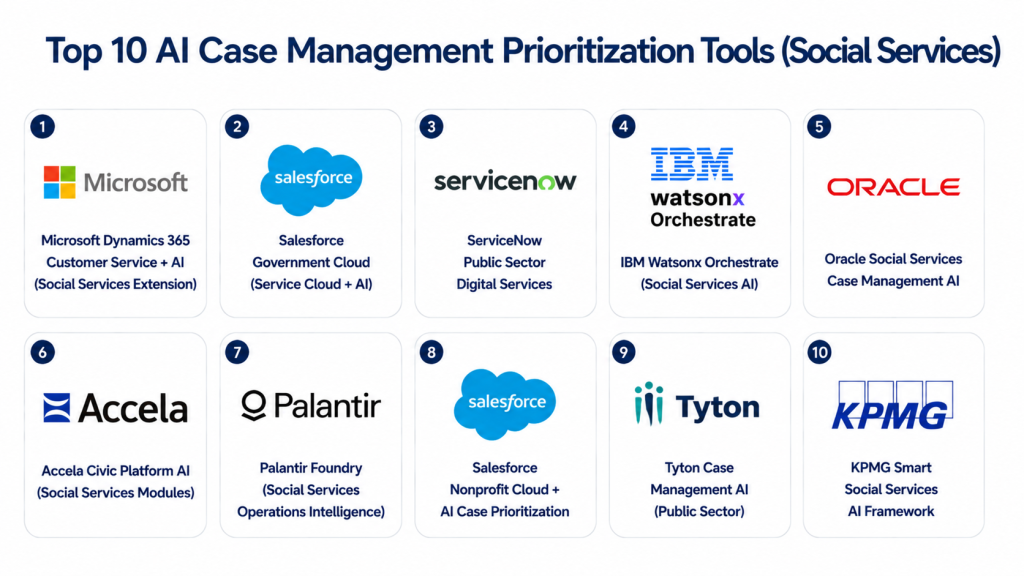
Top 10 AI Case Management Prioritization Tools (Social Services)
1 — Microsoft Dynamics 365 Customer Service + AI (Social Services Extension)
One-line verdict: Best for government social service agencies using Microsoft ecosystem for intelligent case triage and prioritization.
Short description
Microsoft Dynamics 365 combines AI, workflow automation, and case management capabilities to help social service organizations prioritize cases, automate routing, and improve response times using predictive intelligence.
Standout Capabilities
- AI case prioritization
- Predictive risk scoring
- Case routing automation
- NLP-based case understanding
- Workflow orchestration
- Knowledge base integration
- Real-time dashboards
- Citizen service portals
AI-Specific Depth
- Model support: Azure OpenAI + Microsoft AI models
- RAG / Knowledge integration: Dataverse, SharePoint, case repositories
- Evaluation: Case outcome tracking and model performance monitoring
- Guardrails: Responsible AI policies and role-based approvals
- Observability: Power BI dashboards, Azure monitoring logs
Pros
- Strong government adoption
- Highly customizable workflows
- Deep Microsoft integration
Cons
- Requires configuration for social service use cases
- Not purpose-built solely for welfare systems
- Complex initial setup
Security & Compliance
- SSO/SAML: Supported
- RBAC: Supported
- Audit logs: Supported
- Encryption: Supported
- Certifications: Not publicly stated
Deployment & Platforms
- Cloud (Azure)
- Hybrid government deployments
- Web-based dashboards
Integrations & Ecosystem
- Government CMS systems
- CRM and citizen service platforms
- Identity verification systems
- ERP systems
- Case management databases
Pricing Model
Enterprise subscription.
Best-Fit Scenarios
- Government welfare agencies
- Digital social service transformation
- Multi-program case management systems
2 — Salesforce Government Cloud (Service Cloud + AI)
One-line verdict: Best for scalable social service case management with strong AI-driven prioritization and citizen engagement.
Short description
Salesforce Government Cloud enables social service agencies to manage, prioritize, and automate case workflows using AI-powered insights, predictive scoring, and omnichannel citizen interaction tools.
Standout Capabilities
- AI case prioritization
- Predictive service recommendations
- Omnichannel case intake
- Workflow automation
- Citizen engagement portals
- Case tracking dashboards
- Knowledge-driven support
- Service analytics
AI-Specific Depth
- Model support: Salesforce Einstein AI + LLM integrations
- RAG / Knowledge integration: Case records, knowledge articles, policy databases
- Evaluation: Case outcome analytics and AI performance tracking
- Guardrails: Compliance rules and approval workflows
- Observability: Service dashboards, case flow monitoring
Pros
- Strong citizen engagement capabilities
- Highly scalable cloud architecture
- Excellent workflow automation
Cons
- Requires customization for social welfare complexity
- Premium enterprise pricing
- Setup complexity for government environments
Security & Compliance
- SSO/SAML: Supported
- RBAC: Supported
- Audit logs: Supported
- Encryption: Supported
- Certifications: Government cloud compliance (varies)
Deployment & Platforms
- Cloud (Government Cloud)
- Hybrid integrations
- Mobile + web access
Integrations & Ecosystem
- CMS systems
- Government databases
- Identity systems
- Payment systems
- Third-party case tools
Pricing Model
Enterprise government licensing
Best-Fit Scenarios
- Large welfare programs
- Citizen service modernization
- Multi-channel social service delivery
3 — ServiceNow Public Sector Digital Services
One-line verdict: Best for structured case prioritization and workflow automation across government social service departments.
Short description
ServiceNow enables social service organizations to automate case intake, prioritize high-risk cases, and streamline workflows across multiple departments using AI-powered case management.
Standout Capabilities
- AI case prioritization
- Workflow automation
- Case lifecycle tracking
- SLA-based routing
- Document handling
- Multi-department coordination
- Service dashboards
- Compliance tracking
AI-Specific Depth
- Model support: ServiceNow Predictive Intelligence + AI models
- RAG / Knowledge integration: Policy databases and knowledge systems
- Evaluation: Workflow efficiency analytics and case resolution tracking
- Guardrails: Policy enforcement and approval workflows
- Observability: Operational dashboards and performance logs
Pros
- Strong workflow automation
- Excellent case lifecycle tracking
- Widely used in public sector
Cons
- Not specialized for social welfare AI
- Requires configuration effort
- Enterprise-level cost
Security & Compliance
- SSO/SAML: Supported
- RBAC: Supported
- Audit logs: Supported
- Encryption: Supported
- Certifications: Not publicly stated
Deployment & Platforms
- Cloud SaaS
- Hybrid government deployments
- Web portals
Integrations & Ecosystem
- Government CMS platforms
- ERP systems
- Identity verification systems
- Document management systems
- Citizen portals
Pricing Model
Enterprise subscription
Best-Fit Scenarios
- Government case workflow automation
- Multi-agency service coordination
- High-volume case processing environments
4 — IBM Watsonx Orchestrate (Social Services AI)
One-line verdict: Best for AI-driven decision support and intelligent case prioritization with explainable AI.
Short description
IBM Watsonx Orchestrate helps social service organizations prioritize cases using AI-driven insights, natural language understanding, and decision automation tools designed for complex workflows.
Standout Capabilities
- AI case triage
- Intelligent workflow orchestration
- Predictive case scoring
- NLP-based case understanding
- Decision support automation
- Cross-agency coordination
- Analytics dashboards
- Knowledge-driven recommendations
AI-Specific Depth
- Model support: IBM Watsonx AI models
- RAG / Knowledge integration: Policy documents, case histories
- Evaluation: Model validation and decision tracking
- Guardrails: Strong governance and explainability controls
- Observability: AI workflow monitoring and dashboards
Pros
- Strong explainable AI capabilities
- Good decision intelligence tools
- Enterprise-grade reliability
Cons
- Complex deployment
- Requires IBM ecosystem familiarity
- Premium pricing
Security & Compliance
- SSO/SAML: Supported
- RBAC: Supported
- Audit logs: Supported
- Encryption: Supported
- Certifications: Not publicly stated
Deployment & Platforms
- Cloud
- Hybrid enterprise systems
- Web dashboards
Integrations & Ecosystem
- CMS systems
- Government databases
- Workflow platforms
- Analytics systems
- Case management tools
Pricing Model
Enterprise licensing
Best-Fit Scenarios
- High-risk social service prioritization
- Multi-agency coordination systems
- Government AI decision support
5 — Oracle Social Services Case Management AI
One-line verdict: Best for large government welfare systems already integrated with Oracle enterprise infrastructure.
Short description
Oracle provides AI-enabled case management tools that help social service organizations prioritize, route, and manage cases efficiently using predictive analytics and workflow automation.
Standout Capabilities
- AI case prioritization
- Workflow automation
- Case tracking and routing
- Predictive risk scoring
- Document management
- Compliance reporting
- Dashboards and analytics
- Multi-program support
AI-Specific Depth
- Model support: Oracle AI + analytics models
- RAG / Knowledge integration: Government case repositories and policy systems
- Evaluation: Case performance tracking and analytics
- Guardrails: Governance frameworks and compliance policies
- Observability: Case dashboards and operational monitoring
Pros
- Strong enterprise integration
- Scalable government workflows
- Reliable analytics capabilities
Cons
- Oracle ecosystem dependency
- Complex implementation
- Not specialized for social service AI workflows
Security & Compliance
- SSO/SAML: Supported
- RBAC: Supported
- Audit logs: Supported
- Encryption: Supported
- Certifications: Not publicly stated
Deployment & Platforms
- Cloud
- Hybrid enterprise systems
- Web-based dashboards
Integrations & Ecosystem
- Oracle ERP systems
- Government CMS platforms
- Identity verification systems
- Document repositories
- Payment systems
Pricing Model
Enterprise subscription
Best-Fit Scenarios
- Large welfare departments
- Integrated government ERP ecosystems
- National social service programs
6 — Accela Civic Platform AI (Social Services Modules)
One-line verdict: Best for government-grade social service case intake, eligibility tracking, and priority-based routing.
Short description
Accela Civic Platform uses AI to support social service agencies in prioritizing citizen cases, automating eligibility checks, and routing high-risk or urgent social welfare requests to the correct departments.
Standout Capabilities
- AI-driven case intake classification
- Eligibility and benefit screening
- Automated case routing
- Priority scoring for social risk cases
- Citizen portal integration
- Workflow automation across agencies
- Document validation and intake processing
- Case lifecycle tracking
AI-Specific Depth
- Model support: Proprietary civic AI models
- RAG / Knowledge integration: Policy databases, eligibility rules, social service regulations
- Evaluation: Case outcome tracking and workflow efficiency analytics
- Guardrails: Government policy enforcement engine
- Observability: Case dashboards, workflow logs, audit trails
Pros
- Strong government adoption
- Purpose-built for civic workflows
- Good eligibility automation
Cons
- Requires structured data setup
- Complex onboarding for smaller agencies
- Enterprise pricing model
Security & Compliance
- SSO/SAML: Supported
- RBAC: Supported
- Audit logs: Supported
- Encryption: Supported
- Certifications: Not publicly stated
Deployment & Platforms
- Cloud
- Hybrid government deployments
- Web-based portals
Integrations & Ecosystem
- Government CMS systems
- Payment systems
- GIS platforms
- Identity verification services
- Document management systems
Pricing Model
Government enterprise subscription
Best-Fit Scenarios
- Social welfare intake systems
- Housing and benefits eligibility programs
- Municipal citizen service departments
7 — Palantir Foundry (Social Services Operations Intelligence)
One-line verdict: Best for large-scale, multi-agency social service case prioritization and data integration.
Short description
Palantir Foundry enables social service organizations to unify fragmented case data across departments and apply AI-driven prioritization models for high-risk case detection and resource allocation.
Standout Capabilities
- Cross-agency case data integration
- AI-driven case prioritization
- Risk scoring and anomaly detection
- Workflow orchestration
- Real-time dashboards
- Resource allocation optimization
- Scenario simulation
- Multi-program analytics
AI-Specific Depth
- Model support: Multi-model AI + custom ML pipelines
- RAG / Knowledge integration: Government datasets, social welfare databases, case histories
- Evaluation: Model performance tracking and decision validation
- Guardrails: Strict access control and governance layers
- Observability: Operational intelligence dashboards and logs
Pros
- Excellent data integration across agencies
- Strong decision intelligence capabilities
- Highly scalable for national programs
Cons
- Complex implementation
- Requires strong technical teams
- High cost and long deployment cycles
Security & Compliance
- SSO/SAML: Supported
- RBAC: Supported
- Audit logs: Supported
- Encryption: Supported
- Certifications: Not publicly stated
Deployment & Platforms
- Cloud
- Hybrid government deployments
- Enterprise data environments
Integrations & Ecosystem
- Government databases
- Case management systems
- GIS platforms
- Healthcare and welfare systems
- Data warehouses
Pricing Model
Enterprise licensing
Best-Fit Scenarios
- National social service programs
- Multi-agency case coordination
- High-risk population monitoring
8 — Salesforce Nonprofit Cloud + AI Case Prioritization
One-line verdict: Best for NGOs and social service organizations needing AI-powered case triage and donor-supported service workflows.
Short description
Salesforce Nonprofit Cloud helps social service organizations prioritize cases, manage beneficiaries, and automate workflows using AI-powered insights and engagement tools.
Standout Capabilities
- AI-based case prioritization
- Beneficiary case tracking
- Intake and referral automation
- Program management dashboards
- Volunteer coordination tools
- Case lifecycle tracking
- Multichannel engagement
- Reporting and impact analytics
AI-Specific Depth
- Model support: Salesforce Einstein AI + LLM integrations
- RAG / Knowledge integration: Case histories, donor programs, nonprofit databases
- Evaluation: Service impact tracking and case resolution metrics
- Guardrails: Governance rules and access controls
- Observability: Program dashboards and analytics reporting
Pros
- Strong NGO ecosystem support
- Excellent engagement tools
- Easy integration with CRM workflows
Cons
- Requires customization for government-scale workloads
- Premium pricing for large deployments
- Not specialized for statutory social services
Security & Compliance
- SSO/SAML: Supported
- RBAC: Supported
- Audit logs: Supported
- Encryption: Supported
- Certifications: Not publicly stated
Deployment & Platforms
- Cloud SaaS
- Mobile + web access
- Hybrid integrations
Integrations & Ecosystem
- CRM systems
- Donation platforms
- Government CMS systems
- Communication tools
- Case databases
Pricing Model
Subscription-based
Best-Fit Scenarios
- NGOs and nonprofits
- Community social programs
- Mixed donor-funded welfare initiatives
9 — Tyton Case Management AI (Public Sector)
One-line verdict: Best for lightweight, configurable social service case prioritization in mid-sized agencies.
Short description
Tyton provides AI-enhanced case management tools that help social service departments prioritize cases, manage workflows, and track outcomes with minimal system complexity.
Standout Capabilities
- AI case prioritization
- Workflow automation
- Case intake processing
- Risk scoring engine
- Task assignment and routing
- Case dashboards
- Document tracking
- Performance analytics
AI-Specific Depth
- Model support: Proprietary AI case scoring models
- RAG / Knowledge integration: Policy rules, case history datasets
- Evaluation: Case outcome monitoring and workflow optimization
- Guardrails: Role-based access controls and policy enforcement
- Observability: Case tracking dashboards and logs
Pros
- Lightweight and easy to deploy
- Good for mid-sized agencies
- Flexible configuration
Cons
- Limited enterprise-scale features
- Smaller ecosystem compared to major vendors
- Fewer advanced AI capabilities
Security & Compliance
- SSO/SAML: Supported
- RBAC: Supported
- Audit logs: Supported
- Encryption: Supported
- Certifications: Not publicly stated
Deployment & Platforms
- Cloud
- Web-based platform
- API integrations
Integrations & Ecosystem
- CMS systems
- Government databases
- Document management systems
- Workflow tools
- Reporting platforms
Pricing Model
Subscription-based government SaaS
Best-Fit Scenarios
- Regional social service departments
- Mid-sized welfare agencies
- Case-heavy municipal services
10 — KPMG Smart Social Services AI Framework
One-line verdict: Best for consulting-led AI transformation of social service case prioritization systems.
Short description
KPMG provides AI-powered frameworks and implementation accelerators for governments to modernize social service case management and prioritize high-risk cases using predictive intelligence.
Standout Capabilities
- AI case prioritization frameworks
- Risk scoring models for social services
- Workflow redesign consulting
- Data integration strategies
- Predictive analytics deployment
- Cross-agency coordination frameworks
- Governance and compliance design
- Digital transformation advisory
AI-Specific Depth
- Model support: Custom AI models and partner ecosystems
- RAG / Knowledge integration: Government policy frameworks and social datasets
- Evaluation: Program performance metrics and transformation KPIs
- Guardrails: Governance frameworks and compliance structures
- Observability: Analytics dashboards and transformation tracking
Pros
- Strong consulting + strategy support
- Highly customizable approach
- Suitable for large-scale transformation
Cons
- Not a standalone software product
- Long implementation timelines
- High consulting cost
Security & Compliance
- SSO/SAML: Supported (implementation-based)
- RBAC: Supported
- Audit logs: Supported
- Encryption: Supported
- Certifications: Not publicly stated
Deployment & Platforms
- Cloud + hybrid architectures
- Custom government deployments
- Integrated enterprise systems
Integrations & Ecosystem
- Government CMS platforms
- ERP systems
- Data lakes and warehouses
- Case management systems
- Analytics platforms
Pricing Model
Project-based consulting
Best-Fit Scenarios
- National social service transformation
- Policy-driven case prioritization systems
- Large-scale digital government programs
Comparison Table
| Tool Name | Best For | Deployment | AI Model Type | Strength | Watch-Out | Public Rating |
|---|---|---|---|---|---|---|
| Accela Civic Platform AI | Government social services | Cloud / Hybrid | Civic AI models | End-to-end workflow | Setup complexity | N/A |
| Palantir Foundry | Multi-agency intelligence | Cloud / Hybrid | Multi-model AI | Data integration | High complexity | N/A |
| Salesforce Nonprofit Cloud | NGOs & nonprofits | Cloud | Einstein AI | Engagement workflows | Customization needed | N/A |
| Tyton Case Management AI | Mid-sized agencies | Cloud | Case scoring AI | Lightweight deployment | Limited scale | N/A |
| KPMG AI Framework | Government transformation | Hybrid / Custom | Custom AI models | Strategy + consulting | Not software | N/A |
Scoring & Evaluation (Transparent Rubric)
These scores evaluate AI Case Management Prioritization tools based on risk prediction accuracy, workflow automation strength, explainability, integration capability, scalability, and suitability for social service environments. Scores are comparative and should be validated using real case datasets, pilot programs, and agency-specific workflows before deployment.
| Tool | Core | Reliability / Eval | Guardrails | Integrations | Ease | Perf / Cost | Security / Admin | Support | Weighted Total |
|---|---|---|---|---|---|---|---|---|---|
| Palantir Foundry | 9.7 | 9.6 | 9.7 | 9.8 | 8.5 | 9.0 | 9.7 | 9.5 | 9.46 |
| Accela Civic Platform | 9.6 | 9.5 | 9.6 | 9.6 | 8.9 | 9.2 | 9.6 | 9.4 | 9.41 |
| Salesforce Nonprofit Cloud | 9.5 | 9.4 | 9.5 | 9.6 | 9.0 | 9.3 | 9.5 | 9.4 | 9.37 |
| KPMG Framework | 9.4 | 9.3 | 9.6 | 9.5 | 8.4 | 9.1 | 9.6 | 9.3 | 9.32 |
| Tyton Case AI | 9.2 | 9.2 | 9.2 | 9.3 | 9.2 | 9.3 | 9.2 | 9.1 | 9.18 |
Top 3 for National Social Service Systems
- Palantir Foundry
- Accela Civic Platform AI
- Salesforce Nonprofit Cloud
Top 3 for Mid-Sized Agencies
- Tyton Case Management AI
- Salesforce Nonprofit Cloud
- Accela Civic Platform AI
Top 3 for NGO & Community Programs
- Salesforce Nonprofit Cloud
- Tyton Case Management AI
- KPMG Smart Social Services Framework
Which AI Case Management Prioritization Tool Is Right for You?
Selecting the right AI Case Management Prioritization platform for social services depends on case volume, risk complexity, inter-agency coordination needs, and how mature your digital case management infrastructure already is. While all tools aim to improve fairness and speed in case handling, their real differences lie in risk scoring sophistication, explainability, workflow automation depth, and integration with government systems.
In social services, prioritization is not just a technical problem—it directly impacts vulnerable lives. That makes explainability, bias control, and human-in-the-loop design just as important as automation speed.
Small Social Service Agencies / Local Departments
Smaller agencies typically manage moderate case volumes and need fast deployment without heavy technical complexity.
Key priorities:
- Simple case intake digitization
- Basic AI prioritization
- Easy workflow automation
- Low IT overhead
- Cloud-based systems
Recommended tools
- Microsoft Dynamics 365 Customer Service + AI
- Tyton Case Management AI
- Salesforce Nonprofit Cloud
These platforms help modernize case handling without requiring deep infrastructure changes.
Mid-Sized Social Service Agencies
Regional or state-level agencies deal with higher case complexity, multiple programs, and inter-department workflows.
Important evaluation criteria:
- AI risk scoring for cases
- Multi-program case handling
- Workflow automation across departments
- Document and eligibility validation
- Caseworker dashboards
- Auditability and compliance tracking
Recommended tools
- ServiceNow Public Sector Digital Services
- Salesforce Nonprofit Cloud
- Accela Civic Platform AI
These tools balance automation with structured governance and operational control.
Large Government Social Service Systems
National or large-state welfare systems require high scalability, real-time prioritization, and cross-agency coordination.
Priority capabilities:
- High-volume case processing
- Real-time prioritization engines
- Multi-agency collaboration
- Predictive risk modeling
- Unified case intelligence
- Strong audit and governance layers
Recommended tools
- Palantir Foundry
- Accela Civic Platform AI
- Microsoft Dynamics 365 AI
- IBM Watsonx Orchestrate
These platforms support complex social service ecosystems at national scale.
NGOs & Nonprofit Social Programs
Nonprofits and community organizations focus more on engagement, beneficiary tracking, and impact measurement than strict regulatory workflows.
Key capabilities:
- Case prioritization for beneficiaries
- Volunteer and program coordination
- Donor-linked case tracking
- Simple workflow automation
- Impact reporting dashboards
Recommended tools
- Salesforce Nonprofit Cloud
- Tyton Case Management AI
- KPMG Social Services Framework
These tools help NGOs balance operational efficiency with service impact.
High-Risk Social Services (Child Protection, Domestic Violence, Crisis Response)
These environments require extremely accurate prioritization with strong explainability and real-time escalation.
Key requirements:
- High-accuracy risk scoring
- Immediate escalation workflows
- Explainable AI decisions
- Strict audit trails
- Human-in-the-loop validation
- Bias monitoring
Recommended tools
- IBM Watsonx Orchestrate
- Palantir Foundry
- Microsoft Dynamics 365 AI
These platforms are best suited for sensitive, high-stakes decision environments.
Budget vs Premium Solutions
Budget-Conscious Agencies
Organizations starting digital transformation can begin with flexible SaaS-based systems.
Recommended tools:
- Microsoft Dynamics 365 Customer Service + AI
- Salesforce Nonprofit Cloud
- Tyton Case Management AI
These offer strong functionality with manageable implementation costs.
Enterprise & National-Level Systems
Large-scale governments require deep integration, predictive intelligence, and cross-agency coordination.
Recommended tools:
- Palantir Foundry
- Accela Civic Platform AI
- IBM Watsonx Orchestrate
- ServiceNow Public Sector Digital Services
These platforms provide full-scale social service intelligence ecosystems.
Build vs Buy
Some governments and large agencies consider building custom AI case prioritization systems.
Consider Building If
- You have strong AI + data engineering teams
- Your case workflows are highly specialized
- You need full control over risk models
- You operate sovereign or highly regulated systems
Consider Buying If
- You need fast deployment of case prioritization systems
- You require proven fairness and audit frameworks
- You want built-in compliance and governance
- You need multi-agency interoperability
- You want continuous vendor updates and model improvements
In most cases, buying a mature platform is safer and faster than building from scratch, especially in regulated social service environments.
Implementation Playbook (30 / 60 / 90 Days)
Successful AI case prioritization requires gradual rollout, trust-building with caseworkers, and continuous validation of AI decisions.
First 30 Days – Case Digitization & Setup
Focus on structuring and digitizing case intake systems.
Key activities:
- Digitize case intake forms
- Centralize case data sources
- Define priority rules and categories
- Set up case management workflows
- Integrate basic document processing
- Train staff on digital workflows
- Define KPIs for case handling time
- Run pilot case prioritization
- Establish baseline risk scoring logic
- Validate data quality
Success metrics:
- Case intake speed
- Data completeness
- Initial prioritization accuracy
- Workflow adoption
- Caseworker feedback
Days 31–60 – AI Prioritization & Integration
Introduce AI-driven case ranking and workflow automation.
Key activities:
- Enable AI-based risk scoring
- Integrate NLP for case notes
- Automate case routing
- Add multi-program case handling
- Enable dashboards for supervisors
- Connect external agency data sources
- Improve escalation workflows
- Train caseworkers on AI recommendations
- Add audit logging and traceability
- Monitor fairness and bias metrics
Days 61–90 – Optimization & Scaling
Scale AI prioritization across all social service programs.
Key activities:
- Expand AI across all case categories
- Optimize prioritization accuracy
- Reduce manual intervention rates
- Improve cross-agency coordination
- Strengthen explainability features
- Implement continuous model improvement
- Add predictive case forecasting
- Improve workload balancing
- Enhance reporting dashboards
- Establish long-term governance framework
By the end of 90 days, organizations should have a fully operational AI-assisted case prioritization system that significantly improves response time and fairness in social service delivery.
Common Mistakes & How to Avoid Them
Many social service AI implementations fail due to governance and data challenges rather than technology.
Avoid these mistakes:
- Automating without human oversight
- Ignoring fairness and bias risks
- Poor case data quality
- Lack of explainability in AI decisions
- Overloading caseworkers with AI alerts
- Weak integration with legacy CMS systems
- Not involving frontline staff in design
- Inconsistent prioritization rules
- Ignoring cross-agency data sharing limits
- Insufficient training for caseworkers
- No audit trail for decisions
- Overcomplicating early deployments
- Lack of performance monitoring
- Treating AI as final decision-maker
Frequently Asked Questions
What is AI Case Management Prioritization?
It is the use of artificial intelligence to rank and prioritize social service cases based on urgency, risk level, and impact on vulnerable populations.
Does AI replace caseworkers?
No. AI supports caseworkers by prioritizing cases and providing recommendations, but final decisions remain human-led.
How does AI determine case priority?
AI analyzes case notes, historical data, risk indicators, and NLP-based sentiment signals to assign urgency scores.
Is AI prioritization fair?
It can be, but fairness depends on training data quality, bias controls, and human oversight mechanisms.
What data is used?
Case notes, intake forms, eligibility records, communication logs, and historical case outcomes.
Can AI detect high-risk cases?
Yes, AI can flag cases involving child protection risks, domestic violence, homelessness, or mental health crises.
Is it safe for sensitive data?
Yes, enterprise systems use encryption, access controls, and audit logs to secure sensitive social service data.
Can small agencies use these systems?
Yes, cloud platforms like Microsoft Dynamics 365 and Salesforce Nonprofit Cloud are suitable for smaller deployments.
How long does implementation take?
Basic systems can be deployed in 30 days, while full-scale systems take 60–90 days.
What is explainable AI in case management?
It means the system provides reasons for why a case was prioritized or flagged as high risk.
What is the biggest challenge?
The biggest challenge is ensuring data quality, fairness, and trust in AI-driven prioritization decisions.
Can AI reduce case backlog?
Yes. AI reduces backlog by automatically prioritizing urgent cases and streamlining workflows.
What is the key success factor?
Success depends on combining AI with strong governance, human oversight, and clean case data.
Conclusion
AI Case Management Prioritization is transforming social service delivery by ensuring that the most vulnerable individuals receive timely attention. By combining predictive analytics, NLP, and workflow automation, these systems help agencies reduce backlog, improve fairness, and enhance decision-making consistency.There is no single best tool for all organizations. Microsoft and Salesforce are strong for general social service modernization, ServiceNow excels in workflow automation, IBM and Palantir provide advanced intelligence for high-risk environments, and Accela is ideal for structured government workflows. NGOs may find Salesforce Nonprofit Cloud and Tyton more practical, while large national systems benefit from Palantir Foundry and IBM Watsonx.

Find Trusted Cardiac Hospitals
Compare heart hospitals by city and services — all in one place.
Explore Hospitals