
Introduction
AI Checkout Automation Systems use artificial intelligence to streamline the payment and checkout experience for both physical retail and online stores. They leverage computer vision, machine learning, sensor fusion, and predictive analytics to automate item recognition, transaction processing, fraud detection, and personalized upsell or promotions.
In 2026+, checkout automation has become essential for retailers seeking frictionless customer experiences. AI reduces wait times, operational costs, and human errors while increasing conversion and loyalty.
Real-world use cases include:
- Self-checkout in supermarkets and convenience stores.
- AI-enabled smart carts that scan and process payments automatically.
- Real-time fraud and theft detection.
- Personalized promotions or upsell suggestions during checkout.
- Reduced transaction times during peak hours.
- Integration with mobile wallets, loyalty programs, and online carts.
Evaluation Criteria for Buyers: Accuracy and speed, fraud detection, POS/ERP integration, real-time analytics, scalability, guardrails, observability, ease of use, AI evaluation, cost/latency, security/compliance, vendor support.
Best for: Large retailers, supermarket chains, convenience stores, and ecommerce platforms implementing automated checkout.
Not ideal for: Small shops with limited foot traffic, single-location stores, or stores without infrastructure to support AI sensors or smart carts.
What’s Changed in AI Checkout Automation Systems in 2026+
- Advanced computer vision and sensor integration for fully autonomous checkout.
- Real-time fraud detection and anomaly analytics.
- Agentic workflows to auto-apply promotions and dynamic discounts.
- Multimodal input using cameras, scales, barcode scanners, and mobile apps.
- Integration with dynamic pricing and personalized recommendations.
- Privacy-first architectures for sensitive payment and customer data.
- Hybrid/BYO AI models to reduce latency and operational costs.
- Observability dashboards for transaction time, fraud alerts, and AI performance.
- Integration with POS, inventory, and loyalty systems.
- Continuous model evaluation and reliability monitoring.
Quick Buyer Checklist (Scan-Friendly)
- Accuracy and speed of AI checkout recognition
- Fraud and theft detection
- Integration with POS, ERP, inventory systems
- Support for self-checkout and mobile checkout
- Dynamic pricing and personalized upsell
- Guardrails for transaction limits and security
- Observability dashboards for KPIs
- BYO or hybrid AI model support
- Privacy and compliance controls
- Scalability for multiple locations
- Ease of deployment and staff training
- Cost and latency optimization
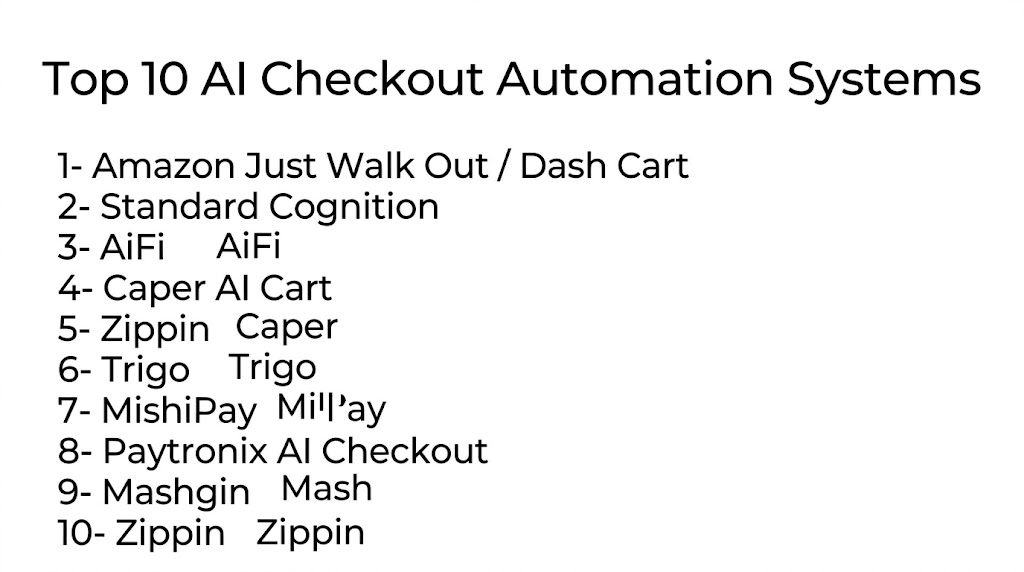
Top 10 AI Checkout Automation Systems
1- Amazon Just Walk Out / Dash Cart
One-line verdict: Best for large retailers seeking fully frictionless, cashierless store experiences.
Short description: Uses AI, sensors, and computer vision to detect purchased items and charge customers automatically as they leave.
Standout Capabilities
- Automatic item detection and payment
- Real-time inventory updates
- Seamless self-checkout experience
- Integration with loyalty programs
- Zero transaction time
AI-Specific Depth
- Model support: Proprietary AI
- RAG / knowledge integration: Inventory and POS
- Evaluation: Continuous monitoring
- Guardrails: Theft detection, anomaly alerts
- Observability: Dashboards for transaction accuracy
Pros
- Fully frictionless experience
- Reduces labor costs
- Enterprise-grade scalability
Cons
- Premium cost and deployment complexity
- Requires extensive sensor infrastructure
- Limited to large-format stores
Security & Compliance
Encrypted payments, audit logs; Not publicly stated
Deployment & Platforms
Cloud, On-premise; Web management
Integrations & Ecosystem
POS, inventory, loyalty systems
Pricing Model
Subscription / enterprise deployment; Not publicly stated
Best-Fit Scenarios
- High-footfall supermarkets
- Large retail chains
- Premium convenience stores
2- Standard Cognition
One-line verdict: Ideal for mid-market and enterprise stores needing autonomous checkout with real-time AI monitoring.
Short description: Uses overhead cameras and AI to track items and shoppers, automatically processing transactions.
Standout Capabilities
- Autonomous checkout with computer vision
- Real-time theft detection
- Dynamic item tracking
- POS and inventory integration
- Scalable multi-store deployment
AI-Specific Depth
- Model support: Proprietary
- RAG / knowledge integration: ERP and inventory
- Evaluation: Continuous accuracy monitoring
- Guardrails: Anti-theft and anomaly detection
- Observability: KPI dashboards
Pros
- Reduces labor costs
- Accurate item detection
- Scalable across multiple locations
Cons
- Requires high-quality cameras
- Premium pricing
- Complex initial deployment
Security & Compliance
Encrypted payment processing; Not publicly stated
Deployment & Platforms
Cloud, On-premise
Integrations & Ecosystem
POS, inventory, analytics dashboards
Pricing Model
Enterprise subscription; Not publicly stated
Best-Fit Scenarios
- Mid-market stores
- High-traffic convenience stores
- Automated supermarkets
3- AiFi
One-line verdict: Great for fully autonomous cashierless experiences with plug-and-play deployment.
Short description: Provides AI checkout systems that track items and process payments automatically.
Standout Capabilities
- Autonomous self-checkout
- Real-time item and shopper tracking
- Inventory integration
- Theft detection alerts
- Dynamic product analytics
AI-Specific Depth
- Model support: Proprietary
- RAG / knowledge integration: Inventory and POS
- Evaluation: Continuous monitoring and back-testing
- Guardrails: Theft detection, transaction verification
- Observability: Operational dashboards
Pros
- Scalable across multiple stores
- Reduces checkout lines
- Easy deployment
Cons
- Limited analytics depth
- Sensor infrastructure required
- Premium pricing
Security & Compliance
Encrypted payments; Not publicly stated
Deployment & Platforms
Cloud, On-premise
Integrations & Ecosystem
POS, ERP, analytics dashboards
Pricing Model
Enterprise subscription; Not publicly stated
Best-Fit Scenarios
- Supermarkets
- Department stores
- High-volume convenience stores
4- Caper AI Cart
One-line verdict: Ideal for SMB and mid-market stores using smart carts for self-checkout.
Short description: AI-enabled smart carts scan items automatically and process payments in real-time.
Standout Capabilities
- Smart cart computer vision
- Automatic checkout
- Real-time inventory tracking
- Loyalty and promotions integration
- Compact solution for small stores
AI-Specific Depth
- Model support: Proprietary
- RAG / knowledge integration: POS, inventory
- Evaluation: Accuracy monitoring
- Guardrails: Theft detection, mis-scan alerts
- Observability: Operational dashboard
Pros
- Compact and mobile
- Easy for SMB stores
- Reduces transaction time
Cons
- Limited coverage per cart
- Hardware cost per unit
- Not suitable for very large stores
Security & Compliance
Encrypted payment; Not publicly stated
Deployment & Platforms
Cloud, On-premise
Integrations & Ecosystem
POS, inventory, loyalty programs
Pricing Model
Subscription; Not publicly stated
Best-Fit Scenarios
- Convenience stores
- SMB supermarkets
- Quick-service stores
5- Zippin
One-line verdict: Enterprise-ready solution for cashierless checkout in high-traffic stores.
Short description: Tracks products and shoppers using cameras and AI to automate payments and update inventory.
Standout Capabilities
- Autonomous checkout with AI
- Theft detection
- Integration with POS and ERP
- Scalable for multiple stores
- Real-time transaction analytics
AI-Specific Depth
- Model support: Proprietary
- RAG / knowledge integration: POS, ERP, inventory
- Evaluation: Continuous validation
- Guardrails: Anti-theft
- Observability: Dashboards
Pros
- Enterprise scalability
- Real-time analytics
- Reduces staffing needs
Cons
- High initial cost
- Hardware intensive
- Deployment complexity
Security & Compliance
Encrypted payments; Not publicly stated
Deployment & Platforms
Cloud, On-premise
Integrations & Ecosystem
POS, inventory, loyalty
Pricing Model
Enterprise subscription; Not publicly stated
Best-Fit Scenarios
- Large supermarkets
- High-volume convenience stores
- Retail chains
6- Trigo
One-line verdict: Excellent for fully automated, cashierless store experiences.
Short description: Trigo uses cameras and AI to track items and automatically charge customers at exit.
Standout Capabilities
- Computer vision checkout
- Theft and fraud detection
- Inventory and POS integration
- Scenario simulation for store layout
- Multi-store scaling
AI-Specific Depth
- Model support: Proprietary
- RAG / knowledge integration: POS, ERP
- Evaluation: Continuous monitoring
- Guardrails: Theft prevention
- Observability: Dashboards
Pros
- Fully autonomous
- Accurate and fast
- Enterprise-ready
Cons
- High hardware cost
- Complex implementation
- Training required
Security & Compliance
Encrypted transactions; Not publicly stated
Deployment & Platforms
Cloud, On-premise
Integrations & Ecosystem
POS, ERP, analytics
Pricing Model
Subscription; Not publicly stated
Best-Fit Scenarios
- Supermarkets
- Urban retail chains
- High-traffic stores
7- MishiPay
One-line verdict: Self-checkout solution for mid-market stores integrating mobile and AI technology.
Short description: Enables shoppers to scan and pay via mobile app, AI detects items in real-time.
Standout Capabilities
- Mobile app scanning
- AI item detection
- Fraud prevention
- POS and ERP integration
- Personalized upsells
AI-Specific Depth
- Model support: Proprietary
- RAG / knowledge integration: POS, ERP
- Evaluation: Continuous validation
- Guardrails: Theft alerts
- Observability: Dashboards
Pros
- Mobile-friendly
- Reduces queues
- Integration with existing POS
Cons
- Mobile dependency
- Requires trained staff
- Limited multi-store analytics
Security & Compliance
Encrypted payments; Not publicly stated
Deployment & Platforms
Cloud, Mobile
Integrations & Ecosystem
POS, ERP, analytics
Pricing Model
Subscription; Not publicly stated
Best-Fit Scenarios
- Mid-market stores
- Mobile-oriented checkout
- Quick-service retail
8- Paytronix AI Checkout
One-line verdict: Integrates AI with loyalty and promotions for optimized checkout.
Short description: Automates payment, applies loyalty rewards, and analyzes promotions with AI insights.
Standout Capabilities
- Loyalty program integration
- AI-powered promotion application
- Automated payment processing
- Fraud detection
- Real-time analytics
AI-Specific Depth
- Model support: Proprietary
- RAG / knowledge integration: POS, ERP, loyalty
- Evaluation: Continuous monitoring
- Guardrails: Fraud detection
- Observability: Operational dashboards
Pros
- Enhances customer experience
- Integrates promotions seamlessly
- Real-time operational insights
Cons
- Hardware required
- Premium subscription
- Not suitable for very small stores
Security & Compliance
Encrypted payments; Not publicly stated
Deployment & Platforms
Cloud, Web
Integrations & Ecosystem
POS, loyalty programs, ERP
Pricing Model
Subscription; Not publicly stated
Best-Fit Scenarios
- Retail chains
- Loyalty-focused stores
- Promotional events
9- Mashgin
One-line verdict: Fast AI self-checkout using computer vision for items on trays.
Short description: Detects multiple items on a tray, automatically charges customers, and reduces queue times.
Standout Capabilities
- Tray scanning with computer vision
- Fraud detection
- POS and inventory integration
- Real-time transaction analytics
- Multi-store deployment
AI-Specific Depth
- Model support: Proprietary
- RAG / knowledge integration: POS, ERP
- Evaluation: Continuous monitoring
- Guardrails: Anti-theft
- Observability: Dashboards
Pros
- Fast checkout
- Reduces labor costs
- Easy integration with existing POS
Cons
- High initial cost
- Limited to certain store formats
- Hardware intensive
Security & Compliance
Encrypted payments; Not publicly stated
Deployment & Platforms
Cloud, On-premise
Integrations & Ecosystem
POS, ERP, inventory
Pricing Model
Enterprise subscription; Not publicly stated
Best-Fit Scenarios
- Supermarkets
- Quick-service stores
- High-traffic retail
10- Zippin
One-line verdict: Enterprise-ready solution for high-volume, autonomous checkout experiences.
Short description: Tracks items and shoppers using AI, cameras, and sensors, automatically processing payments and updating inventory.
Standout Capabilities
- Fully autonomous checkout
- Theft detection
- POS and inventory integration
- Scalable across multiple stores
- Real-time analytics
AI-Specific Depth
- Model support: Proprietary
- RAG / knowledge integration: POS, ERP
- Evaluation: Continuous monitoring
- Guardrails: Anti-theft and transaction verification
- Observability: Dashboards
Pros
- Enterprise-scale
- Reduces staff needs
- Fast, frictionless checkout
Cons
- High deployment cost
- Complex setup
- Hardware intensive
Security & Compliance
Encrypted payments; Not publicly stated
Deployment & Platforms
Cloud, On-premise
Integrations & Ecosystem
POS, ERP, loyalty, analytics
Pricing Model
Subscription; Not publicly stated
Best-Fit Scenarios
- Large supermarkets
- High-volume stores
- Multi-location chains
Comparison Table
| Tool | Best For | Deployment | Model Flexibility | Strength | Watch-Out | Public Rating |
|---|---|---|---|---|---|---|
| Amazon Just Walk Out | Enterprise | Cloud/On-prem | Proprietary | Fully frictionless | Premium | N/A |
| Standard Cognition | Mid-market | Cloud/On-prem | Proprietary | Autonomous checkout | Hardware intensive | N/A |
| AiFi | Enterprise | Cloud/On-prem | Proprietary | Plug-and-play | Costly | N/A |
| Caper AI Cart | SMB | Cloud/On-prem | Proprietary | Smart carts | Hardware per unit | N/A |
| Zippin | Enterprise | Cloud/On-prem | Proprietary | High-volume checkout | Setup complexity | N/A |
| Trigo | Enterprise | Cloud/On-prem | Proprietary | Fully autonomous | High cost | N/A |
| MishiPay | Mid-market | Cloud/Mobile | Proprietary | Mobile checkout | Mobile dependency | N/A |
| Paytronix AI | Mid-market | Cloud | Proprietary | Promotions & loyalty | Hardware required | N/A |
| Mashgin | Enterprise | Cloud/On-prem | Proprietary | Fast tray scanning | Hardware intensive | N/A |
| Zippin | Enterprise | Cloud/On-prem | Proprietary | Multi-store scaling | Complex deployment | N/A |
Scoring & Evaluation (Weighted)
| Tool | Core | Reliability | Guardrails | Integrations | Ease | Perf/Cost | Security | Support | Weighted Total |
|---|---|---|---|---|---|---|---|---|---|
| Amazon Just Walk Out | 9 | 9 | 9 | 9 | 7 | 8 | 8 | 7 | 8.6 |
| Standard Cognition | 8 | 8 | 8 | 8 | 7 | 8 | 7 | 7 | 7.9 |
| AiFi | 8 | 8 | 8 | 8 | 7 | 8 | 7 | 7 | 7.9 |
| Caper AI Cart | 7 | 7 | 7 | 7 | 8 | 7 | 7 | 7 | 7.3 |
| Zippin | 9 | 9 | 9 | 9 | 6 | 8 | 8 | 7 | 8.3 |
| Trigo | 9 | 9 | 9 | 9 | 6 | 8 | 8 | 7 | 8.3 |
| MishiPay | 7 | 7 | 7 | 7 | 8 | 7 | 7 | 7 | 7.2 |
| Paytronix AI | 8 | 8 | 8 | 8 | 7 | 8 | 7 | 7 | 7.8 |
| Mashgin | 8 | 8 | 8 | 8 | 7 | 8 | 7 | 7 | 7.8 |
| Zippin | 9 | 9 | 9 | 9 | 6 | 8 | 8 | 7 | 8.3 |
Top 3 Enterprise: Amazon Just Walk Out, Trigo, Zippin
Top 3 SMB/Mid-market: Caper AI Cart, MishiPay, Paytronix AI
Top 3 Real-time/Operational: AiFi, Mashgin, Standard Cognition
Which AI Checkout Automation Tool Is Right for You?
Solo / Freelancer
- Caper AI Cart, MishiPay
SMB
- Paytronix AI, Caper AI Cart
Mid-Market
- Standard Cognition, AiFi
Enterprise
- Amazon Just Walk Out, Trigo, Zippin
Regulated Industries
- Enterprise solutions with audit logs and secure transactions (Amazon Just Walk Out, Zippin, Trigo)
Budget vs Premium
- Budget: Caper AI Cart, MishiPay
- Premium: Amazon Just Walk Out, Trigo, Zippin
Build vs Buy
- Build if strong AI/data infrastructure exists; buy for fast deployment, reliable fraud detection, and hardware integration.
Implementation Playbook (30 / 60 / 90 Days)
30 Days: Pilot 1–2 stores, integrate POS and sensors, define KPIs, test AI recognition.
60 Days: Expand deployment, integrate loyalty and inventory systems, monitor accuracy.
90 Days: Optimize real-time operations, scenario simulations, dashboards, and governance.
Common Mistakes & How to Avoid Them
- Incomplete or poor-quality data
- Skipping guardrails for theft/fraud
- Over-reliance on AI without human oversight
- Ignoring POS or inventory integration
- Neglecting privacy/compliance requirements
- Not validating AI predictions
- Limited real-time observability
- Over-automation without staff support
- Ignoring cost and latency
- Inadequate scenario testing
- Failure to monitor transaction accuracy
- Not training staff for AI checkout
FAQs
- What is AI Checkout Automation?
AI-enabled systems that automatically recognize products, process payments, and optimize checkout. - Do these replace cashiers?
They reduce human labor but do not replace staff entirely for customer support. - How accurate are AI checkout systems?
Accuracy depends on camera, sensor, and AI model quality. - Can small stores adopt these?
SMB-focused solutions like Caper AI Cart and MishiPay are suitable. - Is real-time detection possible?
Yes — enterprise systems provide real-time item recognition and fraud alerts. - Do they support loyalty and promotions?
Many platforms integrate personalized promotions at checkout. - Are sensors required?
Yes for fully autonomous stores; mobile-only solutions exist for SMBs. - Can they scale across multiple stores?
Enterprise solutions like Amazon Just Walk Out and Trigo are highly scalable. - Do they handle ecommerce checkout too?
Most focus on physical checkout; some integrate online transaction monitoring. - What about privacy and security?
Platforms use encryption, audit logs, and regulatory compliance measures. - Are BYO AI models supported?
Some enterprise platforms allow proprietary model integration. - How long to see ROI?
Depending on store traffic and deployment scale, ROI may appear within 3–6 months.
Conclusion
AI Checkout Automation Systems enable frictionless, fast, and secure retail checkout while reducing operational costs and increasing customer satisfaction. The best tool depends on store size, foot traffic, and data infrastructure. Shortlist 2–3 tools, pilot them with actual stores, validate fraud and transaction accuracy, then scale across locations.

Find Trusted Cardiac Hospitals
Compare heart hospitals by city and services — all in one place.
Explore Hospitals
Checkout automation does not exist in isolation—it depends heavily on:
Missing concerns:
The article treats checkout automation as UI-level optimization, not payment infrastructure.