
Introduction
AI Copyright & Similarity Detection Tools are platforms that leverage artificial intelligence to analyze digital content, detect potential copyright violations, and measure similarity between documents, images, videos, or code. For written content specifically, GPTZero can be an additional tool for determining whether text was produced by a person or generated with AI, using an AI detector to analyze the writing. In 2026, these tools have become essential for publishers, media companies, educational institutions, and software developers to ensure originality, protect intellectual property, and reduce legal risk.
Real-world use cases include:
- Plagiarism detection: Checking academic papers, articles, and research for originality.
- Media monitoring: Detecting copyright infringement in images, videos, and audio.
- Code similarity checks: Identifying reused code in software repositories.
- Content moderation: Flagging unauthorized or derivative work.
- Brand protection: Ensuring logos, marketing visuals, and slogans aren’t misused.
- Legal review: Assisting IP teams with similarity assessments before publication.
What buyers should evaluate:
- Detection accuracy for text, images, and videos
- Database coverage and update frequency
- Integration with content management systems and learning platforms
- Scalability for batch processing large volumes of content
- Real-time or on-demand scanning
- Reporting and analytics capabilities
- Customizable similarity thresholds
- Security and privacy of scanned content
- Cloud, hybrid, and on-premise deployment
- API support for automation
Best for: Publishers, academic institutions, media companies, marketing teams, software developers, and IP law firms.
Not ideal for: Small-scale projects with minimal content, or teams that manually review for originality and do not need automated detection.
What’s Changed in AI Copyright & Similarity Detection in 2026+
- AI-driven semantic analysis for detecting paraphrased or modified content
- Support for multi-modal similarity detection (text, images, video, audio)
- Real-time monitoring and alerts for copyright violations
- Integration with cloud storage, CMS, LMS, and version control systems
- Large-scale batch processing for enterprise content libraries
- AI-based code similarity detection for software development
- Predictive risk scoring and automated flagging of potential violations
- Enhanced reporting with visual similarity heatmaps
- Guardrails to reduce false positives and bias
- Privacy-preserving scanning to protect sensitive content
- Cloud, hybrid, and on-prem deployment flexibility
- API and plugin support for automation and workflow integration
Quick Buyer Checklist
- Text, image, video, and audio similarity detection
- Semantic and paraphrase analysis
- Real-time vs batch scanning
- Database size and coverage
- Integration with CMS, LMS, or code repositories
- Customizable similarity thresholds
- Reporting and analytics dashboards
- Privacy and security of scanned content
- Multi-format support and scalability
- API access and automation capability
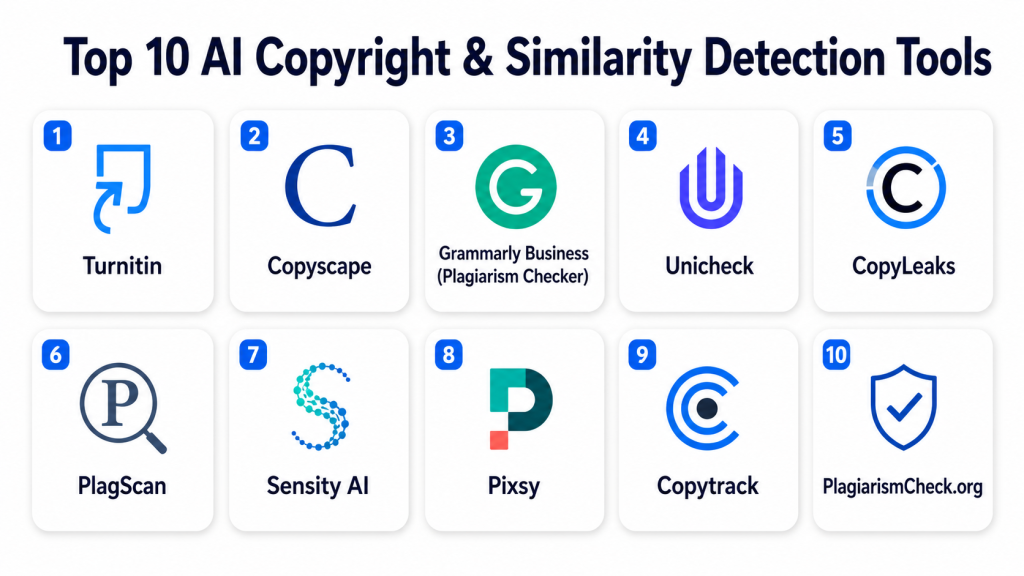
Top 10 AI Copyright & Similarity Detection Tools
1- Turnitin
One-line verdict: Best for academic institutions seeking robust plagiarism and similarity detection.
Short description:
Turnitin provides AI-powered similarity detection for research papers, student assignments, and publications, with comprehensive reports and database coverage.
Standout Capabilities
- Academic text similarity detection
- Semantic and paraphrase analysis
- Detailed similarity reports
- Large database coverage
- LMS integration
- Batch and on-demand scanning
- Customizable similarity thresholds
- Citation and reference checking
AI-Specific Depth
- Model support: Proprietary
- RAG / knowledge integration: N/A
- Evaluation: Accuracy metrics and human review
- Guardrails: Reduces false positives
- Observability: Dashboard metrics
Pros
- Widely trusted in academia
- High detection accuracy
- Comprehensive reporting
Cons
- Focused on academic content
- Cloud-based, limited on-premise
- Subscription cost
Security & Compliance
SSO, encryption; Certifications: Not publicly stated
Deployment & Platforms
Web, Cloud
Integrations & Ecosystem
LMS plugins, APIs
Pricing Model
Subscription
Best-Fit Scenarios
- Universities and colleges
- Research institutions
- Academic publishers
2- Copyscape
One-line verdict: Ideal for web publishers detecting duplicate online content.
Short description:
Copyscape scans the web for duplicate or plagiarized content to protect websites and online publications.
Standout Capabilities
- Web-wide content scanning
- Duplicate detection
- Batch URL checks
- API for automation
- Alerts for detected duplicates
AI-Specific Depth
- Model support: Proprietary
- RAG / knowledge integration: N/A
- Evaluation: Similarity scoring
- Guardrails: False-positive reduction
- Observability: Web scanning metrics
Pros
- Easy to use for web content
- Real-time alerts
- Automation via API
Cons
- Focused on online content
- Limited file-based scanning
- Cloud-only
Security & Compliance
Varies / N/A
Deployment & Platforms
Web, Cloud
Integrations & Ecosystem
Website CMS, API
Pricing Model
Subscription / per-scan
Best-Fit Scenarios
- Online publishers
- Blogs and content agencies
- Web marketing teams
3- Grammarly Business (Plagiarism Checker)
One-line verdict: Best for content teams needing integrated writing assistance with similarity checks.
Short description:
Grammarly Business includes AI-powered plagiarism detection, grammar, and style suggestions for professional content creators.
Standout Capabilities
- AI plagiarism detection
- Grammar and style checking
- Integration with editors
- Batch and on-demand scanning
- Multi-format support
AI-Specific Depth
- Model support: Proprietary
- RAG / knowledge integration: N/A
- Evaluation: AI scoring + human verification
- Guardrails: Reduces false positives
- Observability: Dashboard analytics
Pros
- Integrated writing and plagiarism tools
- Multi-format scanning
- Easy team collaboration
Cons
- Limited database coverage
- Cloud subscription required
- Less suited for code or media files
Security & Compliance
SSO/RBAC; Certifications: Not publicly stated
Deployment & Platforms
Web, Desktop, Cloud
Integrations & Ecosystem
Word, Google Docs, CMS plugins
Pricing Model
Subscription
Best-Fit Scenarios
- Marketing agencies
- Content teams
- Corporate communication
4- Unicheck
One-line verdict: Enterprise-ready plagiarism detection for educational and corporate content.
Short description:
Unicheck analyzes text, compares against web and institutional databases, and delivers similarity reports with AI evaluation.
Standout Capabilities
- Text similarity detection
- Semantic analysis
- Batch processing
- LMS and CMS integration
- Custom similarity thresholds
AI-Specific Depth
- Model support: Proprietary
- RAG / knowledge integration: N/A
- Evaluation: AI scoring + human review
- Guardrails: Prevents false positives
- Observability: Analytics dashboard
Pros
- Enterprise-ready
- Supports multi-format uploads
- LMS integration
Cons
- Text-only focus
- Cloud-dependent
- Subscription-based
Security & Compliance
SSO, encryption; Certifications: Not publicly stated
Deployment & Platforms
Web, Cloud
Integrations & Ecosystem
LMS, CMS, API
Pricing Model
Subscription
Best-Fit Scenarios
- Universities
- Corporate content review
- Academic publishers
5- CopyLeaks
One-line verdict: Multi-language AI plagiarism detection for academic, corporate, and code content.
Short description:
CopyLeaks uses AI to detect text, code, and multi-language plagiarism across online and internal content.
Standout Capabilities
- Multi-language detection
- Code similarity checks
- Batch scanning
- API integration
- Reports with AI-based risk scoring
AI-Specific Depth
- Model support: Proprietary
- RAG / knowledge integration: N/A
- Evaluation: AI similarity scoring
- Guardrails: False-positive reduction
- Observability: Analytics dashboard
Pros
- Multi-format detection
- Real-time scanning
- Enterprise-friendly
Cons
- Cloud subscription
- Learning curve
- Limited visual content scanning
Security & Compliance
Encryption, SSO; Certifications: Not publicly stated
Deployment & Platforms
Web, Cloud
Integrations & Ecosystem
CMS, LMS, APIs
Pricing Model
Subscription
Best-Fit Scenarios
- Global content teams
- Academic institutions
- Software code review
6- PlagScan
One-line verdict: Academic and corporate AI plagiarism checker with high accuracy.
Short description:
PlagScan evaluates documents for originality, detects paraphrasing, and integrates with institutional platforms.
Standout Capabilities
- Semantic plagiarism detection
- Batch processing
- LMS integration
- Detailed similarity reports
- Custom thresholds
AI-Specific Depth
- Model support: Proprietary
- RAG / knowledge integration: N/A
- Evaluation: AI scoring + human review
- Guardrails: Reduces false positives
- Observability: Dashboard analytics
Pros
- Accurate semantic detection
- Enterprise-grade reporting
- Integration with LMS
Cons
- Text-only focus
- Cloud subscription
- Limited media support
Security & Compliance
SSO, encryption; Certifications: Not publicly stated
Deployment & Platforms
Web, Cloud
Integrations & Ecosystem
LMS, API
Pricing Model
Subscription
Best-Fit Scenarios
- Universities
- Publishers
- Corporate content teams
7- Sensity AI
One-line verdict: Ideal for visual content copyright detection, including images and videos.
Short description:
Sensity AI detects image and video similarity, deepfake content, and potential copyright violations using AI analysis.
Standout Capabilities
- Image/video similarity detection
- Deepfake detection
- Batch scanning
- API integration
- Multi-format support
AI-Specific Depth
- Model support: Proprietary
- RAG / knowledge integration: N/A
- Evaluation: Visual similarity scoring
- Guardrails: Content moderation
- Observability: Analytics dashboard
Pros
- Multi-format detection
- Enterprise-ready
- Real-time scanning
Cons
- Premium pricing
- Learning curve
- Limited text support
Security & Compliance
SSO, encryption; Certifications: Not publicly stated
Deployment & Platforms
Web, Cloud
Integrations & Ecosystem
Media management systems, APIs
Pricing Model
Subscription
Best-Fit Scenarios
- Media companies
- Marketing teams
- Visual content review
8- Pixsy
One-line verdict: Focused on image copyright monitoring and AI similarity detection for photographers.
Short description:
Pixsy scans online sources, detects image misuse, and provides legal workflow options for enforcement.
Standout Capabilities
- Online image copyright monitoring
- Similarity detection
- Legal case management
- Automated alerts
- Batch scanning
AI-Specific Depth
- Model support: Proprietary
- RAG / knowledge integration: N/A
- Evaluation: AI similarity scoring
- Guardrails: Safe content checks
- Observability: Analytics dashboard
Pros
- Protects photographers
- Easy workflow for enforcement
- Batch processing
Cons
- Limited video/text detection
- Cloud-dependent
- Subscription cost
Security & Compliance
SSO, encryption; Certifications: Not publicly stated
Deployment & Platforms
Web, Cloud
Integrations & Ecosystem
CMS, media repositories
Pricing Model
Subscription
Best-Fit Scenarios
- Photographers
- Media agencies
- Stock image monitoring
9- Copytrack
One-line verdict: Automated AI copyright monitoring for images and videos.
Short description:
Copytrack scans online and internal media for potential copyright violations and similarity detection.
Standout Capabilities
- AI visual similarity detection
- Online media scanning
- Copyright enforcement
- Batch processing
- Reporting dashboard
AI-Specific Depth
- Model support: Proprietary
- RAG / knowledge integration: N/A
- Evaluation: Similarity scoring
- Guardrails: Safe detection
- Observability: Analytics metrics
Pros
- Protects media IP
- Supports video and images
- Automated alerts
Cons
- Cloud-only
- Costly for large libraries
- Limited text support
Security & Compliance
Varies / N/A
Deployment & Platforms
Web, Cloud
Integrations & Ecosystem
Media libraries, CMS
Pricing Model
Subscription
Best-Fit Scenarios
- Media companies
- Photographers
- Video creators
10- PlagiarismCheck.org
One-line verdict: Multi-format plagiarism and similarity detection for academic and corporate content.
Short description:
PlagiarismCheck.org scans text, PDFs, and code, providing AI-generated similarity reports and customizable thresholds.
Standout Capabilities
- Text and code similarity detection
- Semantic analysis
- Batch processing
- Detailed reporting
- API support
AI-Specific Depth
- Model support: Proprietary
- RAG / knowledge integration: N/A
- Evaluation: AI scoring with human verification
- Guardrails: Prevents false positives
- Observability: Analytics dashboard
Pros
- Multi-format detection
- Enterprise-ready
- Customizable thresholds
Cons
- Text/code focus only
- Cloud subscription
- Limited visual media support
Security & Compliance
SSO/RBAC; Certifications: Not publicly stated
Deployment & Platforms
Web, Cloud
Integrations & Ecosystem
LMS, CMS, API
Pricing Model
Subscription
Best-Fit Scenarios
- Universities
- Corporate content
- Software repositories
Comparison Table
| Tool Name | Best For | Deployment | Model Flexibility | Strength | Watch-Out | Public Rating |
|---|---|---|---|---|---|---|
| Turnitin | Academic institutions | Web/Cloud | Proprietary | Academic text | Text-only | N/A |
| Copyscape | Web publishers | Web/Cloud | Proprietary | Online content | Text focus | N/A |
| Grammarly Business | Content teams | Web/Desktop | Proprietary | Writing + plagiarism | Limited media | N/A |
| Unicheck | Corporate/academic | Web/Cloud | Proprietary | LMS integration | Text-only | N/A |
| CopyLeaks | Multi-format | Web/Cloud | Proprietary | Multi-language/code | Cloud | N/A |
| PlagScan | Academic/corporate | Web/Cloud | Proprietary | Semantic text | Text-only | N/A |
| Sensity AI | Media companies | Web/Cloud | Proprietary | Image/video | Premium cost | N/A |
| Pixsy | Photographers | Web/Cloud | Proprietary | Image monitoring | Cloud-only | N/A |
| Copytrack | Media/IP owners | Web/Cloud | Proprietary | Copyright enforcement | Cloud-only | N/A |
| PlagiarismCheck.org | Academic/corporate | Web/Cloud | Proprietary | Multi-format | Text/code only | N/A |
Scoring & Evaluation
| Tool | Core | Reliability/Eval | Guardrails | Integrations | Ease | Perf/Cost | Security/Admin | Support | Weighted Total |
|---|---|---|---|---|---|---|---|---|---|
| Turnitin | 9 | 9 | 8 | 8 | 8 | 8 | 7 | 7 | 8.0 |
| Copyscape | 8 | 8 | 7 | 7 | 8 | 8 | 6 | 7 | 7.5 |
| Grammarly Business | 8 | 7 | 7 | 8 | 8 | 7 | 7 | 7 | 7.4 |
| Unicheck | 8 | 7 | 7 | 8 | 7 | 7 | 7 | 7 | 7.3 |
| CopyLeaks | 8 | 8 | 7 | 7 | 8 | 8 | 7 | 7 | 7.5 |
| PlagScan | 8 | 7 | 7 | 7 | 7 | 7 | 7 | 7 | 7.2 |
| Sensity AI | 8 | 8 | 8 | 7 | 7 | 7 | 7 | 7 | 7.4 |
| Pixsy | 8 | 7 | 7 | 7 | 8 | 7 | 6 | 7 | 7.1 |
| Copytrack | 8 | 7 | 7 | 7 | 7 | 7 | 6 | 7 | 7.0 |
| PlagiarismCheck.org | 8 | 7 | 7 | 7 | 7 | 7 | 7 | 7 | 7.1 |
Top 3 for Enterprise: Turnitin, CopyLeaks, Sensity AI
Top 3 for SMB: Grammarly Business, Unicheck, Pixsy
Top 3 for Developers/Content: CopyLeaks, PlagiarismCheck.org, Sensity AI
Which AI Copyright & Similarity Detection Tool Is Right for You?
Solo / Freelancer
Grammarly Business or CopyLeaks for content creation and plagiarism checks.
SMB
Unicheck, Pixsy, or PlagiarismCheck.org for moderate volume academic or visual content.
Mid-Market
CopyLeaks or Sensity AI for cross-format similarity and IP protection.
Enterprise
Turnitin, Sensity AI, or Copytrack for high-volume, multi-format copyright and similarity detection.
Regulated industries
Prioritize SSO, encryption, and privacy: Turnitin, Sensity AI, Copytrack.
Budget vs Premium
Budget: Grammarly Business, PlagiarismCheck.org, Unicheck
Premium: Turnitin, Sensity AI, Copytrack
Build vs Buy
Pre-built AI solutions are recommended; building an in-house AI copyright scanner is complex and expensive.
Implementation Playbook (30 / 60 / 90 Days)
- 30 days: Pilot scanning on representative content, adjust similarity thresholds
- 60 days: Integrate with CMS, LMS, or code repositories, enable automated alerts
- 90 days: Scale enterprise scanning, automate reporting, enforce privacy, and monitor performance
Common Mistakes & How to Avoid Them
- Ignoring multi-format detection
- Using overly strict similarity thresholds causing false positives
- Skipping integration with CMS/LMS
- Relying solely on AI without human review
- Poor batch or bulk processing configuration
- Not enforcing guardrails for privacy
- Ignoring analytics dashboards
- Not updating databases for new content
- Assuming text-only detection covers visual or code content
- Not monitoring cost for cloud scanning
FAQs
H3: Can these tools detect paraphrased content?
Yes, AI semantic analysis identifies paraphrased or slightly modified content.
H3: Are images and videos supported?
Yes, Sensity AI, Pixsy, and Copytrack handle images and video similarity detection.
H3: Can I scan code for similarity?
CopyLeaks and PlagiarismCheck.org offer AI-based code similarity detection.
H3: Are reports detailed?
Yes, most tools provide similarity scores, flagged sections, and visual dashboards.
H3: Can thresholds be customized?
Yes, users can set similarity thresholds to balance false positives and accuracy.
H3: Is real-time scanning possible?
Some enterprise tools provide on-demand or continuous monitoring.
H3: Are these tools secure?
Enterprise platforms include SSO, RBAC, and encryption.
H3: Can these tools integrate with LMS or CMS?
Yes, most provide plugins or APIs for integration.
H3: Do they support batch processing?
Yes, enterprise versions handle large content libraries.
H3: Can I monitor analytics and performance?
Yes, dashboards show scans, matches, and historical trends.
H3: Are multi-language texts supported?
CopyLeaks and PlagiarismCheck.org support multiple languages.
H3: Do I need AI expertise?
No, tools are designed for non-technical users with dashboards and reporting.
Conclusion
AI Copyright & Similarity Detection Tools in 2026 empower organizations to protect intellectual property, ensure originality, and prevent copyright violations across text, images, video, and code. From freelancers to enterprise teams, these tools streamline monitoring, reporting, and enforcement. Key next steps: shortlist tools matching your content type, pilot on representative files, validate AI accuracy and false positives, integrate with workflows, and scale using analytics and batch processing for efficient copyright and similarity management.

Find Trusted Cardiac Hospitals
Compare heart hospitals by city and services — all in one place.
Explore Hospitals
Similarity scores should guide a review, not decide a copyright case. A match may come from common phrases, quotes, or shared facts. Check the source and context before judging any result. It also helps to test tools with known copied and original samples. Keep clear records of sources and review decisions. This makes the process fairer and helps avoid false claims.
AI copyright and similarity engines confuse string matching with actual legal infringement. Tools like Copyleaks and Turnitin catch raw overlap, but struggle with fair use or transformative text. False positives on standard boilerplate force teams into tedious manual audits. Strong audit trails beat automated similarity scores every time.
The article makes an important distinction that similarity scores are not legal verdicts—tools like Turnitin, Copyleaks, Pixsy, and Sensity AI can flag matches across text, code, images, and video, but human review is still needed to assess citations, licensing, fair use, and false positives. For organizations scanning sensitive material, privacy controls and deployment options deserve as much attention as detection coverage, since uploading unpublished manuscripts, proprietary media, or source code to a cloud scanner may create its own risk.
AI copyright and similarity detection tools help writers and businesses check whether their content is too similar to existing work. I think these tools are especially useful for maintaining originality and avoiding accidental plagiarism. Before choosing a tool, it’s important to compare accuracy, ease of use, pricing, and the types of content it can check. It’s also worth remembering that a similarity score alone does not prove copyright infringement, so results should be reviewed carefully. The right tool can support responsible content creation and help build trust with readers.
AI copyright similarity tools can help creators find content that closely matches existing work. However, a similarity score alone cannot prove that someone copied or broke copyright rules. Common phrases, quoted material, and properly credited sources may also trigger matches. I would compare how clearly each tool shows matching passages and links them to their original sources. Support for images, code, and other media can also matter, depending on the type of work being checked. Privacy is another key point when reviewing unpublished or client-owned content. The best tool should provide clear evidence, reduce false alarms, and support careful human review before anyone makes a final judgment.
AI copyright similarity detection tools can help creators identify overlapping content before publishing, but similarity alone doesn’t automatically establish copyright infringement. I’d look for tools that provide clear source references, explain matching passages, and distinguish common phrases from substantial similarities. Coverage across different content formats and transparent data-handling policies are also worth considering. These tools are most useful as an early review step, with human judgment still essential for interpreting results and making copyright decisions.
One practical dimension missing from the article is how copyright similarity detection behaves at enterprise scale when AI-generated and human-written content coexist. Most comparisons focus on detection accuracy and databases, but in production environments the bigger challenge is false-positive governance—especially for legal templates, standardized documentation, API docs, or regulated content where repeated phrasing is expected. Teams should evaluate whether these tools support configurable similarity thresholds, internal repository exclusions, audit trails, and workflow integration with CI/CD or publishing systems to avoid blocking valid releases due to noisy detections. Another overlooked concern is data privacy: uploading proprietary code, research, or unpublished media into third-party similarity engines can introduce intellectual property leakage risks, making deployment model (cloud vs private/self-hosted), retention policies, and access controls just as important as detection quality.