
Introduction
AI Customs Document Automation platforms use artificial intelligence, natural language processing (NLP), and robotic process automation (RPA) to digitize, extract, validate, and prepare customs paperwork and trade compliance documents. These systems reduce manual errors, accelerate clearance processes, ensure regulatory compliance, and lower administrative costs. In an era of increasing global trade complexity and evolving regulations, automated AI engines help organizations keep pace with dynamic customs requirements and reduce delays at borders.
Real‑world use cases include:
- Automating extraction, classification, and validation of commercial invoices, packing lists, and certificates of origin.
- Mapping goods to harmonized system (HS) codes with AI inference.
- Ensuring compliance with tariff and trade regulations across jurisdictions.
- Reducing customs clearance time with accurate, structured documentation.
- Integrating with TMS (Transportation Management Systems), ERP, and trade compliance suites.
- Flagging regulatory risks and missing or inconsistent customs fields.
What buyers should evaluate:
- Accuracy of AI parsing and classification.
- Regulatory compliance and update frequency.
- Integration with ERP, TMS, EDI, and document management systems.
- Support for global customs rules and tariff schedules.
- Real‑time validation and exception handling.
- Encryption, data privacy, and audit trails.
- Scalability across trade lanes and document volumes.
- Low‑code/no‑code workflows for business users.
- Observability and analytics for documentation performance.
- Deployment flexibility (cloud, hybrid, on‑premises).
Best for: Logistics leaders, customs brokers, compliance teams, global trade operations, and enterprises handling multi‑country shipments.
Not ideal for: Businesses with only infrequent cross‑border shipments and low document volumes where manual processing is acceptable.
What’s Changed in AI Customs Document Automation in 2026+
- AI inference with multilingual support — automated parsing across diverse languages and formats.
- Regulatory intelligence feeds integrated into document validation pipelines.
- Dynamic HS code recommendation engines with historical accuracy scoring.
- Low‑code workflow builders for compliance teams to configure validations.
- Observability dashboards for document accuracy, exception rates, and lead time reduction metrics.
- Edge document processing for latency‑sensitive border scenarios.
- AI guardrails for incorrect data and conflicting fields.
- Automated EDI/ API exchange with customs authorities and trading partners.
- Continuous learning from corrected documents to improve AI models.
- Interoperability with trade compliance systems, TMS, and finance.
- Secure data retention policies aligned with global privacy laws.
- Predictive risk scoring for high‑risk shipments requiring deeper checks.
Quick Buyer Checklist
- ✅ AI parsing accuracy for customs forms
- ✅ Support for global customs regulations
- ✅ Integration with ERP, TMS, EDI, document stores
- ✅ Dynamic HS code recommendation
- ✅ Exception handling workflows
- ✅ Low‑code/no‑code configurability
- ✅ Guardrails to detect inconsistent entries
- ✅ Observability dashboards (KPIs, exceptions, throughput)
- ✅ Deployment options (cloud, hybrid, on‑prem)
- ✅ Data privacy and encryption
- ✅ Audit trails and compliance reporting
- ✅ Continuous model improvement
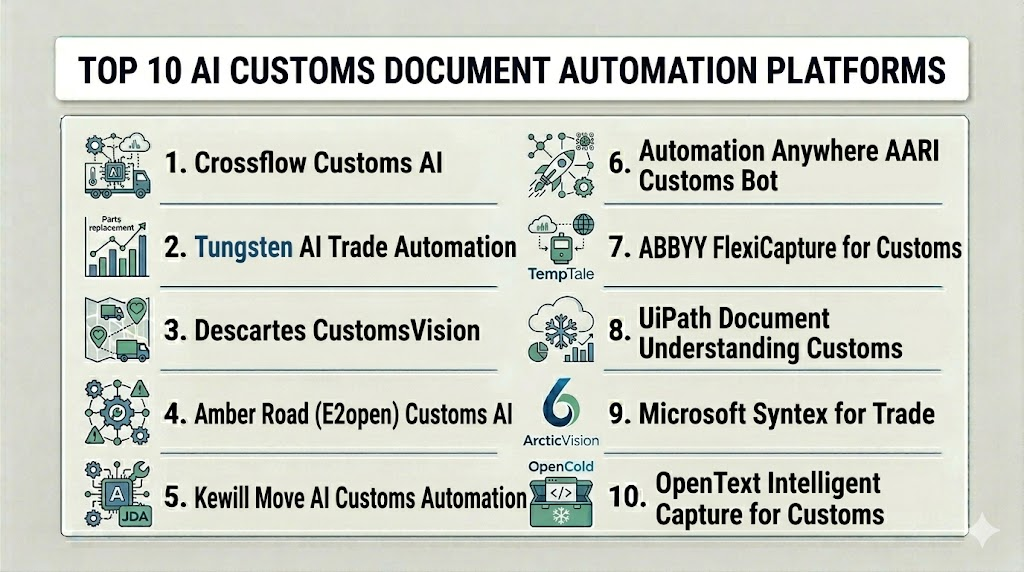
Top 10 AI Customs Document Automation Platforms
1 — Crossflow Customs AI
One‑line verdict: Enterprise customs document automation with strong AI parsing, validation, and regulatory compliance workflows.
Short description: Crossflow leverages AI to parse, extract, and validate customs paperwork at scale, automating compliance checks and reducing clearance delays.
Standout Capabilities
- AI‑driven document text extraction and classification
- Regulatory validation against tariff and trade rules
- Harmonized System (HS) code inference and scoring
- Export and import documentation workflows
- Real‑time exception alerting
- Analytics dashboards showing accuracy and processing KPIs
AI‑Specific Depth
- Model support: Proprietary AI + custom NLP models
- RAG / knowledge integration: Trade regulation feeds; ERP, TMS connectors
- Evaluation: Continuous learning with human corrections
- Guardrails: Conflict detection, field integrity rules
- Observability: Dashboard for accuracy, exception, lead time
Pros
- Strong compliance focus
- Deep customs rule integration
- Scales for high volumes
Cons
- Premium pricing
- Requires integration effort
- Learning curve for non‑technical users
Security & Compliance
- Encryption in transit/at rest; role‑based access
- Audit trails, data retention policies
- Certifications: Not publicly stated
Deployment & Platforms
- Cloud, Web, Hybrid
Integrations & Ecosystem
ERP, TMS, EDI gateways, customs authority APIs
Pricing Model
Subscription; Not publicly stated
Best‑Fit Scenarios
Large global shippers; customs brokers; compliance‑driven operations
2 — Tungsten AI Trade Automation
One‑line verdict: AI solution for customs documentation with strong rule authoring and exception workflows.
Short description: Tungsten automates document processing with a focus on validation and regulatory compliance, enabling rule‑based exceptions and corrections.
Standout Capabilities
- Automated OCR + NLP extraction
- Rule authoring for validation and compliance
- Smart HS code classification with learning feedback
- Workflow for exceptions and manual review
- Regulatory updates feed
- KPI reporting
AI‑Specific Depth
- Model support: Proprietary AI; custom rules
- RAG / knowledge integration: Trade compliance feeds; ERP/TMS
- Evaluation: Back‑testing with human corrections
- Guardrails: Rule engine + AI checks
- Observability: Exception analytics
Pros
- Excellent rule authoring for compliance teams
- Strong exception handling
- Continuous regulatory updates
Cons
- Rule maintenance overhead
- Less emphasis on low‑code workflows
- Premium for small fleets
Security & Compliance
Encryption, RBAC, audit logging
Deployment & Platforms
Cloud, Web
Integrations & Ecosystem
ERP, TMS, EDI, trade feeds
Pricing Model
Subscription; Not publicly stated
Best‑Fit Scenarios
Mid‑to‑large enterprises; compliance‑intensive industries
3 — Descartes CustomsVision
One‑line verdict: Customs automation engine integrated with logistics suite and predictive compliance analytics.
Short description: Descartes combines AI document parsing with logistics workflows and compliance intelligence for automated clearance.
Standout Capabilities
- Document ingestion and field extraction
- Customs classification and validation
- Logistics path integration
- Predictive regulatory risk scoring
- Dashboard and reporting
AI‑Specific Depth
- Model support: Proprietary AI
- RAG / knowledge integration: Trade regulation feeds; logistics systems
- Evaluation: Predictive accuracy tracking
- Guardrails: Data integrity checks
- Observability: Compliance and documentation KPIs
Pros
- Integrated with logistics workflows
- Predictive risk scoring
- Good analytics
Cons
- Best with full Descartes suite
- Premium cost
- Setup complexity
Security & Compliance
Encryption, RBAC, audit trails
Deployment & Platforms
Cloud, Web
Integrations & Ecosystem
ERP, TMS, trade feeds
Pricing Model
Subscription; Not publicly stated
Best‑Fit Scenarios
Large logistics operators; global trade
4 — Amber Road (E2open) Customs AI
One‑line verdict: AI‑powered document automation within a comprehensive trade compliance platform.
Short description: Amber Road’s AI automates extraction and validation while tying into duty management, classification, and compliance.
Standout Capabilities
- Smart classification of customs forms
- Regulatory compliance checks
- Duty forecasting
- Change tracking and audit reports
- Workflow cadences for exceptions
AI‑Specific Depth
- Model support: Proprietary AI
- RAG / knowledge integration: Trade regulation databases
- Evaluation: Continuous improvement loops
- Guardrails: Conflict and compliance rules
- Observability: Audit & exception dashboards
Pros
- Best for complex compliance
- Strong classification accuracy
- Part of a larger trade management suite
Cons
- Higher total cost of ownership
- Requires platform maturity
- Extensive configuration
Security & Compliance
RBAC, encryption, audit logs
Deployment & Platforms
Cloud, Hybrid
Integrations & Ecosystem
ERP, TMS, trade systems
Pricing Model
Subscription; Not publicly stated
Best‑Fit Scenarios
Enterprises with heavy compliance needs; multi‑jurisdiction trade
5 — Kewill Move AI Customs Automation
One‑line verdict: AI document automation tied to freight and customs clearance workflows.
Short description: Kewill’s AI engine streamlines customs paperwork extraction and compliance validation as part of end‑to‑end freight movement.
Standout Capabilities
- NLP extraction of customs docs
- Integration with freight and clearance systems
- Validation against tariff and trade rules
- Exception dashboards
- Contextual insights for clearance delays
AI‑Specific Depth
- Model support: Proprietary AI
- RAG / knowledge integration: Logistics & trade systems
- Evaluation: Accuracy tracking
- Guardrails: Field integrity rules
- Observability: Delay & exception metrics
Pros
- Deep logistics integration
- Real‑time exceptioning
- Good for clearance workflows
Cons
- Best within Kewill ecosystem
- Moderate analytics depth
- Premium implementation
Security & Compliance
Encryption, audit trails
Deployment & Platforms
Cloud, Web
Integrations & Ecosystem
TMS, ERP, customs systems
Pricing Model
Subscription; Not publicly stated
Best‑Fit Scenarios
Freight/logistics operators; customs brokers
6 — Automation Anywhere AARI Customs Bot
One‑line verdict: AI + RPA platform automating customs document handling and workflow orchestration.
Short description: Automation Anywhere’s AI bots extract, validate, and route customs paperwork while integrating with backend systems for verification.
Standout Capabilities
- NLP + OCR document extraction bots
- Workflow orchestration
- Integration with backend systems
- Auto‑triggered validation sequences
- Analytics for bot performance
AI‑Specific Depth
- Model support: Mix of RPA + proprietary AI
- RAG / knowledge integration: ERP, TMS, APIs
- Evaluation: Bot accuracy metrics
- Guardrails: Workflow rules and checkpoints
- Observability: Bot execution and exception logs
Pros
- Excellent automation orchestration
- Flexible workflow design
- Broad backend integrations
Cons
- Requires RPA expertise
- Bot maintenance overhead
- Not a full trade compliance suite
Security & Compliance
RBAC, encryption, audit trails
Deployment & Platforms
Cloud, Hybrid, On‑prem
Integrations & Ecosystem
ERP, TMS, document stores
Pricing Model
Subscription; Not publicly stated
Best‑Fit Scenarios
IT process automation teams; customs back‑office
7 — ABBYY FlexiCapture for Customs
One‑line verdict: AI data capture engine with advanced extraction and integration capabilities.
Short description: ABBYY uses proprietary OCR, NLP, and ML to extract structured data from customs forms and feed downstream systems.
Standout Capabilities
- Document image OCR and data extraction
- Layout‑independent custom models
- Validation workflows
- Export to ERP/TMS
- Exception classification
AI‑Specific Depth
- Model support: Proprietary ML
- RAG / knowledge integration: ERP/TMS connectors
- Evaluation: Extraction accuracy metrics
- Guardrails: Field value checks
- Observability: Extraction dashboards
Pros
- Very strong extraction accuracy
- Flexible form support
- Lower entry cost
Cons
- Not a full compliance suite
- Needs integration for validation
- More technical setup
Security & Compliance
Encryption, access controls
Deployment & Platforms
Cloud, On‑prem, Hybrid
Integrations & Ecosystem
ERP, TMS, document management
Pricing Model
Subscription; Not publicly stated
Best‑Fit Scenarios
Document extract heavy workloads; back‑office
8 — UiPath Document Understanding Customs
One‑line verdict: RPA + AI document platform with robust extraction and workflow automation.
Short description: UiPath leverages AI/ML models with RPA bots to digitize customs docs, populate forms, and integrate with enterprise systems.
Standout Capabilities
- Prebuilt ML extraction models
- Human‑in‑the‑loop exception workflows
- Integration with backend apps via RPA
- Process analytics
AI‑Specific Depth
- Model support: Proprietary ML + open‑source support
- RAG / knowledge integration: ERP, TMS, APIs
- Evaluation: Feedback loops
- Guardrails: Human validation gates
- Observability: Process analytics
Pros
- Strong RPA integration
- Human‑in‑loop for accuracy
- Scalable enterprise automation
Cons
- Requires RPA skillset
- More setup overhead
- Not solely a trade compliance product
Security & Compliance
RBAC, encryption
Deployment & Platforms
Cloud, On‑prem, Hybrid
Integrations & Ecosystem
ERP, TMS, RPA bots
Pricing Model
Subscription; Not publicly stated
Best‑Fit Scenarios
Enterprises with RPA strategies; custom workflows
9 — Microsoft Syntex for Trade
One‑line verdict: Modern AI document processing built on Microsoft 365 ecosystem with custom trade models.
Short description: Microsoft Syntex uses AI models and content services to extract and classify customs documents, enabling integration into broader enterprise systems.
Standout Capabilities
- AI text recognition and classification
- Integration with SharePoint, Power Automate
- Custom model training
- Compliance tagging
AI‑Specific Depth
- Model support: Azure AI + custom models
- RAG / knowledge integration: Microsoft 365, ERP connectors
- Evaluation: Accuracy insights
- Guardrails: Content policies
- Observability: Document processing metrics
Pros
- Good for Microsoft‑centric enterprises
- Custom model training
- Integration with workflow apps
Cons
- Not trade‑native product
- Requires Power Platform expertise
- Extra work to tie into customs logic
Security & Compliance
Enterprise security & compliance
Deployment & Platforms
Cloud (Microsoft)
Integrations & Ecosystem
SharePoint, Power Automate, ERP
Pricing Model
Usage‑based; Not publicly stated
Best‑Fit Scenarios
Microsoft ecosystem customers; content workflows
10 — OpenText Intelligent Capture for Customs
One‑line verdict: Document capture and processing engine with AI enrichment for customs workloads.
Short description: OpenText ingests, extracts, enriches, and validates customs documents using AI and tightly integrates with enterprise content systems.
Standout Capabilities
- Document capture & enrichment
- Taxonomy and classification
- Validation rules engine
- Integration with TMS/ERP and archive systems
AI‑Specific Depth
- Model support: Proprietary + configurable ML
- RAG / knowledge integration: ERP, TMS
- Evaluation: Extraction accuracy reporting
- Guardrails: Field validation
- Observability: Content analytics
Pros
- Enterprise content integration
- Flexible document pipelines
- Broad format support
Cons
- Not fully trade compliance‑centric
- Enterprise complexity
- Higher TCO
Security & Compliance
Enterprise security stack, encryption
Deployment & Platforms
Cloud, Hybrid, On‑prem
Integrations & Ecosystem
Content systems, ERP, TMS
Pricing Model
Subscription; Not publicly stated
Best‑Fit Scenarios
Large enterprises; content‑centric trade
Comparison Table
| Tool Name | Best For | Deployment | Model Flexibility | Strength | Watch‑Out | Public Rating |
|---|---|---|---|---|---|---|
| Crossflow Customs AI | Enterprise trade | Cloud/Hybrid | Proprietary | Compliance workflows | Premium cost | N/A |
| Tungsten AI Trade | Mid/large | Cloud | Proprietary | Rule engine | Rule maintenance | N/A |
| Descartes CustomsVision | Logistics ops | Cloud | Proprietary | Integrated workflows | Best with suite | N/A |
| Amber Road (E2open) | Compliance enterprises | Cloud/Hybrid | Proprietary | Deep compliance | TCO | N/A |
| Kewill Move AI | Freight/logistics | Cloud | Proprietary | Clearance integration | Moderate analytics | N/A |
| Automation Anywhere AARI | RPA+AI | Cloud/On‑prem | RPA+AI | Workflow automation | RPA upkeep | N/A |
| ABBYY FlexiCapture | Extraction heavy | Cloud/Hybrid/On‑prem | Proprietary | Data extraction | Needs validation | N/A |
| UiPath Document Understanding | RPA workflows | Cloud/Hybrid/On‑prem | ML+RPA | Human‑in‑loop | Setup overhead | N/A |
| Microsoft Syntex for Trade | Microsoft ecosystem | Cloud | Azure AI | Custom models | Not trade native | N/A |
| OpenText Intelligent Capture | Content enterprises | Cloud/Hybrid/On‑prem | Proprietary | Document pipelines | Complexity | N/A |
Scoring & Evaluation
Scoring is comparative; weighted criteria: Core 20%, Reliability & Eval 15%, Guardrails 10%, Integrations 15%, Ease 10%, Perf/Cost 15%, Security/Admin 10%, Support 5%.
| Tool | Core | Reliability/Eval | Guardrails | Integrations | Ease | Perf/Cost | Security/Admin | Support | Weighted Total |
|---|---|---|---|---|---|---|---|---|---|
| Crossflow Customs AI | 9 | 9 | 8 | 9 | 7 | 8 | 8 | 7 | 8.4 |
| Tungsten AI Trade | 8 | 8 | 9 | 8 | 7 | 7 | 8 | 7 | 7.9 |
| Descartes CustomsVision | 8 | 8 | 8 | 8 | 7 | 8 | 8 | 7 | 8.0 |
| Amber Road E2open | 9 | 9 | 9 | 9 | 6 | 7 | 8 | 7 | 8.1 |
| Kewill Move AI | 8 | 8 | 8 | 8 | 7 | 8 | 7 | 7 | 7.8 |
| Automation Anywhere AARI | 7 | 7 | 8 | 9 | 7 | 7 | 8 | 7 | 7.6 |
| ABBYY FlexiCapture | 7 | 7 | 7 | 8 | 8 | 7 | 7 | 7 | 7.5 |
| UiPath Document Understanding | 8 | 8 | 8 | 8 | 7 | 7 | 8 | 7 | 7.8 |
| Microsoft Syntex for Trade | 7 | 7 | 7 | 7 | 8 | 7 | 8 | 7 | 7.3 |
| OpenText Intelligent Capture | 7 | 7 | 7 | 8 | 7 | 7 | 8 | 7 | 7.4 |
Top 3 for Enterprise Compliance: Crossflow Customs AI, Amber Road E2open, Descartes CustomsVision
Top 3 for Automation Workflows: UiPath Document Understanding, Automation Anywhere AARI, ABBYY FlexiCapture
Top 3 for Mid‑Market: Tungsten AI Trade, Kewill Move AI, ABBYY FlexiCapture
Which AI Customs Document Automation Tool Is Right for You?
Solo / Small Shippers
- ABBYY FlexiCapture or Microsoft Syntex for affordable extraction and classification.
Mid‑Market
- Tungsten AI Trade or Kewill Move AI for integrated document automation with logical compliance validation.
Large Enterprise
- Crossflow Customs AI, Amber Road E2open, or Descartes CustomsVision for full compliance stack and global automation.
RPA‑Enabled Automation
- UiPath Document Understanding or Automation Anywhere AARI for workflow orchestration alongside AI parsing.
Microsoft Ecosystem
- Microsoft Syntex for organizations already on Microsoft 365 and Azure.
Content‑Centric Enterprises
- OpenText Intelligent Capture for deep document and archive workflows.
Implementation Playbook (30 / 60 / 90 Days)
30 Days
- Ingest sample document types and evaluate AI extraction accuracy.
- Map required customs forms and fields.
- Configure basic validation rules and thresholds.
- Set up exception dashboards and alerts.
60 Days
- Expand to full document set (invoices, packing lists, certificates).
- Integrate with ERP, TMS, EDI, and customs authority APIs.
- Train compliance teams on workflows.
- Tweak guardrails and validation logic.
90 Days
- Automate exception workflows with human‑in‑loop reviews.
- Run simulation tests for new trade lanes and regulatory updates.
- Monitor observability dashboards and adjust models.
- Measure lead time and error reduction to quantify ROI.
Common Mistakes & How to Avoid Them
- Skipping data quality checks: Poor input quality drives poor AI extraction.
- Not integrating regulatory feeds: AI models need live regulatory context.
- Over‑automation without oversight: Always include human‑in‑loop for critical fields.
- Ignoring observability metrics: Track accuracy and exception trends.
- Neglecting guardrails: Without rules, AI can misclassify fields.
- Incomplete integrations: Ensure ERP/TMS/EDI are linked for closed‑loop validation.
- Not tuning post‑deployment: Continuous learning improves accuracy.
- Failing to document exceptions: This hampers model improvement.
- Ignoring security & privacy: Customs data is sensitive.
- Assuming one model fits all countries: Local variations matter.
- Underestimating training needs: Teams must understand workflows.
- Not segmenting by trade lane: Context differs by geography.
FAQs
1‑ What is AI Customs Document Automation?
It’s the use of AI and NLP to parse, validate, classify, and streamline customs paperwork and compliance documentation.
2‑ Do these tools integrate with customs authorities’ systems?
Many provide EDI or API integrations to exchange structured data with customs portals where supported.
3‑ How accurate are the AI extraction models?
Accuracy depends on data quality and training; continuous feedback improves performance.
4‑ Can AI recommend HS codes?
Yes — several platforms provide inferred HS classifications with confidence scoring.
5‑ Do these systems work globally?
Top tools support multi‑jurisdiction trade rules and dynamic regulatory updates.
6‑ How do exception workflows work?
AI identifies mismatches or missing fields and routes documents for human review and correction.
7‑ Are these solutions cloud‑only?
Many offer hybrid or on‑prem options for data sovereignty and latency needs.
8‑ Can AI handle handwritten customs forms?
Advanced OCR + NLP systems can extract printed text; handwriting support varies.
9‑ How is regulatory compliance managed?
Platforms ingest regulatory feeds and apply rule logic to validate document fields.
10‑ What’s human‑in‑loop for document automation?
Operators review flagged exceptions or low‑confidence fields to correct models.
11‑ Do these tools reduce customs clearance lead time?
Yes — by improving accuracy and reducing re‑work, clearance delays diminish.
12‑ What metrics should I track?
Key metrics include extraction accuracy, exception rates, processing lead time, clearance delays, and error reduction.
Conclusion
AI Customs Document Automation platforms provide substantial value for organizations dealing with high volumes of trade documentation and complex regulatory environments. By automating extraction, validation, exception handling, and compliance validation, enterprises can reduce errors, accelerate customs clearance, and improve operational efficiency. The “best” tool depends on your organization’s size, existing systems, compliance needs, and automation maturity. Mid‑market enterprises may prioritize usability and integration ease, while global shippers require deep compliance intelligence and scalability.

Find Trusted Cardiac Hospitals
Compare heart hospitals by city and services — all in one place.
Explore Hospitals
AI customs automation tools save time, but real efficiency depends on handling changing trade regulations, document accuracy, and seamless ERP/logistics integration.