
Introduction
AI Electronic Lab Notebook (ELN) Assistants are platforms that leverage artificial intelligence to enhance traditional electronic lab notebooks with automation, data extraction, predictive suggestions, and intelligent search. They help researchers capture experimental data, generate structured protocols, and analyze results more efficiently. By applying natural language processing and machine learning, these tools reduce the manual burden of documentation, improve data quality, and enable teams to focus on scientific insights rather than tedious note‑taking.
Why it matters: Research reproducibility and knowledge sharing depend on accurate, complete, and searchable lab records. AI ELN Assistants transform static lab notebooks into dynamic, interactive research support systems that boost productivity, reduce human error, and accelerate discovery.
Real‑world use cases:
- Automating experiment documentation and protocol writing
- Extracting structured insights from unstructured lab notes
- Intelligent search across experiments, reagents, and results
- Predictive suggestions for next steps based on historical data
- Data linking between results, instruments, and reagents
- Collaboration and version tracking across research teams
Evaluation criteria for buyers: Natural language understanding quality, integration with instruments and lab software, AI‑assisted search and predictions, data privacy and governance, cross‑team collaboration features, ease of use, security controls, analytics and reporting, workflow automation, ability to customize AI models, and vendor support.
Best for: Pharmaceutical R&D, academic labs with complex workflows, biotech startups, and organizations with high documentation needs.
Not ideal for: Small labs with minimal digital documentation needs or purely manual workflows.
What’s Changed in AI ELN Assistants
- Natural language processing that understands experimental context
- AI‑based summarization of experiment results and outcomes
- Smart search that finds related experiments across teams
- Predictive suggestions guided by past data and protocols
- Integration with instruments and data pipelines
- Guardrails to prevent ambiguous or unsafe documentation
- Observable metrics on notebook usage and AI assistance impact
- Support for multimodal inputs including text, tables, and images
- Improved governance with audit trails and version control
- Customizable AI models for domain‑specific workflows
- Suggestive analytics for reagent usage and experiment bottlenecks
- Real‑time collaboration across distributed teams
Quick Buyer Checklist
- AI natural language quality for scientific text
- Integration with lab instruments, LIMS, and data sources
- Intelligent search and cross‑reference capabilities
- Data privacy policies and governance controls
- Support for multimodal inputs such as images and tables
- Workflow automation features and templates
- Version control and audit logs
- Guardrails for safe documentation
- Collaboration and permission controls
- Analytics and reporting dashboards
- Custom model or BYO model support
- Vendor support and training resources
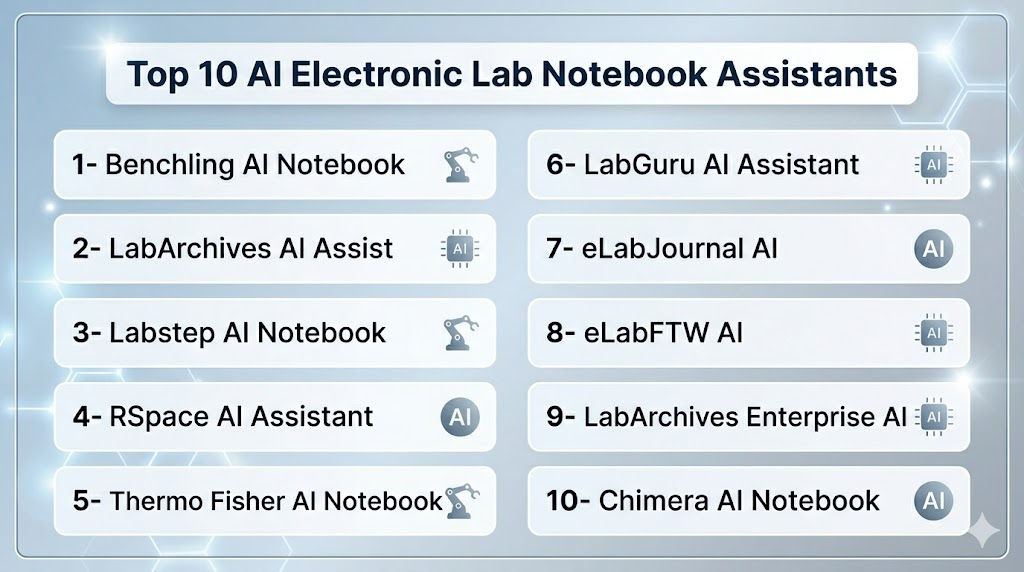
Top 10 AI Electronic Lab Notebook Assistants
1‑ Benchling AI Notebook
One‑line verdict: Best for integrated life sciences workflows with AI‑enhanced documentation and collaboration.
Short description: Benchling AI Notebook enhances traditional electronic lab notebook functionality with AI‑powered suggestions, structured experiment capture, and intelligent search, enabling teams to document research more efficiently. It centralizes data, supports collaboration, and integrates with lab systems.
Standout Capabilities
- AI‑generated protocol templates
- Natural language experiment capture
- Intelligent search across experiments
- Document linking with reagents and assets
- Version tracking and history
- Experiment summaries and highlights
- Cloud‑based collaboration
- Integration with lab software ecosystems
AI‑Specific Depth
- Model support: Proprietary
- RAG / knowledge integration: ELN, instrument logs
- Evaluation: AI accuracy tests and human review
- Guardrails: Documentation safety checks
- Observability: Usage and suggestion metrics
Pros
- Tight integration with lab workflows
- Intelligent search and suggestions
- Supports cross‑team collaboration
Cons
- Proprietary and cloud dependent
- Requires setup for custom workflows
- May require training for complex experiments
Security & Compliance
Role‑based access controls, audit logs, encryption
Deployment & Platforms
Web interface, cloud
Integrations & Ecosystem
- Lab instruments
- LIMS and ELN connectors
- REST API and SDK
- Analytics dashboards
Pricing Model
Subscription‑based tiering
Best‑Fit Scenarios
- Integrated biotech teams
- High collaborative research
- Complex protocol documentation
2‑ LabArchives AI Assist
One‑line verdict: Well‑suited for academic and educational labs needing AI‑assisted experiment documentation.
Short description: LabArchives AI Assist applies AI to generate structured experiment summaries, suggest keywords, and organize notes, helping researchers maintain consistent and searchable lab records while reducing documentation burden.
Standout Capabilities
- Structured experiment summaries
- Keyword and metadata suggestions
- Intelligent search filters
- User annotations and tagging
- Version history tracking
- Cross‑lab collaboration
- Data export tools
AI‑Specific Depth
- Model support: Proprietary
- RAG / knowledge integration: ELN and metadata
- Evaluation: Periodic model validation
- Guardrails: Content quality checks
- Observability: Usage dashboards
Pros
- Simplifies documentation
- Strong search and tagging
- Version tracking
Cons
- Less formal AI guidance than enterprise tools
- Academic focus may lack advanced integrations
- Subscription model
Security & Compliance
Role‑based access, audit logs, encryption
Deployment & Platforms
Web interface, cloud
Integrations & Ecosystem
- ELN and LIMS connectors
- API and export formats
- Collaboration features
Pricing Model
Subscription tiers
Best‑Fit Scenarios
- Academic research
- Educational lab environments
- Team labs with heavy documentation
3‑ Labstep AI Notebook
One‑line verdict: Recommended for labs prioritizing AI‑enhanced search and context linking.
Short description: Labstep AI Notebook improves experiment documentation by offering AI‑powered context linking, intelligent search, and predictive suggestions based on past experiments, enabling faster retrieval of related data across teams.
Standout Capabilities
- Contextual linking of experiments
- Predictive suggestions
- Multi‑format support (text, tables, media)
- Intelligent search across teams
- Collaboration features
- Audit trail and version history
AI‑Specific Depth
- Model support: Proprietary
- RAG / knowledge integration: ELN and data sources
- Evaluation: Search performance metrics
- Guardrails: Content validation
- Observability: Notebook usage dashboards
Pros
- Excellent search and discovery
- Rich context linking
- Supports multimodal content
Cons
- Proprietary system
- Learning curve for advanced features
- Cloud dependency
Security & Compliance
Audit logs, role permissions, encryption
Deployment & Platforms
Cloud‑based, web
Integrations & Ecosystem
- ELN and experiment tools
- APIs for automation
- Collaboration plugins
Pricing Model
Subscription
Best‑Fit Scenarios
- Interdisciplinary research teams
- Projects with large experiment history
- Labs needing intelligent retrieval
4‑ RSpace AI Assistant
One‑line verdict: Best for labs wanting AI assistance tightly coupled with scientific writing.
Short description: RSpace AI Assistant enhances narrative experiment writing, suggests protocols, and organizes results into structured formats, helping researchers produce consistent and reproducible lab records with less manual effort.
Standout Capabilities
- AI‑assisted protocol writing
- Natural language experiment capture
- Structured data extraction
- Smart tagging and metadata
- Collaboration features
- Version history and tracking
AI‑Specific Depth
- Model support: Proprietary
- RAG / knowledge integration: ELN, LIMS
- Evaluation: Model validation metrics
- Guardrails: Safety checks on outputs
- Observability: Suggestion usage tracking
Pros
- Smooth experiment authoring
- Structured extraction
- Collaboration support
Cons
- Subscription cost
- Proprietary AI stack
- May require training
Security & Compliance
Role permissions, audit logs, encryption
Deployment & Platforms
Cloud, web
Integrations & Ecosystem
- LIMS and instrument connectors
- APIs for workflows
- Export tools
Pricing Model
Subscription
Best‑Fit Scenarios
- Labs emphasizing written narratives
- Teams needing structured documentation
- Collaborative research projects
5‑ Thermo Fisher AI Notebook
One‑line verdict: Well‑suited for labs needing instrument‑linked AI documentation.
Short description: Thermo Fisher AI Notebook combines ELN with AI features that extract insights from linked instruments, auto‑generate summaries, and assist researchers in organizing results from complex analytical workflows.
Standout Capabilities
- Instrument data integration
- AI summaries of analytical results
- Structured templates
- Collaboration features
- Real‑time logging
- Version tracking
AI‑Specific Depth
- Model support: Proprietary
- RAG / knowledge integration: Instrument logs and ELN
- Evaluation: Instrument‑linked validation tests
- Guardrails: Data consistency checks
- Observability: Usage and result metrics
Pros
- Tight instrument linkage
- AI summary generation
- Structured experiment capture
Cons
- Proprietary and vendor‑locked
- Cloud dependency
- Pricing tiers
Security & Compliance
Encryption, audit trails, role controls
Deployment & Platforms
Cloud, web
Integrations & Ecosystem
- Instrument APIs
- ELN connectors
- Data analytics dashboards
Pricing Model
Subscription
Best‑Fit Scenarios
- Analytical labs
- Instrument‑heavy environments
- High data volume research
6‑ LabGuru AI Assistant
One‑line verdict: Recommended for life sciences teams wanting task and reagent intelligence.
Short description: LabGuru AI Assistant enriches ELN with reagent tracking intelligence, suggested tasks based on past experiments, and predictive insights, improving lab efficiency and data handling.
Standout Capabilities
- Reagent and inventory intelligence
- AI‑assisted task suggestions
- Experiment summaries
- Intelligent search
- Collaboration features
- Version history
AI‑Specific Depth
- Model support: Proprietary
- RAG / knowledge integration: ELN and inventory data
- Evaluation: Productivity metrics
- Guardrails: Task validation checks
- Observability: Usage dashboards
Pros
- Inventory‑aware suggestions
- Improves lab turnaround
- Strong search
Cons
- Requires inventory setup
- Proprietary stack
- Subscription cost
Security & Compliance
Encryption, audit trails, role control
Deployment & Platforms
Cloud, web
Integrations & Ecosystem
- LIMS/ELN connectors
- API and SDK
- Task and inventory dashboards
Pricing Model
Subscription
Best‑Fit Scenarios
- Labs with reagent tracking
- High turnover experiments
- Collaborative teams
7‑ eLabJournal AI
One‑line verdict: Best for labs needing customizable AI‑driven templates and automation.
Short description: eLabJournal AI provides customizable ELN templates, automated field suggestions, and intelligent tagging, streamlining experiment capture and cross‑project organization to boost reproducibility.
Standout Capabilities
- Customizable templates
- AI suggestions for key data fields
- Smart tagging and filters
- Experiment history linking
- Collaboration and sharing
- Version control
AI‑Specific Depth
- Model support: Proprietary
- RAG / knowledge integration: ELN content
- Evaluation: Suggestion accuracy metrics
- Guardrails: Content validation thresholds
- Observability: Dashboards and usage metrics
Pros
- Highly customizable
- Improves documentation quality
- Strong tagging
Cons
- Subscription required
- Proprietary
- Learning curve
Security & Compliance
Role controls, audit logs, encryption
Deployment & Platforms
Cloud, web
Integrations & Ecosystem
- API and SDK
- ELN connectors
- Data export options
Pricing Model
Subscription
Best‑Fit Scenarios
- Labs needing adaptable workflows
- Projects with varied experiment types
- Teams requiring custom templates
8‑ eLabFTW AI
One‑line verdict: Suitable for open source and DIY lab teams needing AI enhancements.
Short description: eLabFTW AI adds intelligent search, auto‑suggestions, and metadata extraction to an open electronic lab notebook platform, helping teams improve documentation without heavy costs.
Standout Capabilities
- AI‑assisted search
- Metadata extraction
- Tag suggestions
- Version tracking
- Open‑style workflow
- Collaboration features
AI‑Specific Depth
- Model support: Open‑source / proprietary mix
- RAG / knowledge integration: Local data
- Evaluation: Search performance metrics
- Guardrails: Content guidance checks
- Observability: Usage dashboards
Pros
- Cost‑effective
- Open‑friendly
- Search and metadata boosts
Cons
- Less enterprise feature set
- Integration effort
- AI capability limits
Security & Compliance
Varies with deployment
Deployment & Platforms
Web, self‑hosted available
Integrations & Ecosystem
- API and plugin support
- Data exports
- ELN connectors
Pricing Model
Free / open source with optional support
Best‑Fit Scenarios
- Small labs
- DIY setups
- Budget‑conscious teams
9‑ LabArchives Enterprise AI
One‑line verdict: Suited for large organizations needing enterprise‑scale AI ELN orchestration.
Short description: LabArchives Enterprise AI extends standard ELN features with advanced AI search, governance controls, predictive tagging, and team‑wide analytics, enabling large research organizations to maintain consistent documentation practices.
Standout Capabilities
- Enterprise governance and policy controls
- Predictive tagging
- Cross‑team intelligent search
- Data analytics dashboards
- AI‑based summaries
- Version and audit logs
AI‑Specific Depth
- Model support: Proprietary
- RAG / knowledge integration: ELN and governance logs
- Evaluation: Enterprise usage metrics
- Guardrails: Policy enforcement
- Observability: Team dashboards
Pros
- Strong governance
- Enterprise analytics
- Cross‑team collaboration
Cons
- Enterprise pricing
- Complexity to implement
- Proprietary stack
Security & Compliance
- Encryption
- Audit logs
- Policy controls
Deployment & Platforms
Cloud, web
Integrations & Ecosystem
- ELN and LIMS connectors
- APIs
- Analytics suite
Pricing Model
Enterprise subscription
Best‑Fit Scenarios
- Large R&D organizations
- Cross‑site labs
- Regulated environments
10‑ Chimera AI Notebook
One‑line verdict: Recommended for labs needing real‑time AI guidance and contextual assistance.
Short description: Chimera AI Notebook provides real‑time contextual assistance, smart experiment suggestions, automated summaries, and intelligent search to support researchers during documentation and discovery workflows.
Standout Capabilities
- Real‑time AI guidance
- Smart suggestions for experiment steps
- Automated summaries
- Context‑aware search
- Collaboration features
- Versioning
AI‑Specific Depth
- Model support: Proprietary
- RAG / knowledge integration: ELN and experiment context
- Evaluation: Real‑time usage metrics
- Guardrails: Content validation checks
- Observability: Metrics dashboards
Pros
- Interactive AI assistance
- Boosts researcher efficiency
- Strong contextual support
Cons
- Subscription cost
- Proprietary stack
- Cloud dependency
Security & Compliance
Role controls, encryption, audit logs
Deployment & Platforms
Cloud, web
Integrations & Ecosystem
- ELN connectors
- REST API and SDK
- Collaboration plugins
Pricing Model
Subscription
Best‑Fit Scenarios
- Dynamic experimental environments
- Collaborative research teams
- Documentation heavy workflows
Comparison Table
| Tool Name | Best For | Deployment | Model Flexibility | Strength | Watch‑Out | Public Rating |
|---|---|---|---|---|---|---|
| Benchling AI Notebook | Integrated labs | Cloud | Proprietary | Collaboration + AI search | Cloud dependency | N/A |
| LabArchives AI Assist | Academic labs | Cloud | Proprietary | Structured summaries | Limited enterprise integrations | N/A |
| Labstep AI Notebook | Research teams | Cloud | Proprietary | Contextual linking | Proprietary stack | N/A |
| RSpace AI Assistant | Scientific writing | Cloud | Proprietary | Protocol optimization | Requires training | N/A |
| Thermo Fisher AI Notebook | Instrument‑heavy labs | Cloud | Proprietary | Instrument data linkage | Vendor lock‑in | N/A |
| LabGuru AI Assistant | Inventory labs | Cloud | Proprietary | Reagent intelligence | Inventory dependency | N/A |
| eLabJournal AI | Custom workflows | Cloud | Proprietary | Templates | Learning curve | N/A |
| eLabFTW AI | Open labs | Web / Self‑hosted | Open‑source + mix | Cost‑effective | Lower enterprise depth | N/A |
| LabArchives Enterprise AI | Enterprise R&D | Cloud | Proprietary | Governance + analytics | Complexity | N/A |
| Chimera AI Notebook | Dynamic labs | Cloud | Proprietary | Real‑time guidance | Subscription cost | N/A |
Scoring Table
| Tool | Core | Natural Language | Guardrails | Integrations | Ease | Performance/Cost | Security/Admin | Support | Weighted Total |
|---|---|---|---|---|---|---|---|---|---|
| Benchling AI Notebook | 10 | 9 | 9 | 9 | 8 | 8 | 9 | 7 | 8.9 |
| LabArchives AI Assist | 8 | 8 | 8 | 7 | 9 | 8 | 8 | 7 | 7.9 |
| Labstep AI Notebook | 9 | 9 | 8 | 8 | 8 | 8 | 9 | 7 | 8.5 |
| RSpace AI Assistant | 9 | 8 | 9 | 8 | 7 | 8 | 8 | 7 | 8.2 |
| Thermo Fisher AI Notebook | 8 | 7 | 8 | 9 | 8 | 8 | 8 | 7 | 8.1 |
| LabGuru AI Assistant | 8 | 8 | 7 | 8 | 8 | 8 | 8 | 7 | 8.0 |
| eLabJournal AI | 8 | 8 | 8 | 7 | 8 | 8 | 8 | 7 | 8.0 |
| eLabFTW AI | 7 | 7 | 7 | 6 | 9 | 7 | 7 | 6 | 7.2 |
| LabArchives Enterprise AI | 9 | 8 | 9 | 9 | 7 | 8 | 9 | 8 | 8.6 |
| Chimera AI Notebook | 9 | 9 | 8 | 8 | 8 | 8 | 8 | 7 | 8.3 |
Which Tool Is Right for You
- Solo / Freelancer: eLabFTW AI for cost‑effective AI search; LabArchives AI Assist for structured summaries
- SMB: Labstep AI Notebook, LabGuru AI Assistant for balanced ELN plus AI boost
- Mid‑Market: RSpace AI Assistant, Thermo Fisher AI Notebook for integrated instrumentation and writing support
- Enterprise: Benchling AI Notebook, LabArchives Enterprise AI for governance, collaboration, and team scalability
- Regulated industries: Tools with strong audit logs and policy controls like Benchling and LabArchives Enterprise AI
- Budget vs premium: Open‑source or lower‑tier tools for cost‑constrained teams; premium subscriptions for integrated capabilities
- Build vs buy: eLabFTW AI for customizable self‑hosted environments; commercial suites for rapid scaling
Implementation Playbook (30 / 60 / 90 Days)
- 30 days: Pilot two AI ELN assistants with representative documentation workflows, define success metrics, and enable usage dashboards
- 60 days: Integrate with instruments and LIMS, validate AI suggestions with historical data, train users on AI‑assisted features
- 90 days: Harden security policies, implement guardrails, optimize search indexing, scale ELN across teams, and automate protocol templates
Common Mistakes & How to Avoid Them
- Ignoring guardrails and safety checks in auto‑generated notes
- Not evaluating AI suggestions against real experimental context
- Poor data retention policies
- Limited observability of assistant interactions
- Over‑automation without user review
- Vendor lock‑in without abstraction
- Skipping integration with instruments and LIMS
- Misinterpreting AI suggestions without domain review
- Neglecting training and onboarding for users
- Choosing free tools without scalability
- Not tracking versioning of experiments
- Ignoring audit logs in regulated labs
- Not customizing AI models to domain needs
- Underestimating support and documentation resources
FAQs
- Can AI ELN Assistants replace lab notebooks entirely? No, they augment documentation and improve efficiency but still require human oversight and domain expertise.
- Are AI suggestions always accurate? Accuracy varies with training data and context; users should validate suggestions against experimental knowledge.
- Can these tools integrate with lab instruments? Many support integrations with instruments, LIMS, and data sources to enrich notes.
- Is data secure in AI ELN Assistants? Enterprise tools offer encryption, audit logs, and role‑based access; open platforms depend on deployment choices.
- Do these tools support collaboration? Yes, most support multi‑user collaboration with version control and access permissions.
- Can AI extract structured data from unstructured notes? Yes, metadata extraction and tagging features help structure experiment details.
- Are open‑source options available? Some platforms like eLabFTW AI offer open‑style environments with AI enhancements.
- Do ELN Assistants provide predictive experiment suggestions? Many can suggest next steps or highlight related experiments based on past data.
- Can I customize AI models? Customizability varies; enterprise platforms offer domain‑specific tuning.
- How do I evaluate AI notebook quality? Evaluate natural language accuracy, search relevance, and documentation completeness.
- Can these tools help with regulatory compliance? Enterprise solutions with guardrails, audit logs, and governance controls support compliance needs.
- How do I train team members? Use vendor training, guided templates, and pilot projects to build proficiency.
Conclusion
AI Electronic Lab Notebook Assistants are reshaping how researchers document, discover, and analyze experiments by applying AI to natural language capture, intelligent search, structured summaries, and predictive suggestions, enabling teams to reduce manual effort, boost reproducibility, and accelerate discovery, making them indispensable for modern labs of all sizes; selecting the right tool depends on documentation complexity, integration needs, security requirements, and collaboration expectations, with open or budget‑friendly platforms for smaller labs and fully integrated enterprise solutions for regulated environments and large research teams seeking governance, analytics, and AI‑guided workflows, and adopting these tools through piloting, evaluation, training, and governance ensures strong adoption, improved data quality, and enhanced scientific productivity while reducing error and documentation overhead, ultimately improving research outcomes across life sciences and related fields.

Find Trusted Cardiac Hospitals
Compare heart hospitals by city and services — all in one place.
Explore Hospitals
A practical factor often missed is how well these lab notebook tools fit into existing research workflows—easy collaboration and reliable data tracking can make a huge difference over time.