
Introduction
AI Energy Optimization for factories uses artificial intelligence, machine learning, and real-time operational data to help manufacturers reduce energy consumption, lower costs, and improve sustainability. These platforms analyze electricity, gas, steam, compressed air, and other energy flows across machines, production lines, and facilities to identify inefficiencies and recommend actionable improvements.
Energy costs are a significant portion of manufacturing operational expenses. Poorly optimized energy use can lead to unnecessary waste, higher bills, equipment stress, and missed sustainability targets. AI platforms provide predictive insights, optimization recommendations, and automation capabilities to achieve real savings while maintaining production output.
Factories with complex operations, high energy consumption, or multiple facilities benefit most from AI Energy Optimization. The tools can also help companies meet sustainability goals, comply with environmental regulations, and support corporate social responsibility initiatives.
Real-World Use Cases
- Reducing peak energy demand and costs
- Optimizing machine and process energy use
- Predictive scheduling to minimize energy-intensive periods
- Detecting energy wastage from idle equipment
- Integrating renewable energy sources efficiently
- Aligning production schedules with dynamic energy pricing
- Real-time monitoring of energy consumption per machine or line
- Supporting sustainability reporting and carbon footprint reduction
Evaluation Criteria for Buyers
When evaluating AI Energy Optimization platforms, consider:
- Real-time energy data collection and monitoring
- Integration with existing MES, ERP, and IoT systems
- Predictive and prescriptive analytics capabilities
- Energy usage dashboards and reporting
- Automated recommendations for production scheduling and machine operation
- Alerting and anomaly detection
- Support for multiple energy sources and sub-meters
- Scalability across plants and facilities
- Ease of use for operators, engineers, and energy managers
- Security and access control for sensitive energy data
- Compatibility with sustainability and regulatory reporting needs
- Vendor support and analytics expertise
Best For
Manufacturers with high energy consumption, multiple facilities, complex operations, or sustainability goals. Energy managers, plant managers, operations leaders, and sustainability teams will benefit most from these tools.
Not Ideal For
Small factories with minimal energy usage or simple operations where energy costs are insignificant. In such cases, basic monitoring or manual optimization may suffice, and AI investment may not deliver enough ROI.
What’s Changing in AI Energy Optimization
- Integration of AI with IoT sensors and smart meters for real-time energy monitoring
- Predictive scheduling to align production with low-cost energy periods
- Automation of equipment operation to reduce peak energy loads
- AI algorithms for machine learning-based anomaly detection in energy consumption
- Integration with renewable energy sources like solar or wind for dynamic load balancing
- Support for energy cost forecasting and predictive maintenance related to energy efficiency
- Real-time alerts for excessive energy use or inefficiencies
- Multisite energy benchmarking across multiple plants
- Inclusion of carbon footprint and sustainability KPIs
- Enhanced dashboards for both operators and executives
- Expansion of AI models to include HVAC, compressed air, and facility-level systems
- Combining energy optimization with production scheduling and quality optimization
Quick Buyer Checklist
- Can collect real-time energy consumption data from machines and systems
- Provides actionable recommendations for energy efficiency
- Supports predictive and prescriptive analytics
- Integrates with MES, ERP, and IoT systems
- Can automate energy-saving actions or suggest operator interventions
- Supports monitoring of multiple energy sources and sub-meters
- Offers reporting for sustainability, carbon, and regulatory compliance
- Can scale across multiple facilities and plants
- Includes anomaly detection for unusual energy usage
- Provides dashboards for operators, engineers, and management
- Includes access control, audit, and security features
- Vendor provides ongoing support and AI model updates
- Can align energy optimization with production scheduling
- Supports visualization of energy KPIs and metrics
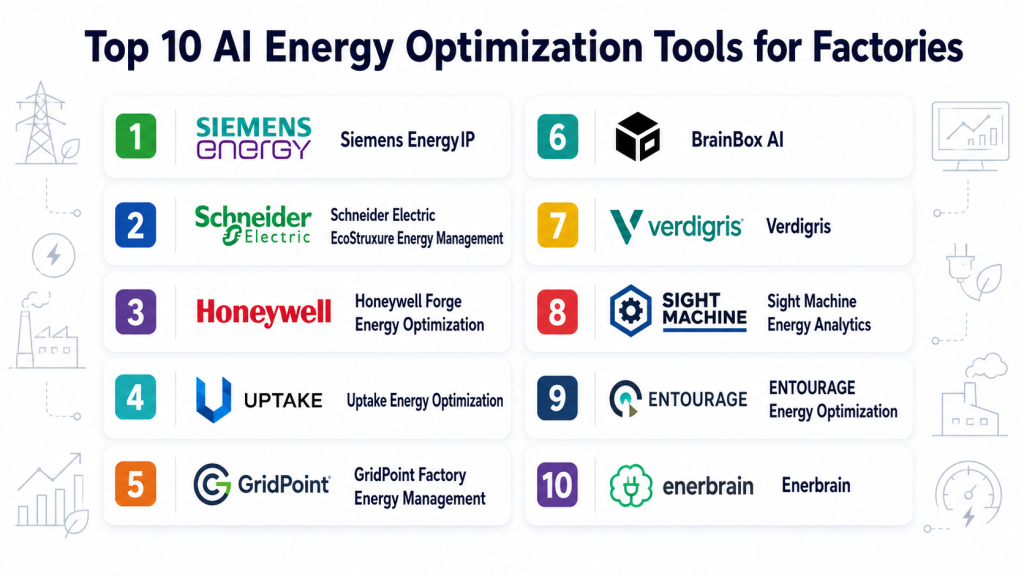
Top 10 AI Energy Optimization Tools for Factories
1- Siemens EnergyIP
One-Line Verdict: Best for manufacturers seeking enterprise-grade energy monitoring and AI-driven optimization across multiple facilities.
Short Description
Siemens EnergyIP collects energy consumption data from machines, lines, and facilities. It uses AI to analyze energy usage, identify inefficiencies, and provide actionable recommendations for savings. It is widely used in large-scale industrial plants with complex energy demands.
Standout Capabilities
- Real-time energy monitoring
- Predictive and prescriptive analytics
- Multi-site energy optimization
- Integration with renewable energy sources
- AI-driven anomaly detection
- Automated reporting and dashboards
- Energy cost and peak demand forecasting
- Plant-level energy benchmarking
AI-Specific Depth
- Model support: Proprietary AI optimization models
- Knowledge integration: IoT sensor and energy meter data
- Evaluation: Energy consumption trends and predictive savings potential
- Guardrails: User approvals for automated recommendations
- Observability: Dashboards, alerts, and KPI visualization
Pros
- Enterprise scalability across multiple facilities
- Strong analytics and predictive insights
- Integrates with existing plant and energy systems
Cons
- Requires significant configuration and integration effort
- Best suited for large-scale operations
- Implementation complexity for small plants
Security and Compliance
Enterprise-grade security features include RBAC, encryption, and audit logging. Compliance with data governance and energy reporting standards is supported.
Deployment and Platforms
- Cloud and on-premises
- Web-based dashboards
- Integration with Siemens and third-party systems
Integrations and Ecosystem
- MES and ERP systems
- IoT devices and smart meters
- Renewable energy sources
- Maintenance and operational systems
- Reporting and analytics tools
Pricing Model
Enterprise subscription licensing. Exact pricing not publicly stated.
Best-Fit Scenarios
- Large manufacturing facilities with complex energy usage
- Multi-site energy optimization and benchmarking
- Integrating renewable energy sources with productio
2- Schneider Electric EcoStruxure Energy Management
One-Line Verdict: Best for factories seeking integrated energy monitoring, AI insights, and predictive recommendations for cost and sustainability.
Short Description
EcoStruxure Energy Management collects energy consumption data from industrial equipment and facility systems. It uses AI to identify inefficiencies, predict peak energy usage, and suggest actionable measures to reduce energy costs while maintaining operational performance. Ideal for mid-to-large factories aiming for sustainability and cost reduction goals.
Standout Capabilities
- Real-time energy monitoring and visualization
- AI-driven predictive recommendations
- Multi-plant energy management
- Peak demand optimization
- Integration with smart building and factory systems
- Energy efficiency benchmarking
- Automated reporting and alerts
- Sustainability KPI tracking
AI-Specific Depth
- Model support: Proprietary AI algorithms for optimization and anomaly detection
- Knowledge integration: IoT and smart meter data
- Evaluation: Historical trend analysis and predictive simulations
- Guardrails: User-defined energy saving thresholds
- Observability: Dashboards, alerts, and KPIs
Pros
- Strong enterprise energy management capabilities
- Real-time and predictive insights
- Supports multi-site energy benchmarking
Cons
- Implementation may require significant IT/OT integration
- Advanced AI features may need tuning for local operations
- Best for medium to large-scale operations
Security and Compliance
Enterprise-grade security including RBAC, audit logging, and encryption. Compliance with energy and environmental reporting standards is supported.
Deployment and Platforms
- Cloud and on-premises
- Web-based dashboards
- Integration with Schneider and third-party devices
Integrations and Ecosystem
- PLCs, IoT devices, and smart meters
- MES and ERP systems
- Renewable energy systems
- Facility automation systems
- Reporting and analytics platforms
Pricing Model
Enterprise subscription licensing. Exact pricing not publicly stated.
Best-Fit Scenarios
- Multi-site energy cost reduction
- Peak demand optimization
- Sustainability KPI monitoring
3- Honeywell Forge Energy Optimization
One-Line Verdict: Best for industrial operators needing AI-driven insights and automated energy recommendations for factory systems.
Short Description
Honeywell Forge collects energy data across industrial plants and uses AI to identify efficiency improvement opportunities. It helps operators reduce energy consumption, lower costs, and predict high-energy-demand periods. The platform is suitable for factories with diverse equipment and complex energy needs.
Standout Capabilities
- AI-driven energy efficiency insights
- Real-time energy monitoring
- Predictive demand forecasting
- Automated recommendation engine
- Multi-plant visualization
- Integration with process control systems
- Alerts for abnormal energy consumption
- Historical trend analysis
AI-Specific Depth
- Model support: Predictive and optimization AI models
- Knowledge integration: Process data and energy meters
- Evaluation: Energy reduction simulations and prediction accuracy
- Guardrails: Operator approval for automated recommendations
- Observability: Energy dashboards and KPI visualization
Pros
- Strong predictive insights for energy savings
- Supports multiple plant and machine types
- Integrates with process control systems
Cons
- Implementation complexity for large industrial setups
- Operator training required for maximum adoption
- May require data preparation for predictive models
Security and Compliance
Enterprise-grade security with role-based access, audit logging, and encrypted communications.
Deployment and Platforms
- Cloud and on-premises
- Web dashboards and operator interfaces
- Edge-enabled data collection
Integrations and Ecosystem
- Process control systems
- Energy meters and IoT devices
- MES/ERP systems
- Facility management tools
- Reporting and analytics platforms
Pricing Model
Enterprise subscription. Exact pricing not publicly stated.
Best-Fit Scenarios
- Factories with diverse energy loads
- Predictive energy demand management
- Automated recommendations for operators
4- Uptake Energy Optimization
One-Line Verdict: Best for manufacturers seeking AI analytics to reduce factory energy costs and improve sustainability.
Short Description
Uptake Energy Optimization uses AI to monitor factory energy consumption, detect inefficiencies, and generate actionable recommendations. It supports energy managers and operations teams in identifying high-impact savings opportunities while maintaining production output.
Standout Capabilities
- Real-time energy monitoring
- AI-powered efficiency recommendations
- Predictive energy usage modeling
- Multi-site benchmarking
- Automated reporting
- Alerts for abnormal energy patterns
- Integration with production systems
- Sustainability and cost KPIs
AI-Specific Depth
- Model support: AI optimization and anomaly detection
- Knowledge integration: Energy meters, sensors, and production data
- Evaluation: Historical performance analysis and simulated improvements
- Guardrails: Operator oversight and recommendation approval
- Observability: Energy dashboards, alerts, and KPI visualization
Pros
- Strong AI-driven energy insights
- Multi-site support
- Helps prioritize high-impact energy-saving actions
Cons
- Requires clean and continuous data collection
- Integration with legacy systems may need effort
- Implementation best suited for medium to large plants
Security and Compliance
Supports enterprise-grade security including access control, encryption, and audit trails.
Deployment and Platforms
- Cloud and hybrid deployments
- Web-based dashboards
- Edge-enabled monitoring
Integrations and Ecosystem
- IoT sensors and smart meters
- ERP and MES systems
- Facility and building management systems
- Reporting and analytics platforms
Pricing Model
Enterprise subscription pricing. Exact pricing not publicly stated.
Best-Fit Scenarios
- Multi-facility energy monitoring
- AI-driven efficiency improvements
- Sustainability and cost KPI tracking
5- GridPoint Factory Energy Management
One-Line Verdict: Best for factories needing AI insights for peak load reduction and energy cost optimization.
Short Description
GridPoint Factory Energy Management provides real-time monitoring and AI-powered recommendations to reduce energy consumption, optimize peak loads, and improve operational efficiency. It helps energy managers identify opportunities for cost savings while maintaining production schedules.
Standout Capabilities
- Real-time energy monitoring
- AI-based load optimization
- Predictive analytics for peak energy periods
- Automated alerts and recommendations
- Multi-facility visibility
- Integration with building and factory systems
- Historical trend analysis
- Sustainability KPIs
AI-Specific Depth
- Model support: Proprietary AI and predictive models
- Knowledge integration: Sensor and production data
- Evaluation: Energy usage trends and simulation analysis
- Guardrails: Operator oversight and threshold controls
- Observability: Dashboards, alerts, and KPI reporting
Pros
- Focus on peak demand reduction
- Multi-site energy monitoring
- Supports sustainability and cost KPIs
Cons
- Integration complexity for legacy equipment
- Best suited for medium-to-large factories
- AI recommendations may require operator review
Security and Compliance
Enterprise-grade security including RBAC, encryption, and audit logging.
Deployment and Platforms
- Cloud and hybrid
- Web-based dashboards
- Edge-enabled monitoring
Integrations and Ecosystem
- Building and factory management systems
- IoT sensors and energy meters
- MES/ERP systems
- Reporting and analytics platforms
Pricing Model
Enterprise subscription. Exact pricing not publicly stated.
Best-Fit Scenarios
Predictive energy management
Peak load energy optimization
Multi-facility energy monitoring
6- BrainBox AI
One-Line Verdict: Best for factories seeking autonomous AI-driven HVAC and energy optimization for large facilities.
Short Description
BrainBox AI uses machine learning and real-time data to autonomously optimize energy consumption for factory HVAC, lighting, and building systems. It continuously adjusts systems to reduce energy costs while maintaining operational comfort and efficiency.
Standout Capabilities
- Autonomous AI-driven HVAC optimization
- Real-time energy consumption adjustments
- Predictive energy usage
- Multi-site visibility
- Integration with building management and IoT systems
- Alerts and anomaly detection
- Energy KPI dashboards
- Automated reporting
AI-Specific Depth
- Model support: Proprietary AI models for HVAC and energy optimization
- Knowledge integration: Building sensors and energy meters
- Evaluation: Energy performance and savings validation
- Guardrails: Operator approvals and safety thresholds
- Observability: Dashboards and energy KPIs
Pros
- Autonomous optimization reduces operator intervention
- Strong predictive energy insights
- Supports multi-site monitoring
Cons
- Primarily focused on building systems rather than all factory equipment
- Integration requires smart sensor infrastructure
- Best suited for medium to large facilities
Security and Compliance
Supports enterprise security including role-based access, encryption, and audit logging.
Deployment and Platforms
- Cloud
- Edge-enabled for on-site devices
- Web-based dashboards
Integrations and Ecosystem
- Building management systems
- IoT sensors and energy meters
- ERP and MES systems
- Reporting platforms
Pricing Model
Enterprise subscription. Exact pricing not publicly stated.
Best-Fit Scenarios
- Autonomous HVAC and lighting energy optimization
- Multi-site factories
- Predictive energy cost management
7- Verdigris
One-Line Verdict: Best for factories needing AI analytics for real-time machine energy efficiency monitoring.
Short Description
Verdigris monitors energy consumption per machine and line, providing AI-driven insights to reduce energy waste. It helps operations and maintenance teams detect anomalies, optimize equipment usage, and lower overall energy costs.
Standout Capabilities
- Real-time machine-level energy monitoring
- AI-driven efficiency recommendations
- Predictive anomaly detection
- Alerts for abnormal energy consumption
- Multi-line and multi-facility analytics
- Energy KPI dashboards
- Integration with IoT sensors and MES
- Automated reporting
AI-Specific Depth
- Model support: Proprietary AI models for equipment energy efficiency
- Knowledge integration: Machine and process data
- Evaluation: Real-time anomaly detection and performance validation
- Guardrails: Operator and engineer approval for actions
- Observability: Dashboards and KPIs
Pros
- Machine-level energy visibility
- Detects anomalies automatically
- Supports energy reduction programs
Cons
- Implementation depends on sensor availability
- Best for medium-to-large industrial plants
- Requires operator training to act on insights
Security and Compliance
Enterprise-grade security with role-based access, encryption, and audit logging.
Deployment and Platforms
- Cloud
- Edge-enabled for real-time monitoring
- Web-based dashboards
Integrations and Ecosystem
- IoT devices and energy meters
- MES and ERP systems
- Facility management tools
- Reporting and analytics dashboards
Pricing Model
Enterprise subscription. Exact pricing not publicly stated.
Best-Fit Scenarios
- Real-time machine energy optimization
- Anomaly detection for energy waste
- Multi-line factory monitoring
8- Sight Machine Energy Analytics
One-Line Verdict: Best for factories needing AI energy optimization integrated with production and operational data.
Short Description
Sight Machine combines production data and energy consumption analytics to provide AI-driven recommendations for reducing energy use. It connects OEE, machine utilization, and energy performance to help factories improve both production and energy efficiency simultaneously.
Standout Capabilities
- Energy monitoring integrated with production data
- AI-driven optimization suggestions
- Multi-line and plant-level visibility
- Predictive energy modeling
- Downtime and production efficiency correlation
- Real-time dashboards and KPIs
- Alerts for high energy usage
- Automated reporting
AI-Specific Depth
- Model support: AI predictive and prescriptive models
- Knowledge integration: Production and energy data
- Evaluation: Energy savings simulation and verification
- Guardrails: Operator approvals for energy recommendations
- Observability: Dashboards and KPI tracking
Pros
- Combines production and energy analytics
- AI recommendations for energy savings
- Supports multi-line operations
Cons
- Requires clean production and energy data
- Implementation can be complex for smaller factories
- Advanced analytics require staff training
Security and Compliance
Enterprise-grade security including role-based access, encryption, and audit trails.
Deployment and Platforms
- Cloud and hybrid
- Web-based dashboards
- Integration with shop floor systems
Integrations and Ecosystem
- MES and ERP systems
- IoT and energy sensors
- Production monitoring systems
- Reporting and analytics platforms
Pricing Model
Enterprise subscription. Exact pricing not publicly stated.
Best-Fit Scenarios
- Combined energy and production optimization
- Multi-line factory monitoring
- AI-driven energy reduction programs
9- ENTOURAGE Energy Optimization
One-Line Verdict: Best for industrial plants needing AI to reduce energy peaks and improve facility efficiency.
Short Description
ENTOURAGE monitors energy consumption across machines, lines, and utilities. AI identifies peak load patterns and provides actionable recommendations to reduce energy costs while maintaining production output. Useful for factories with high variability in energy usage.
Standout Capabilities
- Peak demand analysis and optimization
- AI-driven energy recommendations
- Multi-line and multi-plant monitoring
- Real-time dashboards
- Alerts for abnormal energy usage
- Integration with smart meters and IoT
- Energy KPIs and reporting
- Predictive usage simulations
AI-Specific Depth
- Model support: Proprietary AI for load and consumption optimization
- Knowledge integration: Sensor and utility data
- Evaluation: Peak demand reduction and savings validation
- Guardrails: Operator approvals for automated actions
- Observability: Dashboards and alerts
Pros
- Reduces peak energy costs
- AI recommendations for operational efficiency
- Multi-plant monitoring
Cons
- Implementation may require infrastructure updates
- Best suited for medium and large industrial facilities
- AI recommendations require human review
Security and Compliance
Enterprise-grade access control, encryption, and audit logging.
Deployment and Platforms
- Cloud and hybrid
- Web dashboards
- Integration with energy meters and sensors
Integrations and Ecosystem
- Smart meters and IoT sensors
- MES and ERP systems
- Facility management platforms
- Energy reporting dashboards
Pricing Model
Enterprise subscription. Exact pricing not publicly stated.
Best-Fit Scenarios
- Peak load reduction
- Multi-plant energy monitoring
- Predictive energy cost management
10- Enerbrain
One-Line Verdict: Best for factories and facilities integrating AI for HVAC and energy efficiency improvements.
Short Description
Enerbrain provides AI-based optimization for factory HVAC, lighting, and building energy systems. It automatically adjusts setpoints, manages energy flows, and predicts consumption to minimize waste while ensuring operational comfort and performance.
Standout Capabilities
- AI-based HVAC and lighting optimization
- Predictive energy consumption
- Multi-facility monitoring
- Automated recommendations
- Real-time dashboards and alerts
- Energy efficiency KPIs
- Integration with IoT and building management
- Historical performance analysis
AI-Specific Depth
- Model support: Proprietary AI models for HVAC and energy optimization
- Knowledge integration: Building and machine sensor data
- Evaluation: Energy savings and predictive performance validation
- Guardrails: Operator approval thresholds and limits
- Observability: Dashboards, KPIs, and alerts
Pros
- Autonomous energy optimization
- Strong predictive analytics
- Multi-facility visibility
Cons
- Focused mainly on building systems
- Requires smart sensor infrastructure
- Best for medium-to-large plants
Security and Compliance
Enterprise-grade RBAC, encryption, and audit logging.
Deployment and Platforms
- Cloud
- Edge-enabled devices
- Web dashboards
Integrations and Ecosystem
- Building management systems
- IoT sensors and meters
- Facility automation and MES systems
- Reporting and analytics dashboards
Pricing Model
Enterprise subscription. Exact pricing not publicly stated.
Best-Fit Scenarios
- Autonomous building energy optimization
- Multi-site energy monitoring
- Predictive consumption and cost reduction
Comparison Table
| Tool Name | Best For | Deployment | Model Flexibility | Strength | Watch-Out | Public Rating |
|---|---|---|---|---|---|---|
| Siemens EnergyIP | Enterprise multi-site energy optimization | Cloud / On-prem | Proprietary AI models | Enterprise-scale monitoring | Complex implementation | N/A |
| Schneider Electric EcoStruxure | Integrated energy management & sustainability | Cloud / On-prem | Proprietary AI | Multi-plant cost reduction | Integration effort | N/A |
| Honeywell Forge | Industrial AI-driven energy optimization | Cloud / On-prem | Predictive & optimization AI | Automated recommendations | Data prep required | N/A |
| Uptake Energy Optimization | Energy efficiency insights & predictive analytics | Cloud | Proprietary AI | Actionable energy recommendations | Clean data required | N/A |
| GridPoint | Peak demand and facility energy management | Cloud / Hybrid | Proprietary AI | Peak load reduction | Operator oversight needed | N/A |
| BrainBox AI | Autonomous HVAC & building energy optimization | Cloud / Edge | Proprietary AI | Autonomous optimization | Focused on building systems | N/A |
| Verdigris | Machine-level real-time energy analytics | Cloud / Edge | Proprietary AI | Machine-level visibility | Sensor dependency | N/A |
| Sight Machine | Energy optimization integrated with production data | Cloud / Hybrid | Predictive & prescriptive AI | Combined production-energy insights | Data integration complexity | N/A |
| ENTOURAGE | Peak energy load optimization | Cloud / Hybrid | Proprietary AI | Peak load reduction | Infrastructure requirements | N/A |
| Enerbrain | AI-based HVAC & lighting optimization | Cloud / Edge | Proprietary AI | Predictive building energy savings | Sensor infrastructure required | N/A |
Scoring & Evaluation
The scoring is comparative, reflecting practical suitability for energy optimization in industrial factories. Weighted evaluation considers core features, predictive AI capabilities, guardrails, integration potential, usability, performance impact, security, and vendor support.
| Tool | Core | Reliability/Eval | Guardrails | Integrations | Ease | Perf/Cost | Security/Admin | Support | Weighted Total |
| Siemens EnergyIP | 9 | 9 | 8 | 9 | 7 | 8 | 9 | 8 | 8.5 |
| Schneider EcoStruxure | 8 | 8 | 8 | 9 | 8 | 8 | 8 | 8 | 8.2 |
| Honeywell Forge | 8 | 8 | 7 | 8 | 8 | 8 | 8 | 7 | 7.9 |
| Uptake | 8 | 8 | 7 | 8 | 8 | 8 | 7 | 7 | 7.8 |
| GridPoint | 8 | 7 | 7 | 7 | 8 | 8 | 7 | 7 | 7.5 |
| BrainBox AI | 8 | 8 | 8 | 8 | 8 | 8 | 8 | 8 | 8.0 |
| Verdigris | 8 | 7 | 7 | 8 | 8 | 8 | 7 | 7 | 7.6 |
| Sight Machine | 8 | 8 | 7 | 8 | 7 | 8 | 8 | 7 | 7.8 |
| ENTOURAGE | 7 | 7 | 7 | 7 | 8 | 8 | 7 | 7 | 7.4 |
| Enerbrain | 7 | 7 | 7 | 7 | 8 | 8 | 7 | 7 | 7.4 |
Top 3 for Enterprise
- Siemens EnergyIP
- Schneider Electric EcoStruxure
- Honeywell Forge
Top 3 for SMB
- GridPoint
- BrainBox AI
- Verdigris
Top 3 for Developers
- Sight Machine
- Uptake Energy Optimization
- ENTOURAGE
Which AI Energy Optimization Tool Is Right for You
Solo / Freelancer
Solo consultants can use tools like Verdigris or BrainBox AI to demonstrate measurable energy reductions on pilot lines or single facilities. Tools with intuitive dashboards and clear recommendations work best.
SMB
Small and medium manufacturers should prioritize tools that are easy to deploy, operator-friendly, and cost-effective. GridPoint, BrainBox AI, and ENTOURAGE are practical choices for SMBs with focused energy optimization goals.
Mid-Market
Mid-market factories benefit from platforms that combine predictive AI, production integration, and reporting. Honeywell Forge, Uptake, and Sight Machine are strong options for factories with multiple lines and energy-intensive processes.
Enterprise
Large manufacturers with multi-plant operations require enterprise-grade tools like Siemens EnergyIP, Schneider EcoStruxure, or Honeywell Forge for scalability, predictive AI, and integration with complex MES/ERP systems.
Regulated industries
Pharmaceutical, food, and chemical plants should prioritize energy monitoring that aligns with compliance and reporting standards. Multi-layered dashboards, audit trails, and governance are critical.
Budget vs Premium
Budget-conscious factories can start with Verdigris or BrainBox AI to optimize individual lines or HVAC systems. Premium solutions like Siemens EnergyIP and Schneider EcoStruxure are better for multi-plant optimization with advanced predictive capabilities.
Build vs Buy
Custom-built solutions may work for factories with internal data science teams, but most companies benefit from buying proven AI energy platforms with pre-trained models, dashboards, and vendor support. A hybrid approach can combine commercial AI with tailored analytics.
Implementation Playbook (30 / 60 / 90 Days)
30 Days: Pilot energy monitoring on one production line or facility. Collect baseline data, validate sensors, and train operators.
60 Days: Expand AI recommendations, integrate with MES/ERP, implement anomaly detection, and train energy managers.
90 Days: Scale across multiple facilities, standardize dashboards, automate recommendations, connect predictive AI with production schedules, monitor KPIs, and establish continuous improvement routines.
Common Mistakes & How to Avoid Them
- Ignoring baseline energy data before AI deployment
- Poor sensor and IoT infrastructure for accurate data
- Neglecting operator training and adoption
- Not linking energy optimization with production schedules
- Ignoring peak load periods and dynamic energy pricing
- Failing to validate AI recommendations against actual energy savings
- Overcomplicating dashboards and KPIs
- Not connecting renewable energy sources effectively
- Skipping multi-site standardization
- Using AI without governance and approval workflows
- Ignoring security and access controls
- Expecting energy savings without operational changes
- Focusing on cost reduction only without considering process efficiency
- Scaling too quickly before pilot validation
FAQs
1. What is AI Energy Optimization for factories?
AI Energy Optimization uses artificial intelligence, machine learning, and real-time operational data to reduce energy consumption, improve efficiency, and lower costs while maintaining production output.
2. How does AI detect inefficiencies?
AI analyzes real-time energy data from machines, utilities, and production processes, detecting anomalies, excessive consumption, and peak load patterns to recommend corrective actions.
3. Can AI reduce energy costs without affecting production?
Yes. AI provides prescriptive actions and predictive scheduling to minimize energy consumption while keeping production levels and quality consistent.
4. Which factories benefit most?
Factories with high energy usage, complex processes, multiple facilities, or sustainability targets benefit the most. Industries include automotive, chemicals, food production, electronics, and heavy manufacturing.
5. Can AI integrate with renewable energy sources?
Yes. Many platforms optimize the use of solar, wind, or other renewable sources dynamically, aligning production schedules with available renewable energy.
6. What data is needed?
Energy meters, IoT sensor readings, HVAC and building system data, production machine energy consumption, and historical energy usage are typically required.
7. Does AI support predictive maintenance?
Yes. AI can correlate energy usage anomalies with equipment performance to predict maintenance needs, reducing unplanned downtime and improving efficiency.
8. Can small factories use these tools?
Yes. SMBs can use lightweight AI platforms like GridPoint, BrainBox AI, or Verdigris for targeted optimization on specific lines or buildings.
9. How long does implementation take?
A focused pilot can take 30–60 days. Full multi-facility deployment may take 90 days or longer depending on integration, data availability, and scale.
10. How is ROI measured?
ROI is measured by reduced energy bills, lower peak demand charges, improved operational efficiency, and alignment with sustainability goals.
11. Are dashboards required?
Yes. Dashboards provide visibility for operators, energy managers, and executives to act on AI recommendations and monitor savings in real time.
12. How is AI accuracy validated?
Through baseline energy data, comparison with historical consumption, and measurement of implemented recommendations. Regular audits and KPI tracking ensure accuracy.
13. Can AI optimize HVAC and lighting?
Yes. Some tools like BrainBox AI and Enerbrain focus on HVAC and lighting optimization with autonomous adjustments to reduce energy waste.
14. Are these tools secure?
Enterprise platforms include role-based access, encryption, audit trails, and secure integrations with MES/ERP and IoT devices.
15. What is the future of AI Energy Optimization?
The future includes predictive and prescriptive AI, autonomous control, multi-plant benchmarking, integration with renewable energy, and real-time recommendations tied to production efficiency.
Conclusion
AI Energy Optimization for factories enables manufacturers to reduce energy consumption, improve sustainability, and lower operational costs without compromising production. Siemens EnergyIP, Schneider EcoStruxure, Honeywell Forge, Uptake, GridPoint, BrainBox AI, Verdigris, Sight Machine, ENTOURAGE, and Enerbrain provide solutions across various scales and operational requirements.The recommended approach is to start with a pilot on a critical line or building, validate data, integrate AI recommendations with operational workflows, train operators, and scale gradually with standardized dashboards, governance, and continuous improvement routines. This ensures measurable energy savings, predictable production efficiency, and long-term sustainability success

Find Trusted Cardiac Hospitals
Compare heart hospitals by city and services — all in one place.
Explore Hospitals
AI energy optimization works best when factories already have accurate meter data, real-time monitoring, and control-system integration—not just advanced algorithms.