
Introduction
AI Fleet Maintenance Analytics platforms leverage artificial intelligence to monitor vehicle health, predict component failures, optimize maintenance schedules, and improve fleet uptime. By analyzing real‑time telematics, IoT sensor data, historical maintenance logs, and operational patterns, these tools help organizations reduce downtime, extend asset life, lower repair costs, and improve overall fleet efficiency — all while enabling proactive decision‑making.
Real‑world use cases include:
- Predicting engine or component failures before they occur.
- Scheduling preventive maintenance based on usage and health signals.
- Monitoring vehicle health across large fleets in real time.
- Optimizing spare parts inventory and reducing overstock/stockouts.
- Improving fuel consumption by ensuring timely servicing.
- Enhancing safety compliance through anomaly detection.
What buyers should evaluate:
- Predictive accuracy and model reliability.
- Integration with telematics systems, ERP/WMS, and IoT platforms.
- Real‑time monitoring, alerting, and anomaly detection.
- Maintenance scheduling and automated work order generation.
- Analytics dashboards and hierarchical reporting.
- Scalability across fleet sizes and asset types.
- Deployment flexibility: cloud, hybrid, or on‑premises.
- Data security, access control, and governance.
- Ease of use for maintenance planners and operations leads.
- ROI analysis for cost, downtime, and resource planning.
Best for: Fleet managers, logistics operators, utility and transit agencies, and enterprises with medium to large fleets.
Not ideal for: Very small fleets where manual maintenance scheduling is sufficient.
What’s Changed in AI Fleet Maintenance Analytics in 2026+
- Predictive confidence scoring: Models now output confidence levels for failure predictions.
- IoT and telematics fusion: Seamless ingestion of sensor, GPS, and engine data.
- Anomaly detection: Detect subtle deviations that precede failures.
- Automated work orders: AI generates maintenance tasks dynamically.
- Edge compute: On‑device inference for low‑latency alerts.
- Guardrails & safety: Thresholds ensure only relevant alerts surface.
- Scenario simulation: Predict impacts of changes in usage or operating conditions.
- Observability dashboards: Visualize uptime, downtime, and maintenance ROI.
- Sustainability insights: Predict benefits on fuel and emissions tied to maintenance.
- Role‑based access & audit logs: Stronger governance for compliance.
- Multi‑asset support: Trucks, trailers, heavy equipment, and mixed fleets.
- Cost & parts forecasting: AI forecasts parts needs to optimize inventory.
Quick Buyer Checklist
- ✅ Predictive accuracy and confidence scoring
- ✅ Real‑time anomaly detection and monitoring
- ✅ Integration with telematics, IoT, ERP, and fleet management systems
- ✅ Automated scheduling & work order generation
- ✅ Support for mixed fleet types
- ✅ Observability dashboards and KPI reporting
- ✅ Deployment flexibility (cloud/hybrid/on‑prem)
- ✅ Data privacy, encryption, and RBAC
- ✅ Cost optimization and maintenance ROI insights
- ✅ Compliance and safety guardrails
- ✅ Easy UI for maintenance planners
- ✅ Historical trend analysis and forecasting
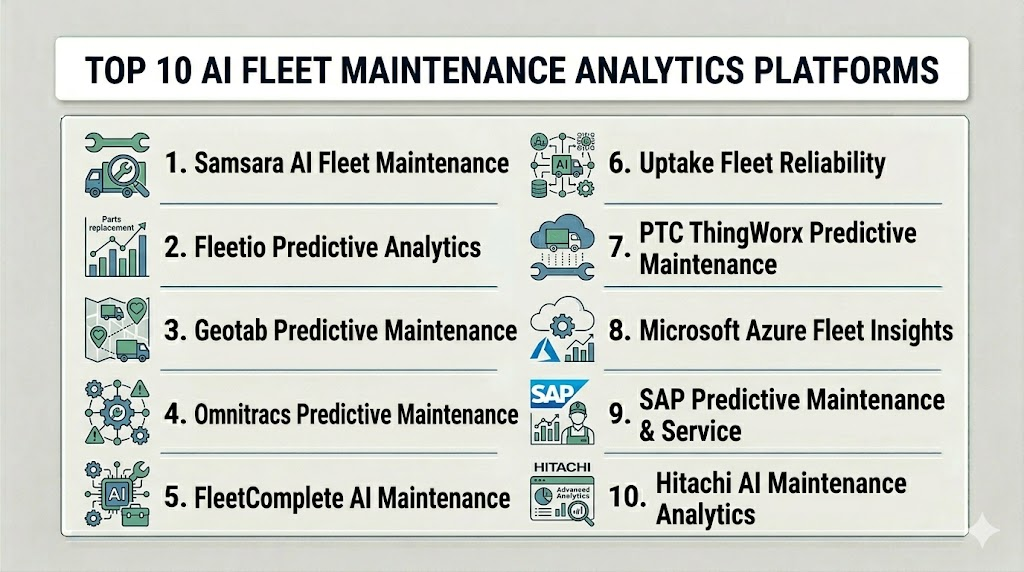
Top 10 AI Fleet Maintenance Analytics Platforms
1 — Samsara AI Fleet Maintenance
One‑line verdict: Real‑time telematics‑driven predictive maintenance and ROI analytics for enterprise fleets.
Short description: Samsara uses telematics data and AI models to predict vehicle and asset health issues, automate maintenance workflows, and drive fleet uptime.
Standout Capabilities
- Predictive failure detection
- Automated maintenance scheduling
- Real‑time telematics visualization
- KPI dashboards for uptime/downtime
- Integration with ERP and fleet systems
- Fuel & emissions analytics
AI‑Specific Depth
- Model support: Proprietary AI
- RAG / knowledge integration: Telematics, ERP
- Evaluation: Historical + real‑time anomaly validation
- Guardrails: Safety & operational thresholds
- Observability: Maintenance & uptime KPIs
Pros
- Strong real‑time analytics
- Enterprise scalability
- Integrates broadly with telematics
Cons
- Premium pricing
- Learning curve for advanced features
- Limited edge compute options
Security & Compliance
- SSO/SAML, encryption, RBAC
- Audit logs & retention controls
- Certifications: Not publicly stated
Deployment & Platforms
- Cloud, Web, iOS/Android
Integrations & Ecosystem
Telematics APIs, ERP/FM systems, analytics dashboards
Pricing Model
Subscription‑based; Not publicly stated
Best‑Fit Scenarios
Large enterprise fleets, mission critical uptime, mixed vehicle types
2 — Fleetio Predictive Analytics
One‑line verdict: User‑friendly AI maintenance solution with automation and predictive alerts.
Short description: Fleetio analyzes vehicle data to forecast failures, automate preventive maintenance, and improve operational readiness.
Standout Capabilities
- Predictive alerts for part failures
- Automated work order generation
- KPI maintenance dashboards
- Multi‑fleet support
- Integration with GPS & IoT
AI‑Specific Depth
- Model support: Proprietary AI
- RAG / knowledge integration: IoT, ERP
- Evaluation: Back‑testing against historical records
- Guardrails: Safety & compliance checks
- Observability: Alert & maintenance dashboards
Pros
- Easy to implement
- Good automation features
- Strong alerting
Cons
- Fewer deep analytics for enterprise fleets
- Premium cost for advanced modules
- Less extensive edge support
Security & Compliance
SSO, encryption, role‑based access
Deployment & Platforms
Cloud, Web, iOS
Integrations & Ecosystem
GPS, telematics, fleet software APIs
Pricing Model
Subscription; Not publicly stated
Best‑Fit Scenarios
Mid‑size fleets, proactive maintenance pilots
3 — Geotab Predictive Maintenance
One‑line verdict: Scalable AI platform for predictive fleet health monitoring and anomaly detection.
Short description: Geotab ingests telematics and sensor data, applies AI models to detect anomalies, and predicts maintenance needs across fleet assets.
Standout Capabilities
- Anomaly detection + failure forecasting
- Multi‑asset vehicle support
- KPI dashboards
- Maintenance prioritization
- Real‑time telematics ingest
AI‑Specific Depth
- Model support: Proprietary AI
- RAG / knowledge integration: Telematics, ERP
- Evaluation: Real‑time & historical model calibration
- Guardrails: Safety thresholding
- Observability: Predictive alerts & visuals
Pros
- Excellent telematics integration
- Rich anomaly detection
- Scales with large fleets
Cons
- Setup complexity
- Training needed for deeper insights
- Premium for heavy analytics
Security & Compliance
Encryption, SSO, RBAC
Deployment & Platforms
Cloud, Web, Mobile
Integrations & Ecosystem
Telematics, ERP, GPS, analytics tools
Pricing Model
Subscription; Not publicly stated
Best‑Fit Scenarios
Commercial fleets, mixed asset types
4 — Omnitracs Predictive Maintenance
One‑line verdict: AI maintenance analytics for large logistics fleets with strong downtime reduction focus.
Short description: Omnitracs leverages machine learning on telematics streams to forecast issues and automate preventive care for vehicles.
Standout Capabilities
- Failure prediction algorithms
- Work order scheduling
- Fleet health KPIs
- Integration with maintenance systems
AI‑Specific Depth
- Model support: Proprietary AI
- RAG / knowledge integration: Telematics, ERP
- Evaluation: Historical validation + real‑time
- Guardrails: Safety & compliance
- Observability: Uptime & issue forecasting
Pros
- Predictive accuracy
- Enterprise readiness
- Uptime optimization
Cons
- Premium pricing
- Integration effort
- Advanced dashboards require training
Security & Compliance
SSO/SAML, audit logs, encryption
Deployment & Platforms
Cloud, Web, Mobile
Integrations & Ecosystem
ERP, GPS, telematics, fleet tools
Pricing Model
Subscription; Not publicly stated
Best‑Fit Scenarios
Large comm fleets, scheduled maintenance optimization
5 — FleetComplete AI Maintenance
One‑line verdict: Predictive maintenance and vehicle health analytics with easy implementation.
Short description: FleetComplete analyzes sensory and operational fleet data to provide predictive alerts and scheduling insights.
Standout Capabilities
- Vehicle health monitoring
- Predictive alerts
- Work order automation
- KPI reporting dashboards
AI‑Specific Depth
- Model support: Proprietary AI
- RAG / knowledge integration: Telematics, ERP
- Evaluation: Back‑testing & real‑time
- Guardrails: Safety & thresholds
- Observability: Maintenance KPIs
Pros
- Easy deployment
- Strong health monitoring
- Multi‑fleet support
Cons
- Less deep analytics for very large fleets
- Premium pricing
- Needs integration setup
Security & Compliance
RBAC, encryption, audit logs
Deployment & Platforms
Cloud, Web, Mobile
Integrations & Ecosystem
Telematics, GPS, ERP APIs
Pricing Model
Subscription; Not publicly stated
Best‑Fit Scenarios
Mid‑size fleets, proactive maintenance
6 — Uptake Fleet Reliability
One‑line verdict: AI reliability platform combining predictive analytics with deep diagnostic insights.
Short description: Uptake analyzes equipment telematics, maintenance logs, and operational loads to forecast failures and recommend maintenance actions.
Standout Capabilities
- Predictive models with confidence scores
- Diagnostic insights for component health
- Failure risk dashboards
- Integration with maintenance systems
AI‑Specific Depth
- Model support: Proprietary AI
- RAG / knowledge integration: IoT, telematics, ERP
- Evaluation: Historical + real‑time validation
- Guardrails: Failure risk thresholds
- Observability: Failure likelihood KPIs
Pros
- Deep diagnostic capability
- Confidence scoring
- Good anomaly detection
Cons
- Premium placement
- Integration complexity
- Training required
Security & Compliance
Encryption, RBAC, audit logs
Deployment & Platforms
Cloud, Hybrid
Integrations & Ecosystem
ERP, IoT sensors, fleet systems
Pricing Model
Subscription; Not publicly stated
Best‑Fit Scenarios
Asset‑intensive fleets, diagnostic needs
7 — PTC ThingWorx Predictive Maintenance
One‑line verdict: Industrial AI platform with extensible analytics for fleets and heavy equipment.
Short description: ThingWorx uses AI and IoT data to provide predictive maintenance insights across mixed fleets and machinery.
Standout Capabilities
- IoT‑driven maintenance analytics
- Predictive models for equipment
- Cross‑vehicle dashboards
- Anomaly and trend detection
AI‑Specific Depth
- Model support: Proprietary & extensible ML
- RAG / knowledge integration: IoT, telematics, ERP
- Evaluation: Simulation & historical validation
- Guardrails: Safety thresholds
- Observability: Trend analytics
Pros
- Deep IoT integration
- Broad platform extensibility
- Good anomaly detection
Cons
- Extensibility requires expertise
- Premium cost
- Larger implementation scope
Security & Compliance
SSO, encryption, RBAC
Deployment & Platforms
Cloud, On‑prem, Hybrid
Integrations & Ecosystem
IoT, fleet systems, ERP
Pricing Model
Subscription; Not publicly stated
Best‑Fit Scenarios
Heavy equipment fleets, mixed assets
8 — Microsoft Azure Fleet Insights
One‑line verdict: Enterprise AI solution for maintenance analytics with cloud scale and extensibility.
Short description: Azure Fleet Insights uses AI services, digital twins, and predictive models to optimize fleet maintenance and asset health.
Standout Capabilities
- Cloud‑scale predictive analytics
- Digital twin integration
- Customizable workflows
- KPI dashboards
AI‑Specific Depth
- Model support: Azure AI + custom models
- RAG / knowledge integration: IoT Hub, ERP
- Evaluation: Continuous learning & testing
- Guardrails: Policy checks
- Observability: Telemetry dashboards
Pros
- Highly extensible
- Enterprise scale
- Azure ecosystem integration
Cons
- Requires expertise
- Setup complexity
- Premium for enterprise
Security & Compliance
Enterprise security, RBAC, encryption
Deployment & Platforms
Cloud, Hybrid
Integrations & Ecosystem
Azure IoT, ERP, fleet systems
Pricing Model
Usage‑based; Not publicly stated
Best‑Fit Scenarios
Global enterprise fleets, custom AI
9 — SAP Predictive Maintenance & Service
One‑line verdict: Integrated AI maintenance for SAP environments with deep analytics and scheduling.
Short description: SAP’s suite uses machine learning to predict failures, automate maintenance tasks, and integrate with ERP and asset management.
Standout Capabilities
- Predictive failure detection
- Maintenance scheduling
- ERP integration
- KPI reporting
AI‑Specific Depth
- Model support: SAP AI
- RAG / knowledge integration: SAP ERP/WMS
- Evaluation: Historical + simulation
- Guardrails: Safety & compliance
- Observability: Maintenance insights
Pros
- Seamless SAP integration
- Enterprise reporting
- Mature analytics
Cons
- Limited outside SAP environments
- Premium cost
- Requires SAP expertise
Security & Compliance
Enterprise RBAC, encryption
Deployment & Platforms
Cloud, Hybrid
Integrations & Ecosystem
SAP ERP/WMS, analytics
Pricing Model
Subscription; Not publicly stated
Best‑Fit Scenarios
SAP fleet operations, large enterprises
10 — Hitachi AI Maintenance Analytics
One‑line verdict: Predictive maintenance for industrial and fleet assets with deep operational analytics.
Short description: Hitachi applies AI to sensor and operational data to forecast failures and prescribe maintenance actions.
Standout Capabilities
- Predictive failure algorithms
- Sensor and telematics ingest
- Maintenance recommendations
- KPI dashboards
AI‑Specific Depth
- Model support: Proprietary AI
- RAG / knowledge integration: IoT, ERP
- Evaluation: Back‑testing & real‑time
- Guardrails: Operational thresholds
- Observability: Uptime & predictive metrics
Pros
- Strong analytics depth
- Industrial & fleet use
- All‑mode data ingest
Cons
- Setup complexity
- Premium pricing
- Training needed
Security & Compliance
Encryption, RBAC, audit logs
Deployment & Platforms
Cloud, Web
Integrations & Ecosystem
IoT, ERP, fleet systems
Pricing Model
Subscription; Not publicly stated
Best‑Fit Scenarios
Industrial fleets, heavy equipment
Comparison Table
| Tool Name | Best For | Deployment | Model Flexibility | Strength | Watch‑Out | Public Rating |
|---|---|---|---|---|---|---|
| Samsara AI Fleet | Enterprise fleets | Cloud | Proprietary | Real‑time prediction | Premium cost | N/A |
| Fleetio | Mid‑size fleets | Cloud | Proprietary | Easy automation | Limited deep analytics | N/A |
| Geotab | Multi‑asset fleets | Cloud/Mobile | Proprietary | Telematics integration | Implementation effort | N/A |
| Omnitracs | Logistics fleets | Cloud | Proprietary | Predictive accuracy | Premium pricing | N/A |
| FleetComplete | Multi‑fleet support | Cloud | Proprietary | Health monitoring | Moderate analytics depth | N/A |
| Uptake Fleet | Asset‑intensive fleets | Cloud/Hybrid | Proprietary | Diagnostic insights | Complex setup | N/A |
| PTC ThingWorx | Heavy equipment | Cloud/On‑prem | Extensible AI | IoT integration | Requires expertise | N/A |
| Azure Fleet Insights | Global enterprise | Cloud/Hybrid | Azure AI | Cloud scale | Requires advanced skills | N/A |
| SAP Predictive Maintenance | SAP stacks | Cloud/Hybrid | SAP AI | ERP integration | SAP only | N/A |
| Hitachi AI Analytics | Industrial fleets | Cloud | Proprietary | Deep analytics | Setup complexity | N/A |
Scoring & Evaluation
Scoring is comparative; Weighted scales use: Core 20%, Reliability/Eval 15%, Guardrails 10%, Integrations 15%, Ease 10%, Performance/Cost 15%, Security/Admin 10%, Support 5%.
| Tool | Core | Reliability/Eval | Guardrails | Integrations | Ease | Perf/Cost | Security/Admin | Support | Weighted Total |
|---|---|---|---|---|---|---|---|---|---|
| Samsara AI | 9 | 9 | 8 | 9 | 7 | 8 | 8 | 7 | 8.4 |
| Fleetio | 8 | 8 | 8 | 8 | 9 | 7 | 7 | 7 | 7.9 |
| Geotab | 9 | 9 | 8 | 9 | 7 | 8 | 8 | 7 | 8.4 |
| Omnitracs | 9 | 9 | 8 | 8 | 7 | 8 | 8 | 7 | 8.3 |
| FleetComplete | 8 | 8 | 8 | 8 | 8 | 7 | 7 | 7 | 7.9 |
| Uptake | 8 | 8 | 7 | 8 | 7 | 7 | 7 | 7 | 7.5 |
| PTC ThingWorx | 8 | 8 | 8 | 8 | 7 | 7 | 7 | 7 | 7.7 |
| Azure Fleet Insights | 9 | 9 | 8 | 9 | 7 | 8 | 9 | 7 | 8.5 |
| SAP Predictive | 8 | 8 | 8 | 9 | 7 | 8 | 8 | 7 | 8.0 |
| Hitachi AI Analytics | 8 | 8 | 8 | 8 | 7 | 8 | 8 | 7 | 7.9 |
Top 3 for Enterprise: Azure Fleet Insights, Samsara AI, Geotab
Top 3 for Mid‑Market: Fleetio, FleetComplete, Hitachi Analytics
Top 3 for Industrial Assets: Azure Fleet Insights, PTC ThingWorx, Hitachi AI Analytics
Which AI Fleet Maintenance Analytics Tool Is Right for You?
Solo / Small Fleet
- Fleetio or FleetComplete for ease of setup and straightforward predictive alerts.
Mid‑Market
- Fleetio, FleetComplete, or Hitachi AI Analytics for balanced analytics and automation.
Enterprise
- Azure Fleet Insights, Samsara AI, or Geotab for scalability and deep integrations.
SAP or Azure Environments
- SAP Predictive Maintenance & Service for SAP stacks
- Azure Fleet Insights for cloud scale and extensibility
Heavy Equipment or Mixed Assets
- PTC ThingWorx or Hitachi AI Analytics for sensor‑driven insights
Budget vs Premium
- Budget‑friendly: Fleetio, FleetComplete
- Premium/Enterprise: Samsara, Azure Insights, Geotab
Implementation Playbook (30 / 60 / 90 Days)
30 Days
- Plug in telematics data and historical maintenance records.
- Validate data quality and set baseline KPIs.
- Configure alert thresholds and safety guardrails.
- Set up dashboards for real‑time visibility.
60 Days
- Begin automated work order generation.
- Expand to multi‑fleet schedules.
- Run simulation scenarios for predictive accuracy.
- Integrate with ERP/fleet systems for lifecycle tracking.
90 Days
- Optimize maintenance intervals based on prediction outcomes.
- Enable edge analytics for low latency.
- Review cost and ROI impacts.
- Train planners and establish governance workflows.
Common Mistakes & How to Avoid Them
- Ignoring historical maintenance data quality.
- Failing to calibrate alert thresholds, leading to noise.
- Overlooking edge compute for real‑time needs.
- Integrating only telematics and ignoring ERP/parts data.
- Skipping scenario simulations for unplanned peaks.
- Underutilizing dashboards for decision‑making.
- Ignoring compliance and audit requirements.
- Not aligning alerting with maintenance workflows.
- Failing to measure maintenance ROI consistently.
- Deploying too quickly without phased pilots.
- Ignoring multi‑asset complexity.
- Not engaging cross‑functional stakeholders early.
FAQs
1‑ What data sources do these platforms use?
They typically ingest telematics, IoT sensor data, GPS, historical maintenance records, ERP data, and fleet management systems.
2‑ How is predictive accuracy measured?
Accuracy is measured by comparing predicted failures vs actual events and tuning ML models over time.
3‑ Can these tools generate work orders automatically?
Yes — many platforms support automated preventive maintenance work orders.
4‑ Are cloud deployments standard?
Most are cloud or hybrid; a few support on‑premises for edge analytics.
5‑ Do these platforms handle mixed fleets?
Yes — sensors and models support different vehicle types, equipment, and assets.
6‑ Are real‑time alerts customizable?
Yes — alert thresholds and notification rules are highly configurable.
7‑ Can they forecast spare parts needs?
Yes — several platforms offer parts forecasting and inventory optimization.
8‑ How do they improve ROI?
By reducing unplanned downtime, optimizing maintenance intervals, and cutting labor/parts costs.
9‑ Do these tools integrate with ERP/ERP systems?
Yes — integrations with ERP, fleet management, and telematics systems are common.
10‑ How do guardrails improve operations?
They ensure alerts are meaningful, reduce noise, and enforce safety thresholds.
11‑ Can they support edge compute?
Some platforms support on‑device inference for low latency alerts.
12‑ How often should models be retrained?
Best practice is periodic retraining based on seasonal or fleet behavior changes.
Conclusion
AI Fleet Maintenance Analytics platforms are transforming how fleets are managed — shifting from reactive to predictive, optimizing uptime, reducing costs, and improving safety. Selection depends on fleet size, assets, data infrastructure, and integration needs. For smaller fleets, lightweight platforms like Fleetio or FleetComplete offer faster value. For global enterprises, scalable solutions like Azure Fleet Insights, Samsara AI, or Geotab provide deep predictive analytics and integration capabilities.

Find Trusted Cardiac Hospitals
Compare heart hospitals by city and services — all in one place.
Explore Hospitals
AI fleet maintenance analytics work best when vehicle telemetry is accurate and maintenance teams consistently act on predictive insights before breakdowns occur.