
Introduction
AI Language Learning Conversation Bots are AI-powered platforms that help users practice speaking, listening, reading, and writing in a foreign language through interactive conversations. Unlike traditional language-learning apps that rely heavily on memorization and static exercises, these tools simulate realistic discussions, provide instant feedback, adapt to learner proficiency, and often support voice-based interactions. Advances in large language models, speech recognition, multimodal AI, and conversational agents have transformed language learning into a highly personalized experience.
These platforms matter more than ever because learners increasingly need practical communication skills rather than theoretical knowledge. Businesses, educators, students, travelers, and professionals are using AI conversation bots to accelerate language acquisition, improve pronunciation, prepare for exams, and practice workplace communication.
Real-world use cases include:
- Daily conversational practice
- Business language training
- Exam preparation
- Travel communication training
- Employee language development
- Cross-cultural communication coaching
Evaluation criteria for buyers include:
- Conversation realism
- Voice recognition quality
- Pronunciation feedback
- Multilingual support
- Personalization capabilities
- AI response quality
- Mobile accessibility
- Progress tracking
- Privacy controls
- Cost effectiveness
Best for: Students, professionals, language schools, multinational organizations, travelers, expatriates, and lifelong learners seeking practical conversation practice.
Not ideal for: Users requiring formal accredited language instruction, highly specialized linguistic research, or fully offline learning environments.
What’s Changed in AI Language Learning Conversation Bots in 2026+
- AI tutors now maintain long-term learning memory across sessions.
- Multimodal learning combines text, voice, images, and contextual scenarios.
- Real-time pronunciation scoring has become significantly more accurate.
- Agentic tutoring workflows create personalized lesson plans automatically.
- Adaptive difficulty adjusts conversation complexity dynamically.
- AI role-playing scenarios simulate workplaces, interviews, and travel situations.
- Better speech recognition supports diverse accents.
- Enterprise language training programs increasingly use AI tutors.
- Enhanced privacy controls offer more transparency over learning data.
- AI evaluation systems continuously measure learner progress.
- Cross-device synchronization enables seamless learning experiences.
- More tools integrate with external educational ecosystems.
Quick Buyer Checklist
Before selecting a platform, verify:
- Supports your target language
- Provides realistic conversation simulations
- Includes voice-based interactions
- Offers pronunciation feedback
- Tracks learning progress
- Provides personalized lesson recommendations
- Supports mobile devices
- Includes privacy and retention controls
- Allows learner customization
- Provides reporting for educators or enterprises
- Offers affordable scaling options
- Minimizes vendor lock-in risks
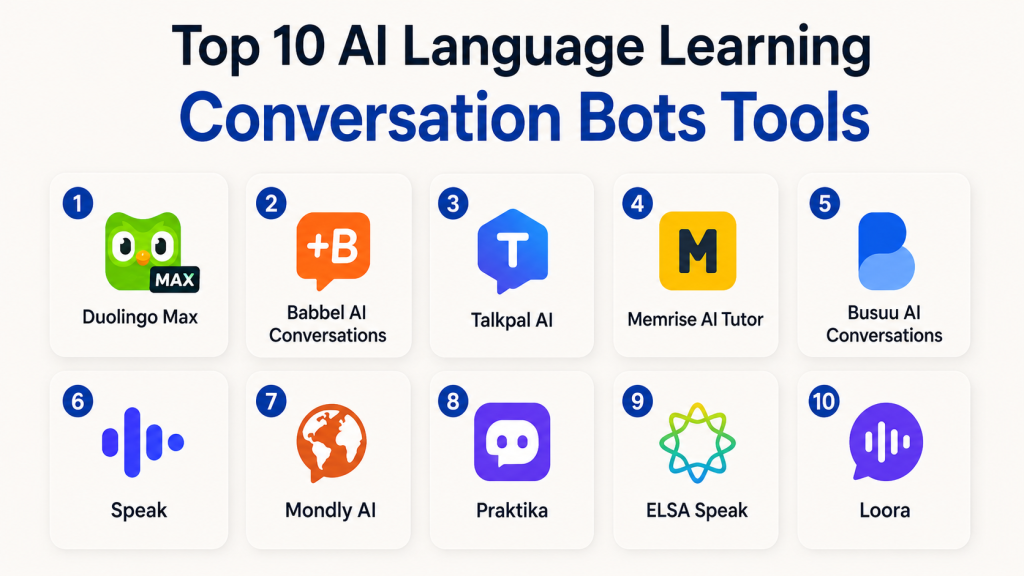
Top 10 AI Language Learning Conversation Bots Tools
1- Duolingo Max
One-line verdict: Best for mainstream learners seeking AI-powered language practice at scale.
Short description:
Duolingo Max expands traditional Duolingo learning with advanced AI conversations, roleplay exercises, and contextual explanations. It is designed for users who want guided language learning combined with conversational practice.
Standout Capabilities
- AI roleplay conversations
- Context-aware explanations
- Interactive dialogue practice
- Adaptive learning paths
- Mobile-first experience
- Gamified engagement
- Large language support
- Personalized exercises
AI-Specific Depth
- Model support: Proprietary
- RAG / knowledge integration: N/A
- Evaluation: Learning progress assessment
- Guardrails: Educational safety controls
- Observability: Limited learner analytics
Pros
- Easy to use
- Strong engagement mechanisms
- Large language catalog
Cons
- Less suitable for advanced learners
- Limited customization
- Primarily consumer-focused
Security & Compliance
Data controls and account management available. Additional enterprise compliance details are not publicly stated.
Deployment & Platforms
- Web
- iOS
- Android
- Cloud
Integrations & Ecosystem
Focused primarily on its own learning ecosystem.
- Mobile ecosystem
- Learning analytics
- Account synchronization
- Progress tracking
Pricing Model
Tiered subscription model.
Best-Fit Scenarios
- Daily language practice
- Beginners and intermediates
- Casual learners
2- Babbel AI Conversations
One-line verdict: Best for structured learners seeking practical conversations and grammar guidance.
Short description:
Babbel combines curriculum-driven language education with conversational AI features designed to reinforce practical communication skills.
Standout Capabilities
- Structured lessons
- Practical dialogues
- Speech recognition
- Grammar reinforcement
- Scenario-based learning
- Personalized recommendations
AI-Specific Depth
- Model support: Proprietary
- RAG / knowledge integration: N/A
- Evaluation: Progress assessments
- Guardrails: Educational moderation
- Observability: Learning metrics
Pros
- Strong educational foundation
- Professional content design
- Practical conversations
Cons
- Less open-ended interaction
- Subscription required
- Limited advanced customization
Security & Compliance
Standard account protections. Additional certifications not publicly stated.
Deployment & Platforms
- Web
- iOS
- Android
- Cloud
Integrations & Ecosystem
- Mobile applications
- Learning dashboards
- Progress tracking
- Account synchronization
Pricing Model
Subscription-based.
Best-Fit Scenarios
- Structured learners
- Corporate language training
- Exam preparation
3- Talkpal AI
One-line verdict: Best for learners wanting highly conversational AI interactions.
Short description:
Talkpal focuses on immersive AI conversations that mimic interactions with native speakers and adapts to user proficiency.
Standout Capabilities
- Voice conversations
- AI roleplay
- Pronunciation coaching
- Scenario simulation
- Adaptive responses
- Multi-language support
AI-Specific Depth
- Model support: Proprietary AI stack
- RAG / knowledge integration: N/A
- Evaluation: Progress analysis
- Guardrails: Conversation moderation
- Observability: Learner tracking
Pros
- Natural conversations
- Strong speaking practice
- Flexible learning modes
Cons
- Premium features gated
- Smaller ecosystem
- Limited enterprise focus
Security & Compliance
Not publicly stated.
Deployment & Platforms
- Web
- iOS
- Android
Integrations & Ecosystem
- Mobile learning
- Progress reporting
- Voice processing
- User profiles
Pricing Model
Freemium with paid tiers.
Best-Fit Scenarios
- Speaking practice
- Travel preparation
- Daily conversations
4- Memrise AI Tutor
One-line verdict: Best for learners combining vocabulary mastery with conversational practice.
Short description:
Memrise incorporates AI tutoring into its language learning ecosystem, helping learners build vocabulary and conversational confidence simultaneously.
Standout Capabilities
- Vocabulary reinforcement
- AI conversations
- Native speaker content
- Pronunciation practice
- Adaptive learning
AI-Specific Depth
- Model support: Proprietary
- RAG / knowledge integration: N/A
- Evaluation: Learning assessments
- Guardrails: Educational moderation
- Observability: Learning dashboards
Pros
- Strong vocabulary training
- Engaging content
- Easy onboarding
Cons
- Limited advanced conversations
- Less enterprise support
- Feature depth varies
Security & Compliance
Not publicly stated.
Deployment & Platforms
- Web
- iOS
- Android
Integrations & Ecosystem
- Learning content library
- Mobile ecosystem
- Progress tracking
- User analytics
Pricing Model
Subscription-based.
Best-Fit Scenarios
- Vocabulary building
- Beginner learners
- Mobile-first learning
5- Busuu AI Conversations
One-line verdict: Best for learners seeking community-supported language learning.
Short description:
Busuu combines AI-assisted conversation practice with peer learning and structured educational content.
Standout Capabilities
- AI conversation practice
- Community corrections
- Structured curriculum
- Pronunciation support
- Learning plans
AI-Specific Depth
- Model support: Proprietary
- RAG / knowledge integration: N/A
- Evaluation: Progress tracking
- Guardrails: Educational controls
- Observability: User analytics
Pros
- Community engagement
- Structured approach
- Multiple languages
Cons
- Less conversational freedom
- Premium features restricted
- Advanced learners may outgrow it
Security & Compliance
Not publicly stated.
Deployment & Platforms
- Web
- iOS
- Android
Integrations & Ecosystem
- Community platform
- Mobile apps
- Progress dashboards
- Learning management features
Pricing Model
Freemium and premium subscriptions.
Best-Fit Scenarios
- Collaborative learning
- Language certification preparation
- Beginners and intermediates
6- Speak
One-line verdict: Best for intensive speaking and pronunciation improvement.
Short description:
Speak is built around verbal interaction, emphasizing speaking confidence and real-time feedback.
Standout Capabilities
- Voice-first learning
- Pronunciation analysis
- AI conversation practice
- Personalized coaching
- Real-time corrections
AI-Specific Depth
- Model support: Proprietary
- RAG / knowledge integration: N/A
- Evaluation: Pronunciation scoring
- Guardrails: Educational moderation
- Observability: Learning insights
Pros
- Excellent speaking focus
- Fast feedback
- Strong mobile experience
Cons
- Less reading emphasis
- Subscription costs
- Limited enterprise tooling
Security & Compliance
Not publicly stated.
Deployment & Platforms
- iOS
- Android
- Cloud
Integrations & Ecosystem
- Voice AI
- Mobile applications
- User analytics
- Progress monitoring
Pricing Model
Subscription-based.
Best-Fit Scenarios
- Pronunciation improvement
- Speaking confidence
- Daily language practice
7- Mondly AI
One-line verdict: Best for immersive language experiences using voice technologies.
Short description:
Mondly delivers AI-powered language lessons with conversational simulations and voice-based interactions.
Standout Capabilities
- Speech recognition
- Virtual conversations
- Multilingual support
- Scenario-based learning
- Interactive lessons
AI-Specific Depth
- Model support: Proprietary
- RAG / knowledge integration: N/A
- Evaluation: Learning analytics
- Guardrails: Educational controls
- Observability: User progress metrics
Pros
- Wide language coverage
- Interactive learning
- Strong mobile support
Cons
- Less open-ended dialogue
- Advanced learners may require more depth
- Enterprise capabilities limited
Security & Compliance
Not publicly stated.
Deployment & Platforms
- Web
- Mobile
- Cloud
Integrations & Ecosystem
- Mobile learning
- Voice recognition
- Analytics
- Educational content ecosystem
Pricing Model
Subscription model.
Best-Fit Scenarios
- Travel preparation
- Beginners
- Daily learning
8- Praktika
One-line verdict: Best for learners seeking AI avatar-based language coaching.
Short description:
Praktika combines conversational AI with virtual tutors to create highly engaging language-learning experiences.
Standout Capabilities
- AI avatars
- Personalized tutoring
- Voice interactions
- Scenario simulations
- Adaptive lessons
AI-Specific Depth
- Model support: Proprietary
- RAG / knowledge integration: N/A
- Evaluation: Progress assessments
- Guardrails: Educational moderation
- Observability: Learning analytics
Pros
- Highly engaging
- Strong visual experience
- Personalized coaching
Cons
- Relatively newer platform
- Premium features required
- Limited enterprise deployment
Security & Compliance
Not publicly stated.
Deployment & Platforms
- Mobile
- Cloud
Integrations & Ecosystem
- Avatar platform
- Mobile ecosystem
- Progress tracking
- Personalization engine
Pricing Model
Subscription-based.
Best-Fit Scenarios
- Visual learners
- Speaking practice
- Interactive coaching
9- ELSA Speak
One-line verdict: Best for pronunciation and accent improvement.
Short description:
ELSA Speak specializes in helping learners improve pronunciation accuracy using AI-powered speech analysis.
Standout Capabilities
- Accent correction
- Speech analysis
- Pronunciation scoring
- Personalized coaching
- Real-time feedback
AI-Specific Depth
- Model support: Proprietary
- RAG / knowledge integration: N/A
- Evaluation: Pronunciation assessment
- Guardrails: Educational moderation
- Observability: Detailed speech analytics
Pros
- Strong pronunciation focus
- Detailed feedback
- Suitable for professionals
Cons
- Narrower language-learning scope
- Less conversational depth
- Premium features required
Security & Compliance
Not publicly stated.
Deployment & Platforms
- Mobile
- Web
- Cloud
Integrations & Ecosystem
- Speech AI
- Mobile learning
- Analytics
- Personalized coaching
Pricing Model
Freemium and premium plans.
Best-Fit Scenarios
- Accent reduction
- Professional communication
- English fluency improvement
10- Loora
One-line verdict: Best for English learners wanting always-available conversational practice.
Short description:
Loora provides AI-powered English conversation practice focused on fluency, confidence, and everyday communication.
Standout Capabilities
- Natural conversations
- Personalized lessons
- Real-time corrections
- Speaking practice
- Progress monitoring
AI-Specific Depth
- Model support: Proprietary
- RAG / knowledge integration: N/A
- Evaluation: Learning assessment
- Guardrails: Educational moderation
- Observability: Learning metrics
Pros
- Strong English practice
- Easy onboarding
- Flexible learning
Cons
- English-focused
- Limited language options
- Enterprise support limited
Security & Compliance
Not publicly stated.
Deployment & Platforms
- Mobile
- Cloud
Integrations & Ecosystem
- Mobile platform
- Learning analytics
- User profiles
- Progress tracking
Pricing Model
Subscription-based.
Best-Fit Scenarios
- English fluency
- Daily conversations
- Speaking confidence
Comparison Table
| Tool | Best For | Deployment | Model Flexibility | Strength | Watch-Out | Public Rating |
|---|---|---|---|---|---|---|
| Duolingo Max | General learners | Cloud | Hosted | Massive ecosystem | Limited customization | N/A |
| Babbel | Structured learning | Cloud | Hosted | Educational content | Less open-ended | N/A |
| Talkpal | Speaking practice | Cloud | Hosted | Natural conversations | Smaller ecosystem | N/A |
| Memrise | Vocabulary learning | Cloud | Hosted | Vocabulary retention | Limited advanced dialogue | N/A |
| Busuu | Community learning | Cloud | Hosted | Peer feedback | Less conversational freedom | N/A |
| Speak | Pronunciation | Cloud | Hosted | Voice-first learning | Narrower scope | N/A |
| Mondly | Interactive learning | Cloud | Hosted | Multilingual support | Advanced depth varies | N/A |
| Praktika | Avatar coaching | Cloud | Hosted | Immersive experience | Newer platform | N/A |
| ELSA Speak | Accent training | Cloud | Hosted | Speech analytics | Focused use case | N/A |
| Loora | English fluency | Cloud | Hosted | Conversational confidence | English-centric | N/A |
Scoring & Evaluation
Scores are comparative rather than absolute. They reflect relative strengths across language-learning conversation bot capabilities, AI quality, user experience, security posture, ecosystem maturity, and long-term scalability.
| Tool | Core | Reliability | Guardrails | Integrations | Ease | Perf/Cost | Security | Support | Weighted Total |
| Duolingo Max | 9 | 8 | 8 | 7 | 10 | 8 | 7 | 9 | 8.35 |
| Babbel | 8 | 8 | 8 | 7 | 9 | 8 | 7 | 8 | 8.00 |
| Talkpal | 8 | 8 | 7 | 6 | 8 | 8 | 6 | 7 | 7.55 |
| Memrise | 8 | 7 | 7 | 6 | 9 | 8 | 6 | 8 | 7.65 |
| Busuu | 8 | 7 | 7 | 6 | 8 | 8 | 6 | 8 | 7.50 |
| Speak | 9 | 8 | 7 | 6 | 9 | 8 | 6 | 7 | 7.95 |
| Mondly | 8 | 7 | 7 | 6 | 8 | 8 | 6 | 7 | 7.40 |
| Praktika | 8 | 7 | 7 | 6 | 9 | 7 | 6 | 7 | 7.45 |
| ELSA Speak | 9 | 9 | 7 | 6 | 8 | 8 | 6 | 8 | 8.05 |
| Loora | 8 | 8 | 7 | 6 | 8 | 8 | 6 | 7 | 7.55 |
Top 3 for Enterprise
- Duolingo Max
- Babbel
- ELSA Speak
Top 3 for SMB
- Speak
- Talkpal
- Busuu
Top 3 for Developers
- Duolingo Max
- Babbel
- Talkpal
Which AI Language Learning Conversation Bot Is Right for You?
Solo / Freelancer
Talkpal, Loora, and Speak offer excellent self-paced learning experiences with strong conversational practice and mobile accessibility.
SMB
Babbel and Busuu provide structured learning environments suitable for employee development programs and team language initiatives.
Mid-Market
Duolingo Max and Speak balance scalability, user engagement, and measurable outcomes for growing organizations.
Enterprise
Large organizations should prioritize Duolingo Max, Babbel, and ELSA Speak due to mature ecosystems and broader deployment capabilities.
Regulated Industries
Focus on vendors that provide stronger administrative controls, privacy transparency, and data management capabilities. Conduct independent compliance reviews before deployment.
Budget vs Premium
Budget-conscious learners can start with freemium platforms such as Talkpal, Busuu, and ELSA Speak. Premium users may benefit from Duolingo Max or Babbel.
Build vs Buy
Most organizations should buy rather than build. Building custom language-learning AI requires expertise in speech recognition, evaluation systems, tutoring logic, content generation, and learner analytics.
Implementation Playbook (30 / 60 / 90 Days)
First 30 Days
- Select pilot users
- Define learning goals
- Establish baseline proficiency metrics
- Test conversation quality
- Measure engagement
- Evaluate pronunciation accuracy
- Document user feedback
Days 31–60
- Expand pilot group
- Configure privacy controls
- Implement evaluation frameworks
- Create governance guidelines
- Perform AI behavior testing
- Validate reporting capabilities
Days 61–90
- Optimize learning pathways
- Monitor usage efficiency
- Improve learner retention
- Refine evaluation processes
- Scale organization-wide deployment
- Establish incident response procedures
- Continuously review AI performance
Common Mistakes & How to Avoid Them
- Choosing based solely on popularity
- Ignoring pronunciation quality
- Failing to evaluate conversation realism
- Not measuring learner outcomes
- Overlooking privacy requirements
- Neglecting data retention policies
- Skipping pilot programs
- Focusing only on vocabulary growth
- Ignoring speaking confidence metrics
- Underestimating change management
- Failing to compare multiple platforms
- Not considering scalability
- Relying entirely on automation
- Ignoring human instructor involvement when needed
FAQs
What is an AI language learning conversation bot?
It is an AI-powered system that simulates real conversations to help learners practice and improve language skills.
Are these tools suitable for beginners?
Yes. Most platforms offer beginner-friendly lessons and gradually increase complexity as proficiency improves.
Can AI replace human language teachers?
Not completely. AI complements teachers by providing unlimited practice opportunities and immediate feedback.
Do these tools support voice conversations?
Most leading platforms now support voice interactions and pronunciation evaluation.
How accurate is pronunciation feedback?
Accuracy has improved significantly, but results may vary depending on language, accent, and speech recognition quality.
Are my conversations stored?
Retention policies vary by vendor. Review privacy documentation before adoption.
Can enterprises use these tools for employee training?
Yes. Many organizations use them for workforce communication and language development initiatives.
Do these platforms support multiple languages?
Most support multiple languages, though coverage differs significantly between vendors.
How should organizations evaluate these platforms?
Evaluate conversation quality, learner outcomes, privacy controls, reporting capabilities, and scalability.
Are AI conversation bots expensive?
Costs vary widely. Many vendors offer freemium plans alongside premium subscriptions.
Can these tools help with exam preparation?
Yes. Several platforms include structured learning paths suitable for language proficiency exams.
What alternatives exist besides AI conversation bots?
Alternatives include human tutors, classroom instruction, language exchange communities, and immersive language programs.
Conclusion
AI Language Learning Conversation Bots have evolved from simple chat systems into sophisticated AI tutors capable of delivering personalized, scalable, and engaging language education. The strongest platforms combine realistic conversations, speech recognition, adaptive learning, and progress measurement to accelerate fluency development. However, the ideal solution depends heavily on your goals. A traveler seeking conversational confidence, an enterprise training global employees, and a student preparing for certification exams may each require a different platform.Rather than searching for a single universal winner, buyers should focus on conversation quality, pronunciation support, privacy controls, learning analytics, scalability, and long-term value. Start by creating a shortlist of two or three candidates, run a structured pilot, verify privacy and evaluation capabilities, and then expand deployment based on measurable learning outcomes. Organizations and individual learners that follow this approach are far more likely to achieve sustainable language-learning success with AI-powered conversation platforms.

Find Trusted Cardiac Hospitals
Compare heart hospitals by city and services — all in one place.
Explore Hospitals
Nice
A useful extension of this topic is how conversational AI language bots support sustained fluency development rather than just short-term practice sessions. Real language acquisition depends on consistency, context-aware dialogue, and the ability to gradually increase complexity based on learner progress. It would also be important to examine challenges such as maintaining cultural and contextual accuracy in conversations, adapting to different proficiency levels, handling code-switching or multilingual users, and ensuring feedback quality remains reliable over time so learners build genuine communication skills instead of relying on scripted or repetitive interactions.