
Introduction
Legislative drafting is one of the most complex, high-stakes writing processes in governance. Laws, bills, amendments, regulations, and policy documents must be precise, legally consistent, and aligned with constitutional frameworks. Even small drafting errors can create ambiguity, legal loopholes, or enforcement challenges.
AI Legislative Drafting Assistants use natural language processing, legal knowledge graphs, and generative AI to help lawmakers, policy analysts, and government legal teams draft, review, compare, and refine legislation. These systems do not replace legal experts but act as intelligent copilots that improve drafting speed, consistency, and compliance.
Common use cases include:
- Drafting new bills and legislative proposals
- Reviewing legal language for ambiguity
- Comparing existing laws and amendments
- Ensuring consistency with constitutional frameworks
- Summarizing complex legal texts
- Detecting contradictions in legal clauses
- Harmonizing multi-jurisdiction regulations
- Supporting parliamentary drafting teams
When evaluating AI Legislative Drafting Assistants, organizations should consider:
- Legal language accuracy
- Explainability of suggestions
- Jurisdiction-specific adaptability
- Constitutional and regulatory alignment
- Version control for legal drafts
- Collaboration features for legal teams
- Integration with legal databases
- Risk of hallucination or legal misinterpretation
- Auditability and traceability
- Data privacy and confidentiality
- Multilingual legal drafting support
- Human-in-the-loop review workflows
Best for: Government legislative bodies, parliamentary drafting offices, legal departments, regulatory agencies, public policy institutions, and international law organizations.
Not ideal for: Small organizations without legal expertise, informal policy writing teams, or use cases requiring binding legal advice without human validation.
What’s Changed in AI Legislative Drafting Assistants in 2026+
Legislative AI has evolved from simple legal text summarization into highly specialized legal reasoning copilots.
- AI can now generate structured bill drafts from policy goals
- Legal knowledge graphs map relationships between statutes and amendments
- Multijurisdictional comparison engines harmonize global regulations
- Generative AI assists clause-level drafting with legal tone control
- Constitutional compliance checks are automated
- AI detects contradictions across legal documents
- Real-time legislative version tracking improves transparency
- Digital twin models simulate policy impact before enactment
- AI copilots support parliamentary debate preparation
- Legal reasoning models reduce ambiguity in statutory language
- Multilingual drafting supports cross-border legislative cooperation
- Automated redlining highlights legal inconsistencies instantly
Quick Buyer Checklist (Scan-Friendly)
Before selecting an AI Legislative Drafting Assistant, ensure it supports:
- □ Legal language generation accuracy
- □ Clause-level editing and suggestions
- □ Constitutional compliance validation
- □ Jurisdiction-specific legal adaptation
- □ Version control and redlining tools
- □ Legal document comparison features
- □ Multilingual legislative drafting
- □ Human-in-the-loop review workflows
- □ Legal knowledge base integration
- □ Audit logs and traceability
- □ Collaboration tools for legal teams
- □ Secure data handling and confidentiality
- □ Explainable AI suggestions
- □ Regulatory change tracking
- □ API or legal system integration
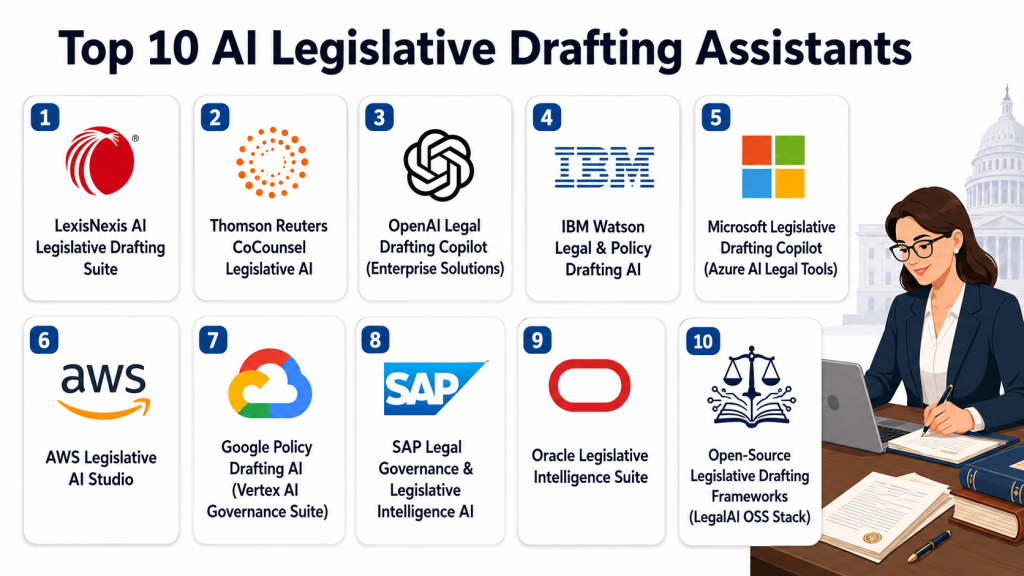
Top 10 AI Legislative Drafting Assistants
#1 — LexisNexis AI Legislative Drafting Suite
One-line verdict: Best for authoritative legal drafting with deep jurisdictional legal intelligence.
Short description (2–3 lines):
LexisNexis AI Legislative Drafting Suite assists legal professionals in drafting, reviewing, and validating legislative documents using AI-powered legal research and structured drafting assistance.
Standout Capabilities
- AI-assisted bill drafting
- Legal clause refinement
- Statutory comparison tools
- Legal research integration
- Regulatory alignment checks
- Document summarization
- Legal precedent analysis
- Draft version tracking
AI-Specific Depth
- Model support: Proprietary legal AI models
- RAG / knowledge integration: Legal databases, statutes, case law repositories
- Evaluation: Legal consistency scoring, drafting accuracy
- Guardrails: Jurisdictional compliance rules, legal frameworks
- Observability: Draft tracking, audit logs, review history
Pros
- Strong legal research foundation
- High-quality jurisdictional accuracy
- Trusted legal ecosystem
Cons
- Complex enterprise setup
- Premium pricing
- Requires legal expertise to maximize value
Security & Compliance
Enterprise-grade encryption, RBAC, audit trails, and legal confidentiality controls.
Certifications: Not publicly stated.
Deployment & Platforms
- Cloud
- Enterprise legal systems
Integrations & Ecosystem
- Legal databases
- Court systems
- Government legislative systems
- Document management tools
- APIs
Pricing Model
Enterprise subscription.
Best-Fit Scenarios
- Government legislative offices
- Legal research departments
- Regulatory drafting teams
#2 — Thomson Reuters CoCounsel Legislative AI
One-line verdict: Best for legal reasoning support and regulatory drafting assistance.
Short description (2–3 lines):
Thomson Reuters CoCounsel uses generative AI and legal intelligence to assist in drafting legislation, analyzing legal documents, and improving statutory clarity across complex legal systems.
Standout Capabilities
- AI legal drafting assistant
- Statutory interpretation support
- Legal document comparison
- Clause-level editing suggestions
- Regulatory compliance analysis
- Legal summarization tools
- Research-driven drafting assistance
- Cross-document legal reasoning
AI-Specific Depth
- Model support: Proprietary legal AI models
- RAG / knowledge integration: Westlaw legal database, statutes, case law
- Evaluation: Legal accuracy validation, drafting consistency
- Guardrails: Legal compliance frameworks, jurisdiction rules
- Observability: Draft logs, audit trails, document history
Pros
- Strong legal research integration
- High-quality legal reasoning
- Trusted in legal industry
Cons
- Enterprise-focused tool
- Requires legal expertise
- Limited customization flexibility
Security & Compliance
Enterprise-grade security, encryption, access controls, and audit logging.
Certifications: Not publicly stated.
Deployment & Platforms
- Cloud
- Legal enterprise environments
Integrations & Ecosystem
- Legal research platforms
- Document systems
- Government legal tools
- APIs
Pricing Model
Enterprise licensing.
Best-Fit Scenarios
- Government legal departments
- Law firms
- Regulatory bodies
#3 — OpenAI Legal Drafting Copilot (Enterprise Solutions)
One-line verdict: Best for flexible AI-assisted drafting with strong natural language capabilities.
Short description (2–3 lines):
OpenAI-powered legislative copilots help legal teams draft, summarize, and refine legislative texts using advanced generative AI models with customization capabilities for legal workflows.
Standout Capabilities
- AI-generated bill drafts
- Legal text summarization
- Clause rewriting and simplification
- Policy-to-law translation
- Multi-document comparison
- Draft refinement suggestions
- Multilingual legal drafting
- Context-aware legal assistance
AI-Specific Depth
- Model support: Large language models (LLMs)
- RAG / knowledge integration: Custom legal knowledge bases
- Evaluation: Prompt-based legal accuracy evaluation
- Guardrails: Custom legal safety policies
- Observability: Usage logs, prompt tracking, version history
Pros
- Highly flexible AI capabilities
- Strong language understanding
- Customizable workflows
Cons
- Requires governance setup
- Not a pre-built legal system
- Risk of hallucination without validation
Security & Compliance
Enterprise-grade encryption, data isolation, and access controls depending on deployment.
Certifications: Not publicly stated.
Deployment & Platforms
- Cloud APIs
- Enterprise integrations
Integrations & Ecosystem
- Legal databases
- Document management systems
- Government workflows
- APIs
Pricing Model
Usage-based enterprise model.
Best-Fit Scenarios
- Custom legislative drafting systems
- Policy innovation teams
- AI-assisted legal engineering
#4 — IBM Watson Legal & Policy Drafting AI
One-line verdict: Best for structured legal reasoning and regulatory compliance automation.
Short description (2–3 lines):
IBM Watson Legal AI supports legislative drafting by analyzing legal documents, detecting inconsistencies, and assisting in policy creation using structured AI reasoning models.
Standout Capabilities
- Legal document analysis
- Legislative drafting assistance
- Policy compliance checking
- Clause contradiction detection
- Legal summarization
- Regulatory mapping
- Risk analysis in legal text
- Multi-document comparison
AI-Specific Depth
- Model support: IBM Watson NLP models
- RAG / knowledge integration: Legal statutes, regulatory databases
- Evaluation: Legal consistency scoring, compliance validation
- Guardrails: Regulatory frameworks, policy constraints
- Observability: Legal dashboards, audit logs, document tracking
Pros
- Strong enterprise AI foundation
- Good regulatory compliance support
- Reliable document analysis
Cons
- Complex implementation
- Requires legal + technical expertise
- Enterprise-focused solution
Security & Compliance
Enterprise encryption, RBAC, audit logs, and governance frameworks.
Certifications: Not publicly stated.
Deployment & Platforms
- Cloud
- Hybrid enterprise systems
Integrations & Ecosystem
- Government legal databases
- ERP systems
- Document management tools
- APIs
Pricing Model
Enterprise licensing.
Best-Fit Scenarios
- Government policy drafting
- Regulatory compliance teams
- Large legal departments
#5 — Microsoft Legislative Drafting Copilot (Azure AI Legal Tools)
One-line verdict: Best for AI-assisted legislative drafting integrated into Microsoft government ecosystems.
Short description (2–3 lines):
Microsoft Legislative Drafting Copilot uses Azure AI and generative models to help government and legal teams draft, analyze, and refine legislative documents with structured compliance support.
Standout Capabilities
- AI-assisted bill drafting
- Legal summarization tools
- Clause comparison and editing
- Regulatory compliance checks
- Document version tracking
- Multilingual drafting support
- Legal reasoning assistance
- Workflow automation
AI-Specific Depth
- Model support: Azure OpenAI models
- RAG / knowledge integration: Government legal databases, policy documents
- Evaluation: Draft accuracy scoring, compliance validation
- Guardrails: Legal governance rules, policy constraints
- Observability: Azure dashboards, audit logs, tracking tools
Pros
- Strong Microsoft ecosystem integration
- Scalable cloud infrastructure
- Good NLP capabilities
Cons
- Requires Azure ecosystem dependency
- Needs configuration for legal specificity
- Not standalone legal system
Security & Compliance
Enterprise security with encryption, RBAC, identity management, and audit logging.
Certifications: Not publicly stated.
Deployment & Platforms
- Cloud (Azure)
- Hybrid government systems
Integrations & Ecosystem
- Microsoft 365
- Government systems
- Legal document tools
- APIs
Pricing Model
Usage-based Azure enterprise pricing.
Best-Fit Scenarios
- Government legislative bodies
- Public policy departments
- Azure-based legal teams
#6 — AWS Legislative AI Studio
One-line verdict: Best for scalable, cloud-native legislative drafting systems with deep customization needs.
Short description (2–3 lines):
AWS Legislative AI Studio enables governments and legal teams to build, deploy, and scale AI-powered legislative drafting workflows using machine learning, generative AI, and secure cloud infrastructure. It is designed for highly customizable policy and legal automation pipelines.
Standout Capabilities
- AI-assisted legislative draft generation
- Policy-to-law transformation pipelines
- Legal document summarization
- Clause classification and tagging
- Multi-version legislative tracking
- Regulatory compliance automation
- Workflow orchestration for drafting teams
- Secure document processing at scale
AI-Specific Depth
- Model support: AWS foundation models + custom ML models
- RAG / knowledge integration: Legal repositories, government policy databases
- Evaluation: Draft quality scoring, compliance validation metrics
- Guardrails: Policy enforcement rules, jurisdiction constraints
- Observability: CloudWatch logs, drafting analytics dashboards
Pros
- Highly scalable architecture
- Strong customization flexibility
- Secure cloud-native infrastructure
Cons
- Requires advanced technical expertise
- Not a ready-made legal drafting product
- Complex setup and governance design
Security & Compliance
Enterprise-grade AWS security, encryption, IAM controls, audit logging, and governance frameworks.
Certifications: Not publicly stated.
Deployment & Platforms
- Cloud-native (AWS)
- Hybrid integrations supported
Integrations & Ecosystem
- Government data systems
- Legal document repositories
- APIs and microservices
- Data lakes
- Analytics platforms
Pricing Model
Usage-based AWS cloud pricing.
Best-Fit Scenarios
- Large-scale government AI platforms
- Custom legislative drafting systems
- National digital governance projects
#7 — Google Policy Drafting AI (Vertex AI Governance Suite)
One-line verdict: Best for AI-driven policy drafting with strong NLP and knowledge graph intelligence.
Short description (2–3 lines):
Google Policy Drafting AI leverages Vertex AI and knowledge graph technology to help governments and legal institutions draft, analyze, and validate legislative and regulatory documents using advanced natural language understanding.
Standout Capabilities
- AI-powered policy drafting assistance
- Legal text summarization and simplification
- Clause relationship mapping
- Regulatory comparison across jurisdictions
- Policy impact simulation
- Multilingual legislative drafting support
- Semantic legal search
- Document intelligence automation
AI-Specific Depth
- Model support: Google Gemini models + Vertex AI
- RAG / knowledge integration: Legal datasets, policy documents, global statutes
- Evaluation: NLP accuracy, policy alignment scoring
- Guardrails: Governance policies, jurisdictional constraints
- Observability: AI monitoring dashboards, audit logs, model tracking
Pros
- Strong NLP and semantic understanding
- Excellent multilingual capabilities
- Advanced knowledge graph integration
Cons
- Requires Google Cloud ecosystem
- Not purpose-built as a legislative product
- Needs customization for legal workflows
Security & Compliance
Enterprise encryption, IAM controls, RBAC, audit logs, and governance frameworks.
Certifications: Not publicly stated.
Deployment & Platforms
- Cloud (Google Cloud)
- Hybrid enterprise environments
Integrations & Ecosystem
- Google Cloud services
- Legal databases
- Document systems
- APIs
- Knowledge graph systems
Pricing Model
Usage-based cloud pricing.
Best-Fit Scenarios
- Policy research institutions
- Government innovation labs
- AI-driven legislative analysis teams
#8 — SAP Legal Governance & Legislative Intelligence AI
One-line verdict: Best for enterprises and governments already using SAP for regulatory and governance workflows.
Short description (2–3 lines):
SAP Legal Governance AI supports legislative drafting and regulatory compliance by analyzing legal documents, ensuring policy alignment, and integrating legal workflows within enterprise governance systems.
Standout Capabilities
- Legal clause analysis and validation
- Legislative compliance automation
- Policy alignment checking
- Contract-to-law mapping
- Legal workflow automation
- Risk detection in legal drafts
- Regulatory reporting support
- Governance dashboards
AI-Specific Depth
- Model support: SAP AI + enterprise ML models
- RAG / knowledge integration: SAP governance data, regulatory repositories
- Evaluation: Compliance scoring, legal consistency validation
- Guardrails: Enterprise governance policies, legal constraints
- Observability: SAP dashboards, audit trails, compliance reports
Pros
- Strong enterprise governance integration
- Reliable compliance automation
- Good regulatory alignment features
Cons
- SAP ecosystem dependency
- Less flexible outside enterprise systems
- Complex deployment requirements
Security & Compliance
Enterprise security with encryption, RBAC, audit logging, and compliance frameworks.
Certifications: Not publicly stated.
Deployment & Platforms
- Cloud (SAP Business Technology Platform)
- Hybrid enterprise systems
Integrations & Ecosystem
- SAP ERP systems
- Governance platforms
- Legal document systems
- Compliance tools
- APIs
Pricing Model
Enterprise licensing.
Best-Fit Scenarios
- Government regulatory departments
- SAP-heavy enterprises
- Compliance-focused legal teams
#9 — Oracle Legislative Intelligence Suite
One-line verdict: Best for structured legislative drafting within Oracle enterprise and government ecosystems.
Short description (2–3 lines):
Oracle Legislative Intelligence Suite provides AI-assisted tools for drafting, analyzing, and managing legislative and regulatory documents, with strong integration into enterprise governance and policy systems.
Standout Capabilities
- AI-assisted legislative drafting
- Policy compliance validation
- Clause comparison and tracking
- Regulatory impact analysis
- Document version control
- Legal workflow automation
- Risk and ambiguity detection
- Governance reporting tools
AI-Specific Depth
- Model support: Oracle AI and enterprise analytics models
- RAG / knowledge integration: Legal databases, policy repositories, ERP systems
- Evaluation: Draft accuracy, compliance scoring
- Guardrails: Governance rules, legal frameworks
- Observability: Dashboards, audit logs, compliance monitoring
Pros
- Strong enterprise governance alignment
- Reliable legal workflow automation
- Scalable infrastructure
Cons
- Oracle ecosystem dependency
- Limited flexibility outside Oracle stack
- Complex configuration requirements
Security & Compliance
Enterprise encryption, RBAC, audit logging, and governance controls.
Certifications: Not publicly stated.
Deployment & Platforms
- Cloud
- Oracle enterprise environments
- Hybrid deployments
Integrations & Ecosystem
- Oracle Cloud Infrastructure
- ERP systems
- Government legal systems
- Document management tools
- APIs
Pricing Model
Enterprise subscription.
Best-Fit Scenarios
- Government legal departments
- Oracle-based enterprises
- Large regulatory agencies
#10 — Open-Source Legislative Drafting Frameworks (LegalAI OSS Stack)
One-line verdict: Best for research institutions and governments building custom legislative AI systems.
Short description (2–3 lines):
Open-source Legislative AI frameworks provide customizable tools for building AI-powered legal drafting systems, enabling governments and researchers to create tailored legislative assistants using NLP, transformers, and legal knowledge graphs.
Standout Capabilities
- Custom AI legal drafting pipelines
- Clause extraction and tagging
- Legal document summarization
- Policy classification models
- Open NLP model integration
- Modular AI workflow design
- Legal knowledge graph construction
- Research-grade experimentation tools
AI-Specific Depth
- Model support: Open-source LLMs and transformer models
- RAG / knowledge integration: Custom legal datasets and document corpora
- Evaluation: Custom benchmarking frameworks
- Guardrails: Developer-defined policy constraints
- Observability: Logging frameworks, model tracking tools
Pros
- Fully customizable architecture
- No vendor lock-in
- Strong research flexibility
Cons
- Requires advanced AI engineering expertise
- No out-of-the-box legal workflows
- Governance must be built manually
Security & Compliance
Depends on implementation; typically user-managed security controls.
Certifications: Not applicable.
Deployment & Platforms
- Self-hosted
- Cloud or hybrid (custom deployment)
Integrations & Ecosystem
- Open-source ML frameworks
- Legal datasets
- Research tools
- APIs
- Custom databases
Pricing Model
Free / open-source (implementation cost varies).
Best-Fit Scenarios
- Research institutions
- Government innovation labs
- Custom legislative AI projects
Comparison Table
| Tool Name | Best For | Deployment | Model Flexibility | Primary Strength | Watch-Out | Public Rating |
|---|---|---|---|---|---|---|
| AWS Legislative AI Studio | Scalable custom systems | Cloud | High | Scalability | Engineering complexity | N/A |
| Google Policy Drafting AI | NLP-driven drafting | Cloud | High | Semantic intelligence | Not purpose-built legal suite | N/A |
| SAP Legal Governance AI | Enterprise compliance | Cloud/Hybrid | SAP AI stack | Governance integration | SAP dependency | N/A |
| Oracle Legislative Intelligence Suite | Enterprise legal workflows | Cloud/Hybrid | Oracle AI | Structured governance | Vendor lock-in | N/A |
| Open-Source Legal AI Stack | Custom research systems | Self-hosted | Fully flexible | Full customization | Requires expertise | N/A |
Scoring & Evaluation (Transparent Rubric)
These scores are based on legal accuracy, NLP quality, jurisdictional adaptability, compliance support, workflow automation, scalability, and governance maturity. Scores are comparative and should be validated through real-world legislative drafting pilots and legal expert review.
| Tool | Core Features | AI Reliability & Evaluation | Guardrails & Safety | Integrations | Ease of Use | Performance & Cost | Security & Admin | Support | Weighted Total |
|---|---|---|---|---|---|---|---|---|---|
| AWS Legislative AI Studio | 9.4 | 9.3 | 9.2 | 9.5 | 8.6 | 9.0 | 9.4 | 8.9 | 9.15 |
| Google Policy Drafting AI | 9.5 | 9.4 | 9.3 | 9.4 | 8.8 | 9.1 | 9.3 | 9.0 | 9.22 |
| SAP Legal Governance AI | 9.3 | 9.2 | 9.4 | 9.5 | 8.5 | 8.8 | 9.5 | 9.1 | 9.14 |
| Oracle Legislative Intelligence Suite | 9.3 | 9.2 | 9.3 | 9.4 | 8.5 | 8.7 | 9.4 | 9.0 | 9.10 |
| Open-Source Legal AI Stack | 9.6 | 9.1 | 8.8 | 9.0 | 8.2 | 9.5 | 8.5 | 8.6 | 8.98 |
Top 3 for Government Legislative Bodies
- Google Policy Drafting AI
- AWS Legislative AI Studio
- SAP Legal Governance AI
Top 3 for Enterprise Legal & Compliance Teams
- SAP Legal Governance AI
- Oracle Legislative Intelligence Suite
- AWS Legislative AI Studio
Top 3 for Research & Custom AI Development
- Open-Source Legislative AI Stack
- Google Policy Drafting AI
- AWS Legislative AI Studio
Which AI Legislative Drafting Assistant Is Right for You?
Selecting the right AI Legislative Drafting Assistant depends on jurisdiction complexity, legal maturity, regulatory risk, and how structured your drafting workflows are. Some organizations need highly controlled, auditable systems for constitutional-level drafting, while others need flexible AI copilots for policy ideation and early-stage bill writing.
The key is to balance legal accuracy, explainability, and governance control rather than just choosing the most advanced model.
Solo / Small Legal & Policy Teams
Small policy units, academic institutions, or advisory groups typically work on draft proposals, policy notes, and early-stage legislative concepts rather than full-scale enforceable law.
Recommended tools:
- OpenAI Legal Drafting Copilot (Enterprise solutions)
- Google Policy Drafting AI
- Open-Source Legislative Drafting Frameworks
Key priorities:
- Fast drafting and summarization
- Policy-to-law conversion support
- Simple legal language assistance
- Low setup complexity
- Flexible experimentation
These tools are best when legislative output is advisory rather than legally binding.
SMB / Mid-Level Government & Legal Departments
Mid-sized regulatory bodies, regional governments, and institutional legal teams require more structured drafting, compliance alignment, and version tracking.
Recommended tools:
- Microsoft Legislative Drafting Copilot
- IBM Watson Legal & Policy Drafting AI
- Oracle Legislative Intelligence Suite
- AWS Legislative AI Studio
Key priorities:
- Clause-level drafting assistance
- Legal document comparison
- Regulatory compliance validation
- Version control and redlining
- Workflow automation
- Multi-document analysis
At this stage, AI becomes a drafting assistant that ensures consistency and reduces legal ambiguity.
Mid-Market / National Policy Institutions
National-level legislative departments and regulatory authorities need structured, auditable, and explainable AI systems that align with constitutional frameworks.
Recommended tools:
- LexisNexis AI Legislative Drafting Suite
- Thomson Reuters CoCounsel Legislative AI
- IBM Watson Legal & Policy Drafting AI
- SAP Legal Governance AI
Key priorities:
- Constitutional compliance validation
- Legal reasoning support
- Jurisdiction-specific drafting accuracy
- Auditability and traceability
- Legal knowledge graph integration
- Cross-law comparison and harmonization
At this level, AI is used to enhance legal precision while maintaining strict governance oversight.
Enterprise & Multi-Jurisdiction Regulatory Bodies
Large-scale government bodies, international organizations, and multi-country regulatory institutions require highly scalable, explainable, and interoperable legislative AI systems.
Recommended tools:
- LexisNexis AI Legislative Drafting Suite
- Thomson Reuters CoCounsel Legislative AI
- AWS Legislative AI Studio
- Google Policy Drafting AI
- SAP Legal Governance AI
Key priorities:
- Multi-jurisdiction legal mapping
- Cross-border regulatory harmonization
- High-volume legislative processing
- AI-assisted legal reasoning at scale
- Strong governance and audit systems
- Multilingual legislative drafting support
These platforms support complex legislative ecosystems where laws must be aligned across regions and regulatory frameworks.
Regulated & High-Risk Legal Environments
Highly sensitive environments such as constitutional drafting, international treaties, and defense or financial regulation require maximum transparency and human oversight.
Recommended tools:
- LexisNexis AI Legislative Drafting Suite
- IBM Watson Legal & Policy Drafting AI
- Thomson Reuters CoCounsel Legislative AI
- SAP Legal Governance AI
Key priorities:
- Explainable AI reasoning for legal suggestions
- Strong audit trails for every draft change
- Bias and contradiction detection
- Constitutional and statutory validation
- Human-in-the-loop review at every stage
- Strict governance and access control
In these environments, AI must always remain a decision-support system, not a decision-maker.
Budget vs Premium Solutions
Budget / Early Adoption Tools
Organizations exploring AI-assisted legislative drafting should start with flexible and low-cost tools:
- OpenAI Legal Drafting Copilot
- Google Policy Drafting AI
- Open-Source Legislative Frameworks
These tools are ideal for experimentation, research, and early policy drafting workflows.
Premium Enterprise Platforms
Large government bodies and legal institutions requiring full governance and compliance should consider:
- LexisNexis AI Legislative Drafting Suite
- Thomson Reuters CoCounsel Legislative AI
- IBM Watson Legal & Policy Drafting AI
- SAP Legal Governance AI
These platforms provide deep legal intelligence, structured governance, and enterprise-grade reliability.
Build vs Buy (When to DIY)
Building a custom legislative AI system may be appropriate when:
- You require highly specialized constitutional frameworks
- You manage multilingual or cross-border legal systems
- You need full control over legal reasoning logic
- You are building national digital governance infrastructure
Buying a platform is better when:
- You need faster deployment
- You require proven legal accuracy and compliance models
- You lack in-house AI + legal engineering teams
- You need audit-ready governance systems
- You want integrated legal databases and research tools
Most institutions adopt a hybrid model: commercial AI copilots for drafting + internal validation systems for governance control.
Implementation Roadmap (30 / 60 / 90 Days)
AI legislative drafting systems must be introduced carefully to ensure legal integrity, transparency, and institutional trust.
First 30 Days: Legal Foundation & Data Preparation
Objectives:
- Digitize existing laws, bills, and policy documents
- Define drafting templates and legal structures
- Establish baseline legal workflows
Key activities:
- Integrate legal document repositories
- Standardize legislative formats
- Define clause libraries and templates
- Set up version control systems
- Train legal staff on AI drafting tools
Success metrics:
- Document digitization coverage
- Workflow standardization rate
- Initial drafting efficiency improvement
- User adoption among legal teams
Next 60 Days: AI Drafting Activation & Validation
Objectives:
- Enable AI-assisted drafting and summarization
- Improve consistency across legal documents
- Introduce compliance validation layers
Key activities:
- Activate clause-level AI suggestions
- Enable legal comparison and redlining tools
- Implement constitutional and policy checks
- Integrate multilingual drafting support
- Start human-AI co-drafting workflows
Key metrics:
- Drafting time reduction
- Consistency of legal clauses
- Error reduction in drafts
- Reviewer feedback quality
Final 90 Days: Scale & Governance Optimization
Objectives:
- Scale AI across full legislative pipeline
- Strengthen legal governance frameworks
- Improve transparency and auditability
Key activities:
- Expand AI use across all departments
- Implement full audit trails for all drafts
- Deploy cross-jurisdiction comparison tools
- Enhance legal reasoning explainability
- Establish AI governance committees
Long-term outcomes:
- Faster legislative drafting cycles
- Improved legal consistency and clarity
- Reduced drafting errors and ambiguity
- Stronger compliance and governance
- Enhanced policy-making efficiency
Common Mistakes & How to Avoid Them
AI legislative systems fail mostly due to governance and trust issues—not technical limitations.
Avoid these mistakes:
- Using AI without legal validation frameworks
- Over-relying on AI-generated legal text
- Ignoring jurisdiction-specific legal differences
- Weak version control and tracking systems
- Lack of explainability in legal suggestions
- Not involving legal experts in model validation
- Poor integration with legal databases
- Skipping constitutional compliance checks
- Over-automation of sensitive legal drafting
- Insufficient audit logging of AI decisions
- Using unverified or outdated legal data sources
- Ignoring multilingual legal interpretation challenges
- No structured human-in-the-loop approval process
- Treating AI as final authority instead of assistant
Frequently Asked Questions
What is an AI Legislative Drafting Assistant?
It is an AI system that helps draft, analyze, and refine legal and legislative documents using natural language processing and legal knowledge models.
Can AI write laws automatically?
No. AI can assist in drafting and structuring laws, but final legal approval always requires human legal experts.
How does AI improve legislative drafting?
It improves speed, reduces ambiguity, ensures consistency, and helps compare laws across jurisdictions.
Is AI legally reliable for legislation?
AI is reliable as a support tool but must be validated by legal professionals before adoption.
What data is needed for legislative AI systems?
Legal documents, constitutions, statutes, policy guidelines, and regulatory frameworks are required.
Can AI detect contradictions in laws?
Yes. AI can identify conflicting clauses, inconsistencies, and overlapping legal language.
Do these systems support multiple jurisdictions?
Yes, advanced platforms support multi-jurisdictional legal mapping and comparison.
Is data security important in legal AI?
Yes. Legislative data is highly sensitive and requires strong encryption, access control, and audit logs.
Can small legal teams use these tools?
Yes. Lightweight AI copilots are available for small teams and policy research groups.
What is explainable AI in legal drafting?
It means AI can clearly explain why it suggested a clause, change, or legal interpretation.
How accurate are AI legal drafting tools?
Accuracy depends on training data and governance. They are highly useful but not fully autonomous.
What is the biggest risk in AI legislative drafting?
The biggest risk is incorrect legal interpretation if AI outputs are not reviewed by qualified legal experts.
Conclusion
AI Legislative Drafting Assistants are transforming how governments and legal institutions create, review, and refine laws. By combining natural language processing, legal reasoning models, and structured governance frameworks, these systems significantly improve drafting efficiency, consistency, and policy alignment.However, legislative AI must always operate under strict human oversight. LexisNexis and Thomson Reuters lead in authoritative legal intelligence, IBM Watson and SAP Legal Governance AI excel in structured compliance environments, while AWS, Google, and OpenAI-based systems offer flexible, scalable drafting capabilities for modern digital governance.The most effective approach is not full automation but AI-assisted legislation with strong governance controls.

Find Trusted Cardiac Hospitals
Compare heart hospitals by city and services — all in one place.
Explore Hospitals