
Introduction
AI Logistics Visibility Prediction platforms use artificial intelligence to provide real‑time and forward‑looking insights into supply chain operations. These solutions ingest data from carriers, IoT sensors, telemetry, ERP/TMS/WMS, weather and external events to forecast delivery arrival times, identify risk, and alert planners about potential disruptions before they occur. In an era of increasingly complex, multi‑modal global logistics, predictive visibility helps organizations reduce delays, optimize inventory planning, enhance customer satisfaction, and mitigate risk.
Real‑world use cases include:
- Predicting shipment arrival times across modes (sea, air, truck, rail).
- Identifying potential disruptions due to weather, traffic, customs, or port congestion.
- Supporting inventory and warehouse planning based on expected deliveries.
- Proactively notifying stakeholders of exceptions and delays.
- Monitoring carrier performance and compliance trends.
- Improving logistics decision‑making with predictive analytics dashboards.
What buyers should evaluate:
- Accuracy of AI models for predictive ETA and risk scoring.
- Integration with TMS, ERP, WMS, IoT telematics, and carrier APIs.
- Support for multi‑carrier and multi‑modal operations.
- Exception management and proactive alerting.
- KPI dashboards and scenario simulation.
- Deployment flexibility (cloud, hybrid, on‑premises).
- Data privacy, governance, and auditability.
- Scalability across global networks.
- Real‑time observability and efficiency metrics.
Best for: Logistics managers, transportation planners, supply chain operations leaders, and global enterprises with complex multi‑modal operations.
Not ideal for: Small, single‑mode carriers or localized operations where manual tracking suffices.
What’s Changed in AI Logistics Visibility Prediction in 2026+
- Multimodal integration: GPS, IoT, telematics, carrier EDI, and port data all feed AI models.
- Predictive ETA with confidence scores: Real‑time forecasts with risk bands.
- AI‑driven scenario simulation: Assess impacts of route changes, port congestion, or carrier substitution.
- Advanced exception management: Automated alerts prevent manual monitoring overhead.
- Observability dashboards: Track model performance, delay patterns, and KPIs.
- Guardrails: Reduce false positives via adaptive thresholding and feedback loops.
- Real‑time recommender alerts: Proactive notifications for planners and customers.
- Sustainability insights: Route and mode optimization to lower emissions.
- Edge compute & latency optimization: Faster inference near data sources.
- Compliance & governance: Audit trails, role‑based security, data retention, and privacy controls.
- Carrier health & risk scoring: Predictive scoring of carriers’ reliability.
- Automated corrective recommendations: Suggest preferred carriers and routes based on prediction outcomes.
Quick Buyer Checklist
- ✅ Predictive ETA accuracy & confidence scoring
- ✅ Integration with TMS, ERP, WMS, and IoT systems
- ✅ Multi‑carrier and multi‑modal support
- ✅ Real‑time exception alerts and proactive notifications
- ✅ Scenario simulation for route changes & disruptions
- ✅ Observability dashboards for KPIs
- ✅ Guardrails to prevent false alerts
- ✅ Deployment flexibility (cloud/hybrid/on‑prem)
- ✅ Data privacy & secure access controls
- ✅ Scalability for global supply chains
- ✅ Sustainability and cost transparency
- ✅ Ease of use for planners and operations teams
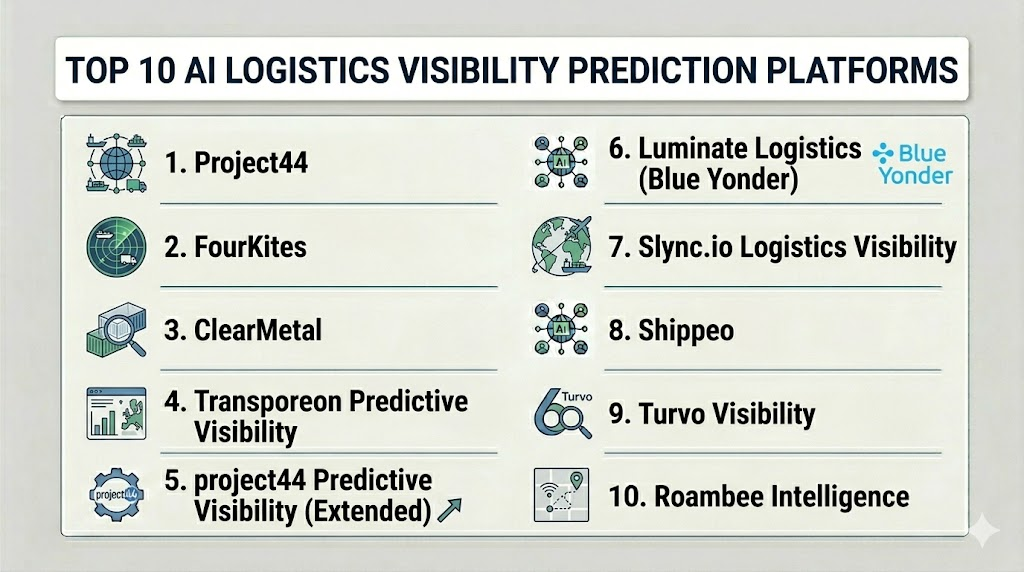
Top 10 AI Logistics Visibility Prediction Platforms
1 — Project44
One‑line verdict: Enterprise logistics visibility platform delivering predictive ETAs, risk scoring, and exception alerts across global carriers.
Short description: Project44 combines carrier data, IoT, telematics, and historical patterns to forecast shipment arrivals, score risk, and surface exceptions in real time.
Standout Capabilities
- Real‑time tracking and predictive ETA with confidence scores
- Multi‑carrier and multi‑modal support
- Automated exception alerts with reroute suggestions
- Carrier performance benchmarking
- KPI dashboards for on‑time delivery rates
- Mobile notifications for field stakeholders
- API connectivity for TMS/ERP integration
AI‑Specific Depth
- Model support: Proprietary AI models
- RAG / knowledge integration: TMS, ERP, carrier APIs
- Evaluation: Real‑time error feedback & historical validation
- Guardrails: Alert filtering to reduce noise
- Observability: ETA accuracy, delay likelihood, exceptions
Pros
- Excellent global coverage
- Strong predictive accuracy
- Rich exception management
Cons
- Premium pricing
- Implementation complexity for smaller fleets
- Advanced features require onboarding
Security & Compliance
- SSO/SAML, RBAC, encryption in transit & at rest
- Audit logs & data retention controls
- Certifications: Not publicly stated
Deployment & Platforms
- Cloud, Web
Integrations & Ecosystem
- ERP, TMS, WMS, carrier APIs, mobile alerts
Pricing Model
- Subscription‑based; Not publicly stated
Best‑Fit Scenarios
- Global logistics operations
- Multi‑modal shipment visibility
- Carrier performance monitoring
2 — FourKites
One‑line verdict: AI logistics visibility and prediction engine with strong predictive ETA, proactive alerts, and multi‑modal support.
Short description: FourKites delivers predictive shipment visibility across road, rail, air, and ocean transports with real‑time exception alerts and risk scoring.
Standout Capabilities
- Real‑time visibility across modes
- Predictive ETA forecasting with confidence metrics
- Exception detection with proactive alerts
- Carrier performance dashboards
- Historical and predictive analytics
- Integration with ERP, TMS, and WMS
AI‑Specific Depth
- Model support: Proprietary AI
- RAG / knowledge integration: ERP/TMS connectors
- Evaluation: Back‑testing against historical shipments
- Guardrails: Adaptive alert thresholds
- Observability: On‑time performance, delay risk
Pros
- Multi‑modal support
- Proactive alert system
- Strong predictive performance
Cons
- Higher subscription costs
- Complexity for smaller operations
- Requires training for full utilization
Security & Compliance
- SSO, RBAC, encryption
- Audit logs
- Certifications: Not publicly stated
Deployment & Platforms
- Cloud, Web, iOS/Android
Integrations & Ecosystem
- ERP, TMS, carrier APIs, analytics
Pricing Model
- Subscription; Not publicly stated
Best‑Fit Scenarios
- Multi‑modal supply chains
- Global shuttle and freight networks
- Carrier exception handling
3 — ClearMetal
One‑line verdict: AI freight prediction engine focused on predictive ETAs, inventory planning insights, and risk alerts.
Short description: ClearMetal applies machine learning to historical and real‑time logistics data to forecast arrivals, manage exceptions, and support inventory allocation decisions.
Standout Capabilities
- Predictive ETA with confidence scoring
- Inventory allocation prediction
- Multi‑carrier visibility
- Exception forecasting
- Dashboard analytics and KPI tracking
AI‑Specific Depth
- Model support: Proprietary ML models
- RAG / knowledge integration: ERP/WMS/TMS connectors
- Evaluation: Historical back‑testing
- Guardrails: Alert thresholds & tuning
- Observability: ETA accuracy, exception likelihood
Pros
- Combines visibility with inventory insights
- Accurate predictions when historical data is rich
- Strong visualization dashboards
Cons
- Requires quality historical data
- Enterprise pricing
- Integration complexity
Security & Compliance
- Encryption, SSO, RBAC
- Audit logs, retention control
- Certifications: Not publicly stated
Deployment & Platforms
- Cloud, Web
Integrations & Ecosystem
- WMS, ERP, TMS, analytics dashboards
Pricing Model
- Subscription‑based; Not publicly stated
Best‑Fit Scenarios
- Demand‑sensitive warehouses
- Multi‑carrier logistics planning
- Inventory optimization workflows
4 — Transporeon Predictive Visibility
One‑line verdict: Enterprise visibility platform with predictive ETA, freight risk scoring, and exception alerts.
Short description: Transporeon delivers real‑time and predictive shipment visibility across carriers and modes with risk scoring and analytics dashboards.
Standout Capabilities
- Predictive ETA and exception alerts
- Freight risk scoring for delayed shipments
- KPI dashboards and reporting
- Multi‑modal coverage
- Supplier and carrier performance dashboards
AI‑Specific Depth
- Model support: Proprietary AI
- RAG / knowledge integration: ERP/TMS connectors
- Evaluation: Historical & simulated validation
- Guardrails: Flexible alert filtering
- Observability: ETA accuracy metrics
Pros
- Strong carrier performance insights
- Predictive risk scoring
- Multi‑modal support
Cons
- Premium pricing
- More complexity than basic trackers
- Integration setup can be extensive
Security & Compliance
- SSO, encryption, RBAC
- Audit logs
- Certifications: Not publicly stated
Deployment & Platforms
- Cloud, Web
Integrations & Ecosystem
- ERP, TMS, carrier APIs, analytics
Pricing Model
- Subscription; Not publicly stated
Best‑Fit Scenarios
- Freight risk analytics
- Multi‑carrier logistics
- Predictive ETA needs
5 — project44 Predictive Visibility (Extended)
One‑line verdict: Predictive ETA and exception forecasting engine designed for multi‑carrier global logistics.
Short description: Builds on core visibility features with deeper predictive analytics, confidence scoring, and exception management.
Standout Capabilities
- Predictive ETA, confidence ranges, anomaly detection
- Real‑time exception and delay alerts
- Multi‑carrier and global tracking
- KPI dashboards and predictive trends
- API connectivity and mobile alerts
AI‑Specific Depth
- Model support: Proprietary AI
- RAG / knowledge integration: ERP, TMS, carrier sources
- Evaluation: Real‑time feedback loops
- Guardrails: Alert threshold tuning
- Observability: Delay likelihood analytics
Pros
- Accurate multi‑carrier predictions
- Strong exception handling
- Global reach
Cons
- Not ideal for single‑mode small fleets
- Implementation effort
- Premium pricing
Security & Compliance
- SSO, encryption, RBAC
- Audit logs
- Certifications: Not publicly stated
Deployment & Platforms
- Cloud, Web
Integrations & Ecosystem
- ERP, TMS, analytics systems
Pricing Model
- Subscription; Not publicly stated
Best‑Fit Scenarios
- Global logistics operations
- Multi‑carrier visibility
- Predictive exception automation
6 — Luminate Logistics (Blue Yonder)
One‑line verdict: AI logistics visibility platform with predictive ETAs and risk scoring integrated into a broader supply chain suite.
Short description: Luminate Logistics adds intelligence to delivery and freight visibility with predictive arrival insights and disruption alerts.
Standout Capabilities
- Predictive ETA forecasting
- Risk scoring for shipments
- Integration with broader SC suites
- Analytics dashboards
- KPI monitoring and alerts
AI‑Specific Depth
- Model support: Proprietary AI
- RAG / knowledge integration: WMS, ERP, TMS
- Evaluation: Scenario & historic validation
- Guardrails: False alert suppression
- Observability: Visibility & risk dashboards
Pros
- Integrated with broader supply chain tools
- Strong analytics
- Predictive risk insight
Cons
- Complex implementation
- Premium cost
- Requires integration expertise
Security & Compliance
- SSO, data encryption, RBAC
- Audit trails
- Certifications: Not publicly stated
Deployment & Platforms
- Cloud, Web
Integrations & Ecosystem
- WMS/ERP/TMS, analytics dashboards
Pricing Model
- Subscription; Not publicly stated
Best‑Fit Scenarios
- Enterprises seeking integrated SC visibility
- Predictive ETA & exception use cases
- Risk management focus
7 — Slync.io Logistics Visibility
One‑line verdict: AI platform for multi‑carrier predictive visibility and cross‑entity exception insights.
Short description: Slync.io delivers real‑time tracking, ETA prediction, and proactive alerts across carriers and modes with collaborative workflows.
Standout Capabilities
- Predictive ETA with accuracy scoring
- Exception and risk alerts
- Multi‑carrier integration
- Collaborative workflow features
- KPI dashboards
AI‑Specific Depth
- Model support: Proprietary AI
- RAG / knowledge integration: ERP, carrier APIs
- Evaluation: Historical & simulated validation
- Guardrails: Alert structuring
- Observability: Visibility & performance metrics
Pros
- Predictive and collaborative
- Straightforward UI
- Strong multi‑carrier coverage
Cons
- Enterprise pricing
- Setup effort required
- Advanced integration complexity
Security & Compliance
- Encryption, SSO
- Audit logs
- Certifications: Not publicly stated
Deployment & Platforms
- Cloud, Web
Integrations & Ecosystem
- ERP, carrier APIs, analytics
Pricing Model
- Subscription; Not publicly stated
Best‑Fit Scenarios
- Multi‑carrier global operations
- Cross‑team collaboration
- Proactive exception workflows
8 — Shippeo
One‑line verdict: Real‑time and predictive logistics visibility platform focused on delivery ETA and disruption alerts.
Short description: Shippeo uses AI to predict arrival times, monitor carrier performance, and send proactive shipment alerts.
Standout Capabilities
- Predictive ETA forecasting
- Real‑time carrier performance insight
- Proactive delay notifications
- KPI dashboards
- Multi‑modal support
AI‑Specific Depth
- Model support: Proprietary AI
- RAG / knowledge integration: Carrier APIs, ERP, TMS
- Evaluation: Back‑testing & live validation
- Guardrails: Alert threshold settings
- Observability: ETA & delay dashboards
Pros
- Strong delivery visibility
- Predictive insights
- Easy carrier integration
Cons
- Premium pricing
- May require data onboarding effort
- Limited scenario simulation
Security & Compliance
- RBAC, encryption, audit logs
- Certifications: Not publicly stated
Deployment & Platforms
- Cloud, Web, Mobile
Integrations & Ecosystem
- Carrier APIs, ERP/TMS, dashboards
Pricing Model
- Subscription; Not publicly stated
Best‑Fit Scenarios
- Live delivery visibility
- ETA prediction
- Multi‑modal logistics
9 — Turvo Visibility
One‑line verdict: AI logistics platform with predictive visibility, collaboration, and exception management.
Short description: Turvo provides collaborative logistics visibility, predictive ETA, and exception alerts across global supply chains.
Standout Capabilities
- Predictive ETA & confidence scores
- Collaboration across stakeholders
- Real‑time alerts
- KPI dashboards
- Multi‑carrier support
AI‑Specific Depth
- Model support: Proprietary AI
- RAG / knowledge integration: ERP/TMS, carrier data
- Evaluation: Simulation & historical tests
- Guardrails: Alert thresholding
- Observability: ETA & performance metrics
Pros
- Collaboration features
- Broad visibility
- Predictive insights
Cons
- Premium pricing
- Deployment complexity
- Requires training
Security & Compliance
- SSO, encryption, audit logs
Deployment & Platforms
- Cloud, Web, Mobile
Integrations & Ecosystem
- ERP, TMS, carrier APIs
Pricing Model
- Subscription; Not publicly stated
Best‑Fit Scenarios
- Collaborative logistics teams
- Multi‑carrier operations
- ETA & exception tracking
10 — Roambee Intelligence
One‑line verdict: AI logistics visibility platform with predictive ETAs, sensor telemetry integration, and anomaly alerts.
Short description: Roambee integrates IoT sensor data with AI prediction to forecast shipment timelines, identify risk, and alert operators of anomalies.
Standout Capabilities
- Predictive ETA with confidence intervals
- Sensor and IoT telemetry ingestion
- Anomaly detection (temperature, route deviation)
- Exception alerting
- Visibility dashboards
AI‑Specific Depth
- Model support: Proprietary AI
- RAG / knowledge integration: IoT sensors, ERP, carrier APIs
- Evaluation: Back‑testing & anomaly learning
- Guardrails: False alert suppression
- Observability: Predictive & anomaly metrics
Pros
- IoT integration for deeper insight
- Predictive ETA and anomaly detection
- Versatile telemetry support
Cons
- Requires IoT investment
- Premium pricing
- Setup complexity
Security & Compliance
- RBAC, encryption, audit logs
Deployment & Platforms
- Cloud, Web, Mobile
Integrations & Ecosystem
- IoT telemetry, ERP, TMS
Pricing Model
- Subscription; Not publicly stated
Best‑Fit Scenarios
- Sensor‑enabled supply chains
- Real‑time anomaly detection
- Predictive visibility across modes
Comparison Table
| Tool Name | Best For | Deployment | Model Flexibility | Strength | Watch‑Out | Public Rating |
|---|---|---|---|---|---|---|
| Project44 | Global multi‑carrier ETA | Cloud/Web | Proprietary AI | Predictive ETAs & exceptions | Premium pricing | N/A |
| FourKites | Multi‑modal predictive visibility | Cloud/Web/Mobile | Proprietary | Proactive alerts & risk scoring | High subscription cost | N/A |
| ClearMetal | Predictive ETA + inventory insights | Cloud/Web | Proprietary | ETA + inventory planning | Historic data dependency | N/A |
| Transporeon | Freight risk & visibility | Cloud/Web | Proprietary | Freight risk scoring | Integration complexity | N/A |
| project44 Predictive | Extended ETA visibility | Cloud/Web | Proprietary | Confidence metrics | Premium pricing | N/A |
| Luminate Logistics | Integrated SC visibility | Cloud/Web | Proprietary | Integrated SC insights | Implementation complexity | N/A |
| Slync.io Visibility | Collaborative predictive visibility | Cloud/Web | Proprietary | Collaboration & predictability | Enterprise pricing | N/A |
| Shippeo | Delivery ETA & alerts | Cloud/Web/Mobile | Proprietary | Delivery visibility | Scenario simulation limited | N/A |
| Turvo Visibility | Collaborative logistics | Cloud/Web/Mobile | Proprietary | Collaborative workflows | Complex training | N/A |
| Roambee Intelligence | Sensor & ETA predictions | Cloud/Web/Mobile | Proprietary | IoT telemetry + ETA | IoT investment required | N/A |
Scoring & Evaluation
Scoring is comparative, with weighted criteria: Core 20%, Reliability/Eval 15%, Guardrails 10%, Integrations 15%, Ease 10%, Perf/Cost 15%, Security/Admin 10%, Support 5%.
| Tool | Core | Reliability/Eval | Guardrails | Integrations | Ease | Perf/Cost | Security/Admin | Support | Weighted Total |
|---|---|---|---|---|---|---|---|---|---|
| Project44 | 9 | 9 | 8 | 9 | 7 | 8 | 8 | 7 | 8.4 |
| FourKites | 9 | 9 | 8 | 9 | 7 | 8 | 8 | 7 | 8.4 |
| ClearMetal | 8 | 8 | 7 | 8 | 8 | 7 | 8 | 7 | 7.7 |
| Transporeon | 8 | 8 | 8 | 8 | 7 | 7 | 8 | 7 | 7.8 |
| project44 Predictive | 9 | 9 | 8 | 8 | 7 | 8 | 8 | 7 | 8.2 |
| Luminate Logistics | 8 | 8 | 7 | 8 | 7 | 7 | 8 | 7 | 7.7 |
| Slync.io Visibility | 8 | 8 | 8 | 8 | 7 | 7 | 8 | 7 | 7.8 |
| Shippeo | 8 | 8 | 7 | 8 | 8 | 7 | 7 | 7 | 7.7 |
| Turvo Visibility | 8 | 8 | 7 | 8 | 7 | 7 | 7 | 7 | 7.5 |
| Roambee Intelligence | 8 | 8 | 8 | 8 | 7 | 7 | 8 | 7 | 7.7 |
Top 3 for Enterprise: Project44, FourKites, project44 Predictive
Top 3 for Mid‑Market: ClearMetal, Shippeo, Transporeon
Top 3 for IoT/Telemetry: Roambee Intelligence, Project44, FourKites
Which AI Logistics Visibility Prediction Platform Is Right for You?
Solo / Small Operations
- Tools like ClearMetal or Shippeo offer ease of use with strong predictive insights.
Mid‑Market
- Transporeon, Shippeo, or ClearMetal balance predictive power and manageability.
Enterprise
- Project44, FourKites, and project44 Predictive for deep integration and global scale.
Multi‑Modal & Global
- FourKites, Project44, Transporeon cover multiple transport modes and carriers.
IoT/Sensor Integration
- Roambee Intelligence shines where IoT telemetry drives visibility.
Budget vs Premium
- Budget: Shippeo, ClearMetal
- Premium: Project44, FourKites, Luminate Logistics
Build vs Buy
- Smaller teams may begin with basic visibility and prediction; large scale or multi‑modal setups require enterprise platforms.
Implementation Playbook (30 / 60 / 90 Days)
30 Days
- Integrate key data sources (carriers, IoT feeds, TMS/ERP)
- Validate historical shipment data quality
- Configure predictive ETA output and dashboards
- Establish alert thresholds
60 Days
- Expand coverage to all key carriers and modes
- Set up exception workflows and proactive notifications
- Run prediction accuracy tests against live shipments
- Train users on KPI dashboards
90 Days
- Optimize alert guardrails to minimize false positives
- Integrate prediction output with planning systems
- Automate scenario simulations for peak seasons
- Review cost/latency and adjust model routing
Common Mistakes & How to Avoid Them
- Skipping data quality checks: Garbage in → inaccurate predictions
- Lack of cross‑system integration: Visibility silos reduce effectiveness
- No alert tuning: Too many false positives frustrate users
- Ignoring governance and privacy: Must enforce retention policies
- Over‑reliance on single data source: Multi‑modal signals improve accuracy
- Underestimating onboarding needs: Training improves adoption
- No baseline KPIs: Without baseline, measuring ROI is hard
- Failing to update models: Periodic retraining improves predictions
- Ignoring edge compute opportunities: Reduces latency and cost
- Not tying predictions to actions: Visibility needs connectivity to planning
FAQs
1‑ What is predictive logistics visibility?
It’s the use of AI to forecast shipment arrival times, identify risk, and alert stakeholders before exceptions occur.
2‑ How does AI predict ETAs?
By combining historical shipment data with real‑time inputs such as GPS, carrier feeds, IoT sensors, and external events like weather.
3‑ Why are confidence scores important?
They help quantify prediction reliability and support planning decisions with risk context.
4‑ Do these tools integrate with TMS and ERP?
Yes — top platforms connect to TMS, ERP, WMS, IoT devices, and carrier APIs.
5‑ Can small companies use these tools?
Yes — lighter platforms like Shippeo or ClearMetal work well for smaller operations.
6‑ What is proactive alerting?
Systems notify planners of potential delays before they occur, enabling intervention.
7‑ What are common guardrails?
Alert thresholds, false positive suppression, and anomaly checks ensure reliable notifications.
8‑ Are these platforms cloud‑only?
Most are cloud or hybrid; some offer on‑premises components for latency control.
9‑ How do we measure model accuracy?
Compare predicted ETA vs actual arrival and monitor confidence score reliability.
10‑ Can predictions help inventory planning?
Yes — accurate arrival forecasts inform warehouse planning and safety stock decisions.
11‑ Do these tools support multi‑modal visibility?
Yes — all top platforms support combinations of road, rail, air, and ocean.
12‑ What is exception management?
Automated identification and alerting of shipments at risk of delay based on AI predictions.
Conclusion
AI Logistics Visibility Prediction platforms are critical for modern supply chains, offering predictive insights that reduce uncertainty, improve planning accuracy, and empower proactive decision‑making. Choosing the right solution depends on scale, multi‑modal complexity, integrations, and analytics needs. Smaller teams benefit from intuitive predictive tools, while large global operations require comprehensive engines with deep integration and risk scoring.

Find Trusted Cardiac Hospitals
Compare heart hospitals by city and services — all in one place.
Explore Hospitals
AI logistics visibility platforms are effective, but real value comes from accurate carrier data, system interoperability, and handling exceptions in real time.