
Introduction
AI Media Transcoding Optimization Tools leverage machine learning to intelligently convert video and audio content from one format or resolution to another, while maximizing quality and minimizing file size. In 2026, these tools are critical for OTT platforms, streaming services, CDNs, and content creators aiming to deliver high-quality media across multiple devices and network conditions.
Real-world use cases include:
- Streaming platforms: Adaptive bitrate streaming for smooth playback.
- CDNs and media delivery: Optimize file size without compromising quality.
- Social media: Automatic resizing and compression for multi-platform posting.
- Enterprise video portals: Efficient storage and playback on diverse devices.
- Gaming/esports content: Compressing live streams for low latency.
- Education: Optimized lecture videos for remote delivery.
What buyers should evaluate:
- ML-based bitrate and quality optimization
- Multi-codec support (H.264, H.265, AV1, VP9, VVC)
- Cloud vs hybrid vs on-prem deployments
- Real-time vs batch processing capabilities
- Adaptive streaming support (HLS/DASH)
- GPU/CPU acceleration for high throughput
- API and workflow integration
- Observability dashboards (cost, quality, processing)
- Privacy and security of content
- Customizable ML models for content-specific optimization
Best for: OTT platforms, media companies, CDNs, video production studios, and enterprises managing large video libraries.
Not ideal for: Low-volume content creators or static media without performance constraints.
What’s Changed in AI Media Transcoding in 2026+
- ML-driven bitrate optimization for device-specific streaming
- Support for next-gen codecs (AV1, VVC) with intelligent tuning
- Real-time adaptive streaming optimization
- GPU/CPU acceleration for high-throughput workflows
- Intelligent frame-level quality prediction
- Multi-device and resolution-aware transcoding
- Integration with cloud storage and CDNs
- Observability dashboards for cost and processing metrics
- Content-aware compression to reduce bandwidth
- Guardrails to prevent over-compression
- API-based workflow integration
- Customizable ML models for content-specific optimization
Quick Buyer Checklist
- ML-based bitrate and quality optimization
- Multi-codec and format support
- Real-time vs batch processing
- Integration with cloud/CDN/NLE
- GPU/CPU acceleration support
- Observability and cost metrics
- Guardrails for content fidelity
- API workflow integration
- Adaptive streaming optimization
- Deployment flexibility (cloud, hybrid, on-prem)
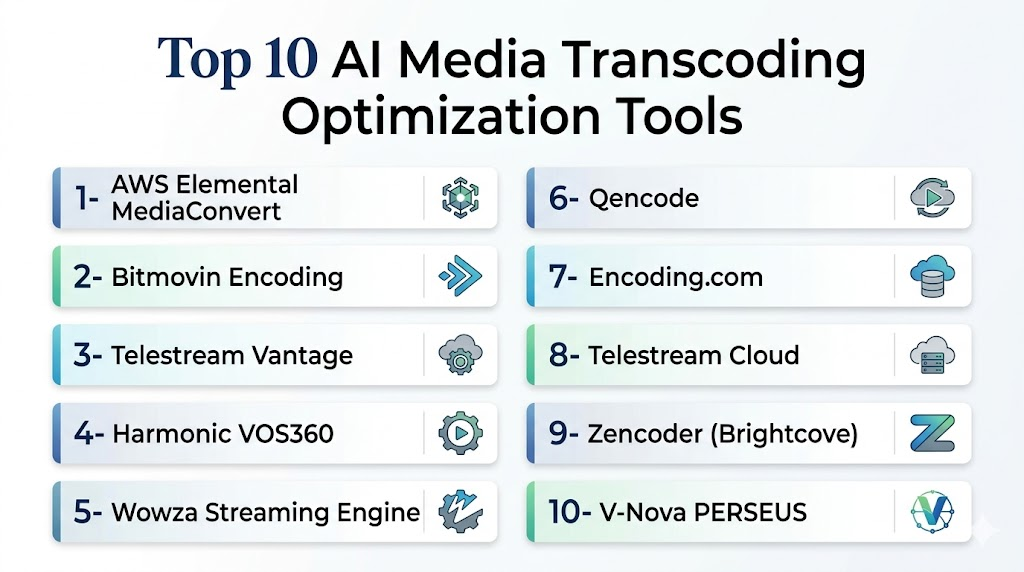
Top 10 AI Media Transcoding Optimization Tools
1- AWS Elemental MediaConvert
One-line verdict: Best for enterprises needing scalable, cloud-based ML-optimized transcoding pipelines.
Short description:
MediaConvert uses ML to optimize bitrate, quality, and file size across resolutions and codecs for adaptive streaming workflows.
Standout Capabilities
- ML-based adaptive bitrate optimization
- Multi-format and codec support
- HDR/SDR support
- AWS CloudFront integration
- Real-time and batch processing
- GPU acceleration
- Automated job scheduling
AI-Specific Depth
- Model support: Proprietary ML
- RAG / knowledge integration: N/A
- Evaluation: Bitrate vs quality analysis
- Guardrails: Ensures visual fidelity
- Observability: Job and cost metrics
Pros
- Cloud-scalable
- Enterprise-grade
- Deep codec support
Cons
- AWS ecosystem dependent
- Cost scales with usage
- Cloud-only
Security & Compliance
SSO, encryption, RBAC; Certifications: Not publicly stated
Deployment & Platforms
Cloud (AWS)
Integrations & Ecosystem
CloudFront, S3, Lambda API
Pricing Model
Usage-based subscription
Best-Fit Scenarios
- OTT platforms
- Streaming services
- Enterprise video portals
2- Bitmovin Encoding
One-line verdict: Ideal for video platforms needing high-throughput ML-based transcoding.
Short description:
Bitmovin leverages ML to optimize streaming quality, reduce bandwidth, and provide adaptive bitrate profiles.
Standout Capabilities
- Multi-codec support (H.264, H.265, AV1)
- AI-based bitrate control
- Real-time adaptive streaming
- Cloud & hybrid deployment
- GPU acceleration for batch jobs
AI-Specific Depth
- Model support: Proprietary ML
- RAG / knowledge integration: N/A
- Evaluation: Bitrate vs perceptual quality metrics
- Guardrails: Prevents over-compression
- Observability: Performance and cost dashboards
Pros
- Fast processing
- Adaptive streaming ready
- Cloud or hybrid deployment
Cons
- Premium pricing
- Learning curve for integration
- Advanced features require enterprise plan
Security & Compliance
Varies / N/A
Deployment & Platforms
Cloud, hybrid, on-prem
Integrations & Ecosystem
CDNs, cloud storage, APIs
Pricing Model
Subscription/usage-based
Best-Fit Scenarios
- OTT streaming
- Multi-device adaptive streaming
- High-volume video libraries
3- Telestream Vantage
One-line verdict: Enterprise solution for broadcast/media companies with ML-enhanced transcoding.
Short description:
Vantage automates video transcoding, leverages ML for quality optimization, and integrates with broadcast and streaming workflows.
Standout Capabilities
- AI-powered bitrate and codec optimization
- Broadcast-quality encoding
- Batch & live processing
- Multi-format export
- Media asset management integration
AI-Specific Depth
- Model support: Proprietary ML
- RAG / knowledge integration: N/A
- Evaluation: Quality metrics per device
- Guardrails: Broadcast compliance
- Observability: Processing and cost metrics
Pros
- Broadcast-ready
- Multi-format support
- ML optimization
Cons
- High cost
- Enterprise-focused
- Hardware dependency
Security & Compliance
Varies / N/A
Deployment & Platforms
Windows, hybrid, on-prem
Integrations & Ecosystem
MAM systems, APIs
Pricing Model
License + subscription
Best-Fit Scenarios
- Broadcast companies
- OTT platforms
- Media production houses
4- Harmonic VOS360
One-line verdict: Cloud-first ML transcoding optimized for streaming and multi-resolution output.
Short description:
Harmonic VOS360 applies ML to balance quality and bandwidth while delivering multi-bitrate adaptive streams.
Standout Capabilities
- Multi-codec AI optimization
- Cloud-native batch & live processing
- Adaptive streaming support
- GPU acceleration
- Analytics dashboards
AI-Specific Depth
- Model support: Proprietary ML
- RAG / knowledge integration: N/A
- Evaluation: Bitrate vs perceptual quality
- Guardrails: Prevents visual artifacts
- Observability: Streaming analytics
Pros
- Cloud-native
- High-throughput
- Adaptive streaming ready
Cons
- Cloud subscription
- Enterprise-focused
- Premium pricing
Security & Compliance
SSO, encryption; Certifications: Not publicly stated
Deployment & Platforms
Cloud, hybrid
Integrations & Ecosystem
CDNs, APIs
Pricing Model
Subscription
Best-Fit Scenarios
- OTT services
- Multi-device streaming
- High-volume transcoding
5- Wowza Streaming Engine
One-line verdict: Flexible ML-based transcoding for live and on-demand video delivery.
Short description:
Wowza uses ML to optimize live streams and VOD content across multiple devices and resolutions.
Standout Capabilities
- Real-time ML transcoding
- Multi-format export
- Adaptive bitrate support
- On-prem and cloud hybrid
- GPU acceleration
AI-Specific Depth
- Model support: Proprietary ML
- RAG / knowledge integration: N/A
- Evaluation: Streaming quality metrics
- Guardrails: Avoids quality degradation
- Observability: Real-time dashboards
Pros
- Flexible deployment
- Live + VOD support
- Scalable
Cons
- Learning curve
- Hardware requirements for on-prem
- Subscription cost
Security & Compliance
Encryption, RBAC; Certifications: Not publicly stated
Deployment & Platforms
Windows, Linux, Cloud, Hybrid
Integrations & Ecosystem
CDN, APIs, NLE export
Pricing Model
Subscription/License
Best-Fit Scenarios
- Live event streaming
- OTT services
- Enterprise video portals
6- Qencode
One-line verdict: Best for developers needing API-driven ML transcoding at scale.
Short description:
Qencode offers cloud-based ML-optimized transcoding via API with adaptive bitrate and codec management.
Standout Capabilities
- API-based ML transcoding
- Multi-codec support
- Adaptive streaming
- Batch & real-time processing
- GPU acceleration
AI-Specific Depth
- Model support: Proprietary ML
- RAG / knowledge integration: N/A
- Evaluation: Perceptual quality scoring
- Guardrails: Avoids oversize or low-quality outputs
- Observability: API metrics
Pros
- Developer-friendly
- Scalable
- Real-time API control
Cons
- Cloud subscription
- API integration required
- Limited UI
Security & Compliance
Varies / N/A
Deployment & Platforms
Cloud API
Integrations & Ecosystem
CDN, cloud storage, NLE
Pricing Model
Usage-based
Best-Fit Scenarios
- OTT platforms
- SaaS video apps
- High-volume batch processing
7- Encoding.com
One-line verdict: Enterprise ML transcoding with cloud & hybrid workflows.
Short description:
Encoding.com leverages ML for optimized transcoding, multi-bitrate streaming, and automated workflow integration.
Standout Capabilities
- Cloud & hybrid deployment
- Multi-codec ML optimization
- Batch & real-time processing
- Adaptive streaming
- Analytics dashboards
AI-Specific Depth
- Model support: Proprietary ML
- RAG / knowledge integration: N/A
- Evaluation: Bitrate-quality analysis
- Guardrails: Content fidelity enforcement
- Observability: Job and cost metrics
Pros
- Flexible deployment
- Enterprise-ready
- Multi-format support
Cons
- Costly for small teams
- Cloud-heavy
- Learning curve
Security & Compliance
SSO, encryption; Certifications: Not publicly stated
Deployment & Platforms
Cloud, hybrid
Integrations & Ecosystem
CDN, APIs, workflow automation
Pricing Model
Subscription
Best-Fit Scenarios
- OTT platforms
- Enterprise media pipelines
- Large video libraries
8- Telestream Cloud
One-line verdict: Cloud-first ML transcoding for enterprise video delivery.
Short description:
Telestream Cloud uses AI to optimize bitrate, codec, and adaptive streaming for multi-platform video distribution.
Standout Capabilities
- Cloud-based ML optimization
- Adaptive streaming
- Batch and real-time processing
- GPU acceleration
- Analytics and dashboards
AI-Specific Depth
- Model support: Proprietary ML
- RAG / knowledge integration: N/A
- Evaluation: Quality and bandwidth metrics
- Guardrails: Avoids over-compression
- Observability: Job analytics
Pros
- Enterprise-ready
- Multi-platform
- High throughput
Cons
- Cloud subscription
- Premium pricing
- Less on-prem control
Security & Compliance
SSO, encryption; Certifications: Not publicly stated
Deployment & Platforms
Cloud
Integrations & Ecosystem
CDN, cloud storage, APIs
Pricing Model
Subscription
Best-Fit Scenarios
- OTT platforms
- Streaming services
- Enterprise video portals
9- Zencoder (Brightcove)
One-line verdict: Cloud ML transcoding for content delivery and streaming workflows.
Short description:
Zencoder applies ML for bitrate optimization, multi-codec conversion, and adaptive streaming for high-volume content delivery.
Standout Capabilities
- Cloud ML transcoding
- Multi-codec support
- Adaptive bitrate streaming
- Batch & real-time processing
- Analytics dashboards
AI-Specific Depth
- Model support: Proprietary ML
- RAG / knowledge integration: N/A
- Evaluation: Bitrate-quality analysis
- Guardrails: Prevents quality loss
- Observability: Performance dashboards
Pros
- Cloud scalable
- Multi-format support
- Batch processing
Cons
- Cloud subscription
- Limited on-premise
- Learning curve
Security & Compliance
Varies / N/A
Deployment & Platforms
Cloud
Integrations & Ecosystem
CDN, APIs, NLE
Pricing Model
Usage-based subscription
Best-Fit Scenarios
- Streaming services
- OTT platforms
- Large video pipelines
10- V-Nova PERSEUS
One-line verdict: AI-powered ML video compression and transcoding for OTT and broadcast-quality content.
Short description:
PERSEUS leverages ML to compress video efficiently, optimize streaming quality, and reduce bandwidth usage while maintaining visual fidelity.
Standout Capabilities
- ML-based compression
- Multi-codec support
- Adaptive streaming
- HDR/SDR support
- Cloud & on-prem options
AI-Specific Depth
- Model support: Proprietary ML
- RAG / knowledge integration: N/A
- Evaluation: Perceptual quality metrics
- Guardrails: Ensures visual fidelity
- Observability: Cost and performance dashboards
Pros
- Bandwidth-efficient
- High-quality output
- Supports multiple codecs
Cons
- Enterprise pricing
- Cloud/on-prem learning curve
- Limited small-scale packages
Security & Compliance
Varies / N/A
Deployment & Platforms
Cloud, hybrid, on-prem
Integrations & Ecosystem
CDN, OTT platforms, APIs
Pricing Model
Subscription/License
Best-Fit Scenarios
- OTT services
- Enterprise streaming
- Broadcast-quality content
Comparison Table
| Tool Name | Best For | Deployment | Model Flexibility | Strength | Watch-Out | Public Rating |
|---|---|---|---|---|---|---|
| AWS MediaConvert | OTT platforms | Cloud | Proprietary ML | Scalable cloud transcoding | AWS-only | N/A |
| Bitmovin Encoding | Multi-device streaming | Cloud/Hybrid | Proprietary ML | Adaptive bitrate | Enterprise cost | N/A |
| Telestream Vantage | Broadcast/media | On-prem/Hybrid | Proprietary ML | Enterprise ML optimization | High cost | N/A |
| Harmonic VOS360 | OTT/cloud | Cloud | Proprietary ML | Multi-resolution | Cloud-only | N/A |
| Wowza Streaming Engine | Live + VOD | Hybrid | Proprietary ML | Real-time ML transcoding | Learning curve | N/A |
| Qencode | Developers | Cloud/API | Proprietary ML | API-driven automation | Cloud-only | N/A |
| Encoding.com | Enterprise pipelines | Cloud/Hybrid | Proprietary ML | Batch + real-time | Premium | N/A |
| Telestream Cloud | Enterprise OTT | Cloud | Proprietary ML | High throughput | Cloud-only | N/A |
| Zencoder | Streaming services | Cloud | Proprietary ML | Cloud scalable | Learning curve | N/A |
| V-Nova PERSEUS | OTT/broadcast | Cloud/Hybrid/On-prem | Proprietary ML | Bandwidth-efficient | Enterprise pricing | N/A |
Scoring & Evaluation
| Tool | Core | Reliability/Eval | Guardrails | Integrations | Ease | Perf/Cost | Security/Admin | Support | Weighted Total |
|---|---|---|---|---|---|---|---|---|---|
| AWS MediaConvert | 9 | 9 | 8 | 8 | 8 | 8 | 7 | 7 | 8.0 |
| Bitmovin Encoding | 9 | 8 | 8 | 8 | 7 | 7 | 7 | 7 | 7.7 |
| Telestream Vantage | 8 | 8 | 8 | 7 | 6 | 6 | 7 | 7 | 7.2 |
| Harmonic VOS360 | 8 | 8 | 7 | 7 | 7 | 7 | 7 | 7 | 7.3 |
| Wowza Streaming Engine | 8 | 7 | 7 | 7 | 7 | 7 | 7 | 7 | 7.2 |
| Qencode | 8 | 8 | 7 | 7 | 7 | 7 | 6 | 7 | 7.1 |
| Encoding.com | 8 | 8 | 8 | 7 | 7 | 7 | 7 | 7 | 7.4 |
| Telestream Cloud | 8 | 8 | 7 | 7 | 7 | 7 | 6 | 7 | 7.1 |
| Zencoder | 8 | 7 | 7 | 7 | 7 | 7 | 6 | 7 | 7.0 |
| V-Nova PERSEUS | 9 | 8 | 8 | 7 | 7 | 8 | 7 | 7 | 7.7 |
Top 3 for Enterprise: AWS MediaConvert, Bitmovin Encoding, V-Nova PERSEUS
Top 3 for SMB: Harmonic VOS360, Wowza Streaming Engine, Qencode
Top 3 for Developers: Qencode, Encoding.com, Zencoder
Which AI Media Transcoding Tool Is Right for You?
Solo / Freelancer
Use Qencode or Encoding.com for cloud API-based transcoding with automated ML optimization.
SMB
Harmonic VOS360, Wowza Streaming Engine, or Telestream Cloud provide batch and adaptive streaming options.
Mid-Market
Bitmovin Encoding, Encoding.com, or AWS MediaConvert for multi-device, high-throughput transcoding.
Enterprise
AWS MediaConvert, V-Nova PERSEUS, or Telestream Vantage for broadcast-quality, ML-optimized pipelines.
Regulated industries
Choose on-prem/hybrid deployments with SSO/RBAC: V-Nova PERSEUS, Telestream Vantage, AWS MediaConvert.
Budget vs Premium
Budget: Qencode, Zencoder, Telestream Cloud
Premium: AWS MediaConvert, Bitmovin Encoding, V-Nova PERSEUS
Build vs Buy
Pre-built AI transcoding tools are faster to deploy and optimized for quality, bandwidth, and multi-device delivery.
Implementation Playbook (30 / 60 / 90 Days)
- 30 days: Pilot with representative content, test ML-based bitrate optimization
- 60 days: Integrate with CDN/storage pipelines, enable batch and adaptive workflows
- 90 days: Full rollout, monitor quality/cost dashboards, enforce guardrails, and optimize for multi-device delivery
Common Mistakes & How to Avoid Them
- Ignoring multi-codec ML tuning
- Not validating perceptual quality after AI optimization
- Overloading cloud processing without monitoring costs
- Failing to integrate with CDN and delivery pipelines
- Skipping adaptive streaming configuration
- Assuming AI replaces human quality assurance
- Not monitoring GPU/CPU usage
- Ignoring batch vs real-time processing differences
- Not enforcing guardrails on content fidelity
- Using default ML settings without testing
FAQs
H3: Can ML-based transcoding reduce bandwidth?
Yes, AI adjusts bitrate intelligently to maintain quality while minimizing bandwidth.
H3: Are multiple codecs supported?
Yes, tools support H.264, H.265, AV1, VP9, VVC, and more.
H3: Can these tools do real-time streaming optimization?
Yes, several tools support live adaptive streaming with ML optimization.
H3: Is GPU acceleration necessary?
GPU acceleration improves speed and scalability, especially for batch processing.
H3: Can these tools integrate with CDNs?
Yes, cloud and hybrid solutions integrate directly with CDNs for automated delivery.
H3: Are on-prem options available?
Some enterprise tools like V-Nova PERSEUS and Telestream Vantage offer on-prem deployments.
H3: Can ML optimize content for multiple devices?
Yes, adaptive streaming profiles adjust bitrate and resolution for each device type.
H3: Is batch processing supported?
All enterprise solutions provide batch processing for high-volume video libraries.
H3: Can I track cost and performance?
Yes, observability dashboards provide detailed metrics for processing, quality, and cost.
H3: Do these tools support HDR/SDR?
Yes, most enterprise tools handle HDR, SDR, and wide-color gamut content.
H3: Can AI prevent visual quality loss?
Yes, guardrails prevent over-compression or unwanted artifacts during ML-based transcoding.
H3: Do I need ML expertise?
No, tools are designed for easy deployment with automated optimization.
Conclusion
AI Media Transcoding Optimization Tools in 2026 provide powerful, ML-driven solutions to deliver high-quality video across devices, reduce bandwidth, and scale enterprise workflows. From freelancers to global streaming platforms, these tools save time, ensure consistent visual quality, and integrate seamlessly with CDNs and storage pipelines. Key next steps: shortlist tools based on platform and volume, pilot on representative content, validate ML optimization, and scale batch or real-time transcoding with monitoring, guardrails, and adaptive streaming enabled.

Find Trusted Cardiac Hospitals
Compare heart hospitals by city and services — all in one place.
Explore Hospitals
One aspect that deserves more discussion is the operational reliability of ML-driven transcoding decisions in production. Most comparisons focus on bitrate reduction and encoding efficiency, but at scale the harder problem is maintaining predictable output quality across highly variable content types. For example, sports footage, animation, dark scenes, and user-generated content behave very differently under aggressive optimization. A practical engineering question is whether these platforms support continuous quality regression testing and automated rollback when perceptual quality drops after model updates. Another overlooked concern is cost governance—ML-based transcoding may reduce bandwidth costs while quietly increasing GPU utilization and pipeline complexity, which changes the overall economics for streaming platforms operating at scale.