
Introduction
AI Merchandising Decision Support platforms help retailers make data-driven merchandising decisions by analyzing customer behavior, sales data, inventory levels, promotions, and market trends. These tools provide actionable recommendations for product assortment, pricing, promotions, and inventory allocation to maximize revenue and customer engagement.
In 2026, AI merchandising is essential as retailers face omnichannel complexity, seasonal fluctuations, and dynamic consumer behavior. AI-driven insights allow faster, more accurate decisions compared to manual analysis.
Real-world use cases include:
- Optimizing product assortment by store or channel
- Recommending price and promotion strategies
- Planning seasonal campaigns and markdowns
- Inventory allocation and replenishment guidance
- Forecasting product performance at SKU level
- Cross-sell and upsell recommendations in digital and physical stores
Evaluation criteria buyers should use:
- AI-powered recommendation accuracy
- Integration with POS, ERP, WMS, and e-commerce platforms
- Forecasting and scenario simulation capabilities
- Inventory and assortment optimization
- Multi-channel support (in-store, online, marketplaces)
- Analytics dashboards and KPI tracking
- Guardrails to prevent stock-outs or overstock
- Security and privacy compliance
- Ease of implementation and adoption
- Extensibility through APIs and SDKs
- Observability of AI decisions and forecasts
- Evaluation and retraining frameworks
Best for: Merchandising managers, category managers, inventory planners, retail executives, and enterprise/mid-market retailers with multi-channel operations.
Not ideal for: Small retailers with simple catalogs, static product lines, or limited historical data.
What’s Changed in AI Merchandising Decision Support in 2026+
- Real-time analytics to adjust merchandising strategies dynamically
- Multimodal inputs: sales, inventory, promotions, customer reviews, and social data
- AI-powered scenario simulations for assortment, pricing, and promotions
- Hybrid AI models combining proprietary, BYO, and open-source algorithms
- Guardrails for pricing, inventory allocation, and promotions
- Integrated recommendations across online and physical channels
- Observability dashboards for AI decisions, forecast accuracy, and KPIs
- Multi-channel inventory alignment
- Privacy-first AI design to comply with GDPR/CCPA
- Predictive alerts for underperforming products or overstock
- Automated decision suggestions for planners
- Scalability for large SKUs and multi-store networks
Quick Buyer Checklist (Scan-Friendly)
- Confirm AI recommendation accuracy
- Check integration with POS, ERP, WMS, and e-commerce platforms
- Validate scenario simulation and predictive insights
- Assess guardrails and exception handling
- Review analytics dashboards and observability
- Ensure privacy and compliance
- Evaluate multi-channel support
- Verify API/SDK extensibility
- Check scalability for multi-store, multi-SKU operations
- Confirm AI evaluation and retraining framework
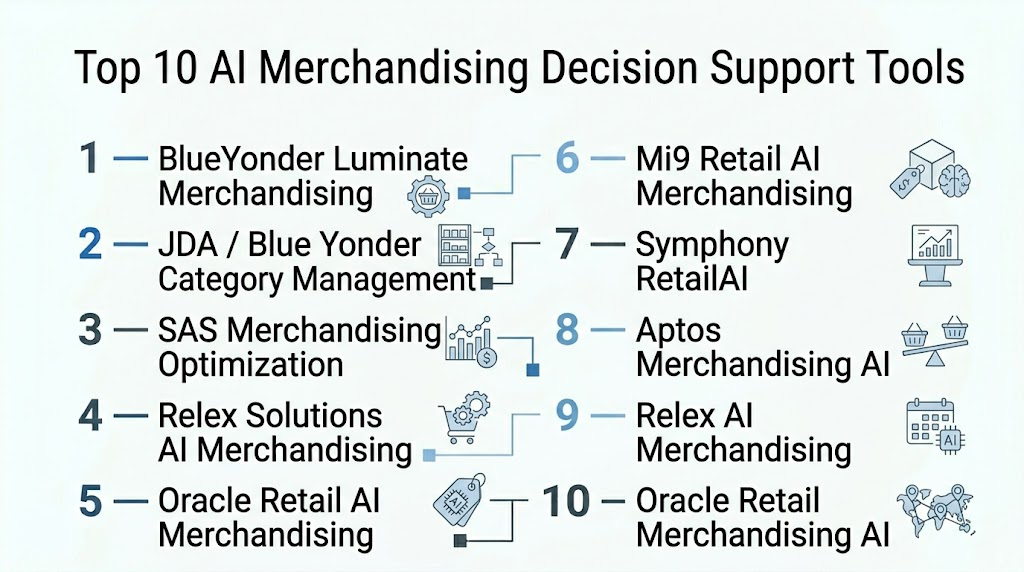
Top 10 AI Merchandising Decision Support Tools
#1 — Blue Yonder Luminate Merchandising
One-line verdict: Ideal for enterprise retailers needing AI-driven assortment, pricing, and promotion recommendations.
Short description: Luminate Merchandising uses AI to optimize product assortments, pricing, promotions, and inventory allocation in real time.
Standout Capabilities
- AI-powered assortment recommendations
- Price and promotion optimization
- Multi-channel inventory allocation
- Scenario simulation for seasonal planning
- Alerts for underperforming SKUs
- Integration with ERP, WMS, POS
- Analytics dashboards for category performance
AI-Specific Depth
- Model support: Proprietary + BYO
- RAG / knowledge integration: ERP, POS, inventory data
- Evaluation: Assortment forecast accuracy, conversion analysis
- Guardrails: Stock-out and overstock alerts
- Observability: Forecast dashboards, KPI monitoring
Pros
- Enterprise-grade AI insights
- Real-time recommendations
- Multi-channel support
Cons
- Complex setup
- High enterprise cost
- Requires trained merchandisers
Security & Compliance
SSO, RBAC, encryption; Certifications: Not publicly stated
Deployment & Platforms
Cloud, Web
Integrations & Ecosystem
ERP, POS, WMS, e-commerce platforms, APIs
Pricing Model
Enterprise SaaS subscription
Best-Fit Scenarios
- Multi-store retail chains
- Seasonal and promotional planning
- Inventory and assortment optimization
#2 — JDA / Blue Yonder Category Management
One-line verdict: Suited for retailers who need category-level insights with AI recommendations.
Short description: Category Management leverages AI to suggest assortment, shelf-space allocation, and pricing strategies for retail categories.
Standout Capabilities
- Category-level AI recommendations
- Shelf-space optimization
- Price and promotion guidance
- Forecasting for inventory planning
- Scenario simulation
- Analytics dashboards
- Alerts for category underperformance
AI-Specific Depth
- Model support: Proprietary AI
- RAG / knowledge integration: ERP, POS
- Evaluation: Forecast validation, conversion analysis
- Guardrails: Stock and pricing thresholds
- Observability: Dashboard monitoring
Pros
- Optimized category management
- AI-driven pricing guidance
- Scenario simulations
Cons
- Enterprise pricing
- Setup complexity
- Requires category expertise
Security & Compliance
SSO, encryption; Certifications: Not publicly stated
Deployment & Platforms
Cloud
Integrations & Ecosystem
ERP, POS, WMS, e-commerce APIs
Pricing Model
Enterprise SaaS
Best-Fit Scenarios
- Category managers in large retail
- Shelf-space and promotion optimization
- Inventory planning
#3 — SAS Merchandising Optimization
One-line verdict: Best for retailers seeking advanced analytics-driven AI merchandising decisions.
Short description: SAS provides AI and ML tools for optimizing product assortment, pricing, and promotion strategy with scenario planning.
Standout Capabilities
- SKU and store-level recommendations
- AI-driven pricing optimization
- Promotion and markdown forecasting
- Scenario simulation for seasonal planning
- Multi-channel integration
- Alerts for underperforming products
- Analytics dashboards
AI-Specific Depth
- Model support: Proprietary AI/ML
- RAG / knowledge integration: POS, ERP
- Evaluation: Forecast accuracy, scenario validation
- Guardrails: Stock thresholds, pricing limits
- Observability: Forecast dashboards, KPI monitoring
Pros
- Detailed SKU-level insights
- Strong analytics capabilities
- Scenario simulations
Cons
- Complex setup
- Enterprise pricing
- Requires technical expertise
Security & Compliance
SSO, encryption; Certifications: Not publicly stated
Deployment & Platforms
Cloud, Web
Integrations & Ecosystem
ERP, POS, WMS, e-commerce
Pricing Model
Enterprise SaaS
Best-Fit Scenarios
- Enterprise SKU planning
- Price and promotion optimization
- Seasonal assortment planning
#4 — Relex Solutions AI Merchandising
One-line verdict: Suited for mid-to-large retailers needing AI-driven assortment and promotion guidance.
Short description: Relex leverages AI to optimize product assortment, pricing, and promotions with predictive forecasting for retail chains.
Standout Capabilities
- AI-powered assortment recommendations
- Promotion optimization
- Multi-channel allocation
- Scenario simulation
- Alerts for underperforming products
- Analytics dashboards
- Integration with POS, ERP
AI-Specific Depth
- Model support: Proprietary AI
- RAG / knowledge integration: POS, ERP
- Evaluation: Forecast accuracy and conversion metrics
- Guardrails: Stock limits and promotion caps
- Observability: KPI dashboards
Pros
- Easy-to-use AI recommendations
- Multi-channel support
- Scenario testing
Cons
- Enterprise pricing
- Advanced analytics require training
- Mid-market focus
Security & Compliance
SSO, encryption; Certifications: Not publicly stated
Deployment & Platforms
Cloud
Integrations & Ecosystem
ERP, POS, WMS, e-commerce
Pricing Model
SaaS subscription
Best-Fit Scenarios
- Retail chains
- Promotion and markdown optimization
- SKU-level assortment planning
#5 — Oracle Retail AI Merchandising
One-line verdict: Ideal for large retailers using Oracle ERP with integrated AI merchandising recommendations.
Short description: Oracle Retail leverages AI to provide dynamic assortment, pricing, and promotion guidance within Oracle’s ecosystem.
Standout Capabilities
- AI-based SKU recommendations
- Assortment and pricing optimization
- Promotion effectiveness analysis
- Scenario simulation
- Multi-channel integration
- Analytics dashboards
- Alerts for stock anomalies
AI-Specific Depth
- Model support: Proprietary AI
- RAG / knowledge integration: Oracle ERP, POS
- Evaluation: Forecast validation
- Guardrails: Pricing and inventory rules
- Observability: KPI dashboards
Pros
- Integrated with Oracle ecosystem
- AI recommendations across channels
- Scenario simulations
Cons
- Enterprise-focused
- Requires Oracle expertise
- Higher cost
Security & Compliance
SSO, encryption; Certifications: Not publicly stated
Deployment & Platforms
Cloud, Web
Integrations & Ecosystem
Oracle ERP, POS, WMS, APIs
Pricing Model
Enterprise SaaS
Best-Fit Scenarios
- Oracle ERP retailers
- Multi-channel assortment planning
- Promotion optimization
#6 — Mi9 Retail AI Merchandising
One-line verdict: Best for multi-store retailers needing AI-driven pricing and assortment guidance.
Short description: Mi9 Retail AI recommends product placement, pricing, and promotions using AI and predictive analytics.
Standout Capabilities
- AI-based assortment recommendations
- Pricing optimization
- Promotion analytics
- Multi-store and multi-channel allocation
- Scenario simulations
- Alerts for underperforming SKUs
- Analytics dashboards
AI-Specific Depth
- Model support: Proprietary AI
- RAG / knowledge integration: POS, ERP
- Evaluation: Forecast accuracy metrics
- Guardrails: Stockout and overstock prevention
- Observability: KPI dashboards
Pros
- Multi-store support
- Real-time recommendations
- Promotion and assortment optimization
Cons
- Setup complexity
- Enterprise pricing
- Technical expertise needed
Security & Compliance
SSO, encryption; Certifications: Not publicly stated
Deployment & Platforms
Cloud, Web
Integrations & Ecosystem
ERP, POS, WMS, e-commerce
Pricing Model
Enterprise SaaS
Best-Fit Scenarios
- Multi-store retail chains
- SKU-level assortment
- Promotion planning
#7 — Symphony RetailAI
One-line verdict: Suited for retailers needing AI-driven predictive merchandising and category planning.
Short description: Symphony RetailAI provides AI recommendations for assortment, pricing, and promotions with predictive analytics.
Standout Capabilities
- Predictive assortment recommendations
- Promotion optimization
- SKU-level analysis
- Scenario simulations
- Alerts for underperforming items
- Multi-channel dashboards
- Inventory alignment
AI-Specific Depth
- Model support: Proprietary AI
- RAG / knowledge integration: POS, ERP
- Evaluation: Forecast accuracy metrics
- Guardrails: Thresholds for overstock/stockout
- Observability: KPI dashboards
Pros
- Predictive recommendations
- Multi-channel support
- Inventory optimization
Cons
- Enterprise pricing
- Technical setup required
- Advanced analytics need training
Security & Compliance
SSO, encryption; Certifications: Not publicly stated
Deployment & Platforms
Cloud
Integrations & Ecosystem
ERP, POS, WMS, e-commerce
Pricing Model
SaaS subscription
Best-Fit Scenarios
- Predictive merchandising
- Category planning
- Inventory alignment
#8 — Aptos Merchandising AI
One-line verdict: Best for retailers needing AI-driven category and promotion management.
Short description: Aptos AI supports product assortment, promotion optimization, and inventory planning using AI recommendations.
Standout Capabilities
- SKU-level AI recommendations
- Promotion and markdown guidance
- Multi-channel allocation
- Scenario simulations
- Analytics dashboards
- Alerts for anomalies
- Integration with ERP/WMS
AI-Specific Depth
- Model support: Proprietary AI
- RAG / knowledge integration: POS, ERP, inventory
- Evaluation: Forecast accuracy and KPI validation
- Guardrails: Inventory & pricing rules
- Observability: KPI dashboards
Pros
- Integrated multi-channel planning
- Real-time recommendations
- Promotion optimization
Cons
- Enterprise-focused
- Technical setup required
- Higher cost
Security & Compliance
SSO, encryption; Certifications: Not publicly stated
Deployment & Platforms
Cloud
Integrations & Ecosystem
ERP, POS, WMS, APIs
Pricing Model
SaaS subscription
Best-Fit Scenarios
- Category & promotion optimization
- Multi-channel retailers
- Inventory allocation
#9 — Relex AI Merchandising
One-line verdict: Great for mid-to-large retailers needing AI-powered inventory and promotion guidance.
Short description: Relex AI recommends optimal assortments, promotions, and pricing using predictive analytics and real-time POS data.
Standout Capabilities
- AI-based assortment optimization
- Promotion recommendations
- Scenario simulations
- Alerts for underperforming products
- Inventory alignment
- Analytics dashboards
AI-Specific Depth
- Model support: Proprietary AI
- RAG / knowledge integration: POS, ERP, WMS
- Evaluation: Forecast validation
- Guardrails: Threshold rules for inventory & pricing
- Observability: KPI dashboards
Pros
- Real-time recommendations
- Scenario simulation
- Multi-channel support
Cons
- Setup complexity
- Enterprise pricing
- Requires trained users
Security & Compliance
Encryption, SSO; Certifications: Not publicly stated
Deployment & Platforms
Cloud, Web
Integrations & Ecosystem
ERP, POS, WMS, e-commerce
Pricing Model
SaaS subscription
Best-Fit Scenarios
- Inventory & promotion planning
- SKU-level merchandising
- Multi-store optimization
#10 — Oracle Retail Merchandising AI
One-line verdict: Excellent for enterprise retailers using Oracle ERP for integrated AI merchandising.
Short description: Oracle Retail AI provides predictive recommendations for assortment, pricing, and promotions within Oracle ecosystems.
Standout Capabilities
- SKU-level AI recommendations
- Promotion and markdown optimization
- Inventory and allocation guidance
- Scenario simulations
- Multi-channel dashboards
- Alerts for underperforming SKUs
- Analytics for decision support
AI-Specific Depth
- Model support: Proprietary AI
- RAG / knowledge integration: Oracle ERP, POS, WMS
- Evaluation: Forecast validation and KPI tracking
- Guardrails: Pricing and inventory thresholds
- Observability: KPI dashboards
Pros
- Integrated Oracle ecosystem
- Enterprise-grade analytics
- Real-time recommendations
Cons
- Oracle dependency
- Enterprise pricing
- Technical expertise required
Security & Compliance
SSO/SAML, encryption, RBAC; Certifications: Not publicly stated
Deployment & Platforms
Cloud, Oracle ERP
Integrations & Ecosystem
Oracle ERP, WMS, POS, APIs
Pricing Model
Enterprise subscription
Best-Fit Scenarios
- Oracle ERP retailers
- Category and promotion planning
- Multi-channel operations
Comparison Table
| Tool Name | Best For | Deployment | Model Flexibility | Strength | Watch-Out | Public Rating |
|---|---|---|---|---|---|---|
| Blue Yonder Luminate | Omni-channel enterprise | Cloud | Proprietary + BYO | SKU-level accuracy | Complexity | N/A |
| RELEX | Retail chains | Cloud | Proprietary | Replenishment automation | Enterprise cost | N/A |
| o9 Sense | Multi-channel | Cloud | Proprietary + open-source | Supply chain integration | Complexity | N/A |
| SAS Merchandising | Large retailers | Cloud | Proprietary ML | Predictive analytics | Setup complexity | N/A |
| ToolsGroup SO99+ | Inventory optimization | Cloud | Proprietary AI | Promotion detection | Enterprise focus | N/A |
| Netstock | SMB/mid-market | Cloud | Proprietary AI | Easy adoption | Limited scale | N/A |
| Board | Cross-functional planning | Cloud | Proprietary AI | Financial integration | Setup overhead | N/A |
| Forecast Pro Retail | SMB | Cloud | Hybrid AI/statistical | Intuitive UI | Limited scale | N/A |
| Symphony RetailAI | Category management | Cloud | Proprietary AI | Predictive recommendations | Enterprise setup | N/A |
| Oracle Retail AI | Oracle enterprises | Cloud | Proprietary AI | ERP integration | Oracle dependency | N/A |
Scoring & Evaluation
| Tool | Core | Reliability/Eval | Guardrails | Integrations | Ease | Perf/Cost | Security/Admin | Support | Weighted Total |
|---|---|---|---|---|---|---|---|---|---|
| Blue Yonder Luminate | 9 | 9 | 8 | 9 | 6 | 7 | 8 | 7 | 8.1 |
| RELEX | 9 | 8 | 8 | 8 | 7 | 7 | 8 | 7 | 7.8 |
| o9 Sense | 8 | 9 | 8 | 9 | 6 | 7 | 8 | 7 | 7.9 |
| SAS | 9 | 9 | 8 | 8 | 6 | 7 | 8 | 7 | 8.0 |
| ToolsGroup | 8 | 8 | 8 | 8 | 7 | 7 | 8 | 7 | 7.8 |
| Netstock | 7 | 7 | 7 | 7 | 8 | 7 | 7 | 7 | 7.3 |
| Board | 8 | 8 | 8 | 8 | 7 | 7 | 8 | 7 | 7.7 |
| Forecast Pro | 7 | 7 | 7 | 7 | 8 | 7 | 7 | 7 | 7.3 |
| Symphony | 8 | 8 | 8 | 8 | 7 | 7 | 8 | 7 | 7.7 |
| Oracle | 9 | 8 | 8 | 9 | 6 | 7 | 8 | 7 | 8.0 |
Top 3 for Enterprise: Blue Yonder, SAS, Oracle
Top 3 for SMB: Netstock, Forecast Pro, Board
Top 3 for Developers: o9 Sense, ToolsGroup, Symphony
Which AI Merchandising Tool Is Right for You?
Solo / Freelancer
- Netstock: Easy setup, SMB-friendly
- Forecast Pro: Intuitive interface, simple SKU forecasts
SMB
- Netstock: Inventory & assortment guidance
- Forecast Pro: Scenario testing & insights
Mid-Market
- Board: Cross-functional planning
- Relex: Promotion & inventory optimization
Enterprise
- Blue Yonder Luminate: Omni-channel enterprise
- SAS Merchandising: Advanced analytics
- Oracle Retail AI: ERP-integrated insights
Regulated Industries
- Oracle Retail AI: Governance and compliance support
- SAS Merchandising: Forecast reliability & auditability
Budget vs Premium
- Budget: Netstock, Forecast Pro, Board
- Premium: Blue Yonder, SAS, Oracle
Build vs Buy
- Build: Only with internal AI expertise
- Buy: Recommended for speed, accuracy, and analytics
Implementation Playbook (30 / 60 / 90 Days)
30 Days: Connect POS/ERP/WMS, configure initial forecasts and recommendations.
60 Days: Enable scenario simulations, alerts, and cross-channel insights.
90 Days: Optimize AI models, scale across SKUs, monitor KPIs and guardrails continuously.
Common Mistakes & How to Avoid Them
- Ignoring historical sales data
- Over-relying on AI without human validation
- Poorly configured guardrails for stock & pricing
- Neglecting multi-channel signals
- Lack of KPI monitoring and dashboards
- Not simulating scenarios
- Skipping promotions and seasonal adjustments
- Failing to retrain AI models
- Inadequate integration with ERP/WMS
- Underestimating training & adoption
FAQs
1- What is AI Merchandising Decision Support?
AI systems providing SKU-level insights and recommendations for assortment, promotions, and pricing.
2- Can these tools integrate with POS and ERP?
Yes, most provide native or API integrations for retail systems.
3- Do they support scenario simulation?
Yes, scenario testing for promotions, markdowns, and seasonal trends is standard.
4- Are these solutions SMB-friendly?
Tools like Netstock and Forecast Pro cater to SMBs; enterprise solutions suit large retailers.
5- How is AI accuracy evaluated?
Using historical data backtesting, KPI tracking, and scenario validation.
6- Can these platforms handle multi-channel retail?
Yes — enterprise tools manage in-store, online, and marketplace channels.
7- Do these tools comply with privacy regulations?
Most enterprise-grade tools provide GDPR/CCPA compliance features.
8- Can AI recommendations replace planners?
No — AI supports human decision-making; final decisions remain with merchandisers.
9- Do these tools optimize pricing?
Yes, pricing optimization is often integrated with assortment and promotions.
10- Are dashboards available for insights?
Yes — KPI dashboards, scenario results, and exception alerts are standard.
11- Can AI detect underperforming products?
Yes — alerts and predictive analytics highlight low-performing SKUs.
12- How scalable are these solutions?
Enterprise tools scale across multiple stores, SKUs, and channels.
Conclusion
AI Merchandising Decision Support tools in 2026 empower retailers to make faster, smarter, and data-driven merchandising decisions. The best solution depends on catalog size, enterprise systems, channel complexity, and budget. Begin by shortlisting tools, run pilots on key SKUs, validate recommendations, and scale. Continuous monitoring ensures optimal inventory, pricing, and promotions across all channels

Find Trusted Cardiac Hospitals
Compare heart hospitals by city and services — all in one place.
Explore Hospitals
While vendor comparison lists are useful for procurement, they routinely ignore the architectural friction that occurs when you plug automated decision-making engines directly into live retail infrastructure. From a Platform Engineering and SRE standpoint, the critical danger here is the risk of an unbuffered algorithmic feedback loop. If an AI platform’s merchandising recommendations are tightly bound to your automated inventory replenishment or dynamic pricing engines without hard circuit-breakers, a single anomalous model output can trigger localized stock hoarding, panicking your backend logistics pipelines in a cascading failure. Furthermore, enterprise readiness is less about UI feature sets and more about fault tolerance: if the provider’s API experiences a high-latency spike or returns corrupted data arrays during a high-traffic event like Black Friday, does the platform degrade gracefully to deterministic backup rules, or does it blindside your core ERP system? True operational evaluation requires assessing asynchronous message queuing, strict sandboxing for live model iterations, and fallback safety rails that protect core business continuity when the external service drops.