
Introduction
AI MES Augmentation Modules enhance traditional Manufacturing Execution Systems with artificial intelligence capabilities. They provide predictive analytics, anomaly detection, production optimization, and real-time decision support. These modules enable manufacturers to transform raw MES data into actionable insights, helping production teams, quality engineers, plant managers, and operators make smarter decisions.
Why It Matters: Modern manufacturing generates vast amounts of machine, sensor, and operator data. Traditional MES platforms provide visibility but often lack predictive intelligence, automated anomaly detection, and optimization features. AI augmentation modules analyze live data, detect bottlenecks, recommend corrective actions, and continuously learn from historical trends. This reduces downtime, improves throughput, enhances product quality, and strengthens operational efficiency.
Real-World Use Cases:
- Predictive maintenance recommendations integrated with MES
- Real-time production scheduling and resource allocation optimization
- Process anomaly detection and root cause suggestions
- Quality trend analysis with automated alerts for deviations
- Energy and resource consumption optimization in production lines
- Intelligent material handling and inventory recommendations
- Operator guidance for complex production workflows
- Multi-site production coordination with AI insights
- Batch release decision support based on predictive quality metrics
- Performance benchmarking across machines, lines, or plants
Evaluation Criteria for Buyers:
- Compatibility with existing MES platforms
- Real-time data ingestion and AI analytics
- Integration with ERP, QMS, IoT, and production systems
- Predictive analytics and anomaly detection capabilities
- Ease of use for operators, supervisors, and engineers
- Scalability across lines, shifts, and multiple sites
- Alerting, KPI dashboards, and visualization tools
- Security, governance, and compliance features
- Support for root cause analysis and continuous improvement
- Ability to leverage both historical and real-time data
- Vendor support and AI model transparency
Best For: Plant managers, MES administrators, production supervisors, and operations teams in high-volume or complex manufacturing environments seeking AI-enabled decision support.
Not Ideal For: Small-scale operations with minimal MES usage or simple scheduling needs where manual adjustments are sufficient.
What’s Changed in AI MES Augmentation Modules
- Integration of AI models directly within MES for real-time decision-making
- Predictive analytics for production scheduling, maintenance, and quality
- Anomaly detection in process parameters, machine performance, and batch quality
- AI-assisted root cause analysis for deviations and defects
- Dynamic optimization of production sequencing and material flow
- Operator guidance with AI-generated work instructions
- Multi-site coordination with centralized AI insights
- AI-based energy consumption and efficiency optimization
- Alert prioritization and workflow automation within MES
- Continuous learning from historical and live production data
- Cloud and hybrid deployment options for flexibility
- Enhanced visualization dashboards for management and operations
- Governance, audit, and compliance support for regulated manufacturing
Quick Buyer Checklist
- Integration with current MES platform
- Real-time data analysis and predictive capability
- Anomaly detection and root cause recommendation
- Quality monitoring and alerting
- Operator guidance and workflow assistance
- Multi-site scalability
- ERP, QMS, and IoT integration
- Role-based access and auditability
- Dashboarding and reporting flexibility
- Energy and resource optimization features
- Batch and discrete production support
- Vendor support and AI model transparency
- Security, governance, and compliance controls
- Ease of deployment and user adoption
- Alert prioritization and KPI alignment
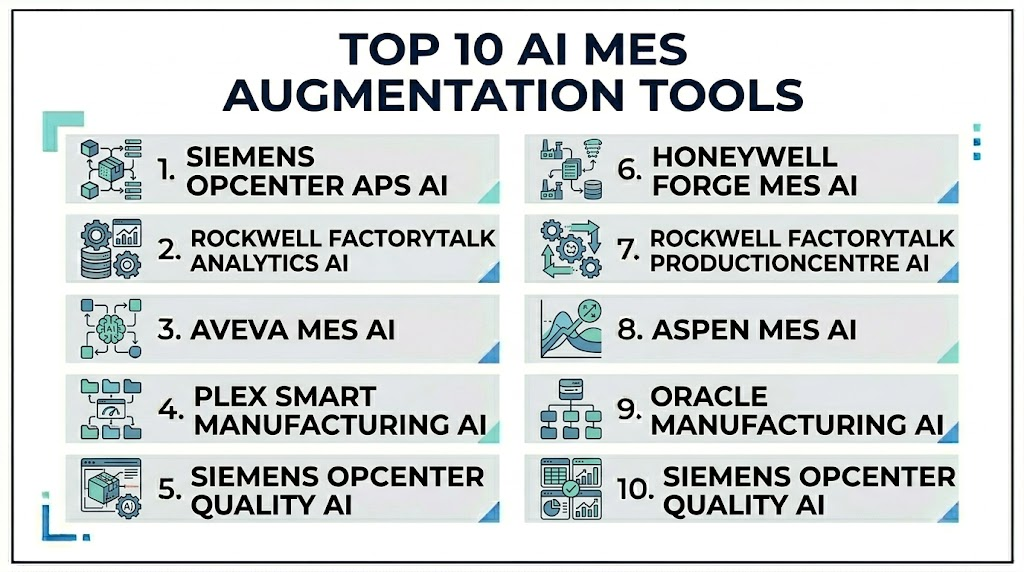
Top 10 AI MES Augmentation Tools
1- Siemens Opcenter APS AI
One-Line Verdict: Best for manufacturers needing AI-enhanced production planning and scheduling with MES integration.
Short Description: Siemens Opcenter APS integrates AI to optimize production sequencing, material allocation, and scheduling decisions. It reduces bottlenecks, improves throughput, and balances resources while staying integrated with MES.
Standout Capabilities
- AI-driven production scheduling
- Material allocation optimization
- Bottleneck prediction
- Machine utilization analysis
- Predictive maintenance alerts
- Multi-site coordination
- KPI dashboards and reporting
- Operator guidance integration
AI-Specific Depth
- Model support: Proprietary AI models for scheduling optimization
- Knowledge integration: MES data, ERP inputs, sensor readings
- Evaluation: Throughput metrics and schedule adherence
- Guardrails: Operational limits and production constraints
- Observability: Dashboards, schedule tracking, KPI monitoring
Pros
- Reduces production bottlenecks
- Improves resource utilization
- Seamless MES integration
Cons
- Implementation complexity
- Advanced features require training
- Proprietary AI limits customization
Security & Compliance
SSO, role-based access, audit logs, encryption, compliance support
Deployment & Platforms
Cloud, hybrid, web dashboards
Integrations & Ecosystem
MES systems, ERP platforms, IoT sensors, KPI dashboards, operator guidance
Pricing Model
Subscription or licensing, not publicly stated
Best-Fit Scenarios
- Multi-line production scheduling
- Complex material flow environments
- Multi-site plant coordination
2- Rockwell FactoryTalk Analytics AI
One-Line Verdict: Best for discrete manufacturers needing AI-based MES insights and process optimization.
Short Description: Rockwell FactoryTalk AI modules analyze MES production data to detect anomalies, optimize processes, and provide real-time insights for operators and quality teams.
Standout Capabilities
- Process anomaly detection
- Predictive production insights
- AI-driven operator guidance
- KPI dashboards
- Root cause recommendations
- Multi-line visibility
- Real-time alerts
- MES integration
AI-Specific Depth
- Model support: Proprietary AI analytics modules
- Knowledge integration: MES logs, machine sensors, production metrics
- Evaluation: Throughput and defect tracking
- Guardrails: Alert thresholds and safety constraints
- Observability: Dashboards, alerts, KPI monitoring
Pros
- Real-time process visibility
- Integrates production and quality insights
- Proactive production adjustments
Cons
- Best with Rockwell MES
- Requires operator training
- Proprietary AI models
Security & Compliance
Role-based access, SSO, audit logs, encryption
Deployment & Platforms
Cloud and on-prem, web and mobile dashboards
Integrations & Ecosystem
MES system, IoT sensors, ERP platforms, KPI dashboards, operator guidance
Pricing Model
Subscription-based, not publicly stated
Best-Fit Scenarios
- Discrete manufacturing lines
- Production anomaly prevention
- KPI-based operational decision support
3- AVEVA MES AI
One-Line Verdict: Best for process industries integrating AI into MES for predictive control and optimization.
Short Description: AVEVA MES AI modules provide predictive analytics, quality monitoring, and production optimization. Teams can respond proactively to deviations and improve throughput.
Standout Capabilities
- Predictive production insights
- Quality anomaly detection
- KPI dashboards
- Operator recommendations
- Multi-site monitoring
- Real-time alerts
- Root cause analysis
- MES integration
AI-Specific Depth
- Model support: Proprietary AI predictive models
- Knowledge integration: MES, sensor, quality, and historical data
- Evaluation: Production adherence, quality KPIs
- Guardrails: Safety limits and operational constraints
- Observability: Dashboards, alerts, KPI trends
Pros
- Enhances MES with predictive intelligence
- Supports multi-site coordination
- Reduces process deviations
Cons
- Complex setup
- Training required
- Proprietary AI limits flexibility
Security & Compliance
RBAC, audit logs, encryption, compliance tracking
Deployment & Platforms
Cloud, hybrid, web dashboards
Integrations & Ecosystem
MES, historian, ERP, IoT sensors, operator dashboards, KPI visualization
Pricing Model
Enterprise subscription, not publicly stated
Best-Fit Scenarios
- Continuous process production
- Predictive quality monitoring
- Multi-site process optimization
4- Plex Smart Manufacturing AI
One-Line Verdict: Best for cloud MES with AI insights for discrete and batch production.
Short Description: Plex AI modules augment MES with real-time insights, predictive analytics, anomaly detection, and operator guidance to improve efficiency and quality.
Standout Capabilities
- Predictive production insights
- Anomaly detection
- Operator alerts and guidance
- KPI dashboards
- Batch and discrete process insights
- Workflow optimization
- Multi-site visibility
- MES integration
AI-Specific Depth
- Model support: Proprietary predictive modules
- Knowledge integration: MES and production data
- Evaluation: Production KPIs, deviation monitoring
- Guardrails: Alert thresholds, workflow approval
- Observability: Dashboards, alerts, KPI monitoring
Pros
- Enhances MES decision-making
- Cloud-based flexibility
- Predictive insights improve throughput
Cons
- Works best with Plex MES
- Proprietary AI
- Training required
Security & Compliance
SSO, audit logs, role-based access, encryption
Deployment & Platforms
Cloud, web dashboards
Integrations & Ecosystem
MES, ERP, IoT sensors, operator dashboards, KPI visualization
Pricing Model
Subscription, not publicly stated
Best-Fit Scenarios
- Plex MES augmentation
- Predictive insights for production
- Multi-site MES monitoring
5- Siemens Opcenter Quality AI
One-Line Verdict: Best for MES augmentation focusing on quality and process anomaly detection.
Short Description: Opcenter Quality AI modules enhance MES to monitor production quality, detect deviations, and provide operator alerts and root cause recommendations.
Standout Capabilities
- Predictive quality analytics
- Defect prediction
- Anomaly detection
- Operator alerts
- MES integration
- KPI dashboards
- Root cause analysis
- Multi-site visibility
AI-Specific Depth
- Model support: Proprietary AI models
- Knowledge integration: MES, production, and sensor data
- Evaluation: Defect rate reduction, process compliance
- Guardrails: Alert thresholds, operator review
- Observability: Dashboards, KPI tracking, alerts
Pros
- Focus on quality augmentation
- Integrates with MES
- Reduces defect rates
Cons
- Advanced configuration required
- Best with Siemens MES
- Proprietary AI
Security & Compliance
Role-based access, audit logs, encryption, regulatory support
Deployment & Platforms
Cloud, hybrid, web dashboards
Integrations & Ecosystem
MES, quality systems, sensors, dashboards, KPI visualization
Pricing Model
Subscription-based, not publicly stated
Best-Fit Scenarios
- Quality-driven MES augmentation
- Defect prevention
- Multi-site production monitoring
6- Honeywell Forge MES AI
One-Line Verdict: Best for industrial process MES environments with AI-driven predictive insights.
Short Description: Honeywell Forge AI modules augment MES with predictive production insights, anomaly detection, and process optimization, suitable for process and hybrid industries.
Standout Capabilities
- Predictive analytics
- Process optimization
- Anomaly detection
- KPI dashboards
- Operator guidance
- Multi-site coordination
- MES integration
- Root cause insights
AI-Specific Depth
- Model support: Proprietary predictive AI
- Knowledge integration: MES, historian, sensor, and production data
- Evaluation: Throughput, OEE, and quality metrics
- Guardrails: Operational limits, alert thresholds
- Observability: Dashboards, alerts, KPI monitoring
Pros
- Enhances MES decision-making
- Supports process optimization
- Predictive insights improve throughput
Cons
- MES-specific integration required
- Proprietary models
- Training needed
Security & Compliance
Role-based access, audit logs, encryption, compliance support
Deployment & Platforms
Cloud, hybrid, web dashboards
Integrations & Ecosystem
MES, historian, ERP, IoT, operator dashboards
Pricing Model
Enterprise subscription, not publicly stated
Best-Fit Scenarios
- Process industry MES augmentation
- Predictive production insights
- Multi-site coordination
7- Rockwell FactoryTalk ProductionCentre AI
One-Line Verdict: Best for discrete MES environments with AI-driven production intelligence.
Short Description: FactoryTalk ProductionCentre AI modules augment MES with predictive analytics, quality monitoring, and workflow optimization.
Standout Capabilities
- Predictive production insights
- Quality monitoring
- AI-based workflow optimization
- KPI dashboards
- Operator guidance alerts
- MES integration
- Anomaly detection
- Multi-site support
AI-Specific Depth
- Model support: Proprietary AI modules
- Knowledge integration: MES, ERP, sensor, and production data
- Evaluation: Throughput, quality metrics
- Guardrails: Alert rules, operational constraints
- Observability: Dashboards, alerts, KPI monitoring
Pros
- Real-time MES augmentation
- Supports discrete manufacturing needs
- Operator guidance improves execution
Cons
- Requires Rockwell MES
- Proprietary AI models
- Training required
Security & Compliance
Role-based access, audit logs, encrypted communication
Deployment & Platforms
Cloud, hybrid, web dashboards
Integrations & Ecosystem
MES, ERP, sensors, operator dashboards, KPI visualization
Pricing Model
Subscription-based, not publicly stated
Best-Fit Scenarios
- Discrete production optimization
- Quality monitoring
- MES workflow improvement
8- Aspen MES AI
One-Line Verdict: Best for process manufacturers seeking AI-driven MES augmentation and analytics.
Short Description: Aspen MES AI modules provide predictive process insights, quality anomaly detection, and workflow guidance to improve MES decision-making.
Standout Capabilities
- Predictive process analytics
- Anomaly detection
- Operator guidance
- KPI dashboards
- Workflow recommendations
- Multi-site visibility
- Quality alerts
- MES integration
AI-Specific Depth
- Model support: Proprietary predictive AI
- Knowledge integration: MES, historian, sensor, and production data
- Evaluation: Throughput, quality KPIs
- Guardrails: Alert thresholds, process limits
- Observability: Dashboards, alerts, KPI monitoring
Pros
- Process industry MES augmentation
- Predictive insights
- Operator guidance
Cons
- Proprietary AI
- MES-specific integration required
- Training needed
Security & Compliance
Role-based access, audit logs, encryption, regulatory support
Deployment & Platforms
Cloud, hybrid, web dashboards
Integrations & Ecosystem
MES, historian, ERP, IoT, operator dashboards
Pricing Model
Enterprise subscription, not publicly stated
Best-Fit Scenarios
- Process manufacturing MES
- Predictive process insights
- Quality monitoring
9- Oracle Manufacturing AI
One-Line Verdict: Best for enterprises using Oracle MES seeking AI-driven production insights and anomaly detection.
Short Description: Oracle MES AI modules augment MES with real-time analytics, predictive insights, quality alerts, and operator guidance.
Standout Capabilities
- Predictive analytics
- Quality anomaly detection
- Operator alerts and guidance
- KPI dashboards
- MES integration
- Multi-site monitoring
- Workflow recommendations
- Root cause insights
AI-Specific Depth
- Model support: Proprietary AI predictive modules
- Knowledge integration: MES, ERP, sensor, and production data
- Evaluation: Production throughput, quality metrics
- Guardrails: Alerts, operational constraints
- Observability: Dashboards, KPI trends, production alerts
Pros
- Enterprise MES augmentation
- Predictive insights
- Operator guidance
Cons
- Proprietary AI
- Oracle MES dependency
- Training required
Security & Compliance
SSO, audit logs, role-based access, encryption, compliance support
Deployment & Platforms
Cloud, web dashboards
Integrations & Ecosystem
Oracle MES, ERP, IoT sensors, dashboards, operator guidance
Pricing Model
Enterprise subscription, not publicly stated
Best-Fit Scenarios
- Oracle MES augmentation
- Predictive production insights
- Quality anomaly monitoring
10- Siemens Opcenter Quality AI
One-Line Verdict: Best for MES quality augmentation focusing on defect prediction and process monitoring.
Short Description: Siemens Opcenter Quality AI modules provide predictive quality analytics, defect detection, and operator alerts to enhance MES quality monitoring.
Standout Capabilities
- Predictive quality analytics
- Defect prediction
- Anomaly detection
- Operator alerts
- KPI dashboards
- MES integration
- Root cause analysis
- Multi-site visibility
AI-Specific Depth
- Model support: Proprietary AI models
- Knowledge integration: MES, production, and sensor data
- Evaluation: Defect rate reduction, process compliance
- Guardrails: Alert thresholds, operator review
- Observability: Dashboards, KPI tracking, alerts
Pros
- Enhances MES quality monitoring
- Supports defect prevention
- Multi-site capability
Cons
- Best with Siemens MES
- Proprietary AI models
- Training required
Security & Compliance
Role-based access, audit logs, encryption, compliance support
Deployment & Platforms
Cloud, hybrid, web dashboards
Integrations & Ecosystem
MES, quality systems, sensors, dashboards, KPI visualization
Pricing Model
Subscription-based, not publicly stated
Best-Fit Scenarios
- MES quality augmentation
- Predictive defect detection
- Multi-site production monitoring
Comparison Table
| Tool Name | Best For | Deployment | Model Flexibility | Strength | Watch-Out | Public Rating |
|---|---|---|---|---|---|---|
| Siemens Opcenter APS AI | Production planning | Cloud/hybrid | Proprietary | Scheduling optimization | Complex integration | N/A |
| Rockwell FactoryTalk Analytics AI | Discrete MES | Cloud/on-prem | Proprietary | Real-time insights | MES-specific | N/A |
| AVEVA MES AI | Process MES | Cloud/hybrid | Proprietary | Multi-site optimization | Setup complexity | N/A |
| Plex Smart Manufacturing AI | Cloud MES | Cloud | Proprietary | Predictive insights | Plex MES dependency | N/A |
| Siemens Opcenter Quality AI | MES quality | Cloud/hybrid | Proprietary | Defect prediction | Siemens MES | N/A |
| Honeywell Forge MES AI | Process MES | Cloud/hybrid | Proprietary | Predictive insights | MES integration required | N/A |
| Rockwell FactoryTalk ProductionCentre AI | Discrete MES | Cloud/on-prem | Proprietary | Operator guidance | MES-specific | N/A |
| Aspen MES AI | Process MES | Cloud/hybrid | Proprietary | Quality anomaly detection | Proprietary AI | N/A |
| Oracle Manufacturing AI | Enterprise MES | Cloud | Proprietary | Enterprise insights | Oracle MES dependency | N/A |
| Siemens Opcenter Quality AI | MES quality | Cloud/hybrid | Proprietary | Defect prediction | Siemens MES | N/A |
Scoring & Evaluation
Scoring is comparative, highlighting AI intelligence, MES integration, real-time analytics, anomaly detection, ease of use, and enterprise scalability.
| Tool | Core Features | AI Analytics | Guardrails | Integrations | Ease of Use | Performance & Cost | Security/Admin | Support | Weighted Total |
|---|---|---|---|---|---|---|---|---|---|
| Siemens Opcenter APS AI | 9 | 9 | 8 | 8 | 8 | 8 | 8 | 8 | 8.3 |
| Rockwell FactoryTalk Analytics AI | 8 | 9 | 8 | 8 | 8 | 8 | 8 | 8 | 8.2 |
| AVEVA MES AI | 9 | 8 | 8 | 9 | 7 | 8 | 8 | 8 | 8.2 |
| Plex Smart Manufacturing AI | 8 | 8 | 8 | 9 | 8 | 8 | 8 | 8 | 8.1 |
| Siemens Opcenter Quality AI | 8 | 8 | 8 | 8 | 8 | 8 | 8 | 8 | 8.0 |
| Honeywell Forge MES AI | 8 | 8 | 8 | 8 | 7 | 8 | 8 | 8 | 7.9 |
| Rockwell FactoryTalk ProductionCentre AI | 8 | 8 | 8 | 8 | 7 | 8 | 8 | 7 | 7.9 |
| Aspen MES AI | 8 | 8 | 7 | 8 | 7 | 8 | 8 | 7 | 7.8 |
| Oracle Manufacturing AI | 8 | 8 | 8 | 8 | 7 | 8 | 8 | 7 | 7.9 |
| Siemens Opcenter Quality AI | 8 | 8 | 8 | 8 | 7 | 8 | 8 | 7 | 7.9 |
Which AI MES Augmentation Module Is Right for You
Solo / Freelancer
Use lightweight modules like Plex AI or Siemens Opcenter Quality AI for proof-of-concept and single-line MES augmentation.
SMB
Modules like Plex Smart Manufacturing AI and Rockwell FactoryTalk Analytics AI are ideal for smaller MES deployments needing predictive insights and anomaly detection.
Mid-Market
Siemens Opcenter APS AI, AVEVA MES AI, and Honeywell Forge MES AI provide predictive scheduling, quality alerts, and multi-line analytics.
Enterprise
Siemens Opcenter APS AI, AVEVA MES AI, and Oracle Manufacturing AI offer multi-site MES augmentation, predictive insights, and governance-ready dashboards.
Regulated industries
AVES MES AI, Oracle Manufacturing AI, and Siemens Opcenter Quality AI provide audit-ready dashboards, traceable alerts, and compliance support.
Budget vs Premium
Budget-conscious teams can start with Plex AI or Rockwell FactoryTalk Analytics AI. Premium enterprise solutions provide advanced predictive optimization and multi-site capabilities.
Build vs Buy
Pre-built modules reduce implementation risk and accelerate deployment. Build only if the organization has strong data engineering and MES expertise.
Implementation Playbook (30 / 60 / 90 Days)
30 Days: Pilot on one line, validate data sources, define KPIs, train operators, establish alerts.
60 Days: Expand to multiple lines, integrate with ERP/QMS, refine AI models, optimize workflows, verify dashboards.
90 Days: Scale multi-site, standardize dashboards, optimize predictive models, implement continuous improvement, review governance.
Common Mistakes & How to Avoid Them
- Implementing AI without clean MES data
- Overloading dashboards with too many metrics
- Ignoring operator training
- Failing to integrate with ERP or QMS
- Neglecting alert governance
- Assuming AI predictions are always accurate
- Not monitoring model drift
- Deploying without KPIs
- Ignoring compliance requirements
- Failing to standardize dashboards
- Underestimating implementation complexity
- Ignoring AI model validation
- Over-reliance on one module
- Neglecting multi-site coordination
FAQs
1- What are AI MES Augmentation Modules?
Modules that integrate AI with MES to provide predictive analytics, anomaly detection, optimization, and decision support.
2- Why do manufacturers need them?
They enhance MES visibility, reduce downtime, improve throughput, and support proactive process control.
3- How do they integrate with MES?
Via APIs, plugins, or direct database connections for real-time data analysis.
4- Can they predict production delays?
Yes, using historical and live data to forecast bottlenecks or equipment downtime.
5- Do they support quality control?
Yes, they detect anomalies, deviations, and trends, and provide actionable recommendations.
6- Are they useful for small manufacturers?
Yes, if production complexity justifies predictive insights; smaller modules or pilots may suffice.
7- How is predictive maintenance supported?
Modules analyze machine and sensor data to forecast failures and suggest maintenance actions.
8- Can operators trust AI recommendations?
Yes, when validated, with defined KPIs and human-in-the-loop verification.
9- Do these modules require cloud deployment?
No, they can be cloud, hybrid, or on-prem depending on IT and governance requirements.
10- How do they help with multi-site operations?
They provide centralized dashboards, standardized KPIs, and coordination across multiple sites.
11- Are they suitable for regulated industries?
Yes, they support audit trails, role-based access, and compliance-ready dashboards.
12- How do modules impact MES performance?
Proper configuration minimizes performance impact. AI modules may run separately interfacing via APIs.
13- Can modules be customized?
Yes, dashboards, alerts, KPIs, and thresholds can be configured to match production requirements.
14- How is ROI measured?
By reduced downtime, increased throughput, improved quality, faster anomaly response, and operator productivity.
15- Are AI modules vendor-specific?
Some are MES-specific, others support multi-vendor integrations. Choice depends on existing MES environment.
Conclusion
AI MES Augmentation Modules enhance MES platforms with predictive analytics, anomaly detection, scheduling optimization, and operator guidance. Choosing the right module depends on MES environment, production complexity, regulatory requirements, and enterprise scale. Start with one process or line, validate predictive and optimization features, train operators, and scale with standardized dashboards and governance. Focus on KPI monitoring, alert response, predictive insights, and integration with quality and production workflows to maximize benefits.

Find Trusted Cardiac Hospitals
Compare heart hospitals by city and services — all in one place.
Explore Hospitals
MES selection matters less than shop-floor data maturity and integration readiness, which ultimately decide whether it delivers real production value.