
Introduction
AI Product Recommendation Engines are software platforms that use artificial intelligence and machine learning to deliver personalized product suggestions in real time. These engines analyze customer behavior, browsing patterns, purchase history, and contextual signals to recommend products that are most likely to engage each user. By automating personalization at scale, businesses can increase conversions, customer loyalty, and average order value while reducing churn.
In 2026, customers expect highly relevant and personalized shopping experiences across web, mobile, and omnichannel touchpoints. Manual recommendation strategies are no longer sufficient. AI‑driven engines adapt continuously to real‑time user behavior, cross‑channel signals, and changing contexts like seasonality or trends.
Real‑world use cases include:
- Personalized product recommendations on e‑commerce websites
- Cross‑sell and upsell suggestions in mobile apps
- Dynamic email recommendations based on real‑time behavior
- Search‑integrated suggestions improving discovery
- Recommendations in retail kiosks and in‑store screens
- Adaptive recommendations for streaming, playlists, and content
Evaluation criteria buyers should consider:
- Recommendation accuracy and relevance
- Real‑time adaptive learning
- Integration with e‑commerce, CRM, and analytics
- Scalability for large product catalogs
- Explainable AI for recommendations
- Security, privacy, and compliance (SSO, encryption, audit logs)
- Observability and performance metrics
- Guardrails for inappropriate or biased suggestions
- Deployment flexibility (cloud, hybrid, self‑hosted)
- A/B testing and evaluation tooling
- Ease of use for non‑technical teams
- Vendor support and ecosystem
Best for: E‑commerce managers, product and marketing teams, large retailers, subscription services, and digital platforms.
Not ideal for: Small businesses with minimal catalog and low traffic where manual promotions suffice.
What’s Changed in AI Product Recommendation Engines in 2026+
- Agentic workflows: Systems that automatically trigger campaigns based on real‑time user behavior.
- Multimodal personalization: Combining browse history with image and text embeddings for deeper relevance.
- Real‑time adaptive learning: Instant learning from clicks, purchases, and session data.
- Evaluation frameworks: Built‑in A/B test matrices, regression testing, and reliability scoring.
- Guardrails & safety: Filtering inappropriate or biased recommendations.
- Enterprise privacy: Data residency controls, retention policies, encryption by design.
- Cost & latency optimization: Intelligent model routing and usage tracking for cost control.
- Observability: Dashboards tracking recommendations, user engagement, and system health.
- Explainable AI: Outputs that provide insights into why recommendations were made.
- Omnichannel integration: Recommendations across web, mobile, email, kiosks, and apps.
- Cross‑domain insights: Using CRM, search, and third‑party signals for richer personalization.
- Compliance reporting: Built‑in reports for GDPR/CCPA and internal governance.
Quick Buyer Checklist (Scan‑Friendly)
- 📌 Data privacy & retention: Does it support compliant data policies?
- ⚙️ Model flexibility: Hosted, BYO, open‑source, or multi‑model?
- 🔗 Integrations: CRM, ERP, e‑commerce platform, analytics connectors.
- 🧪 Evaluation tooling: A/B tests, regression testing, bias checks.
- 🔒 Guardrails: Filters for inappropriate or harmful suggestions.
- 🚦 Observability: Metrics, latency, cost, and performance dashboards.
- 📊 Real‑time learning: Adaptive personalization capabilities.
- 📍 Explainability: Ability to understand why recommendations were made.
- 📈 Cross‑channel support: Web, mobile, email, in‑store, push notifications.
- 🔄 Deployment: Cloud/Hybrid/Self‑hosted flexibility.
- 🧠 User roles & admin: Role‑based access, audit logs.
- 🛠️ Ease of use: Interfaces for marketers without technical skills.
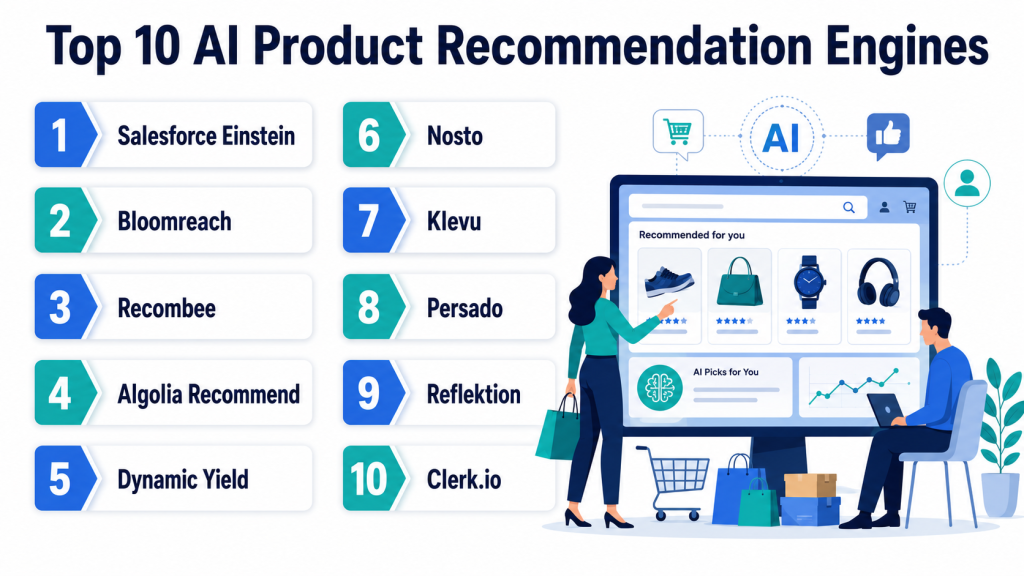
Top 10 AI Product Recommendation Engines
#1 — Salesforce Einstein
One‑line verdict: Best for enterprises needing deeply integrated AI recommendations across CRM and commerce.
Short description: Salesforce Einstein Tailors product recommendations using CRM data, behavior signals, and purchase history across multiple Salesforce clouds.
Standout Capabilities
- Personalized commerce recommendations
- AI‑powered email and marketing suggestions
- Predictive scoring for cross‑sells and upsells
- Deep CRM integration for lifecycle‑aware recommendations
- Omnichannel personalization
- Explainable AI outputs for business teams
AI‑Specific Depth
- Model support: Proprietary hosted
- RAG / knowledge integration: CRM, commerce, analytics
- Evaluation: A/B testing, regression analysis
- Guardrails: Policy filters and content moderation
- Observability: Engagement and performance dashboards
Pros
- Enterprise‑grade integration
- Real‑time adaptive personalization
- Strong analytics and reporting
Cons
- Premium pricing
- Best value only within Salesforce ecosystem
- Requires specialized training
Security & Compliance
Enterprise controls include SSO/SAML, encryption, role‑based access, audit logs, and GDPR compliance.
Certifications: Not publicly stated
Deployment & Platforms
Cloud‑based with web and mobile admin dashboards.
Integrations & Ecosystem
Tight integration with Salesforce CRM, commerce, service, and marketing clouds; extensible APIs and SDKs for custom workflows.
Pricing Model
Subscription‑based enterprise tiers.
Not publicly stated
Best‑Fit Scenarios
- Global retail brands
- CRM‑driven marketing teams
- Large omnichannel e‑commerce
#2 — Bloomreach
One‑line verdict: Excellent for e‑commerce platforms needing unified search and recommendation personalization.
Short description: Bloomreach Personalization combines search, merchandising, and AI recommendations to deliver relevant product suggestions across channels.
Standout Capabilities
- Commerce search + recommendations combo
- Real‑time adaptive insights
- Personalized experiences across web/mobile/email
- Automated merchandising rules
- Behavioral segmentation
- Continuous A/B optimization
AI‑Specific Depth
- Model support: Proprietary hosted
- RAG / knowledge integration: ERP, CMS, analytics
- Evaluation: Regression testing and A/B experiments
- Guardrails: Content and product filters
- Observability: Unified dashboards for engagement metrics
Pros
- Unified search and recommendation experience
- Strong behavioral personalization
- Omnichannel coverage
Cons
- Premium setup complexity
- Training required for full optimization
- Less flexible outside commerce scope
Security & Compliance
Encryption, single sign‑on, and access controls.
Certifications: Not publicly stated
Deployment & Platforms
Cloud with web admin suite.
Integrations & Ecosystem
Connectors for ERP, CMS, email platforms; APIs for extensibility.
Pricing Model
Tiered subscriptions.
Not publicly stated
Best‑Fit Scenarios
- E‑commerce retailers
- Marketing teams optimizing campaigns
- Mid‑ to enterprise‑scale catalogs
#3 — Recombee
One‑line verdict: Developer‑first recommendation engine with flexible APIs for highly customizable use cases.
Short description: Recombee provides machine learning‑driven product and content recommendations via APIs, optimized for developers and custom applications.
Standout Capabilities
- Real‑time API‑based recommendations
- Collaborative and content filtering
- Customizable business logic
- Session‑aware personalization
- A/B testing frameworks
- Supports high‑traffic loads
AI‑Specific Depth
- Model support: Proprietary with BYO model options
- RAG / knowledge integration: N/A
- Evaluation: Offline evaluation, regression
- Guardrails: Threshold validation, content filters
- Observability: Performance and cost metrics
Pros
- Clean API design
- Highly customizable
- Real‑time personalization
Cons
- Requires technical expertise
- Lacks native business dashboard
- Smaller ecosystem for non‑dev teams
Security & Compliance
Encryption and role‑based access controls.
Certifications: Not publicly stated
Deployment & Platforms
Cloud or self‑hosted options with CLI and API tools.
Integrations & Ecosystem
SDKs for Python, JavaScript, Java; event‑driven integration support; event streams for workflows.
Pricing Model
Usage based.
Not publicly stated
Best‑Fit Scenarios
- SaaS platforms
- Mobile apps
- Custom e‑commerce integrations
#4 — Algolia Recommend
One‑line verdict: Ideal for search‑driven applications where fast, scalable product recommendations are essential.
Short description: Algolia Recommend extends search capabilities to provide AI‑powered product suggestions that integrate seamlessly with discovery experiences.
Standout Capabilities
- Instant recommendations integrated with search
- Contextual and session‑aware suggestions
- APIs and SDKs for quick integration
- High throughput and low latency
- Multi‑channel support
AI‑Specific Depth
- Model support: Proprietary
- RAG / knowledge integration: N/A
- Evaluation: Regression and offline testing
- Guardrails: Content moderation layers
- Observability: Latency and throughput metrics
Pros
- Fast and scalable
- Tight search & recommend integration
- Strong developer tooling
Cons
- Limited analytics reporting
- Smaller enterprise stack
- Requires technical setup
Security & Compliance
Encryption and access control.
Certifications: Not publicly stated
Deployment & Platforms
Cloud with APIs and SDKs for web and mobile.
Integrations & Ecosystem
APIs, SDKs, workflow integrations, event hooks.
Pricing Model
Usage‑based tiers.
Not publicly stated
Best‑Fit Scenarios
- Large catalogs with heavy search traffic
- Discovery‑centric apps
- Developers needing real‑time recommendations
#5 — Dynamic Yield
One‑line verdict: Enterprise‑grade omnichannel personalization engine with advanced recommendation workflows.
Short description: Dynamic Yield uses machine learning to optimize product recommendations, personalization campaigns, and cross‑sell/upsell tactics across user journeys.
Standout Capabilities
- Behavioral segmentation and targeting
- Real‑time product recommendations
- Email and campaign personalization
- Sub‑segment enrichment
- Predictive analytics for conversions
- Built‑in A/B and multivariate testing
AI‑Specific Depth
- Model support: Proprietary hosted
- RAG / knowledge integration: CRM, analytics tools
- Evaluation: A/B test matrices and regression
- Guardrails: Policy filters and bias mitigation
- Observability: Engagement and performance dashboards
Pros
- Comprehensive personalization suite
- Strong analytics
- Cross‑channel capabilities
Cons
- Premium pricing
- Complex setup
- Requires trained analysts
Security & Compliance
Encryption, access controls, session logs.
Certifications: Not publicly stated
Deployment & Platforms
Cloud with web dashboards.
Integrations & Ecosystem
ERP, CRM, marketing automation connectors; APIs for extensibility.
Pricing Model
Tiered enterprise subscriptions.
Not publicly stated
Best‑Fit Scenarios
- Large retail ecosystems
- Multi‑channel personalization
- Data‑rich marketing teams
#6 — Nosto
One‑line verdict: Great choice for SMBs and mid‑market retailers seeking AI recommendations with simpler setup.
Short description: Nosto combines purchase behavior, browsing data, and segmentation for automated product suggestions across web and email.
Standout Capabilities
- Out‑of‑the‑box recommendations
- On‑site and email personalization
- User behavior segmentation
- Basic A/B testing
- Pre‑configured templates
AI‑Specific Depth
- Model support: Proprietary ML
- RAG / knowledge integration: POS/ERP connectors
- Evaluation: A/B tests and regression
- Guardrails: Threshold and policy filters
- Observability: Engagement dashboards
Pros
- Easy to deploy
- Tailored for SMBs
- Quick personalization launch
Cons
- Not deep customization
- Limited analytics
- Less powerful for large catalogs
Security & Compliance
Encryption and role‑based controls.
Certifications: Not publicly stated
Deployment & Platforms
Cloud with admin dashboard.
Integrations & Ecosystem
ERP, POS, email connectors; plugin support.
Pricing Model
Subscription.
Not publicly stated
Best‑Fit Scenarios
- Small retailers
- Mid‑market catalogs
- SMB marketing teams
#7 — Klevu
One‑line verdict: Good for retail discovery with combined search and product recommendations.
Short description: Klevu enhances product discovery with search‑linked recommendations tailored to shopper intent.
Standout Capabilities
- Search‑integrated recommendations
- Automated merchandising controls
- Real‑time relevance scoring
- Quick setup for retail platforms
AI‑Specific Depth
- Model support: Proprietary ML
- RAG / knowledge integration: ERP/CMS connectors
- Evaluation: Offline tests
- Guardrails: Content filters
- Observability: Search relevance dashboards
Pros
- Fast to deploy
- Strong search relevance
- Retail focus
Cons
- Limited deep personalization
- Smaller analytics
- Less omnichannel
Security & Compliance
Encryption, access control.
Certifications: Not publicly stated
Deployment & Platforms
Cloud with search API
Integrations & Ecosystem
CMS, POS connectors; API support
Pricing Model
Subscription
Not publicly stated
Best‑Fit Scenarios
- Retail search & recommendations
- Smaller catalogs
- Quick personalization adoption
#8 — Persado
One‑line verdict: Powerful for AI‑driven recommendation plus content personalization in campaigns.
Short description: Persado combines AI product recommendations with persuasive language generation for personalized campaigns.
Standout Capabilities
- AI‑generated content with recommendations
- Campaign orchestration
- Behavioral segmentation
- Predictive customer intent
- Feedback loops for messaging
AI‑Specific Depth
- Model support: Proprietary hosted
- RAG / knowledge integration: CRM connectors
- Evaluation: Campaign performance tests
- Guardrails: Content and language filters
- Observability: Engagement and response analytics
Pros
- Combines recommendations with messaging
- Strong campaign optimization
- Behavioral insights
Cons
- Specialized use case
- Higher complexity
- Requires trained marketing teams
Security & Compliance
Encryption, access controls.
Certifications: Not publicly stated
Deployment & Platforms
Cloud with dashboard and campaign tools
Integrations & Ecosystem
CRM, marketing automation connectors; API access
Pricing Model
Tiered subscription
Not publicly stated
Best‑Fit Scenarios
- Marketing personalization
- Campaign‑driven recommendations
- Customer engagement teams
#9 — Reflektion
One‑line verdict: Adaptive personalization platform for e‑commerce with robust real‑time recommendations.
Short description: Reflektion uses machine learning to deliver individualized recommendations based on shopper interaction.
Standout Capabilities
- Real‑time adaptive recommendations
- Behavioral analysis
- Search and browse optimization
- Continuous learning models
- Ecommerce templates
AI‑Specific Depth
- Model support: Proprietary ML
- RAG / knowledge integration: ERP/CMS connectors
- Evaluation: Regression testing
- Guardrails: Content moderation
- Observability: Performance dashboards
Pros
- Adaptive real‑time personalization
- Ecommerce focus
- Continuous learning
Cons
- Premium pricing
- Setup effort
- Less flexible outside ecommerce
Security & Compliance
Encryption, access control.
Certifications: Not publicly stated
Deployment & Platforms
Cloud with dashboards
Integrations & Ecosystem
ERP, CMS, analytics connectors; APIs
Pricing Model
Tiered subscription
Not publicly stated
Best‑Fit Scenarios
- Ecommerce enterprises
- Real‑time personalization needs
- Data‑driven merchandisers
#10 — Clerk.io
One‑line verdict: Easy to adopt AI engine for SMBs seeking product recommendations with minimal setup.
Short description: Clerk.io provides automated product suggestions and behavioral targeting with simple interfaces.
Standout Capabilities
- On‑site recommendations
- Email product suggestions
- Behavior‑based segmentation
- Quick installation
- Pre‑built templates
AI‑Specific Depth
- Model support: Proprietary ML
- RAG / knowledge integration: ERP/POS connectors
- Evaluation: Basic A/B testing
- Guardrails: Threshold filters
- Observability: Engagement dashboards
Pros
- Quick to adopt
- Budget‑friendly
- Simple dashboards
Cons
- Limited enterprise features
- Smaller analytics
- Less adaptive learning
Security & Compliance
Encryption and access controls.
Certifications: Not publicly stated
Deployment & Platforms
Cloud with admin dashboard
Integrations & Ecosystem
ERP/POS connectors; email integrations
Pricing Model
Subscription
Not publicly stated
Best‑Fit Scenarios
- Small online stores
- SMB marketing
- Quick personalization launch
Comparison Table
| Tool Name | Best For | Deployment | Model Flexibility | Strength | Watch‑Out | Public Rating |
|---|---|---|---|---|---|---|
| Salesforce Einstein | Enterprise | Cloud | Proprietary | Deep CRM integration | Costly | N/A |
| Bloomreach | E‑commerce | Cloud | Proprietary | Unified search & personalization | Premium pricing | N/A |
| Recombee | Developers | Cloud / Self‑hosted | BYO optional | Flexible APIs | Requires technical expertise | N/A |
| Algolia Recommend | Search‑centric | Cloud | Proprietary | Fast real‑time recommendations | Limited analytics | N/A |
| Dynamic Yield | Enterprise | Cloud | Proprietary | Omnichannel personalization | Complex setup | N/A |
| Nosto | SMB / Mid‑market | Cloud | Proprietary | Easy to deploy | Limited customization | N/A |
| Klevu | Mid‑market retail | Cloud | Proprietary | Search recommendations | Smaller analytics | N/A |
| Persado | Marketing campaigns | Cloud | Proprietary | Combines recommendations + content | Specialized use case | N/A |
| Reflektion | Ecommerce | Cloud | Proprietary | Adaptive real‑time personalization | Premium pricing | N/A |
| Clerk.io | SMB | Cloud | Proprietary | Quick adoption | Less advanced analytics | N/A |
Scoring & Evaluation (Transparent Rubric)
Scores are relative and comparative among tools weighted by predictive quality, integrations, guardrails, performance, ease, and admin controls.
| Tool | Core | Reliability/Eval | Guardrails | Integrations | Ease | Perf/Cost | Security/Admin | Support | Weighted Total |
|---|---|---|---|---|---|---|---|---|---|
| Salesforce Einstein | 9 | 9 | 8 | 9 | 8 | 8 | 8 | 8 | 8.6 |
| Bloomreach | 8 | 8 | 8 | 9 | 7 | 8 | 7 | 7 | 7.8 |
| Recombee | 8 | 8 | 7 | 7 | 8 | 7 | 7 | 6 | 7.2 |
| Algolia Recommend | 8 | 8 | 7 | 7 | 8 | 8 | 7 | 6 | 7.4 |
| Dynamic Yield | 9 | 9 | 8 | 9 | 7 | 8 | 8 | 7 | 8.1 |
| Nosto | 7 | 7 | 7 | 6 | 9 | 8 | 7 | 6 | 7.2 |
| Klevu | 7 | 7 | 7 | 6 | 8 | 7 | 7 | 6 | 6.9 |
| Persado | 8 | 8 | 8 | 7 | 7 | 7 | 7 | 6 | 7.4 |
| Reflektion | 8 | 8 | 8 | 7 | 7 | 7 | 7 | 6 | 7.5 |
| Clerk.io | 7 | 7 | 7 | 6 | 9 | 7 | 7 | 6 | 7.0 |
Top 3 for Enterprise: Salesforce Einstein, Dynamic Yield, Bloomreach
Top 3 for SMB: Nosto, Clerk.io, Algolia Recommend
Top 3 for Developers: Recombee, Algolia Recommend, Clerk.io
Which AI Product Recommendation Engine Is Right for You?
Solo / Freelancer
Choose Recombee or Clerk.io — API‑friendly, easy to integrate, low setup.
SMB
Nosto, Clerk.io, or Klevu — simple dashboards, quick launch, easy personalization.
Mid‑Market
Bloomreach, Algolia Recommend, Reflektion — stronger analytics, omni‑channel support, real‑time personalization.
Enterprise
Salesforce Einstein, Dynamic Yield — deep integration, cross‑channel workflows, advanced analytics.
Regulated industries
Salesforce Einstein, Dynamic Yield — strong guardrails and governance, audit trails.
Budget vs Premium
Budget friendly: Clerk.io, Nosto, Klevu
Premium enterprise: Salesforce Einstein, Dynamic Yield, Bloomreach
Build vs Buy
Build if you need custom model logic (Recombee)
Buy for mature personalization workflows (Salesforce, Bloomreach)
Implementation Playbook (30 / 60 / 90 Days)
30 days:
- Select pilot channels
- Integrate engine with web or mobile apps
- Define metrics (engagement, CTR, conversions)
60 days:
- Configure guardrails and filters
- Set up A/B tests and evaluation dashboards
- Train marketing/ops teams on workflows
90 days:
- Monitor performance trends
- Optimize catalog and model thresholds
- Scale across email, mobile push, and in‑store channels
Common Mistakes & How to Avoid Them
- Ignoring evaluation and A/B testing
- Deploying without guardrails
- Poor data hygiene for training data
- Incomplete integrations with CRM or analytics
- Not monitoring recommendation performance
- Overcomplicated personalization rules
- Lack of explainability
- Ignoring privacy compliance
- Not tracking cost/latency metrics
- Using a single data source only
- Underestimating traffic spikes
- Skipping predictive scenario simulations
- Relying on generic recommendations
- Neglecting cross‑channel consistency
FAQs
1‑ What data do AI recommendation engines use?
They use browsing data, purchase history, search queries, CRM signals, and product metadata.
2‑ Are real‑time recommendations possible?
Yes — most modern engines adapt in real time across channels.
3‑ Can these tools integrate with email campaigns?
Yes — many engines tie into marketing automation for email personalization.
4‑ Do they comply with GDPR/CCPA?
Leading engines include controls and policies aligned with privacy regulations.
5‑ Do these platforms support A/B testing?
Yes — most include A/B and multivariate testing for evaluation.
6‑ Are developer APIs included?
Yes — APIs and SDKs are common for flexible integration.
7‑ What deployment options exist?
Cloud is standard; some support hybrid and self‑hosted.
8‑ Do they support omnichannel recommendations?
Yes — web, app, email, and even in‑store screens.
9‑ How is pricing structured?
Subscription or usage based; enterprise tools use tiered pricing.
10‑ How do I evaluate recommendation quality?
Use A/B tests, engagement metrics, and conversion lifts.
11‑ Can SMBs benefit?
Yes — platforms like Nosto and Clerk.io are tailored for SMBs.
12‑ What are guardrails?
Rules to prevent irrelevant, biased, or inappropriate recommendations.
Conclusion
AI Product Recommendation Engines are essential for delivering personalized shopping experiences that boost engagement, conversion, and customer loyalty. The right tool depends on catalog size, channels, technical resources, and budget. SMBs can start quickly with Nosto or Clerk.io, while enterprises gain deep value from Salesforce Einstein or Dynamic Yield. Successful adoption requires careful evaluation, integration planning, and continuous performance monitoring.

Find Trusted Cardiac Hospitals
Compare heart hospitals by city and services — all in one place.
Explore Hospitals