
Introduction
Cities, transportation networks, public venues, and critical infrastructure environments are generating massive volumes of video data every second through CCTV cameras, body-worn cameras, drones, traffic monitoring systems, and smart city sensors. Monitoring this data manually is no longer feasible. AI Public Safety Video Analytics Tools use computer vision, deep learning, object detection, facial analysis, behavioral recognition, and real-time event detection to automatically identify risks, alert authorities, and improve public safety response times.
Unlike traditional surveillance systems that only record footage, modern AI video analytics platforms actively interpret video streams in real time. They can detect suspicious behavior, recognize unusual crowd movement, identify unattended objects, monitor traffic violations, track incidents, and generate automated alerts for law enforcement or emergency response teams. Many platforms also integrate with command centers, emergency dispatch systems, smart city platforms, and law enforcement databases.
As public safety agencies modernize surveillance infrastructure, AI video analytics has become a critical layer in smart city ecosystems. These systems help reduce response times, improve situational awareness, enhance threat detection, and support evidence collection for investigations. At the same time, they introduce important considerations around privacy, ethics, governance, and explainability.
Common use cases include:
- Crowd monitoring and control
- Traffic violation detection
- Suspicious behavior detection
- Perimeter security monitoring
- Public event safety management
- Emergency incident detection
- Missing person tracking
- Infrastructure protection (airports, stations, ports)
When evaluating AI Public Safety Video Analytics tools, buyers should consider:
- Real-time detection accuracy
- Object and behavior recognition capabilities
- Video stream processing speed
- Scalability across camera networks
- Integration with command centers (PSIM/C4I systems)
- Alerting and incident response automation
- Facial and object recognition capabilities
- Privacy and compliance controls
- Edge vs cloud processing capability
- Multi-camera tracking
- Data retention and auditability
- API and system integration support
Best for: Smart cities, law enforcement agencies, transportation authorities, airport security, railway networks, stadium operators, border security agencies, critical infrastructure operators, public safety departments, and private security organizations.
Not ideal for: Small businesses with minimal surveillance needs, organizations without video infrastructure, or environments where AI surveillance is unnecessary or legally restricted.
What’s Changed in AI Public Safety Video Analytics
AI video analytics has rapidly evolved from passive surveillance systems to intelligent real-time safety platforms.
Key trends include:
- Real-time edge AI processing reduces latency in threat detection.
- Multimodal AI combines video, audio, and sensor data for better situational awareness.
- Generative AI summarizes incidents automatically for command centers.
- Advanced object detection identifies weapons, vehicles, and unusual behavior patterns.
- Crowd analytics help prevent stampedes and manage large gatherings.
- AI-powered facial recognition supports identity verification (where legally permitted).
- Drone-based surveillance enhances aerial monitoring capabilities.
- Privacy-preserving AI techniques reduce data exposure risks.
- Automated incident reporting replaces manual surveillance logging.
- AI agents assist control room operators with decision support.
- Smart city integration connects traffic, emergency, and surveillance systems.
- Predictive analytics forecast high-risk zones and incidents.
Quick Buyer Checklist
Before selecting an AI Public Safety Video Analytics platform, ensure it provides:
- ✔ Real-time video processing
- ✔ Object detection and tracking
- ✔ Behavior and anomaly detection
- ✔ Multi-camera correlation
- ✔ Edge and cloud deployment options
- ✔ Integration with command center systems
- ✔ Automated alerting and escalation
- ✔ Scalability across large camera networks
- ✔ Privacy and data governance controls
- ✔ API and system integration support
- ✔ Audit logs and compliance tracking
- ✔ AI explainability and confidence scoring
- ✔ Incident reporting workflows
- ✔ Secure video data storage
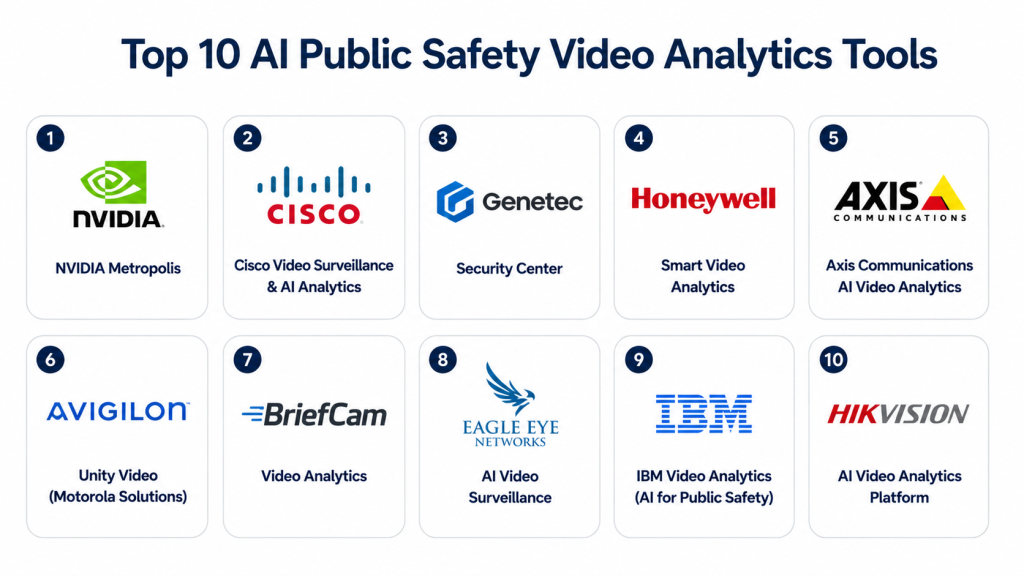
Top 10 AI Public Safety Video Analytics Tools
1 — NVIDIA Metropolis
One-line verdict: Best for building high-performance AI video analytics pipelines for smart cities and critical infrastructure.
Short description
NVIDIA Metropolis is an AI-powered platform that enables real-time video analytics using GPU-accelerated deep learning models for object detection, behavior recognition, and intelligent surveillance at scale.
Standout Capabilities
- Real-time video analytics
- GPU-accelerated processing
- Object detection and tracking
- Smart city integration
- Edge AI deployment
- Multi-camera analytics
- Traffic monitoring
- Incident detection
AI-Specific Depth
- Model support: NVIDIA AI models + custom deep learning models
- RAG / Knowledge integration: N/A (video-first AI platform)
- Evaluation: Model training, validation pipelines, accuracy monitoring
- Guardrails: Policy-based deployment controls, safety constraints
- Observability: GPU performance monitoring, video analytics dashboards, latency tracking
Pros
- Extremely high-performance processing
- Excellent scalability for smart cities
- Strong edge AI capabilities
Cons
- Requires advanced technical expertise
- Hardware dependency (GPU infrastructure)
- Not turnkey for non-technical teams
Security & Compliance
- SSO/SAML: Supported (enterprise setups)
- RBAC: Supported
- Audit logs: Supported
- Encryption: Supported
- Certifications: Not publicly stated
Deployment & Platforms
- Edge
- Cloud
- Hybrid infrastructure
- Linux-based AI systems
Integrations & Ecosystem
- Smart city platforms
- CCTV systems
- IoT sensors
- Traffic systems
- Command center dashboards
Pricing Model
Enterprise / infrastructure-based licensing.
Best-Fit Scenarios
- Smart city surveillance
- Traffic monitoring systems
- Large-scale video analytics infrastructure
2 — Cisco Video Surveillance & AI Analytics
One-line verdict: Best for enterprise and government-grade secure video surveillance integrated with network infrastructure.
Short description
Cisco provides AI-enhanced video surveillance and analytics capabilities integrated with its networking and security ecosystem, enabling real-time monitoring of public safety environments.
Standout Capabilities
- Video surveillance analytics
- Network-integrated security
- Real-time alerting
- Incident detection
- Edge processing support
- Secure video transmission
- Command center integration
- Scalable architecture
AI-Specific Depth
- Model support: Cisco AI + third-party vision models
- RAG / Knowledge integration: N/A
- Evaluation: Monitoring dashboards, system analytics
- Guardrails: Network security policies, access controls
- Observability: Network + video performance monitoring
Pros
- Strong enterprise security integration
- Reliable infrastructure scalability
- Good for mission-critical environments
Cons
- Hardware/network dependency
- Less flexible AI customization
- Requires Cisco ecosystem familiarity
Security & Compliance
- SSO/SAML: Supported
- RBAC: Supported
- Audit logs: Supported
- Encryption: Supported
- Certifications: Enterprise-grade Cisco compliance frameworks
Deployment & Platforms
- On-premises
- Hybrid
- Edge network deployments
Integrations & Ecosystem
- Cisco networking infrastructure
- CCTV systems
- Command center platforms
- Security operations centers
- IoT systems
Pricing Model
Enterprise hardware + software licensing.
Best-Fit Scenarios
- Government surveillance systems
- Airport and transport security
- Critical infrastructure monitoring
3 — Genetec Security Center
One-line verdict: Best for unified public safety video management and command center operations.
Short description
Genetec Security Center is a unified security platform combining video surveillance, access control, and AI-powered analytics for public safety and critical infrastructure protection.
Standout Capabilities
- Unified video management
- AI video analytics
- Incident detection
- Access control integration
- Real-time monitoring
- Multi-site surveillance
- Investigation tools
- Command center dashboards
AI-Specific Depth
- Model support: AI video analytics modules + integrations
- RAG / Knowledge integration: Security databases and event logs
- Evaluation: Incident review workflows
- Guardrails: Role-based access, security policies
- Observability: Video event analytics, system health dashboards
Pros
- Strong unified security platform
- Excellent investigation tools
- Widely used in public safety sector
Cons
- Complex deployment
- Enterprise pricing
- Requires training for operators
Security & Compliance
- SSO/SAML: Supported
- RBAC: Supported
- Audit logs: Supported
- Encryption: Supported
- Certifications: Not publicly stated
Deployment & Platforms
- Cloud
- On-premises
- Hybrid
Integrations & Ecosystem
- CCTV systems
- Access control systems
- Public safety platforms
- Emergency response systems
- IoT sensors
Pricing Model
Enterprise licensing.
Best-Fit Scenarios
- City surveillance centers
- Law enforcement monitoring
- Critical infrastructure security
4 — Honeywell Smart Video Analytics
One-line verdict: Best for industrial and infrastructure safety monitoring with AI-driven surveillance.
Short description
Honeywell provides AI video analytics solutions for monitoring industrial environments, transportation hubs, and critical infrastructure with automated threat detection and safety monitoring.
Standout Capabilities
- AI video monitoring
- Industrial safety detection
- Perimeter security
- Object tracking
- Incident alerts
- Multi-camera support
- Edge analytics
- Security dashboards
AI-Specific Depth
- Model support: Honeywell AI + partner models
- RAG / Knowledge integration: N/A
- Evaluation: Event analytics and validation tools
- Guardrails: Safety and security policy enforcement
- Observability: Operational dashboards, video event tracking
Pros
- Strong industrial safety use cases
- Reliable infrastructure monitoring
- Good edge deployment options
Cons
- Less flexible for custom AI models
- Industrial-focused rather than city-wide
- Enterprise deployment complexity
Security & Compliance
- SSO/SAML: Supported
- RBAC: Supported
- Audit logs: Supported
- Encryption: Supported
- Certifications: Not publicly stated
Deployment & Platforms
- Edge
- Hybrid
- On-premises
Integrations & Ecosystem
- Industrial IoT systems
- CCTV infrastructure
- Safety systems
- Command centers
- SCADA environments
Pricing Model
Enterprise + infrastructure licensing.
Best-Fit Scenarios
- Industrial safety monitoring
- Airports and railways
- Critical infrastructure protection
5 — Axis Communications AI Video Analytics
One-line verdict: Best for scalable camera-based AI surveillance with edge intelligence.
Short description
Axis provides AI-enabled video analytics integrated directly into network cameras, enabling edge-based detection of events without requiring centralized processing.
Standout Capabilities
- Edge AI video analytics
- Object detection
- Motion tracking
- Scene analysis
- Camera-based intelligence
- Scalable surveillance networks
- Event alerts
- Remote monitoring
AI-Specific Depth
- Model support: Edge AI models embedded in cameras
- RAG / Knowledge integration: N/A
- Evaluation: Camera-level analytics monitoring
- Guardrails: Device-level security policies
- Observability: Camera analytics dashboards, event logs
Pros
- Strong edge processing capability
- Scalable deployment across cameras
- Reduced central processing load
Cons
- Hardware dependency (Axis cameras)
- Limited advanced AI customization
- Requires device ecosystem investment
Security & Compliance
- SSO/SAML: Supported (system-level integrations)
- RBAC: Supported
- Audit logs: Supported
- Encryption: Supported
- Certifications: Not publicly stated
Deployment & Platforms
- Edge devices
- On-premises
- Hybrid surveillance networks
Integrations & Ecosystem
- CCTV systems
- Video management systems
- Smart city platforms
- Security operations centers
- IoT systems
Pricing Model
Hardware + software licensing.
Best-Fit Scenarios
- Smart surveillance networks
- Public infrastructure monitoring
- Distributed camera deployments
6 — Avigilon Unity Video (Motorola Solutions)
One-line verdict: Best for law enforcement and city surveillance centers needing AI-driven investigation and real-time video intelligence.
Short description
Avigilon Unity Video provides AI-powered video analytics for public safety environments, enabling real-time threat detection, facial recognition (where permitted), object tracking, and investigative search across large surveillance networks.
Standout Capabilities
- AI video analytics for public safety
- Real-time object detection
- Facial recognition (jurisdiction dependent)
- Smart search across video archives
- Incident investigation tools
- Multi-site video management
- Alerting and notification system
- Evidence management
AI-Specific Depth
- Model support: Proprietary AI + computer vision models
- RAG / Knowledge integration: Video metadata indexing and search systems
- Evaluation: Event validation workflows, investigator feedback loops
- Guardrails: Access control policies, privacy filters, usage restrictions
- Observability: Video analytics dashboards, alert logs, system performance monitoring
Pros
- Strong law enforcement adoption
- Excellent investigative tools
- High-performance video search
Cons
- Enterprise-level complexity
- Facial recognition availability varies by regulation
- Requires dedicated infrastructure
Security & Compliance
- SSO/SAML: Supported
- RBAC: Supported
- Audit logs: Supported
- Encryption: Supported
- Certifications: Not publicly stated
Deployment & Platforms
- Cloud
- On-premises
- Hybrid
Integrations & Ecosystem
- Motorola public safety systems
- CCTV infrastructure
- Command centers
- Emergency response systems
- Evidence management platforms
Pricing Model
Enterprise licensing (project-based)
Best-Fit Scenarios
- Law enforcement video surveillance
- City command centers
- Public safety investigation units
7 — BriefCam Video Analytics
One-line verdict: Best for rapid video summarization and forensic analysis of large-scale surveillance footage.
Short description
BriefCam uses AI-powered video analytics to condense hours of surveillance footage into searchable, actionable insights, helping investigators quickly identify incidents, patterns, and anomalies.
Standout Capabilities
- Video summarization
- Object classification
- Motion tracking
- Forensic search
- Crowd analytics
- Incident detection
- Time compression analytics
- Investigation tools
AI-Specific Depth
- Model support: Computer vision + deep learning models
- RAG / Knowledge integration: Video metadata indexing systems
- Evaluation: Investigator feedback loop, accuracy tuning
- Guardrails: Role-based access control, privacy filters
- Observability: Video event analytics dashboards, search logs
Pros
- Excellent forensic investigation speed
- Powerful video summarization
- Strong object tracking capabilities
Cons
- Focused more on post-event analysis than real-time detection
- Requires structured video storage
- Enterprise deployment required
Security & Compliance
- SSO/SAML: Supported
- RBAC: Supported
- Audit logs: Supported
- Encryption: Supported
- Certifications: Not publicly stated
Deployment & Platforms
- Cloud
- On-premises
- Hybrid
Integrations & Ecosystem
- CCTV systems
- VMS platforms
- Law enforcement databases
- Smart city systems
- Security command centers
Pricing Model
Enterprise subscription / licensing
Best-Fit Scenarios
- Criminal investigations
- Surveillance video analysis
- Public safety forensics
8 — Eagle Eye Networks AI Video Surveillance
One-line verdict: Best for cloud-native AI video surveillance across distributed public safety environments.
Short description
Eagle Eye Networks provides cloud-based AI video surveillance with real-time analytics, remote monitoring, and scalable infrastructure for public safety and smart city deployments.
Standout Capabilities
- Cloud video surveillance
- AI motion detection
- Real-time alerts
- Remote monitoring
- Multi-location management
- Video search
- API-based integration
- Edge recording support
AI-Specific Depth
- Model support: Cloud AI models for video analytics
- RAG / Knowledge integration: Cloud video indexing system
- Evaluation: System monitoring, event validation workflows
- Guardrails: Cloud security policies, access control
- Observability: Cloud dashboards, alert analytics, system logs
Pros
- Fully cloud-native architecture
- Easy scalability across locations
- Strong remote access capabilities
Cons
- Requires stable internet connectivity
- Advanced analytics may require add-ons
- Less specialized for law enforcement workflows
Security & Compliance
- SSO/SAML: Supported
- RBAC: Supported
- Audit logs: Supported
- Encryption: Supported
- Certifications: Not publicly stated
Deployment & Platforms
- Cloud
- Edge + Cloud hybrid
Integrations & Ecosystem
- CCTV systems
- Smart city platforms
- Security dashboards
- IoT systems
- API-based integrations
Pricing Model
Subscription-based (camera + cloud usage)
Best-Fit Scenarios
- Smart city surveillance
- Multi-site public monitoring
- Distributed infrastructure security
9 — IBM Video Analytics (AI for Public Safety)
One-line verdict: Best for enterprise-grade AI video analytics integrated with governance and security intelligence.
Short description
IBM Video Analytics applies AI and computer vision to analyze surveillance video for security threats, behavioral anomalies, and public safety events, with strong enterprise governance capabilities.
Standout Capabilities
- AI video analytics
- Object detection
- Behavioral analysis
- Incident detection
- Video indexing
- Security monitoring
- Event alerts
- Enterprise reporting
AI-Specific Depth
- Model support: IBM AI + Watson-based computer vision models
- RAG / Knowledge integration: Enterprise security data systems
- Evaluation: Model validation pipelines, human review feedback
- Guardrails: Strong governance, compliance controls, policy enforcement
- Observability: Analytics dashboards, system monitoring, event logs
Pros
- Strong enterprise security integration
- Reliable AI analytics capabilities
- Good governance and compliance features
Cons
- Complex deployment
- Requires IBM ecosystem familiarity
- Higher enterprise cost
Security & Compliance
- SSO/SAML: Supported
- RBAC: Supported
- Audit logs: Supported
- Encryption: Supported
- Certifications: Not publicly stated
Deployment & Platforms
- Cloud
- Hybrid
- On-premises
Integrations & Ecosystem
- IBM security stack
- Command centers
- CCTV systems
- Government security databases
- Analytics platforms
Pricing Model
Enterprise licensing
Best-Fit Scenarios
- Government surveillance systems
- Enterprise security operations
- Smart infrastructure monitoring
10 — Hikvision AI Video Analytics Platform
One-line verdict: Best for large-scale surveillance camera networks with embedded AI edge analytics.
Short description
Hikvision provides AI-enabled video analytics integrated into surveillance cameras and video management systems, supporting real-time monitoring, object detection, and security automation at scale.
Standout Capabilities
- AI edge video analytics
- Object detection and classification
- Facial detection (region dependent)
- Intrusion detection
- Crowd monitoring
- Vehicle tracking
- Smart alerts
- Video management integration
AI-Specific Depth
- Model support: Embedded AI models on edge devices
- RAG / Knowledge integration: N/A
- Evaluation: Device-level analytics performance monitoring
- Guardrails: Device-level policies, access restrictions
- Observability: Camera-level event logs, analytics dashboards
Pros
- Highly scalable camera ecosystem
- Strong edge AI capabilities
- Cost-effective for large deployments
Cons
- Privacy and compliance considerations vary by region
- Advanced analytics require ecosystem integration
- Limited centralized AI intelligence compared to cloud platforms
Security & Compliance
- SSO/SAML: Supported (system-level integration)
- RBAC: Supported
- Audit logs: Supported
- Encryption: Supported
- Certifications: Not publicly stated
Deployment & Platforms
- Edge devices
- On-premises
- Hybrid surveillance systems
Integrations & Ecosystem
- CCTV infrastructure
- Smart city systems
- Command centers
- Security operations platforms
- IoT systems
Pricing Model
Hardware + enterprise licensing
Best-Fit Scenarios
- Large surveillance networks
- Public infrastructure monitoring
- City-wide camera deployments
Comparison Table
| Tool Name | Best For | Deployment | AI Model Type | Strength | Watch-Out | Public Rating |
|---|---|---|---|---|---|---|
| Avigilon Unity Video | Law enforcement surveillance | Cloud / On-prem | Proprietary AI | Investigation tools | Regulatory limits | N/A |
| BriefCam | Video forensics | Cloud / Hybrid | CV + AI models | Video summarization | Not real-time focused | N/A |
| Eagle Eye Networks | Cloud surveillance | Cloud | Cloud AI models | Scalability | Internet dependency | N/A |
| IBM Video Analytics | Enterprise security | Cloud / Hybrid | Watson AI | Governance | Complex setup | N/A |
| Hikvision AI Platform | Large camera networks | Edge / On-prem | Edge AI models | Cost-effective scale | Compliance concerns | N/A |
Scoring & Evaluation (Transparent Rubric)
These scores compare AI Public Safety Video Analytics tools based on detection accuracy, scalability, real-time performance, governance, integration capability, and operational efficiency. These are comparative benchmarks for shortlisting—not absolute rankings. Organizations should validate performance using real-world surveillance scenarios before deployment.
| Tool | Core | Reliability / Eval | Guardrails | Integrations | Ease | Perf / Cost | Security / Admin | Support | Weighted Total |
|---|---|---|---|---|---|---|---|---|---|
| Avigilon Unity Video | 9.6 | 9.5 | 9.4 | 9.5 | 8.8 | 9.0 | 9.5 | 9.3 | 9.32 |
| BriefCam | 9.5 | 9.4 | 9.3 | 9.4 | 9.0 | 9.2 | 9.4 | 9.2 | 9.30 |
| IBM Video Analytics | 9.4 | 9.3 | 9.4 | 9.5 | 8.7 | 8.9 | 9.5 | 9.3 | 9.28 |
| Eagle Eye Networks | 9.3 | 9.2 | 9.2 | 9.3 | 9.2 | 9.3 | 9.2 | 9.1 | 9.23 |
| Hikvision AI Platform | 9.2 | 9.1 | 9.0 | 9.1 | 9.4 | 9.4 | 9.1 | 9.0 | 9.15 |
Top 3 for Smart Cities
- Eagle Eye Networks
- IBM Video Analytics
- Hikvision AI Platform
Top 3 for Law Enforcement
- Avigilon Unity Video
- BriefCam
- IBM Video Analytics
Top 3 for Large-Scale Surveillance Networks
- Hikvision AI Platform
- Eagle Eye Networks
- Avigilon Unity Video
Which AI Public Safety Video Analytics Tool Is Right for You?
Selecting the right AI Public Safety Video Analytics platform depends heavily on your surveillance scale, infrastructure maturity, regulatory environment, and whether your priority is real-time threat detection, forensic investigation, or city-wide situational awareness. While all tools in this category analyze video data, the key difference lies in how they balance real-time intelligence, edge processing, cloud scalability, and investigative depth.
Public safety organizations must also evaluate privacy compliance, explainability, integration with command centers, and operational readiness. In many cases, success depends less on the AI model itself and more on how well the system integrates into emergency response workflows and existing security infrastructure.
Small Municipalities / Local Authorities
Smaller cities or municipalities typically have limited budgets and smaller surveillance networks. They need practical, easy-to-deploy systems that still provide meaningful AI insights.
Key priorities include:
- Easy deployment and maintenance
- Cloud or hybrid video storage
- Basic AI alerts (motion, intrusion, object detection)
- Affordable scalability
- Minimal infrastructure complexity
Recommended tools
- Eagle Eye Networks
- Axis Communications AI Video Analytics
- Hikvision AI Video Analytics Platform
These solutions offer strong baseline AI capabilities without requiring heavy infrastructure investments.
Mid-Sized Cities / Regional Authorities
Mid-sized public safety organizations manage more cameras, higher traffic density, and increased incident complexity.
Important evaluation criteria include:
- Multi-camera correlation
- Real-time alerting
- AI-driven incident detection
- Integration with command centers
- Edge + cloud hybrid deployment
- Video search and indexing
Recommended tools
- Genetec Security Center
- Avigilon Unity Video
- BriefCam
These platforms balance operational control with advanced AI-driven situational awareness.
Large Smart Cities
Large metropolitan areas require real-time intelligence across transportation, public spaces, utilities, and critical infrastructure.
Priority capabilities include:
- City-wide surveillance integration
- Real-time AI analytics at scale
- Multi-agency coordination
- Traffic and crowd analytics
- Emergency response automation
- Command center dashboards
Recommended tools
- NVIDIA Metropolis
- Genetec Security Center
- IBM Video Analytics
- Eagle Eye Networks
These systems are designed for high-volume, distributed, mission-critical environments.
Law Enforcement & Investigation Units
Police departments and investigative agencies focus on post-event analysis, evidence gathering, and criminal pattern detection.
Essential capabilities include:
- Video forensics and search
- Object and person tracking
- Behavioral anomaly detection
- Evidence management
- Cross-camera tracking
- Case investigation tools
Recommended tools
- Avigilon Unity Video
- BriefCam
- IBM Video Analytics
- Genetec Security Center
These platforms provide strong investigative intelligence and video search capabilities.
Critical Infrastructure & Industrial Security
Airports, railways, ports, power plants, and industrial zones require high reliability, edge intelligence, and continuous monitoring.
Important evaluation criteria include:
- Edge AI processing
- Perimeter security monitoring
- Industrial safety detection
- Low-latency alerts
- High resilience systems
- Offline capability
Recommended tools
- Honeywell Smart Video Analytics
- Axis Communications AI Video Analytics
- Cisco Video Surveillance Solutions
These tools are optimized for mission-critical environments where downtime is not acceptable.
Budget vs Premium Solutions
Budget-Conscious Deployments
Organizations with limited funding should prioritize scalable cloud-based surveillance solutions.
Recommended platforms:
- Eagle Eye Networks
- Axis Communications
- Hikvision AI Platform
These provide cost-effective AI surveillance with strong baseline capabilities.
Premium Enterprise & Smart City Deployments
Large governments and smart cities require advanced AI intelligence, deep integration, and high-performance infrastructure.
Recommended platforms:
- NVIDIA Metropolis
- Genetec Security Center
- IBM Video Analytics
- Avigilon Unity Video
- BriefCam
These platforms deliver advanced analytics, investigation tools, and city-scale scalability.
Build vs Buy
Some governments consider building custom AI video analytics systems using open frameworks, GPUs, and computer vision models.
Consider Building If
- You have strong AI/ML engineering teams
- You need highly customized surveillance models
- Existing commercial tools cannot meet regulatory requirements
- You are building a sovereign smart city platform
Consider Buying If
- Rapid deployment is required
- You need proven reliability and accuracy
- Integration with command centers is critical
- You want ongoing AI model updates
- Operational risk must be minimized
For most public safety organizations, buying a mature platform is faster, safer, and more cost-effective than building from scratch.
Implementation Playbook (30 / 60 / 90 Days)
A successful AI Public Safety Video Analytics deployment requires structured rollout, careful calibration, and close coordination with security operations teams.
First 30 Days – Infrastructure Setup & Pilot
Focus on establishing a functional pilot environment.
Key activities:
- Map existing camera infrastructure
- Identify high-risk zones (traffic, public events, critical sites)
- Connect initial camera feeds
- Configure AI detection models
- Define alert thresholds
- Set up command center integration
- Run pilot monitoring
- Validate detection accuracy
- Train operators
- Establish baseline metrics
Success metrics:
- Detection accuracy
- False alarm rate
- Alert response time
- Camera coverage efficiency
- System latency
Days 31–60 – Expansion & Integration
Extend AI capabilities across broader surveillance networks.
Key activities:
- Add multi-camera correlation
- Integrate emergency response systems
- Enable incident workflows
- Deploy edge AI nodes (if applicable)
- Improve alert filtering logic
- Expand analytics dashboards
- Integrate traffic and crowd systems
- Strengthen cybersecurity controls
- Train additional operators
- Refine detection models
Days 61–90 – Optimization & Scaling
Move from pilot to full-scale operational deployment.
Key activities:
- Scale across city-wide camera networks
- Optimize AI detection accuracy
- Reduce false positives using feedback loops
- Enable predictive analytics for hotspots
- Improve cross-agency coordination
- Integrate drone or IoT feeds (if available)
- Enhance forensic search capabilities
- Strengthen governance and audit logs
- Optimize cloud/edge cost balance
- Establish continuous monitoring framework
By the end of 90 days, organizations should have a fully operational AI-driven surveillance ecosystem supporting real-time public safety decision-making.
Common Mistakes & How to Avoid Them
Many public safety AI deployments fail due to operational and governance issues rather than technology limitations.
Avoid these mistakes:
- Deploying AI without clean camera infrastructure
- Ignoring privacy and legal compliance requirements
- Over-reliance on facial recognition without safeguards
- Poor alert filtering causing operator overload
- Lack of integration with emergency response systems
- Not training control room operators
- Weak cybersecurity on surveillance networks
- Ignoring edge vs cloud trade-offs
- No feedback loop for improving AI accuracy
- Underestimating bandwidth requirements
- No audit trail for incidents
- Over-deployment leading to surveillance fatigue
- Failure to test in real-world conditions
- Treating AI as a replacement for human oversight
Frequently Asked Questions
What is AI Public Safety Video Analytics?
It is an AI-powered system that analyzes live or recorded video feeds to detect incidents, recognize objects or behaviors, and support real-time public safety decision-making.
How does AI improve surveillance systems?
AI automatically detects threats, reduces manual monitoring effort, improves response times, and helps identify incidents that humans may miss in real-time video streams.
Can AI detect crimes in real time?
Yes. AI systems can detect suspicious behavior, unauthorized access, crowd anomalies, and safety incidents in real time, depending on configuration and infrastructure.
Is facial recognition always included?
No. Facial recognition is optional and depends on legal regulations, privacy policies, and platform configuration.
What types of incidents can AI detect?
AI can detect intrusions, abandoned objects, crowd surges, traffic violations, fires, accidents, and unusual behavioral patterns.
Do these systems work without internet?
Some edge-based systems can operate offline, but cloud-based analytics require connectivity for full functionality.
Can AI integrate with emergency response systems?
Yes. Most enterprise platforms integrate with command centers, dispatch systems, and emergency response workflows.
What is edge AI in video analytics?
Edge AI processes video directly on cameras or local devices instead of sending all data to the cloud, reducing latency and bandwidth usage.
Are AI video analytics systems accurate?
Accuracy depends on camera quality, lighting conditions, model training, and system configuration. Continuous tuning improves performance over time.
How is privacy handled?
Modern systems use access controls, anonymization techniques, audit logs, and governance frameworks to ensure responsible use of surveillance data.
Can AI replace human operators?
No. AI assists operators by filtering and prioritizing alerts, but human oversight remains essential for decision-making.
What is the biggest implementation challenge?
The biggest challenge is not AI itself but integrating surveillance systems, ensuring data quality, and managing alert overload in control centers.
Conclusion
AI Public Safety Video Analytics is transforming how cities and security agencies monitor, detect, and respond to incidents in real time. By combining computer vision, deep learning, and edge/cloud processing, these platforms significantly improve situational awareness, reduce response times, and enhance public safety outcomes.However, no single solution fits every environment. Smart cities may benefit most from NVIDIA Metropolis or Genetec Security Center, while law enforcement agencies may prefer Avigilon Unity Video or BriefCam. Infrastructure-heavy environments like airports and industrial zones often require Honeywell or Axis-based systems, while scalable cloud surveillance is best served by Eagle Eye Networks.

Find Trusted Cardiac Hospitals
Compare heart hospitals by city and services — all in one place.
Explore Hospitals