
Introduction
AI Rail Scheduling Optimization tools use artificial intelligence, machine learning, optimization algorithms, and real-time operational data to improve railway planning, train scheduling, and network management. These platforms analyze information such as train movements, passenger demand, infrastructure availability, maintenance activities, weather conditions, and operational constraints to create more efficient railway schedules.
Traditional rail scheduling often depends on predefined timetables and manual adjustments by railway operators. As rail networks become larger and more complex, AI-powered scheduling systems help operators predict disruptions, optimize train frequency, improve resource allocation, and enhance passenger reliability.
Modern AI rail optimization platforms support railway companies, metro operators, freight networks, and transportation authorities by providing predictive insights and automated scheduling recommendations. These technologies help improve punctuality, reduce operational conflicts, optimize track usage, and support smarter transportation planning.
Real-world use cases:
- 🚆 Optimizing train schedules based on demand, infrastructure, and operational constraints.
- ⏱️ Predicting delays and automatically adjusting train movements.
- 🛤️ Improving track utilization across busy railway networks.
- 👥 Forecasting passenger demand for better service planning.
- 🔧 Coordinating train schedules with maintenance activities.
- 🚉 Supporting disruption management during unexpected operational events.
Evaluation Criteria for Buyers:
- AI scheduling accuracy and reliability.
- Real-time optimization capabilities.
- Support for complex rail network constraints.
- Integration with railway management systems.
- Predictive delay and disruption analysis.
- Passenger demand forecasting capabilities.
- AI model evaluation and monitoring.
- Data privacy and security controls.
- Scalability for large rail networks.
- Support for human operational decisions.
- Cost optimization capabilities.
- API and ecosystem integration options.
Best for: Railway operators, metro systems, freight rail companies, transportation authorities, and organizations managing complex rail networks.
Not ideal for: Small transportation operators with simple routes, organizations without digital rail data infrastructure, or networks where manual scheduling remains sufficient.
What’s Changed in AI Rail Scheduling Optimization in 2026+
AI Rail Scheduling Optimization is evolving from static timetable planning into intelligent transportation management systems. Modern solutions combine predictive analytics, optimization algorithms, automation, and real-time operational intelligence.
Key changes include:
- 🤖 AI-powered scheduling assistants: Railway teams are increasingly using AI systems that recommend schedule adjustments and operational actions.
- 🚆 Dynamic timetable optimization: AI models can help adjust schedules based on changing demand, delays, and infrastructure conditions.
- 🧠 Predictive disruption management: Machine learning helps identify potential delays before they impact operations.
- 📊 Real-time railway intelligence: Modern platforms combine train location, infrastructure, and operational data for faster decisions.
- 👥 Demand-based scheduling: AI helps rail operators adjust service frequency based on passenger patterns.
- 🔧 Maintenance-aware scheduling: AI considers maintenance requirements when optimizing train operations.
- 🧪 AI evaluation and monitoring: Railway organizations are focusing on measuring prediction accuracy and optimization performance.
- 🔐 Privacy-focused transportation data management: Organizations are improving controls around operational and passenger-related data.
- 🛡️ Responsible AI decision-making: Human oversight remains important for critical railway operations.
- 💰 Operational cost optimization: AI helps reduce delays, improve resource usage, and increase network efficiency.
- 🔗 Connected rail ecosystems: AI systems are integrating with signaling systems, fleet platforms, passenger systems, and transportation databases.
- ⚡ Faster operational response: AI enables quicker reactions to disruptions and changing conditions.
Quick Buyer Checklist (Scan-Friendly)
Use this checklist before selecting an AI Rail Scheduling Optimization platform:
✅ Scheduling capabilities
- Can the platform optimize complex train schedules?
- Does it handle multiple operational constraints?
✅ Real-time optimization
- Can schedules adjust during disruptions?
- Does it process live operational data?
✅ AI capabilities
- Does it support predictive analytics?
- Can models improve over time?
✅ Rail network integration
- Can it connect with:
- Train management systems?
- Signaling platforms?
- Passenger information systems?
- Maintenance systems?
✅ Evaluation and monitoring
- Can operators measure scheduling performance?
- Are optimization reports available?
✅ Security and governance
- Access controls.
- Operational audit capabilities.
- Data protection.
✅ Scalability
- Can it support national rail networks?
- Does it handle high-volume scheduling data?
✅ Human decision support
- Can operators review AI recommendations?
- Are manual controls available?
✅ Cost management
- Infrastructure costs.
- Operational savings.
- Resource optimization.
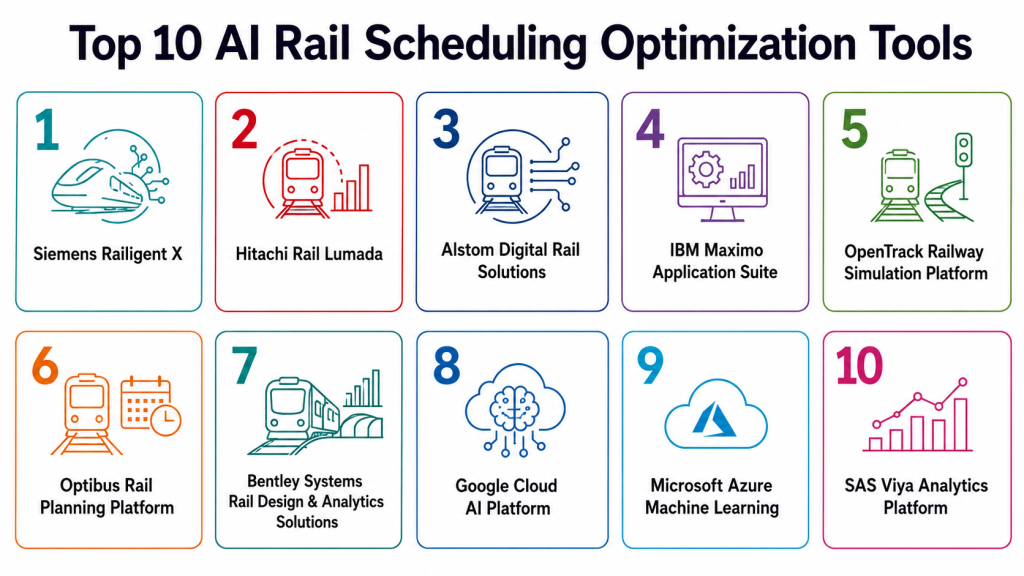
Top 10 AI Rail Scheduling Optimization Tools
#1 — Siemens Railigent X
One-line verdict: Best for railway operators using digital intelligence to optimize rail operations.
Short description:
Siemens Railigent X provides digital railway solutions that use data analytics and connected technologies to improve rail operations. It helps railway organizations monitor assets, analyze performance, and support operational improvements.
Standout Capabilities
- Railway operational analytics.
- Asset intelligence.
- Predictive insights.
- Rail data processing.
- Operational monitoring.
- Digital railway workflows.
- Performance optimization.
AI-Specific Depth
- Model support: AI and analytics capabilities vary by solution.
- RAG / knowledge integration: Varies depending on implementation.
- Evaluation: Performance evaluation depends on operational metrics.
- Guardrails: Railway governance depends on deployment.
- Observability: Monitoring capabilities vary.
Pros
- Strong railway industry focus.
- Supports digital rail transformation.
- Useful for complex rail operations.
Cons
- Enterprise-focused solution.
- Implementation can require railway expertise.
- Specific AI capabilities vary.
Security & Compliance
Security capabilities depend on deployment and customer requirements. Specific certifications are not publicly stated.
Deployment & Platforms
- Cloud-based railway platforms.
- Enterprise environments.
Integrations & Ecosystem
Supports integration with:
- Railway systems
- Asset monitoring platforms
- Operational databases
- Transportation applications
- Enterprise systems
Pricing Model
Not publicly stated.
Best-Fit Scenarios
- Large railway operators.
- Smart rail initiatives.
- Digital transportation programs.
#2 — Hitachi Rail Lumada
One-line verdict: Best for rail organizations combining AI analytics with large-scale transportation operations.
Short description:
Hitachi Rail Lumada provides digital solutions for railway operations, infrastructure monitoring, and transportation analytics. It helps organizations use operational data to improve efficiency, reliability, and decision-making.
Standout Capabilities
- Rail data analytics.
- Operational intelligence.
- Predictive maintenance support.
- Transportation optimization.
- Infrastructure insights.
- Digital rail workflows.
- Data-driven decisions.
AI-Specific Depth
- Model support: AI and analytics capabilities vary by solution.
- RAG / knowledge integration: Varies depending on implementation.
- Evaluation: Requires operational validation.
- Guardrails: Depends on railway deployment requirements.
- Observability: Monitoring capabilities vary.
Pros
- Strong transportation technology expertise.
- Supports complex rail environments.
- Useful for enterprise rail operations.
Cons
- Large-scale implementation requirements.
- Not only focused on scheduling optimization.
- Pricing details are not publicly stated.
Security & Compliance
Security depends on implementation. Specific certifications are not publicly stated.
Deployment & Platforms
- Cloud-based solutions.
- Enterprise rail environments.
Integrations & Ecosystem
Supports:
- Railway management systems
- Infrastructure platforms
- Data environments
- Transportation applications
- Operational tools
Pricing Model
Not publicly stated.
Best-Fit Scenarios
- National rail operators.
- Metro systems.
- Smart transportation projects.
#3 — Alstom Digital Rail Solutions
One-line verdict: Best for railway organizations improving network planning and intelligent transportation operations.
Short description:
Alstom provides railway technology solutions that support train operations, signaling, mobility management, and digital transportation workflows. Its digital capabilities help operators improve scheduling, operational visibility, and network performance.
Standout Capabilities
- Railway operations management.
- Train scheduling support.
- Digital rail analytics.
- Network performance monitoring.
- Operational optimization.
- Transportation data analysis.
- Rail system integration.
AI-Specific Depth
- Model support: AI and analytics capabilities vary by solution.
- RAG / knowledge integration: Varies depending on implementation.
- Evaluation: Operational performance evaluation depends on deployment.
- Guardrails: Railway safety controls depend on system configuration.
- Observability: Monitoring capabilities vary.
Pros
- Strong railway industry expertise.
- Supports large transportation networks.
- Useful for digital rail transformation.
Cons
- Enterprise deployment complexity.
- AI-specific details vary by solution.
- Pricing information is not publicly stated.
Security & Compliance
Security capabilities depend on implementation. Specific certifications are not publicly stated.
Deployment & Platforms
- Enterprise railway environments.
- Cloud and hybrid deployments.
Integrations & Ecosystem
Supports:
- Railway management systems
- Signaling platforms
- Fleet systems
- Transportation databases
- Operational applications
Pricing Model
Not publicly stated.
Best-Fit Scenarios
- National rail networks.
- Metro operators.
- Large transportation authorities.
#4 — IBM Maximo Application Suite
One-line verdict: Best for rail operators combining asset intelligence with operational optimization.
Short description:
IBM Maximo Application Suite provides asset management and operational analytics capabilities that can support railway organizations. It helps operators monitor infrastructure, manage maintenance activities, and improve operational planning.
Standout Capabilities
- Asset management.
- Predictive analytics.
- Maintenance optimization.
- Operational monitoring.
- Data analysis.
- Workflow automation.
- Infrastructure intelligence.
AI-Specific Depth
- Model support: Supports AI and analytics capabilities.
- RAG / knowledge integration: Available depending on implementation.
- Evaluation: Requires organization-specific evaluation workflows.
- Guardrails: Governance depends on deployment.
- Observability: Monitoring capabilities available.
Pros
- Strong enterprise asset management capabilities.
- Supports predictive operations.
- Flexible integration options.
Cons
- Not specifically designed only for scheduling.
- Requires implementation expertise.
- Pricing information is not publicly stated.
Security & Compliance
Security depends on deployment configuration. Specific certifications are not publicly stated.
Deployment & Platforms
- Cloud.
- Hybrid.
- Enterprise environments.
Integrations & Ecosystem
Supports:
- Railway asset systems
- Enterprise databases
- Maintenance platforms
- Analytics tools
- Operational applications
Pricing Model
Not publicly stated.
Best-Fit Scenarios
- Rail infrastructure management.
- Predictive maintenance programs.
- Large transportation organizations.
#5 — OpenTrack Railway Simulation Platform
One-line verdict: Best for rail planners testing schedules and analyzing network performance scenarios.
Short description:
OpenTrack is a railway simulation platform used for analyzing train operations, timetables, and infrastructure scenarios. It helps railway planners evaluate scheduling decisions before operational implementation.
Standout Capabilities
- Railway simulation.
- Timetable analysis.
- Train movement modeling.
- Infrastructure evaluation.
- Capacity analysis.
- Scenario testing.
- Operational planning support.
AI-Specific Depth
- Model support: Simulation models and analytics capabilities.
- RAG / knowledge integration: N/A.
- Evaluation: Based on simulation performance metrics.
- Guardrails: Operational constraints can be modeled.
- Observability: Simulation analysis capabilities available.
Pros
- Useful for railway planning.
- Supports complex network analysis.
- Helps evaluate scheduling scenarios.
Cons
- Requires rail planning expertise.
- Not a complete AI scheduling platform.
- Custom workflows may require additional development.
Security & Compliance
Security depends on deployment. Specific certifications are not publicly stated.
Deployment & Platforms
- Desktop and enterprise environments.
- Deployment options vary.
Integrations & Ecosystem
Supports:
- Railway planning systems
- Simulation workflows
- Operational data sources
- Infrastructure models
- Scheduling tools
Pricing Model
Not publicly stated.
Best-Fit Scenarios
- Rail planning teams.
- Timetable optimization projects.
- Network simulation studies.
#6 — Optibus Rail Planning Platform
One-line verdict: Best for public transportation operators optimizing schedules and workforce planning.
Short description:
Optibus provides AI-powered planning and scheduling solutions for public transportation operations. Its technology helps transit organizations improve scheduling efficiency, resource allocation, and operational planning.
Standout Capabilities
- AI scheduling.
- Transit planning.
- Resource optimization.
- Workforce planning.
- Operational analytics.
- Scenario modeling.
- Schedule management.
AI-Specific Depth
- Model support: AI optimization capabilities.
- RAG / knowledge integration: Varies depending on implementation.
- Evaluation: Scheduling performance evaluation depends on operational metrics.
- Guardrails: Operational constraints are configured by users.
- Observability: Analytics and reporting capabilities vary.
Pros
- Strong transportation scheduling focus.
- Supports complex planning scenarios.
- Useful for transit operations.
Cons
- Primarily focused on public transportation.
- Railway-specific capabilities may vary.
- Pricing information is not publicly stated.
Security & Compliance
Security depends on deployment. Specific certifications are not publicly stated.
Deployment & Platforms
- Cloud-based platform.
- Web environments.
Integrations & Ecosystem
Supports:
- Transit systems
- Scheduling applications
- Workforce systems
- Operational databases
- Transportation platforms
Pricing Model
Not publicly stated.
Best-Fit Scenarios
- Metro systems.
- Public transit operators.
- Transportation planning teams.
#7 — Bentley Systems Rail Design & Analytics Solutions
One-line verdict: Best for rail organizations combining infrastructure modeling with operational planning.
Short description:
Bentley Systems provides digital engineering and infrastructure software solutions used in transportation projects. Its platforms support rail design, infrastructure management, and data-driven planning.
Standout Capabilities
- Rail infrastructure modeling.
- Digital engineering.
- Asset information management.
- Infrastructure analytics.
- Transportation planning.
- Data visualization.
- Operational insights.
AI-Specific Depth
- Model support: Analytics and AI capabilities vary.
- RAG / knowledge integration: Varies.
- Evaluation: Depends on operational workflows.
- Guardrails: Infrastructure governance depends on implementation.
- Observability: Monitoring varies.
Pros
- Strong infrastructure capabilities.
- Supports digital rail projects.
- Useful for engineering teams.
Cons
- Not primarily a scheduling optimization tool.
- Requires specialized knowledge.
- AI features vary.
Security & Compliance
Security depends on deployment. Specific certifications are not publicly stated.
Deployment & Platforms
- Cloud.
- Enterprise environments.
Integrations & Ecosystem
Supports:
- Engineering platforms
- Rail infrastructure systems
- Data environments
- Enterprise applications
- Digital twin workflows
Pricing Model
Not publicly stated.
Best-Fit Scenarios
- Rail infrastructure projects.
- Digital twin initiatives.
- Engineering-led optimization.
#8 — Google Cloud AI Platform
One-line verdict: Best for developers building custom AI rail scheduling optimization systems.
Short description:
Google Cloud AI services provide machine learning infrastructure that organizations can use to create customized rail scheduling and prediction applications. Railway companies can build models for demand forecasting, delay prediction, and operational optimization.
Standout Capabilities
- Machine learning development.
- Predictive analytics.
- Data processing.
- AI model deployment.
- Custom optimization workflows.
- Cloud scalability.
- Data analytics.
AI-Specific Depth
- Model support: Custom AI and machine learning models.
- RAG / knowledge integration: Available depending on architecture.
- Evaluation: Requires custom evaluation frameworks.
- Guardrails: Application-level controls required.
- Observability: Cloud monitoring capabilities available.
Pros
- Flexible AI development environment.
- Supports large-scale data processing.
- Suitable for customized solutions.
Cons
- Requires AI engineering expertise.
- Not railway-specific.
- Development effort is required.
Security & Compliance
Security depends on configuration. Specific railway certifications are not publicly stated.
Deployment & Platforms
- Cloud.
- Hybrid environments.
Integrations & Ecosystem
Supports:
- Railway databases
- AI pipelines
- Data platforms
- Enterprise applications
- Machine learning workflows
Pricing Model
Usage-based pricing model.
Best-Fit Scenarios
- Rail technology developers.
- Custom scheduling systems.
- AI research projects.
#9 — Microsoft Azure Machine Learning
One-line verdict: Best for rail organizations developing enterprise AI scheduling and prediction models.
Short description:
Microsoft Azure Machine Learning provides tools for building, training, deploying, and monitoring machine learning models. Railway organizations can use it to create custom scheduling optimization and operational prediction solutions.
Standout Capabilities
- Machine learning workflows.
- Model management.
- AI deployment.
- Data analytics.
- Predictive modeling.
- Enterprise integration.
- Monitoring tools.
AI-Specific Depth
- Model support: Supports multiple machine learning frameworks.
- RAG / knowledge integration: Available depending on implementation.
- Evaluation: Supports model testing and monitoring.
- Guardrails: Requires implementation-specific controls.
- Observability: Monitoring capabilities available.
Pros
- Strong enterprise AI ecosystem.
- Flexible model development.
- Supports large organizations.
Cons
- Requires technical expertise.
- Not rail-specific.
- Custom development required.
Security & Compliance
Security depends on Azure configuration. Specific railway certifications are not publicly stated.
Deployment & Platforms
- Cloud.
- Hybrid environments.
Integrations & Ecosystem
Supports:
- Data platforms
- AI workflows
- Enterprise applications
- Railway systems
- Analytics environments
Pricing Model
Usage-based pricing model.
Best-Fit Scenarios
- Enterprise rail AI projects.
- Predictive scheduling development.
- Data science teams.
#10 — SAS Viya Analytics Platform
One-line verdict: Best for railway organizations requiring advanced analytics and forecasting capabilities.
Short description:
SAS Viya provides analytics and AI capabilities that organizations can use for forecasting, optimization, and operational decision-making. Rail operators can apply these capabilities to analyze schedules, demand, and performance data.
Standout Capabilities
- Predictive analytics.
- Forecasting.
- Machine learning.
- Data visualization.
- Optimization analytics.
- Decision support.
- Enterprise reporting.
AI-Specific Depth
- Model support: Analytics and machine learning models.
- RAG / knowledge integration: Varies depending on implementation.
- Evaluation: Supports model evaluation workflows.
- Guardrails: Governance depends on configuration.
- Observability: Analytics monitoring available.
Pros
- Strong analytics capabilities.
- Supports forecasting projects.
- Enterprise-ready platform.
Cons
- Requires analytics expertise.
- Not rail-specific.
- Implementation varies.
Security & Compliance
Security depends on deployment. Specific certifications are not publicly stated.
Deployment & Platforms
- Cloud.
- Enterprise environments.
Integrations & Ecosystem
Supports:
- Railway data platforms
- Enterprise databases
- Analytics systems
- AI workflows
- Reporting tools
Pricing Model
Not publicly stated.
Best-Fit Scenarios
- Rail analytics teams.
- Demand forecasting.
- Operational intelligence projects.
Comparison Table (Top 10 AI Rail Scheduling Optimization Tools)
| Tool Name | Best For | Deployment | Model Flexibility | Strength | Watch-Out | Public Rating |
|---|---|---|---|---|---|---|
| Siemens Railigent X | Digital rail operations | Cloud | Analytics models | Rail intelligence | Enterprise setup | N/A |
| Hitachi Rail Lumada | Smart rail systems | Cloud | AI analytics | Transportation analytics | Solution variation | N/A |
| Alstom Digital Rail | Rail operations | Hybrid | Analytics models | Railway expertise | Complex deployment | N/A |
| IBM Maximo | Asset optimization | Cloud/Hybrid | AI models | Asset intelligence | Not scheduling-only | N/A |
| OpenTrack | Rail simulation | Enterprise | Simulation models | Timetable analysis | Requires expertise | N/A |
| Optibus | Transit scheduling | Cloud | AI optimization | Schedule planning | Rail scope varies | N/A |
| Bentley Systems | Rail engineering | Cloud | Analytics models | Infrastructure modeling | Not scheduling-focused | N/A |
| Google Cloud AI | Custom AI | Cloud | Custom models | Developer flexibility | Requires building | N/A |
| Azure Machine Learning | Enterprise AI | Cloud/Hybrid | Multi-model | ML development | Technical skills needed | N/A |
| SAS Viya | Analytics | Cloud/Enterprise | Multi-model | Forecasting | Implementation effort | N/A |
Scoring & Evaluation (Transparent Rubric)
The following scoring framework compares AI Rail Scheduling Optimization tools based on practical railway requirements. The evaluation considers scheduling capabilities, predictive analytics, optimization performance, integrations, scalability, security, cost efficiency, and operational usability. Scores are comparative indicators and should be validated based on railway network complexity, operational goals, infrastructure requirements, and deployment environment.
| Tool | Core | Reliability/Eval | Guardrails | Integrations | Ease | Perf/Cost | Security/Admin | Support | Weighted Total |
|---|---|---|---|---|---|---|---|---|---|
| Siemens Railigent X | 9 | 9 | 8 | 10 | 8 | 8 | 9 | 9 | 8.85 |
| Hitachi Rail Lumada | 9 | 9 | 8 | 10 | 8 | 8 | 9 | 9 | 8.85 |
| Alstom Digital Rail Solutions | 9 | 8 | 9 | 10 | 8 | 8 | 9 | 9 | 8.80 |
| IBM Maximo Application Suite | 8 | 9 | 9 | 9 | 8 | 8 | 9 | 9 | 8.60 |
| OpenTrack Railway Simulation | 8 | 8 | 8 | 8 | 7 | 8 | 8 | 8 | 7.85 |
| Optibus Rail Planning Platform | 9 | 9 | 8 | 9 | 9 | 8 | 8 | 9 | 8.75 |
| Bentley Systems Rail Solutions | 8 | 8 | 8 | 9 | 8 | 8 | 9 | 9 | 8.35 |
| Google Cloud AI Platform | 8 | 9 | 8 | 10 | 7 | 9 | 9 | 9 | 8.65 |
| Microsoft Azure Machine Learning | 8 | 9 | 8 | 10 | 7 | 9 | 9 | 9 | 8.65 |
| SAS Viya Analytics Platform | 8 | 9 | 9 | 9 | 7 | 8 | 9 | 9 | 8.50 |
Top 3 for Enterprise
1. Siemens Railigent X
Best suited for large railway operators that need digital rail intelligence, operational analytics, and connected railway workflows.
2. Hitachi Rail Lumada
A strong option for organizations managing complex rail networks and looking for data-driven transportation improvements.
3. Alstom Digital Rail Solutions
Suitable for railway operators requiring advanced rail technology integration and operational optimization.
Top 3 for SMB
1. Optibus Rail Planning Platform
Best for transportation operators that need practical scheduling and planning optimization.
2. Google Cloud AI Platform
Useful for smaller technology teams building customized railway AI applications.
3. SAS Viya Analytics Platform
Suitable for organizations focusing on analytics, forecasting, and operational insights.
Top 3 for Developers
1. Google Cloud AI Platform
Best for developers building custom rail scheduling and prediction solutions.
2. Microsoft Azure Machine Learning
Useful for creating enterprise AI workflows with flexible machine learning capabilities.
3. IBM Maximo Application Suite
Suitable for developers working on asset intelligence and operational optimization projects.
Which AI Rail Scheduling Optimization Tool Is Right for You?
Selecting the right AI Rail Scheduling Optimization platform depends on railway network size, operational complexity, technology maturity, and business objectives.
Some organizations need complete railway management solutions, while others need flexible AI development platforms to create customized scheduling systems.
Solo / Freelancer
Individual developers, railway researchers, and transportation consultants usually need flexible tools for experimentation and model development.
Recommended Options:
- Google Cloud AI Platform.
- Microsoft Azure Machine Learning.
- SAS Viya Analytics Platform.
Best Approach:
- Start with railway datasets.
- Build timetable optimization prototypes.
- Test delay prediction models.
- Analyze scheduling scenarios.
Important Priorities:
- API availability.
- Model flexibility.
- Testing capability.
- Cost control.
SMB
Small transit operators and transportation technology companies usually need practical scheduling improvements without large transformation projects.
Recommended Options:
- Optibus.
- Google Cloud AI Platform.
- SAS Viya.
Important Priorities:
- Easy implementation.
- Schedule improvement.
- Operational visibility.
- Integration simplicity.
SMBs should focus on solving specific scheduling challenges before adopting complex enterprise platforms.
Mid-Market
Growing railway operators require scalable solutions that support increasing operational complexity.
Recommended Options:
- IBM Maximo Application Suite.
- Optibus.
- OpenTrack.
Important Evaluation Areas:
- Scheduling accuracy.
- Infrastructure planning.
- Maintenance coordination.
- Operational analytics.
- System integration.
Mid-market organizations should select solutions that support gradual expansion.
Enterprise
Large railway networks require advanced optimization, governance, and integration across multiple operational systems.
Recommended Options:
- Siemens Railigent X.
- Hitachi Rail Lumada.
- Alstom Digital Rail Solutions.
Enterprise Priorities:
- Large-scale scheduling.
- Real-time operational adjustments.
- Network-wide visibility.
- Security controls.
- AI governance.
- Long-term scalability.
Regulated Industries (Finance, Healthcare, Public Sector)
Railway systems are critical infrastructure environments where operational data, passenger information, and transportation records require strong governance.
Important considerations:
- Secure data management.
- Access control policies.
- Operational audit trails.
- Data retention rules.
- Human oversight.
- Transparent AI recommendations.
Organizations should evaluate AI governance practices before implementing scheduling automation.
Budget vs Premium
Budget-Focused Approach
Suitable for smaller rail operators, startups, and organizations testing AI capabilities.
Consider:
- Cloud AI platforms.
- Analytics solutions.
- Limited scheduling optimization projects.
Advantages:
- Lower initial investment.
- Faster experimentation.
- Flexible development.
Premium Enterprise Approach
Suitable for national rail operators and large transportation networks.
Consider:
- Railway-specific digital platforms.
- Integrated scheduling systems.
- Advanced optimization engines.
Advantages:
- Better network coordination.
- Higher scalability.
- Advanced automation.
- Improved operational efficiency.
Build vs Buy (When to DIY)
Build Custom AI Rail Scheduling Systems When:
- Scheduling optimization is a strategic advantage.
- Unique railway constraints exist.
- Internal AI engineering resources are available.
- Existing solutions cannot meet requirements.
Buy Existing Platforms When:
- Faster deployment is required.
- Railway-specific capabilities are needed.
- Internal technical resources are limited.
- Standard scheduling workflows are sufficient.
A hybrid approach is often effective by combining railway platforms with custom AI models for specialized forecasting and optimization needs.
Implementation Playbook (30 / 60 / 90 Days)
First 30 Days: Pilot and Define Success Metrics
The first phase focuses on understanding current scheduling challenges and preparing AI foundations.
Key Activities:
- Identify scheduling improvement opportunities.
- Review existing timetable processes.
- Collect operational rail data.
- Select pilot routes or networks.
Success Metrics:
- Improved timetable accuracy.
- Reduced delays.
- Better resource utilization.
- Increased operational reliability.
- Improved passenger service quality.
AI-Specific Tasks:
- Prepare railway datasets.
- Define evaluation benchmarks.
- Establish data governance rules.
- Create baseline optimization models.
First 60 Days: Security, Evaluation, and Controlled Rollout
The second phase focuses on improving AI reliability and preparing wider adoption.
Key Activities:
- Test AI-generated schedules.
- Compare recommendations with existing planning methods.
- Review operational feedback.
- Improve scheduling workflows.
AI-Specific Tasks:
- Evaluate optimization results.
- Test disruption scenarios.
- Monitor prediction errors.
- Review AI explanations.
- Establish incident handling procedures.
First 90 Days: Optimization and Scale
The final phase focuses on expanding AI adoption across railway operations.
Key Activities:
- Expand to additional routes.
- Connect more operational systems.
- Improve automation coverage.
- Optimize infrastructure costs.
AI-Specific Tasks:
- Monitor model drift.
- Update optimization models.
- Improve prediction accuracy.
- Track AI performance.
- Establish continuous governance.
Common Mistakes & How to Avoid Them
- ❌ Implementing AI without understanding scheduling problems.
✅ Define clear operational goals first. - ❌ Using incomplete railway data.
✅ Improve data quality before modeling. - ❌ Ignoring railway expert input.
✅ Combine AI recommendations with human expertise. - ❌ Automating schedules without review processes.
✅ Maintain operational control. - ❌ Not testing AI under disruption scenarios.
✅ Validate models with realistic conditions. - ❌ Ignoring system integration challenges.
✅ Connect AI with existing railway systems. - ❌ Overlooking cybersecurity requirements.
✅ Protect critical infrastructure data. - ❌ Not monitoring model performance.
✅ Continuously evaluate AI results. - ❌ Choosing tools without scalability planning.
✅ Consider future network growth. - ❌ Ignoring operational costs.
✅ Track efficiency improvements. - ❌ Depending completely on one vendor.
✅ Maintain flexible architecture. - ❌ Focusing only on technology.
✅ Prioritize measurable transportation outcomes.
FAQs
1. What is AI Rail Scheduling Optimization?
AI Rail Scheduling Optimization uses artificial intelligence and advanced algorithms to improve train timetables, resource allocation, and railway operations.
2. How does AI improve railway scheduling?
AI analyzes operational data, demand patterns, infrastructure conditions, and disruptions to recommend better schedules.
3. Can AI predict train delays?
Yes. AI models can analyze operational factors to support delay prediction and disruption management.
4. Does AI replace railway planners?
No. AI supports planners by providing recommendations while humans maintain operational control.
5. What data is required for AI rail scheduling?
Common data includes train movements, timetables, infrastructure information, passenger demand, and maintenance schedules.
6. Can small railway operators use AI scheduling tools?
Yes. Smaller operators can use cloud-based platforms or focused optimization solutions.
7. Are AI railway systems secure?
Security depends on system architecture, deployment practices, and organizational controls.
8. How accurate are AI scheduling predictions?
Accuracy depends on data quality, model design, network complexity, and implementation.
9. Can AI optimize freight rail operations?
Yes. AI can support freight scheduling, resource planning, and operational optimization.
10. Can AI integrate with existing railway systems?
Many solutions support integration with transportation, fleet, infrastructure, and enterprise systems.
11. How do rail operators evaluate AI scheduling platforms?
Operators should evaluate optimization accuracy, scalability, integrations, security, cost, and operational impact.
12. What is the future of AI in railway operations?
Future railway AI systems are expected to become more predictive, automated, connected, and capable of supporting real-time operational decisions.
Conclusion
AI Rail Scheduling Optimization is transforming railway operations by combining artificial intelligence, predictive analytics, optimization algorithms, and real-time data processing. These technologies help railway organizations improve punctuality, manage disruptions, optimize resources, and provide more reliable transportation services.The best solution depends on railway network complexity, operational goals, technology maturity, and available infrastructure. Large rail operators may require dedicated digital rail platforms, while smaller organizations may benefit from flexible AI development tools.Successful implementation requires accurate data, strong governance, continuous evaluation, and collaboration between AI systems and railway experts. Organizations that adopt AI responsibly can build more efficient, reliable, and scalable rail networks.

Find Trusted Cardiac Hospitals
Compare heart hospitals by city and services — all in one place.
Explore Hospitals