
Introduction
Urban mobility is reaching a breaking point in many cities due to population growth, increasing vehicle density, inefficient signal timing, and aging infrastructure. Traffic congestion leads to lost productivity, higher fuel consumption, increased emissions, and reduced quality of life. AI Traffic Flow Optimization Systems use artificial intelligence, computer vision, real-time sensor data, and predictive analytics to dynamically manage traffic signals, optimize road usage, predict congestion, and improve overall transportation efficiency.
Unlike traditional traffic management systems that rely on fixed signal schedules or manual adjustments, modern AI-driven platforms continuously analyze live traffic data from cameras, IoT sensors, GPS feeds, connected vehicles, and historical patterns. They adjust traffic signals in real time, predict congestion before it happens, and recommend routing strategies for emergency services, public transport, and commuters.
Common use cases include:
- Real-time traffic signal optimization in smart cities
- Congestion prediction and mitigation
- Emergency vehicle route prioritization
- Public transportation scheduling optimization
- Highway traffic monitoring
- Smart intersection management
- Event-based traffic control
- Pollution reduction through optimized flow
When evaluating AI Traffic Flow Optimization Systems, organizations should consider:
- Real-time responsiveness
- AI-based prediction accuracy
- Computer vision capabilities
- Sensor and IoT integration
- Edge computing support
- Scalability across city-wide networks
- Integration with emergency systems
- Digital twin simulation capabilities
- API availability
- Security and data privacy controls
- Cloud vs edge deployment flexibility
- Reporting and analytics dashboards
- Cost efficiency
Best for: Smart city planners, municipal transportation departments, highway authorities, urban mobility agencies, public safety organizations, airport traffic systems, logistics hubs, and governments managing large-scale transportation infrastructure.
Not ideal for: Small towns with minimal traffic complexity, private parking systems without city integration, or organizations that only require static scheduling rather than real-time optimization.
What’s Changed in AI Traffic Flow Optimization Systems in 2026+
Traffic optimization has evolved into a highly intelligent, adaptive ecosystem driven by AI, IoT, and edge computing. Key trends shaping this domain include:
- AI agents dynamically adjust traffic signals based on real-time congestion patterns
- Computer vision systems detect vehicles, pedestrians, cyclists, and emergency vehicles with high precision
- Digital twins simulate entire city traffic networks before implementing changes
- Vehicle-to-infrastructure (V2I) communication improves predictive routing accuracy
- Edge AI enables sub-second traffic signal adjustments
- Multimodal traffic optimization now includes pedestrians, bicycles, and public transport systems
- Generative AI assists traffic engineers in designing optimized signal strategies
- Predictive congestion modeling reduces bottlenecks before they form
- Integration with emergency response systems ensures priority routing
- Cloud-based platforms provide centralized traffic intelligence dashboards
- Sustainability optimization reduces emissions and fuel consumption
- Real-time adaptive tolling and congestion pricing models are increasingly AI-driven
Quick Buyer Checklist (Scan-Friendly)
Before selecting an AI Traffic Flow Optimization System, verify the following capabilities:
- □ Real-time traffic signal optimization
- □ AI-based congestion prediction
- □ Computer vision for traffic monitoring
- □ IoT sensor integration
- □ Edge computing support
- □ Vehicle detection accuracy
- □ Emergency vehicle prioritization
- □ Multi-modal traffic support
- □ Digital twin simulation
- □ API availability
- □ Cloud scalability
- □ Cybersecurity controls
- □ Data privacy compliance
- □ Analytics dashboards
- □ Integration with city systems
- □ Low-latency decision-making
- □ Open standards and interoperability
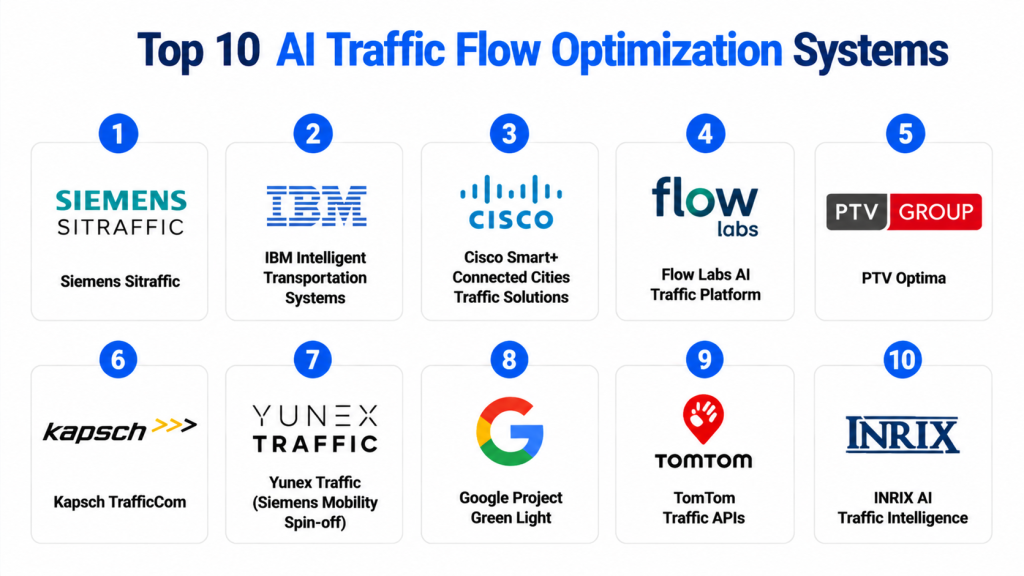
Top 10 AI Traffic Flow Optimization Systems
#1 — Siemens Sitraffic
One-line verdict: Best for large smart city deployments requiring AI-driven adaptive traffic signal control.
Short description (2–3 lines):
Siemens Sitraffic provides intelligent traffic management using AI-powered signal control, real-time data analysis, and adaptive traffic optimization to improve urban mobility and reduce congestion in complex city environments.
Standout Capabilities
- AI-based adaptive traffic signal control
- Real-time congestion management
- Vehicle detection and classification
- Emergency vehicle prioritization
- Intersection optimization
- Traffic flow analytics
- Smart city integration
- Edge-based signal control
AI-Specific Depth
- Model support: Proprietary AI traffic optimization models
- RAG / knowledge integration: City traffic databases and historical mobility data
- Evaluation: Traffic flow optimization metrics, congestion reduction analytics
- Guardrails: Traffic safety rules, regulatory constraints, signal timing policies
- Observability: Real-time dashboards, intersection monitoring, traffic KPIs
Pros
- Strong smart city focus
- Highly scalable infrastructure
- Reliable industrial-grade system
Cons
- Complex deployment
- Requires city-wide infrastructure investment
- Premium cost structure
Security & Compliance
Supports secure communications, encryption, role-based access control, and audit logging depending on deployment.
Certifications: Not publicly stated.
Deployment & Platforms
- Cloud
- Edge computing
- On-premise municipal systems
Integrations & Ecosystem
Designed for integration with smart city infrastructure and transportation systems.
- City traffic control systems
- IoT sensors
- Emergency response systems
- Public transport systems
- APIs for municipal platforms
Pricing Model
Government and enterprise licensing. Public pricing is not publicly stated.
Best-Fit Scenarios
- Smart cities
- Urban traffic control centers
- Highway authorities
#2 — IBM Intelligent Transportation Systems
One-line verdict: Best for enterprise and government-scale traffic intelligence and mobility optimization.
Short description (2–3 lines):
IBM’s intelligent transportation solutions use AI, analytics, and real-time data processing to optimize traffic flow, reduce congestion, and improve urban mobility planning for large-scale transportation networks.
Standout Capabilities
- AI-powered traffic analytics
- Predictive congestion modeling
- Smart mobility optimization
- Incident detection and response
- Traffic simulation
- Multi-modal transportation analysis
- City-scale data integration
- Decision support systems
AI-Specific Depth
- Model support: IBM proprietary AI systems
- RAG / knowledge integration: City mobility and transport datasets
- Evaluation: Traffic efficiency metrics, predictive accuracy modeling
- Guardrails: Urban traffic policies and safety constraints
- Observability: City dashboards, mobility insights, operational analytics
Pros
- Strong enterprise analytics capabilities
- Excellent predictive modeling
- Scalable city-wide architecture
Cons
- Requires significant infrastructure investment
- Complex implementation
- Best suited for large governments
Security & Compliance
Supports enterprise-grade security, encryption, access control, and audit logging depending on deployment.
Certifications: Not publicly stated.
Deployment & Platforms
- Cloud
- Hybrid
- On-premise government infrastructure
Integrations & Ecosystem
Integrates with transportation systems, city data platforms, and IoT networks.
- APIs
- Smart city platforms
- Emergency systems
- Traffic sensors
- Public transit systems
Pricing Model
Enterprise/government licensing.
Best-Fit Scenarios
- National transportation systems
- Smart city initiatives
- Metropolitan traffic authorities
#3 — Cisco Smart+ Connected Cities Traffic Solutions
One-line verdict: Best for cities requiring connected infrastructure and network-driven traffic optimization.
Short description (2–3 lines):
Cisco Smart+ Connected Cities leverages networking, IoT, and AI analytics to optimize traffic flow, enhance road safety, and enable real-time mobility intelligence across urban environments.
Standout Capabilities
- IoT-enabled traffic monitoring
- Real-time data processing
- Adaptive traffic signal systems
- Video-based traffic analytics
- Incident detection
- Smart intersection control
- Connected infrastructure
- Emergency response prioritization
AI-Specific Depth
- Model support: Cisco AI-enabled analytics systems
- RAG / knowledge integration: City infrastructure and IoT datasets
- Evaluation: Traffic efficiency and congestion metrics
- Guardrails: Safety rules, traffic regulations, policy enforcement
- Observability: Network dashboards, mobility analytics, traffic visualization
Pros
- Strong IoT integration
- Excellent network infrastructure
- Scalable for smart cities
Cons
- Requires Cisco ecosystem familiarity
- Complex deployment architecture
- Hardware dependencies
Security & Compliance
Supports enterprise networking security, encryption, identity management, and audit controls.
Certifications: Not publicly stated.
Deployment & Platforms
- Cloud
- Edge
- Hybrid city infrastructure
Integrations & Ecosystem
Strong integration with networking and smart city systems.
- IoT devices
- Network infrastructure
- Traffic cameras
- City control centers
- APIs
Pricing Model
Enterprise and municipal licensing.
Best-Fit Scenarios
- Smart city infrastructure
- Connected transportation systems
- Urban mobility networks
#4 — Flow Labs AI Traffic Platform
One-line verdict: Best for AI-first traffic simulation, optimization, and predictive mobility modeling.
Short description (2–3 lines):
Flow Labs provides AI-powered traffic modeling, simulation, and optimization tools that help cities and transportation agencies predict congestion and design better traffic flow strategies.
Standout Capabilities
- AI traffic simulation
- Predictive congestion modeling
- Scenario planning tools
- Signal optimization
- Traffic pattern analysis
- Digital twin traffic modeling
- Mobility forecasting
- Urban planning support
AI-Specific Depth
- Model support: Proprietary AI simulation models
- RAG / knowledge integration: Transportation datasets and historical traffic data
- Evaluation: Simulation accuracy and traffic prediction validation
- Guardrails: Urban planning constraints and traffic safety rules
- Observability: Simulation dashboards, traffic analytics, predictive insights
Pros
- Strong simulation capabilities
- Useful for planning and forecasting
- AI-driven modeling tools
Cons
- Less focused on hardware deployment
- Requires high-quality traffic data
- Best suited for planning teams
Security & Compliance
Security features vary by deployment.
Certifications: Not publicly stated.
Deployment & Platforms
- Cloud
- Web-based platform
Integrations & Ecosystem
Designed for integration with transportation planning systems.
- APIs
- City planning tools
- Traffic datasets
- Simulation engines
Pricing Model
Subscription-based government/enterprise licensing.
Best-Fit Scenarios
- Urban planning departments
- Traffic simulation projects
- Smart mobility design
#5 — PTV Optima
One-line verdict: Best for real-time traffic management and multimodal transport optimization.
Short description (2–3 lines):
PTV Optima provides real-time traffic management, predictive analytics, and multimodal transport optimization to improve traffic efficiency and reduce congestion in urban environments.
Standout Capabilities
- Real-time traffic optimization
- Predictive congestion modeling
- Multimodal transport analysis
- Signal timing optimization
- Incident management
- Traffic forecasting
- Simulation tools
- Urban mobility analytics
AI-Specific Depth
- Model support: Proprietary traffic AI models
- RAG / knowledge integration: Transportation datasets and sensor networks
- Evaluation: Traffic flow efficiency metrics
- Guardrails: Traffic control rules and safety constraints
- Observability: Traffic dashboards, mobility insights, real-time monitoring
Pros
- Strong real-time optimization
- Multimodal support
- Reliable traffic forecasting
Cons
- Complex configuration
- Requires data integration effort
- Enterprise deployment focus
Security & Compliance
Supports enterprise security controls, encryption, access management, and audit logging depending on deployment.
Certifications: Not publicly stated.
Deployment & Platforms
- Cloud
- On-premise
- Hybrid
Integrations & Ecosystem
Integrates with transportation systems and smart city platforms.
- APIs
- Traffic sensors
- Public transport systems
- City dashboards
- GIS platforms
Pricing Model
Enterprise licensing.
Best-Fit Scenarios
- Urban traffic control centers
- Transportation authorities
- Smart mobility projects
#6 — Kapsch TrafficCom
One-line verdict: Best for large-scale intelligent transportation systems and highway traffic management.
Short description (2–3 lines):
Kapsch TrafficCom delivers AI-enabled traffic management solutions for highways, urban road networks, and tolling systems. It focuses on optimizing traffic flow, reducing congestion, and improving road safety using real-time data analytics and intelligent control systems.
Standout Capabilities
- Intelligent traffic management systems
- AI-assisted congestion control
- Highway traffic optimization
- Electronic tolling integration
- Incident detection and response
- Real-time traffic analytics
- Smart intersection control
- Multi-city traffic coordination
AI-Specific Depth
- Model support: Proprietary traffic optimization models
- RAG / knowledge integration: Traffic and mobility datasets
- Evaluation: Congestion reduction metrics, travel time optimization
- Guardrails: Traffic safety policies, regulatory compliance rules
- Observability: Traffic dashboards, highway monitoring systems, analytics reporting
Pros
- Strong highway and tolling expertise
- Scalable for national infrastructure
- Reliable real-time traffic control
Cons
- Complex infrastructure requirements
- Enterprise and government focus only
- High implementation cost
Security & Compliance
Supports secure government-grade infrastructure, encryption, role-based access control, and audit logging depending on deployment.
Certifications: Not publicly stated.
Deployment & Platforms
- On-premise
- Hybrid
- Edge + cloud combinations
Integrations & Ecosystem
Kapsch integrates with national transportation systems and smart infrastructure networks.
- Traffic sensors
- Tolling systems
- Emergency response systems
- City traffic control centers
- APIs for mobility platforms
Pricing Model
Government and enterprise licensing.
Best-Fit Scenarios
- Highway authorities
- National traffic systems
- Smart city road networks
#7 — Yunex Traffic (Siemens Mobility Spin-off)
One-line verdict: Best for smart city traffic orchestration and adaptive intersection control systems.
Short description (2–3 lines):
Yunex Traffic provides AI-powered urban traffic management solutions that optimize traffic signals, reduce congestion, and improve mobility across complex city environments using adaptive control systems and real-time analytics.
Standout Capabilities
- Adaptive traffic signal control
- Real-time traffic optimization
- Smart intersection systems
- AI-based congestion management
- Traffic flow analytics
- Urban mobility coordination
- Incident detection systems
- Emergency vehicle prioritization
AI-Specific Depth
- Model support: Proprietary AI traffic control systems
- RAG / knowledge integration: City mobility datasets and sensor networks
- Evaluation: Travel time reduction, congestion metrics
- Guardrails: Urban traffic safety rules, regulatory constraints
- Observability: Traffic control dashboards, intersection monitoring, analytics visualization
Pros
- Strong smart city specialization
- Advanced signal optimization
- Reliable urban traffic systems
Cons
- Requires city infrastructure modernization
- Limited use outside urban systems
- High deployment complexity
Security & Compliance
Supports secure communications, encryption, identity management, and audit logging depending on deployment.
Certifications: Not publicly stated.
Deployment & Platforms
- Edge computing
- Cloud
- On-premise traffic control systems
Integrations & Ecosystem
Designed for smart city ecosystems and transportation networks.
- Traffic sensors
- City control centers
- Emergency response systems
- Public transit networks
- APIs
Pricing Model
Municipal and enterprise licensing.
Best-Fit Scenarios
- Smart cities
- Urban traffic control systems
- Metropolitan transportation networks
#8 — Google Project Green Light
One-line verdict: Best for AI-powered traffic signal optimization using real-world Google Maps data insights.
Short description (2–3 lines):
Google Project Green Light uses AI and aggregated Google Maps driving data to optimize traffic light timing and reduce stop-and-go traffic in urban intersections, improving fuel efficiency and reducing emissions.
Standout Capabilities
- AI traffic signal optimization
- Google Maps data integration
- Intersection-level optimization
- Congestion reduction insights
- Emissions reduction modeling
- Traffic pattern analysis
- Real-world driving data insights
- Smart signal recommendations
AI-Specific Depth
- Model support: Google AI and traffic modeling systems
- RAG / knowledge integration: Google Maps mobility datasets
- Evaluation: Travel delay reduction, stop frequency optimization
- Guardrails: Traffic safety constraints, municipal control policies
- Observability: Traffic performance dashboards, intersection analytics
Pros
- Strong real-world traffic data foundation
- Easy integration for cities using Google ecosystems
- Proven congestion reduction insights
Cons
- Limited deployment flexibility
- Dependent on Google ecosystem
- Not a full traffic management suite
Security & Compliance
Operates under Google’s enterprise and municipal data protection frameworks.
Certifications: Not publicly stated.
Deployment & Platforms
- Cloud-based
- City integration APIs
Integrations & Ecosystem
Integrates with municipal traffic systems and Google Maps ecosystem.
- Google Maps data
- City traffic systems
- APIs for traffic analytics
- Urban planning tools
Pricing Model
Not publicly stated (pilot-based municipal programs).
Best-Fit Scenarios
- Smart city pilots
- Urban intersection optimization
- Emissions reduction programs
#9 — TomTom Traffic APIs
One-line verdict: Best for real-time traffic intelligence and routing optimization across mobility applications.
Short description (2–3 lines):
TomTom Traffic APIs provide real-time traffic data, predictive congestion insights, and routing intelligence that can be integrated into transportation systems, logistics platforms, and smart city applications.
Standout Capabilities
- Real-time traffic data feeds
- Predictive congestion analytics
- Route optimization APIs
- Incident detection data
- Historical traffic modeling
- Travel time estimation
- Mobility intelligence APIs
- Scalable cloud traffic services
AI-Specific Depth
- Model support: Proprietary traffic intelligence models
- RAG / knowledge integration: Global traffic datasets
- Evaluation: ETA accuracy, congestion prediction metrics
- Guardrails: Data validation rules, routing constraints
- Observability: API analytics, traffic data dashboards, performance metrics
Pros
- Highly scalable global traffic data
- Strong API ecosystem
- Easy integration for developers
Cons
- Not a full traffic control system
- Requires external platform integration
- Limited physical infrastructure control
Security & Compliance
Supports enterprise-grade API security, authentication, encryption, and usage monitoring.
Certifications: Not publicly stated.
Deployment & Platforms
- Cloud APIs
- Web services
- Mobile integration
Integrations & Ecosystem
Widely used in mobility, logistics, and navigation systems.
- Navigation apps
- Fleet management systems
- Logistics platforms
- Smart city dashboards
- Developer APIs
Pricing Model
Usage-based API subscription.
Best-Fit Scenarios
- Logistics optimization
- Navigation systems
- Mobility applications
- Smart routing platforms
#10 — INRIX AI Traffic Intelligence
One-line verdict: Best for enterprise-grade traffic analytics, mobility intelligence, and transportation planning.
Short description (2–3 lines):
INRIX provides AI-powered traffic intelligence and mobility analytics used by cities, governments, and enterprises to optimize transportation networks, reduce congestion, and improve urban planning decisions.
Standout Capabilities
- AI traffic analytics
- Predictive congestion modeling
- Mobility intelligence dashboards
- Urban planning insights
- Real-time traffic monitoring
- Transportation forecasting
- Incident detection
- Travel time analytics
AI-Specific Depth
- Model support: Proprietary AI traffic intelligence models
- RAG / knowledge integration: Global mobility datasets
- Evaluation: Traffic prediction accuracy, congestion metrics
- Guardrails: Data governance and municipal policies
- Observability: Traffic dashboards, analytics reports, mobility KPIs
Pros
- Strong global traffic dataset coverage
- Excellent analytics capabilities
- Widely used in public sector planning
Cons
- Not a real-time traffic control system
- Requires integration for execution systems
- Enterprise-focused licensing
Security & Compliance
Supports enterprise security controls, data governance, encryption, and access management depending on deployment.
Certifications: Not publicly stated.
Deployment & Platforms
- Cloud
- API-based services
- Web dashboards
Integrations & Ecosystem
Integrates with transportation planning and analytics ecosystems.
- City planning tools
- Navigation systems
- Logistics platforms
- Smart city dashboards
- APIs for mobility intelligence
Pricing Model
Enterprise and government subscription.
Best-Fit Scenarios
- Urban planning departments
- Transportation authorities
- Smart mobility analytics
- Logistics optimization
Comparison Table
| Tool Name | Best For | Deployment | Model Flexibility | Primary Strength | Watch-Out | Public Rating |
|---|---|---|---|---|---|---|
| Kapsch TrafficCom | Highway traffic systems | Hybrid / On-prem | Proprietary | Large-scale traffic control | Complex deployment | N/A |
| Yunex Traffic | Smart city intersections | Edge / Cloud | Proprietary | Adaptive signal control | Infrastructure-heavy | N/A |
| Google Project Green Light | Urban signal optimization | Cloud | Google AI ecosystem | Real-world traffic data | Limited flexibility | N/A |
| TomTom Traffic APIs | Mobility & routing apps | Cloud APIs | Proprietary | Traffic intelligence APIs | Not full system | N/A |
| INRIX AI Traffic Intelligence | Traffic analytics | Cloud | Proprietary | Mobility insights | Not real-time control | N/A |
Scoring & Evaluation (Transparent Rubric)
The following scores represent a comparative evaluation based on AI traffic prediction accuracy, real-time responsiveness, scalability, smart city integration, ease of deployment, data coverage, and ecosystem maturity. These scores should be validated using real-world pilot deployments because traffic conditions vary significantly across regions and infrastructure types.
| Tool | Core Features | AI Reliability & Evaluation | Guardrails & Safety | Integrations | Ease of Use | Performance & Cost | Security & Admin | Support | Weighted Total |
|---|---|---|---|---|---|---|---|---|---|
| Siemens Sitraffic | 9.7 | 9.5 | 9.4 | 9.3 | 8.7 | 8.8 | 9.3 | 9.0 | 9.25 |
| IBM Intelligent Transportation Systems | 9.6 | 9.4 | 9.3 | 9.4 | 8.6 | 8.7 | 9.4 | 9.1 | 9.18 |
| Yunex Traffic | 9.5 | 9.3 | 9.2 | 9.2 | 8.8 | 8.8 | 9.2 | 9.0 | 9.10 |
| Kapsch TrafficCom | 9.5 | 9.2 | 9.2 | 9.3 | 8.5 | 8.7 | 9.3 | 8.9 | 9.06 |
| INRIX AI Traffic Intelligence | 9.3 | 9.2 | 9.0 | 9.5 | 9.0 | 8.9 | 9.1 | 9.0 | 9.05 |
| Google Project Green Light | 9.2 | 9.1 | 9.0 | 9.2 | 9.3 | 9.2 | 9.0 | 8.8 | 9.03 |
| Flow Labs AI Traffic Platform | 9.1 | 9.0 | 8.9 | 9.0 | 9.0 | 8.9 | 8.9 | 8.8 | 8.94 |
| PTV Optima | 9.1 | 8.9 | 8.9 | 9.1 | 8.8 | 8.8 | 9.0 | 8.8 | 8.92 |
| Cisco Smart City Traffic Solutions | 9.0 | 8.8 | 8.9 | 9.3 | 8.7 | 8.7 | 9.1 | 9.0 | 8.91 |
| TomTom Traffic APIs | 8.9 | 8.8 | 8.7 | 9.4 | 9.2 | 9.3 | 9.0 | 8.8 | 8.89 |
Top 3 for Enterprise
- Siemens Sitraffic
- IBM Intelligent Transportation Systems
- Yunex Traffic
These platforms provide full-scale smart city control, adaptive signal systems, and enterprise-grade traffic optimization infrastructure.
Top 3 for Smart City Deployment
- Siemens Sitraffic
- Yunex Traffic
- Kapsch TrafficCom
These tools are best suited for real-time city-wide traffic control and infrastructure-heavy deployments.
Top 3 for Developers & APIs
- TomTom Traffic APIs
- INRIX AI Traffic Intelligence
- Google Project Green Light
These platforms offer data-driven traffic intelligence, APIs, and integration-ready mobility services.
Which AI Traffic Flow Optimization System Is Right for You?
Choosing the right AI Traffic Flow Optimization System depends on city size, infrastructure maturity, data availability, and whether your goal is real-time control, planning, or analytics. Some platforms focus on adaptive signal control at intersections, while others specialize in predictive mobility intelligence or API-based traffic data services. The right choice depends on whether you are building a smart city ecosystem or improving an existing transportation network.
Solo / Small Municipal Areas
Smaller towns, pilot projects, and limited infrastructure deployments usually don’t require complex city-wide orchestration systems. These setups benefit more from lightweight AI optimization and data-driven insights.
Recommended tools:
- Google Project Green Light
- PTV Optima
- TomTom Traffic APIs
Key priorities:
- Intersection-level optimization
- Easy deployment
- Real-time traffic insights
- Low infrastructure dependency
- Affordable pilot programs
These solutions are ideal for testing AI-driven traffic improvements before scaling to full smart city systems.
SMB / Regional Transport Authorities
Mid-sized cities, regional transportation departments, and growing urban areas require a balance between real-time optimization and scalable analytics.
Recommended tools:
- PTV Optima
- Flow Labs AI Traffic Platform
- INRIX AI Traffic Intelligence
- Cisco Smart+ Connected Cities Traffic Solutions
Focus areas:
- Traffic forecasting
- Congestion reduction
- Multi-intersection coordination
- Incident detection
- Integration with public transport systems
- Scalable cloud dashboards
These tools help cities transition from static traffic control to dynamic, AI-assisted mobility systems.
Mid-Market Smart Cities
Medium-to-large cities with growing congestion problems require advanced AI systems capable of managing multiple transport modes and integrating IoT infrastructure.
Recommended tools:
- Yunex Traffic
- Kapsch TrafficCom
- IBM Intelligent Transportation Systems
Key priorities:
- Adaptive traffic signal control
- Real-time congestion management
- Emergency vehicle prioritization
- City-wide traffic coordination
- IoT sensor integration
- Edge computing support
- Digital traffic modeling
At this level, traffic optimization becomes a core part of urban planning and sustainability strategy.
Enterprise & National Transportation Systems
Large metropolitan cities, national highway authorities, and government transportation networks require full-scale AI-driven control systems with high resilience and real-time optimization.
Recommended tools:
- Siemens Sitraffic
- IBM Intelligent Transportation Systems
- Yunex Traffic
- Kapsch TrafficCom
Enterprise priorities:
- City-wide adaptive traffic control
- Real-time optimization at scale
- High-volume sensor data processing
- Emergency coordination systems
- Cross-city mobility integration
- High availability and redundancy
- National infrastructure planning
These systems are designed for mission-critical transportation environments where delays directly impact economic productivity and public safety.
Regulated Infrastructure (Government & Public Safety Systems)
Traffic systems tied to emergency response, public safety, and national infrastructure require strong governance, auditability, and reliability.
Recommended tools:
- Siemens Sitraffic
- IBM Intelligent Transportation Systems
- Cisco Smart+ Connected Cities
- Kapsch TrafficCom
Key evaluation criteria:
- Data security and privacy controls
- Emergency vehicle prioritization
- Audit logs and compliance tracking
- Reliable real-time decision-making
- Resilient edge infrastructure
- Explainable AI traffic decisions
In these environments, system reliability and safety are more important than optimization speed alone.
Budget vs Premium
Budget / Pilot-Friendly Options
Cities starting with smart mobility initiatives should focus on lightweight, API-driven, or pilot-ready solutions.
Recommended:
- Google Project Green Light
- TomTom Traffic APIs
- PTV Optima
These are ideal for proof-of-concept deployments and early-stage smart traffic projects.
Premium Enterprise Platforms
Large cities and national systems should evaluate full-scale infrastructure solutions.
Recommended:
- Siemens Sitraffic
- IBM Intelligent Transportation Systems
- Yunex Traffic
- Kapsch TrafficCom
These platforms offer deep integration, real-time control, and long-term scalability for complex urban environments.
Build vs Buy (When to DIY)
Building a custom traffic optimization system may be suitable when:
- You have access to city-wide IoT sensor networks
- You employ data science and AI engineering teams
- You need highly customized traffic rules
- You are developing experimental smart city infrastructure
Buying a platform is better when:
- You need fast deployment
- You require proven traffic optimization models
- You must ensure safety and regulatory compliance
- You lack large-scale AI infrastructure teams
- You want integration with existing city systems
Most cities benefit from hybrid strategies: using commercial platforms for real-time control and custom analytics layers for planning and research.
Implementation Playbook (30 / 60 / 90 Days)
Successful AI traffic optimization requires gradual deployment, starting with pilot intersections and scaling to full city networks.
First 30 Days: Data Collection & Pilot Setup
Objectives:
- Identify congestion hotspots
- Select pilot intersections or corridors
- Deploy sensors and cameras
- Collect baseline traffic data
Key activities:
- Integrate IoT traffic sensors
- Set up data ingestion pipelines
- Map traffic flow patterns
- Establish baseline congestion metrics
- Configure initial dashboards
- Define success KPIs
Success metrics:
- Data completeness
- Real-time signal visibility
- Baseline congestion mapping
- Sensor uptime reliability
Next 60 Days: AI Activation & Optimization
Objectives:
- Enable AI-driven signal optimization
- Begin real-time traffic adjustments
- Validate congestion predictions
Key activities:
- Deploy adaptive signal control
- Enable predictive congestion models
- Integrate emergency routing systems
- Optimize traffic signal timing
- Connect public transport data
- Train traffic management teams
Key metrics:
- Reduction in travel time
- Decrease in idle time at signals
- Emergency response improvement
- Traffic flow stability
- Prediction accuracy
Final 90 Days: Scale City-Wide Deployment
Objectives:
- Expand across multiple districts
- Improve system-wide coordination
- Optimize long-term traffic flow
Key activities:
- Scale AI across intersections
- Implement digital twin simulations
- Optimize multi-modal traffic (cars, buses, bikes, pedestrians)
- Integrate highway systems
- Refine AI traffic models
- Improve cross-city coordination
Long-term outcomes:
- Reduced congestion
- Lower emissions
- Faster emergency response
- Improved public transport efficiency
- Better urban mobility experience
Common Mistakes & How to Avoid Them
Avoid these mistakes when implementing AI Traffic Flow Optimization Systems:
- Deploying AI without reliable traffic sensor data
- Ignoring pedestrian and bicycle traffic flows
- Over-reliance on simulations without real-world validation
- Poor integration with emergency response systems
- Not accounting for seasonal or event-based traffic spikes
- Lack of edge computing for real-time response
- Underestimating infrastructure upgrade requirements
- Skipping pilot testing before city-wide rollout
- Not aligning transportation, police, and city planning teams
- Ignoring data privacy and surveillance concerns
- Over-optimizing single intersections instead of network-wide flow
- Failing to maintain sensor calibration and data accuracy
- Lack of explainability in AI decisions
- Treating traffic optimization as a one-time deployment
Frequently Asked Questions
What is an AI Traffic Flow Optimization System?
It is a system that uses artificial intelligence, IoT sensors, and real-time data to dynamically manage and optimize traffic flow in cities and transportation networks.
How does AI improve traffic management?
AI analyzes live traffic data, predicts congestion, and adjusts traffic signals and routing decisions in real time to improve mobility and reduce delays.
Can AI reduce traffic congestion?
Yes. AI systems can significantly reduce congestion by optimizing signal timing, rerouting traffic, and predicting bottlenecks before they occur.
Do these systems work with existing traffic lights?
Yes. Most modern systems integrate with existing traffic infrastructure, although some upgrades may be required for full optimization.
What role do sensors play?
Sensors provide real-time data such as vehicle count, speed, and traffic density, which AI systems use for decision-making.
Are these systems safe for public use?
Yes. These systems are designed with strict safety constraints and are typically governed by municipal or national transportation authorities.
Do they support emergency vehicles?
Yes. Many systems prioritize emergency vehicles by dynamically adjusting traffic signals and routes.
Can they integrate with public transport?
Yes. They can optimize bus lanes, transit signals, and schedules to improve public transport efficiency.
Is cloud computing required?
Not always. Many systems use hybrid or edge computing for real-time responsiveness.
How accurate are traffic predictions?
Accuracy depends on data quality, sensor coverage, and AI model maturity, but modern systems can achieve high predictive reliability in urban environments.
What is a digital twin in traffic systems?
A digital twin is a virtual simulation of a city’s traffic network used to test and optimize traffic strategies before deployment.
What is the biggest challenge in implementation?
The biggest challenges are data integration, infrastructure readiness, and coordination across multiple city departments.
Conclusion
AI Traffic Flow Optimization Systems are transforming how modern cities manage mobility. By combining real-time sensor data, predictive analytics, and adaptive control systems, these platforms reduce congestion, improve safety, and enhance overall urban efficiency. However, successful deployment depends on infrastructure readiness, data quality, and coordinated governance between transportation, emergency services, and city planners.There is no universal best solution. Siemens Sitraffic and IBM Intelligent Transportation Systems excel in large-scale urban control, Yunex Traffic and Kapsch TrafficCom are strong for smart city infrastructure, while Google Project Green Light, PTV Optima, and TomTom Traffic APIs provide flexible, data-driven or API-based solutions. The right choice depends on whether your goal is real-time traffic control, planning optimization, or mobility intelligence.

Find Trusted Cardiac Hospitals
Compare heart hospitals by city and services — all in one place.
Explore Hospitals