
Introduction
AI Workforce Planning Platforms are advanced HR intelligence systems that help organizations predict future workforce needs, optimize talent allocation, identify skill gaps, and align staffing strategies with business goals using artificial intelligence, predictive analytics, and skills intelligence models. These platforms combine HR data, business demand signals, and external labor market insights to create a continuously evolving workforce strategy layer.
Unlike traditional HR planning tools that rely on static spreadsheets or historical reporting, AI-driven workforce planning platforms simulate future scenarios, forecast hiring demand, and recommend optimal workforce structures. Many modern systems also integrate skills ontology, internal mobility engines, and generative AI assistants to support strategic decision-making at scale. These platforms are becoming a core part of enterprise digital transformation and AI-powered HR ecosystems.
Why It Matters
Workforces today are changing faster than traditional planning cycles can handle. Organizations face skill shortages, rapid automation, remote work complexity, and evolving job roles. AI workforce planning platforms help companies:
- Predict future hiring needs accurately
- Reduce workforce inefficiencies and over-hiring
- Identify critical skill gaps early
- Improve internal mobility and retention
- Align talent strategy with business growth
Without AI-driven planning, companies risk talent mismatches, increased hiring costs, and slow response to market changes.
Real World Use Cases
- Enterprise workforce forecasting and capacity planning
- IT and engineering resource allocation
- Retail and hospitality shift workforce optimization
- Healthcare staffing prediction and scheduling
- HR transformation and digital workforce strategy
- Internal mobility and reskilling planning
- Mergers and acquisitions workforce integration
- Global talent demand forecasting
Evaluation Criteria for Buyers
When evaluating AI Workforce Planning Platforms, organizations should focus on:
- Accuracy of workforce demand forecasting
- Skills-based planning and ontology support
- Scenario modeling and simulation capabilities
- Real-time data integration across HR systems
- AI-driven recommendations and automation
- Workforce analytics and visualization depth
- Internal mobility and talent redeployment features
- Scalability for global enterprise environments
- Compliance and governance capabilities
- Integration with ATS, HRIS, and ERP systems
What’s Changed in AI Workforce Planning Platforms
Modern workforce planning has shifted from static forecasting models to AI-driven dynamic planning systems. These platforms now use machine learning, skills intelligence graphs, and predictive analytics to continuously adjust workforce strategies based on market changes, business demand, and internal talent availability.
Recent systems also integrate generative AI assistants and autonomous planning agents that can simulate workforce scenarios and recommend strategic actions in real time, making workforce planning more proactive than reactive.
Quick Buyer Checklist
| Requirement | Why It Matters |
|---|---|
| Predictive workforce forecasting | Anticipates future hiring needs |
| Skills-based planning | Aligns workforce with capabilities |
| Scenario modeling | Enables strategic decision-making |
| Real-time HR data integration | Ensures accurate planning inputs |
| AI-driven recommendations | Improves decision quality |
| Internal mobility insights | Reduces external hiring cost |
| Labor market intelligence | Tracks external talent supply |
| Scenario simulation | Supports business planning |
| Workforce analytics dashboards | Improves visibility |
| Scalability | Supports enterprise-wide deployment |
Best For
- Large enterprises with complex workforce structures
- HR strategy and workforce planning teams
- Global organizations with multi-region staffing needs
- Tech, finance, healthcare, and retail industries
- Digital transformation leaders
- HR analytics and people operations teams
Not Ideal For
- Small businesses with simple hiring needs
- Organizations without structured HR systems
- Manual HR workflows without data infrastructure
- Companies without long-term workforce planning needs
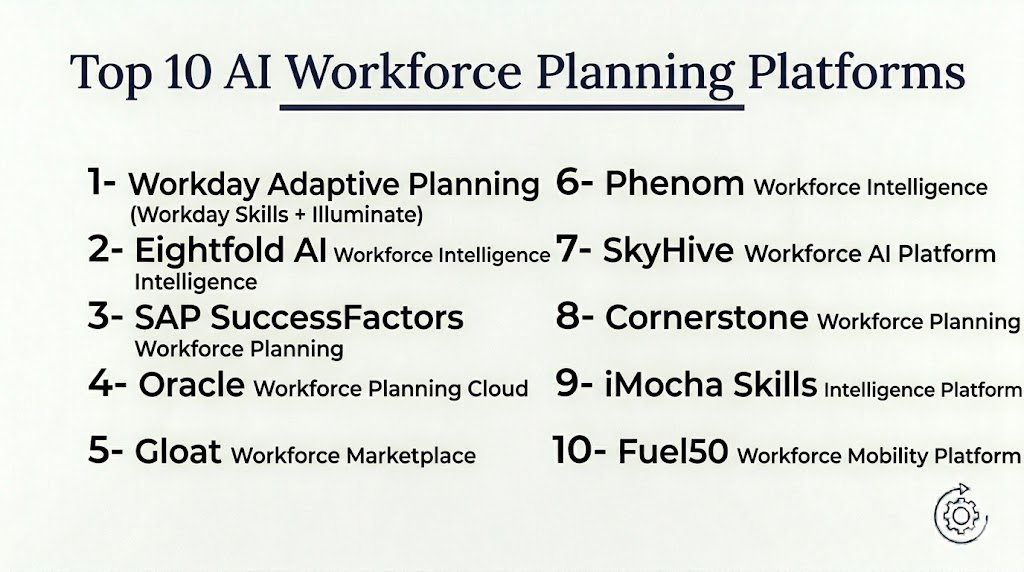
Top 10 AI Workforce Planning Platforms
1- Workday Adaptive Planning (Workday Skills + Illuminate)
2- Eightfold AI Workforce Intelligence
3- SAP SuccessFactors Workforce Planning
4- Oracle Workforce Planning Cloud
5- Gloat Workforce Marketplace
6- Phenom Workforce Intelligence
7- SkyHive Workforce AI Platform
8- Cornerstone Workforce Planning
9- iMocha Skills Intelligence Platform
10- Fuel50 Workforce Mobility Platform
1- Workday Adaptive Planning
One-line Verdict
Best for enterprise-grade AI workforce planning integrated with HR and finance systems.
Short Description
Workday Adaptive Planning provides AI-powered workforce forecasting, budgeting, and scenario modeling integrated with HR and finance data. It enables organizations to align workforce strategy with business performance in real time.
Standout Capabilities
- AI-driven workforce forecasting
- Financial + HR planning integration
- Scenario modeling and simulation
- Real-time workforce analytics
- Talent demand prediction
- Skills-based workforce insights
- Enterprise reporting dashboards
AI-Specific Depth
Workday uses machine learning models to analyze workforce trends, predict staffing needs, and simulate future workforce scenarios across large enterprise datasets.
Pros
- Strong enterprise scalability
- Deep HR + finance integration
- Reliable forecasting models
- Strong governance features
Cons
- Complex implementation
- Requires Workday ecosystem
- High enterprise cost
Security & Compliance
Not publicly stated
Deployment & Platforms
- Cloud HR and finance platform
- Enterprise workforce system
Integrations & Ecosystem
- HRIS systems
- ERP systems
- Payroll tools
- Analytics platforms
Pricing Model
Enterprise subscription
Best-Fit Scenarios
- Global workforce planning
- Finance-linked HR planning
- Enterprise forecasting systems
- Large-scale HR transformation
2- Eightfold AI Workforce Intelligence
One-line Verdict
Best for AI-driven talent intelligence and predictive workforce planning.
Short Description
Eightfold AI uses deep learning and talent graphs to predict workforce needs, map skills, and optimize hiring and internal mobility decisions across enterprises.
Standout Capabilities
- AI talent graph
- Workforce demand prediction
- Skills inference engine
- Internal mobility optimization
- Talent matching system
- Diversity workforce insights
- Career path forecasting
AI-Specific Depth
Eightfold uses neural networks trained on global talent datasets to predict workforce requirements and map skill evolution across industries.
Pros
- Extremely strong AI intelligence
- Excellent skills forecasting
- Strong enterprise adoption
- Advanced workforce analytics
Cons
- Requires large HR datasets
- Complex deployment
- Premium pricing
Security & Compliance
Not publicly stated
Deployment & Platforms
- Cloud AI workforce platform
Integrations & Ecosystem
- ATS systems
- HRIS platforms
- Workforce analytics tools
- Enterprise systems
Pricing Model
Custom enterprise pricing
Best-Fit Scenarios
- AI workforce transformation
- Skill-based workforce planning
- Global enterprise HR systems
- Talent intelligence programs
3- SAP SuccessFactors Workforce Planning
One-line Verdict
Best for enterprise workforce planning integrated into SAP ecosystem.
Short Description
SAP SuccessFactors provides AI-enhanced workforce planning tools that help organizations forecast staffing needs, manage skills gaps, and align workforce strategy with business objectives.
Standout Capabilities
- Workforce forecasting tools
- Skills gap analysis
- Scenario planning models
- HR analytics dashboards
- AI-driven planning insights
- Global workforce modeling
- Compliance reporting
AI-Specific Depth
SAP uses AI models within its Business AI ecosystem to support workforce forecasting and predictive HR analytics across enterprise operations.
Pros
- Strong enterprise ecosystem
- Deep SAP integration
- Reliable HR analytics
- Scalable architecture
Cons
- Complex configuration
- Requires SAP ecosystem
- High implementation cost
Security & Compliance
Enterprise-grade compliance
Deployment & Platforms
- SAP cloud HR platform
Integrations & Ecosystem
- SAP ERP
- HR systems
- Finance tools
- Enterprise analytics
Pricing Model
Enterprise subscription
Best-Fit Scenarios
- SAP-based organizations
- Global workforce planning
- HR + finance integration
- Large enterprise systems
4- Oracle Workforce Planning Cloud
One-line Verdict
Best for AI-powered enterprise workforce planning in Oracle ecosystem.
Short Description
Oracle Workforce Planning Cloud helps organizations forecast workforce needs, model staffing scenarios, and align HR strategy with financial planning.
Standout Capabilities
- Workforce forecasting engine
- Scenario modeling tools
- Skills gap analysis
- AI-driven insights
- HR + finance integration
- Workforce analytics dashboards
- Resource allocation planning
AI-Specific Depth
Oracle uses machine learning to simulate workforce scenarios and predict staffing needs based on business performance and external trends.
Pros
- Strong enterprise integration
- Good financial alignment
- Reliable forecasting tools
- Scalable architecture
Cons
- Requires Oracle ecosystem
- Complex implementation
- Enterprise pricing
Security & Compliance
Not publicly stated
Deployment & Platforms
- Oracle cloud HR platform
Integrations & Ecosystem
- Oracle ERP
- HR systems
- Finance platforms
- Analytics tools
Pricing Model
Enterprise subscription
Best-Fit Scenarios
- Enterprise workforce forecasting
- Finance-driven HR planning
- Global organizations
- Oracle ecosystem users
5- Gloat Workforce Marketplace
One-line Verdict
Best for internal talent mobility and skills-based workforce planning.
Short Description
Gloat provides an AI-powered workforce marketplace that connects employees to roles, projects, and opportunities based on skills and business needs.
Standout Capabilities
- AI skills marketplace
- Internal mobility engine
- Workforce matching system
- Skills gap visibility
- Project allocation tools
- Talent rediscovery
- Workforce analytics
AI-Specific Depth
Gloat uses AI-driven skill inference and matching algorithms to optimize workforce allocation and internal mobility across enterprises.
Pros
- Strong internal mobility focus
- Excellent skills intelligence
- Good employee engagement
- Real-time matching
Cons
- Requires HR transformation maturity
- Complex integration setup
- Enterprise focus only
Security & Compliance
Not publicly stated
Deployment & Platforms
- Cloud workforce marketplace
Integrations & Ecosystem
- HRIS systems
- ATS platforms
- LMS systems
- Enterprise tools
Pricing Model
Enterprise subscription
Best-Fit Scenarios
- Internal talent marketplaces
- Workforce redeployment
- Skills-based planning
- Employee mobility programs
6- Phenom Workforce Intelligence
One-line Verdict
Best for AI-driven talent experience and workforce planning.
Short Description
Phenom provides a workforce intelligence platform that combines workforce planning, skills mapping, and talent experience optimization using AI.
Standout Capabilities
- Workforce intelligence engine
- Skills-based job matching
- Internal mobility tools
- Talent analytics dashboards
- Candidate engagement AI
- Workforce forecasting
- Career path modeling
AI-Specific Depth
Phenom uses AI to connect workforce data with skills, roles, and hiring demand to improve planning accuracy and talent allocation.
Pros
- Strong talent experience layer
- Good workforce insights
- Integrated HR platform
- Strong personalization
Cons
- Complex implementation
- Requires HR ecosystem maturity
- Enterprise pricing model
Security & Compliance
Varies / N/A
Deployment & Platforms
- Cloud talent platform
Integrations & Ecosystem
- ATS systems
- HR platforms
- CRM tools
- LMS systems
Pricing Model
Enterprise pricing
Best-Fit Scenarios
- Workforce experience optimization
- HR transformation
- Internal mobility systems
- Skills-based planning
7- SkyHive Workforce AI Platform
One-line Verdict
Best for labor market intelligence and workforce transformation planning.
Short Description
SkyHive uses AI to analyze labor market data and internal workforce skills to predict future workforce needs and transformation opportunities.
Standout Capabilities
- Labor market intelligence
- Workforce forecasting
- Skills ontology mapping
- Job transformation modeling
- Reskilling recommendations
- Economic workforce analysis
- AI-driven planning insights
AI-Specific Depth
SkyHive uses AI models to analyze global labor data and predict how job roles and skills will evolve over time.
Pros
- Strong predictive insights
- Excellent labor intelligence
- Good workforce transformation tools
- Global data coverage
Cons
- Complex enterprise setup
- Not recruitment-focused
- Requires analytics maturity
Security & Compliance
Not publicly stated
Deployment & Platforms
- Cloud workforce intelligence platform
Integrations & Ecosystem
- HR systems
- Government labor data
- Enterprise analytics
- Learning platforms
Pricing Model
Enterprise pricing
Best-Fit Scenarios
- Workforce transformation
- Reskilling strategies
- Labor market forecasting
- Strategic HR planning
8- Cornerstone Workforce Planning
One-line Verdict
Best for workforce planning integrated with learning and development systems.
Short Description
Cornerstone provides workforce planning capabilities combined with learning and skills development systems to support workforce optimization.
Standout Capabilities
- Workforce planning engine
- Skills gap analysis
- Learning integration
- Career path modeling
- Talent development tools
- Workforce analytics
- Internal mobility support
AI-Specific Depth
Cornerstone uses AI to align workforce planning with learning recommendations and skills development pathways.
Pros
- Strong learning integration
- Good workforce alignment
- Scalable enterprise platform
- Strong HR ecosystem
Cons
- Complex implementation
- Requires enterprise maturity
- Heavy system setup
Security & Compliance
Not publicly stated
Deployment & Platforms
- Cloud HR + learning platform
Integrations & Ecosystem
- LMS systems
- HRIS platforms
- ATS systems
- Analytics tools
Pricing Model
Enterprise subscription
Best-Fit Scenarios
- Learning-driven workforce planning
- Skills development programs
- Enterprise HR transformation
- Workforce analytics systems
9- iMocha Skills Intelligence Platform
One-line Verdict
Best for skills-based workforce planning and gap analysis.
Short Description
iMocha provides AI-powered skills intelligence tools that help organizations identify skill gaps, map workforce capabilities, and plan future workforce needs.
Standout Capabilities
- Skills gap analysis
- Workforce skill mapping
- AI skill inference
- Talent benchmarking
- Learning recommendations
- Workforce analytics
- Role-based planning
AI-Specific Depth
iMocha uses AI to normalize and infer skills from HR data, assessments, and job roles to improve workforce planning accuracy.
Pros
- Strong skills analytics
- Good workforce insights
- Useful for upskilling programs
- Flexible integrations
Cons
- Limited marketplace features
- Requires structured HR data
- Not fully end-to-end planning
Security & Compliance
Not publicly stated
Deployment & Platforms
- Cloud skills intelligence platform
Integrations & Ecosystem
- LMS systems
- HRIS platforms
- ATS systems
- Analytics tools
Pricing Model
Subscription-based
Best-Fit Scenarios
- Skills gap analysis
- Workforce planning support
- Upskilling strategies
- Talent analytics
10- Fuel50 Workforce Mobility Platform
One-line Verdict
Best for career pathing and internal workforce mobility planning.
Short Description
Fuel50 uses AI to map employee skills and career paths to support workforce planning and internal mobility strategies.
Standout Capabilities
- AI career path mapping
- Skills ontology engine
- Internal mobility marketplace
- Workforce planning insights
- Talent matching system
- Learning recommendations
- Employee engagement tools
AI-Specific Depth
Fuel50 uses AI to continuously map employee skills to future career opportunities and workforce demand trends.
Pros
- Strong internal mobility tools
- Good employee engagement
- Easy user experience
- Useful career planning features
Cons
- Limited deep forecasting analytics
- Requires integration setup
- Moderate enterprise depth
Security & Compliance
Not publicly stated
Deployment & Platforms
- Cloud workforce mobility platform
Integrations & Ecosystem
- HR systems
- LMS platforms
- ATS systems
- Workforce tools
Pricing Model
Enterprise subscription
Best-Fit Scenarios
- Career pathing systems
- Internal mobility programs
- Employee development planning
- Skills-based workforce planning
Comparison Table
| Platform | Best For | Workforce Forecasting | Skills Intelligence | Internal Mobility | Enterprise Fit |
|---|---|---|---|---|---|
| Workday | Enterprise planning | Excellent | Strong | Strong | Excellent |
| Eightfold AI | Talent intelligence | Excellent | Excellent | Strong | Excellent |
| SAP SuccessFactors | HR + finance planning | Strong | Strong | Moderate | Excellent |
| Oracle | Enterprise forecasting | Strong | Strong | Moderate | Excellent |
| Gloat | Talent marketplace | Strong | Excellent | Excellent | Excellent |
| Phenom | Talent experience | Strong | Strong | Strong | Excellent |
| SkyHive | Labor intelligence | Excellent | Excellent | Moderate | Excellent |
| Cornerstone | Learning-driven planning | Strong | Strong | Strong | Excellent |
| iMocha | Skills gap analysis | Moderate | Strong | Moderate | Strong |
| Fuel50 | Career mobility | Moderate | Strong | Excellent | Strong |
Evaluation & Scoring Table
| Platform | Core Features 25% | Ease of Use 15% | Integrations 15% | Security 10% | Performance 10% | Support 10% | Value 15% | Total |
|---|---|---|---|---|---|---|---|---|
| Workday | 9.4 | 7.8 | 9.3 | 8.8 | 9.2 | 8.7 | 7.9 | 8.8 |
| Eightfold AI | 9.5 | 7.8 | 9.2 | 8.8 | 9.4 | 8.6 | 7.9 | 8.9 |
| SAP SuccessFactors | 9.2 | 7.7 | 9.1 | 8.8 | 9.0 | 8.6 | 7.8 | 8.7 |
| Oracle | 9.1 | 7.8 | 9.0 | 8.7 | 9.0 | 8.5 | 7.8 | 8.7 |
| Gloat | 9.3 | 7.8 | 9.1 | 8.8 | 9.3 | 8.7 | 7.9 | 8.8 |
| Phenom | 9.0 | 8.1 | 8.9 | 8.6 | 9.0 | 8.6 | 8.2 | 8.7 |
| SkyHive | 9.2 | 7.6 | 9.0 | 8.7 | 9.2 | 8.5 | 7.8 | 8.6 |
| Cornerstone | 9.1 | 7.9 | 9.0 | 8.7 | 9.0 | 8.6 | 8.0 | 8.7 |
| iMocha | 8.8 | 8.5 | 8.7 | 8.5 | 8.8 | 8.4 | 8.6 | 8.6 |
| Fuel50 | 8.7 | 8.6 | 8.5 | 8.4 | 8.6 | 8.4 | 8.8 | 8.5 |
Top 3 Recommendations
Best for Enterprise Workforce Planning
- Workday
- Eightfold AI
- SAP SuccessFactors
Best for Skills & Mobility Driven Planning
- Gloat
- Fuel50
- Phenom
Best for Workforce Intelligence & Forecasting
- SkyHive
- Oracle
- Eightfold AI
Which Tool Is Right for You
Choose Workday if
You want an enterprise-grade HR + finance-integrated workforce planning system.
Choose Eightfold AI if
You need predictive talent intelligence and AI-driven workforce forecasting.
Choose SAP SuccessFactors if
You already operate in the SAP ecosystem and need integrated planning.
Choose Oracle if
You want enterprise workforce planning tightly connected to Oracle ERP.
Choose Gloat if
You want an internal talent marketplace and mobility-first planning system.
Choose Phenom if
You want workforce planning combined with talent experience personalization.
Choose SkyHive if
You need labor market intelligence and workforce transformation insights.
Choose Cornerstone if
You want learning-driven workforce planning and skills development alignment.
Choose iMocha if
You focus on skills gap analysis and workforce capability mapping.
Choose Fuel50 if
You prioritize career pathing and employee mobility strategies.
30 60 90 Days Implementation Playbook
First 30 Days
- Define workforce planning goals
- Map HR and business data sources
- Identify skill and role structures
- Choose planning model approach
- Align stakeholders
Next 60 Days
- Integrate HRIS and ATS systems
- Build initial workforce models
- Enable scenario planning
- Validate forecasting outputs
- Train HR teams
Final 90 Days
- Scale workforce planning system
- Enable predictive analytics
- Optimize staffing decisions
- Expand internal mobility planning
- Automate planning workflows
Common Mistakes
- Using static workforce models
- Ignoring skills-based planning
- Poor data integration between HR systems
- Overcomplicating forecasting models
- Lack of HR-business alignment
- Not validating AI predictions
- Ignoring internal mobility potential
- Weak governance frameworks
Frequently Asked Questions FAQs
1. What is an AI workforce planning platform?
It is a system that uses AI to forecast workforce needs, optimize staffing, and align talent strategy with business goals.
2. How does AI improve workforce planning?
AI predicts demand, analyzes skills, and simulates future workforce scenarios to improve planning accuracy.
3. What is skills-based workforce planning?
It is planning based on employee skills rather than job titles or roles.
4. Why is workforce planning important?
It helps organizations ensure they have the right talent at the right time.
5. Do these tools integrate with HR systems?
Yes, most integrate with HRIS, ATS, and ERP systems.
6. What industries use workforce planning tools?
Large enterprises, tech companies, healthcare, retail, and finance sectors.
7. Can small businesses use these tools?
Most are designed for medium to large enterprises.
8. What is scenario modeling in workforce planning?
It is the ability to simulate different workforce strategies and outcomes.
9. How does AI predict workforce demand?
It uses historical HR data, business trends, and external labor data.
10. What is the biggest benefit of AI workforce planning?
Better decision-making through predictive, data-driven workforce strategies.
Conclusion
AI Workforce Planning Platforms are redefining how organizations manage talent strategy by shifting from reactive hiring to predictive, skills-based workforce intelligence. These tools help enterprises forecast staffing needs, identify skill gaps, and align workforce decisions with business goals using AI-driven insights and scenario modeling. As organizations face rapid change in skills demand and labor markets, these platforms become essential for maintaining agility and competitiveness. The right solution depends on enterprise size, HR maturity, and integration needs, but all leading platforms share a common goal: enabling smarter, faster, and more strategic workforce decisions.

Find Trusted Cardiac Hospitals
Compare heart hospitals by city and services — all in one place.
Explore Hospitals
Loved how clearly the features and differences were explained.