
Introduction
Content moderation platforms are specialized tools designed to review, filter, classify, and manage user-generated content across digital platforms. As online communities, marketplaces, social networks, and SaaS products continue to grow, so does the volume of text, images, videos, and audio that must be monitored for safety, legality, and brand integrity.
Effective content moderation is no longer optional. Harmful, misleading, or illegal content can quickly damage user trust, invite regulatory penalties, and expose organizations to serious reputational risk. From hate speech and harassment to misinformation, fraud, explicit material, and policy violations, moderation platforms help organizations maintain healthy, compliant digital environments.
In real-world use, these platforms support social media moderation, marketplace safety, community forums, gaming chats, live streams, reviews, comments, ads, and customer-generated media. Modern solutions combine AI-based automation with human-in-the-loop workflows, enabling teams to scale moderation without sacrificing accuracy.
When choosing a content moderation platform, buyers should evaluate AI accuracy, customization, language coverage, workflow flexibility, integrations, scalability, security, compliance readiness, reporting, and total cost of ownership. The right platform aligns with both operational needs and long-term growth.
Best for:
Content moderation platforms are ideal for social networks, online communities, marketplaces, SaaS platforms, media companies, gaming platforms, fintech, health platforms, and enterprises handling large volumes of user-generated content. Roles that benefit most include Trust & Safety teams, Compliance officers, Product managers, Community managers, and Legal teams.
Not ideal for:
These tools may be unnecessary for static websites, small blogs with no user interaction, or internal systems without public content submission, where manual review or basic filters may be sufficient.
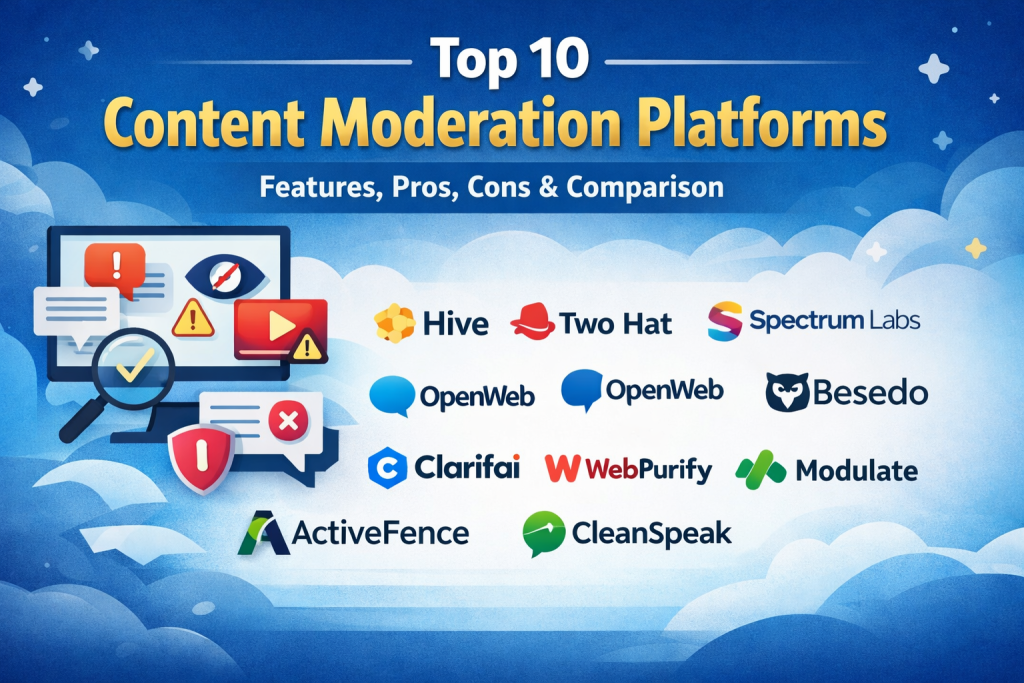
Top 10 Content Moderation Platforms Tools
1 — Hive
Short description:
Hive provides AI-powered content moderation for images, video, and text, built for high-scale platforms requiring fast, accurate classification.
Key features:
- Image, video, and text moderation models
- Near real-time content classification
- Custom taxonomy and thresholds
- API-first architecture
- Multilingual support
- Analytics and performance insights
Pros:
- Strong accuracy for visual content
- Highly scalable for large platforms
Cons:
- Requires technical integration effort
- Pricing can scale quickly with volume
Security & compliance:
SOC 2, GDPR alignment, encrypted data handling
Support & community:
Enterprise onboarding, detailed documentation, direct support channels
2 — Two Hat
Short description:
Two Hat focuses on proactive moderation and policy enforcement, particularly for gaming and youth-focused communities.
Key features:
- Text moderation with contextual AI
- Real-time chat filtering
- Behavioral pattern analysis
- Custom policy rules
- Community health reporting
Pros:
- Excellent for live chat moderation
- Strong safety focus for vulnerable users
Cons:
- Limited image/video moderation
- Less suited for e-commerce reviews
Security & compliance:
GDPR-ready, data encryption, access controls
Support & community:
Hands-on onboarding, responsive support, smaller but focused user base
3 — Spectrum Labs
Short description:
Spectrum Labs delivers advanced AI moderation and behavioral intelligence for large-scale online platforms.
Key features:
- Context-aware text moderation
- Harassment and toxicity detection
- Policy customization
- Human-in-the-loop workflows
- Advanced reporting dashboards
Pros:
- Deep contextual understanding
- Strong analytics and insights
Cons:
- Enterprise-centric pricing
- Setup may feel complex for SMBs
Security & compliance:
SOC 2, GDPR, audit logs available
Support & community:
Dedicated account teams, enterprise SLAs
4 — OpenWeb
Short description:
OpenWeb combines moderation, engagement, and publishing tools for publishers and media-driven communities.
Key features:
- Comment moderation and filtering
- Identity and reputation scoring
- AI-assisted moderation queues
- Publisher-friendly workflows
- Engagement analytics
Pros:
- Excellent for news and media sites
- Encourages healthy discussions
Cons:
- Narrower use cases
- Less flexible for marketplaces
Security & compliance:
GDPR compliance, moderation audit trails
Support & community:
Strong publisher support, onboarding assistance
5 — Besedo
Short description:
Besedo offers hybrid AI and human moderation services, ideal for marketplaces and global platforms.
Key features:
- Text, image, and listing moderation
- Human review services
- Policy customization
- Multilingual coverage
- Fraud and scam detection
Pros:
- Human-in-the-loop accuracy
- Suitable for regulated industries
Cons:
- Slower turnaround for manual reviews
- Cost varies with human volume
Security & compliance:
GDPR, ISO-aligned processes, data protection standards
Support & community:
Dedicated moderation teams, managed service model
6 — Clarifai
Short description:
Clarifai provides customizable AI models for content moderation and visual recognition.
Key features:
- Custom AI model training
- Image and video moderation
- API-based deployment
- Scalable infrastructure
- Model explainability tools
Pros:
- High flexibility for custom needs
- Strong visual AI performance
Cons:
- Requires ML expertise
- Less out-of-the-box workflows
Security & compliance:
Enterprise security controls, GDPR support
Support & community:
Developer documentation, enterprise support plans
7 — WebPurify
Short description:
WebPurify specializes in profanity filtering and image moderation for websites and apps.
Key features:
- Profanity and keyword filtering
- Image moderation APIs
- Custom word lists
- Real-time filtering
- Simple integrations
Pros:
- Easy to implement
- Cost-effective for SMBs
Cons:
- Limited advanced AI context
- Basic reporting features
Security & compliance:
Standard encryption, GDPR-aware processing
Support & community:
Email support, straightforward documentation
8 — Modulate
Short description:
Modulate focuses on voice moderation and real-time audio analysis for gaming and live platforms.
Key features:
- Voice toxicity detection
- Real-time audio processing
- Behavioral insights
- Custom enforcement rules
- Gaming-optimized APIs
Pros:
- Leading voice moderation tech
- Real-time intervention
Cons:
- Audio-only focus
- Niche applicability
Security & compliance:
Data encryption, privacy-first voice processing
Support & community:
Specialized support, close customer collaboration
9 — ActiveFence
Short description:
ActiveFence detects malicious content, fraud, and disinformation across platforms.
Key features:
- Multi-modal content analysis
- Threat intelligence feeds
- Fraud and scam detection
- Policy enforcement workflows
- Global coverage
Pros:
- Strong threat detection
- Suitable for high-risk environments
Cons:
- Enterprise-only focus
- Less transparent pricing
Security & compliance:
SOC 2, GDPR, advanced audit capabilities
Support & community:
Enterprise onboarding, analyst support
10 — CleanSpeak
Short description:
CleanSpeak offers customizable moderation workflows for communities, dating apps, and marketplaces.
Key features:
- Text and image moderation
- Rule-based workflows
- Human review queues
- Policy customization
- Reporting dashboards
Pros:
- Flexible moderation rules
- Good balance of automation and control
Cons:
- UI feels dated
- Limited advanced AI models
Security & compliance:
GDPR compliance, access controls
Support & community:
Email and ticket support, onboarding assistance
Comparison Table
| Tool Name | Best For | Platform(s) Supported | Standout Feature | Rating |
|---|---|---|---|---|
| Hive | Large-scale platforms | Web, Mobile, API | Visual AI accuracy | N/A |
| Two Hat | Gaming & youth communities | Web, Mobile | Real-time chat moderation | N/A |
| Spectrum Labs | Enterprise trust & safety | Web, Mobile | Contextual AI insights | N/A |
| OpenWeb | Media publishers | Web | Community engagement | N/A |
| Besedo | Marketplaces | Web, Mobile | Human-AI hybrid | N/A |
| Clarifai | Custom AI needs | API | Model customization | N/A |
| WebPurify | SMB websites | Web, API | Profanity filtering | N/A |
| Modulate | Voice platforms | Gaming, Live audio | Voice moderation | N/A |
| ActiveFence | High-risk platforms | Web, Mobile | Threat intelligence | N/A |
| CleanSpeak | Communities | Web, Mobile | Workflow flexibility | N/A |
Evaluation & Scoring of Content Moderation Platforms
| Criteria | Weight | Explanation |
|---|---|---|
| Core features | 25% | Breadth and depth of moderation capabilities |
| Ease of use | 15% | Setup, UI clarity, learning curve |
| Integrations & ecosystem | 15% | APIs, platform compatibility |
| Security & compliance | 10% | Data protection and standards |
| Performance & reliability | 10% | Speed and uptime |
| Support & community | 10% | Responsiveness and resources |
| Price / value | 15% | Cost vs delivered value |
Which Content Moderation Platforms Tool Is Right for You?
- Solo users & small teams: Simple tools with quick setup and basic filtering
- SMBs: Balanced AI automation with affordable pricing
- Mid-market: Workflow customization and reporting depth
- Enterprise: Scalability, compliance, advanced AI, and SLAs
Budget-conscious teams may prioritize ease of use and essential features, while premium buyers often value accuracy, compliance, and global scale. Always match the tool to your content volume, risk profile, and regulatory environment.
Frequently Asked Questions (FAQs)
1. What is a content moderation platform?
It is software that reviews and manages user-generated content to ensure safety, compliance, and quality.
2. Are AI moderation tools fully automated?
Most combine AI automation with optional human review for accuracy.
3. Can these tools handle multiple languages?
Many support multilingual moderation, but coverage varies.
4. Are they suitable for regulated industries?
Yes, especially platforms with strong compliance and audit features.
5. Do I need developers to integrate them?
API-based tools usually require some technical involvement.
6. How accurate is AI moderation?
Accuracy is high for common violations but improves with tuning.
7. Can rules be customized?
Most platforms allow policy and threshold customization.
8. Are these tools expensive?
Pricing depends on volume, features, and service model.
9. Can they moderate live content?
Some support real-time moderation for chat, voice, or streams.
10. What is the biggest mistake buyers make?
Choosing tools without aligning them to content type and scale.
Conclusion
Content moderation platforms play a critical role in protecting users, brands, and businesses in today’s digital ecosystem. The best solutions balance automation, accuracy, flexibility, and compliance, while fitting operational and budget realities.
There is no universal winner. The right platform depends on content type, scale, risk tolerance, and organizational maturity. By clearly defining your needs and evaluating tools against practical criteria, you can build a safer, more trusted online environment that grows with your platform.

Find Trusted Cardiac Hospitals
Compare heart hospitals by city and services — all in one place.
Explore Hospitals
I would also give more attention to how moderation accuracy changes across languages, regions, and evolving user behavior. Slang, sarcasm, coded language, and new forms of harmful content can make previously reliable detection models less effective. Maintaining representative test datasets and regularly evaluating false positives and false negatives across different language groups can reveal problems that overall accuracy scores may hide. This is especially important for platforms serving international communities.
Content moderation platforms need to balance fast detection with consistent, context-aware decisions, especially in communities where slang, sarcasm, and cultural differences can change the meaning of a post. Automated models can help process large volumes of text, images, and video, but relying on them alone may lead to both harmful content being missed and legitimate users being unfairly restricted. I’d look for tools that support human review queues, clear policy-based explanations, appeals, and audit trails so moderation decisions can be evaluated and improved. Multilingual coverage and the ability to adapt policies to different communities are also important, since a model trained on one language or context may not perform equally well elsewhere. Teams should monitor false-positive and false-negative rates alongside moderator workload and response time. The strongest platform is one that protects users while preserving fairness, transparency, and trust in the community.
Scaling platform safety requires automated multimodal AI filters that evaluate images, video, and text simultaneously to catch subtle context-dependent harassment and CSAM material. Automated filtering must be paired with streamlined human review queues that protect moderator mental health through automated image blurring and exposure limits. Auditable appeal workflows are critical for upholding platform fairness and preserving community trust.
Content moderation platforms help organizations review user-generated content and maintain safer online communities. When comparing options, consider automated detection accuracy, human review workflows, policy customization, appeal management, language support, reporting, response time, and user privacy safeguards.
Content moderation platforms protect communities at scale, and this article handles a difficult topic thoughtfully. I like the balance between automated detection and human review, since context still matters for nuance. One practical note is that moderation policies should be transparent to users, because opacity breeds distrust even when decisions are correct. Healthy communities need consistent enforcement. Important and balanced coverage.
Content moderation platforms help businesses review and manage user-generated content across websites, apps, and social media channels. When comparing these platforms, I would focus on automated content detection, policy customization, image and text moderation, review workflows, and reporting capabilities. These features can help identify harmful content, maintain community standards, and reduce manual review efforts. The right platform should provide accurate moderation, flexible policy controls, and reliable support for managing content at scale.
Content moderation platforms help businesses maintain safe and trustworthy digital environments by identifying and managing inappropriate, harmful, or policy-violating content. Features such as AI-powered detection, image and video moderation, text analysis, sentiment classification, automated flagging, and human review workflows can improve moderation efficiency. When comparing solutions, organizations should consider detection accuracy, customization, scalability, multilingual support, integration capabilities, and response times. The right platform can reduce manual moderation efforts, protect online communities, enforce content guidelines, and create safer digital experiences for users.
Moderation systems need a clear process for reviewing decisions that users or staff challenge. Incorrect actions can frustrate genuine users, while missed violations may create risks for the wider community. Keeping reviewer explanations and policy references makes these cases easier to investigate. It also helps teams spot patterns where certain languages or content types receive inconsistent treatment. Regularly reviewing these cases can make moderation rules more reliable as online communities grow.
Content moderation platforms help teams review posts, images, videos, and messages against community rules. Automation can handle common cases, but context and fair review remain important. I would compare language coverage, detection accuracy, reviewer workflows, appeals, and audit records. Teams should test harmful content as well as harmless posts that may be flagged incorrectly. Clear policies help reviewers make consistent decisions. It is also useful to monitor how quickly urgent cases reach a human reviewer. A strong platform should support safer communities while limiting unfair removals and making moderation decisions easier to explain.
Content moderation platforms need to handle harmful material consistently without removing legitimate posts by mistake. When comparing tools, check whether moderators can review context, appeal automated decisions, and apply different rules across languages and communities. Tracking overturned decisions and disagreement between human reviewers can help teams identify weak moderation rules and improve accuracy as the platform grows.
Content moderation platforms work best when automated detection is combined with human judgment for sensitive or unclear cases. Businesses should look beyond detection speed and evaluate false positives, language support, and how easily moderators can review flagged content. Clear escalation workflows and regular updates to moderation policies can also help teams respond consistently as online communities grow. The right balance between automation and human oversight helps maintain safer spaces without unfairly limiting genuine user expression.
Content moderation platforms help digital businesses maintain safer online communities by identifying spam, abusive language, harmful media, and policy violations. Combining automated detection with human review can improve response times while accounting for context that algorithms may overlook. Customizable moderation rules, transparent appeal processes, and performance monitoring also help organizations apply policies consistently, protect users, and adapt to changing community standards.
Content moderation systems also need a reliable way to handle disputed decisions and policy changes. A post that violates one community’s rules may be acceptable in another, so applying identical thresholds across every audience can create unnecessary removals. Teams should maintain versioned moderation policies, record the reasons behind enforcement actions, and allow reviewers to reverse incorrect decisions. It is also useful to replay previously reviewed cases against updated rules before deploying policy changes. This helps teams understand how new settings may affect existing users and content. Tracking appeal outcomes and reversal rates can reveal systematic errors that standard detection metrics may miss, while making moderation decisions more consistent and easier to audit.
Great evaluation, but it skips the critical latency overhead of synchronous moderation API calls in high-throughput user funnels. Blocking post submissions for third-party inference creates severe response-time degradation. Platform engineers must implement asynchronous pub/sub pipelines with optimistic UI rendering and automated rollback capabilities to maintain platform responsiveness without sacrificing safety guardrails.
Content moderation platforms help businesses review user posts, images, videos, and comments to keep online spaces safe and useful. When comparing tools, consider automated detection accuracy, human review workflows, language support, customizable policies, and reporting features. Combining automated checks with human judgment can reduce harmful content while limiting false removals and ensuring moderation decisions stay consistent.
Content moderation platforms help businesses review user-generated content, detect harmful material, and maintain safer online communities across websites and social media channels. Solutions like Hive offer AI-powered content classification and moderation tools, helping teams identify inappropriate content faster, reduce manual review workloads, and create a more trustworthy experience for users.
Choosing between pure AI automation and a hybrid human-in-the-loop workflow often comes down to your platform’s risk tolerance for edge cases. While automated models handle high-volume text and visual filtering efficiently, nuanced community contexts or complex regulatory environments usually require dedicated human review layers to avoid costly false positives. Matching your tool selection directly to your specific content volume and compliance demands is definitely the key takeaway here.
Effective content moderation depends on more than detecting harmful content; it also requires consistent policies and clear escalation paths for complex cases. Combining automated detection with human review and regularly auditing false positives can help platforms protect users without suppressing genuine discussions.