
Introduction
Contract Repository Tools are specialized software platforms designed to store, organize, search, and manage contracts in a centralized digital system. Instead of contracts being scattered across email inboxes, shared drives, or filing cabinets, these tools create a single source of truth for all agreements—vendor contracts, customer agreements, NDAs, employment contracts, and more.
In today’s business environment, contracts are no longer static documents. They contain critical obligations, renewal dates, risk clauses, compliance requirements, and financial commitments. Contract repository tools help organizations reduce legal risk, avoid missed renewals, improve visibility, and support better decision-making by turning contracts into structured, searchable data.
Why Contract Repository Tools Matter
- Missed renewals can lead to unwanted auto-renewals or lost revenue
- Poor visibility increases legal and compliance risk
- Manual contract searches waste time and productivity
- Lack of audit trails creates governance gaps
Key Real-World Use Cases
- Centralizing vendor and supplier agreements
- Tracking renewals, expirations, and obligations
- Supporting legal, procurement, finance, and compliance teams
- Enabling audits, regulatory reviews, and internal controls
What to Look for When Choosing a Tool (Evaluation Criteria)
- Robust search and metadata tagging
- Strong security and access controls
- Integration with CLM, ERP, CRM, and procurement systems
- Ease of use for non-legal users
- Scalability and compliance readiness
Best for:
Legal teams, procurement leaders, finance teams, compliance officers, SMBs scaling operations, and enterprises managing thousands of contracts across regions and departments.
Not ideal for:
Individuals with very few contracts, teams that already have a full CLM suite with a built-in repository, or organizations that rely entirely on simple file storage without compliance needs.
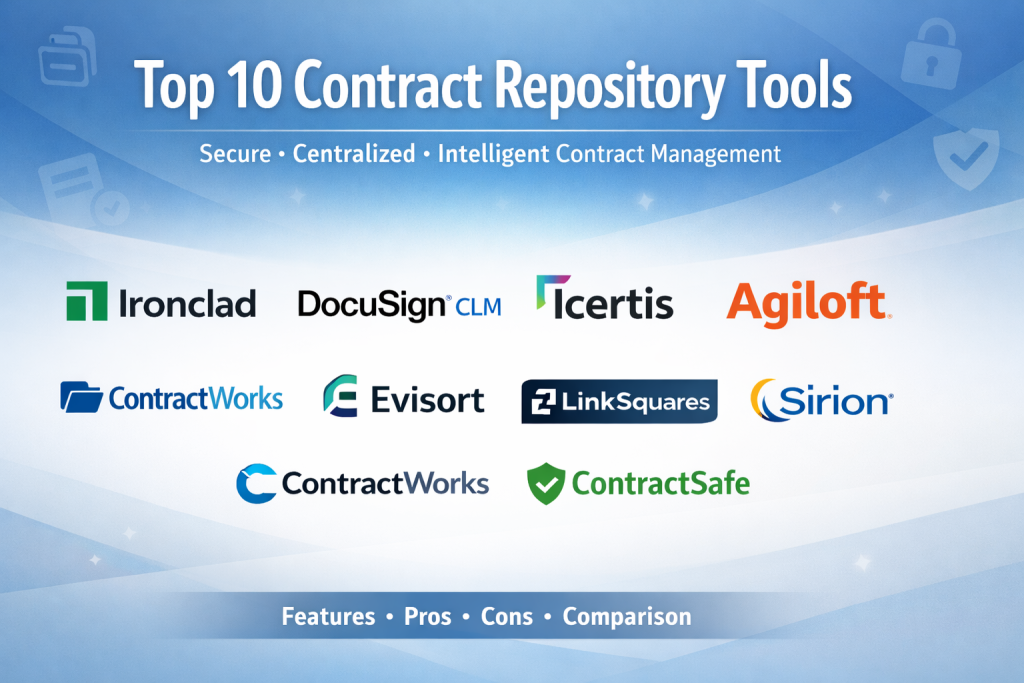
Top 10 Contract Repository Tools
1 — Ironclad
Short description:
Ironclad provides a modern, enterprise-grade contract repository tightly integrated with contract lifecycle workflows. It is designed for fast-moving legal and business teams.
Key features:
- Centralized contract repository with advanced search
- AI-powered clause and metadata extraction
- Version control and audit trails
- Role-based access and permissions
- Contract lifecycle visibility (draft to archive)
- Integrations with CRM and productivity tools
Pros:
- Intuitive interface for legal and business users
- Strong automation and AI capabilities
Cons:
- Premium pricing
- May be complex for very small teams
Security & compliance:
SSO, encryption at rest and in transit, audit logs, SOC 2, GDPR
Support & community:
Enterprise onboarding, strong documentation, dedicated customer success teams
2 — DocuSign CLM
Short description:
DocuSign CLM extends beyond e-signatures to offer a structured contract repository for organizations that want end-to-end contract visibility.
Key features:
- Central contract storage and categorization
- Automated tagging and metadata capture
- Integrated e-signature workflows
- Clause library and version tracking
- Renewal and obligation alerts
- Reporting and analytics dashboards
Pros:
- Seamless connection with DocuSign eSignature
- Strong enterprise credibility
Cons:
- Repository features depend on configuration
- Can feel heavy for smaller teams
Security & compliance:
SSO, encryption, SOC 2, ISO 27001, GDPR
Support & community:
Global enterprise support, extensive documentation and training
3 — Icertis
Short description:
Icertis delivers a highly scalable contract repository with deep analytics, built for large enterprises and regulated industries.
Key features:
- Centralized global contract repository
- AI-driven contract intelligence
- Advanced metadata and obligation tracking
- Multilingual and multi-entity support
- Compliance and risk dashboards
- Deep ERP and CRM integrations
Pros:
- Extremely powerful for complex environments
- Strong compliance and governance capabilities
Cons:
- Long implementation cycles
- Steep learning curve
Security & compliance:
SOC 1 & 2, ISO 27001, GDPR, enterprise-grade controls
Support & community:
Dedicated enterprise support, implementation partners, structured onboarding
4 — Agiloft
Short description:
Agiloft offers a flexible contract repository with no-code customization, making it popular with organizations needing tailored workflows.
Key features:
- Centralized contract repository
- Highly customizable metadata and fields
- Workflow automation without coding
- Full audit trails
- Integration with business systems
- Reporting and dashboards
Pros:
- Exceptional configurability
- Strong value for complex requirements
Cons:
- Interface can feel dated
- Requires thoughtful setup
Security & compliance:
SSO, encryption, SOC 2, GDPR
Support & community:
Responsive support, strong documentation, professional services available
5 — Conga Contracts
Short description:
Conga Contracts focuses on contract repositories tied closely to sales and revenue operations, especially for CRM-driven teams.
Key features:
- Central contract repository linked to CRM records
- Clause and template management
- Automated approvals and workflows
- Reporting on contract performance
- Version control and audit history
Pros:
- Excellent CRM integration
- Strong for sales-driven organizations
Cons:
- Less suitable for legal-only use cases
- Customization may require admin expertise
Security & compliance:
Encryption, role-based access, GDPR, SOC 2
Support & community:
Enterprise support, onboarding assistance, active customer community
6 — ContractWorks
Short description:
ContractWorks is a simple, user-friendly contract repository designed for fast deployment and everyday use.
Key features:
- Central contract storage
- OCR-powered full-text search
- Automatic alerts for renewals
- Role-based access controls
- Contract tagging and categorization
Pros:
- Extremely easy to use
- Quick implementation
Cons:
- Limited advanced automation
- Not ideal for very large enterprises
Security & compliance:
Encryption, audit logs, SOC 2
Support & community:
Highly rated customer support, clean documentation
7 — Evisort
Short description:
Evisort provides an AI-driven contract repository that excels at extracting insights from existing contracts.
Key features:
- AI-powered contract ingestion
- Advanced clause extraction
- Search across legacy contracts
- Risk and obligation analytics
- Dashboard-based reporting
Pros:
- Excellent for analyzing historical contracts
- Strong AI accuracy
Cons:
- Higher cost
- Less focused on drafting workflows
Security & compliance:
SSO, encryption, SOC 2, GDPR
Support & community:
Dedicated onboarding, enterprise-level support
8 — LinkSquares
Short description:
LinkSquares is built specifically for in-house legal teams seeking clarity and speed in contract storage and retrieval.
Key features:
- Central legal contract repository
- AI-based tagging and search
- Matter-based organization
- Renewal and obligation tracking
- Legal analytics dashboards
Pros:
- Legal-team-centric design
- Fast contract retrieval
Cons:
- Limited non-legal workflows
- Premium pricing
Security & compliance:
SOC 2, encryption, GDPR
Support & community:
Strong legal-focused onboarding and support
9 — Sirion
Short description:
Sirion focuses on post-signature contract performance and compliance, making its repository ideal for complex supplier agreements.
Key features:
- Centralized contract repository
- Obligation and performance tracking
- AI-based risk analysis
- Supplier and partner monitoring
- Compliance reporting
Pros:
- Excellent for vendor-heavy environments
- Strong post-award visibility
Cons:
- Complex setup
- Overkill for small teams
Security & compliance:
ISO 27001, SOC 2, GDPR
Support & community:
Enterprise support, implementation specialists
10 — ContractSafe
Short description:
ContractSafe is a lightweight contract repository aimed at teams that want simplicity without sacrificing core functionality.
Key features:
- Central document storage
- Full-text search
- Contract reminders
- Folder-based organization
- Permission controls
Pros:
- Affordable and easy to adopt
- Minimal training required
Cons:
- Limited automation
- Not built for complex enterprises
Security & compliance:
Encryption, basic audit logs, GDPR
Support & community:
Helpful support team, straightforward documentation
Comparison Table
| Tool Name | Best For | Platform(s) Supported | Standout Feature | Rating |
|---|---|---|---|---|
| Ironclad | Enterprise legal teams | Web | Workflow-driven repository | N/A |
| DocuSign CLM | End-to-end contract ops | Web | E-signature integration | N/A |
| Icertis | Global enterprises | Web | Contract intelligence | N/A |
| Agiloft | Custom workflows | Web | No-code customization | N/A |
| Conga Contracts | Sales-centric orgs | Web | CRM-native repository | N/A |
| ContractWorks | SMBs | Web | Simplicity and speed | N/A |
| Evisort | AI-driven insights | Web | Legacy contract analysis | N/A |
| LinkSquares | In-house legal | Web | Legal-focused AI search | N/A |
| Sirion | Supplier contracts | Web | Post-award performance | N/A |
| ContractSafe | Small teams | Web | Ease of use | N/A |
Evaluation & Scoring of Contract Repository Tools
| Criteria | Weight | Key Considerations |
|---|---|---|
| Core features | 25% | Search, metadata, versioning |
| Ease of use | 15% | UI, onboarding, usability |
| Integrations & ecosystem | 15% | CRM, ERP, CLM, APIs |
| Security & compliance | 10% | SSO, audit logs, certifications |
| Performance & reliability | 10% | Speed, uptime, scalability |
| Support & community | 10% | Documentation, responsiveness |
| Price / value | 15% | ROI, pricing flexibility |
Which Contract Repository Tool Is Right for You?
- Solo users: Simple tools with fast search and reminders
- SMBs: Affordable platforms with minimal setup and strong support
- Mid-market: Balanced tools offering automation and integrations
- Enterprise: Scalable, secure solutions with AI and compliance controls
Budget-conscious vs premium:
Choose simplicity if cost matters; invest in AI and analytics for scale.
Feature depth vs ease of use:
Legal-heavy teams benefit from depth; business users value simplicity.
Integration needs:
CRM and ERP integration becomes critical as organizations scale.
Security & compliance:
Regulated industries should prioritize certifications and audit trails.
Frequently Asked Questions (FAQs)
- What is a contract repository tool?
A centralized system for storing, organizing, and searching contracts securely. - How is it different from cloud storage?
It adds metadata, alerts, audit logs, and compliance controls. - Do small businesses need one?
Yes, especially to avoid missed renewals and lost agreements. - Can these tools scan old contracts?
Many support OCR and AI-based ingestion. - Are they secure?
Most offer enterprise-grade encryption and access controls. - Do they replace CLM systems?
Some are standalone; others are part of full CLM platforms. - How long does implementation take?
From days for simple tools to months for enterprise systems. - Can non-legal teams use them?
Yes, many are designed for cross-functional access. - Are reminders customizable?
Most allow alerts for renewals, expirations, and obligations. - What’s the biggest mistake buyers make?
Underestimating future scale and integration needs.
Conclusion
Contract Repository Tools play a critical role in reducing risk, improving visibility, and increasing operational efficiency. While features like AI, automation, and analytics are valuable, usability, security, and alignment with business needs matter just as much.
There is no single “best” contract repository tool. The right choice depends on team size, contract volume, compliance requirements, and integration needs. By focusing on what truly matters to your organization, you can select a solution that delivers long-term value and confidence in your contract management process.

Find Trusted Cardiac Hospitals
Compare heart hospitals by city and services — all in one place.
Explore Hospitals
Contract repository tools help organizations centralize agreements, improve document accessibility, and maintain better control over contracts throughout their lifecycle. Features such as advanced search, metadata tagging, version control, access permissions, renewal alerts, and integration with contract management systems can simplify retrieval and reduce the risk of missed obligations. I believe search accuracy, security, audit trails, and ease of integration are essential factors when comparing these solutions. The right platform should do more than store documents; it should help legal, procurement, and business teams quickly find reliable contract information, maintain compliance, and make better-informed decisions while reducing administrative effort.
AI-powered contract extraction can save considerable effort, but its real value depends on how accurately it identifies clauses, obligations, and critical dates in older agreements. Testing a repository with real contracts, including scanned documents and inconsistent formats, can expose limitations before implementation.
Managing contracts becomes difficult when teams have to search through folders and emails to find the right document. A useful contract repository should make it easy to search by renewal date, vendor, and contract type, while keeping access limited to the right people. I also think automatic reminders for upcoming renewals can help businesses avoid missed deadlines and unwanted costs. Keeping a clear history of document changes is another practical feature worth considering.
Contract repository tools help businesses store agreements and find key details in one place. A useful platform should offer fast search, clear access rules, and reminders for important dates. Version history can help teams avoid using outdated documents. Metadata fields also make it easier to sort contracts by owner, type, or renewal date. When comparing tools, review search accuracy, security, integrations, and document import options. A well-organized repository reduces time spent searching through folders and emails. It also helps teams manage renewals and keep contract records consistent.
Contract repository tools help organizations centralize agreements, maintain version control, and locate critical documents without relying on scattered folders or manual searches. Metadata tagging, automated renewal reminders, and role-based permissions improve visibility while reducing the risk of missed obligations or unauthorized access. Integrating the repository with e-signature and contract lifecycle systems further strengthens document governance and supports more consistent legal and procurement workflows.
A contract repository needs a reliable way to track obligations that depend on dates, approvals, or actions from other parties. Teams should check whether reminders can reach the right owner when staff change roles or leave the organization. It is also useful to connect key obligations with renewal calendars and approval workflows, rather than relying on someone to review documents manually. Regular checks can reveal missed alerts or outdated ownership details. This helps prevent important contract deadlines from slipping through unnoticed.
A contract repository becomes far more valuable when teams can quickly find the latest approved version and track key dates. Role-based permissions, renewal alerts, and searchable metadata help reduce missed deadlines and prevent unauthorized access to sensitive agreements. Connecting the repository with e-signature and contract management workflows can also reduce manual work and give teams better visibility throughout the contract lifecycle.
Centralizing corporate legal agreements within indexed contract repositories enables AI-driven clause extraction, automated milestone tracking, and granular role-based permissions, mitigating renewal oversights and regulatory non-compliance across enterprise legal operations without manual filing overhead.
One important factor when choosing a contract repository tool is how well it supports teams after a contract is signed. Automated renewal reminders are useful, but tracking ownership, obligations, and upcoming deadlines can prevent costly oversights. I would also recommend testing search accuracy with older scanned contracts and checking whether permissions can be set by department or contract type. Integration with existing procurement and finance systems can make contract data much more actionable. How do organizations balance advanced automation with ease of use when selecting a repository for different teams?
Legacy contract migration can be more challenging than selecting the repository itself. Organizations often have scanned documents, inconsistent naming conventions, duplicate files, and amendments stored separately from their original agreements. Moving everything into a new platform without validating these relationships can create gaps in legal history and unreliable contract records. Before migration, teams should define data-cleaning rules, verify extracted metadata against source documents, and establish a process for handling records that automated tools cannot classify confidently. A sample-based review by legal and procurement teams can catch errors before the full archive moves. Maintaining traceable migration logs and keeping the original records available during validation also makes it easier to investigate discrepancies. This preparation can reduce migration risks and prevent old data problems from carrying into the new system.
Contract repository tools help organizations keep agreements organized, searchable, and accessible to the right people. When comparing platforms, I would prioritize full-text search, version control, permission management, renewal reminders, and integration with existing business systems. Clear metadata and consistent naming rules can make a major difference when teams need to find specific clauses or review contract history. Automated alerts also help prevent important deadlines from being missed. How can organizations maintain a reliable contract repository while ensuring sensitive agreements remain secure and easy to retrieve?
Choosing the right contract repository tool really depends on whether your organization needs deep AI-driven clause extraction for legacy PDFs or simply streamlined renewal alerts. Many teams overlook how crucial proper metadata tagging and CRM integrations are for avoiding compliance blind spots post-signature. A helpful approach is evaluating tools based on how easily cross-functional teams like procurement, sales, and legal can adopt them daily. What factors do you prioritize most when comparing the security versus usability of these platforms.
Contract repositories become harder to manage when agreements are renewed automatically or amended without updating the original record. It helps when the software links each amendment to the signed contract and alerts teams before renewal deadlines. This makes it easier to track current terms, avoid missed cancellation windows, and reduce confusion when several departments use the same agreement.
Contract repository tools make it easier for organizations to store, organize, and retrieve agreements from a centralized, secure location. Evaluating document search, version control, access permissions, renewal alerts, and compliance tracking helps businesses reduce manual effort, maintain accurate contract records, and manage important legal documents more efficiently.
Excellent guide! I particularly appreciated the focus on the post-signature stage of the contract lifecycle. It’s often easy to forget that a contract is a ‘living asset’ that needs constant monitoring for renewals and compliance obligations. This post does a fantastic job of highlighting tools that turn static documents into structured, actionable data. Very informative and well-structured!