
Introduction
Copyright Registration Tools are specialized platforms designed to help creators, businesses, and organizations secure legal ownership of original work. These tools streamline the process of documenting creation dates, authorship, and ownership—often adding digital proof such as timestamps, certificates, or blockchain records. In an era where content is created and distributed globally in seconds, proving ownership quickly and reliably has become essential.
Copyright protection is important because it prevents misuse, plagiarism, and unauthorized commercial exploitation of creative assets. Whether it’s a blog post, software code, music track, photograph, design, or video, copyright registration provides legal leverage in disputes and takedown requests.
Common real-world use cases include:
- Creators protecting digital content before publishing
- Businesses safeguarding marketing assets and software IP
- Agencies managing copyrights for multiple clients
- Startups documenting ownership for investors and acquisitions
When choosing a Copyright Registration Tool, users should evaluate:
- Ease of registration and documentation
- Type of proof provided (timestamp, certificate, blockchain)
- Jurisdictional relevance
- Security and data protection
- Scalability for teams or enterprises
- Ongoing monitoring or enforcement features
Best for:
Copyright Registration Tools are ideal for content creators, freelancers, SMBs, digital agencies, software teams, media houses, publishers, e-commerce brands, and enterprises managing large intellectual property portfolios.
Not ideal for:
These tools may not be necessary for individuals creating private, non-commercial work, or for organizations relying solely on traditional government copyright offices with in-house legal teams.
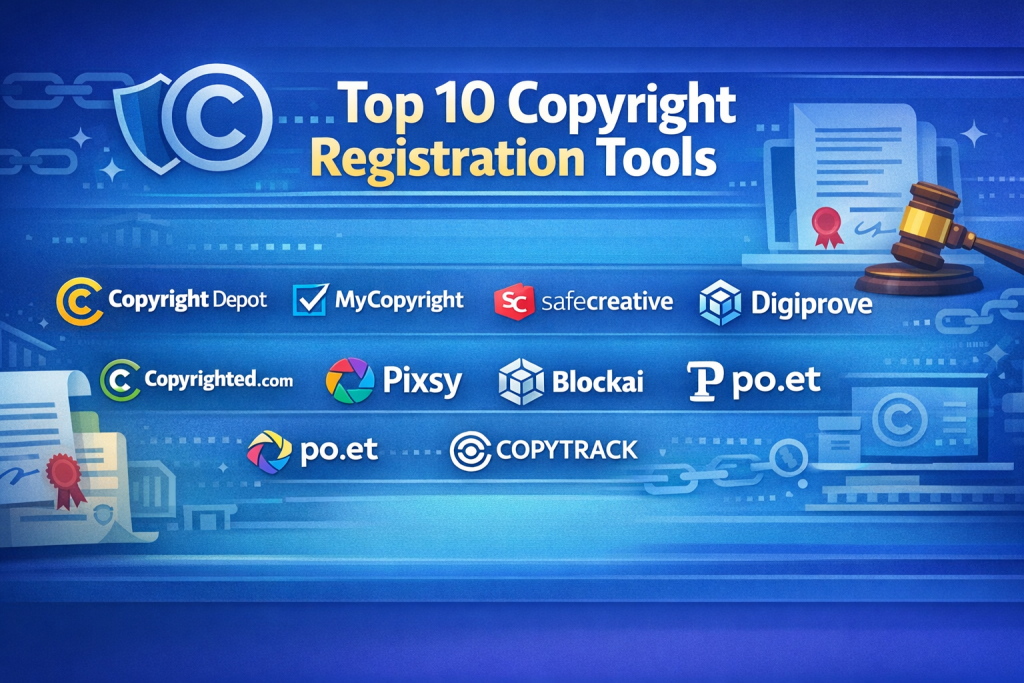
Top 10 Copyright Registration Tools
1 — Copyright Depot
Short description:
A streamlined copyright registration service designed for creators and small businesses seeking fast documentation and proof of ownership.
Key features
- Digital copyright registration certificates
- Timestamped proof of creation
- Coverage for text, images, music, and videos
- Simple submission workflow
- Asset storage and retrieval
- Ownership documentation reports
Pros
- Very easy to use for beginners
- Fast turnaround for registrations
Cons
- Limited enterprise-grade features
- Minimal integration options
Security & compliance:
Standard encryption; compliance varies by jurisdiction.
Support & community:
Email support, basic documentation, small but responsive user base.
2 — MyCopyright
Short description:
A digital-first copyright registration platform focused on creators and online businesses.
Key features
- Online copyright filing
- Proof-of-creation timestamping
- Downloadable ownership certificates
- Multi-asset registration
- Cloud-based records
- International coverage support
Pros
- Affordable for individual creators
- Clean, intuitive interface
Cons
- Limited automation
- No advanced monitoring tools
Security & compliance:
Encryption at rest; GDPR-aligned data handling.
Support & community:
Email support and FAQs; limited enterprise assistance.
3 — Safe Creative
Short description:
A well-known global copyright registry emphasizing legal validity and international recognition.
Key features
- International copyright registry
- Legal proof certificates
- Multiple content formats supported
- Licensing and rights management
- Public or private registrations
- Ownership history tracking
Pros
- Strong legal credibility
- Widely recognized internationally
Cons
- Interface feels dated
- Advanced features require paid plans
Security & compliance:
GDPR compliant; encrypted data storage.
Support & community:
Extensive documentation and multilingual support.
4 — Digiprove
Short description:
A blockchain-based digital proof solution used for copyright and intellectual property protection.
Key features
- Blockchain timestamping
- Immutable proof of ownership
- File hashing and verification
- Long-term proof storage
- Legal audit trail
- Multi-file uploads
Pros
- High trust due to blockchain backing
- Strong tamper resistance
Cons
- Less beginner-friendly
- Not focused solely on creative industries
Security & compliance:
Blockchain integrity, encryption, GDPR-aligned.
Support & community:
Technical documentation and ticket-based support.
5 — Binded
Short description:
A creator-focused copyright protection tool popular among photographers and visual artists.
Key features
- Image copyright registration
- Metadata and authorship tracking
- Portfolio management
- Proof-of-creation records
- Public creator profiles
- Discovery tools
Pros
- Excellent for photographers
- Community-driven approach
Cons
- Limited support for non-visual content
- Fewer enterprise controls
Security & compliance:
Standard encryption; privacy controls vary.
Support & community:
Active creative community, online help center.
6 — Copyrighted.com
Short description:
A combined copyright registration and monitoring platform focused on enforcement.
Key features
- Copyright registration
- Online infringement monitoring
- Evidence collection
- Ownership records
- Enforcement workflow support
- Reporting dashboard
Pros
- Strong monitoring capabilities
- Good for publishers and agencies
Cons
- More complex setup
- Higher learning curve
Security & compliance:
Encrypted data storage; GDPR compliant.
Support & community:
Knowledge base, email support, enterprise plans available.
7 — Pixsy
Short description:
A specialized copyright platform designed for photographers to track and enforce image rights.
Key features
- Automated image scanning
- Copyright registration records
- Infringement detection
- Legal claim assistance
- Image tracking dashboard
- Revenue recovery tools
Pros
- Excellent enforcement focus
- Strong success-based recovery model
Cons
- Limited to images
- Not suitable for text or software
Security & compliance:
GDPR compliant; secure cloud infrastructure.
Support & community:
Dedicated support teams and photographer community.
8 — Blockai
Short description:
A blockchain-based copyright registration platform emphasizing immutable proof.
Key features
- Blockchain timestamps
- Copyright certificates
- File integrity verification
- Creator identity linking
- Audit-ready records
- Multi-format support
Pros
- Strong trust and transparency
- Future-proof ownership proof
Cons
- Limited integrations
- Smaller ecosystem
Security & compliance:
Blockchain security; compliance varies by region.
Support & community:
Documentation and direct support; limited community.
9 — Po.et
Short description:
A decentralized protocol for registering creative works with transparent ownership records.
Key features
- Blockchain-based ownership records
- Media metadata storage
- Open protocol design
- Timestamped proof
- Public verification
- Decentralized architecture
Pros
- Transparent and open
- Ideal for publishers and media outlets
Cons
- Requires technical understanding
- Less polished UI
Security & compliance:
Blockchain security; compliance depends on implementation.
Support & community:
Developer-driven community, technical documentation.
10 — Copytrack
Short description:
A copyright protection and enforcement service primarily for visual creators.
Key features
- Image copyright registration
- Global infringement detection
- Legal enforcement services
- Evidence documentation
- Claim management
- Revenue recovery
Pros
- Strong legal enforcement
- Hands-off infringement handling
Cons
- Focused mainly on images
- Less control for DIY users
Security & compliance:
GDPR compliant; secure case management systems.
Support & community:
Dedicated case managers and professional support.
Comparison Table
| Tool Name | Best For | Platform(s) Supported | Standout Feature | Rating |
|---|---|---|---|---|
| Copyright Depot | Individual creators | Web | Fast digital certificates | N/A |
| MyCopyright | Freelancers & SMBs | Web | Simple online filing | N/A |
| Safe Creative | International creators | Web | Legal credibility | N/A |
| Digiprove | IP-heavy organizations | Web | Blockchain proof | N/A |
| Binded | Photographers | Web | Creative portfolios | N/A |
| Copyrighted.com | Publishers | Web | Monitoring & evidence | N/A |
| Pixsy | Image creators | Web | Infringement recovery | N/A |
| Blockai | Blockchain advocates | Web | Immutable records | N/A |
| Po.et | Media companies | Web / Protocol | Decentralized ownership | N/A |
| Copytrack | Visual professionals | Web | Legal enforcement | N/A |
Evaluation & Scoring of Copyright Registration Tools
| Criteria | Weight | Avg. Score |
|---|---|---|
| Core features | 25% | High |
| Ease of use | 15% | Medium-High |
| Integrations & ecosystem | 15% | Medium |
| Security & compliance | 10% | High |
| Performance & reliability | 10% | High |
| Support & community | 10% | Medium |
| Price / value | 15% | Medium-High |
Which Copyright Registration Tool Is Right for You?
- Solo users: Choose simple tools with quick certificates and low cost.
- SMBs: Look for scalable storage, multi-asset support, and clear proof.
- Mid-market teams: Prioritize monitoring, enforcement, and reporting.
- Enterprises: Focus on compliance, audit trails, and portfolio management.
Budget-conscious users may prefer basic registration tools, while premium users benefit from monitoring and enforcement. Simpler tools work best for ease of use, while advanced platforms offer deeper protection and scalability.
Frequently Asked Questions (FAQs)
1. Are copyright registration tools legally valid?
They provide strong evidence of ownership but may complement, not replace, government registration.
2. Do I need one if I already own the content?
Yes, documentation helps prove when and by whom it was created.
3. Are blockchain-based tools better?
They offer stronger tamper resistance but may be more complex.
4. Can I register multiple works at once?
Most tools support bulk or multi-asset registration.
5. Are these tools expensive?
Pricing ranges from free/basic to premium enforcement services.
6. Do they monitor infringement?
Only some tools include active monitoring.
7. Is international coverage included?
Many tools support global proof, but legal recognition varies.
8. Can businesses use them for software?
Yes, especially blockchain and enterprise-focused platforms.
9. What’s a common mistake?
Waiting too long to register after publishing content.
10. Are these tools secure?
Most use encryption; security maturity varies by provider.
Conclusion
Copyright Registration Tools play a vital role in protecting creative and intellectual property in today’s digital landscape. The right tool depends on who you are, what you create, and how much protection you need. Some prioritize simplicity, others enforcement or blockchain proof. There is no single universal winner—only the solution that best fits your legal, operational, and budgetary requirements.

Find Trusted Cardiac Hospitals
Compare heart hospitals by city and services — all in one place.
Explore Hospitals