
Introduction
eDiscovery software (electronic discovery software) is a category of legal technology designed to identify, collect, process, review, analyze, and produce electronically stored information (ESI) for legal, regulatory, and investigative matters. This data may include emails, documents, chat messages, cloud files, databases, mobile data, and system logs.
In today’s digital-first world, almost every legal dispute or compliance investigation involves massive volumes of electronic data. Manual review is no longer practical, accurate, or defensible. eDiscovery software helps legal teams manage data efficiently, reduce risk, control costs, and meet strict legal deadlines.
Why eDiscovery software is important:
- Litigation volumes and data sizes are growing rapidly
- Courts expect defensible, auditable discovery processes
- Regulatory scrutiny is increasing across industries
- Speed and accuracy directly impact legal outcomes
Common real-world use cases include:
- Civil and criminal litigation
- Internal investigations
- Regulatory and compliance audits
- Data breach and incident response
- Corporate governance and risk management
Key evaluation criteria when choosing eDiscovery software:
- Data ingestion and processing capabilities
- Search, analytics, and review efficiency
- Scalability and performance
- Security and compliance standards
- Ease of use and collaboration
- Pricing transparency and value
Best for:
Legal teams, law firms, corporate legal departments, compliance officers, investigators, and eDiscovery service providers handling large volumes of electronic data across multiple sources.
Not ideal for:
Very small cases with minimal digital data, organizations without legal discovery obligations, or teams that rely entirely on manual document review or basic file search tools.
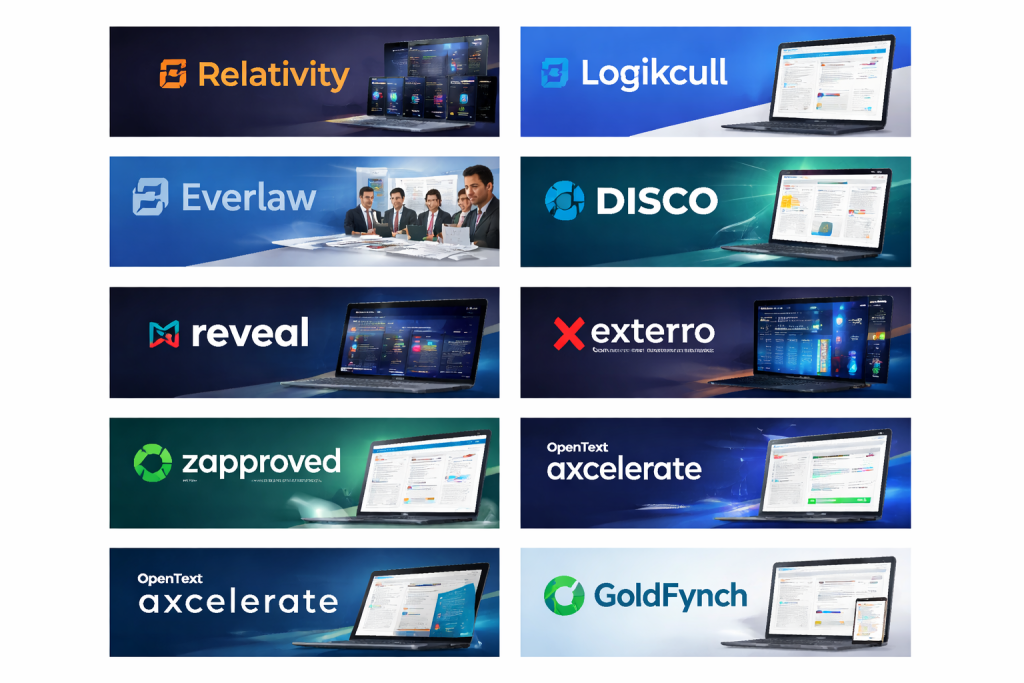
Top 10 eDiscovery Software Tools
1 — Relativity
Short description:
Relativity is a market-leading eDiscovery and legal data intelligence platform used by law firms, enterprises, and government agencies for complex litigation and investigations.
Key features:
- Advanced data processing and indexing
- Powerful search, filtering, and analytics
- AI-assisted document review and categorization
- Collaboration tools for legal teams
- Custom workflows and automation
- Extensive reporting and audit trails
Pros:
- Extremely robust and scalable
- Industry-standard platform with broad adoption
- Strong analytics and AI capabilities
Cons:
- Steep learning curve for new users
- Higher cost compared to many competitors
- Requires skilled administrators
Security & compliance:
SSO, encryption at rest and in transit, detailed audit logs, GDPR support, SOC-aligned controls.
Support & community:
Extensive documentation, strong enterprise support, large global user community, certified training programs.
2 — Logikcull
Short description:
Logikcull is a cloud-based eDiscovery platform focused on simplicity and speed, designed primarily for legal teams and smaller firms.
Key features:
- Automated data ingestion and processing
- Fast search and filtering
- Built-in analytics and deduplication
- Easy document review interface
- Matter-based organization
- Simple export and production tools
Pros:
- Very easy to use
- Quick setup with minimal training
- Transparent pricing model
Cons:
- Limited customization for complex cases
- Less advanced analytics than enterprise tools
- Not ideal for extremely large datasets
Security & compliance:
Encryption, role-based access control, audit logs, GDPR compliance.
Support & community:
Good onboarding, responsive customer support, smaller but active user base.
3 — Everlaw
Short description:
Everlaw is a modern, cloud-native eDiscovery platform emphasizing collaboration, visual analytics, and intuitive design.
Key features:
- Visual timelines and document mapping
- AI-driven predictive coding
- Real-time collaboration and annotations
- Cloud-native performance
- Advanced search and filtering
- Integrated production workflows
Pros:
- Clean, intuitive user interface
- Strong collaboration features
- Powerful analytics without complexity
Cons:
- Premium pricing
- Fewer third-party integrations
- Less customization than legacy platforms
Security & compliance:
Encryption, SSO, SOC-aligned security controls, GDPR readiness.
Support & community:
High-quality documentation, guided onboarding, strong customer success focus.
4 — Nuix Discover
Short description:
Nuix Discover is an enterprise-grade eDiscovery solution built for large-scale investigations and data-heavy litigation.
Key features:
- High-speed data processing
- Advanced analytics and clustering
- AI-assisted review workflows
- Customizable dashboards
- Large dataset handling
- Flexible deployment options
Pros:
- Exceptional performance at scale
- Powerful analytics engine
- Suitable for forensic-heavy cases
Cons:
- Complex configuration
- Requires technical expertise
- Higher operational costs
Security & compliance:
Encryption, access controls, audit logs, regulatory compliance support.
Support & community:
Enterprise support options, training resources, professional services available.
5 — DISCO
Short description:
DISCO is an AI-powered eDiscovery platform focused on fast, accurate document review and legal insight.
Key features:
- AI-driven document review
- Rapid data ingestion
- Smart tagging and categorization
- Intuitive review interface
- Strong search capabilities
- Case analytics and reporting
Pros:
- Fast setup and processing
- Strong AI accuracy
- Clean, user-friendly interface
Cons:
- Less flexible for custom workflows
- Limited forensic depth
- Pricing can escalate with data volume
Security & compliance:
Encryption, audit trails, SOC-aligned practices, GDPR compliance.
Support & community:
Responsive support, onboarding assistance, growing user community.
6 — Reveal
Short description:
Reveal is a scalable eDiscovery platform offering end-to-end capabilities from collection to production.
Key features:
- Data processing and analytics
- AI-assisted review
- Integrated forensic tools
- Customizable workflows
- Multi-language support
- Large dataset scalability
Pros:
- Flexible deployment options
- Strong analytics features
- Suitable for service providers
Cons:
- User interface can feel dated
- Requires training for advanced features
- Documentation can be dense
Security & compliance:
Encryption, access controls, audit logs, GDPR and industry compliance support.
Support & community:
Enterprise support, professional services, training resources.
7 — Exterro
Short description:
Exterro provides an integrated eDiscovery and legal governance platform with strong compliance and risk management features.
Key features:
- End-to-end eDiscovery workflow
- Legal hold management
- Data mapping and classification
- Analytics and review tools
- Compliance tracking
- Reporting and dashboards
Pros:
- Strong governance and compliance focus
- Unified platform approach
- Good for regulated industries
Cons:
- Interface complexity
- Higher cost
- Slower onboarding for small teams
Security & compliance:
SSO, encryption, audit logs, GDPR, HIPAA, regulatory compliance support.
Support & community:
Dedicated enterprise support, structured onboarding, professional services.
8 — Zapproved (ZDiscovery)
Short description:
Zapproved focuses on legal hold management and early-stage eDiscovery workflows for corporate legal teams.
Key features:
- Legal hold automation
- Data preservation tracking
- Custodian management
- Early case assessment
- Audit-ready reporting
- Integration with review platforms
Pros:
- Excellent legal hold workflows
- Easy for in-house teams
- Strong defensibility
Cons:
- Limited full review capabilities
- Requires integration for complete eDiscovery
- Narrower scope than full platforms
Security & compliance:
Encryption, audit trails, compliance reporting, GDPR support.
Support & community:
Good documentation, enterprise support, focused user base.
9 — OpenText Axcelerate
Short description:
OpenText Axcelerate is an enterprise eDiscovery solution designed for large organizations with complex discovery needs.
Key features:
- Advanced data processing
- Predictive coding and analytics
- Scalable review environments
- Workflow automation
- Enterprise reporting
- Integration with content systems
Pros:
- Enterprise-grade scalability
- Strong analytics and automation
- Integrated with broader content platforms
Cons:
- High cost
- Complex deployment
- Requires specialized expertise
Security & compliance:
Encryption, access controls, audit logs, enterprise compliance frameworks.
Support & community:
Enterprise support, training programs, professional services.
10 — GoldFynch
Short description:
GoldFynch is a lightweight, cloud-based eDiscovery platform aimed at solo practitioners and small law firms.
Key features:
- Simple data upload and processing
- Basic search and review tools
- Case-based organization
- Affordable pricing
- Cloud-native access
- Easy exports
Pros:
- Very affordable
- Easy to learn and use
- Fast setup
Cons:
- Limited analytics
- Not suitable for large cases
- Basic feature set
Security & compliance:
Encryption, access controls, GDPR-ready features.
Support & community:
Email-based support, simple documentation, smaller community.
Comparison Table
| Tool Name | Best For | Platform(s) Supported | Standout Feature | Rating |
|---|---|---|---|---|
| Relativity | Large enterprises, law firms | Cloud / On-prem | Industry-leading analytics | N/A |
| Logikcull | SMBs, legal teams | Cloud | Ease of use | N/A |
| Everlaw | Collaborative legal teams | Cloud | Visual analytics | N/A |
| Nuix Discover | Large investigations | Cloud / On-prem | High-speed processing | N/A |
| DISCO | AI-driven review | Cloud | Review automation | N/A |
| Reveal | Service providers | Cloud / Hybrid | Flexible workflows | N/A |
| Exterro | Compliance-heavy orgs | Cloud / On-prem | Governance integration | N/A |
| Zapproved | Legal hold management | Cloud | Defensibility | N/A |
| OpenText Axcelerate | Global enterprises | Enterprise | Scalability | N/A |
| GoldFynch | Solo & small firms | Cloud | Affordability | N/A |
Evaluation & Scoring of eDiscovery Software
| Tool | Core Features (25%) | Ease of Use (15%) | Integrations (15%) | Security (10%) | Performance (10%) | Support (10%) | Price/Value (15%) | Total Score |
|---|---|---|---|---|---|---|---|---|
| Relativity | 23 | 10 | 14 | 9 | 9 | 9 | 8 | 82 |
| Everlaw | 21 | 14 | 12 | 9 | 9 | 9 | 8 | 82 |
| Logikcull | 18 | 15 | 10 | 8 | 8 | 8 | 14 | 81 |
| DISCO | 20 | 13 | 11 | 9 | 9 | 8 | 9 | 79 |
| Exterro | 21 | 10 | 12 | 9 | 8 | 9 | 8 | 77 |
Which eDiscovery Software Tool Is Right for You?
- Solo users: Lightweight, affordable tools with minimal setup work best.
- SMBs: Cloud-based platforms offering ease of use and predictable pricing.
- Mid-market: Balanced tools with analytics, collaboration, and integrations.
- Enterprise: Highly scalable platforms with compliance and customization.
Budget-conscious teams should prioritize usability and pricing transparency.
Premium buyers may value advanced analytics, AI, and enterprise support.
Choose deeper features if handling complex litigation, or simplicity if speed and usability matter more. Always consider data growth, integration needs, and regulatory exposure.
Frequently Asked Questions (FAQs)
1. What is eDiscovery software used for?
It helps legal teams manage electronic data for litigation, investigations, and compliance matters.
2. Is eDiscovery only for large law firms?
No. Many tools are designed for solo lawyers, SMBs, and corporate teams.
3. How secure is eDiscovery software?
Most platforms use encryption, access controls, and audit logs to protect sensitive data.
4. Does eDiscovery software use AI?
Yes, many tools use AI for document classification, relevance ranking, and review acceleration.
5. How long does implementation take?
Cloud tools can be ready in hours, while enterprise deployments may take weeks.
6. Can it handle cloud and chat data?
Modern tools support email, cloud storage, messaging apps, and collaboration platforms.
7. Is training required?
Basic tools need minimal training; advanced platforms benefit from structured onboarding.
8. How is pricing usually calculated?
Pricing often depends on data volume, users, and features.
9. What are common mistakes buyers make?
Overbuying complex tools or underestimating data growth.
10. Are there alternatives to eDiscovery software?
Manual review and basic search tools exist but lack defensibility and scalability.
Conclusion
eDiscovery software has become essential for managing legal risk in a data-driven world. The right platform can dramatically reduce costs, improve accuracy, and ensure defensible legal processes.
When choosing an eDiscovery tool, focus on data volume, usability, security, scalability, and total value, not just brand recognition. There is no single “best” solution for everyone—only the best fit for your specific legal, technical, and organizational needs.
A thoughtful evaluation today can save significant time, money, and risk tomorrow.

Find Trusted Cardiac Hospitals
Compare heart hospitals by city and services — all in one place.
Explore Hospitals
eDiscovery software helps legal teams and organizations identify, collect, preserve, review, and produce electronically stored information for litigation, investigations, and regulatory requests. Features such as advanced search, email and document processing, predictive coding, data deduplication, and secure collaboration can significantly reduce the time and cost involved in managing large volumes of digital evidence. When comparing platforms, important factors include data processing speed, review accuracy, security controls, integration capabilities, scalability, and pricing transparency. Choosing the right solution can streamline legal workflows, improve defensibility, and help organizations handle complex investigations and compliance requirements more efficiently.
eDiscovery software can make legal investigations more manageable by bringing emails, documents, chats, and other digital evidence into a searchable workflow. When comparing tools, I’d focus on how accurately they identify relevant information, remove duplicates, and preserve the chain of custody. Strong access controls and clear audit trails are essential when handling sensitive material. It’s also worth testing how well the platform handles large data volumes without making reviews slow or expensive.
eDiscovery software can make legal investigations more manageable by bringing document collection, review, and preservation into a structured workflow. Advanced search, deduplication, and early case assessment help teams reduce unnecessary review time while controlling costs. Maintaining a defensible chain of custody and applying consistent retention policies are equally important for protecting evidence integrity and supporting reliable legal outcomes.
Large eDiscovery reviews can slow down when search rules behave differently across file types, languages, or scanned documents. Teams should validate extraction quality with sample files before running a full review, especially when OCR or unusual formats are involved. It also helps to track processing errors and estimate how much evidence the system could not index. Without those checks, important records may remain invisible even when a search appears complete. A documented quality review gives legal and technical teams more confidence in the results.
Evidence integrity deserves close attention when evaluating eDiscovery platforms. Collecting documents is only part of the process; organizations must also prove that files remained unchanged and that every transfer or processing step was properly recorded. I would test whether the platform supports cryptographic hashes, chain-of-custody records, failed-collection alerts, and repeatable exports. It is also important to preserve timestamps and metadata when moving information between cloud services, archives, and review environments. These checks become especially valuable when dealing with deleted messages, changing retention policies, or incomplete collections. Strong evidence verification can reduce disputes over authenticity and help legal teams demonstrate that their discovery process was reliable and defensible.
eDiscovery software helps legal and investigation teams find, review, and manage information that may be relevant to a case. A major challenge is reducing the amount of material that people must review without missing important evidence. Search quality, filtering, and document organization can make a significant difference. Teams should also protect the original records and maintain a clear chain of custody. When comparing platforms, it is worth testing how they handle large data collections, duplicate files, and access permissions. A reliable process can reduce review effort while keeping evidence organized and defensible throughout an investigation.
eDiscovery software helps legal teams collect, search, review, and manage digital evidence during investigations and legal cases. When comparing platforms, organizations should assess search accuracy, document processing speed, data security, and support for different file formats. Strong audit trails and clear access controls also help preserve evidence integrity and make the review process more reliable.
Automating the ingestion, deduplication, and AI-assisted review of electronically stored information across enterprise communication channels accelerates early case assessments, drastically lowers legal review costs, and maintains a legally defensible chain of custody during litigation and regulatory audits.
eDiscovery software helps legal teams collect, review, organize, and analyze electronic information for investigations and legal proceedings. When comparing platforms, I would focus on data collection, search capabilities, document review, and security controls. These features can reduce manual effort and make large volumes of information easier to manage. The right solution should support accurate evidence handling while keeping legal workflows efficient and secure.
A challenge that often emerges after deployment is controlling the cost and complexity of retaining large volumes of legal data. Organizations may need to preserve information for years while ensuring expired records follow approved deletion policies. I would assess whether the platform can apply retention rules across email, collaboration tools, cloud storage, and archived systems without conflicting with active legal holds. Teams should also test what happens when a retention policy changes while a case remains open. Clear ownership, automated policy checks, and regular storage reviews can reduce unnecessary data accumulation while helping legal and IT teams meet their obligations. This becomes especially important as organizations add more data sources and handle multiple investigations at once.
Choosing the right eDiscovery platform isn’t just about matching feature checklists to current case loads, but anticipating how your organization’s data footprint will scale over the next few years. Many legal teams overlook the hidden costs of data ingestion and long-term hosting fees, which can quickly outweigh initial software subscriptions as collections grow. Furthermore, striking the right balance between advanced AI-assisted review and team-wide usability often determines whether a platform successfully accelerates workflows or simply introduces a steep learning curve. Conducting a pilot test with representative, messy dataset samples is one of the most practical ways to evaluate true search performance and review efficiency before making a long-term enterprise commitment.
eDiscovery software is most effective when it helps legal teams find relevant information quickly while preserving the integrity of digital evidence. Strong search capabilities are important, but defensible collection, accurate metadata, and clear chain-of-custody records are equally essential. I would also recommend using deduplication and early case assessment to reduce review costs without overlooking important documents. Integration with existing data sources can make collection more consistent and efficient.
eDiscovery software is especially useful when legal teams need to collect emails, chat messages, and documents without losing their original context. It helps to compare how each platform handles duplicate files, preserves metadata, and records every step taken during evidence collection. Strong legal holds and clear audit trails can also prevent relevant information from being deleted before a case or investigation is complete.
Finding the right information quickly can make a big difference when businesses handle legal cases or internal investigations. This comparison highlights useful eDiscovery features such as document search, email review, data collection, and secure file management. It can help legal teams and businesses understand which tools fit their needs, save time during reviews, and manage large amounts of digital information more easily.