
Introduction
Healthcare Interoperability APIs based on HL7 and FHIR standards are the backbone of modern digital healthcare. They enable secure, structured, and real-time exchange of clinical data across hospitals, labs, payers, pharmacies, and patient-facing applications. Instead of siloed systems and manual data reconciliation, interoperability APIs allow healthcare organizations to share patient records, lab results, medications, and care plans seamlessly.
The importance of HL7/FHIR APIs has grown rapidly due to regulatory mandates, value-based care models, telehealth adoption, and patient demand for data access. Whether it is syncing EHR systems, powering mobile health apps, or enabling population health analytics, interoperability APIs play a critical role in improving care quality, reducing operational friction, and supporting clinical decision-making.
When choosing a Healthcare Interoperability API, buyers should evaluate FHIR compliance depth, scalability, security controls, ease of integration, data normalization capabilities, and long-term vendor reliability. Not all solutions offer the same maturity across these dimensions, making careful evaluation essential.
Best for:
Healthcare Interoperability APIs are ideal for hospitals, digital health startups, health IT vendors, payers, labs, public health agencies, and large provider networks that rely on multi-system data exchange.
Not ideal for:
Organizations with standalone systems, minimal data exchange needs, or very small clinics that rely on manual workflows may not immediately benefit from advanced interoperability platforms.
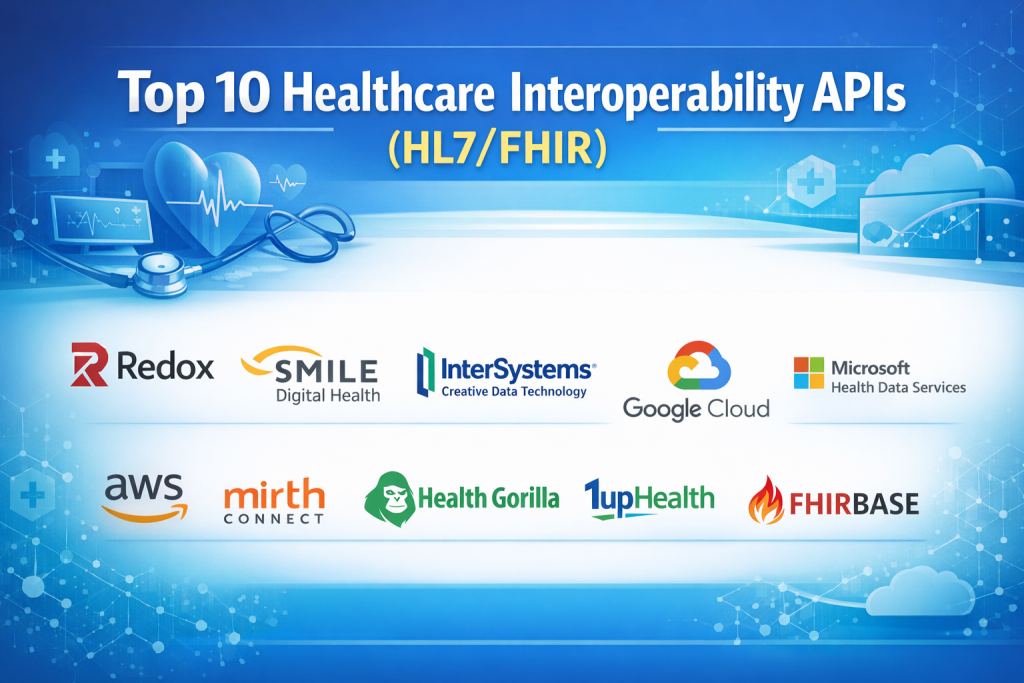
Top 10 Healthcare Interoperability APIs (HL7/FHIR) Tools
1 — Redox
Short description:
Redox provides a unified healthcare integration platform that simplifies HL7, FHIR, and custom EHR connections for digital health companies and providers.
Key features:
- HL7 v2, FHIR, and CCD data support
- Normalized clinical data models
- Event-based data streaming
- Prebuilt EHR integrations
- Real-time patient data updates
- Scalable API architecture
Pros:
- Significantly reduces integration complexity
- Strong EHR ecosystem coverage
Cons:
- Premium pricing for smaller teams
- Customization may require onboarding support
Security & compliance:
HIPAA, SOC 2, encryption in transit and at rest, audit logging
Support & community:
Strong documentation, dedicated onboarding teams, enterprise-grade support
2 — Smile Digital Health
Short description:
Smile Digital Health delivers an enterprise-grade FHIR platform designed for large-scale healthcare interoperability and national health systems.
Key features:
- Full FHIR R4/R5 support
- Terminology and identity services
- API gateway and data federation
- Bulk data export
- SMART on FHIR enablement
Pros:
- Deep FHIR-native architecture
- Highly scalable for enterprise use
Cons:
- Requires strong technical expertise
- Less suited for lightweight integrations
Security & compliance:
HIPAA, GDPR, ISO-aligned controls, enterprise IAM
Support & community:
Professional services, strong implementation guidance, active FHIR community
3 — InterSystems
Short description:
InterSystems offers robust interoperability engines and FHIR APIs widely used in hospitals and national healthcare infrastructures.
Key features:
- HL7, FHIR, and DICOM support
- High-performance data engine
- Complex workflow orchestration
- Built-in analytics tools
- Proven scalability
Pros:
- Extremely reliable and mature
- Trusted by large health systems
Cons:
- Higher licensing costs
- Steeper learning curve
Security & compliance:
HIPAA, ISO certifications, advanced audit and access controls
Support & community:
Enterprise support, extensive documentation, global partner ecosystem
4 — Google Cloud Healthcare API
Short description:
Google Cloud Healthcare API provides managed HL7, FHIR, and DICOM services integrated with cloud analytics and AI tooling.
Key features:
- Managed FHIR stores
- HL7 v2 message ingestion
- Cloud-native scalability
- Integration with analytics pipelines
- Machine learning readiness
Pros:
- Seamless cloud scalability
- Strong analytics and AI integration
Cons:
- Cloud lock-in considerations
- Requires cloud expertise
Security & compliance:
HIPAA, GDPR, encryption, IAM-based access controls
Support & community:
Extensive documentation, enterprise cloud support, large developer ecosystem
5— Microsoft Azure Health Data Services
Short description:
Azure Health Data Services enables secure ingestion, storage, and exchange of FHIR and HL7 data within the Azure ecosystem.
Key features:
- Azure FHIR Service
- Role-based access control
- SMART on FHIR support
- Integration with Power BI and AI tools
- High availability architecture
Pros:
- Strong enterprise cloud alignment
- Excellent compliance tooling
Cons:
- Azure dependency
- Cost management required at scale
Security & compliance:
HIPAA, ISO, SOC, enterprise IAM, encryption
Support & community:
Global enterprise support, rich learning resources
6 — AWS HealthLake
Short description:
AWS HealthLake is a FHIR-based data lake that transforms clinical data into normalized, queryable formats for analytics and AI.
Key features:
- Native FHIR data store
- NLP-based data structuring
- Scalable ingestion pipelines
- Integration with AWS analytics tools
- Population health insights
Pros:
- Excellent performance at scale
- Advanced analytics capabilities
Cons:
- AWS ecosystem dependency
- Requires cloud architecture expertise
Security & compliance:
HIPAA, encryption, IAM, audit trails
Support & community:
Strong AWS documentation, enterprise support options
7 — Mirth Connect
Short description:
Mirth Connect is a widely used open-core integration engine supporting HL7, FHIR, and custom healthcare interfaces.
Key features:
- HL7 and FHIR message routing
- Visual workflow builder
- Custom scripting support
- Broad protocol compatibility
- On-premise and cloud deployment
Pros:
- Highly flexible
- Cost-effective entry point
Cons:
- Requires integration expertise
- UI feels dated
Security & compliance:
Varies by deployment, supports encryption and access control
Support & community:
Large user community, optional enterprise support
8— Health Gorilla
Short description:
Health Gorilla provides nationwide clinical data exchange using FHIR APIs and HIE connectivity.
Key features:
- Nationwide HIE access
- FHIR and HL7 data exchange
- Identity matching
- Lab and clinical data retrieval
- Care coordination workflows
Pros:
- Broad data network reach
- Strong compliance focus
Cons:
- Pricing may limit smaller teams
- Customization constraints
Security & compliance:
HIPAA, SOC-aligned controls, audit logging
Support & community:
Enterprise onboarding, strong regulatory guidance
9 — 1upHealth
Short description:
1upHealth offers a developer-friendly FHIR data platform for health data aggregation, exchange, and analytics.
Key features:
- FHIR-native APIs
- Bulk data ingestion
- SMART on FHIR support
- Analytics-ready data models
- Cloud deployment
Pros:
- Developer-centric design
- Flexible integration options
Cons:
- Smaller ecosystem than hyperscalers
- Advanced features require configuration
Security & compliance:
HIPAA, encryption, role-based access
Support & community:
Good documentation, responsive support teams
10 — FHIRbase
Short description:
FHIRbase is an open-source FHIR-native database designed for organizations seeking maximum control and customization.
Key features:
- Native FHIR resource storage
- SQL-based querying
- Open-source architecture
- Custom schema extensions
- On-premise deployment
Pros:
- Full data control
- No vendor lock-in
Cons:
- Requires in-house expertise
- Limited enterprise support
Security & compliance:
Varies by implementation
Support & community:
Open-source community support, limited commercial backing
Comparison Table
| Tool Name | Best For | Platform(s) Supported | Standout Feature | Rating |
|---|---|---|---|---|
| Redox | Digital health integrations | Cloud | Normalized EHR integrations | N/A |
| Smile Digital Health | Large enterprises | Cloud / Hybrid | Full FHIR platform | N/A |
| InterSystems | Hospitals & governments | On-prem / Cloud | Proven scalability | N/A |
| Google Cloud Healthcare API | Data-driven healthcare | Cloud | AI-ready interoperability | N/A |
| Azure Health Data Services | Enterprise IT | Cloud | Compliance tooling | N/A |
| AWS HealthLake | Population analytics | Cloud | NLP-powered insights | N/A |
| Mirth Connect | Custom integrations | On-prem / Cloud | Workflow flexibility | N/A |
| Health Gorilla | Nationwide data exchange | Cloud | HIE connectivity | N/A |
| 1upHealth | Developers & startups | Cloud | FHIR-first APIs | N/A |
| FHIRbase | Technical teams | On-prem | Open-source control | N/A |
Evaluation & Scoring of Healthcare Interoperability APIs (HL7/FHIR)
| Criteria | Weight | Description |
|---|---|---|
| Core features | 25% | HL7/FHIR coverage, data models |
| Ease of use | 15% | Developer experience, onboarding |
| Integrations & ecosystem | 15% | EHRs, cloud tools, partners |
| Security & compliance | 10% | HIPAA, IAM, auditing |
| Performance & reliability | 10% | Scalability, uptime |
| Support & community | 10% | Documentation, vendor help |
| Price / value | 15% | Cost vs capability |
Which Healthcare Interoperability APIs (HL7/FHIR) Tool Is Right for You?
- Solo users & SMBs: Developer-friendly platforms like Mirth Connect or 1upHealth
- Mid-market organizations: Redox or Health Gorilla for faster integrations
- Enterprise & government: InterSystems, Smile Digital Health, or hyperscaler platforms
- Budget-conscious teams: Open-source or modular solutions
- Compliance-heavy environments: Azure, Google Cloud, or AWS offerings
The right choice depends on scale, technical maturity, regulatory burden, and long-term interoperability goals.
Frequently Asked Questions (FAQs)
- What is HL7 vs FHIR?
HL7 is a legacy messaging standard, while FHIR is a modern, API-based framework. - Are FHIR APIs mandatory?
Many regulations increasingly encourage or require FHIR-based data access. - Can these APIs work with legacy systems?
Yes, most platforms support hybrid HL7 and FHIR workflows. - Do I need cloud infrastructure?
Not always—some tools support on-premise deployments. - How secure are interoperability APIs?
Most enterprise tools follow HIPAA and encryption best practices. - What is SMART on FHIR?
A framework enabling secure app integration within EHR systems. - Are open-source tools viable?
Yes, with sufficient technical expertise and governance. - How long does implementation take?
Ranges from weeks to months depending on complexity. - Do these tools support analytics?
Many integrate with BI and AI platforms. - What is the biggest mistake buyers make?
Underestimating long-term scalability and compliance needs.
Conclusion
Healthcare Interoperability APIs built on HL7 and FHIR standards are essential for connected, data-driven healthcare ecosystems. The best solution is not universal—it depends on organizational size, integration complexity, compliance demands, and technical maturity. By focusing on standards support, security, scalability, and ecosystem fit, healthcare organizations can choose an interoperability platform that delivers lasting value and improved patient outcomes.

Find Trusted Cardiac Hospitals
Compare heart hospitals by city and services — all in one place.
Explore Hospitals
This article provides a very practical and timely comparison of interoperability APIs built on HL7 and FHIR standards — the foundational technologies that enable structured, real‑time clinical data exchange across hospitals, labs, payers, and patient apps. I appreciate how the guide goes beyond surface‑level tool lists to highlight real‑world considerations such as FHIR compliance depth, scalability, security and compliance like HIPAA, and integration complexity with legacy systems — all of which are critical when selecting an API for mission‑critical healthcare workflows. By outlining both strengths and trade‑offs across platforms — from cloud‑native services like Google Cloud Healthcare API and Azure Health Data Services to flexible engines like Mirth Connect and developer‑focused tools like 1upHealth — the article helps healthcare IT teams and developers align their interoperability strategy with technical goals and regulatory demands. For anyone building or modernizing healthcare data ecosystems, this structured comparison makes a complex landscape far easier to navigate.