
Introduction
Media Monitoring Tools are platforms that help organizations track, analyze, and understand mentions of their brand, competitors, topics, or keywords across digital and traditional media. This includes online news, blogs, social media, forums, broadcasts, podcasts, and sometimes even print media. In today’s always-on digital world, conversations about brands happen 24/7—and often without warning.
These tools are important because reputation now moves faster than press releases. A single viral post, negative review, or breaking news mention can shape public perception within minutes. Media monitoring allows teams to respond quickly, spot trends early, manage crises, measure PR impact, and make data-driven communication decisions.
Key real-world use cases
- Brand reputation and crisis management
- PR campaign measurement and media coverage tracking
- Competitive intelligence and market trend analysis
- Influencer and journalist discovery
- Executive and product sentiment tracking
What to look for when choosing a Media Monitoring Tool
- Coverage breadth (news, social, broadcast, forums)
- Accuracy of sentiment and keyword matching
- Real-time alerts and reporting depth
- Ease of use vs. analytical power
- Integrations with PR, CRM, and analytics tools
- Security, compliance, and scalability
Best for:
PR professionals, brand managers, marketing teams, communications leaders, agencies, public affairs teams, and enterprises in regulated or reputation-sensitive industries.
Not ideal for:
Very small teams with minimal brand exposure, hobby projects, or users who only need basic social listening rather than full media intelligence.
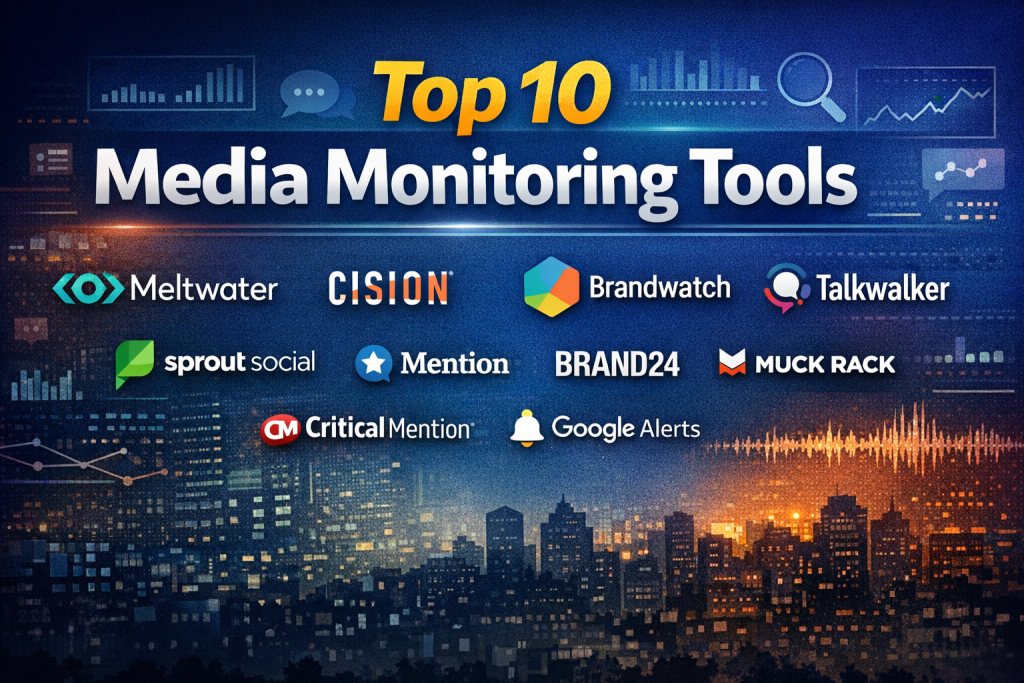
Top 10 Media Monitoring Tools
1 — Meltwater
Short description:
A comprehensive media intelligence platform designed for enterprise PR, communications, and marketing teams.
Key features
- Global news, social, and broadcast monitoring
- Advanced sentiment and share-of-voice analysis
- AI-powered media insights and trend detection
- Influencer and journalist databases
- Custom dashboards and executive reports
- Crisis alerts and real-time notifications
Pros
- Extremely broad global media coverage
- Strong analytics for enterprise reporting
Cons
- Premium pricing
- Steeper learning curve for beginners
Security & compliance:
SSO, encryption, GDPR compliance, enterprise-grade security (SOC controls vary by plan)
Support & community:
Dedicated account managers, onboarding support, strong documentation, enterprise SLAs
2 — Cision
Short description:
An all-in-one PR and media monitoring platform widely used by agencies and large brands.
Key features
- Media monitoring across news, social, and broadcasts
- Extensive journalist and media contact database
- PR distribution and campaign tracking
- Sentiment and reach analytics
- Customizable dashboards
Pros
- Strong PR workflow integration
- Trusted by large agencies
Cons
- Interface can feel complex
- Costly for smaller teams
Security & compliance:
SSO, GDPR compliance, enterprise security standards
Support & community:
Dedicated support teams, training sessions, strong enterprise onboarding
3 — Brandwatch
Short description:
An advanced consumer and media intelligence tool focused on deep analytics and insights.
Key features
- Powerful social and digital media monitoring
- AI-driven sentiment and emotion analysis
- Trend forecasting and audience insights
- Image and logo recognition
- Custom data visualizations
Pros
- Best-in-class analytics depth
- Excellent for research-driven teams
Cons
- High complexity
- Premium pricing
Security & compliance:
SOC 2, GDPR, enterprise encryption, SSO
Support & community:
Enterprise onboarding, strong analyst support, learning resources
4 — Talkwalker
Short description:
A global media monitoring and social listening platform with strong AI capabilities.
Key features
- Online, social, print, and broadcast coverage
- AI-powered sentiment and image recognition
- Real-time alerts and crisis detection
- Competitive benchmarking
- Multilingual global monitoring
Pros
- Excellent global and multilingual coverage
- Strong visual analytics
Cons
- Reporting customization can be complex
- Pricing varies by region
Security & compliance:
GDPR compliant, enterprise security standards, SSO support
Support & community:
Dedicated account support, onboarding programs, knowledge base
5 — Sprout Social
Short description:
A social-first platform combining media monitoring with engagement and publishing.
Key features
- Social listening and brand mentions
- Unified inbox and engagement tools
- Sentiment and trend analysis
- Team collaboration workflows
- Reporting and analytics dashboards
Pros
- Very easy to use
- Strong collaboration features
Cons
- Limited traditional media coverage
- Less suitable for broadcast-heavy PR
Security & compliance:
SSO, GDPR compliance, encrypted data storage
Support & community:
Excellent documentation, live support, strong user community
6 — Mention
Short description:
A lightweight and accessible media monitoring tool for SMBs and startups.
Key features
- Web and social media monitoring
- Real-time alerts
- Basic sentiment analysis
- Competitive tracking
- Shareable reports
Pros
- Affordable and quick to set up
- User-friendly interface
Cons
- Limited advanced analytics
- Smaller media database
Security & compliance:
GDPR compliant, standard encryption
Support & community:
Email and chat support, clear documentation
7 — Brand24
Short description:
A cost-effective tool focused on online mentions and sentiment tracking.
Key features
- Social and online media monitoring
- Influencer identification
- Sentiment and reach metrics
- Alerting and dashboards
- Competitive comparisons
Pros
- Strong value for money
- Simple reporting
Cons
- Limited enterprise features
- Broadcast monitoring not included
Security & compliance:
GDPR compliant, standard SaaS security
Support & community:
Responsive support, learning resources, active user base
8 — Muck Rack
Short description:
A PR-centric media monitoring and journalist relationship platform.
Key features
- News and online media monitoring
- Journalist profiles and pitching tools
- Share of voice analysis
- Media coverage reports
- Team collaboration features
Pros
- Excellent for PR outreach
- Accurate journalist data
Cons
- Limited social listening
- Less suited for marketing analytics
Security & compliance:
Enterprise security, GDPR compliance
Support & community:
Strong onboarding, PR-focused training, responsive support
9 — Critical Mention
Short description:
A broadcast-focused media monitoring solution for TV and radio coverage.
Key features
- Real-time TV and radio monitoring
- Video clipping and archives
- Keyword-based alerts
- Coverage reporting
- Global broadcast access
Pros
- Best-in-class broadcast monitoring
- Fast real-time alerts
Cons
- Limited social media analytics
- Higher cost for full coverage
Security & compliance:
Enterprise-grade security, standard compliance controls
Support & community:
Dedicated account teams, onboarding support
10 — Google Alerts
Short description:
A free, basic tool for tracking keyword mentions across the web.
Key features
- Email alerts for keyword mentions
- Simple setup
- Web-wide coverage
- No cost
Pros
- Free and easy to use
- Good for basic monitoring
Cons
- No analytics or sentiment
- Delayed and incomplete coverage
Security & compliance:
N/A (consumer-grade service)
Support & community:
Limited support, self-service only
Comparison Table
| Tool Name | Best For | Platforms Supported | Standout Feature | Rating |
|---|---|---|---|---|
| Meltwater | Enterprise PR teams | Web, Social, Broadcast | Global intelligence depth | N/A |
| Cision | Agencies & enterprises | Web, Social, Broadcast | PR workflows | N/A |
| Brandwatch | Insight-driven teams | Web & Social | Advanced analytics | N/A |
| Talkwalker | Global brands | Web, Social, Print | AI & visual listening | N/A |
| Sprout Social | Social-first teams | Social platforms | Usability | N/A |
| Mention | SMBs & startups | Web & Social | Real-time alerts | N/A |
| Brand24 | Budget-conscious teams | Online & Social | Value for money | N/A |
| Muck Rack | PR professionals | Online news | Journalist database | N/A |
| Critical Mention | Broadcast-heavy PR | TV & Radio | Real-time clips | N/A |
| Google Alerts | Individuals | Web | Free monitoring | N/A |
Evaluation & Scoring of Media Monitoring Tools
| Criteria | Weight |
|---|---|
| Core features | 25% |
| Ease of use | 15% |
| Integrations & ecosystem | 15% |
| Security & compliance | 10% |
| Performance & reliability | 10% |
| Support & community | 10% |
| Price / value | 15% |
Which Media Monitoring Tool Is Right for You?
- Solo users: Start with lightweight or free tools focused on alerts.
- SMBs: Look for affordability, ease of setup, and essential sentiment tracking.
- Mid-market: Balance analytics depth with usability and integrations.
- Enterprise: Prioritize coverage breadth, security, scalability, and dedicated support.
Budget-conscious vs premium:
Lower-cost tools work well for visibility, while premium platforms deliver strategic intelligence.
Feature depth vs ease of use:
Advanced analytics often mean complexity—choose based on team skill level.
Security & compliance:
Highly regulated industries should prioritize SSO, audit logs, and compliance certifications.
Frequently Asked Questions (FAQs)
- What is a media monitoring tool?
It tracks brand or keyword mentions across digital and traditional media channels. - Is social listening the same as media monitoring?
Social listening is a subset focused on social platforms; media monitoring is broader. - Do small businesses need media monitoring?
Yes, but lightweight tools are often sufficient. - How accurate is sentiment analysis?
Accuracy varies; AI improves results but human review is still important. - Are free tools reliable?
They work for basic alerts but lack depth and analytics. - How fast are alerts?
Enterprise tools often provide near real-time alerts. - Can these tools help with crisis management?
Yes, especially those with real-time monitoring and alerts. - Do they cover offline media?
Some tools include TV, radio, and print coverage. - Are integrations important?
Yes, especially for reporting and workflow efficiency. - What’s the biggest mistake buyers make?
Choosing based on brand name instead of actual needs.
Conclusion
Media Monitoring Tools are no longer optional—they are essential for protecting reputation, measuring impact, and staying informed in real time. The right platform depends on your goals, budget, team size, and the depth of insight you need. Rather than searching for a universal winner, focus on fit, coverage, and usability. When chosen thoughtfully, a media monitoring tool becomes a strategic asset, not just a reporting dashboard.

Find Trusted Cardiac Hospitals
Compare heart hospitals by city and services — all in one place.
Explore Hospitals
Media monitoring becomes more useful when teams can separate meaningful public reactions from artificial activity. A sudden increase in brand mentions may come from bot accounts, syndicated articles, or coordinated campaigns rather than genuine customer interest. Teams should check how platforms identify duplicate content, assess source credibility, and explain unusual changes in mention volume. I would also test sentiment results against sarcasm, local slang, and industry-specific terms, since automated classifications can misread context. Tracking alert precision over time can help teams reduce false alarms without missing real reputation risks. These checks make monitoring reports more reliable and help communication teams focus on issues that require an actual response.
Mapping these PR platforms made me realize that sentiment accuracy means little without robust API-driven webhook pipelines. If social listening feeds cannot push incident alerts directly into PagerDuty or Slack bots during unexpected reputational spikes, engineering and crisis response teams still remain blocked by manual reporting delays.
Choosing between broadcast-heavy monitoring like Critical Mention and deep social intelligence like Brandwatch really comes down to your organization’s primary crisis vectors. One hidden pitfall teams often run into is assuming that broad keyword coverage equals accurate sentiment analysis, when context and sarcasm still frequently break automated scoring. Matching the tool to your actual workflow rather than raw database size makes all the difference in avoiding alert fatigue.
Media monitoring tools help organizations track brand mentions, industry news, competitor activity, and public conversations across different channels. When comparing platforms, check source coverage, keyword alerts, sentiment analysis, reporting options, and the ability to filter irrelevant mentions. Reviewing trends over time and checking sentiment results manually can help teams understand public reactions and respond to important issues more effectively.
Media monitoring tools help businesses track brand mentions, follow industry news, and understand how their products or campaigns are discussed across different channels. Platforms like Mention offer real-time alerts, social media monitoring, and sentiment insights, helping teams respond to conversations faster, protect brand reputation, and make smarter communication decisions.
Media monitoring works best when alerts are paired with clear response plans and human sentiment checks, especially during a sudden spike in negative coverage. Tracking competitor mentions alongside brand coverage also helps teams spot emerging trends and measure their share of voice more accurately.