
Introduction
Rail Operations Management Software is a specialized category of enterprise software designed to plan, control, monitor, and optimize day-to-day railway operations. These platforms help rail operators manage train movements, timetables, crew assignments, rolling stock, maintenance activities, safety compliance, and real-time disruptions from a single, integrated system.
In an era of increasing passenger expectations, tighter safety regulations, and pressure to improve efficiency, railways can no longer rely on fragmented systems or manual processes. Modern rail operations software enables real-time visibility, data-driven decision-making, and predictive planning, helping operators reduce delays, improve asset utilization, and maintain regulatory compliance.
Typical real-world use cases include timetable planning, traffic control, incident management, predictive maintenance, crew scheduling, energy optimization, and performance reporting. When evaluating tools in this category, buyers should look for scalability, real-time capabilities, integration with signaling and legacy systems, usability for operations staff, strong security, and proven reliability in mission-critical environments.
Best for:
Rail Operations Management Software is best suited for national railways, metro and suburban rail operators, freight rail companies, infrastructure managers, operations control centers, and transport authorities managing complex rail networks.
Not ideal for:
These tools may be excessive for very small private rail operators, heritage railways, or organizations with minimal operational complexity, where simpler scheduling or asset management tools may be sufficient.
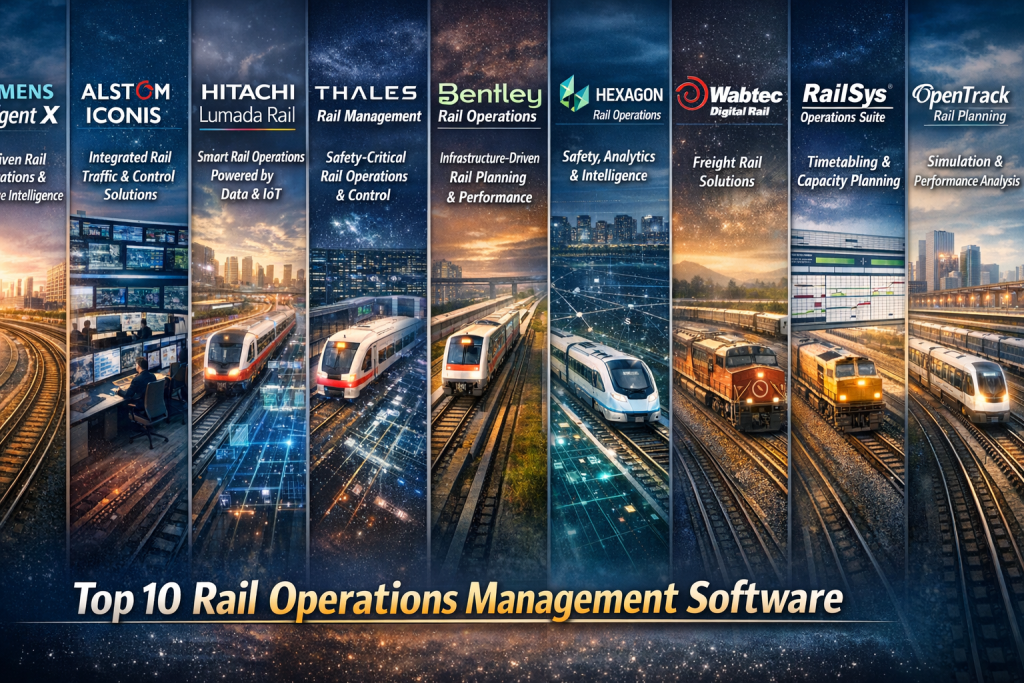
Top 10 Rail Operations Management Software Tools
1 — Siemens Mobility Railigent X
Short description:
Railigent X is a data-driven rail operations platform designed for large-scale passenger and freight rail networks, focusing on real-time monitoring and predictive analytics.
Key features:
- Real-time operations monitoring across rail assets
- Predictive maintenance using AI and IoT data
- Integrated traffic and incident management
- Energy consumption optimization
- Advanced analytics and KPI dashboards
- Cloud-based, scalable architecture
Pros:
- Strong analytics and predictive capabilities
- Proven performance in large, complex networks
- Deep integration with rail infrastructure
Cons:
- High cost for smaller operators
- Requires significant implementation effort
Security & compliance:
Enterprise-grade encryption, role-based access control, audit logs, ISO-aligned security practices.
Support & community:
Comprehensive documentation, enterprise onboarding, dedicated support teams, global professional services.
2 — Alstom ICONIS Rail Control Solutions
Short description:
ICONIS provides an integrated suite for traffic management, signaling, and rail operations control, widely used by metro and mainline operators.
Key features:
- Centralized traffic management system
- Real-time train tracking and control
- Timetable and capacity management
- Incident and disruption handling
- Interoperability with signaling systems
- Operations performance analytics
Pros:
- Strong focus on safety and reliability
- Seamless integration with signaling
- Trusted by major rail authorities
Cons:
- Complex configuration
- Less flexible for non-Alstom environments
Security & compliance:
High safety integrity standards, encryption, access control, compliance with rail safety regulations.
Support & community:
Enterprise-level support, detailed documentation, long-term maintenance contracts.
3 — Hitachi Rail Lumada Rail Platform
Short description:
Lumada Rail is a digital operations platform combining IoT, analytics, and asset management for modern rail systems.
Key features:
- Asset and operations data integration
- Predictive maintenance and condition monitoring
- Real-time operations dashboards
- Incident and performance management
- Cloud and hybrid deployment options
- AI-driven insights
Pros:
- Strong asset-centric approach
- Scalable and future-ready architecture
- Good balance of operations and maintenance
Cons:
- Customization can be time-consuming
- Higher dependency on data quality
Security & compliance:
Enterprise security controls, encryption, GDPR-ready configurations.
Support & community:
Professional onboarding, enterprise support, limited open user community.
4 — Thales Transport Integrated Rail Management
Short description:
Thales offers integrated rail operations and traffic management solutions focused on safety-critical environments.
Key features:
- Traffic supervision and control
- Timetable planning and optimization
- Incident and emergency management
- Integration with signaling and control systems
- Real-time network visibility
Pros:
- Excellent safety and reliability record
- Suitable for high-density rail networks
- Strong regulatory compliance
Cons:
- High upfront investment
- Less intuitive UI for new users
Security & compliance:
Safety-certified systems, encryption, audit trails, compliance with international rail standards.
Support & community:
Enterprise-grade support, long-term service agreements, limited community forums.
5 — Bentley Rail Operations Management
Short description:
Bentley’s rail solutions focus on integrating infrastructure data with operational planning and performance management.
Key features:
- Rail network modeling and simulation
- Operations planning and optimization
- Asset and infrastructure integration
- Performance and capacity analysis
- Data visualization tools
Pros:
- Strong planning and simulation capabilities
- Good for infrastructure-heavy operators
- Robust data modeling
Cons:
- Less real-time control focus
- Requires skilled users
Security & compliance:
Standard enterprise security, role-based access, compliance varies by deployment.
Support & community:
Extensive documentation, enterprise support, active professional user base.
6 — Trimble Rail Operations Solutions
Short description:
Trimble provides rail operations tools focused on asset tracking, maintenance coordination, and operational efficiency.
Key features:
- Rail asset tracking and monitoring
- Maintenance planning and execution
- Operations performance reporting
- GIS-enabled visualization
- Integration with enterprise systems
Pros:
- Strong asset visibility
- Useful for maintenance-driven operations
- GIS integration adds clarity
Cons:
- Limited traffic control features
- Less suitable for large passenger networks
Security & compliance:
Standard enterprise security, encryption in transit and at rest.
Support & community:
Good documentation, responsive support, moderate user community.
7 — Hexagon Rail Operations & Safety Suite
Short description:
Hexagon’s rail solutions emphasize operational safety, analytics, and performance optimization.
Key features:
- Operational risk and safety analytics
- Real-time monitoring and alerts
- Incident reporting and analysis
- Performance dashboards
- Integration with sensor data
Pros:
- Strong safety and analytics focus
- Useful for compliance reporting
- Modular deployment options
Cons:
- Not a full end-to-end operations suite
- Requires integration with other systems
Security & compliance:
Enterprise security controls, audit logs, compliance reporting support.
Support & community:
Enterprise support, detailed technical documentation.
8 — Wabtec Digital Rail Operations
Short description:
Wabtec offers digital rail operations tools aimed primarily at freight rail operators.
Key features:
- Train operations and dispatch support
- Freight asset tracking
- Fuel and energy optimization
- Predictive analytics for rolling stock
- Operations performance metrics
Pros:
- Strong freight rail expertise
- Proven analytics capabilities
- Improves fuel efficiency
Cons:
- Limited passenger rail focus
- UI can feel dated
Security & compliance:
Enterprise-grade security, encryption, access controls.
Support & community:
Dedicated enterprise support, strong industry expertise.
9— RailSys Operations Suite
Short description:
RailSys provides advanced planning, simulation, and timetable management software for rail operators.
Key features:
- Timetable planning and validation
- Capacity and conflict analysis
- Operations simulation
- Infrastructure modeling
- Scenario planning
Pros:
- Excellent planning depth
- Widely used by planners and engineers
- Accurate simulation models
Cons:
- Limited real-time operations control
- Steep learning curve
Security & compliance:
Standard enterprise security, compliance varies by customer setup.
Support & community:
Strong documentation, specialized support, niche expert community.
10 — OpenTrack Rail Operations Planning
Short description:
OpenTrack focuses on rail operations simulation and performance evaluation rather than live control.
Key features:
- Detailed train movement simulation
- Capacity and delay analysis
- Timetable robustness testing
- Scenario comparison
- Performance reporting
Pros:
- Highly accurate simulations
- Useful for long-term planning
- Research-backed methodology
Cons:
- Not designed for real-time operations
- Requires technical expertise
Security & compliance:
Varies / N/A depending on deployment.
Support & community:
Good academic and professional support, limited enterprise services.
Comparison Table
| Tool Name | Best For | Platform(s) Supported | Standout Feature | Rating |
|---|---|---|---|---|
| Siemens Railigent X | Large national rail networks | Web, Cloud | Predictive analytics | N/A |
| Alstom ICONIS | Metro & mainline control | On-prem, Hybrid | Traffic & signaling integration | N/A |
| Hitachi Lumada Rail | Asset-centric operators | Cloud, Hybrid | AI-driven insights | N/A |
| Thales Rail Management | Safety-critical networks | On-prem | High safety standards | N/A |
| Bentley Rail Ops | Infrastructure-heavy planning | Desktop, Web | Simulation & modeling | N/A |
| Trimble Rail | Maintenance-focused ops | Web, Mobile | GIS visualization | N/A |
| Hexagon Rail Suite | Safety & analytics | Web | Risk analytics | N/A |
| Wabtec Digital | Freight rail operators | Web | Fuel optimization | N/A |
| RailSys | Timetable planners | Desktop | Capacity analysis | N/A |
| OpenTrack | Long-term planning | Desktop | Detailed simulation | N/A |
Evaluation & Scoring of Rail Operations Management Software
| Evaluation Criteria | Weight | Key Considerations |
|---|---|---|
| Core features | 25% | Traffic control, planning, maintenance, analytics |
| Ease of use | 15% | UI clarity, learning curve, workflows |
| Integrations & ecosystem | 15% | Signaling, ERP, IoT, legacy systems |
| Security & compliance | 10% | Encryption, access control, audits |
| Performance & reliability | 10% | Uptime, real-time responsiveness |
| Support & community | 10% | Documentation, onboarding, SLAs |
| Price / value | 15% | ROI, scalability, total cost |
Which Rail Operations Management Software Tool Is Right for You?
- Solo users or small teams: Planning-focused tools like OpenTrack or RailSys may be sufficient.
- SMBs and mid-market operators: Modular platforms such as Trimble or Hexagon provide flexibility without overwhelming complexity.
- Enterprise and national railways: Siemens, Alstom, Hitachi, and Thales offer the scale, reliability, and compliance required.
Budget-conscious buyers should prioritize modularity and phased implementation, while premium buyers can invest in predictive analytics and real-time control. Organizations must balance feature depth vs ease of use, ensuring staff adoption. Integration with existing signaling, asset, and ERP systems is critical, as are security and regulatory requirements.
Frequently Asked Questions (FAQs)
1. What is Rail Operations Management Software?
It is software that helps manage train movements, schedules, assets, crews, and operational performance in real time.
2. Is this software only for passenger rail?
No, many tools support freight, metro, suburban, and mixed rail operations.
3. How long does implementation usually take?
Enterprise deployments can take months, while modular tools may be deployed faster.
4. Does it replace signaling systems?
No, it typically integrates with existing signaling and control systems.
5. Is cloud deployment common?
Increasingly yes, though many operators still prefer hybrid or on-prem setups.
6. How important is predictive maintenance?
Very important, as it reduces downtime and improves asset lifespan.
7. Are these tools compliant with rail safety standards?
Most enterprise tools are designed to meet strict safety and regulatory requirements.
8. Can smaller operators afford these solutions?
Some vendors offer scaled-down or modular options for smaller budgets.
9. What are common implementation mistakes?
Underestimating data quality issues and change management.
10. Are there alternatives to full operations suites?
Yes, planning-only or asset-only tools can be alternatives depending on needs.
Conclusion
Rail Operations Management Software plays a vital role in ensuring safe, efficient, and reliable rail services. From real-time traffic control to predictive maintenance and long-term planning, these tools empower operators to handle increasing complexity with confidence.
When choosing a solution, focus on operational fit, scalability, integration capability, usability, and long-term value. There is no single “best” tool for everyone — the right choice depends on network size, operational complexity, budget, and strategic goals. Selecting the software that aligns with your specific needs will deliver the greatest impact on performance and passenger satisfaction.

Find Trusted Cardiac Hospitals
Compare heart hospitals by city and services — all in one place.
Explore Hospitals
This article provides a well-structured and informative overview of the top rail operations management software options, highlighting not just feature sets but also real-world pros and cons that matter to transportation professionals. By comparing tools side-by-side, it helps readers quickly grasp how different platforms support scheduling, asset tracking, safety compliance, and performance analysis — all critical for efficient rail operations. The clear explanations and practical insights make it easier for decision-makers to evaluate which solution aligns best with their operational needs and strategic goals. Overall, a valuable resource for anyone researching software to improve rail system efficiency and reliability.