
Introduction
Reinforcement Learning for Control Tooling refers to software platforms, frameworks, and environments that help developers build, train, test, and deploy reinforcement learning models for controlling complex systems. These tools enable AI agents to learn optimal actions through interaction with environments, feedback signals, and reward-based learning mechanisms.
Unlike traditional control systems that depend on predefined rules, reinforcement learning systems can improve decision-making by learning from experience. In robotics, autonomous systems, industrial automation, and intelligent machines, reinforcement learning helps optimize behaviors such as movement, resource allocation, navigation, and adaptive control.
The growth of AI agents, autonomous robotics, simulation environments, and edge AI is increasing demand for reinforcement learning control platforms. Organizations are using these tools to develop systems that can adapt to changing conditions, optimize performance, and solve complex control problems that are difficult to model manually.
Modern reinforcement learning control tooling focuses on simulation-based training, safe exploration, model evaluation, scalable training infrastructure, real-time deployment, and integration with robotics and industrial systems.
Real-world use cases include:
- Robotics control where reinforcement learning helps robots learn movement, manipulation, and adaptive behaviors.
- Autonomous vehicles where AI agents optimize navigation and decision-making.
- Industrial automation where systems improve production efficiency through adaptive control.
- Energy management where AI optimizes resource usage and operational decisions.
- Warehouse automation where reinforcement learning improves robot coordination.
- Game simulation and research environments for developing advanced AI agents.
When evaluating Reinforcement Learning for Control Tooling, buyers should consider:
- Reinforcement learning algorithm support.
- Simulation environment compatibility.
- Training scalability.
- Hardware acceleration support.
- Model evaluation capabilities.
- Safe exploration mechanisms.
- Real-time deployment support.
- Robotics integration options.
- Data management capabilities.
- Monitoring and observability.
- Security controls.
- Developer ecosystem.
Best for: AI researchers, robotics engineers, autonomous system developers, industrial automation teams, universities, technology companies, and organizations building adaptive AI control systems.
Not ideal for: Teams needing simple automation rules, organizations without AI engineering expertise, or projects where traditional control algorithms already solve the problem efficiently.
What’s Changed in Reinforcement Learning for Control Tooling in 2026+
Reinforcement learning is moving from experimental research toward practical AI control applications. Modern tooling focuses on safer training, scalable simulation, efficient deployment, and integration with real-world systems.
Key trends shaping this category include:
- AI agents for autonomous control: Reinforcement learning is increasingly combined with AI agents that can plan, adapt, and execute complex tasks.
- Simulation-first training: Organizations are training AI control systems in virtual environments before deploying them in physical systems.
- Digital twin integration: Reinforcement learning platforms are increasingly connected with digital twins for safer experimentation and optimization.
- Improved safety mechanisms: New workflows focus on limiting unsafe exploration and controlling AI behavior during learning.
- Large-scale distributed training: Organizations are using cloud and accelerated computing infrastructure to train more complex models.
- Multimodal learning: Reinforcement learning systems are incorporating visual, sensor, and environmental data for better decisions.
- Real-world transfer optimization: Researchers are improving methods that allow models trained in simulation to work effectively in physical environments.
- Better evaluation frameworks: Organizations require stronger testing methods to measure reliability, stability, and performance.
- Edge AI deployment: Reinforcement learning models are increasingly optimized for low-latency deployment on devices.
- Human feedback integration: Some systems incorporate human guidance to improve learning outcomes.
- Model observability: Teams need visibility into training progress, reward patterns, failures, and model behavior.
- Governance and security: Enterprises are focusing on controlling autonomous AI systems through policies and monitoring.
Quick Buyer Checklist (Scan-Friendly)
Use this checklist when selecting Reinforcement Learning for Control Tooling:
- Check supported reinforcement learning algorithms.
- Evaluate simulation environment compatibility.
- Review training scalability.
- Check GPU and accelerator support.
- Evaluate robotics integration.
- Review deployment options.
- Check model evaluation capabilities.
- Assess safety testing features.
- Review monitoring and observability.
- Check API and SDK availability.
- Evaluate community and ecosystem.
- Review documentation quality.
- Understand infrastructure requirements.
- Check enterprise support options.
- Evaluate long-term scalability.
AI-specific considerations:
- Data privacy and retention: Understand how training data, simulation data, and operational information are stored.
- Model choice: Check support for different reinforcement learning algorithms, frameworks, and custom models.
- Evaluation: Verify reward analysis, benchmarking, testing environments, and performance validation.
- Guardrails: Evaluate safe exploration methods, constraints, and controls for AI actions.
- Observability: Ensure visibility into training metrics, model decisions, failures, and performance.
- Cost controls: Review computing requirements, training expenses, infrastructure usage, and deployment costs.
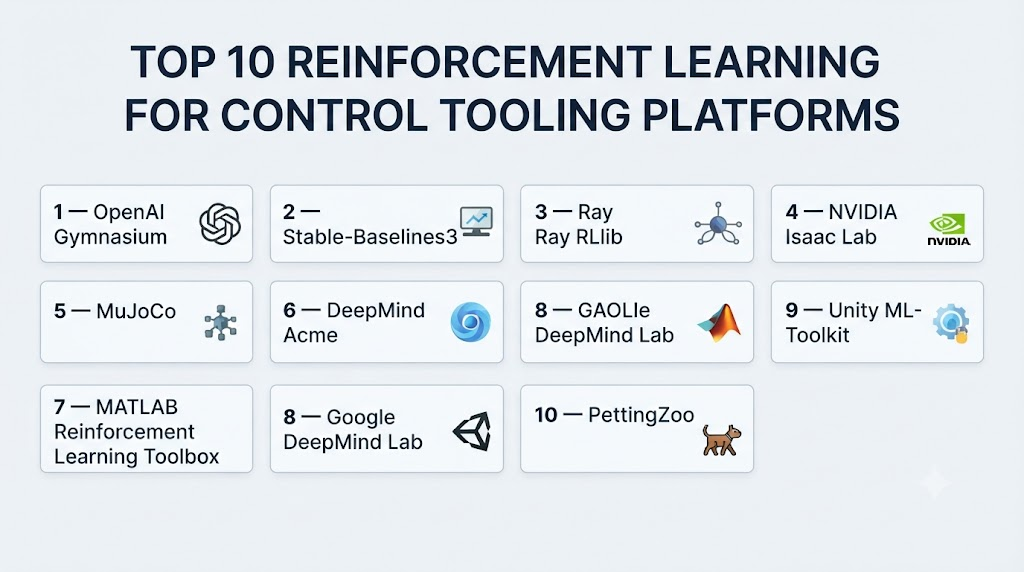
Top 10 Reinforcement Learning for Control Tooling Platforms
#1 — OpenAI Gymnasium
One-line verdict: Best for developers building and evaluating reinforcement learning algorithms in standardized environments.
Short description:
Gymnasium is an open-source reinforcement learning environment toolkit that provides standardized interfaces for developing, testing, and comparing reinforcement learning algorithms. It is widely used by researchers and developers working on AI control problems.
Standout Capabilities
- Standard reinforcement learning environments.
- Algorithm experimentation support.
- Environment customization.
- Benchmarking workflows.
- Research-friendly architecture.
- Community-developed environments.
- AI agent experimentation.
AI-Specific Depth
- Model support: Supports reinforcement learning algorithms through connected libraries.
- RAG / knowledge integration: Not applicable.
- Evaluation: Provides environment-based evaluation workflows.
- Guardrails: Safety depends on environment design.
- Observability: Training metrics depend on connected tools.
Pros
- Widely adopted reinforcement learning framework.
- Flexible for research and experimentation.
- Large ecosystem.
Cons
- Not a complete production deployment platform.
- Requires reinforcement learning expertise.
- Enterprise monitoring needs additional tools.
Security & Compliance
Security depends on implementation, environment design, and deployment practices.
Deployment & Platforms
- Development environments.
- Research platforms.
- Cloud training environments.
Integrations & Ecosystem
Common integrations include:
- Reinforcement learning libraries.
- Simulation environments.
- AI frameworks.
- Research tools.
- Custom environments.
Pricing Model
Open-source software. Infrastructure and compute costs vary.
Best-Fit Scenarios
- RL research.
- Algorithm development.
- AI experimentation.
#2 — Stable-Baselines3
One-line verdict: Best for developers needing reliable reinforcement learning algorithm implementations.
Short description:
Stable-Baselines3 provides implementations of popular reinforcement learning algorithms built on modern deep learning frameworks. It helps developers train and evaluate AI agents using standardized approaches.
Standout Capabilities
- Reinforcement learning algorithms.
- Training workflows.
- Model evaluation.
- Environment integration.
- Algorithm benchmarking.
- Developer-friendly APIs.
- Research experimentation.
AI-Specific Depth
- Model support: Supports multiple reinforcement learning algorithms.
- RAG / knowledge integration: Not applicable.
- Evaluation: Supports training evaluation workflows.
- Guardrails: Depends on environment implementation.
- Observability: Provides training metrics through integrations.
Pros
- Easy adoption for RL developers.
- Strong algorithm implementations.
- Useful for experimentation.
Cons
- Not designed as a full enterprise platform.
- Requires understanding of RL concepts.
- Production deployment needs additional infrastructure.
Security & Compliance
Security depends on deployment environment and application design.
Deployment & Platforms
- Local development.
- Cloud environments.
- Research systems.
Integrations & Ecosystem
Common integrations include:
- Gymnasium environments.
- Deep learning frameworks.
- Simulation tools.
- Custom environments.
Pricing Model
Open-source software. Infrastructure costs vary.
Best-Fit Scenarios
- RL prototyping.
- Academic projects.
- AI control experiments.
#3 — Ray RLlib
One-line verdict: Best for scalable reinforcement learning workloads requiring distributed training capabilities.
Short description:
Ray RLlib is a reinforcement learning library designed for scalable AI training. It supports distributed reinforcement learning workflows and is used by teams building larger AI systems requiring flexible computing resources.
Standout Capabilities
- Distributed reinforcement learning.
- Scalable training.
- Multiple algorithm support.
- Parallel environment execution.
- Large-scale experimentation.
- Cloud-compatible workflows.
- AI agent development.
AI-Specific Depth
- Model support: Supports multiple RL algorithms and deep learning frameworks.
- RAG / knowledge integration: Not applicable.
- Evaluation: Supports evaluation workflows and training analysis.
- Guardrails: Requires additional safety implementations.
- Observability: Integrates with monitoring workflows.
Pros
- Strong scalability.
- Suitable for complex AI workloads.
- Supports distributed training.
Cons
- Higher learning curve.
- Requires infrastructure knowledge.
- More complex than lightweight RL libraries.
Security & Compliance
Security depends on infrastructure deployment and access management.
Deployment & Platforms
- Cloud environments.
- Distributed computing systems.
- Enterprise AI infrastructure.
Integrations & Ecosystem
Common integrations include:
- Machine learning frameworks.
- Simulation environments.
- Cloud infrastructure.
- Data pipelines.
- AI platforms.
Pricing Model
Open-source software. Infrastructure costs vary.
Best-Fit Scenarios
- Large-scale RL training.
- Enterprise AI research.
- Complex control systems.
#4 — NVIDIA Isaac Lab
One-line verdict: Best for robotics teams training reinforcement learning models in realistic simulation environments.
Short description:
NVIDIA Isaac Lab is a robotics simulation framework designed for developing and training AI-powered robots. It supports reinforcement learning workflows by providing realistic simulation environments for robot learning and control.
Standout Capabilities
- Robotics simulation.
- RL-based robot training.
- Synthetic data generation.
- Physics-based environments.
- Robot learning workflows.
- GPU acceleration.
- Autonomous behavior testing.
AI-Specific Depth
- Model support: Supports reinforcement learning workflows with robotics AI systems.
- RAG / knowledge integration: Not applicable.
- Evaluation: Supports simulation-based evaluation.
- Guardrails: Safety depends on training environment design.
- Observability: Provides simulation and training monitoring capabilities.
Pros
- Strong robotics focus.
- Advanced simulation capabilities.
- Useful for autonomous robot development.
Cons
- Requires robotics expertise.
- Hardware requirements may be significant.
- More suitable for advanced teams.
Security & Compliance
Security depends on deployment environment and infrastructure configuration.
Deployment & Platforms
- Simulation environments.
- GPU-enabled systems.
- Robotics development platforms.
Integrations & Ecosystem
Common integrations include:
- Robotics frameworks.
- AI models.
- Simulation systems.
- Robot platforms.
- Training workflows.
Pricing Model
Pricing varies depending on infrastructure and deployment requirements.
Best-Fit Scenarios
- Robot reinforcement learning.
- Autonomous control research.
- Simulation-based training.
#5 — MuJoCo
One-line verdict: Best for researchers developing advanced reinforcement learning control systems through physics-based simulation.
Short description:
MuJoCo is a physics simulation environment widely used for robotics, biomechanics, and reinforcement learning research. It provides realistic simulation capabilities that allow developers to train and evaluate AI control policies before deployment in physical systems.
Standout Capabilities
- Physics-based simulation.
- Robotics environment modeling.
- Reinforcement learning experimentation.
- High-performance simulation.
- Contact dynamics modeling.
- Robot control testing.
- Research benchmarking.
AI-Specific Depth
- Model support: Supports reinforcement learning workflows through connected libraries.
- RAG / knowledge integration: Not applicable.
- Evaluation: Provides simulation environments for policy evaluation.
- Guardrails: Safety depends on environment configuration.
- Observability: Simulation metrics depend on connected tools.
Pros
- Highly realistic physics simulation.
- Strong research adoption.
- Useful for robotics control development.
Cons
- Requires technical expertise.
- Not a complete production deployment system.
- Real-world transfer requires additional validation.
Security & Compliance
Security depends on implementation and deployment environment.
Deployment & Platforms
- Research environments.
- Cloud computing systems.
- Robotics simulation platforms.
Integrations & Ecosystem
Common integrations include:
- Reinforcement learning libraries.
- Robotics frameworks.
- AI research tools.
- Simulation workflows.
Pricing Model
Open-source availability. Infrastructure costs vary.
Best-Fit Scenarios
- Robotics research.
- Control algorithm development.
- Physics-based AI training.
#6 — DeepMind Acme
One-line verdict: Best for researchers building advanced reinforcement learning agents and experimental control systems.
Short description:
Acme is a reinforcement learning framework designed for building and experimenting with AI agents. It provides components for developing scalable reinforcement learning systems and evaluating agent behavior.
Standout Capabilities
- Reinforcement learning agent development.
- Modular architecture.
- Research experimentation.
- Distributed learning support.
- Agent evaluation workflows.
- Algorithm experimentation.
- Scalable training components.
AI-Specific Depth
- Model support: Supports reinforcement learning approaches through connected machine learning frameworks.
- RAG / knowledge integration: Not applicable.
- Evaluation: Supports research evaluation workflows.
- Guardrails: Requires custom safety approaches.
- Observability: Depends on connected experiment tracking tools.
Pros
- Flexible research framework.
- Suitable for advanced AI experiments.
- Supports complex RL architectures.
Cons
- Requires deep reinforcement learning knowledge.
- Not designed for business users.
- Production deployment requires additional engineering.
Security & Compliance
Security depends on implementation and infrastructure controls.
Deployment & Platforms
- Research environments.
- Cloud training systems.
- AI development platforms.
Integrations & Ecosystem
Common integrations include:
- Machine learning frameworks.
- Simulation environments.
- Research tools.
- Custom AI systems.
Pricing Model
Open-source framework. Infrastructure costs vary.
Best-Fit Scenarios
- AI research.
- Advanced reinforcement learning experiments.
- Agent development.
#7 — MATLAB Reinforcement Learning Toolbox
One-line verdict: Best for engineers developing and testing control algorithms with simulation workflows.
Short description:
MATLAB Reinforcement Learning Toolbox provides tools for designing, training, and testing reinforcement learning agents. It is used by engineers working on control systems, robotics, and simulation-based development.
Standout Capabilities
- RL agent design.
- Control system integration.
- Simulation workflows.
- Algorithm testing.
- Training visualization.
- Model-based development.
- Engineering analysis.
AI-Specific Depth
- Model support: Supports reinforcement learning algorithms and custom models.
- RAG / knowledge integration: Not applicable.
- Evaluation: Supports simulation-based testing and performance analysis.
- Guardrails: Safety depends on control system design.
- Observability: Provides training visualization and analysis tools.
Pros
- Strong engineering workflow.
- Useful for control system professionals.
- Good simulation integration.
Cons
- Commercial licensing required.
- Requires MATLAB expertise.
- Less suitable for lightweight experimentation.
Security & Compliance
Security depends on enterprise deployment and user access controls.
Deployment & Platforms
- Desktop engineering environments.
- Simulation platforms.
- Research systems.
Integrations & Ecosystem
Common integrations include:
- Simulink.
- Robotics systems.
- Control models.
- Simulation tools.
- Engineering workflows.
Pricing Model
Commercial licensing model. Exact pricing varies.
Best-Fit Scenarios
- Industrial control development.
- Robotics engineering.
- Simulation-based training.
#8 — Google DeepMind Lab
One-line verdict: Best for researchers studying reinforcement learning agents in complex environments.
Short description:
DeepMind Lab is a 3D learning environment designed for research into artificial intelligence and reinforcement learning. It provides challenging environments for testing learning algorithms and agent capabilities.
Standout Capabilities
- 3D simulation environments.
- AI agent testing.
- Reinforcement learning research.
- Complex navigation scenarios.
- Benchmark experimentation.
- Virtual environments.
- Research workflows.
AI-Specific Depth
- Model support: Supports reinforcement learning research workflows.
- RAG / knowledge integration: Not applicable.
- Evaluation: Provides benchmark environments.
- Guardrails: Requires custom implementation.
- Observability: Depends on research tooling.
Pros
- Useful for AI research.
- Supports complex environments.
- Helps benchmark agent performance.
Cons
- Not designed for enterprise deployment.
- Requires research expertise.
- Limited industrial control focus.
Security & Compliance
Security depends on deployment environment.
Deployment & Platforms
- Research systems.
- Simulation environments.
- AI development platforms.
Integrations & Ecosystem
Common integrations include:
- AI research frameworks.
- Reinforcement learning libraries.
- Simulation tools.
- Experimental platforms.
Pricing Model
Open-source research software. Infrastructure costs vary.
Best-Fit Scenarios
- AI research.
- Agent evaluation.
- Reinforcement learning experiments.
#9 — Unity ML-Agents Toolkit
One-line verdict: Best for developers creating interactive reinforcement learning simulation environments.
Short description:
Unity ML-Agents Toolkit enables developers to train intelligent agents inside Unity-based simulation environments. It is commonly used for reinforcement learning experiments, game AI, robotics simulation, and virtual training scenarios.
Standout Capabilities
- Interactive simulations.
- Agent training environments.
- Visual reinforcement learning.
- Custom environment creation.
- Multi-agent training.
- Simulation-based learning.
- Virtual testing.
AI-Specific Depth
- Model support: Supports reinforcement learning algorithms through connected ML workflows.
- RAG / knowledge integration: Not applicable.
- Evaluation: Supports training evaluation through simulation.
- Guardrails: Depends on environment design.
- Observability: Provides training metrics through integrations.
Pros
- Strong visualization capabilities.
- Easy environment customization.
- Useful for simulation-based learning.
Cons
- Requires Unity development knowledge.
- Not a dedicated industrial control platform.
- Production robotics integration requires additional work.
Security & Compliance
Security depends on application design and deployment environment.
Deployment & Platforms
- Desktop systems.
- Simulation environments.
- Cloud training workflows.
Integrations & Ecosystem
Common integrations include:
- Unity environments.
- AI frameworks.
- Simulation tools.
- Custom agents.
- Robotics workflows.
Pricing Model
Software licensing varies depending on Unity usage model and deployment requirements.
Best-Fit Scenarios
- Simulation training.
- AI agent development.
- Virtual robotics environments.
#10 — PettingZoo
One-line verdict: Best for developers experimenting with multi-agent reinforcement learning environments.
Short description:
PettingZoo is an open-source toolkit for multi-agent reinforcement learning environments. It provides standardized interfaces for developing and evaluating AI agents that interact with multiple entities.
Standout Capabilities
- Multi-agent environments.
- Reinforcement learning experimentation.
- Standardized APIs.
- Agent interaction testing.
- Research workflows.
- Environment development.
- AI experimentation.
AI-Specific Depth
- Model support: Supports reinforcement learning algorithms through connected libraries.
- RAG / knowledge integration: Not applicable.
- Evaluation: Supports multi-agent evaluation workflows.
- Guardrails: Requires custom safety mechanisms.
- Observability: Depends on connected tools.
Pros
- Useful for multi-agent research.
- Flexible open-source toolkit.
- Supports experimentation.
Cons
- Not a production control platform.
- Requires RL expertise.
- Additional deployment systems are needed.
Security & Compliance
Security depends on implementation and environment design.
Deployment & Platforms
- Research systems.
- Development environments.
- Cloud training platforms.
Integrations & Ecosystem
Common integrations include:
- RL libraries.
- Simulation environments.
- AI frameworks.
- Research workflows.
Pricing Model
Open-source software. Infrastructure costs vary.
Best-Fit Scenarios
- Multi-agent reinforcement learning.
- AI research.
- Experimental control systems.
Comparison Table
| Tool Name | Best For | Deployment (Cloud/Self-hosted/Hybrid) | Model Flexibility | Strength | Watch-Out | Public Rating |
|---|---|---|---|---|---|---|
| OpenAI Gymnasium | RL experimentation | Self-hosted / Cloud | Custom algorithms | Standard environments | Not production platform | N/A |
| Stable-Baselines3 | RL development | Self-hosted | RL algorithms | Easy adoption | Limited enterprise features | N/A |
| Ray RLlib | Large-scale training | Cloud / Hybrid | Multi-framework | Distributed training | Complexity | N/A |
| NVIDIA Isaac Lab | Robot control learning | Edge / Simulation | AI models | Robotics training | Requires expertise | N/A |
| MuJoCo | Physics simulation | Self-hosted | Custom models | Realistic simulation | Research focus | N/A |
| DeepMind Acme | AI research | Self-hosted | Custom RL | Advanced agents | Technical complexity | N/A |
| MATLAB RL Toolbox | Engineering control | Desktop | Custom models | Control simulation | Licensing | N/A |
| DeepMind Lab | Research environments | Self-hosted | RL models | Agent testing | Limited production use | N/A |
| Unity ML-Agents | Interactive simulation | Desktop / Cloud | Custom agents | Visual training | Unity dependency | N/A |
| PettingZoo | Multi-agent RL | Self-hosted | Custom algorithms | Multi-agent testing | Research focus | N/A |
Scoring & Evaluation (Transparent Rubric)
The following scoring compares Reinforcement Learning for Control Tooling platforms using a practical evaluation framework. Scores are comparative rather than absolute because reinforcement learning requirements vary significantly between research, robotics, industrial automation, and enterprise AI applications.
The evaluation considers algorithm capabilities, training reliability, safety controls, integration flexibility, usability, performance optimization, security expectations, and ecosystem maturity.
| Tool | Core | Reliability/Eval | Guardrails | Integrations | Ease | Perf/Cost | Security/Admin | Support | Weighted Total |
|---|---|---|---|---|---|---|---|---|---|
| OpenAI Gymnasium | 9 | 8 | 7 | 10 | 9 | 8 | 7 | 10 | 8.45 |
| Stable-Baselines3 | 9 | 8 | 7 | 9 | 10 | 8 | 7 | 9 | 8.35 |
| Ray RLlib | 10 | 9 | 8 | 10 | 7 | 10 | 8 | 9 | 8.95 |
| NVIDIA Isaac Lab | 10 | 9 | 8 | 9 | 7 | 10 | 8 | 9 | 8.85 |
| MuJoCo | 9 | 9 | 7 | 9 | 8 | 9 | 7 | 10 | 8.45 |
| DeepMind Acme | 9 | 9 | 7 | 9 | 7 | 9 | 7 | 10 | 8.20 |
| MATLAB RL Toolbox | 9 | 9 | 8 | 9 | 8 | 8 | 8 | 10 | 8.60 |
| DeepMind Lab | 8 | 8 | 7 | 8 | 8 | 8 | 7 | 9 | 7.90 |
| Unity ML-Agents | 9 | 8 | 7 | 9 | 9 | 8 | 8 | 9 | 8.40 |
| PettingZoo | 8 | 8 | 7 | 9 | 9 | 8 | 7 | 10 | 8.20 |
Top 3 for Enterprise
1. Ray RLlib
Best suited for enterprises requiring scalable reinforcement learning training, distributed workloads, and large AI experimentation environments.
2. NVIDIA Isaac Lab
Strong choice for organizations developing AI-powered robotics and autonomous control systems.
3. MATLAB Reinforcement Learning Toolbox
Suitable for engineering organizations validating control algorithms through simulation and model-based workflows.
Top 3 for SMB
1. Stable-Baselines3
A practical choice for smaller teams needing reliable reinforcement learning algorithms without large infrastructure requirements.
2. Unity ML-Agents
Useful for companies creating simulation-based AI training environments.
3. OpenAI Gymnasium
Suitable for teams experimenting with reinforcement learning concepts and prototypes.
Top 3 for Developers
1. OpenAI Gymnasium
Provides a flexible foundation for reinforcement learning experiments and custom environments.
2. Ray RLlib
Best for developers building scalable reinforcement learning systems.
3. NVIDIA Isaac Lab
Ideal for developers working on robotics control and autonomous systems.
Which Reinforcement Learning for Control Tooling Is Right for You?
The best reinforcement learning platform depends on your goals, technical expertise, computing resources, and deployment requirements. Research teams, robotics companies, and enterprise engineering groups often require different approaches.
Solo / Freelancer
Individual developers usually need accessible frameworks for learning, experimenting, and building prototypes.
Recommended options:
- OpenAI Gymnasium for learning and experimentation.
- Stable-Baselines3 for practical algorithm development.
- Unity ML-Agents for interactive simulations.
Focus on:
- Documentation quality.
- Community support.
- Easy experimentation.
- Available environments.
- Development flexibility.
Avoid complex distributed training platforms unless building advanced systems.
SMB
Small and medium businesses typically need reinforcement learning tools that balance capability with implementation effort.
Recommended options:
- Stable-Baselines3 for efficient development.
- Unity ML-Agents for simulation-driven projects.
- MATLAB Reinforcement Learning Toolbox for engineering teams.
Important considerations:
- Development skills.
- Infrastructure requirements.
- Simulation needs.
- Deployment goals.
- Maintenance effort.
SMBs should begin with focused optimization problems before investing in complex AI control systems.
Mid-Market
Mid-market organizations often need stronger simulation, deployment, and operational capabilities.
Recommended options:
- Ray RLlib for scalable training.
- NVIDIA Isaac Lab for robotics applications.
- MATLAB RL Toolbox for engineering workflows.
Important evaluation areas:
- Training scalability.
- Simulation quality.
- Model evaluation.
- Hardware integration.
- Operational monitoring.
Enterprise
Large enterprises developing autonomous systems require scalable reinforcement learning infrastructure.
Recommended options:
- Ray RLlib for distributed AI training.
- NVIDIA Isaac Lab for robotics control.
- MATLAB Reinforcement Learning Toolbox for engineering validation.
- MuJoCo for advanced simulation research.
Enterprise buyers should evaluate:
- AI safety controls.
- Model governance.
- Training reproducibility.
- Infrastructure scalability.
- Deployment monitoring.
- Security requirements.
Regulated Industries (Finance, Healthcare, Public Sector)
Organizations using reinforcement learning in sensitive environments should prioritize:
- Explainable decision processes.
- Controlled experimentation.
- Human review workflows.
- Audit capabilities.
- Data protection.
- Safe deployment practices.
Recommended practices:
- Validate policies before production use.
- Maintain training records.
- Monitor AI decisions.
- Limit unsafe exploration.
- Establish governance procedures.
Budget vs Premium
Budget-focused approach
Suitable for startups, researchers, and small engineering teams:
- Use open-source frameworks.
- Start with simulation.
- Focus on narrow control problems.
- Optimize computing usage.
Common choices:
- OpenAI Gymnasium.
- Stable-Baselines3.
- PettingZoo.
- MuJoCo.
Premium enterprise approach
Suitable for organizations building production AI systems:
- Use scalable training infrastructure.
- Implement advanced simulation.
- Add monitoring and governance.
- Support large AI workloads.
Common choices:
- Ray RLlib.
- NVIDIA Isaac Lab.
- MATLAB RL Toolbox.
Build vs Buy (When to DIY)
Building custom reinforcement learning infrastructure makes sense when:
- The control problem is highly specialized.
- Existing tools cannot support the required environment.
- The organization has strong AI expertise.
- Custom algorithms provide business value.
Buying established tooling is usually better when:
- Faster development is required.
- Standard algorithms are sufficient.
- Reliability matters.
- Teams need supported workflows.
A hybrid approach is often effective: use established reinforcement learning frameworks while customizing environments, reward functions, and deployment pipelines.
Implementation Playbook (30 / 60 / 90 Days)
First 30 Days: Pilot and Define Learning Objectives
The first stage should focus on identifying a practical reinforcement learning problem.
Key activities:
- Select a specific control problem.
- Define reward objectives.
- Choose simulation environments.
- Establish evaluation metrics.
- Build initial experiments.
- Compare baseline approaches.
AI-specific tasks:
- Create training environments.
- Test reinforcement learning algorithms.
- Monitor reward behavior.
- Evaluate model performance.
- Define safety boundaries.
First 60 Days: Security, Evaluation, and Controlled Testing
The second stage focuses on improving reliability before deployment.
Key activities:
- Expand simulation scenarios.
- Validate trained policies.
- Improve training efficiency.
- Test failure conditions.
- Document model behavior.
AI-specific tasks:
- Perform policy evaluation.
- Test edge cases.
- Analyze unexpected actions.
- Track model versions.
- Establish monitoring workflows.
First 90 Days: Optimize Performance and Scale
The final stage focuses on operational deployment and continuous improvement.
Key activities:
- Deploy controlled workloads.
- Optimize computing resources.
- Improve training pipelines.
- Automate experiments.
- Establish governance.
AI-specific tasks:
- Monitor model drift.
- Improve reward functions.
- Optimize inference performance.
- Maintain evaluation records.
- Review AI safety metrics.
Common Mistakes & How to Avoid Them
- Using reinforcement learning for problems that traditional control solves: Evaluate whether RL is actually required.
- Poor reward design: Incorrect rewards can produce unexpected behavior.
- Skipping simulation: Test policies before real-world deployment.
- Ignoring safety constraints: Autonomous exploration requires boundaries.
- No evaluation framework: Measure performance consistently.
- Training with insufficient data or environments: Diverse scenarios improve reliability.
- Ignoring compute costs: RL training can require significant resources.
- Deploying without monitoring: Track AI behavior after deployment.
- Overlooking model version control: Maintain records of policy changes.
- Poor transfer from simulation to reality: Validate real-world performance.
- No human oversight: Maintain intervention options for critical systems.
- Ignoring security: Protect training environments and deployed models.
FAQs
What is Reinforcement Learning for Control Tooling?
Reinforcement Learning for Control Tooling includes platforms that help developers train AI agents to make decisions and control systems through interaction and feedback.
How is reinforcement learning different from traditional control?
Traditional control uses predefined models and rules, while reinforcement learning learns strategies through experience and rewards.
What industries use reinforcement learning control systems?
Industries include robotics, manufacturing, autonomous vehicles, energy management, logistics, and research.
Does reinforcement learning require simulation?
Simulation is often important because it allows safe training before deploying AI systems in real environments.
Can reinforcement learning work with robots?
Yes. Reinforcement learning is widely used for robot movement, manipulation, navigation, and adaptive control.
What are reinforcement learning guardrails?
Guardrails are safety mechanisms that limit AI actions and prevent unsafe decisions.
Is reinforcement learning expensive?
Costs depend on model complexity, computing requirements, training duration, and deployment environment.
Can small teams use reinforcement learning tools?
Yes. Open-source frameworks allow smaller teams to experiment with reinforcement learning.
How are reinforcement learning models evaluated?
Models are evaluated using simulations, benchmarks, performance metrics, and real-world testing.
Can reinforcement learning models run on edge devices?
Some models can be optimized for edge deployment depending on complexity and hardware capabilities.
Should companies build or buy reinforcement learning infrastructure?
The decision depends on customization requirements, technical expertise, and operational goals.
How will reinforcement learning evolve?
Future systems are expected to improve through better simulation, safer learning methods, AI agents, and stronger evaluation frameworks.
Conclusion
Reinforcement Learning for Control Tooling is becoming an important technology for developing adaptive AI systems capable of solving complex control problems. From robotics and autonomous machines to industrial optimization, reinforcement learning enables systems to improve through experience rather than relying only on predefined rules.The best reinforcement learning platform depends on the use case, technical expertise, simulation requirements, and deployment goals. Developers may prefer flexible open-source frameworks, while enterprises often require scalable training infrastructure, governance, and monitoring capabilities.Successful reinforcement learning adoption requires careful environment design, reliable evaluation, safety controls, and continuous improvement. Organizations that combine reinforcement learning with strong engineering practices can build more intelligent and adaptable control systems.

Find Trusted Cardiac Hospitals
Compare heart hospitals by city and services — all in one place.
Explore Hospitals
An important consideration is how reinforcement learning controllers are managed throughout their operational lifecycle. A policy that delivers strong results in simulated environments may require ongoing evaluation as equipment, environmental conditions, or input data change over time. Implementing continuous validation, runtime performance monitoring, safety guardrails, and structured update processes helps maintain dependable system behavior while reducing the risk of unexpected outcomes in production control applications.