
Introduction
Revenue Operations Platforms—often called RevOps platforms—are systems designed to align sales, marketing, and customer success around a single, shared revenue goal. Instead of teams working in silos with fragmented data, RevOps platforms unify processes, data, analytics, and automation across the entire customer lifecycle—from first touch to renewal and expansion.
In today’s competitive, data-driven environment, revenue growth is no longer just about hiring more salespeople or running more campaigns. It’s about operational efficiency, visibility, predictability, and alignment. Revenue Operations Platforms help organizations eliminate friction, improve forecasting accuracy, standardize workflows, and deliver better customer experiences at scale.
Why Revenue Operations Platforms Matter
- Revenue leakage due to disconnected systems is a major growth blocker
- Leadership needs reliable forecasts, not gut feelings
- Modern buyers expect seamless handoffs between teams
- Scaling revenue without scaling chaos requires automation and governance
Common Real-World Use Cases
- Aligning marketing-qualified leads (MQLs) with sales pipelines
- Improving deal velocity and win rates
- Revenue forecasting and pipeline health monitoring
- Automating renewals, upsells, and cross-sells
- Standardizing GTM (go-to-market) processes across regions
What to Look for When Choosing a Revenue Operations Platform
When evaluating tools in this category, buyers should focus on:
- Cross-team visibility (sales, marketing, CS in one view)
- Data accuracy and enrichment
- Automation and workflow flexibility
- Analytics, forecasting, and reporting depth
- Integrations with CRM, marketing, and finance tools
- Scalability and governance
- Security and compliance readiness
Best for:
Revenue Operations Platforms are ideal for B2B companies, SaaS businesses, subscription-based models, revenue leaders, RevOps managers, CROs, sales ops, marketing ops, and customer success teams—especially in SMB, mid-market, and enterprise environments.
Not ideal for:
They may be excessive for solo founders, very early-stage startups without defined revenue processes, or businesses with extremely simple, low-volume sales cycles where basic CRM tools are sufficient.
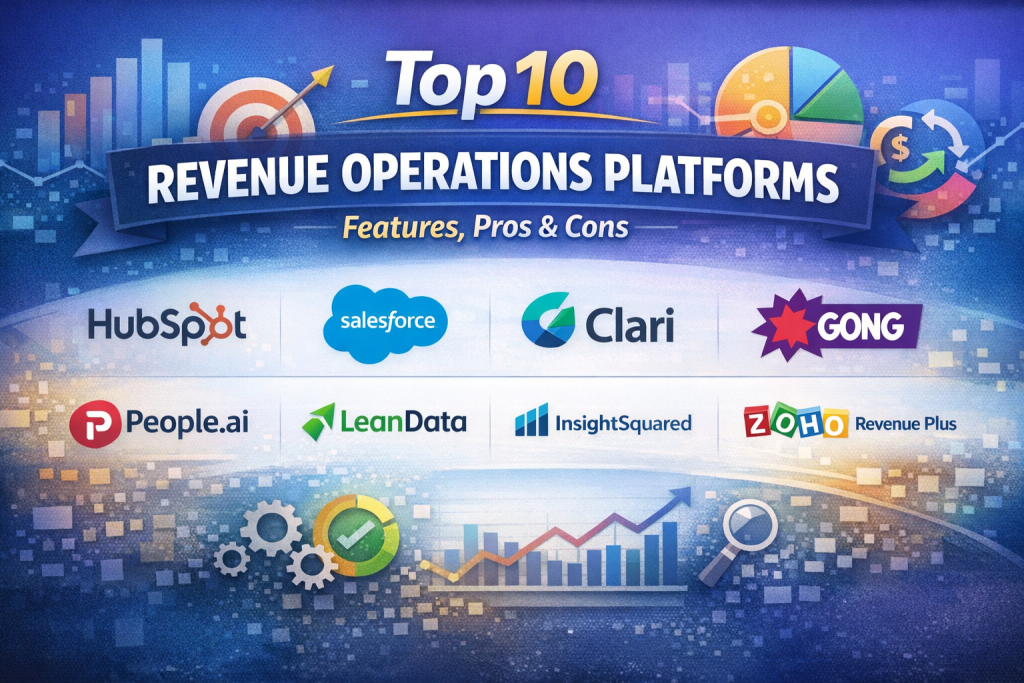
Top 10 Revenue Operations Platforms Tools
1 — HubSpot
Short description:
HubSpot offers an all-in-one Revenue Operations ecosystem combining CRM, marketing, sales, service, and operations hubs. It’s designed for growing teams that want simplicity without sacrificing power.
Key features
- Unified CRM across marketing, sales, and service
- Revenue attribution and lifecycle reporting
- Deal pipelines and forecasting tools
- Workflow automation and lead scoring
- Custom objects and data synchronization
- AI-powered insights and recommendations
Pros
- Very easy to adopt and scale
- Strong alignment across GTM teams
- Clean, intuitive user interface
Cons
- Advanced features can get expensive
- Less customization than pure enterprise CRMs
- Reporting limits at lower tiers
Security & compliance
SSO, encryption, GDPR support, SOC 2 (varies by plan)
Support & community
Excellent documentation, onboarding resources, large global user community, strong partner ecosystem
2 — Salesforce
Short description:
Salesforce is a deeply customizable enterprise-grade CRM and RevOps backbone used by large organizations with complex revenue models.
Key features
- Sales Cloud, Marketing Cloud, Service Cloud integration
- Advanced forecasting and pipeline analytics
- Revenue intelligence and AI (Einstein)
- Custom objects, workflows, and automation
- AppExchange ecosystem
- Multi-region, multi-currency support
Pros
- Extremely powerful and flexible
- Best-in-class ecosystem
- Strong enterprise governance
Cons
- Steep learning curve
- High implementation and admin costs
- Overkill for smaller teams
Security & compliance
SOC 2, ISO, GDPR, advanced audit logs, enterprise-grade security
Support & community
Massive global community, extensive documentation, enterprise support tiers available
3 — Clari
Short description:
Clari focuses on revenue visibility, forecasting accuracy, and deal inspection for sales and RevOps leaders.
Key features
- AI-powered revenue forecasting
- Pipeline health analysis
- Deal risk identification
- Sales activity tracking
- Scenario planning
- CRM data normalization
Pros
- Best-in-class forecasting accuracy
- Strong executive dashboards
- Improves forecast discipline
Cons
- Relies heavily on CRM data quality
- Limited marketing functionality
- Premium pricing
Security & compliance
SSO, encryption, SOC 2, GDPR
Support & community
Dedicated onboarding, enterprise-focused support, smaller but focused user base
4 — Gong
Short description:
Gong is a revenue intelligence platform that analyzes customer conversations to improve deal execution and revenue outcomes.
Key features
- Call recording and transcription
- Deal risk and sentiment analysis
- Coaching insights for reps
- Pipeline and forecast insights
- CRM data enrichment
- AI-driven recommendations
Pros
- Unmatched conversational intelligence
- Strong sales coaching value
- Improves win rates
Cons
- Primarily sales-focused
- Requires behavior adoption
- Expensive for small teams
Security & compliance
SOC 2, GDPR, encryption, access controls
Support & community
High-quality onboarding, customer success-led adoption, strong thought leadership content
5 — People.ai
Short description:
People.ai automates activity capture and provides revenue insights by connecting people activity to outcomes.
Key features
- Automatic sales activity capture
- Revenue attribution analytics
- Forecast and pipeline insights
- CRM data hygiene automation
- AI-driven performance analysis
Pros
- Reduces manual CRM work
- Improves data accuracy
- Strong RevOps analytics
Cons
- Complex initial setup
- Less intuitive UI
- Enterprise-focused pricing
Security & compliance
SOC 2, GDPR, SSO, encryption
Support & community
Enterprise onboarding, strong customer success, limited open community
6 — LeanData
Short description:
LeanData specializes in lead, account, and opportunity routing for RevOps teams managing complex sales structures.
Key features
- Advanced lead-to-account matching
- Routing automation and logic builder
- Revenue attribution tracking
- Funnel analytics
- CRM-native workflows
Pros
- Exceptional routing accuracy
- Reduces lead leakage
- Highly customizable logic
Cons
- Narrower RevOps scope
- Requires CRM expertise
- Not a full RevOps suite
Security & compliance
SOC 2, GDPR, SSO
Support & community
Strong technical documentation, responsive support, RevOps-focused audience
7 — InsightSquared
Short description:
InsightSquared delivers revenue analytics, forecasting, and performance reporting for sales and RevOps teams.
Key features
- Sales and pipeline dashboards
- Forecasting and trend analysis
- Goal tracking
- Activity performance insights
- CRM integrations
Pros
- Fast time to value
- Clear, executive-friendly dashboards
- Strong analytics depth
Cons
- Limited automation
- Less customization
- Depends on CRM accuracy
Security & compliance
SOC 2, GDPR (varies)
Support & community
Good onboarding, helpful support, moderate user community
8 — Revenue.io
Short description:
Revenue.io combines sales engagement with revenue intelligence to optimize rep productivity and outcomes.
Key features
- AI-guided selling
- Dialer and engagement tracking
- Forecast insights
- CRM synchronization
- Rep performance analytics
Pros
- Improves rep efficiency
- Strong activity intelligence
- Easy CRM integration
Cons
- Sales-centric focus
- Limited marketing visibility
- Requires consistent usage
Security & compliance
SOC 2, encryption, GDPR
Support & community
Strong onboarding, sales-focused enablement resources
9 — Scratchpad
Short description:
Scratchpad is a lightweight RevOps productivity tool designed to improve CRM adoption and data accuracy for sales teams.
Key features
- In-browser CRM updates
- Pipeline hygiene tools
- Deal notes and insights
- Workflow shortcuts
- RevOps dashboards
Pros
- Very easy to use
- Improves CRM data quality
- Affordable for teams
Cons
- Limited enterprise depth
- Not a full RevOps platform
- Sales-first orientation
Security & compliance
SSO, encryption, GDPR (basic)
Support & community
Fast support, modern documentation, growing user base
10 — Zoho Revenue Plus
Short description:
Zoho Revenue Plus is a bundled RevOps suite combining CRM, marketing, sales engagement, and analytics at a competitive price.
Key features
- Unified Zoho CRM ecosystem
- Marketing and sales automation
- Revenue analytics dashboards
- Workflow automation
- Multi-channel engagement
Pros
- Excellent value for money
- Broad feature coverage
- Strong SMB focus
Cons
- UI less polished than competitors
- Limited enterprise customization
- Smaller global community
Security & compliance
ISO, GDPR, encryption, role-based access
Support & community
Solid documentation, ticket-based support, active Zoho user community
Comparison Table
| Tool Name | Best For | Platform(s) Supported | Standout Feature | Rating |
|---|---|---|---|---|
| HubSpot | Growing SMBs | Web | Unified RevOps CRM | N/A |
| Salesforce | Enterprises | Web | Extreme customization | N/A |
| Clari | Forecast accuracy | Web | AI revenue forecasting | N/A |
| Gong | Sales intelligence | Web | Conversation analytics | N/A |
| People.ai | Data-driven RevOps | Web | Automated activity capture | N/A |
| LeanData | Complex routing | Web | Lead-to-account matching | N/A |
| InsightSquared | Revenue analytics | Web | Executive dashboards | N/A |
| Revenue.io | Sales productivity | Web | AI-guided selling | N/A |
| Scratchpad | CRM hygiene | Browser | Fast CRM updates | N/A |
| Zoho Revenue Plus | Budget-conscious teams | Web | All-in-one value suite | N/A |
Evaluation & Scoring of Revenue Operations Platforms
| Evaluation Criteria | Weight | Description |
|---|---|---|
| Core features | 25% | Coverage across sales, marketing, CS |
| Ease of use | 15% | Adoption speed and usability |
| Integrations & ecosystem | 15% | CRM, marketing, finance tools |
| Security & compliance | 10% | Enterprise readiness |
| Performance & reliability | 10% | Data accuracy and uptime |
| Support & community | 10% | Help, onboarding, ecosystem |
| Price / value | 15% | ROI relative to cost |
Which Revenue Operations Platforms Tool Is Right for You?
- Solo users & early startups: Lightweight CRM or productivity tools
- SMBs: HubSpot or Zoho Revenue Plus
- Mid-market: HubSpot, Clari, InsightSquared
- Enterprise: Salesforce, Gong, People.ai
Budget-conscious teams should prioritize bundled suites, while premium buyers gain value from deep analytics and AI.
Choose ease of use if adoption is a challenge; choose feature depth if complexity demands it.
Security-sensitive industries should favor enterprise-grade compliance and auditability.
Frequently Asked Questions (FAQs)
- What is a Revenue Operations Platform?
A system that aligns sales, marketing, and customer success around revenue goals. - Is RevOps only for large companies?
No. SMBs benefit significantly from early alignment. - Do I need multiple tools for RevOps?
Not always. Some platforms offer end-to-end coverage. - How long does implementation take?
Anywhere from weeks to several months, depending on complexity. - Are RevOps tools expensive?
Pricing varies widely based on features and scale. - Do these tools replace CRM systems?
Some include CRM; others enhance existing CRMs. - What’s the biggest mistake buyers make?
Ignoring data quality and adoption planning. - Are these tools secure?
Most leading platforms meet enterprise security standards. - Can RevOps platforms improve forecasting?
Yes, forecasting accuracy is a core benefit. - What’s the best alternative to a full RevOps platform?
A well-integrated CRM with analytics and automation.
Conclusion
Revenue Operations Platforms play a critical role in modern, scalable growth strategies. They bring structure, visibility, and predictability to revenue generation by aligning teams, data, and processes.
There is no single “best” platform for everyone. The right choice depends on company size, revenue complexity, budget, and operational maturity. Focus on alignment, data accuracy, and adoption—not just feature lists—and you’ll select a tool that truly drives sustainable revenue growth.

Find Trusted Cardiac Hospitals
Compare heart hospitals by city and services — all in one place.
Explore Hospitals
Revenue operations works best when sales, marketing, and customer success teams share reliable data. A suitable platform should help connect these teams, improve reporting, and reveal gaps across the customer journey. However, adding another system will not solve poor data quality by itself. Teams should check how each platform connects with their existing CRM, marketing tools, and billing systems. Reporting flexibility and ease of use also deserve attention. The right choice should reduce manual work and help people make decisions from the same trusted view of revenue performance.
Revenue operations platforms are most useful when sales, marketing, and customer success teams work from consistent data. When comparing tools, check how they handle lead ownership changes, duplicate account records, and handoffs between teams throughout the customer lifecycle. Tracking where deals stall and which handoffs lead to lost opportunities can help businesses improve forecasting and fix process gaps that individual departments might otherwise miss.
Revenue operations platforms deliver the most value when sales, marketing, and customer success teams work from consistent data and shared performance metrics. Automating pipeline reporting, forecasting, and workflow management can reduce manual effort while helping teams identify revenue gaps earlier. Clear ownership of data quality and regular process reviews are essential for turning these platforms into reliable tools for sustainable business growth.
Revenue operations platforms deliver the most value when sales, marketing, and customer success teams work from consistent data instead of separate reports. Clear pipeline visibility, accurate forecasting, and automated data synchronization can help teams identify bottlenecks before they affect revenue targets. It is also important to establish shared metrics across departments so everyone measures success in the same way. With clean data and well-defined processes, these platforms can support better decisions and more predictable business growth.
Revenue reporting becomes difficult when teams change sales territories, attribution models, or the rules used to classify opportunities. Without consistent historical records, a change in reported performance may reflect new calculation rules rather than actual business growth. Before adopting a RevOps platform, I would check whether it preserves historical snapshots, records changes to forecasting logic, and allows teams to compare results using consistent definitions. Testing territory transfers, merged accounts, and opportunities that span multiple reporting periods can expose gaps that standard demonstrations rarely reveal. These controls help finance and sales leaders explain forecast changes, compare performance fairly, and make decisions based on reliable trends rather than shifting metrics.
The article effectively covers GTM alignment, but from an engineering perspective, RevOps platforms introduce massive schema drift and event synchronization debt across distributed data stacks. Integrating bidirectional sync engines like Census or Hightouch with automated contract testing prevents silent CRM record mutations from corrupting financial telemetry and enterprise data warehouses.
Revenue operations platforms help align sales, marketing, and customer success teams around shared data and business goals. When comparing tools, review CRM integration, pipeline reporting, workflow automation, forecasting, and data quality features. Bringing these functions together can reduce manual work, reveal gaps in the customer journey, and help teams make better decisions about revenue growth.
Revenue operations platforms help sales, marketing, and customer success teams align their processes, manage data, and gain a clearer view of the entire customer journey. Tools like HubSpot provide CRM, sales automation, reporting, and workflow management features, helping businesses reduce data silos, improve team collaboration, and make more informed revenue decisions.
While unifying go-to-market teams on platforms like HubSpot or Salesforce is crucial, the biggest bottleneck is rarely the software—it’s getting sales, marketing, and CS to agree on shared definitions of data hygiene and lifecycle stages. Without that foundational alignment, even the most advanced forecasting or conversation intelligence tools just automate confusion at scale.
A RevOps platform delivers the most value when sales, marketing, and customer success teams follow consistent data definitions and processes. Prioritizing CRM data quality and team adoption during implementation helps improve forecast reliability and prevent disconnected workflows from undermining revenue visibility.
This article provides a clear and practical comparison of today’s leading Revenue Operations platforms — a category that’s becoming essential for aligning sales, marketing, and customer success around unified metrics and operational workflows. I appreciate how it breaks down not only core capabilities like data unification, forecasting, workflow automation, and analytics, but also real‑world considerations such as integration flexibility, usability for business teams, and scalability for growing organizations. By outlining the strengths and limitations of each platform in a pros/cons format, the guide makes it easier for decision‑makers to match tool capabilities to their specific operational goals, whether that’s improving pipeline visibility, reducing manual processes, or driving cross‑functional accountability. This structured comparison is a valuable resource for anyone evaluating RevOps solutions that truly connect data, process, and execution.