
Introduction
Serialization & Track-and-Trace Software plays a critical role in modern regulated supply chains, especially in industries such as pharmaceuticals, medical devices, food & beverage, and high-value consumer goods. At its core, this software assigns unique serial numbers to individual products or batches and then tracks their movement across the entire supply chain—from manufacturing to distribution and final dispensing or sale.
The importance of serialization and traceability has grown rapidly due to strict global regulations, rising counterfeit risks, and increasing demands for supply-chain transparency. Governments and regulators require companies to prove product authenticity, ensure patient and consumer safety, and enable rapid recalls when issues arise. Beyond compliance, businesses also use these systems to gain real-time visibility, reduce losses, improve operational efficiency, and strengthen brand trust.
Real-world use cases include pharmaceutical DSCSA and EU FMD compliance, vaccine tracking, medical device recalls, food contamination tracing, and brand protection against counterfeits. When choosing a solution, buyers should evaluate regulatory coverage, scalability, integration capabilities, data security, reporting depth, and long-term vendor reliability—not just initial compliance checkboxes.
Best for:
Serialization & Track-and-Trace Software is best suited for pharmaceutical manufacturers, CMOs, biotech firms, distributors, logistics providers, food processors, medical device companies, and regulated brand owners, especially those operating across multiple regions or regulatory frameworks.
Not ideal for:
These tools may be unnecessary for small, unregulated businesses, local producers with no serialization mandates, or companies with extremely simple supply chains where batch-level tracking is sufficient.
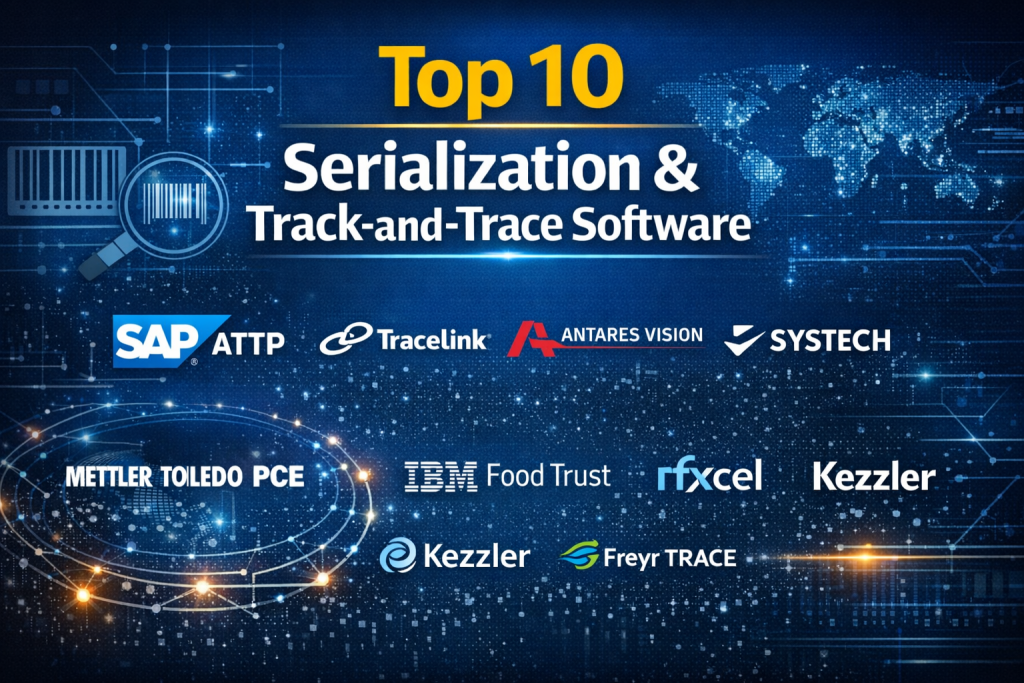
Top 10 Serialization & Track-and-Trace Software Tools
1 — SAP Advanced Track and Trace for Pharmaceuticals
Short description:
An enterprise-grade serialization and traceability platform designed specifically for pharmaceutical manufacturers operating under strict global regulations.
Key features:
- End-to-end pharmaceutical serialization and aggregation
- Native support for global regulations (DSCSA, EU FMD, others)
- Tight integration with SAP ERP and SAP S/4HANA
- Real-time supply chain visibility and event reporting
- Automated regulatory reporting and alerting
- High-volume serial number management
- Advanced analytics and compliance dashboards
Pros:
- Deep regulatory coverage for global pharma operations
- Highly scalable for large, complex enterprises
- Strong integration with existing SAP ecosystems
Cons:
- High implementation and licensing costs
- Requires SAP expertise for deployment and maintenance
Security & compliance:
Enterprise-grade security, role-based access, encryption, audit logs, GDPR alignment, ISO-aligned controls.
Support & community:
Extensive enterprise support, certified partners, detailed documentation, global consulting ecosystem.
2 — TraceLink
Short description:
A cloud-based digital network connecting life sciences manufacturers, CMOs, wholesalers, and dispensers for serialization and compliance.
Key features:
- Cloud-native serialization and compliance management
- Global regulatory coverage for pharma and biotech
- Network-based partner connectivity
- Exception management and compliance reporting
- Master data management for trading partners
- Recall and verification workflows
Pros:
- Strong network effects across the life sciences ecosystem
- Faster onboarding of partners
- Reduces integration complexity
Cons:
- Subscription pricing may increase with scale
- Limited customization compared to on-premise solutions
Security & compliance:
SOC-aligned controls, encryption, audit trails, GDPR compliance.
Support & community:
Strong customer success teams, structured onboarding, active life sciences user community.
3 — Antares Vision Group
Short description:
A comprehensive serialization, inspection, and track-and-trace solution combining software with vision systems for regulated manufacturing.
Key features:
- Line-level serialization and aggregation
- Vision inspection and verification
- End-to-end traceability across supply chains
- Regulatory compliance reporting
- Modular architecture for scalability
- Integration with packaging equipment
Pros:
- Strong combination of hardware and software
- Well-suited for packaging-centric environments
- Proven pharma and medical device expertise
Cons:
- Hardware dependency may increase costs
- Less suitable for purely software-only needs
Security & compliance:
Secure access controls, audit logs, compliance with pharma regulatory standards.
Support & community:
Global support teams, strong engineering support, industry-specific expertise.
4 — Systech
Short description:
A leading provider of brand protection, authentication, and serialization solutions focused on preventing counterfeiting and diversion.
Key features:
- Unique digital identity creation
- Serialization and aggregation management
- Anti-counterfeiting and authentication tools
- Supply chain visibility and analytics
- Consumer engagement capabilities
- Integration with packaging and ERP systems
Pros:
- Strong brand protection focus
- Advanced authentication technologies
- Flexible deployment models
Cons:
- Advanced features may require customization
- Pricing varies significantly by use case
Security & compliance:
Encryption, audit trails, role-based access, compliance varies by deployment.
Support & community:
Enterprise support, solution architects, detailed documentation.
5 — OPTEL Group
Short description:
A global traceability provider offering serialization and supply-chain visibility solutions across regulated and consumer industries.
Key features:
- End-to-end traceability platforms
- Serialization and aggregation management
- Multi-industry regulatory support
- Packaging line integration
- Real-time monitoring and reporting
- Cloud and on-premise options
Pros:
- Flexible deployment options
- Strong manufacturing integration
- Suitable for multi-industry operations
Cons:
- Implementation timelines can be long
- UI may feel complex for smaller teams
Security & compliance:
ISO-aligned security practices, encryption, audit logs.
Support & community:
Global implementation teams, technical training, enterprise support.
6 — METTLER TOLEDO PCE
Short description:
A serialization and inspection solution integrated into packaging and quality control workflows for regulated manufacturing.
Key features:
- Serialization and aggregation control
- Inline inspection and verification
- Regulatory reporting tools
- Packaging line connectivity
- Quality and compliance analytics
- Scalable modular architecture
Pros:
- Strong quality assurance integration
- Reliable hardware-software combination
- Well-known brand in regulated industries
Cons:
- Best suited for manufacturing environments
- Less flexible for post-manufacturing tracking
Security & compliance:
Secure industrial controls, audit trails, compliance-driven design.
Support & community:
Global service network, technical specialists, structured onboarding.
7 — IBM Food Trust
Short description:
A blockchain-based traceability platform focused on improving transparency, safety, and trust across food supply chains.
Key features:
- Blockchain-backed traceability records
- End-to-end product provenance tracking
- Recall and contamination response tools
- Partner data sharing network
- Real-time dashboards and analytics
- Cloud-based deployment
Pros:
- Strong transparency and data integrity
- Trusted enterprise technology provider
- Suitable for multi-stakeholder ecosystems
Cons:
- Less specialized for pharmaceutical serialization
- Requires ecosystem participation to maximize value
Security & compliance:
Enterprise cloud security, encryption, access controls, GDPR support.
Support & community:
Enterprise support, partner ecosystem, extensive documentation.
8 — rfxcel
Short description:
A traceability and compliance platform designed to meet global pharmaceutical and food safety regulations.
Key features:
- Serialization and aggregation management
- Global regulatory compliance support
- Real-time supply chain event tracking
- Recall and verification workflows
- Analytics and reporting dashboards
- Cloud-based architecture
Pros:
- Strong regulatory expertise
- Flexible deployment options
- User-friendly dashboards
Cons:
- Smaller ecosystem than some competitors
- Advanced integrations may require customization
Security & compliance:
Encryption, audit logs, compliance with major regulations.
Support & community:
Dedicated support teams, onboarding assistance, industry expertise.
9 — Kezzler
Short description:
A digital product identity platform enabling item-level serialization, traceability, and consumer engagement.
Key features:
- Unique digital identifiers for products
- Serialization and lifecycle tracking
- Consumer interaction and verification
- Analytics on product movement
- API-driven integrations
- Cloud-native deployment
Pros:
- Strong focus on item-level engagement
- Lightweight and flexible architecture
- Easy API integration
Cons:
- Less comprehensive regulatory tooling for pharma
- Best for brand-driven use cases
Security & compliance:
Cloud security controls, encryption, GDPR compliance.
Support & community:
Responsive support, developer documentation, growing community.
10 — Freyr Trace
Short description:
A compliance-focused serialization and traceability solution tailored for life sciences companies navigating global regulations.
Key features:
- Serialization and compliance workflows
- Regulatory reporting automation
- Partner data exchange
- Compliance dashboards and alerts
- Cloud-based architecture
- Scalable for growing organizations
Pros:
- Compliance-first design
- Easier adoption for mid-market companies
- Clear regulatory focus
Cons:
- Smaller feature set than large enterprise suites
- Limited brand recognition compared to market leaders
Security & compliance:
Role-based access, encryption, audit trails, GDPR alignment.
Support & community:
Dedicated customer support, compliance expertise, onboarding assistance.
Comparison Table
| Tool Name | Best For | Platform(s) Supported | Standout Feature | Rating |
|---|---|---|---|---|
| SAP ATTP | Large pharma enterprises | Cloud / On-prem | Deep SAP integration | N/A |
| TraceLink | Network-driven compliance | Cloud | Partner connectivity | N/A |
| Antares Vision | Packaging-centric pharma | Hybrid | Vision + serialization | N/A |
| Systech | Brand protection | Hybrid | Anti-counterfeiting | N/A |
| OPTEL Group | Multi-industry traceability | Cloud / On-prem | Manufacturing integration | N/A |
| METTLER TOLEDO PCE | Quality-driven manufacturing | On-prem / Hybrid | Inline inspection | N/A |
| IBM Food Trust | Food supply chains | Cloud | Blockchain traceability | N/A |
| rfxcel | Regulated supply chains | Cloud | Regulatory expertise | N/A |
| Kezzler | Digital product identity | Cloud | Consumer engagement | N/A |
| Freyr Trace | Mid-market life sciences | Cloud | Compliance automation | N/A |
Evaluation & Scoring of Serialization & Track-and-Trace Software
| Criteria | Weight | Evaluation Focus |
|---|---|---|
| Core features | 25% | Serialization depth, aggregation, reporting |
| Ease of use | 15% | UI clarity, onboarding effort |
| Integrations & ecosystem | 15% | ERP, partners, APIs |
| Security & compliance | 10% | Encryption, audits, standards |
| Performance & reliability | 10% | Scalability, uptime |
| Support & community | 10% | Documentation, enterprise support |
| Price / value | 15% | ROI vs total cost |
Which Serialization & Track-and-Trace Software Tool Is Right for You?
- Solo users / SMBs: Cloud-native, compliance-focused tools with simpler onboarding
- Mid-market: Scalable platforms offering regulatory depth without enterprise complexity
- Enterprise: Highly configurable solutions with deep ERP and partner integrations
- Budget-conscious: Modular tools that allow phased implementation
- Premium needs: Full-suite platforms with analytics, network connectivity, and global support
- High compliance: Solutions with proven regulatory reporting and audit readiness
Frequently Asked Questions (FAQs)
1. Is serialization mandatory for all industries?
No. It is mandatory mainly in regulated sectors like pharmaceuticals and medical devices.
2. How long does implementation take?
Anywhere from a few weeks for cloud tools to several months for enterprise deployments.
3. Can these tools integrate with ERP systems?
Most enterprise-grade solutions support ERP integration, especially with SAP environments.
4. Are cloud solutions accepted by regulators?
Yes, provided they meet data security and compliance requirements.
5. What is aggregation in serialization?
It links individual product serials to cases and pallets for efficient tracking.
6. How do these tools help with recalls?
They enable rapid identification of affected products and locations.
7. Is blockchain required for traceability?
No, but it enhances transparency and trust in multi-party networks.
8. What are common implementation mistakes?
Underestimating data quality, partner onboarding, and change management.
9. Are these tools scalable globally?
Most leading platforms are designed for multi-country operations.
10. Do all tools offer anti-counterfeiting?
Not all—some focus purely on compliance and logistics traceability.
Conclusion
Serialization & Track-and-Trace Software is no longer just a compliance checkbox—it is a strategic investment in supply-chain resilience, safety, and transparency. The right solution depends on regulatory scope, scale, integration needs, and long-term growth plans. Rather than searching for a single “best” tool, organizations should focus on fit-for-purpose platforms that align with their operational complexity, compliance obligations, and future roadmap.

Find Trusted Cardiac Hospitals
Compare heart hospitals by city and services — all in one place.
Explore Hospitals
Serialization and track-and-trace software helps businesses improve product visibility, strengthen supply chain integrity, and reduce the risk of counterfeit goods. Reliable integration with ERP, warehouse, and manufacturing systems ensures that product movements are recorded accurately across every stage of distribution. Maintaining consistent data standards and real-time traceability also makes regulatory reporting, product recalls, and inventory verification more efficient.
Serialization and track-and-trace software can help businesses follow products through every stage of the supply chain. I think accurate data capture and easy integration with existing systems are key to avoiding errors. Regularly checking product records can also make it easier to spot issues and respond quickly. This is especially important for maintaining product safety and meeting regulatory requirements.
Serialization systems need a reliable way to recover when packaging equipment or connected applications stop sending data. Missing scans, repeated identifiers, and incorrect carton links can create confusion about a product’s location and status. I would verify that the software detects these inconsistencies before releasing shipments for distribution. Recovery workflows should let operators correct errors while preserving a complete record of previous actions. It is also important to confirm that physical package scans match the digital hierarchy recorded in the system. Simulated recalls can reveal whether teams can trace individual units through cartons, pallets, and delivery locations. Alerts for unresolved events can help staff address problems before they affect more shipments. Testing these situations under realistic production conditions provides stronger evidence of traceability than a routine demonstration.
Serialization and track-and-trace software helps companies follow products through the supply chain using unique identifiers. Accurate records matter because a missing or incorrect event can break the chain of traceability. I would compare how each system handles code generation, aggregation, shipment events, and partner data exchange. Integration with packaging equipment and enterprise systems can also affect reliability. Teams should test how the platform responds to duplicate codes, rejected messages, and delayed updates. Clear audit records help during recalls and inspections. A useful system should make product movement easier to verify and support fast, accurate action when a problem appears.
Packaging-line disruptions can create difficult reconciliation problems when products receive serial numbers but fail inspection, or when production systems lose connectivity midway through a batch. Manufacturers need clear procedures for quarantining affected units, recovering unused serial numbers, and reconciling physical inventory with system records before production resumes. I would test scenarios such as printer failures, scanner misreads, interrupted aggregation, and partial data transmission between line equipment and central systems. Automated reconciliation checks can help identify gaps before products leave the facility. This level of operational testing is essential because a small mismatch between physical products and digital records can delay shipments, complicate audits, and undermine recall accuracy.
Serialization and track-and-trace software helps manufacturers and distributors follow products through packaging, shipping, and the supply chain. When comparing platforms, consider unique identifier management, barcode and scanner support, batch tracking, regulatory reporting, and integration with ERP and warehouse systems. Accurate data capture at each handoff can improve product traceability, simplify recalls, and help teams detect missing or mismatched items before they reach customers.
A major operational challenge in track-and-trace architectures is high-throughput serial number allocation and parent-child aggregation latency on packaging lines. If edge line-controllers experience network partitions with Level 4 enterprise repositories during packaging runs, missing batch buffers cause production line stoppages, un-aggregated pallet states, and costly regulatory compliance re-works.
Serialization track and trace software should maintain a reliable product history from manufacturing through distribution and final delivery. When comparing platforms, check how they manage unique serial numbers, aggregate cases and pallets, and reconcile shipment records when products move between trading partners. Strong exception handling is also important, as duplicate codes, damaged labels, or missing scan events need to be resolved before they disrupt traceability or product recalls.
Choosing between enterprise platforms like SAP and network-focused solutions like TraceLink often comes down to existing ecosystem complexity and partner onboarding speed. For mid-market companies navigating tight regulations, the overhead of line-level aggregation vs. cloud-based verification remains a critical architectural trade-off to weigh early.
Serialization and track-and-trace software is most effective when product identifiers remain accurate and traceable across every stage of the supply chain. Integrating barcode or RFID scanning with inventory systems can reduce manual errors and make recalls faster, while regular data validation helps maintain reliable records.
Serialization and track-and-trace software helps manufacturers and distributors assign unique identifiers to products, monitor their movement through the supply chain, and maintain traceability records. Solutions like TraceLink support pharmaceutical serialization and supply chain visibility, helping organizations improve product authenticity checks, strengthen regulatory compliance, and respond more effectively to recalls or distribution issues.
This article offers a helpful overview of serialization and track‑and‑trace software by clearly comparing the key features, benefits, and limitations of the top solutions in the market. Understanding how these platforms handle item serialization, supply chain visibility, reporting, and regulatory compliance makes it easier for businesses to choose the right tool for their operational needs. Breaking down each solution’s strengths and weaknesses gives practical insight into what matters most when improving traceability and reducing risks in manufacturing and logistics environments. Overall, this is a useful guide for anyone evaluating software to enhance supply chain transparency and efficiency.