
Introduction
Supply Chain Control Tower Platforms have become a critical capability for modern supply chains that operate across multiple regions, partners, and transportation modes. At their core, these platforms act as a centralized command center that provides end-to-end visibility, real-time insights, and decision support across procurement, manufacturing, logistics, and distribution. Instead of managing supply chain activities through disconnected systems and spreadsheets, organizations use control towers to see what is happening now, understand what might happen next, and take corrective action before disruptions escalate.
In today’s volatile environment—marked by demand fluctuations, geopolitical risks, transportation delays, and supplier uncertainty—having reactive systems is no longer enough. Supply Chain Control Tower Platforms enable proactive and predictive management, helping organizations reduce costs, improve service levels, and respond faster to disruptions. Common real-world use cases include shipment tracking, inventory imbalance detection, supplier risk monitoring, demand-supply alignment, and exception management.
When choosing a Supply Chain Control Tower Platform, buyers should evaluate factors such as real-time visibility, analytics depth, AI-driven insights, integration capabilities, scalability, security, and usability. The right platform should not only show data but also help teams make better decisions faster.
Best for:
Supply Chain Control Tower Platforms are ideal for mid-market to enterprise organizations, supply chain leaders, logistics managers, operations teams, and executives who need real-time visibility and coordinated decision-making across complex, multi-tier supply chains.
Not ideal for:
These platforms may not be suitable for very small businesses, single-location operations, or companies with simple supply chains where basic ERP or inventory tools already provide sufficient visibility.
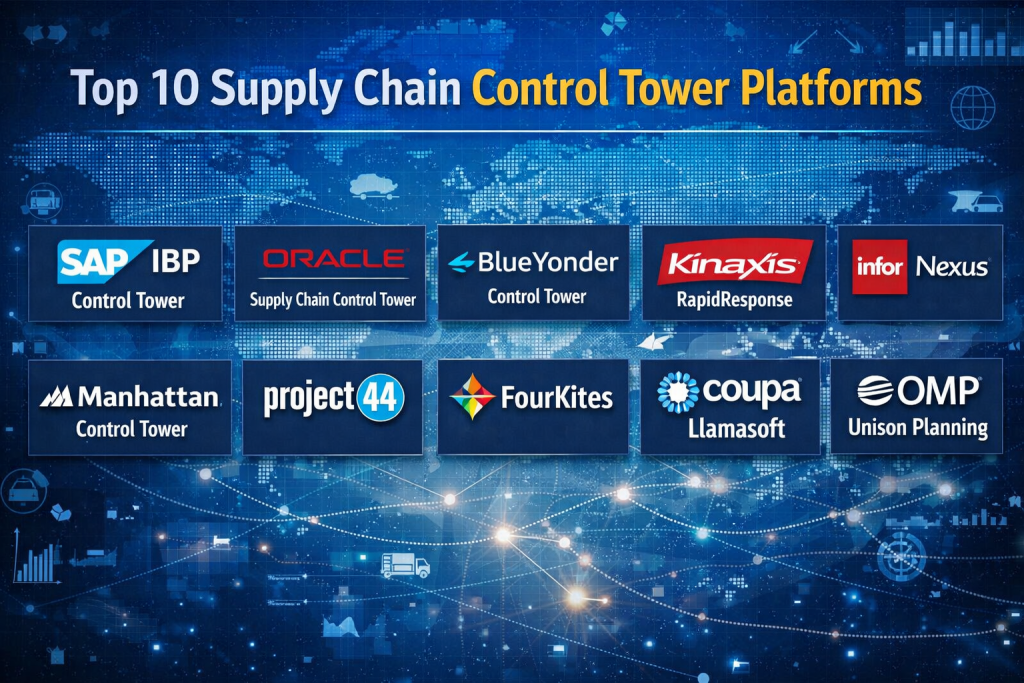
Top 10 Supply Chain Control Tower Platforms Tools
1 — SAP Integrated Business Planning (IBP) Control Tower
Short description:
SAP IBP Control Tower provides end-to-end supply chain visibility and advanced analytics for large, global enterprises. It is designed for organizations already invested in SAP’s ecosystem.
Key features:
- End-to-end supply chain visibility across planning and execution
- Real-time KPI dashboards and alerts
- Scenario planning and what-if analysis
- Advanced demand and supply analytics
- Strong ERP and data integration
- AI-driven insights and forecasting
Pros:
- Extremely powerful analytics and planning capabilities
- Deep integration with SAP ERP and S/4HANA
Cons:
- High implementation complexity
- Requires significant SAP expertise
Security & compliance:
Enterprise-grade security, role-based access, encryption, GDPR support, ISO-aligned controls.
Support & community:
Extensive documentation, global enterprise support, large SAP user community.
2 — Oracle Supply Chain Control Tower
Short description:
Oracle’s Supply Chain Control Tower offers real-time visibility, AI-powered insights, and orchestration across supply chain processes, ideal for large enterprises.
Key features:
- Real-time event tracking and alerts
- AI and machine learning-driven insights
- Unified data model across Oracle SCM modules
- Predictive risk identification
- Automated workflows and exception handling
Pros:
- Strong AI-driven decision support
- Seamless integration with Oracle SCM Cloud
Cons:
- Best value when used within Oracle ecosystem
- Customization can be time-consuming
Security & compliance:
SOC-aligned controls, encryption, identity management, GDPR compliance.
Support & community:
Enterprise-grade support, structured onboarding, strong documentation.
3 — Blue Yonder Control Tower
Short description:
Blue Yonder Control Tower focuses on real-time visibility and AI-driven orchestration for complex, fast-moving supply chains.
Key features:
- Real-time visibility across supply chain nodes
- AI-powered predictive analytics
- Dynamic exception management
- Inventory and demand sensing
- Scenario-based decision support
Pros:
- Excellent AI and predictive capabilities
- Strong in retail and consumer goods industries
Cons:
- Implementation effort can be significant
- Premium pricing
Security & compliance:
Enterprise security standards, encryption, role-based access.
Support & community:
Dedicated enterprise support, training programs, industry-focused user groups.
4 — Kinaxis RapidResponse Control Tower
Short description:
Kinaxis RapidResponse offers concurrent planning and control tower capabilities for organizations needing fast, scenario-based decision-making.
Key features:
- Concurrent planning across demand and supply
- Real-time data synchronization
- Scenario simulation and comparison
- Integrated analytics and alerts
- Strong collaboration tools
Pros:
- Excellent scenario modeling
- Fast response to supply chain disruptions
Cons:
- Learning curve for new users
- Higher cost for smaller organizations
Security & compliance:
SOC 2-aligned controls, encryption, access management.
Support & community:
High-quality enterprise support, strong customer success focus.
5 — Infor Nexus Control Tower
Short description:
Infor Nexus Control Tower specializes in global trade, logistics, and multi-enterprise collaboration across supply chain partners.
Key features:
- Multi-enterprise supply chain visibility
- Logistics and shipment tracking
- Supplier collaboration tools
- Risk and disruption monitoring
- Trade compliance support
Pros:
- Strong partner and supplier network
- Excellent logistics visibility
Cons:
- Less focus on deep planning analytics
- Interface may feel complex
Security & compliance:
Enterprise security, encryption, audit logs, GDPR support.
Support & community:
Global support teams, onboarding assistance, partner ecosystem.
6 — Manhattan Associates Supply Chain Control Tower
Short description:
Manhattan Associates Control Tower is designed for distribution-heavy environments, providing strong execution visibility and operational control.
Key features:
- Real-time execution visibility
- Warehouse and transportation insights
- Exception-based alerts
- Performance monitoring dashboards
- Integration with WMS and TMS
Pros:
- Excellent for logistics and fulfillment operations
- Strong execution focus
Cons:
- Less strategic planning depth
- Best suited for Manhattan ecosystem users
Security & compliance:
Enterprise-grade security, access controls, encryption.
Support & community:
Strong enterprise support, industry expertise, training resources.
7 — Project44 Control Tower
Short description:
Project44 Control Tower focuses on real-time transportation visibility and predictive logistics intelligence.
Key features:
- Real-time shipment tracking
- Predictive ETA and delay alerts
- Carrier and transportation visibility
- Exception management
- Analytics dashboards
Pros:
- Best-in-class transportation visibility
- Easy to deploy compared to larger suites
Cons:
- Limited beyond transportation scope
- Less planning functionality
Security & compliance:
SOC-aligned security, encryption, role-based access.
Support & community:
Responsive customer support, good documentation, growing user base.
8 — FourKites Intelligent Control Tower
Short description:
FourKites Intelligent Control Tower delivers real-time transportation and logistics visibility with predictive analytics.
Key features:
- Real-time tracking across modes
- Predictive analytics for delays
- AI-driven insights
- Workflow automation
- Carrier collaboration
Pros:
- Strong logistics intelligence
- User-friendly dashboards
Cons:
- Focused mainly on transportation
- Limited broader supply chain planning
Security & compliance:
Enterprise-grade security, encryption, compliance-ready controls.
Support & community:
Dedicated support teams, onboarding programs, active customer community.
9 — Llamasoft (Coupa) Supply Chain Control Tower
Short description:
Llamasoft, now part of Coupa, combines supply chain design and analytics with control tower visibility.
Key features:
- End-to-end visibility
- Supply chain modeling and simulation
- Cost and risk analysis
- Scenario planning
- Integration with spend management
Pros:
- Strong modeling and optimization
- Excellent for strategic decision-making
Cons:
- Less operational real-time focus
- Requires analytics expertise
Security & compliance:
SOC-aligned security, encryption, GDPR support.
Support & community:
Enterprise support, professional services, analytics-focused community.
10— OMP Unison Planning Control Tower
Short description:
OMP Unison Planning Control Tower focuses on advanced planning and orchestration for complex manufacturing supply chains.
Key features:
- Integrated planning and execution visibility
- Advanced optimization algorithms
- Scenario-based planning
- End-to-end orchestration
- Manufacturing-focused insights
Pros:
- Excellent for complex manufacturing environments
- Deep planning and optimization
Cons:
- Not ideal for logistics-only use cases
- Implementation complexity
Security & compliance:
Enterprise security standards, encryption, role-based access.
Support & community:
Specialized enterprise support, industry expertise, strong consulting network.
Comparison Table
| Tool Name | Best For | Platform(s) Supported | Standout Feature | Rating |
|---|---|---|---|---|
| SAP IBP Control Tower | Large global enterprises | Cloud | Deep planning & analytics | N/A |
| Oracle Control Tower | Enterprise SCM users | Cloud | AI-driven insights | N/A |
| Blue Yonder Control Tower | Retail & CPG | Cloud | Predictive AI orchestration | N/A |
| Kinaxis RapidResponse | Rapid scenario planning | Cloud | Concurrent planning | N/A |
| Infor Nexus | Global trade & logistics | Cloud | Multi-enterprise visibility | N/A |
| Manhattan Associates | Distribution & fulfillment | Cloud | Execution visibility | N/A |
| Project44 | Transportation visibility | Cloud | Real-time shipment tracking | N/A |
| FourKites | Logistics intelligence | Cloud | Predictive ETAs | N/A |
| Llamasoft (Coupa) | Strategic supply chain design | Cloud | Simulation & modeling | N/A |
| OMP Unison Planning | Manufacturing planning | Cloud | Optimization algorithms | N/A |
Evaluation & Scoring of Supply Chain Control Tower Platforms
| Criteria | Weight | SAP | Oracle | Blue Yonder | Kinaxis | Infor Nexus | Manhattan | Project44 | FourKites | Llamasoft | OMP |
|---|---|---|---|---|---|---|---|---|---|---|---|
| Core features | 25% | High | High | High | High | Medium | Medium | Medium | Medium | High | High |
| Ease of use | 15% | Medium | Medium | Medium | Medium | Medium | Medium | High | High | Medium | Medium |
| Integrations & ecosystem | 15% | High | High | High | Medium | High | Medium | Medium | Medium | Medium | Medium |
| Security & compliance | 10% | High | High | High | High | High | High | Medium | Medium | High | High |
| Performance & reliability | 10% | High | High | High | High | Medium | High | High | High | Medium | High |
| Support & community | 10% | High | High | High | High | Medium | Medium | Medium | Medium | Medium | Medium |
| Price / value | 15% | Medium | Medium | Medium | Medium | Medium | Medium | High | High | Medium | Medium |
Which Supply Chain Control Tower Platforms Tool Is Right for You?
Choosing the right platform depends heavily on your organization’s size, complexity, and goals.
- Solo users or small businesses: These platforms may be overkill; simpler inventory or logistics tools are often sufficient.
- SMBs: Transportation-focused control towers like Project44 or FourKites offer faster ROI.
- Mid-market organizations: Platforms like Infor Nexus or Kinaxis balance power and scalability.
- Enterprises: SAP, Oracle, Blue Yonder, and OMP are best for global, complex operations.
Budget-conscious vs premium:
Transportation visibility tools typically cost less, while full-suite control towers require higher investment.
Feature depth vs ease of use:
Advanced planning platforms offer depth but require training, while logistics-focused tools are easier to adopt.
Integration & scalability:
Ecosystem alignment with existing ERP and SCM tools is critical for long-term success.
Security & compliance:
Highly regulated industries should prioritize platforms with strong governance and audit controls.
Frequently Asked Questions (FAQs)
1. What is a Supply Chain Control Tower?
A centralized platform that provides real-time visibility, analytics, and decision support across the supply chain.
2. How is it different from an ERP?
ERPs manage transactions, while control towers focus on visibility, insights, and orchestration.
3. Do small businesses need control towers?
Usually not, unless their operations are complex or global.
4. Are these platforms cloud-based?
Most modern control towers are cloud-native.
5. How long does implementation take?
From a few weeks for logistics tools to several months for enterprise platforms.
6. Do they use AI?
Yes, many platforms use AI for prediction, alerts, and scenario analysis.
7. Are they secure?
Leading platforms follow enterprise security and compliance standards.
8. Can they integrate with existing systems?
Integration is a core capability, especially with ERP, TMS, and WMS.
9. What industries benefit most?
Manufacturing, retail, pharmaceuticals, automotive, and logistics-heavy industries.
10. What is the biggest mistake when choosing a control tower?
Selecting a tool that shows data but does not support decision-making or action.
Conclusion
Supply Chain Control Tower Platforms have evolved from simple dashboards into intelligent, decision-centric systems that help organizations navigate complexity and uncertainty. The best platforms combine real-time visibility, advanced analytics, and actionable insights to drive faster and better decisions.
There is no single “best” solution for everyone. The right choice depends on organizational size, supply chain complexity, existing systems, budget, and strategic goals. By carefully evaluating features, integration needs, and long-term scalability, organizations can select a control tower platform that delivers lasting value and resilience in an increasingly dynamic supply chain landscape.

Find Trusted Cardiac Hospitals
Compare heart hospitals by city and services — all in one place.
Explore Hospitals
Supply chain control tower platforms provide end-to-end visibility into supply chain operations, helping organizations monitor shipments, track inventory, and respond quickly to disruptions. Features such as real-time tracking, predictive analytics, risk alerts, demand forecasting, and integration with ERP and transportation management systems can improve coordination across the supply chain. I believe data accuracy, visibility across multiple partners, scenario planning, and actionable exception management are essential factors when comparing these solutions. The right platform should do more than display operational data; it should help teams anticipate potential bottlenecks, make faster decisions, reduce supply chain risks, and build greater resilience in an increasingly unpredictable business environment.
Supply chain control tower platforms help teams track shipments, inventory, and supplier activity from one place. I would check how quickly a platform updates data and alerts teams about delays, stock shortages, or route changes. A clear view of these issues can help teams act before small problems affect customer deliveries. Integration with existing systems is also important because incomplete data can lead to poor decisions. How can businesses use control tower platforms to respond faster to supply chain risks while keeping costs under control?
Supply chain control tower platforms help businesses monitor operations and improve visibility across their supply chains. Real-time tracking and predictive analytics can help teams identify disruptions and respond quickly. Features like inventory monitoring, automated alerts, and data integration are essential for effective management. Businesses should compare scalability, reporting capabilities, and ease of use before choosing a platform. The right solution can improve efficiency and support better supply chain decisions.
One important factor in evaluating supply chain control towers is how quickly predictive alerts translate into coordinated action across suppliers, warehouses, and transportation partners. While Kinaxis emphasizes scenario planning and Project44 focuses on shipment visibility, organizations should also measure alert accuracy, exception resolution time, and data synchronization reliability.
Supply chain control tower platforms provide valuable visibility by bringing inventory, shipment, supplier, and demand information into a unified operational view. Real-time alerts, predictive analytics, and scenario planning help teams identify disruptions early and respond before delays escalate into costly problems. Integrating data from multiple supply chain partners is essential for turning centralized visibility into faster decisions and more resilient operations.
Real-time visibility dashboards and AI-driven predictive alerts are powerful, but a control tower is only as effective as the data flowing from its connected nodes. If enterprise resource planning, warehouse management, and transportation systems operate in silos, leaders will struggle to act decisively during critical supply chain disruptions. Bridging the gap between real-time data ingestion and cross-functional operational workflows is the ultimate key to achieving true supply chain resilience.
Supply chain control tower platforms help businesses monitor goods, orders, and possible delays across their networks. Useful tools should combine data from suppliers, warehouses, transport, and planning systems. Alerts can help teams focus on problems that need action. Clear dashboards should show both the issue and its likely effect. When comparing platforms, review data freshness, integration support, alert quality, and reporting. A control tower works best when teams can act on its insights. Better visibility can support faster decisions and more reliable delivery planning.
Supply chain control towers also need a clear way to handle poor-quality data from external partners. A carrier may send late updates, while a supplier may use different product codes or shipment references. These small gaps can create false warnings and lead teams to make the wrong call. I’d check whether the platform can flag missing updates, match records across systems, and show how reliable each data source is. Over time, tracking these issues can help teams fix the root causes and make daily planning more dependable.
Supply chain control tower platforms help businesses monitor shipments, inventory, and supplier activities from a central view. When comparing tools, I would focus on real-time visibility, predictive alerts, risk monitoring, and integration with existing supply chain systems. Accurate updates can help teams respond quickly to delays and avoid disruptions. The right platform should improve coordination, support faster decisions, and make supply chain operations more reliable.
Supply chain control tower platforms are most valuable when they turn real-time data into clear actions across suppliers, warehouses, and transport networks. Teams should check data accuracy, integration quality, and alert settings to spot disruptions without creating unnecessary noise. Connecting alerts to clear response plans can help businesses resolve delays faster and maintain better visibility across the supply chain.
Supply chain control tower platforms are valuable because they give teams better visibility into shipments, inventory, and potential disruptions across the supply chain. When comparing solutions, I would focus on real-time data integration, predictive alerts, scenario planning, and clear exception management. A unified view is only useful when the underlying data is timely and reliable, so integration with suppliers and logistics partners matters greatly. Teams also need actionable recommendations rather than dashboards filled with alerts they cannot easily prioritize. How can businesses turn control tower insights into faster decisions when disruptions affect multiple suppliers, routes, or distribution centers?
A key challenge in supply chain visibility is maintaining consistent data across systems that use different product codes, shipment identifiers, and supplier records. Even a well-designed control tower can produce misleading insights when information from ERP, warehouse, and transport systems does not match. Before choosing a platform, I would examine how it handles data mapping, missing records, duplicate events, and changes to integration formats. It is also worth checking whether teams can update these connections without disrupting existing workflows. Strong data validation and clear ownership of master data can prevent costly reporting errors and help businesses trust the decisions they make from the platform.
Choosing the right control tower really comes down to whether your bottleneck is in physical transportation tracking or deep multi-tier planning. While enterprise platforms like SAP and Oracle excel at end-to-end orchestration, companies often struggle with data silos during integration. Tools focused heavily on execution agility can sometimes deliver faster ROI than massive suites. It’s crucial to align the platform choice with your organization’s actual operational maturity rather than just feature lists.
Choosing a control tower platform can be tricky when a company already uses different systems for inventory, transport, and demand planning. It helps to check whether teams can trace a problem from a delayed shipment back to its impact on stock and customer orders. This makes it easier to prioritize the issues that need attention first.
Achieving end-to-end supply chain visibility demands streaming telemetry from diverse carrier networks, combining predictive delay modeling with automated exception orchestration to resolve inventory bottlenecks and logistics disruptions before they impact downstream fulfillment milestones.
Supply chain control tower platforms give businesses a centralized view of shipments, inventory, supplier activity, and potential disruptions across their operations. Comparing real-time visibility, predictive analytics, exception management, and system integration helps organizations evaluate solutions that improve coordination, enable faster responses to delays, and build more resilient supply chains.
This article provides a clear and practical comparison of the top supply chain control tower platforms by outlining their key features, advantages, and limitations in an easy‑to‑understand way. I especially appreciate how it highlights capabilities like real‑time visibility, predictive analytics, and seamless integration — all of which are crucial for improving decision‑making and responsiveness across complex supply networks. For supply chain leaders and operations professionals evaluating control tower solutions, this guide offers valuable insights that support smarter, more informed software choices.