
Introduction
Workforce Marketplace Platforms are digital ecosystems that connect businesses with skilled professionals for short-term, long-term, or project-based work. Unlike traditional hiring models, these platforms provide on-demand access to global talent, flexible engagement models, and built-in tools for sourcing, contracting, payments, and performance tracking.
In today’s fast-changing business environment—where agility, speed, and specialized skills matter more than headcount—workforce marketplaces have become a strategic hiring channel rather than a backup option. Organizations use them to scale teams quickly, access niche expertise, manage costs, and reduce hiring risks.
Common real-world use cases include:
- Hiring developers, designers, marketers, and data experts for projects
- Scaling remote teams without long-term payroll commitments
- Accessing vetted senior talent for critical initiatives
- Managing freelance and contractor compliance centrally
When choosing a Workforce Marketplace Platform, buyers should evaluate:
- Talent quality and vetting depth
- Ease of hiring and management
- Payment, compliance, and contract handling
- Security, data protection, and auditability
- Scalability for future workforce needs
Best for:
Startups, SMBs, enterprises, HR leaders, procurement teams, project managers, and digital agencies across IT, marketing, consulting, healthcare, finance, and creative industries.
Not ideal for:
Organizations with only full-time, on-site hiring needs, highly regulated government roles with strict citizenship requirements, or teams needing permanent employees only.
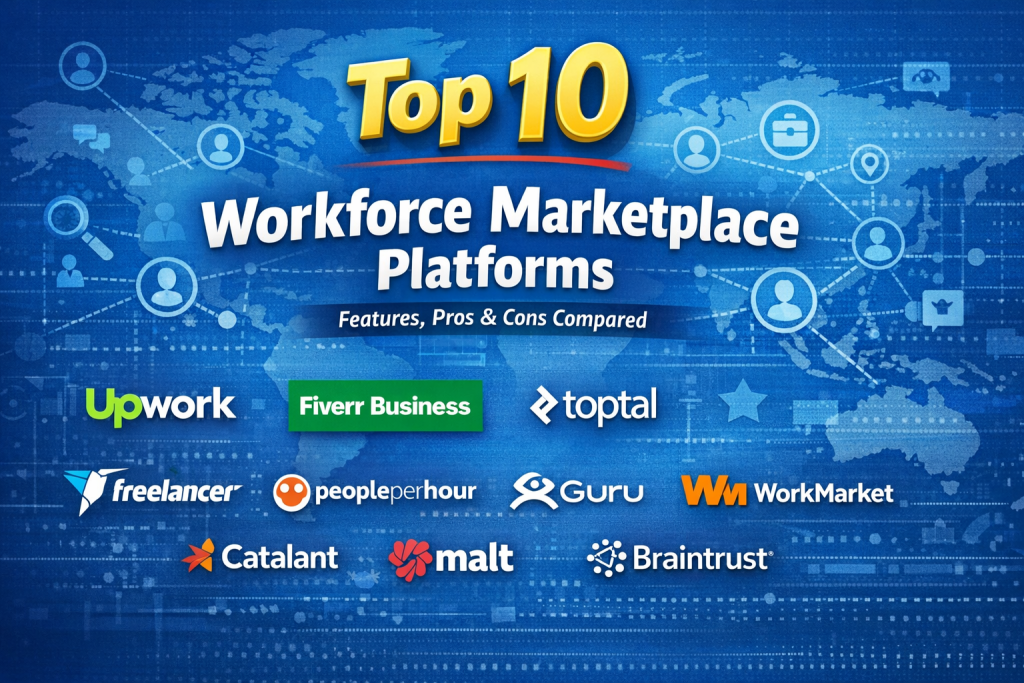
Top 10 Workforce Marketplace Platforms Tools
1 — Upwork
Upwork
Short description:
A large global freelance marketplace connecting businesses with professionals across technical, creative, and business domains.
Key features
- Massive global talent pool
- Project-based and hourly contracts
- Built-in time tracking
- Escrow-based payments
- Talent search with filters
- Enterprise hiring solutions
Pros
- Broad skill coverage
- Flexible hiring models
- Strong brand trust
Cons
- Variable talent quality
- Platform fees can add up
Security & compliance:
SSO (enterprise), encrypted payments, GDPR support, audit logs (enterprise).
Support & community:
Extensive documentation, community forums, standard and enterprise support.
2 — Fiverr Business
Fiverr
Short description:
A service-based marketplace focused on fast, predefined deliverables with curated talent for teams.
Key features
- Pre-packaged service listings
- Fiverr Business team workspace
- Talent curation
- Fixed-price pricing
- Collaboration tools
- Milestone management
Pros
- Fast turnaround
- Transparent pricing
- Easy for non-technical users
Cons
- Limited customization
- Less suited for complex projects
Security & compliance:
Standard encryption, GDPR support; enterprise compliance varies.
Support & community:
Knowledge base, ticket support, business onboarding assistance.
3 — Toptal
Toptal
Short description:
An exclusive network of top-tier freelancers focused on senior and enterprise-grade talent.
Key features
- Rigorous talent screening
- Senior-level professionals only
- Dedicated account management
- Rapid talent matching
- Flexible engagement models
- Quality assurance process
Pros
- Exceptional talent quality
- Low hiring risk
- Strong enterprise alignment
Cons
- Premium pricing
- Smaller talent pool
Security & compliance:
Enterprise-grade security, GDPR compliance, contractual safeguards.
Support & community:
Dedicated account managers, onboarding support, enterprise SLAs.
4 — Freelancer
Freelancer
Short description:
A bidding-based marketplace allowing businesses to post projects and receive competitive proposals.
Key features
- Competitive bidding system
- Wide talent categories
- Escrow payments
- Contests for creative work
- Project milestones
- Global reach
Pros
- Cost-competitive
- Large freelancer base
- Flexible pricing
Cons
- Requires proposal screening
- Quality varies significantly
Security & compliance:
Escrow protection, basic encryption, GDPR alignment.
Support & community:
Help center, ticket support, global user community.
5 — PeoplePerHour
PeoplePerHour
Short description:
A project-based freelance platform popular in Europe for creative and digital services.
Key features
- Project postings and offers
- Hourly and fixed-price work
- AI-assisted talent matching
- Escrow payments
- Proposal management
- European talent focus
Pros
- Strong design and marketing talent
- Clear pricing structures
- User-friendly interface
Cons
- Smaller global reach
- Limited enterprise tooling
Security & compliance:
Secure payments, GDPR compliance.
Support & community:
Help center, email support, freelancer community.
6 — Guru
Guru
Short description:
A long-standing freelance marketplace emphasizing work history transparency and collaboration.
Key features
- Workroom collaboration tools
- Escrow and milestone payments
- Freelancer performance ratings
- Proposal management
- Team collaboration
- Flexible contracts
Pros
- Transparent work history
- Strong collaboration features
- Reliable payments
Cons
- Dated interface
- Smaller talent pool
Security & compliance:
Escrow protection, encrypted payments, GDPR support.
Support & community:
Documentation, email support, freelancer forums.
7 — WorkMarket
WorkMarket
Short description:
An enterprise-focused workforce marketplace and freelancer management system.
Key features
- Centralized freelancer management
- Compliance and classification tools
- Automated payments
- Talent pools
- Reporting and analytics
- Enterprise integrations
Pros
- Strong compliance focus
- Scalable enterprise solution
- Workforce visibility
Cons
- Complex setup
- Less freelancer discovery
Security & compliance:
SOC-aligned controls, audit logs, GDPR support.
Support & community:
Enterprise onboarding, dedicated support teams.
8 — Catalant
Catalant
Short description:
A marketplace connecting businesses with experienced consultants and industry experts.
Key features
- Strategy and consulting talent
- Project scoping support
- Talent vetting
- Enterprise reporting
- Flexible engagement models
- Knowledge-based matching
Pros
- High-caliber consultants
- Strategic project focus
- Enterprise credibility
Cons
- Higher cost
- Limited for tactical tasks
Security & compliance:
Enterprise security practices, GDPR support.
Support & community:
Account management, onboarding, enterprise advisory.
9 — Malt
Malt
Short description:
A European workforce marketplace emphasizing transparency and direct freelancer engagement.
Key features
- Direct freelancer relationships
- Transparent pricing
- European compliance focus
- Contract management
- Talent discovery
- Employer branding tools
Pros
- Strong EU presence
- Transparent fees
- Quality freelancers
Cons
- Limited outside Europe
- Smaller talent pool globally
Security & compliance:
GDPR-centric design, secure contracts.
Support & community:
Localized support, community events, documentation.
10 — Braintrust
Braintrust
Short description:
A decentralized talent marketplace owned and governed by its professional community.
Key features
- Talent-owned network
- No traditional platform fees
- High-skill tech talent
- Transparent governance
- Enterprise hiring tools
- Community vetting
Pros
- High-quality professionals
- Transparent cost structure
- Strong community trust
Cons
- Smaller network
- Less mainstream adoption
Security & compliance:
Standard enterprise security; compliance varies by client.
Support & community:
Active community, onboarding support, enterprise assistance.
Comparison Table
| Tool Name | Best For | Platform(s) Supported | Standout Feature | Rating |
|---|---|---|---|---|
| Upwork | General freelance hiring | Web | Largest talent pool | N/A |
| Fiverr Business | Fast, fixed-price work | Web | Predefined services | N/A |
| Toptal | Premium enterprise talent | Web | Elite vetting | N/A |
| Freelancer | Cost-competitive projects | Web | Competitive bidding | N/A |
| PeoplePerHour | EU-focused digital work | Web | AI matching | N/A |
| Guru | Collaboration-heavy projects | Web | Workroom tools | N/A |
| WorkMarket | Enterprise workforce ops | Web | Compliance management | N/A |
| Catalant | Consulting & strategy | Web | Senior expertise | N/A |
| Malt | European companies | Web | Transparent pricing | N/A |
| Braintrust | Tech & product teams | Web | Talent-owned model | N/A |
Evaluation & Scoring of Workforce Marketplace Platforms
| Criteria | Weight | Avg Score |
|---|---|---|
| Core features | 25% | High |
| Ease of use | 15% | Medium-High |
| Integrations & ecosystem | 15% | Medium |
| Security & compliance | 10% | Medium-High |
| Performance & reliability | 10% | High |
| Support & community | 10% | Medium |
| Price / value | 15% | Medium-High |
Which Workforce Marketplace Platform Is Right for You?
- Solo users: Fiverr, PeoplePerHour for simplicity
- SMBs: Upwork, Guru for flexibility
- Mid-market: Malt, Braintrust for quality control
- Enterprise: Toptal, WorkMarket, Catalant for compliance and scale
Budget-conscious teams may prioritize open marketplaces, while regulated or mission-critical projects benefit from curated or enterprise-grade platforms.
Frequently Asked Questions (FAQs)
1. Are workforce marketplaces suitable for long-term work?
Yes, many platforms support ongoing contracts and team extensions.
2. How do these platforms ensure talent quality?
Through ratings, reviews, vetting processes, or curated networks.
3. Are payments secure?
Most use escrow systems and encrypted transactions.
4. Can enterprises manage compliance?
Enterprise-focused tools provide classification and audit support.
5. Are these platforms global?
Most are global, though some focus on specific regions.
6. Do they replace traditional hiring?
They complement, not replace, permanent hiring.
7. How fast can I hire?
From hours to days, depending on the platform and role.
8. Are contracts customizable?
Yes, especially on enterprise and premium platforms.
9. What is the biggest risk?
Mismatch in expectations—clear scoping is critical.
10. Can I scale teams easily?
Yes, scalability is a core advantage.
Conclusion
Workforce Marketplace Platforms have transformed how organizations access talent—making hiring faster, more flexible, and globally scalable. The right platform depends on your budget, talent quality needs, compliance requirements, and growth plans. There is no universal winner; the best choice is the one that aligns most closely with your business goals and workforce strategy.

Find Trusted Cardiac Hospitals
Compare heart hospitals by city and services — all in one place.
Explore Hospitals