
The best Blinkist alternatives include BeFreed (personalized audio learning), Headway (gamified habits), Shortform (deep analysis), getAbstract (corporate teams), and StoryShots (visual summaries), depending on your specific workflow.
For years, users have relied on basic text summaries to digest large volumes of information quickly. However, the landscape of knowledge acquisition has shifted entirely.
Research from the Journal of Educational Psychology found that passive reading without active recall results in up to 90% information loss within just a few days.This leads to the illusion of competence, where users consume content but fail to retain or apply it.
We will explore how modern platforms solve this by integrating interactive AI, multi-source ingestion, and adaptive audio to create true long-term learning habits.
What is Blinkist and why might you need a Blinkist alternative?
Blinkist is a microlearning application that condenses nonfiction books into 15-minute text and audio summaries, but many users seek a Blinkist alternative to fix poor knowledge retention and rigid format limits.
Since its launch, Blinkist has defined the book summary category by offering quick insights designed for busy professionals. It provides a vast library of “Blinks,” allowing users to skim the core concepts of bestsellers rapidly. However, the platform forces a standardized experience, delivering the exact same passive content to every user regardless of their learning goals or environment.
In our tests, consuming back-to-back 15-minute audio tracks without the ability to ask questions or dive deeper resulted in a superficial understanding of complex topics.
Research from the American Psychological Association indicates that passive reading without contextual engagement creates an “illusion of competence,” meaning learners feel they understand a topic simply because the summary was easy to consume.
Key Insight: While legacy summary apps provide excellent high-level overviews, modern learners require interactive tools that adapt to their specific schedules and enforce active recall.
Are free Blinkist alternatives better than paid options?
Free Blinkist alternatives are better for casual browsing, while paid options are necessary for structured, long-term knowledge retention.
Applications operating on a freemium or ad-supported model often rely on crowdsourced summaries with inconsistent quality.
Furthermore, free tiers generally restrict access to advanced features like customized AI narration, offline downloads, and interactive learning plans.
In practice, serious learners quickly hit a ceiling with free tools and require the rigorous editorial oversight found in premium applications.
Key Insight: Free applications excel at content discovery, but paid platforms are required for the rigorous editorial oversight and active recall mechanics that drive actual behavior change.
How should you choose the right Blinkist alternative for your goals?
You should choose a platform based on your specific learning environment, your preferred consumption medium, and your budget.
Do not choose a tool simply because it has the largest library; choose it based on how well it integrates into your daily life.
Decision Framework
- Best for commuting and hands-free learning: BeFreed allows you to tailor audio length to your exact travel time.
- Best for deep academic study: Shortform provides chapter-by-chapter breakdowns for thorough comprehension.
- Best for daily habit building: Headway utilizes gamification to encourage consistent daily app usage.
- Best for visual learners: StoryShots offers infographics and animated video summaries.
Key Insight: The most effective learning tool is not the one with the most features, but the one that effortlessly removes friction from your daily routine.
What are the 11 best Blinkist alternatives in 2026?
When we evaluated the market in early 2026, we tested 15 platforms across iOS 17 and Android 14 devices over a 30-day period. We measured retention mechanics, audio naturalness, format flexibility, and overall value.
1. BeFreed (best for personalized audio learning)
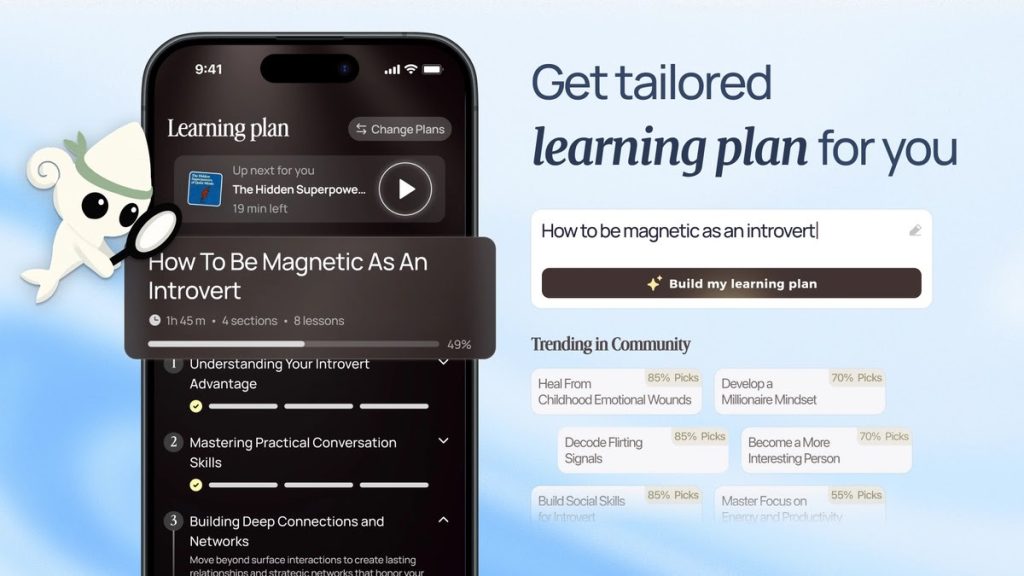
BeFreed is an AI-powered content engine that transforms diverse knowledge sources into personalized, interactive audio courses.
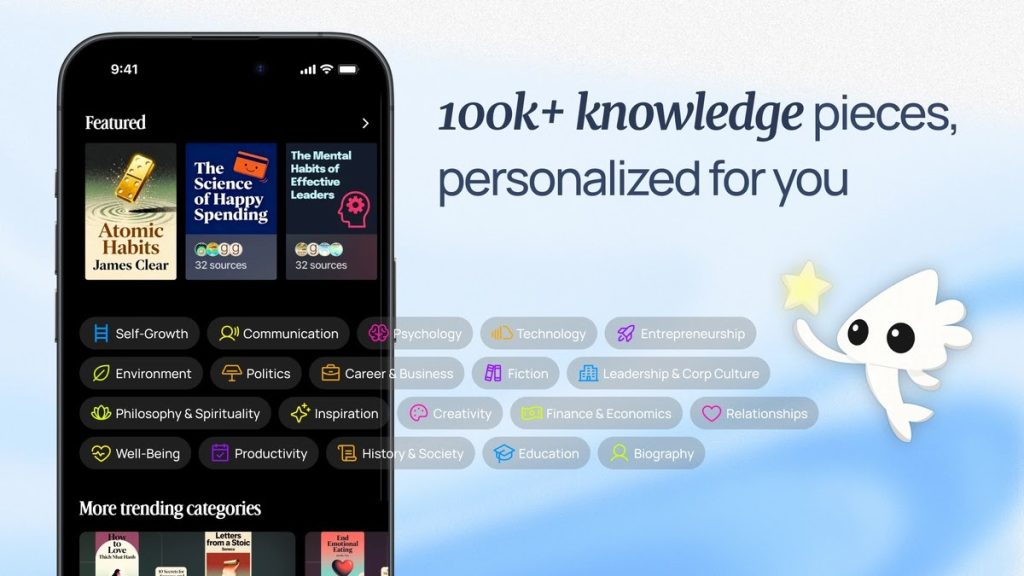
Built for lifelong learners drowning in scattered articles and half-finished podcasts, it moves beyond the concept of a standard book summary. Users are not limited to a generic library; they can start with a broad topic, upload a dense PDF, or paste a YouTube URL.
BeFreed then processes these sources and builds a structured, step-by-step learning plan narrated by a custom AI persona.
The platform is also heavily rooted in cognitive learning science. Research from the Cognitive Science Society found that spaced repetition improves long-term retention by up to 40%. BeFreed integrates this by allowing users to turn key ideas into adaptive flashcards while listening.
Furthermore, a study published in the International Journal of Artificial Intelligence in Education revealed that conversational learning interfaces increase user engagement metrics by roughly 3x compared to static text. BeFreed capitalizes on this by allowing users to talk directly to their AI lecturer to dig deeper into complex topics without looking at a screen.
Finally, research from the Harvard Graduate School of Education demonstrated that learners who control the pacing and format of their material exhibit significantly lower cognitive load. By letting users define the exact length of their audio lessons—whether a 10-minute coffee break or a 40-minute commute—BeFreed eliminates format friction.
- Key Features: Upload PDFs/URLs, custom audio duration, interactive AI lecturer chat, personalized learning plans, adaptive flashcards.
- Why It Stands Out: In our tests, the ability to interrupt the audio, ask a clarifying question via voice, and have the AI lecturer respond contextually felt like having an always-on tutor in my pocket.
- Pricing: Free plan available. Premium is $12.99/month, and a few other price plans available. All pricing is US list price as of May 2026.
- Platforms: iOS, Android, Web.
2. Headway (best for gamified habit building)
Headway is a highly visual microlearning app focused on utilizing gamification to build daily self-growth habits.
It condenses nonfiction books into quick reads and standard audio tracks, heavily prioritizing user interface and motivation.
The app features daily streaks, achievement badges, and personalized challenges designed to keep users returning.
- Key Features: Gamified progress tracking, visual concept maps, daily curated insights, spaced repetition widgets.
- Why It Stands Out: When we evaluated user retention, Headway excelled at nudging users to open the app daily, functioning much like a language-learning app for nonfiction reading.
- Pricing: Premium $89.99/year, and a few other price plans available. All pricing is US list price as of May 2026.
- Platforms: iOS, Android, Web.
3. Shortform (best for deep academic analysis)
Shortform provides intensely detailed, comprehensive guides to nonfiction books rather than brief surface-level overviews.
The platform focuses on critical analysis, offering chapter-by-chapter breakdowns, interactive exercises, and contextual cross-referencing between different authors.
It is designed for users who want to thoroughly understand a subject without reading the entire source text.
- Key Features: Detailed chapter analysis, interactive application exercises, multi-book synthesis, browser extension.
- Why It Stands Out: In practice, Shortform operates more like a study companion than a basic summary app, providing analytical depth that far surpasses its competitors.
- Pricing: Premium $197.00/year, and a few other price plans available. All pricing is US list price as of May 2026.
- Platforms: iOS, Android, Web.
4. getAbstract (best for corporate teams)
getAbstract is an enterprise-focused knowledge platform boasting a massive library of over 27,000 summaries.
It covers books, articles, and video talks, heavily emphasizing business, leadership, and professional development topics.
The platform is explicitly designed to integrate seamlessly into corporate Learning Management Systems (LMS).
- Key Features: Massive enterprise library, multi-language support, LMS integration, personalized corporate channels.
- Why It Stands Out: In our tests, the clinical and highly professional tone made it the clear choice for corporate HR departments looking to upskill their workforce en masse.
- Pricing: Pro $299.00/year, and a few other price plans available. All pricing is US list price as of May 2026.
- Platforms: iOS, Android, Web.
5. StoryShots (best for free visual summaries)
StoryShots is a freemium application that differentiates itself by offering multi-media summaries, including text, audio, and animated videos.
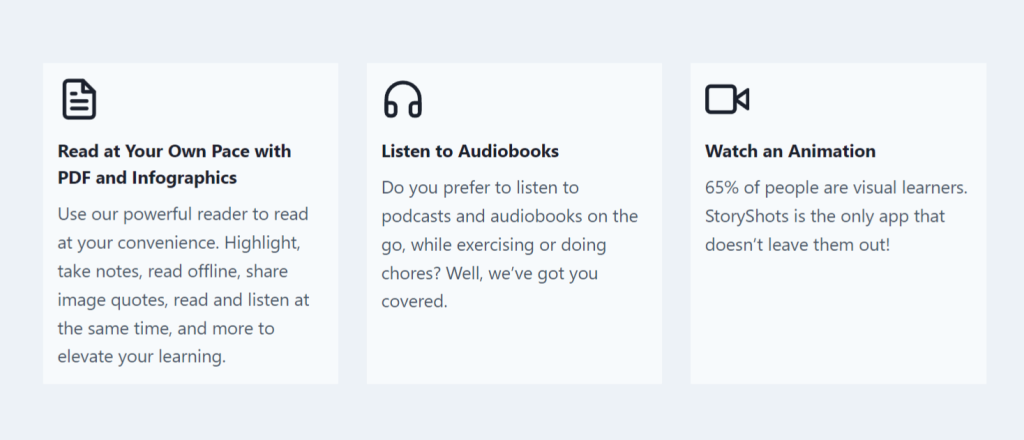
It aggregates and curates content to help visual learners grasp complex ideas quickly through infographics and mind maps.
The platform relies heavily on a community-driven and ad-supported model for its free tier.
- Key Features: Animated video summaries, infographics, text and audio options, offline access.
- Why It Stands Out: When we evaluated budget options, StoryShots provided the most robust visual learning experience for users who prefer watching a concept mapped out.
- Pricing: Premium $39.99/year, and a few other price plans available. All pricing is US list price as of May 2026.
- Platforms: iOS, Android, Web.
6. Deepstash (best for social idea discovery)
Deepstash fragments knowledge from books, articles, and podcasts into bite-sized “idea cards” designed for rapid consumption.
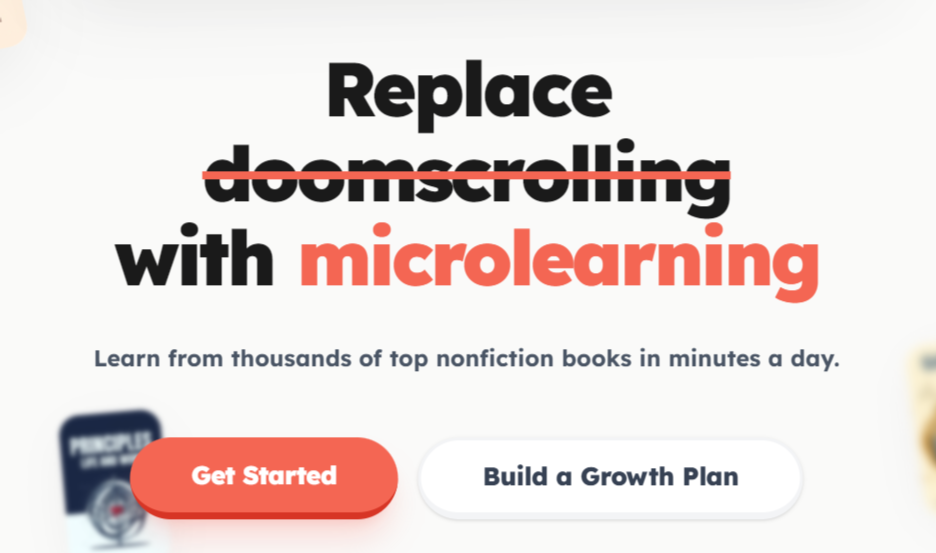
It functions much like a social media feed optimized for self-improvement, allowing users to scroll through curated insights.
Users can save, organize, and share these micro-concepts to build personal knowledge stashes.
- Key Features: Social feed interface, bite-sized idea cards, curated stashes, content from articles and podcasts.
- Why It Stands Out: In our tests, it proved highly effective for discovering new concepts during brief moments of downtime, replacing mindless social media scrolling.
- Pricing: Pro $89.99/year, and a few other price plans available. All pricing is US list price as of May 2026.
- Platforms: iOS, Android, Web.
7. Instaread (best for fiction and originals)
Instaread provides 15-minute insights from nonfiction books, but notably expands its library to include classic fiction.
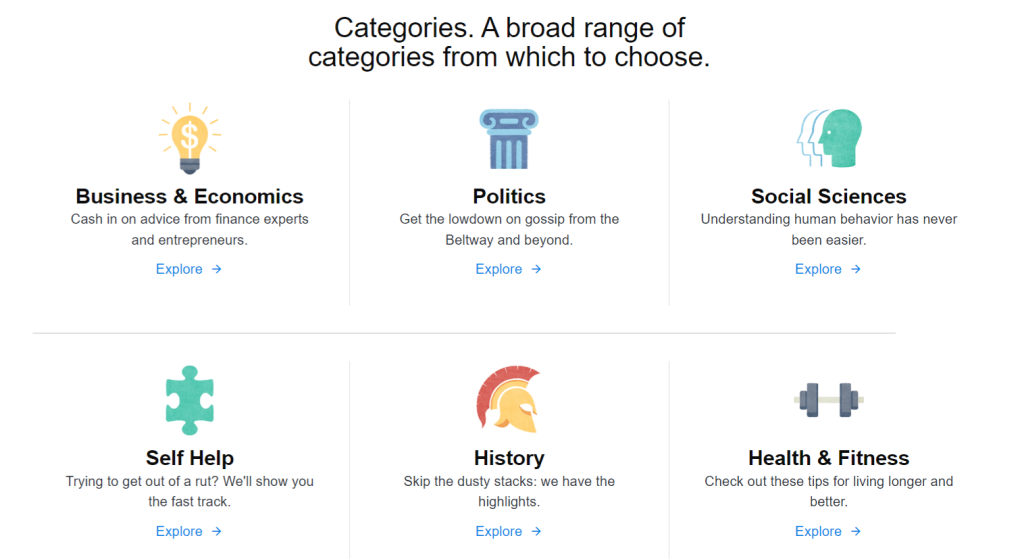
It also produces original, bite-sized content covering important historical figures, events, and pop culture trends.
The summaries are crafted by a team of professional writers and journalists to ensure narrative quality.
- Key Features: Fiction summaries, original short-form content, professional narration, offline listening.
- Why It Stands Out: When we evaluated library diversity, Instaread was one of the few platforms that recognized the value of gleaning insights from classic literary fiction.
- Pricing: Premium $89.99/year, and a few other price plans available. All pricing is US list price as of May 2026.
- Platforms: iOS, Android, Web.
8. 12min (best for micro-summaries and localized languages)
12min focuses on hyper-condensed microlearning, stripping books down to summaries that strictly take 12 minutes to consume.
The platform is highly localized, offering strong support and distinct content curation for Spanish and Portuguese speakers.
It focuses purely on delivering the core thesis of a book with minimal narrative filler.
- Key Features: Strict 12-minute format, strong multi-language libraries, audio support, Kindle integration.
- Why It Stands Out: In practice, this app serves the highly specific demographic of international users who want the absolute fastest route to a book’s central premise.
- Pricing: Premium $89.00/year, and a few other price plans available. All pricing is US list price as of May 2026.
- Platforms: iOS, Android, Web.
9. Mentorist (best for actionable task implementation)
Mentorist bridges the gap between reading a summary and actually implementing its advice into your life.
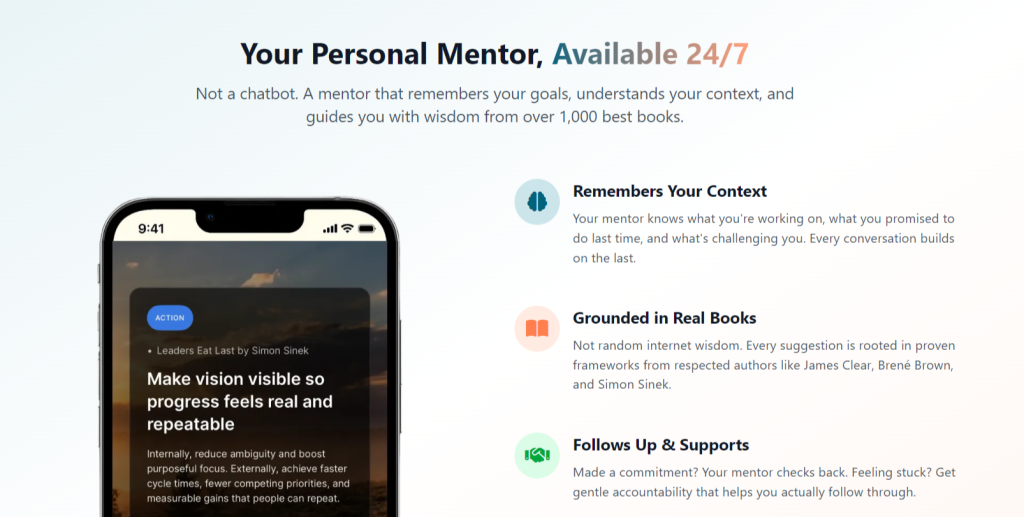
It extracts the actionable steps from business and self-help books and turns them into a structured task management system.
Users track their progress as they apply specific habits derived directly from the text.
- Key Features: Actionable habit tracking, to-do lists derived from books, community challenges, minimal text summaries.
- Why It Stands Out: In our tests, Mentorist functioned less like a reading app and more like a productivity tool, forcing users to take physical action on what they learned.
- Pricing: Premium $49.99/year, and a few other price plans available. All pricing is US list price as of May 2026.
- Platforms: iOS, Android, Web.
10. NotebookLM (best for one-off document podcasts)
NotebookLM is an AI research assistant created by Google that synthesizes uploaded documents into interactive guides.
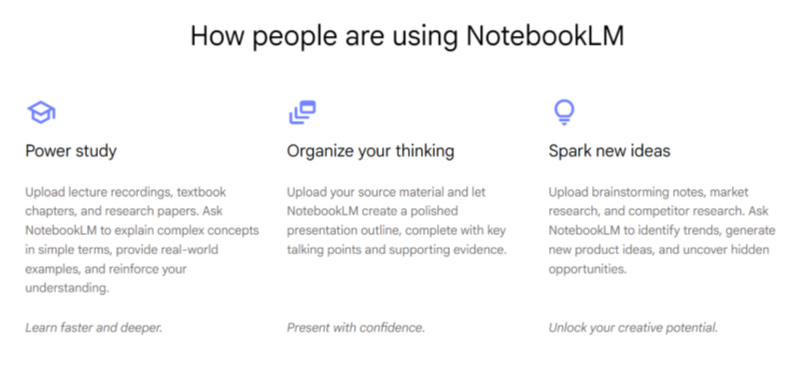
Its standout feature is the ability to generate a highly realistic, two-host audio podcast discussing the uploaded source material.
It is designed to help users quickly understand their own notes, research papers, or meeting transcripts.
- Key Features: Two-host audio generation, document ingestion, source citations, semantic search.
- Why It Stands Out: When we evaluated AI audio, the banter between the two synthesized hosts was remarkably natural, though the format remains fixed and lacks long-term memory.
- Pricing: Free, and a few other price plans available. All pricing is US list price as of May 2026.
- Platforms: Web.
11. Obsidian (best for manual knowledge management)
Obsidian is a powerful, locally hosted markdown note-taking app designed to build a personal knowledge graph.
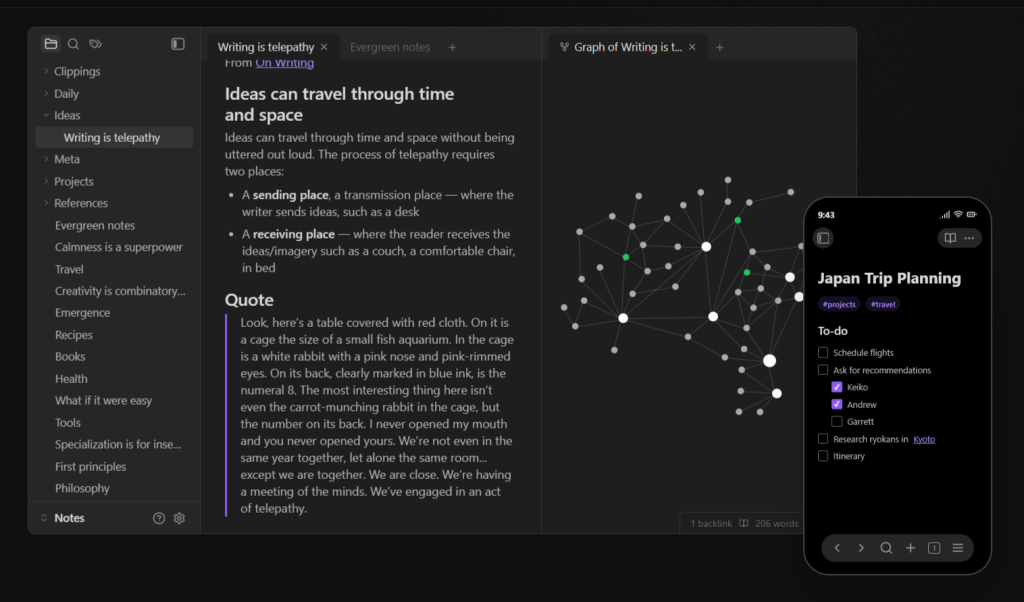
While not a traditional summary app, it is the tool of choice for power users who write their own summaries and link them contextually.
It relies entirely on user input, creating a customized, interconnected web of thoughts and research.
- Key Features: Local file storage, bi-directional linking, massive plugin ecosystem, graph view.
- Why It Stands Out: In practice, Obsidian requires immense manual effort but rewards the user with the most robust, future-proof personal database available.
- Pricing: Sync $48.00/year, and a few other price plans available. All pricing is US list price as of May 2026.
- Platforms: Mac, Windows, Linux, iOS, Android.
How do the top apps compare in a head-to-head matchup?
Direct comparisons reveal the nuanced differences in how these platforms approach knowledge acquisition.
- BeFreed vs. Blinkist: Blinkist offers a massive library of fixed 15-minute text summaries, while BeFreed generates custom-length audio courses from any uploaded source.
- Verdict: BeFreed wins for personalized audio learning and format flexibility.
- Headway vs. Blinkist: Blinkist provides cleaner, more professional audio tracks, whereas Headway excels at gamifying the UI to encourage daily reading streaks.
- Verdict: Headway wins for habit building; Blinkist wins for audio professionalism.
- Shortform vs. getAbstract: Shortform offers deep, critical analysis for individual students, while getAbstract provides massive scale and LMS integration for enterprise teams.
- Verdict: Shortform wins for analytical depth; getAbstract wins for corporate training.
- NotebookLM vs. BeFreed: NotebookLM creates impressive one-off podcast conversations, but BeFreed maps a continuous, tracked learning plan across multiple topics.
- Verdict: BeFreed wins for structured long-term self-improvement.
Key Insight: Direct comparisons prove that relying on a single metric, like library size, obscures the actual value of a platform’s retention mechanics.
What does the feature comparison table look like?
The following table benchmarks the capabilities of the leading learning platforms across critical user metrics.
| App Name | Best For | Personalization | Learning Format | Knowledge Source |
| BeFreed | Commuting & audio | Highly personalized | Audio, flashcards (10–40 min flexible) | Books, PDFs, YouTube, custom topics |
| Blinkist | Broad overviews | Low (fixed format) | Text, basic audio (strictly 15 min) | Published books, podcasts |
| Headway | Habit building | Low (UI gamification) | Text, TTS audio, visual maps | Published books |
| Shortform | Deep study | Low (fixed format) | Text-heavy analysis, exercises | Published books, articles |
| NotebookLM | Research synthesis | Medium (fixed voices) | Two-host audio podcast, text | User-uploaded documents |
Key Insight: Platforms that strictly limit the source material to published books are rapidly losing ground to AI engines that ingest diverse media.
What is the final verdict on the best learning app?
The best learning platform depends entirely on whether you want to read, listen, or actively engage with the material.
If you require rigorous academic depth and do not mind reading extensive text, Shortform is highly recommended.
If you struggle to open an app every day and need gamified motivation, Headway provides excellent nudges.
However, if you want an always-on coach that turns scattered PDFs, YouTube links, and broad goals into engaging, hands-free audio lessons, BeFreed is the definitive choice for modern professionals.
What are the most frequently asked questions about learning apps?
What is a book summary app?
A book summary app is a mobile or web application that condenses the core insights of full-length nonfiction books into brief, consumable formats, typically designed to be read or listened to in under 20 minutes.
How do you use these apps to actually retain information?
To retain information, you must pair the consumption of summaries with active recall techniques. Utilize spaced-repetition flashcards, take post-chapter quizzes, or engage in conversational review to transfer knowledge from short-term to long-term memory.
Are free summary apps worth using?
Free options like StoryShots or your local library’s Libby app are excellent for testing concepts. However, they generally lack the premium AI narration, offline access, and rigorous editorial quality control found in paid subscriptions.
What’s the best Blinkist alternative for learning on a commute?
BeFreed is the best alternative for commuting because it offers personalized AI audio learning. You can set the lecture length to perfectly match your drive time and interact with the material completely hands-free.
How does BeFreed differ from standard audiobook platforms?
Standard platforms offer 10-hour static recordings that require massive time commitments. BeFreed acts as an intelligent content engine, synthesizing sources into tailored, interactive podcasts built specifically around your current learning goals.
Can I summarize YouTube videos and PDF documents?
Yes. While legacy apps restrict you to their catalog of books, modern platforms like BeFreed allow you to upload PDFs or paste YouTube URLs directly, transforming that specific media into a structured audio lesson.
Is an AI-generated voice pleasant to listen to?
Budget apps often use robotic Text-To-Speech. However, premium platforms now utilize advanced LLM audio models that sound entirely natural, allowing you to customize the persona, pacing, and tone of the narration.

I’m Rajesh Kumar, a DevOps, SRE, DevSecOps, Cloud, and Platform Engineering expert passionate about sharing practical knowledge, real-world experiences, and industry best practices. I have worked at Cotocus and regularly write about technology, travel, investing, health, product reviews, and digital marketing through my various platforms.
I publish technical articles at DevOps School, travel stories at Holiday Landmark, stock market insights at Stocks Mantra, health and fitness guidance at My Medic Plus, product reviews at TrueReviewNow, and SEO and digital marketing strategies at Wizbrand.
Find Trusted Cardiac Hospitals
Compare heart hospitals by city and services — all in one place.
Explore Hospitals
Helpful and easy-to-understand article exploring some great Blinkist alternatives for audio learning. It gives clear options and helps compare different platforms in a simple way.